
Canaries are beautiful, lively birds, but they aren’t usually the type of pet that wants to sit on your shoulder or cuddle in your hand.
That’s an important thing to understand before trying to handle one.
Unlike many parrots, canaries have traditionally been kept and bred primarily for their songs, colors, and appearance rather than close physical interaction with people. Many are naturally cautious about hands, and being grabbed can be frightening.
That doesn’t mean you can’t build a relationship with your canary.
With patience and a calm approach, a canary can learn that you’re safe. Some become comfortable taking treats from their owners or voluntarily approaching a hand. The key is working at the bird’s pace instead of trying to force physical contact.
Here’s how to safely handle a canary when necessary while building the kind of trust that makes everyday care much easier.
Do Canaries Like Being Handled?
Most canaries don’t naturally enjoy being picked up or held.
They’re small prey animals, and a large hand reaching toward them can feel threatening. Even a canary that’s comfortable with its owner may prefer interacting from a perch rather than being touched.
This makes canaries quite different from birds such as budgies, cockatiels, and some larger parrots.
A well-socialized canary may eventually:
- Approach when you come near the cage
- Remain relaxed while you’re nearby
- Take a treat from your fingers
- Investigate your hand
- Step onto a finger or handheld perch
- Fly toward you voluntarily
Some canaries become surprisingly comfortable with people. Others always prefer a little distance.
Both are normal.
Your goal shouldn’t necessarily be to turn your canary into a bird that enjoys being held. A better goal is to establish enough trust that routine interactions aren’t frightening.
Why Building Trust Matters
Trust isn’t only about making your canary friendlier.
It makes everyday care easier.
A bird that isn’t terrified whenever you approach the cage will generally be easier to manage when you’re:
- Changing food and water
- Cleaning the cage
- Replacing perches or toys
- Moving the bird
- Checking its condition
- Taking it to a veterinarian
- Allowing supervised exercise outside the cage
Trust also reduces unnecessary stress.
Instead of associating your presence with chasing and grabbing, your canary can learn that you’re simply part of its normal environment.
Start by Giving Your Canary Time to Settle In
When you first bring a canary home, don’t immediately start trying to touch it.
Everything has changed from the bird’s perspective.
The cage is different. The room is unfamiliar. There are new sounds, smells, people, routines, and movements.
Give your canary time to observe its surroundings and establish a routine.
During the first several days, focus on essential care.
Provide:
- Fresh food
- Clean water
- A clean cage
- Comfortable perches
- A calm environment
- A predictable day-and-night routine
Spend time nearby without demanding interaction.
Simply being around your canary while behaving calmly helps teach the bird that your presence isn’t dangerous.
Learn Your Canary’s Body Language
Before attempting closer interaction, learn what your bird looks like when it’s comfortable versus frightened.
A relaxed canary may:
- Eat while you’re nearby
- Preen normally
- Sing or vocalize
- Move comfortably between perches
- Investigate its surroundings
- Rest without constantly watching you
A frightened or stressed canary may:
- Frantically fly around the cage
- Press itself against the cage bars
- Freeze and remain unusually still
- Breathe rapidly
- Attempt repeatedly to escape
- Move as far away from you as possible
If your canary starts panicking whenever your hand enters the cage, pushing forward isn’t going to build trust.
Back off and make the interaction easier.
How to Build Trust With a Canary
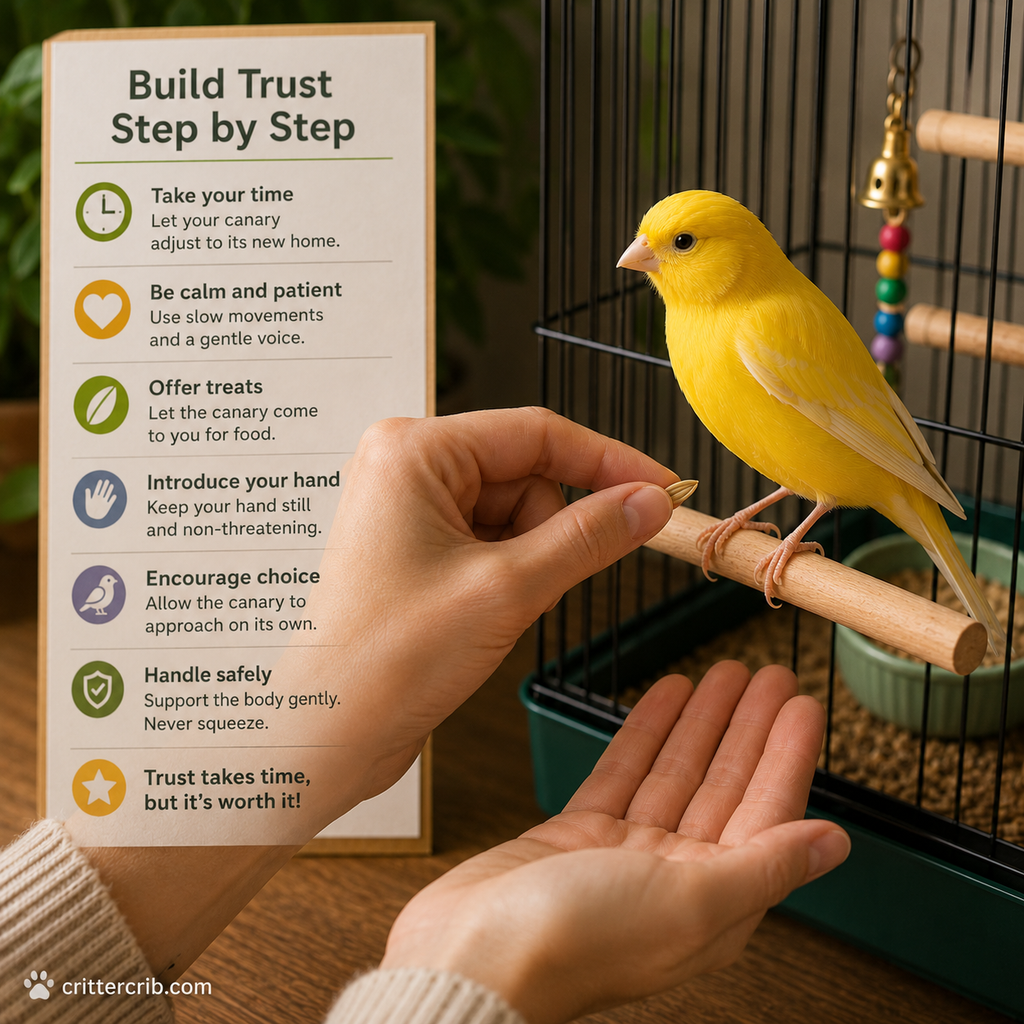
Building trust is usually a gradual process rather than a single training session.
Think in terms of small successes.
Step 1: Spend Time Near the Cage
Begin by simply spending time in the same room.
Sit near the cage, read, work, or talk quietly.
Avoid staring continuously at your canary. Direct, prolonged attention can feel intimidating to a prey animal.
Over time, the bird should become accustomed to seeing you nearby.
Step 2: Approach the Cage Calmly
Fast movements can trigger a fear response.
When you need to change food or water, approach predictably and move slowly.
Talking gently before you reach into the cage can also help your bird recognize what’s happening.
Try to follow roughly the same routine each day.
Predictability helps build confidence.
Step 3: Find a Favorite Treat
Food can create a positive association with your presence.
Experiment with small amounts of healthy, canary-safe foods to discover what your bird particularly enjoys.
Once you’ve found something appealing, reserve that favorite treat for trust-building sessions.
The idea is simple:
Your presence predicts something good.
Step 4: Offer Treats Without Forcing Interaction
Start by offering a treat somewhere your canary feels comfortable taking it.
At first, this might mean placing it in the cage and moving your hand away.
Eventually, you can try holding the treat while keeping your hand still.
Don’t chase the bird around with food.
Let your canary decide whether to approach.
If it won’t come close, that’s fine. Try again another day.
Step 5: Gradually Introduce Your Hand
Once your canary remains calm while you’re working around the cage, you can begin making your hand a normal part of the environment.
Place your hand inside the cage without moving toward the bird.
Keep the session short.
If your canary stays reasonably relaxed, that’s progress—even if it doesn’t come anywhere near you.
Gradually increase the amount of time your hand remains present.
Step 6: Encourage Voluntary Contact
Eventually, a confident canary may approach your hand for food.
Some birds may even learn to step onto a finger.
Don’t force this milestone.
A canary voluntarily standing on your finger is very different from a canary that has been chased until it has nowhere else to go.
Trust comes from giving the bird choices.
How Long Does It Take to Tame a Canary?
There’s no fixed timeline.
One canary may become noticeably more comfortable within a few weeks. Another might need several months before it willingly approaches a hand.
Factors that can influence the process include:
- Age
- Individual temperament
- Previous handling
- Breeding and early socialization
- Past frightening experiences
- Your training consistency
- The bird’s environment
Don’t judge progress solely by whether your canary sits on your finger.
A previously nervous bird that now eats comfortably while you’re standing beside the cage has already made meaningful progress.
How to Handle a Canary Safely
Sometimes physical handling is necessary.
You might need to move your canary into a carrier, examine it briefly, administer veterinary-prescribed treatment, or respond to an emergency.
Because canaries are so small and delicate, handling should be gentle and purposeful.
Never Squeeze a Canary’s Chest
This is one of the most important rules when physically restraining a bird.
Birds need movement of the chest and body wall to breathe effectively. Excessive pressure around the chest can interfere with respiration.
A canary should be held securely enough that it can’t injure itself, but never squeezed.
Keep Handling Brief
If you must physically restrain your canary, accomplish what needs to be done and release the bird as soon as it’s safe.
Unnecessary restraint adds stress.
Before catching your bird, have everything you need ready so you aren’t holding it while searching for supplies.
How to Catch a Canary When Necessary
Catching should be reserved for situations where physical restraint is genuinely needed.
If your canary can be encouraged to enter a carrier or move voluntarily, that’s usually preferable.
When catching is unavoidable:
- Close all doors and windows in the room.
- Turn off ceiling fans.
- Remove or block obvious hazards.
- Prepare the carrier or supplies beforehand.
- Keep your movements calm and deliberate.
- Avoid prolonged chasing.
- Secure the bird gently without compressing its chest.
- Complete the necessary task quickly.
- Return the bird to a safe environment.
Repeatedly chasing a canary around a cage can cause significant stress and may damage the trust you’ve been building.
Can You Use a Towel to Handle a Canary?
A soft cloth or small towel can sometimes help with necessary restraint, particularly when you want the bird to associate hands less directly with being captured.
However, canaries are tiny.
A large, heavy towel can make handling unnecessarily difficult and potentially dangerous.
If you need to restrain your bird for medication, nail care, examination, or another procedure, ask an avian veterinarian to demonstrate the proper technique.
Seeing how to safely hold a small bird is far better than trying to learn restraint through trial and error.
How to Transfer a Canary to a Carrier
A carrier is necessary for veterinary visits and emergencies, so it’s useful to make it familiar before you urgently need it.
Whenever possible, introduce the carrier gradually.
Leave it somewhere visible and allow your canary to become accustomed to its presence.
Depending on your setup, you may be able to:
- Position the carrier next to the cage
- Encourage the bird toward it with a favorite food
- Use a familiar perch
- Train the bird to enter voluntarily
If your canary must be physically caught and placed inside, keep the transfer calm and quick.
The carrier should be secure, appropriately ventilated, and designed so your bird can’t escape or become injured during transportation.
Should You Pet a Canary?
Most canaries don’t particularly enjoy petting.
Even a tame canary may prefer sitting near you or taking food from your hand without wanting its feathers touched.
Don’t assume that because your bird is comfortable on your finger, it wants to be stroked.
Watch its reaction.
If the bird moves away, becomes tense, or shows signs of fear, respect that boundary.
A relationship with a canary doesn’t have to involve petting to be rewarding.
Can You Teach a Canary to Step Up?
Some canaries can learn to step onto a finger or perch, although this behavior isn’t as automatic to train as it can be with companion parrots.
A handheld perch can be a good starting point for a bird that’s afraid of hands.
Present the perch calmly and reward voluntary interaction.
Once the canary is comfortable stepping onto the perch, you may gradually work toward your hand if the bird’s temperament allows it.
Keep sessions short and positive.
Use Positive Reinforcement
Trust-based training works best when desirable behavior produces something the bird likes.
That might be:
- A favorite treat
- Access to an enjoyable activity
- Calm verbal attention
- The opportunity to explore
Avoid punishment.
Yelling, tapping the cage, spraying your bird with water as discipline, chasing it, or intentionally frightening it won’t teach the behavior you want.
It teaches the canary that you’re unpredictable.
Don’t Chase Your Canary Around the Cage
Imagine being trapped in a small room while something much larger repeatedly reaches toward you.
That’s roughly what chasing can feel like to a bird.
If your canary moves away from your hand, don’t keep following it from perch to perch unless there’s a genuine reason you must catch the bird.
During ordinary training, moving away is communication.
Your bird is telling you that you’ve crossed its comfort threshold.
Respecting that signal is part of building trust.
Keep Training Sessions Short
You don’t need hour-long training sessions.
A few calm minutes can be much more productive.
End while your canary is still comfortable rather than continuing until the bird becomes stressed.
Several short, positive interactions spread throughout the week are generally better than an occasional intense training session.
Let Your Canary Come to You
One of the biggest shifts in bird training is realizing that progress doesn’t always require doing more.
Sometimes you need to do less.
Place your hand somewhere safe. Offer a reward. Wait.
Curiosity may eventually do much of the work.
When your canary realizes that your hand isn’t going to chase or grab it, approaching becomes less risky.
That voluntary choice is the foundation of genuine trust.
How to Handle a Canary Outside the Cage
If your canary has supervised out-of-cage time, prepare the room first.
Before opening the cage:
- Close exterior doors
- Close or secure windows
- Turn off ceiling fans
- Cover obvious hazards
- Remove other pets
- Close toilet lids
- Avoid open water containers
- Make windows and mirrors easier for the bird to recognize
- Keep hot appliances and cooking areas inaccessible
Don’t release a canary into an unsafe room and then rely on catching it afterward.
Plan how the bird will return to the cage before opening the door.
Getting Your Canary Back Into Its Cage
A hungry bird may naturally return to its cage for food and water.
You can also use familiar perches and treats to encourage it.
Avoid immediately chasing the canary around the room with a net or your hands.
The more your bird learns that returning to its cage doesn’t involve panic, the easier future out-of-cage sessions can become.
Can Children Handle Canaries?
Young children should generally not physically handle canaries without close adult supervision.
Canaries are extremely delicate.
A child may accidentally squeeze, drop, chase, or frighten the bird without intending any harm.
Children can still participate in canary care by:
- Helping prepare food
- Watching the bird
- Speaking gently near the cage
- Helping with appropriate cleaning tasks
- Learning about canary behavior
- Offering treats under supervision
Teaching children to respect the bird’s space can be more valuable than teaching them how to hold it.
What If Your Canary Bites?
Canaries can bite, particularly when they’re frightened or being restrained.
Because they’re small birds, their bites aren’t usually comparable to the powerful bites of larger parrots.
Still, don’t punish your bird for biting.
Try to understand what happened immediately beforehand.
Were you trying to grab it? Did it attempt to move away first? Was your hand blocking its escape?
A bite is often a defensive response after subtler signals have failed.
Adjusting your approach can prevent the same situation from happening again.
What to Do After Necessary Restraint
Sometimes you have no choice but to catch your canary.
Don’t worry that one necessary veterinary trip will permanently destroy your relationship.
Afterward, return to your normal calm routine.
Give the bird space to settle down, then resume positive interactions when it’s comfortable.
You may notice temporary nervousness around your hands. If so, go back a few steps in the trust-building process rather than immediately trying to handle the bird again.
Common Canary Handling Mistakes
Many handling problems come from moving too quickly rather than having bad intentions.
Avoid these common mistakes:
- Grabbing the bird unnecessarily
- Chasing it around the cage
- Forcing it onto your finger
- Squeezing during restraint
- Expecting it to enjoy petting
- Moving your hands suddenly
- Punishing fearful behavior
- Training for too long
- Ignoring signs of stress
- Comparing your bird’s progress with another canary
- Allowing unsupervised children to handle it
- Releasing it into an unsafe room
Patience usually produces better results than persistence.
How Do You Know Your Canary Trusts You?
Trust can be subtle.
Your canary doesn’t need to land on your head or fall asleep in your hand to demonstrate that it feels safe around you.
Signs of growing trust may include:
- Eating while you’re nearby
- Singing in your presence
- Remaining relaxed when you approach
- Preening near you
- Taking treats from your fingers
- Approaching the front of the cage
- Showing curiosity about your hands
- Stepping onto a handheld perch
- Eventually stepping onto your finger
Pay attention to these smaller milestones.
They’re often a better reflection of your relationship than physical handling alone.
Frequently Asked Questions About Handling Canaries
Can Canaries Become Hand-Tame?
Yes, some canaries can become hand-tame with patient, consistent training. Individual temperament varies considerably, though, and not every canary will want to perch on a person’s hand.
Do Canaries Bond With Their Owners?
Canaries can become familiar and comfortable with their owners. They may recognize routines, voices, and the people who regularly care for them.
Their relationships with humans may be more subtle than those of highly social companion parrots.
How Often Should I Handle My Canary?
There’s usually no need to physically pick up a canary regularly.
Instead, focus on frequent, positive interactions that allow the bird to participate voluntarily. Physical restraint should generally be reserved for situations where it’s necessary.
Should I Grab My Canary to Make It Used to Me?
No.
Repeated grabbing is more likely to make your canary afraid of hands than comfortable with them.
Gradual exposure and positive reinforcement are much better ways to develop trust.
Can I Hold a Canary in My Hand?
A canary can be gently restrained when necessary, but its chest must never be squeezed or compressed.
If you’re unsure how to safely restrain such a small bird, ask an avian veterinarian to demonstrate the correct technique.
Why Is My Canary Afraid of My Hand?
Hands can look threatening to a small prey animal, especially if the bird hasn’t experienced gentle handling before.
Previous grabbing, chasing, or frightening experiences can make this fear stronger.
Introduce your hand gradually and associate it with positive experiences.
Will My Canary Ever Sit on My Finger?
Possibly.
Some canaries learn to step onto fingers, while others remain more comfortable using a handheld perch or interacting without physical contact.
Don’t make finger-perching the only measure of successful training.
Can I Train an Older Canary?
Yes. Older birds can still learn new routines and become more comfortable around people.
The process may require extra patience, especially if the bird has spent years with limited human interaction or has developed a strong fear of hands.
Final Thoughts
Learning how to handle a canary safely starts with understanding that most canaries don’t need—or necessarily want—to be handled frequently.
Instead of trying to make your bird tolerate being grabbed, focus on building trust.
Spend time near the cage. Move predictably. Offer favorite foods. Introduce your hand gradually. Reward voluntary interaction. Most importantly, pay attention when your bird tells you that it’s uncomfortable.
Some canaries eventually become confident enough to take treats directly from their owners and perch on their fingers. Others prefer maintaining a little distance even after years in a loving home.
Either outcome is okay.
A trusting relationship with a canary isn’t measured by how often you can hold the bird. It’s reflected in how safe and relaxed your canary feels when you’re around.
When physical handling is necessary, keep it gentle, brief, and purposeful. Never squeeze the chest, avoid prolonged chasing, and ask an avian veterinarian to demonstrate proper restraint if you’re uncertain.
Give your canary patience and choices, and you’ll have a much better chance of developing the calm, trusting relationship you’re looking for.