Land snails might look perfectly content slowly cruising around their enclosure, but they’re surprisingly dependent on the conditions around them. Temperature and humidity influence their activity, hydration, feeding, and overall comfort.
The tricky part is that there isn’t one perfect temperature or humidity level for every land snail.
Different species come from different climates. A snail adapted to a warm tropical environment may need noticeably different conditions from one found in a cooler temperate region.
For many commonly kept land snails, moderate temperatures and relatively high humidity provide a useful starting point. But before adjusting heaters or reaching for the spray bottle, identify your species whenever possible.
Once you know what you’re keeping, maintaining the right environment becomes much easier.
What Temperature Do Land Snails Need?
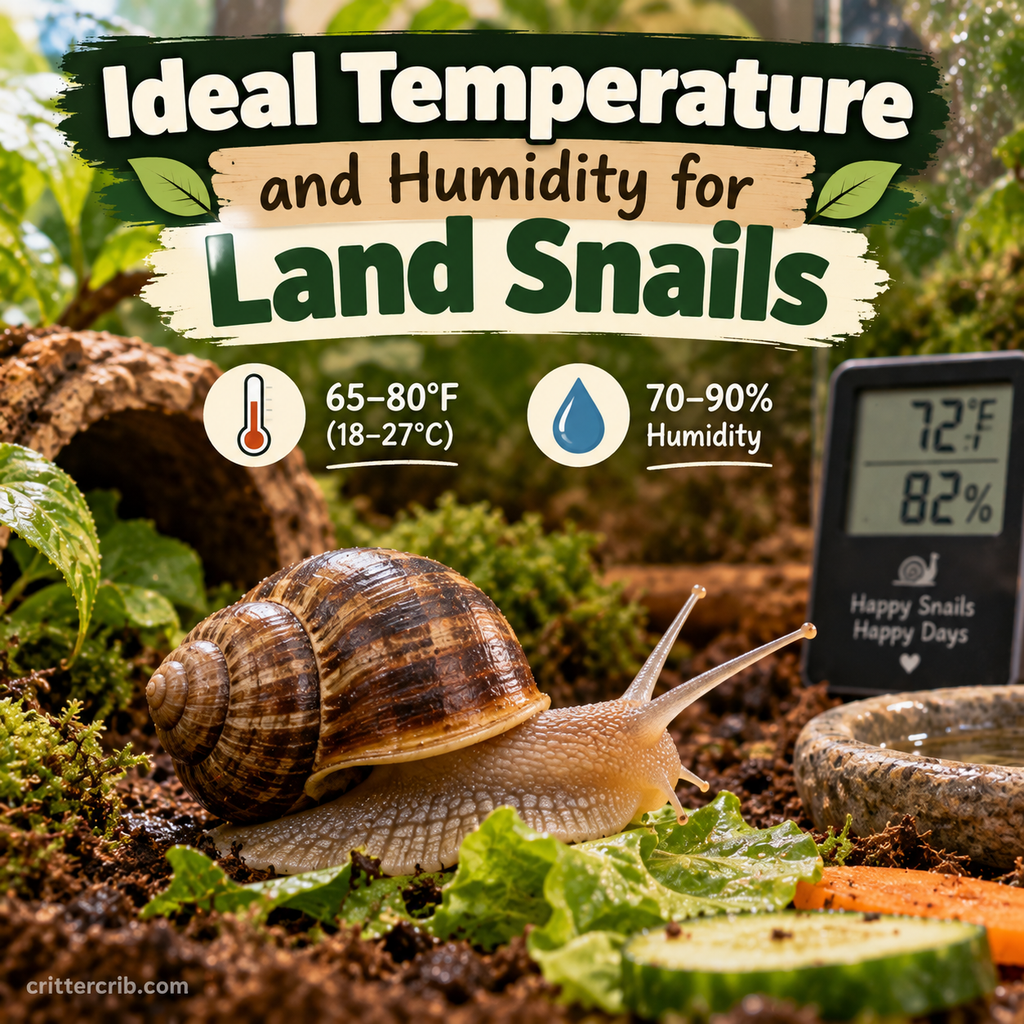
Many commonly kept land snails are comfortable somewhere around 65–80°F (18–27°C), but the ideal range can be narrower depending on the species.
Temperate species may be comfortable toward the cooler end, while tropical land snails may require temperatures in the 70s or higher.
Rather than treating 65–80°F as a target for every snail, think of it as a broad range covering many commonly encountered species.
The temperature your snail actually needs should be based on:
- Species
- Natural geographic range
- Age and life stage
- Seasonal patterns
- Enclosure humidity
- Established captive-care recommendations
Stable conditions are generally preferable to large, rapid temperature swings.
What Humidity Do Land Snails Need?
Land snails generally require a humid environment because their bodies lose moisture easily.
For many commonly kept species, relative humidity somewhere around 70–90% may be appropriate. However, just like temperature, the ideal humidity depends on the species.
Some snails tolerate periods of lower humidity, while tropical species may require consistently humid conditions.
The goal isn’t to keep everything soaking wet.
A healthy snail enclosure should provide moisture while still allowing adequate airflow.
Think:
humid and moist, not stagnant and waterlogged.
Why Humidity Is So Important for Land Snails
Snails have soft bodies and depend heavily on moisture.
When conditions become too dry, a snail may reduce its activity and retreat into its shell to conserve water.
If dry conditions continue, some species may enter a period of dormancy known as aestivation.
A humid environment supports normal activities such as:
- Moving around
- Feeding
- Exploring
- Maintaining hydration
- Producing mucus
- Burrowing
- Normal daily activity
Humidity is therefore more than just a number on a hygrometer. It’s a major part of creating a usable habitat.
How to Measure Temperature
A small digital thermometer is one of the easiest ways to monitor your snail enclosure.
Place the sensor where it gives you a reasonable representation of the conditions your snail experiences.
Avoid placing it:
- Directly beside a heater
- Against a cold window
- Immediately beneath a lamp
- In direct sunlight
You want to measure the enclosure environment, not an artificial hot or cold spot.
Check the temperature at different times of day when first setting up the habitat.
This helps you understand how much conditions change between daytime and nighttime.
How to Measure Humidity
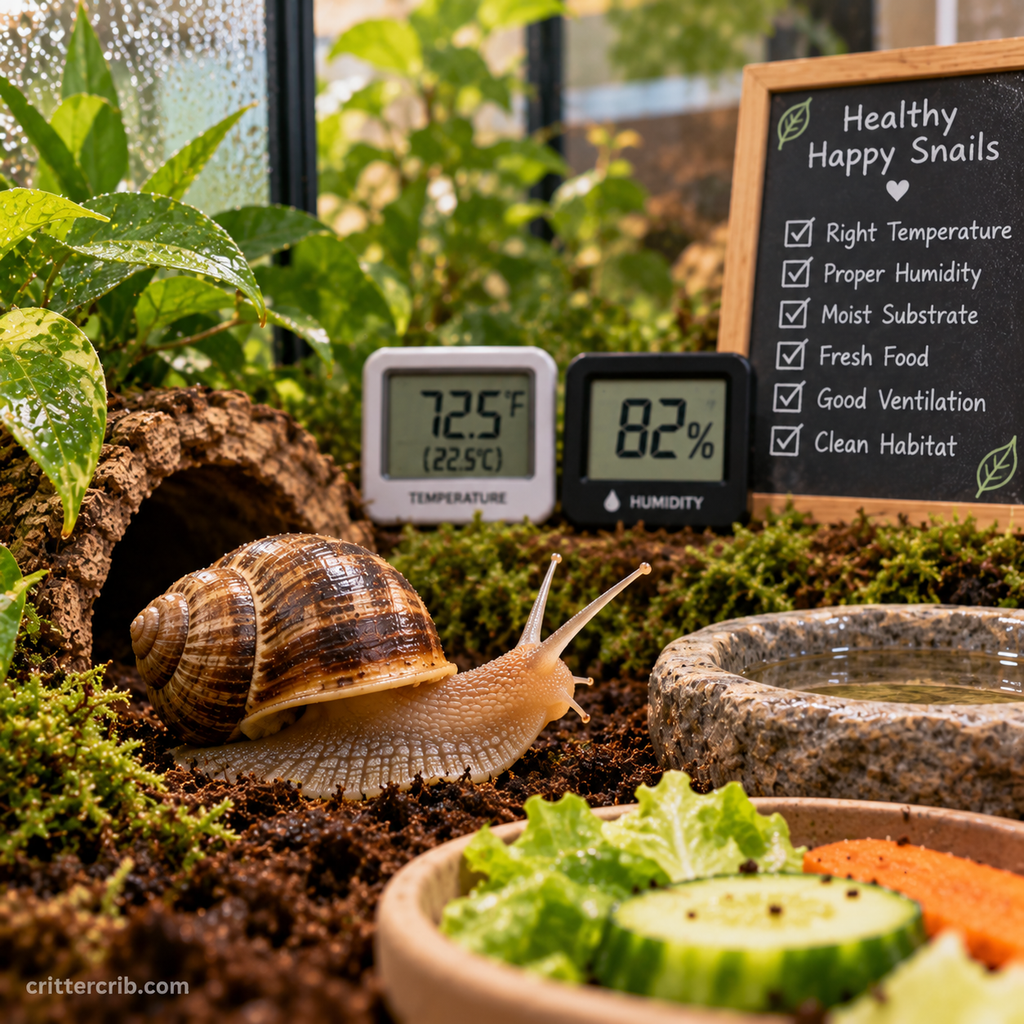
A digital hygrometer can help you monitor relative humidity.
They’re particularly useful when you’re learning how quickly a new enclosure dries out.
Keep in mind that inexpensive hygrometers aren’t always perfectly accurate.
Humidity readings can also vary depending on where the sensor is positioned. A sensor close to damp substrate may show a different reading from one near a heavily ventilated lid.
Use the number as a guide rather than treating it as the only thing that matters.
Also pay attention to:
- Substrate moisture
- Condensation
- Ventilation
- Snail activity
- How quickly the enclosure dries
- Species-specific requirements
Together, these give you a much better picture of the habitat.
How to Maintain Proper Humidity
For many land snail setups, maintaining humidity is fairly straightforward.
The main tools are:
- Moist substrate
- Appropriate ventilation
- Occasional misting
- A secure enclosure
- Monitoring
You usually don’t need complicated automatic misting systems for a small pet snail enclosure.
Keep the Substrate Moist
Substrate is one of the most important moisture reservoirs in the habitat.
It should generally feel moist without being saturated.
If you squeeze a handful and water pours out, it’s probably too wet.
If the substrate is dusty and completely dry, it’s probably too dry for a moisture-dependent land snail.
The exact moisture level should still reflect the needs of your species.
Mist When Necessary
Lightly misting the enclosure can increase humidity and provide droplets that snails may encounter as they move around.
How often you need to mist depends on:
- Ventilation
- Room humidity
- Temperature
- Substrate depth
- Enclosure size
- Snail species
One enclosure might need attention daily, while another retains moisture much longer.
Rather than following a rigid schedule, learn how quickly your particular setup dries.
Don’t Spray Just to Hit a Number
One common mistake is repeatedly spraying an enclosure because the hygrometer dropped a few percentage points.
Humidity naturally fluctuates.
Constant spraying can leave the substrate saturated and the enclosure dripping wet.
Instead of chasing an exact percentage, ask:
- Is the substrate still appropriately moist?
- Is the snail behaving normally?
- Is there some condensation or moisture without everything being soaked?
- Is airflow adequate?
- Is the enclosure drying excessively fast?
A stable environment matters more than keeping the hygrometer frozen at one exact reading.
Ventilation and Humidity Have to Work Together
You might assume a snail enclosure should have as little ventilation as possible because snails need humidity.
That’s not a good approach.
An enclosure that traps every bit of moisture can become stagnant.
Poor airflow combined with excessive moisture can encourage:
- Mold
- Unpleasant odors
- Excessive bacterial growth
- Spoiled food
- Persistent condensation
- Waterlogged substrate
The challenge is finding the balance.
Your enclosure needs enough ventilation for fresh air while retaining enough moisture for the snail.
If humidity disappears immediately after misting, you may have too much ventilation or too little moisture-retaining substrate.
If the enclosure remains dripping wet for days, you may have the opposite problem.
What Substrate Helps Maintain Humidity?
A suitable substrate helps stabilize moisture while also giving the snail somewhere to burrow.
Depending on the species and setup, appropriate materials may include:
- Pesticide-free organic topsoil
- Coconut fiber used appropriately
- Other snail-safe soil mixtures
- Leaf litter mixed or layered into suitable substrate
Avoid soil containing:
- Pesticides
- Fertilizers
- Perlite
- Added chemicals
- Artificial fragrances
The substrate should generally be deep enough for the snail to bury itself comfortably.
Burrowing is normal behavior and may help the snail regulate moisture and temperature.
Is Condensation Good or Bad?
A little condensation isn’t automatically a problem.
It simply indicates that moisture in the enclosure is condensing against a cooler surface.
Persistent heavy condensation, however, may indicate that the habitat is overly wet or lacks sufficient ventilation.
Don’t use condensation alone to determine humidity.
You can have high humidity without the walls being covered in water.
Likewise, visible droplets don’t guarantee that every part of the habitat is providing ideal conditions.
What Happens If a Land Snail Gets Too Dry?
When humidity becomes too low, a snail may become less active.
You might notice it:
- Spending more time inside its shell
- Remaining in one location
- Eating less
- Becoming active primarily after misting
- Seeking the dampest part of the enclosure
- Sealing itself inside its shell
Some snails can form a temporary membrane across the shell opening to reduce moisture loss.
If your snail repeatedly becomes inactive when the enclosure dries and emerges soon after humidity increases, that’s a good reason to review your moisture management.
Don’t simply soak the enclosure in response. Correct the conditions gradually and determine why it’s drying too quickly.
Can a Snail Enclosure Be Too Humid?
Yes.
High humidity itself isn’t necessarily harmful to moisture-loving species, but extremely wet conditions combined with poor ventilation can create an unhealthy habitat.
A snail enclosure shouldn’t resemble a swamp unless you’re keeping an animal specifically adapted to such conditions.
Watch for:
- Water pooling on the substrate
- Constantly saturated soil
- Persistent heavy condensation
- Strong unpleasant odors
- Rapid mold growth
- Food spoiling unusually quickly
If these occur, improve ventilation and allow excess moisture to dissipate.
What Happens If a Land Snail Gets Too Cold?
Snails are ectothermic, so their body temperature and metabolism are influenced by their environment.
When temperatures become too low for the species, activity may decrease.
The snail may:
- Move less
- Eat less
- Remain hidden
- Spend more time buried
- Become dormant
A modest nighttime temperature drop may be perfectly normal for some species.
The concern is prolonged exposure to temperatures outside the appropriate range.
Research the species before assuming inactivity means the enclosure needs additional heat.
What Happens If a Land Snail Gets Too Hot?
Excessive heat can be dangerous.
High temperatures can increase moisture loss and cause an enclosure to dry faster.
A snail experiencing unsuitable heat may retreat, become inactive, or seek cooler and damper areas.
One of the biggest risks is direct sunlight.
Never place a snail enclosure where strong sunlight can shine directly through the glass or plastic.
A small terrarium can heat up surprisingly quickly, even when the surrounding room feels comfortable.
Do Land Snails Need a Heat Mat?
Not necessarily.
If your room naturally stays within the appropriate temperature range for your snail species, supplemental heat may not be required.
Tropical species kept in cooler homes may need additional warmth.
If you use supplemental heating, it should be carefully controlled with an appropriate thermostat and monitored with a thermometer.
You also want to preserve a temperature gradient whenever possible so the snail can move away from the warmer area.
Avoid heating the entire enclosure uniformly to an excessive temperature.
Heat also increases evaporation, so adding a heat source may change how often you need to manage moisture.
Do Land Snails Need a Heat Lamp?
Usually not.
Heat lamps can create concentrated hot areas and rapidly dry a small enclosure.
They may also increase the risk of overheating.
If additional heat is required, use a carefully controlled method appropriate for the species and enclosure rather than assuming reptile-style overhead heating is necessary.
Any heat source should be monitored.
Should Land Snails Have a Water Dish?
Some keepers provide a very shallow water dish, particularly for larger land snail species.
If you do, it must be shallow and easy to exit.
A deep container can create a drowning risk, especially for smaller snails.
Fresh water should also be free from substances that may be harmful to the species.
Many land snails obtain significant moisture from their environment and food, so a deep bowl is unnecessary.
Humidity and appropriately moist substrate remain much more important.
How Food Affects Enclosure Humidity
Fresh vegetables and other moist foods contribute a small amount of moisture to the enclosure.
They also spoil faster in warm, humid conditions.
Remove uneaten fresh food before it becomes badly decomposed or covered with mold.
This is particularly important in heavily humidified enclosures.
Don’t confuse rotting food with the normal organic material that may be part of a naturalistic substrate.
Routine spot cleaning helps maintain a healthier environment without sterilizing the habitat.
Temperature and Humidity at Night
It’s normal for enclosure conditions to change somewhat between day and night.
Temperatures may decrease while relative humidity rises.
That isn’t necessarily a problem.
Many land snails become more active during the evening and nighttime, when conditions naturally tend to be cooler and more humid.
Unless your species requires unusually strict conditions, you don’t need to eliminate every small daily fluctuation.
Focus on keeping changes within a safe range.
Why Your Snail May Become Active After Misting
Many snail keepers notice that their pets suddenly become more active after the enclosure is misted.
That makes sense.
Higher moisture levels create conditions that reduce the risk of dehydration while moving around.
You may see your snail:
- Emerge from its shell
- Begin feeding
- Climb enclosure walls
- Explore the substrate
- Move between hides
This can help you understand your snail’s normal routine.
However, if your snail is only active immediately after heavy spraying and becomes inactive as soon as the enclosure dries, you may need to improve overall moisture retention.
Create a Moisture Gradient
When possible, providing slightly different microclimates within the enclosure gives your snail choices.
For example, one area may have:
- Deeper, moister substrate
- Moss
- Leaf litter
- A hide
Another portion may be slightly less damp.
Your snail can then move between areas depending on its needs.
You don’t need dramatic differences. Even subtle variations can make an enclosure more useful than one where every inch is identical.
Signs Your Snail’s Environment Is Comfortable
You can’t judge enclosure quality from one behavior alone.
Look for a combination of normal activities.
A comfortable land snail may:
- Explore regularly
- Feed normally
- Burrow
- Rest in sheltered locations
- Climb enclosure surfaces
- Become more active at night
- Respond naturally to moisture changes
- Maintain a healthy-looking body and shell
Remember that periods of inactivity can be normal.
Species, temperature, humidity, time of day, age, and seasonal changes can all affect activity.
Common Temperature and Humidity Mistakes
Most problems come from pushing conditions too far in either direction.
Keeping the Enclosure Soaking Wet
Humidity doesn’t require standing water or permanently saturated substrate.
Allowing the Substrate to Completely Dry Out
Land snails depend heavily on moisture and shouldn’t be kept in chronically dry conditions.
Eliminating Ventilation to Increase Humidity
Reducing airflow too much can create stagnant conditions.
Chasing Exact Hygrometer Readings
Use your hygrometer as a tool, not as the entire care strategy.
Placing the Enclosure in Direct Sunlight
This can cause rapid overheating.
Adding Heat Without Monitoring It
Any supplemental heating can change both temperature and humidity.
Assuming Every Land Snail Has the Same Requirements
A care guide for one species isn’t automatically appropriate for another.
A Simple Daily Check
You don’t need to obsess over the enclosure throughout the day.
A quick routine is usually enough.
Check:
- The temperature.
- The humidity.
- The moisture level of the substrate.
- Whether ventilation openings are clear.
- The condition of fresh food.
- Whether anything smells unusual.
- Your snail’s general appearance and behavior.
After maintaining the same enclosure for a while, you’ll learn how quickly it gains and loses moisture.
That makes care much easier.
Frequently Asked Questions
What is the ideal temperature for land snails?
Many commonly kept land snails fall somewhere within a broad range of approximately 65–80°F (18–27°C), but the ideal temperature depends on species. Tropical land snails may require warmer conditions than temperate species.
What humidity do land snails need?
Many pet land snails do well with relatively high humidity, often somewhere around 70–90%, depending on species. Don’t use one percentage as a universal target for every snail.
Can humidity be too high for a land snail?
An enclosure can certainly be too wet. Very high humidity combined with saturated substrate and poor ventilation can encourage stagnant conditions, mold, and food spoilage.
How often should I mist my snail enclosure?
There’s no universal schedule. Mist according to the species and how quickly your enclosure loses moisture. Substrate should remain appropriately moist without becoming waterlogged.
Do land snails need a heater?
Not always. If your home remains within the correct temperature range for your species, additional heating may be unnecessary. Some tropical species may require supplemental warmth in cooler homes.
Why is my snail sleeping all the time?
Snails naturally spend periods inactive, particularly during the day. Persistent inactivity can also be related to temperature, humidity, seasonal behavior, or other husbandry factors.
Why is my snail burrowing?
Burrowing is normal behavior. Snails may burrow to rest, regulate moisture and temperature, lay eggs, or respond to environmental conditions.
Should a snail enclosure always have condensation?
No. Visible condensation isn’t required for an enclosure to have appropriate humidity. Persistent heavy condensation may actually indicate excessive moisture or insufficient ventilation.
Final Thoughts
Finding the ideal temperature and humidity for land snails is less about hitting one perfect number and more about creating a stable, species-appropriate environment.
For many commonly kept land snails, moderate temperatures around 65–80°F and relatively high humidity around 70–90% provide a broad starting point. Those numbers aren’t universal, though.
Your particular snail may need conditions toward one end of those ranges—or outside them altogether.
Once you’ve identified the species, focus on the entire habitat: moist substrate, appropriate ventilation, stable temperatures, safe hydration, and enough environmental variation for the snail to choose where it wants to be.
Use a thermometer and hygrometer to keep an eye on conditions, but don’t let the numbers distract you from what’s happening inside the enclosure.
A habitat that’s moist without being waterlogged, humid without being stagnant, and warm without overheating gives your land snail a much better foundation for normal, healthy behavior.