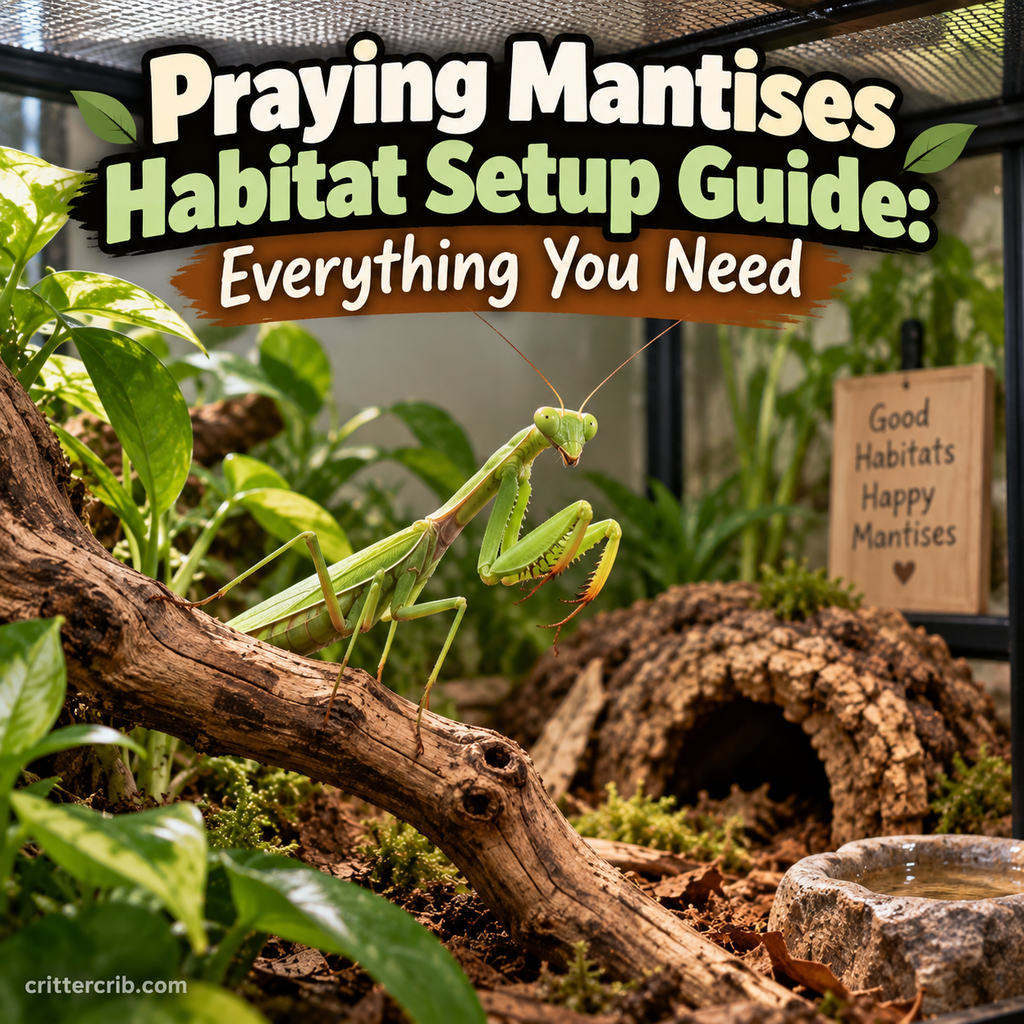
Setting up a praying mantis habitat looks simple at first. Find a container, add a few branches, and you’re done—right?
Not quite.
Praying mantises have some unusual housing requirements, especially when it comes to vertical space and molting. A setup that looks attractive to us can actually be dangerous if a mantis doesn’t have enough room to hang upside down and shed its old exoskeleton.
The good news is that you don’t need an elaborate terrarium or expensive equipment. A well-designed mantis enclosure can be fairly simple.
The key is providing the right combination of space, ventilation, climbing surfaces, temperature, humidity, and safe furnishings for the species you’re keeping.
Here’s everything you need to know about setting up a comfortable praying mantis habitat.
What Does a Praying Mantis Habitat Need?
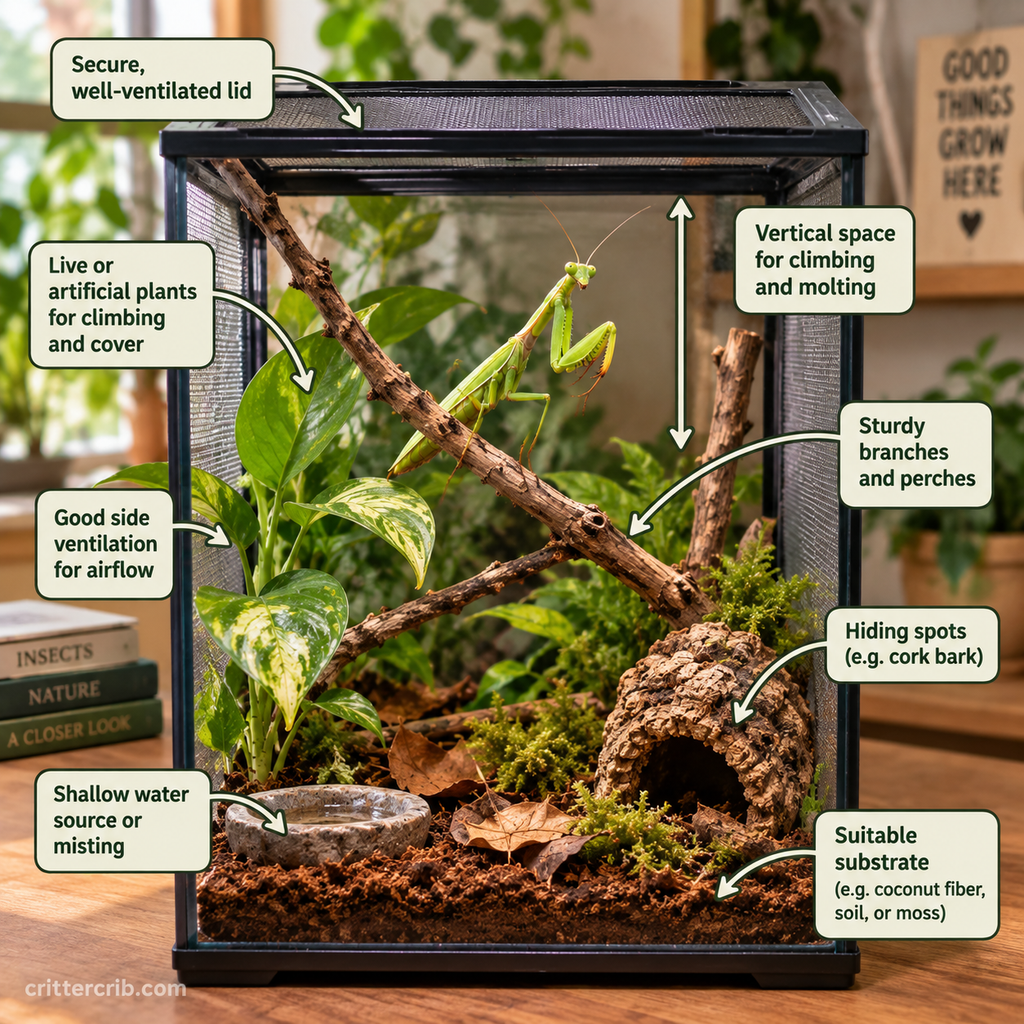
A basic praying mantis enclosure needs several things:
- Enough vertical space for molting
- Good ventilation
- Suitable climbing surfaces
- Places to hang upside down
- Species-appropriate temperature
- Appropriate humidity
- Safe substrate or enclosure flooring
- Access to suitable live prey
- An enclosure that prevents escapes
The exact requirements vary between species.
A hardy species from a relatively dry environment shouldn’t automatically be housed the same way as a tropical mantis that requires warmer, more humid conditions.
Before building the enclosure, identify your mantis species and research its specific environmental needs.
Choosing the Right Praying Mantis Enclosure
Praying mantises don’t necessarily require enormous enclosures.
In fact, an enclosure that’s excessively large can sometimes make it more difficult for a small mantis to locate prey.
What matters more is providing usable vertical space.
Mantises spend much of their time climbing and waiting for prey. They also need to hang upside down when molting.
A tall enclosure is therefore generally more useful than a short, wide one.
Suitable enclosure options include:
- Purpose-built insect enclosures
- Ventilated acrylic enclosures
- Glass terrariums with appropriate ventilation
- Modified plastic containers
- Mesh enclosures for suitable species
Whatever you choose, make sure the mantis can’t squeeze through ventilation holes or gaps around doors and lids.
Young nymphs can escape through surprisingly small openings.
How Big Should a Praying Mantis Enclosure Be?
A commonly used starting guideline is to provide an enclosure approximately three times the mantis’s body length in height and around twice its body length in width.
More space can be provided as long as the mantis can still find food easily.
Vertical clearance is especially important.
When a mantis molts, it typically hangs upside down from a secure surface. It must then emerge from its old exoskeleton and extend downward while the new body and limbs harden.
If the mantis touches the floor or decorations during this process, the molt can go badly.
For this reason, don’t fill every inch of the enclosure with branches and decorations. Your mantis needs open hanging space too.
Why Molting Space Is So Important
Molting is one of the most vulnerable parts of a praying mantis’s life.
As the mantis grows, it periodically sheds its exoskeleton. During a molt, it hangs upside down and gradually pulls itself free.
A poorly designed enclosure can interfere with this process.
Make sure there is:
- A secure surface at the top for hanging
- Clear vertical space beneath it
- No sharp decorations directly below
- Adequate humidity for the species
- Minimal disturbance during the molt
Once a mantis begins molting, leave it alone.
Don’t handle it, spray it directly, or attempt to “help” remove the old exoskeleton.
Provide a Grippable Ceiling
One of the most important features of a mantis enclosure is easy to overlook: the ceiling.
Your mantis needs to be able to grip the top securely.
Smooth plastic or glass may not provide enough traction.
Depending on the enclosure, you can provide a suitable mesh or other safe textured surface that allows the mantis to hang naturally.
Check that the material doesn’t have sharp edges or openings that could trap feet.
The goal is a ceiling the mantis can comfortably walk across and hang from.
Ventilation Is Essential
A mantis enclosure needs airflow.
Poor ventilation combined with excessive moisture can create stagnant conditions and encourage mold.
Cross-ventilation is particularly useful. Instead of having ventilation only at the top, openings on different sides of the enclosure allow air to move through the habitat.
Good ventilation can help:
- Reduce stagnant air
- Control excessive moisture
- Limit condensation
- Discourage mold
- Create a healthier enclosure environment
Remember that ventilation affects humidity.
An enclosure with extensive mesh will usually dry faster than a mostly enclosed acrylic or glass habitat.
You’ll need to balance airflow with the humidity requirements of your particular species.
What Temperature Do Praying Mantises Need?
There’s no universal temperature that’s ideal for every praying mantis.
Different species originate from different climates.
Many commonly kept species can tolerate typical indoor temperatures, while tropical species may require warmer conditions.
Always research your specific species rather than assuming all mantises need the same temperature.
Avoid placing the enclosure:
- In direct sunlight
- Against a radiator
- Beside a heater
- Directly under an air-conditioning vent
- Near a drafty window
Direct sunlight is particularly risky because small enclosures can overheat quickly.
A digital thermometer can help you monitor the habitat if your species requires a more specific temperature range.
Do Praying Mantises Need a Heat Lamp?
Not necessarily.
If your room naturally remains within the appropriate range for your species, additional heating may not be needed.
A heat lamp can also dry a small enclosure rapidly and create dangerously hot areas if used incorrectly.
If supplemental heat is required, use a controlled setup appropriate for the enclosure and monitor temperatures carefully.
Don’t guess based on how warm the outside of the enclosure feels.
Measure the actual temperature.
Praying Mantis Humidity Requirements
Humidity is another species-specific part of mantis care.
Some species prefer relatively moderate conditions, while tropical mantises may require higher humidity.
Humidity also matters during molting.
Conditions that are excessively dry may contribute to molting difficulties in species requiring more moisture. At the same time, constantly soaking the enclosure isn’t the answer.
Too much moisture combined with poor airflow can create its own problems.
Aim for the appropriate balance of:
- Moisture
- Ventilation
- Temperature
Rather than blindly misting on a schedule, observe how quickly the enclosure dries and adjust your routine to your species and setup.
Should You Mist a Praying Mantis Enclosure?
Light misting is commonly used to provide moisture and help maintain appropriate humidity.
Mantises may also drink droplets from enclosure surfaces.
How often you need to mist depends on:
- Mantis species
- Enclosure ventilation
- Room humidity
- Temperature
- Substrate
- Enclosure size
A highly ventilated enclosure may dry much faster than an enclosed terrarium.
When misting, you generally want droplets available without turning the habitat into a permanently soaked environment.
Avoid blasting the mantis directly with a strong spray.
A fine mist applied to enclosure surfaces is gentler.
Do Praying Mantises Need a Water Dish?
A traditional open water bowl usually isn’t necessary for most praying mantises and may create a drowning risk for very small mantises or feeder insects.
Mantises commonly obtain water from prey and droplets in their environment.
For many setups, appropriate misting provides accessible drinking droplets.
Again, species requirements matter, so follow care recommendations for the mantis you’re keeping.
Choosing Substrate for a Praying Mantis
Substrate helps manage moisture and makes the enclosure easier to maintain.
Common options include:
- Coconut fiber
- Organic soil suitable for invertebrate enclosures
- Sphagnum moss used appropriately
- Paper towel for simple or temporary setups
Naturalistic substrates can retain moisture and make the enclosure look more attractive.
Paper towel is less decorative but has practical advantages. It’s inexpensive, easy to replace, and allows you to monitor waste.
For young mantises or quarantine setups, simplicity can be useful.
Whatever substrate you choose, avoid anything treated with:
- Pesticides
- Fertilizers
- Fragrances
- Cleaning chemicals
- Other potentially harmful additives
How Deep Should the Substrate Be?
Praying mantises aren’t generally dependent on deep substrate in the way burrowing tarantulas or millipedes can be.
A modest layer is usually enough to absorb moisture and waste.
The more important measurement is the open vertical space above it.
Don’t sacrifice molting clearance simply to create a deep, elaborate substrate layer.
If you’re creating a planted bioactive enclosure, substrate requirements may be different because the plants and cleanup organisms need adequate depth.
Add Branches and Climbing Structures
Mantises are built to climb.
Branches, twigs, and plant stems provide pathways through the enclosure and places to wait for prey.
Arrange them so your mantis can easily travel between:
- The substrate
- Enclosure walls
- Plants
- Upper branches
- The ceiling
Make sure branches are stable.
A decoration that collapses when the mantis climbs onto it isn’t useful.
Natural branches can work well, but only use materials that haven’t been exposed to pesticides or harmful chemicals.
Don’t Overdecorate the Enclosure
It’s easy to get carried away when building a naturalistic mantis habitat.
More plants. More branches. More vines. More moss.
Eventually, you’ve created a beautiful miniature jungle with nowhere for the mantis to molt.
Keep the central and upper portions of the enclosure functional.
Your mantis needs clear hanging areas with unobstructed space beneath them.
A good enclosure can still look natural without being packed from floor to ceiling.
Live or Artificial Plants?
Both can work.
Live Plants
Live plants can create an attractive naturalistic enclosure and may help maintain humidity.
Suitable plants depend on the enclosure conditions, but whatever you choose should be:
- Non-toxic
- Pesticide-free
- Appropriate for the available light
- Able to tolerate the enclosure’s moisture
- Positioned so they don’t interfere with molting
Artificial Plants
Artificial plants are easier to maintain and can provide additional cover and climbing surfaces.
Choose products without sharp edges, loose fibers, glitter, paint that flakes easily, or other materials that could create problems.
Wash new decorations before placing them in the enclosure.
Create Good Perching Areas
Mantises are ambush predators.
Rather than constantly roaming after food, they often wait from a suitable position and strike when prey comes within reach.
Branches and plants should provide comfortable perching locations throughout the enclosure.
A good perch allows the mantis to:
- Remain elevated
- Observe its surroundings
- Reach passing prey
- Move toward the ceiling
- Retreat into cover
You don’t need to create a perch every inch. A few well-positioned structures are better than a tangled mass of decorations.
Lighting for a Praying Mantis Habitat
Mantises benefit from a normal day-and-night cycle.
Ambient room lighting may be enough for simple setups, particularly if the enclosure receives indirect natural daylight.
If you’re keeping live plants, additional plant lighting may be necessary.
Avoid placing the enclosure in direct sunlight just to provide light.
Direct sun through glass or plastic can rapidly overheat a small habitat.
If artificial lighting is used, maintain a consistent day-and-night schedule and monitor enclosure temperatures.
Where Should You Put the Enclosure?
Location matters more than you might expect.
Choose an area that is:
- Away from direct sunlight
- Free from strong drafts
- Away from heating and cooling vents
- Protected from household sprays
- Relatively stable in temperature
- Safe from other pets
- Easy for you to monitor
Avoid kitchens or other areas where aerosols, smoke, cleaning products, or cooking fumes may regularly reach the enclosure.
Insects can be sensitive to substances that seem harmless to us.
Feeding Considerations When Designing the Habitat
Praying mantises generally require live prey.
That means enclosure design should make feeding manageable.
Common feeder insects vary according to mantis size and species and may include:
- Fruit flies
- Houseflies
- Bluebottle or bottle flies
- Roaches of appropriate size
- Other suitable captive-raised feeder insects
Prey shouldn’t be so large that it can injure the mantis.
Avoid collecting random insects from areas that may have been treated with pesticides or exposed to other contaminants.
An enclosure that’s extremely large or densely planted can make it difficult for a young mantis to locate prey.
Watch feeding rather than simply assuming the mantis will eventually find whatever you release.
Remove Uneaten Prey When Necessary
Don’t allow feeder insects to accumulate indefinitely.
Uneaten prey can disturb a mantis, particularly when it is preparing to molt.
Once your mantis enters premolt or begins hanging in preparation for a molt, remove potentially troublesome feeder insects.
After molting, give the mantis time for its new exoskeleton to harden before feeding again.
Can Praying Mantises Live Together?
For most pet mantises, individual housing is the safest approach.
Mantises are predators, and cannibalism is a very real possibility.
Even if two individuals appear to tolerate each other temporarily, that doesn’t mean communal housing is safe long term.
Some species and life stages may be kept communally under specialized conditions by experienced keepers, but that shouldn’t be treated as a general rule.
If you’re new to mantis keeping, house each mantis separately unless reliable species-specific guidance clearly indicates otherwise.
Bioactive Praying Mantis Enclosures
A bioactive enclosure uses living organisms and natural materials to create a more self-sustaining habitat.
A mantis bioactive setup might contain:
- Live plants
- Natural substrate
- Leaf litter
- Springtails
- Other appropriate cleanup organisms
Springtails can help consume mold and decomposing organic material.
A bioactive enclosure can be attractive and functional, but it isn’t maintenance-free.
You still need to:
- Monitor moisture
- Remove problematic waste
- Maintain plants
- Watch for pests
- Provide appropriate ventilation
- Feed the mantis
- Monitor temperature
For beginners, there’s nothing wrong with starting with a simpler enclosure.
Good husbandry matters more than creating an elaborate ecosystem.
Setting Up a Praying Mantis Habitat Step by Step
Once you’ve gathered your supplies, setup is straightforward.
1. Choose the Enclosure
Select a secure enclosure with enough vertical space for your mantis to molt safely.
2. Check the Ventilation
Make sure there is adequate airflow without openings large enough for the mantis or feeder insects to escape.
3. Prepare the Ceiling
Provide a safe, grippable surface from which the mantis can hang.
4. Add Substrate
Add an appropriate substrate based on your species and preferred maintenance style.
5. Install Branches and Plants
Create climbing routes and perches while leaving clear vertical molting space.
6. Check Stability
Make sure nothing can easily fall, collapse, or trap the mantis.
7. Monitor Temperature and Humidity
Check the enclosure conditions before introducing the mantis.
8. Add the Mantis
Once conditions are stable, carefully introduce your mantis and allow it to explore without unnecessary handling.
9. Observe Before Making Changes
Watch how the mantis uses the habitat.
You can adjust branch placement, moisture, or other elements later if something clearly isn’t working.
Common Praying Mantis Habitat Mistakes
Avoiding a few common mistakes can make mantis keeping much easier.
Not Providing Enough Molting Space
This is one of the most important enclosure mistakes to avoid.
Always leave unobstructed vertical room beneath hanging surfaces.
Using a Smooth Ceiling
A mantis needs a secure grip when hanging and molting.
Poor Ventilation
A warm, wet enclosure without sufficient airflow can quickly become stagnant.
Excessive Misting
Higher humidity doesn’t mean the enclosure should remain soaking wet.
Keeping the Enclosure Too Dry
The opposite can also cause problems, particularly for moisture-dependent tropical species.
Overdecorating
An enclosure can look fantastic while being poorly designed for the animal.
Function comes first.
Using Wild Materials Without Considering Contamination
Branches, leaves, plants, and soil may carry pesticides or other contaminants.
Know where your materials came from.
Putting the Habitat in Direct Sunlight
Small enclosures can become dangerously hot surprisingly quickly.
Housing Mantises Together
Unless you have species-specific knowledge supporting communal housing, keep mantises individually.
Praying Mantis Habitat Setup Checklist
Before introducing your mantis, check the basics:
- Secure, escape-resistant enclosure
- Adequate vertical molting space
- Grippable ceiling
- Good ventilation
- Appropriate temperature
- Species-appropriate humidity
- Safe substrate
- Stable branches
- Suitable plants or cover
- Open hanging areas
- Safe location away from direct sunlight
- Appropriate live feeder insects ready
If those fundamentals are covered, you already have the foundation of a good mantis habitat.
Frequently Asked Questions
What size enclosure does a praying mantis need?
A commonly used guideline is an enclosure around three times the mantis’s body length in height and approximately twice its body length in width. The most important consideration is providing enough unobstructed vertical space for safe molting.
Do praying mantises need a terrarium?
Not necessarily. A secure, appropriately sized, well-ventilated insect enclosure can work perfectly well. The enclosure’s design matters more than whether it’s technically considered a terrarium.
Do praying mantises need heat?
Some species do, while others can live comfortably at typical indoor temperatures. Research the temperature requirements of your particular species before adding supplemental heat.
Do praying mantises need humidity?
Yes, but the appropriate humidity varies by species. Tropical species often require more moisture than species adapted to drier environments.
Should I mist my praying mantis?
Lightly misting enclosure surfaces can provide moisture and drinking droplets. Frequency depends on species, temperature, ventilation, and how quickly the enclosure dries.
Do praying mantises need a water bowl?
Most mantises don’t require a traditional water bowl. They commonly drink droplets from enclosure surfaces and obtain moisture from prey.
What should I put on the bottom of a mantis enclosure?
Options include coconut fiber, suitable organic soil, sphagnum moss used appropriately, or paper towel for a simple setup. Choose based on the species and how you plan to maintain humidity and cleanliness.
Can I keep two praying mantises together?
Individual housing is generally safest because many mantises may attack and eat one another. Communal housing should only be attempted when appropriate for a particular species and under suitable conditions.
Do praying mantises need live plants?
No. Live plants can make an enclosure attractive and help create a natural environment, but artificial plants and branches can also provide suitable climbing and hiding opportunities.
Final Thoughts
A good praying mantis habitat doesn’t need to be complicated.
Start with the things the mantis actually needs: a secure enclosure, good ventilation, appropriate temperature and humidity, climbing surfaces, and plenty of vertical space for molting.
That last point deserves extra attention.
A beautifully decorated enclosure isn’t useful if your mantis can’t hang safely from the ceiling and complete a molt without hitting a branch, plant, or the substrate below.
Once the fundamentals are covered, you can make the enclosure as simple or naturalistic as you like.
Research the particular species you’re keeping, monitor how the enclosure behaves over time, and pay attention to how your mantis uses the space.
The best habitat isn’t necessarily the fanciest one. It’s the one that allows your mantis to climb, hunt, rest, and molt safely.