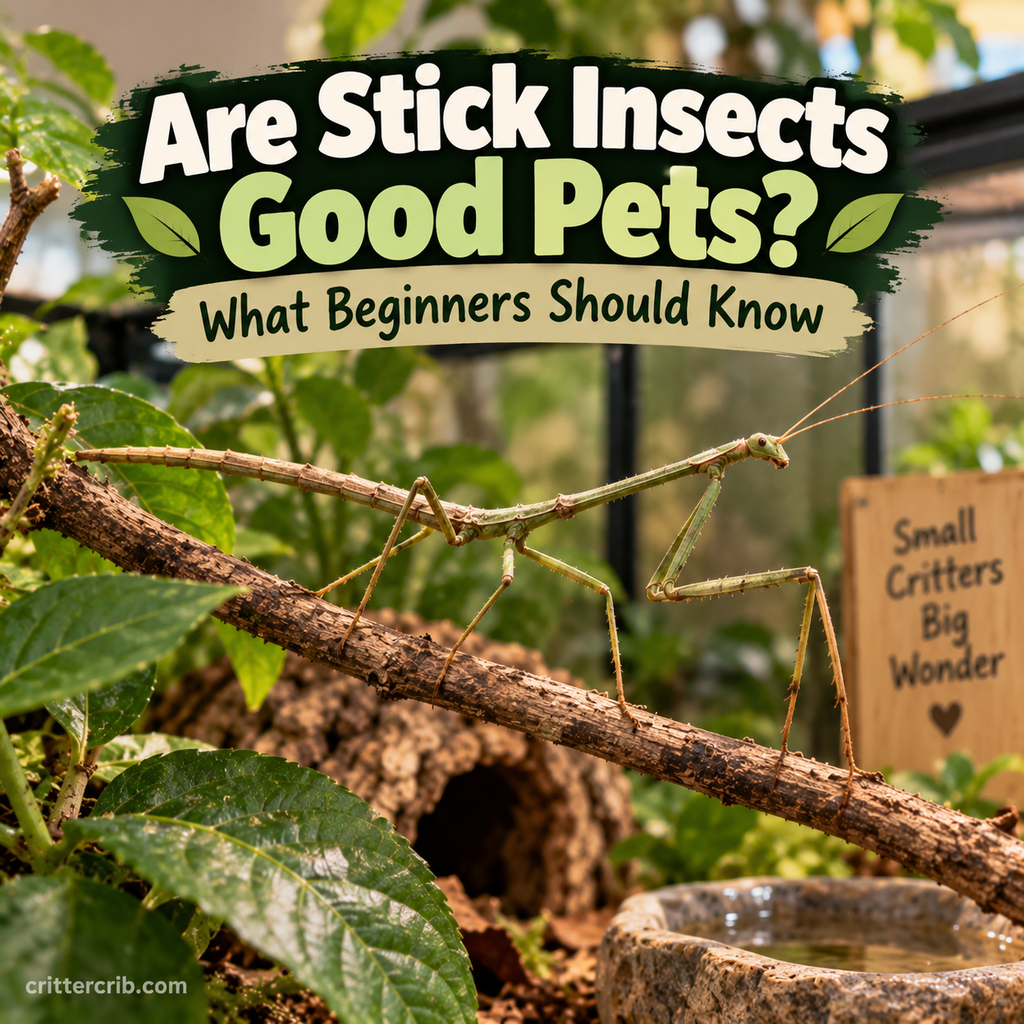
Stick insects are about as different from a traditional pet as you can get. They don’t bark, cuddle, learn tricks, or come running when they hear a food container open.
They may, however, spend several hours pretending to be a twig.
For the right person, that’s part of their charm.
Stick insects—also called walking sticks or phasmids—can make fascinating, relatively low-maintenance pets. They’re quiet, don’t require much space, and their unusual appearance makes even a simple enclosure interesting to watch.
They’re not perfect for everyone, though. Stick insects are delicate, their diet can require a steady supply of fresh leaves, and some species have specific temperature and humidity requirements.
If you’re thinking about keeping stick insects for the first time, here’s what you should know before bringing one home.
Are Stick Insects Good Pets for Beginners?
Many commonly kept stick insect species can be good pets for beginners.
Their basic care is often fairly straightforward once you have an appropriate enclosure and a reliable source of food plants.
Some of their biggest advantages include:
- They’re quiet.
- They require relatively little space.
- They don’t need daily social interaction.
- They generally don’t produce strong odors when properly maintained.
- Their behavior is fascinating to observe.
- Many species have fairly simple diets.
- They don’t need walks, toys, or traditional training.
- Basic setups can be relatively inexpensive.
The important qualification is species choice.
There are thousands of stick insect species, and they don’t all have identical care requirements. Some are much easier for beginners than others.
Before getting one, identify the exact species and research its adult size, diet, humidity, temperature, defensive behaviors, and reproduction.
What Are Stick Insects Like as Pets?
Keeping stick insects is closer to maintaining a small natural habitat than owning an interactive companion animal.
Much of the enjoyment comes from observation.
You may see your stick insect:
- Feeding on leaves
- Climbing branches
- Swaying like a twig in the wind
- Hanging upside down
- Molting
- Resting motionless for long periods
- Exploring after dark
Some species are primarily nocturnal, so don’t be surprised if your stick insect seems fairly inactive during the day.
Their camouflage can also be incredibly effective. You may occasionally look directly into the enclosure and wonder where your pet went, only to realize it has been sitting on the same branch the entire time.
Are Stick Insects Friendly?
“Friendly” isn’t really the best way to describe a stick insect.
They’re not social pets that seek affection or form the type of relationship people commonly associate with dogs, cats, birds, or some mammals.
However, many commonly kept species are docile and can tolerate careful interaction.
A calm stick insect may walk across your hands without showing obvious defensive behavior.
Others may freeze, sway, drop from a branch, play dead, or use species-specific defenses when disturbed.
The goal shouldn’t be to make a stick insect affectionate. Instead, learn its normal behavior and keep handling gentle and limited.
Can You Handle Stick Insects?
Many stick insects can be handled carefully, but they’re delicate.
Their legs are particularly vulnerable.
Never pull a stick insect from a branch or your clothing. If it has a strong grip, allow it to release naturally.
When handling:
- Wash and thoroughly rinse your hands.
- Keep your hands low over a table or enclosure.
- Place your hand in front of the insect.
- Allow it to walk onto you.
- Move slowly.
- Keep the interaction brief.
- Let it step back onto a branch when you’re finished.
Avoid grabbing the insect around its body or legs.
Young nymphs can be especially fragile and are often better left inside the enclosure.
Do Stick Insects Bite?
Most commonly kept stick insects aren’t considered a significant biting risk to people.
Their defenses vary by species, however.
Depending on the stick insect, defensive strategies can include:
- Remaining motionless
- Swaying
- Dropping to the ground
- Playing dead
- Kicking
- Pinching with the legs
- Displaying bright warning colors
- Releasing defensive chemicals
This is another reason species identification matters.
Don’t assume every stick insect is harmless to handle simply because another species is extremely docile.
Some defensive secretions can irritate the skin or eyes, so learn about the particular species you’re considering before handling it.
How Much Space Do Stick Insects Need?
Stick insects don’t require enormous habitats, but enclosure proportions are important.
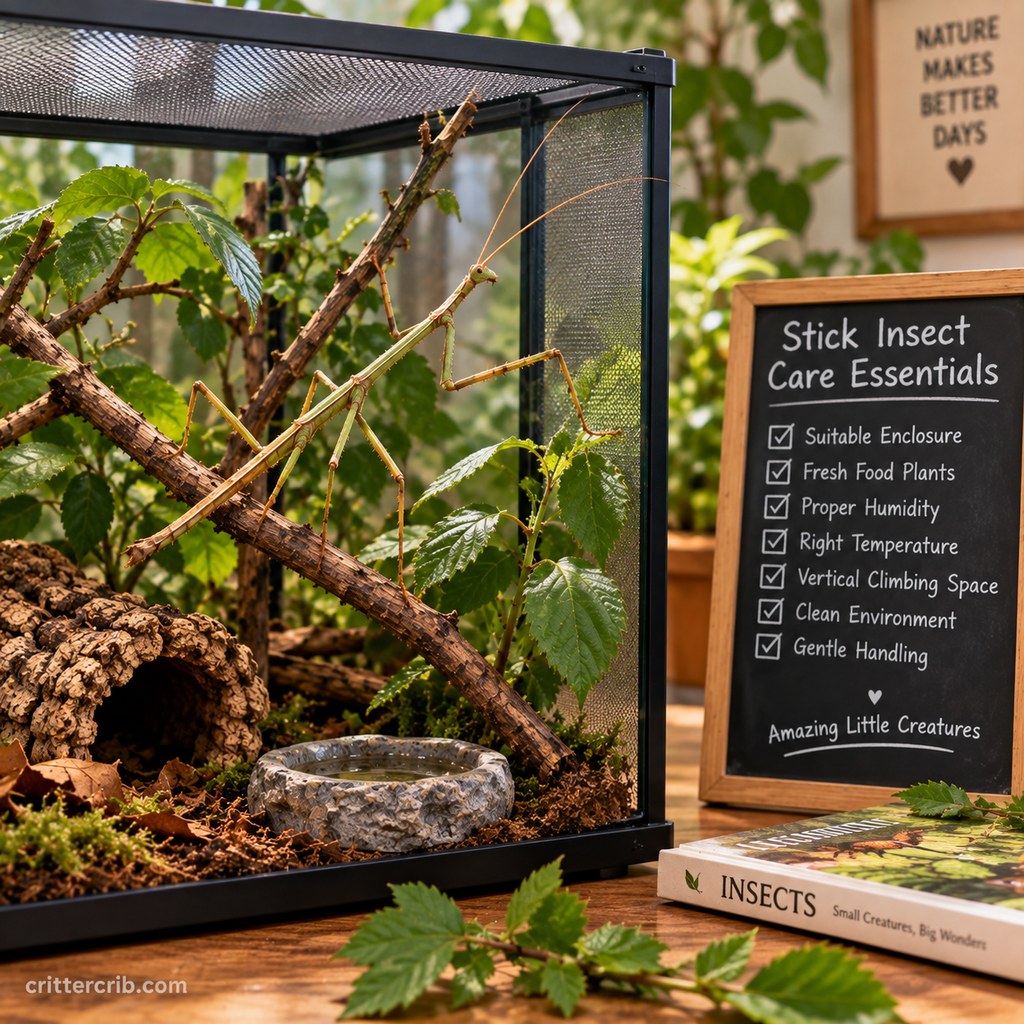
Height is especially critical because stick insects need to hang while molting.
A commonly used guideline is to provide an enclosure at least around three times the insect’s body length in height and approximately twice its body length in width.
Larger is generally fine as long as the insect can find its food easily.
For multiple insects, you’ll need additional space and enough feeding material to prevent crowding.
Why Enclosure Height Matters
Molting is one of the most vulnerable periods in a stick insect’s life.
As it grows, a stick insect periodically sheds its old exoskeleton.
To do this successfully, it usually hangs from a secure surface and emerges downward.
If the enclosure is too short, the insect may touch the floor or another object before it has fully emerged. A failed molt can result in deformities, lost limbs, or death.
Your enclosure therefore needs:
- A grippable ceiling or upper surface
- Plenty of vertical clearance
- Secure branches
- Open space beneath molting areas
Don’t pack the enclosure so tightly with decorations that there is nowhere to molt safely.
What Kind of Enclosure Do Stick Insects Need?
Several types of enclosures can work.
Common options include:
- Mesh insect cages
- Purpose-built invertebrate enclosures
- Ventilated plastic enclosures
- Modified containers
- Tall terrariums with suitable airflow
Ventilation is important.
At the same time, species from humid environments may need an enclosure that retains enough moisture.
The ideal balance depends on the species you’re keeping.
Whatever enclosure you use, make sure it’s secure. Small nymphs can escape through surprisingly tiny gaps.
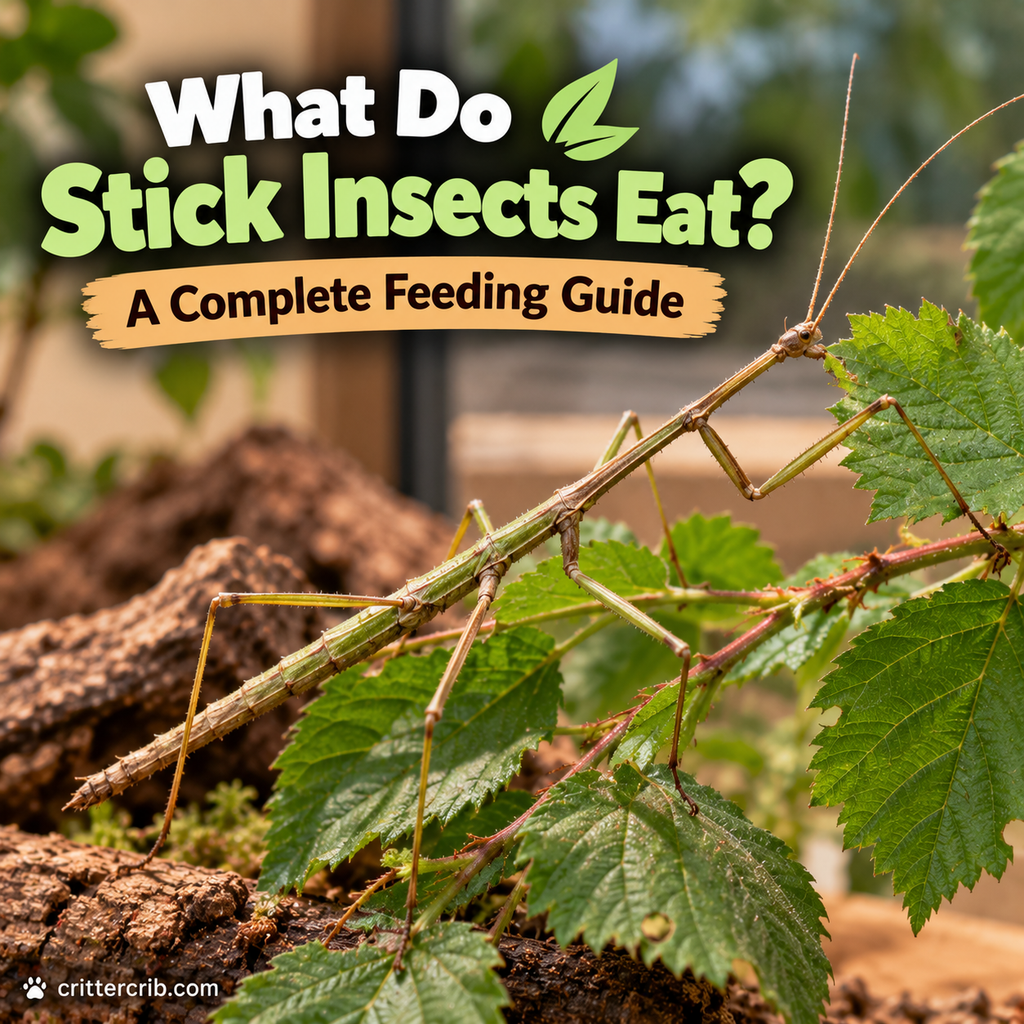
What Do Stick Insects Eat?
This is one of the most important things to figure out before getting a stick insect.
Stick insects are herbivores, but you shouldn’t assume they’ll eat any leaves you give them.
Different species accept different food plants.
Commonly used food plants for various captive species include:
- Bramble or blackberry
- Rose
- Oak
- Ivy
- Privet
- Eucalyptus
- Raspberry
- Hazel
That doesn’t mean every stick insect can eat everything on this list.
Research your exact species and provide plants known to be suitable for it.
Ideally, determine where you’ll obtain fresh food year-round before acquiring the insect.
Finding Safe Food Plants
Fresh leaves need to be free from pesticides and other harmful chemicals.
Avoid collecting food plants:
- Beside heavily traveled roads
- From areas treated with pesticides
- From chemically maintained gardens
- From plants you can’t confidently identify
If you’re purchasing plants to feed your insects, remember that garden centers may use pesticides or systemic insecticides.
“Fresh” doesn’t automatically mean safe.
A reliable source of uncontaminated food plants is one of the biggest practical considerations in stick insect ownership.
Keeping Food Fresh in the Enclosure
Cut branches are often placed in a container of water to keep the leaves fresh.
If you use this method, cover the opening around the stems.
An uncovered container of water can create a drowning hazard, particularly for small nymphs.
You can use material such as mesh, foil, or another secure barrier around the stems so the insects can’t fall into the water.
Replace food branches before the leaves become badly wilted or moldy.
Do Stick Insects Need Water?
Stick insects commonly drink droplets from leaves and enclosure surfaces.
Light misting can provide drinking opportunities while also helping maintain appropriate humidity.
How often you mist depends on:
- Species
- Temperature
- Ventilation
- Enclosure type
- Ambient humidity
Don’t assume that more moisture is always better.
An enclosure that’s constantly soaking wet with poor airflow can encourage mold and create unhealthy conditions.
The goal is to meet your species’ humidity needs while maintaining adequate ventilation.
What Temperature Do Stick Insects Need?
Temperature requirements vary by species.
Many commonly kept species can live at normal household temperatures, while tropical species may require warmer conditions.
Before getting a stick insect, find out the recommended temperature range for that particular species.
Avoid placing the enclosure:
- In direct sunlight
- Beside a heater
- Near a radiator
- Directly beneath an air-conditioning vent
- In a cold draft
Direct sunlight is especially dangerous because a small enclosure can heat up quickly.
If supplemental heating is necessary, temperatures should be monitored carefully rather than guessed.
What Humidity Do Stick Insects Need?
Humidity requirements also vary.
Some stick insects originate from relatively humid environments, while others tolerate drier conditions.
Proper humidity becomes particularly important around molting.
A species kept too dry may experience problems, but keeping the enclosure permanently saturated isn’t a safe solution.
Good stick insect husbandry balances humidity with ventilation.
Research the species rather than targeting a generic humidity percentage for every walking stick.
Are Stick Insects Messy?
Compared with many traditional pets, stick insects are relatively tidy.
Most enclosure maintenance involves:
- Removing droppings
- Replacing old food plants
- Removing dead leaves
- Cleaning mold when necessary
- Wiping enclosure surfaces
- Replacing substrate or floor lining when needed
Many keepers use paper towel or another simple liner because it makes cleanup easy.
Naturalistic substrate can also be used, depending on the setup.
Be cautious when cleaning if eggs may be present. Stick insect eggs can resemble seeds, droppings, or tiny pieces of debris.
It’s surprisingly easy to throw them away accidentally.
Do Stick Insects Smell?
A properly maintained stick insect enclosure generally shouldn’t have a strong unpleasant odor.
Bad smells may indicate:
- Moldy food
- Excess moisture
- Poor ventilation
- Accumulated waste
- Decaying organic material
Regularly removing old food and keeping the enclosure appropriately ventilated usually keeps odor minimal.
That makes stick insects appealing for bedrooms, offices, and smaller homes where a strong-smelling pet might be a problem.
How Often Do Stick Insects Need Care?
Stick insects are relatively low maintenance, but they aren’t no-maintenance pets.
You’ll still need to check them regularly.
Routine care includes:
- Checking food quality
- Replacing wilted leaves
- Misting when appropriate
- Monitoring temperature and humidity
- Removing waste
- Watching for molting problems
- Checking enclosure security
Fresh food is the biggest ongoing responsibility.
If your species eats a plant that’s difficult to obtain in winter, feeding can become considerably more complicated.
Solve that problem before buying the insect rather than afterward.
How Long Do Stick Insects Live?
Lifespan varies considerably between species.
Many stick insects live roughly several months to a couple of years, with females of some species living longer than males.
Their life cycle usually includes:
- Egg
- Nymph
- Adult
Nymphs resemble smaller versions of adults and grow through a series of molts.
Because lifespan differs so much between species, check the expected longevity before purchasing one.
A stick insect isn’t necessarily a multi-year commitment like a dog or cat, but it’s still an animal that needs consistent care throughout its life.
Stick Insect Reproduction Can Surprise Beginners
This is something every new keeper should know.
Some stick insect species can reproduce through parthenogenesis, meaning females can produce offspring without mating with a male.
That means keeping a single female doesn’t necessarily guarantee you’ll only ever have one stick insect.
Depending on the species, females may lay numerous eggs over their lifetime.
Before allowing eggs to hatch, consider whether you have:
- Enough enclosure space
- Enough food
- Time to care for the offspring
- A legal and responsible way to rehome extras
Never release unwanted captive stick insects or eggs outdoors.
Non-native species can potentially cause ecological problems, and releasing them may also be illegal.
Are Stick Insects Expensive Pets?
Basic stick insect keeping can be relatively inexpensive compared with many pets.
Typical expenses may include:
- Enclosure
- Substrate or floor lining
- Branches and furnishings
- Thermometer or humidity monitor if needed
- Supplemental heating if required
- Food plants
- Replacement supplies
Food may cost very little if you have reliable access to suitable pesticide-free plants.
However, the initial price of the insect isn’t the most important consideration.
You should first make sure you can consistently provide the correct food and environmental conditions.
Are Stick Insects Good Pets for Children?
Stick insects can be fascinating educational pets for children, but adult supervision is important.
Their delicate bodies make rough handling dangerous.
Children should be taught to:
- Let the insect walk onto their hand
- Never squeeze it
- Never pull it from a branch
- Keep their hands low
- Avoid touching freshly molted insects
- Wash their hands after handling
- Respect the insect when it doesn’t want to move
For younger children, observing the insect inside its enclosure may be safer than frequent handling.
Stick insects can be particularly interesting for children who enjoy nature, insects, and watching animal behavior rather than physically playing with a pet.
Can Stick Insects Live Together?
Many commonly kept stick insects can be housed with members of their own species when enough space and food are provided.
However, this isn’t a universal rule.
Crowding can interfere with molting and increase competition for food.
Different species also shouldn’t automatically be mixed together. They may have different environmental requirements or interfere with one another.
For beginners, keeping one species per enclosure is usually the simplest approach.
Are Stick Insects Legal to Keep?
This is an important consideration that sometimes gets overlooked.
Rules surrounding the possession, transport, sale, or importation of non-native stick insects vary depending on where you live and which species you’re considering.
Some species may be regulated because of their potential to become agricultural or environmental pests.
Before purchasing a stick insect, check applicable local and national regulations.
Don’t assume an animal is legal simply because you found someone selling it online.
Advantages of Keeping Stick Insects
Stick insects have quite a few qualities that make them appealing pets.
They’re Quiet
There are no barking, chirping, or loud nighttime noises to worry about.
They Don’t Require Much Space
A properly sized vertical enclosure can fit comfortably in many homes.
They’re Fascinating to Watch
Camouflage, swaying behavior, feeding, climbing, and molting provide plenty to observe.
Their Basic Care Can Be Simple
Once food and environmental conditions are sorted out, routine maintenance is usually manageable.
They Don’t Need Social Attention From You
You don’t have to feel guilty because you didn’t spend an hour playing with your stick insect.
They’re Great for Nature Lovers
Few pets allow you to observe insect camouflage and behavior this closely.
Disadvantages of Keeping Stick Insects
They’re not ideal for everyone.
They’re Fragile
Rough handling can injure legs or other parts of the body.
Fresh Food Can Be Inconvenient
Finding pesticide-free leaves year-round may be the hardest part of ownership.
They’re Not Very Interactive
If you want a pet that recognizes you or actively seeks your attention, a stick insect probably won’t satisfy that expectation.
Molting Can Be Risky
Improper enclosure height, humidity, or disturbance can contribute to molting problems.
Reproduction Can Get Out of Hand
Some species can produce large numbers of eggs, even without males.
Legal Restrictions May Apply
Depending on your location and species, ownership may be regulated.
Who Should Get a Stick Insect?
A stick insect may be a good pet for you if you:
- Enjoy observing insects
- Want a quiet pet
- Have limited space
- Don’t need frequent physical interaction
- Can reliably obtain suitable food plants
- Are comfortable maintaining an enclosure
- Enjoy naturalistic habitats
- Don’t mind caring for live invertebrates
They’re particularly well suited to someone who finds enjoyment in simply watching an unusual animal behave naturally.
Who Might Prefer a Different Pet?
You may want to consider another animal if you’re looking for:
- A highly interactive pet
- An animal that enjoys frequent handling
- A pet you can train
- A long-term companion lasting many years
- A pet that eats commercially packaged food exclusively
- An animal that can be left without regular checks
Stick insects are relatively easy to care for, but “easy” doesn’t mean disposable.
They still depend entirely on you for food and appropriate living conditions.
Beginner Stick Insect Checklist
Before getting your first stick insect, make sure you can answer these questions:
- What exact species am I getting?
- How large will it become?
- What plants does it eat?
- Can I obtain those plants year-round?
- Are the food plants pesticide-free?
- What temperature does the species need?
- What humidity does it require?
- Is my enclosure tall enough for molting?
- Does the enclosure have adequate ventilation?
- Can young nymphs escape through any gaps?
- Does this species have defensive behaviors I should know about?
- Can females reproduce without males?
- Is this species legal to keep where I live?
If you can confidently answer those questions, you’re in a much better position to care for the animal successfully.
Frequently Asked Questions
Are stick insects easy to keep as pets?
Many commonly kept species are relatively easy to care for once you have an appropriate enclosure and reliable source of fresh food plants. Requirements vary between species, so research is still important.
Can you hold a pet stick insect?
Many species can be handled gently. Let the insect walk onto your hand rather than pulling it from a branch. Young or freshly molted insects should generally be left alone.
Do stick insects recognize their owners?
There’s no good evidence that stick insects recognize or bond with their owners in the way more socially complex pets do. They’re best kept as observation pets.
Do stick insects need live food?
No. Stick insects are herbivores and eat leaves from suitable food plants. The exact plants accepted depend on the species.
Do stick insects need a heat lamp?
Not always. Many species can be kept at suitable household temperatures. Tropical species may require supplemental warmth, but any heating should be carefully controlled.
Can a stick insect live alone?
Yes, many stick insects can be kept individually. They don’t require companionship in the same way social mammals do.
Are stick insects good apartment pets?
They can be excellent pets for smaller living spaces because they’re quiet, require relatively compact enclosures, and generally produce little odor when properly maintained.
Can one stick insect have babies by itself?
In some species, yes. Females of certain stick insects can reproduce through parthenogenesis without mating with a male.
Final Thoughts
So, are stick insects good pets?
For the right person, absolutely.
They’re quiet, unusual, inexpensive to maintain in many cases, and endlessly interesting if you enjoy observing small animals. Their camouflage alone can turn checking the enclosure into a daily game of “find the stick insect.”
But they’re observation pets first.
They don’t need affection, and they don’t benefit from constant handling. What they need is a tall, secure enclosure, appropriate temperature and humidity, safe molting space, and a reliable supply of the correct fresh leaves.
That last requirement is worth thinking about carefully. Before buying a stick insect, figure out exactly what your species eats and where you’ll get that food throughout the year.
If you’re comfortable with that responsibility and want a small pet that’s more fascinating than demanding, a stick insect can be an excellent introduction to keeping invertebrates.