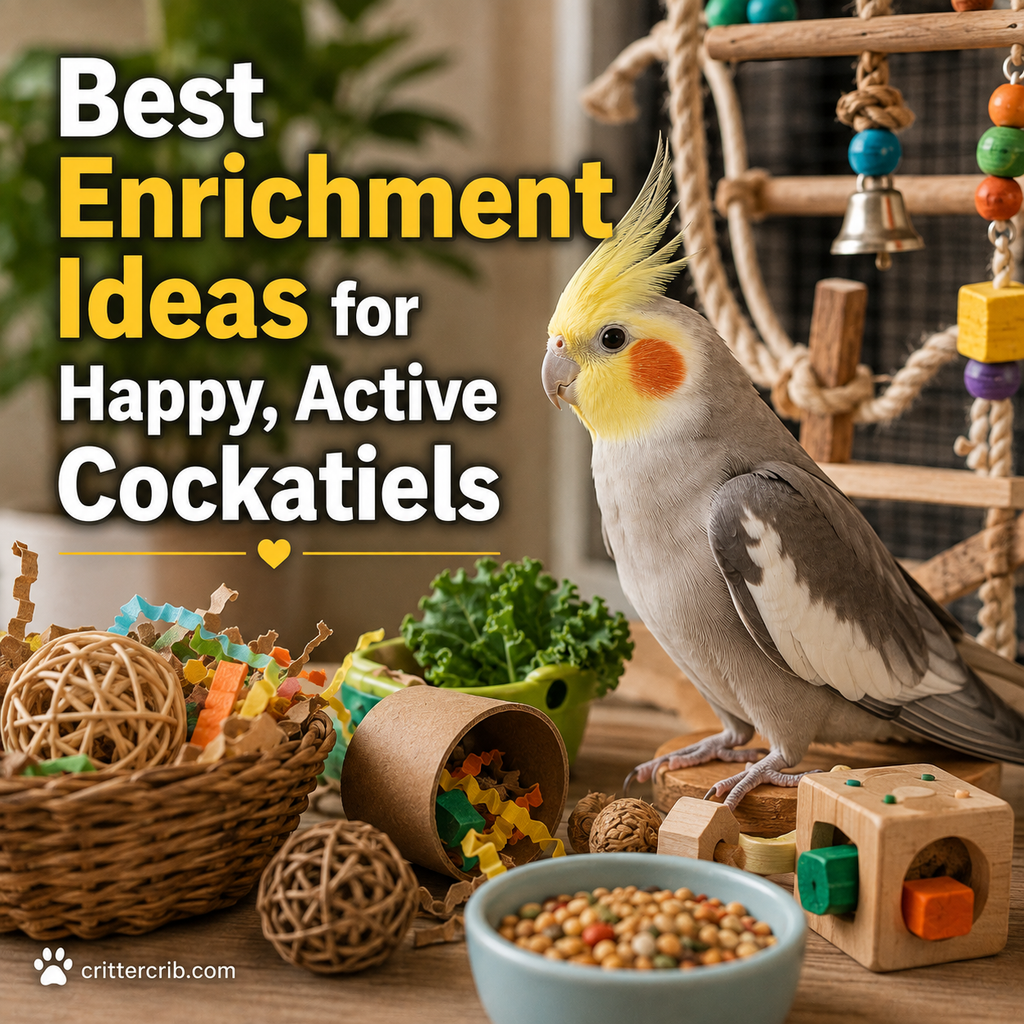
Cockatiels may spend part of their day relaxing on a favorite perch, but they’re definitely not birds that should sit in an empty cage with nothing to do.
They’re curious, social parrots that naturally explore, chew, forage, climb, fly, communicate, and investigate their surroundings. A good enrichment routine gives them safe ways to use those instincts at home.
And enrichment doesn’t have to mean buying a pile of expensive bird toys.
A cardboard box to shred, vegetables tucked into different feeding locations, a short training session, or an afternoon exploring a play stand can sometimes be more interesting than another colorful toy hanging from the cage.
The best approach is variety.
Here are some of the best enrichment ideas for cockatiels, along with practical ways to keep your bird mentally stimulated, physically active, and interested in its environment.
Why Do Cockatiels Need Enrichment?
Wild cockatiels spend much of their day doing things.
They search for food, travel, communicate with other birds, avoid danger, investigate their surroundings, and interact socially.
A pet cockatiel doesn’t have to spend hours searching for dinner.
That’s convenient, but it also means much of the activity that would normally fill a bird’s day has disappeared.
Enrichment helps fill that gap.
A stimulating environment gives your cockatiel opportunities to:
- Explore
- Forage
- Chew
- Shred
- Climb
- Fly
- Solve simple problems
- Learn
- Play
- Interact socially
- Make choices
The goal isn’t to keep your cockatiel busy every second.
Birds need downtime too.
Instead, enrichment creates opportunities for natural behavior throughout the day.
1. Turn Mealtime Into a Foraging Activity
Foraging is one of the most useful forms of enrichment because it turns something your bird already does—eating—into an activity.
Rather than putting every piece of food in an easily accessible bowl, encourage your cockatiel to search and work for some of it.
Start easy.
A bird that’s never foraged before may not understand a complicated puzzle feeder.
Try:
- Placing food in several locations
- Tucking leafy greens between cage bars
- Putting a treat inside loosely crumpled bird-safe paper
- Hiding food underneath a small piece of paper
- Using simple commercial foraging toys
- Placing a favorite treat inside a cardboard item the bird can shred
Let your cockatiel see you hide the food at first.
Once the bird understands the game, you can gradually make the challenge more interesting.
Don’t Make All Food Difficult to Access
Foraging should be enrichment, not a survival test.
Your cockatiel should still have reliable access to its normal balanced diet and fresh water.
Use foraging to make part of the day’s food more interesting.
2. Give Your Cockatiel Things to Shred
Many cockatiels love destroying things.
Fortunately, destruction can be a perfectly healthy activity when you provide appropriate materials.
Shredding lets your bird use its beak and gives it something productive to investigate.
Bird-safe shredding materials can include:
- Plain paper
- Unprinted cardboard
- Bird-safe paper toys
- Palm-leaf toys
- Appropriate natural fibers
- Bird-safe soft wood
Some cockatiels immediately attack a shredding toy.
Others stare suspiciously at it for several days.
Don’t force interaction. Give your bird time to investigate unfamiliar objects.
3. Provide Safe Chewing Toys
Chewing is normal parrot behavior.
Your cockatiel doesn’t know that your furniture, picture frames, books, and charging cables aren’t bird toys.
Providing appropriate chewing options gives the bird somewhere better to direct that instinct.
Try toys made from suitable bird-safe materials such as:
- Soft woods
- Natural branches
- Paper
- Cardboard
- Palm leaves
- Other bird-safe chewable materials
Replace toys as they become worn or destroyed.
A toy that has been successfully demolished wasn’t necessarily a waste of money.
It did its job.
4. Create a Cockatiel Play Stand
A play stand gives your bird somewhere interesting to go outside the cage.
It doesn’t have to be elaborate.
A useful setup might include:
- Natural perches
- A ladder
- A swing
- Chewing toys
- Shredding materials
- Foraging activities
- A small food dish
- Training space
Position the stand somewhere your cockatiel can safely participate in household activity.
A dedicated play area also gives your bird an alternative to immediately landing on furniture you’d rather it didn’t chew.
5. Encourage Safe Climbing
Cockatiels aren’t as acrobatic as some parrots, but many still enjoy climbing.
You can create different routes around the cage or play area using:
- Ladders
- Natural branches
- Rope perches
- Platforms
- Climbing toys
Make sure climbing equipment is securely attached.
Inspect ropes regularly for loose fibers and fraying that could become an entanglement hazard.
The setup should provide a challenge without creating dangerous falls or traps.
6. Offer Different Types of Perches
Perches can contribute to enrichment too.
A cage containing only identical wooden dowels doesn’t offer much variety.
Instead, use appropriately sized natural perches with different shapes and diameters.
This creates different places to:
- Rest
- Climb
- Observe
- Chew
- Move between areas
Arrange perches so your cockatiel has clear routes through the cage.
Don’t fill every inch.
Movement space is just as important as the accessories themselves.
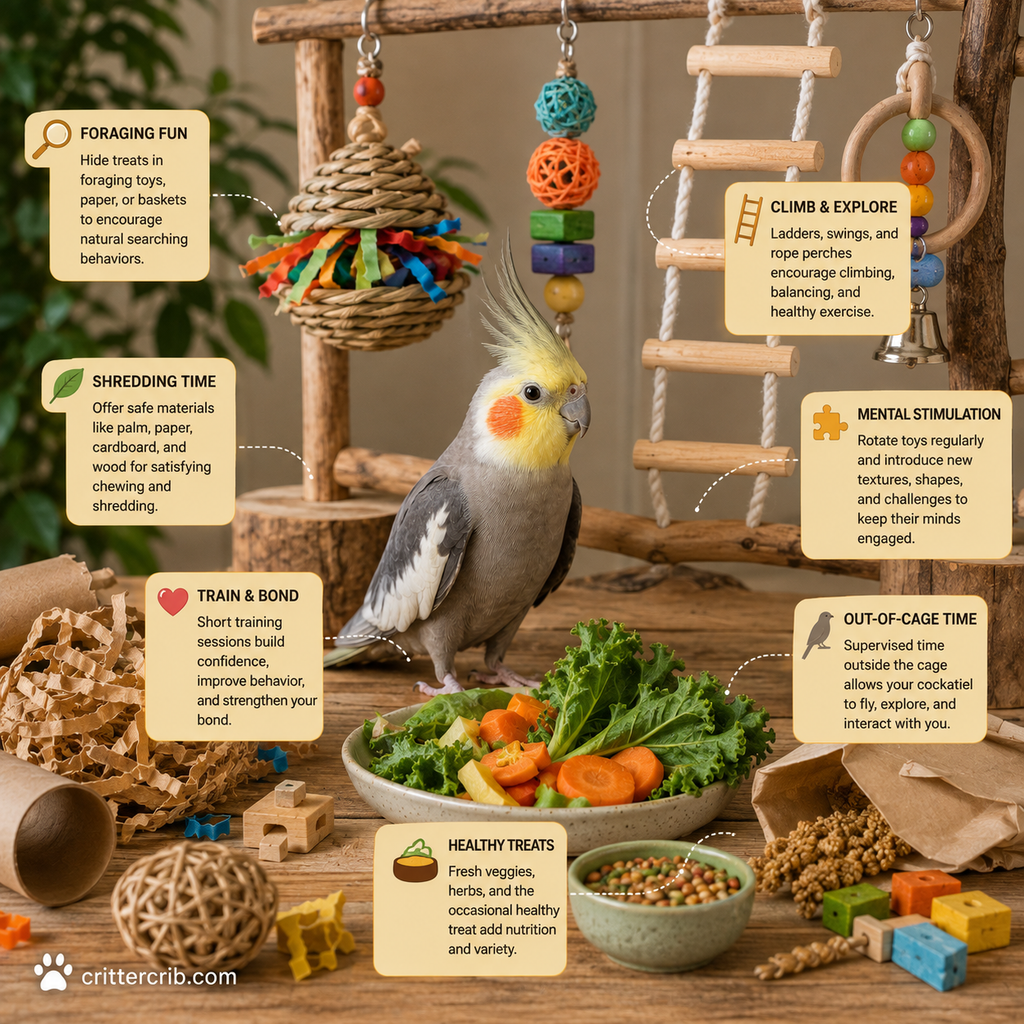
7. Give Your Cockatiel Supervised Out-of-Cage Time
One of the best forms of enrichment is simply getting out of the cage.
Supervised time in a bird-safe room gives your cockatiel opportunities to move, fly, climb, explore, and interact with you.
Before opening the cage:
- Close exterior doors
- Secure windows
- Turn off ceiling fans
- Remove other pets
- Close toilet lids
- Cover or remove dangerous water containers
- Keep hot surfaces inaccessible
- Remove toxic plants
- Protect electrical cords
- Block dangerous gaps
Bird-proofing should happen before your cockatiel comes out.
Trying to remove hazards while a curious bird is already flying around the room is much harder.
8. Encourage Flight and Exercise
If your cockatiel can safely fly, flight is excellent physical and mental exercise.
Flying requires coordination, balance, decision-making, and physical effort.
A safe indoor environment can allow your bird to move between:
- The cage
- Play stands
- Training perches
- Familiar people
- Other designated landing areas
If your cockatiel doesn’t currently fly because of health, age, injury, or another reason, discuss appropriate exercise options with an avian veterinarian.
Never force a bird into strenuous activity.
9. Teach Simple Tricks
Training is enrichment.
It gives your cockatiel something to think about while also improving communication between you and your bird.
Useful behaviors might include:
- Step up
- Step down
- Targeting
- Turning around
- Walking to a specific perch
- Entering a carrier
- Flying to you when called
- Stationing on a designated perch
Keep training sessions short.
A few productive minutes can be better than continuing until the bird loses interest.
Use positive reinforcement rather than punishment.
10. Try Target Training
Target training is particularly useful.
The basic idea is teaching your cockatiel to touch or move toward a target, often a small stick, in exchange for a reward.
Once the bird understands the concept, targeting can help you:
- Encourage movement
- Direct the bird to different perches
- Teach tricks
- Make carrier training easier
- Encourage voluntary cage entry
- Build confidence
Start with tiny steps and reward progress.
Training should feel like a game rather than something the bird is forced to do.
11. Teach Your Cockatiel to Enter a Carrier
Carrier training may not sound like enrichment, but it can be both mentally stimulating and extremely practical.
Instead of making the carrier appear only when something unpleasant is about to happen, introduce it during ordinary life.
Let your bird explore it.
Place treats near the entrance. Eventually, reward the bird for stepping inside voluntarily.
A cockatiel that’s comfortable with its carrier may experience less stress when it’s time for:
- Veterinary visits
- Travel
- Emergencies
- Temporary relocation
Practical training can still be fun.
12. Rotate Toys Instead of Buying More and More
Your cockatiel doesn’t need 30 toys inside the cage simultaneously.
In fact, too many accessories can reduce usable space.
Keep a selection of toys and rotate some periodically.
For example, you might have toys for:
- Shredding
- Chewing
- Foraging
- Climbing
- Manipulating
- Exploring
Swap a few items occasionally while leaving familiar favorites in place.
This creates novelty without completely changing your bird’s environment every week.
Don’t Change Everything at Once
Some cockatiels are cautious about unfamiliar objects.
Replacing every toy and rearranging the entire cage at once may create stress rather than enrichment.
Introduce changes gradually.
13. Use Food as Enrichment
Healthy fresh foods can provide sensory enrichment through different:
- Colors
- Shapes
- Textures
- Flavors
- Locations
Instead of always chopping vegetables into exactly the same bowl, vary how appropriate foods are presented.
For example, you might:
- Clip leafy greens to the cage
- Offer larger vegetable pieces to investigate
- Place food in a foraging toy
- Put vegetables at different cage locations
Always use bird-safe foods and remove fresh items before they spoil.
14. Introduce Bird-Safe Fresh Greens
Some cockatiels enjoy investigating fresh greens.
Leafy vegetables can be both nutritious and interesting to manipulate.
Depending on your bird’s diet and veterinary guidance, suitable options may include:
- Kale
- Romaine lettuce
- Cilantro
- Parsley in appropriate amounts
- Other bird-safe leafy vegetables
Wash produce thoroughly before offering it.
Don’t use plants from outdoors unless you’re certain of the species and know they haven’t been exposed to pesticides, fertilizers, vehicle pollution, or animal waste.
15. Offer Bathing Opportunities
Bathing can be both grooming and enrichment.
Some cockatiels enjoy a shallow dish of water. Others prefer a gentle mist.
And some act personally offended by the entire concept.
Let your bird show you what it prefers.
You can experiment with:
- A shallow bird bath
- A clean shallow dish
- Gentle misting
- Bathing near wet leafy greens
Use clean, appropriately warm water and allow your bird to dry somewhere comfortable and free from drafts.
Never force a frightened bird to bathe.
16. Spend Time Talking and Whistling
Social interaction is a major form of enrichment.
Cockatiels are naturally communicative birds, and many enjoy responding to familiar voices and whistles.
Talk to your bird while you’re:
- Preparing food
- Cleaning the cage
- Working nearby
- Walking through the room
- Relaxing together
You don’t need to constantly entertain your cockatiel.
Simply including it in normal household activity can provide meaningful social stimulation.
17. Teach Whistles and Sounds
Many cockatiels are enthusiastic whistlers, particularly males, although individual behavior varies.
You can repeat a simple whistle and see whether your bird becomes interested.
Short patterns are easier to imitate than complicated tunes.
Don’t blast recordings at your bird all day in an attempt to teach sounds.
Interactive sessions with you are generally more meaningful than constant background noise.
18. Let Your Cockatiel Observe the Household
Sometimes enrichment is simply watching what’s happening.
A cage or play stand in an appropriate social area allows your bird to observe people moving around, conversations, and everyday household activity.
That doesn’t mean putting the cage in the loudest possible location.
Your cockatiel still needs somewhere it can relax.
Avoid placing the cage:
- In the kitchen
- Beside loud speakers
- Directly under an HVAC vent
- In constant foot traffic
- Somewhere other pets can stalk the bird
The ideal location provides both security and interesting things to observe.
19. Provide Safe Window Watching
Many birds enjoy looking outside.
A window can provide changing visual stimulation from:
- Trees
- Clouds
- People
- Outdoor birds
- Weather
- Moving shadows
However, don’t place the cage where intense sunlight can cause overheating.
Your cockatiel should always have access to shade.
Some birds may also become frightened by predators or unfamiliar activity outside. If your bird repeatedly panics at the window, choose another location.
20. Use Simple DIY Enrichment
Cockatiel enrichment doesn’t have to be expensive.
Some of the best activities can be created from simple bird-safe household materials.
Ideas include:
- Treats wrapped loosely in plain paper
- Small cardboard items to shred
- Paper cups containing hidden food
- Plain paper strips
- Homemade foraging opportunities
- Cardboard tubes modified safely for supervised play
Avoid materials containing unsafe adhesives, coatings, inks, loose fibers, sharp pieces, or small components that could be swallowed.
When you’re uncertain whether something is bird-safe, don’t use it.
21. Create Different Activity Zones
A well-designed cage can have different areas for different behaviors.
For example:
Feeding Area
Keep food and water somewhere accessible and protected from droppings.
Foraging Area
Place simple puzzles or hidden treats somewhere your cockatiel needs to investigate.
Chewing Area
Add bird-safe shredding and chewing toys.
Resting Area
Maintain a comfortable perch where your bird can relax without constantly bumping into toys.
Activity Area
Leave enough open space for climbing, wing stretching, and movement.
You don’t need literal dividers between these zones.
The idea is simply to think about how your bird uses the available space.
22. Give Your Cockatiel Choices
Choice itself can be enriching.
Instead of deciding every part of your bird’s day, provide safe options.
Let your cockatiel choose between:
- Different perches
- Several toys
- Appropriate foods
- A play stand or cage
- Different foraging activities
- Interacting with you or taking a break
You still control the environment for safety.
But within that safe environment, giving your bird some control can help build confidence.
23. Keep Enrichment Sessions Positive
Watch your cockatiel’s body language.
An enrichment activity isn’t useful if the bird is terrified of it.
Signs that your bird may need more space or time include:
- Moving away repeatedly
- Frantic flying
- Freezing
- Hissing
- Lunging
- Attempting to escape
Don’t force the bird toward an unfamiliar toy.
Place the item farther away and let curiosity develop naturally.
How Much Enrichment Does a Cockatiel Need?
There’s no perfect number of toys or minutes of training that applies to every cockatiel.
Instead, aim to provide opportunities for different types of activity throughout the day.
A good routine may include:
- Social interaction
- Foraging
- Chewing or shredding
- Exercise
- Out-of-cage activity
- Training
- Independent play
- Rest
Your cockatiel doesn’t need you actively participating in every activity.
Learning to play independently is healthy.
Signs Your Cockatiel May Be Bored
Boredom can be difficult to identify because behavioral changes can have many causes.
Possible signs of insufficient stimulation may include:
- Excessive screaming or calling
- Repetitive behaviors
- Constantly seeking attention
- Destructive behavior
- Reduced interest in the environment
- Excessive inactivity
- Feather damaging behavior
However, never assume a behavioral change is “just boredom.”
Medical problems, hormones, fear, stress, sleep disruption, diet, and environmental issues can cause similar changes.
If your cockatiel suddenly behaves differently—particularly if appetite, droppings, breathing, weight, or activity also change—contact an avian veterinarian.
Enrichment Shouldn’t Replace the Basics
Toys can’t compensate for poor husbandry.
Before worrying about elaborate enrichment, make sure your cockatiel has:
- An appropriately spacious cage
- A balanced diet
- Fresh water
- Clean surroundings
- Appropriate perches
- Regular exercise
- Social opportunities
- Consistent sleep
- Clean air
- Veterinary care
Enrichment works best as part of an already healthy environment.
Common Cockatiel Enrichment Mistakes
Most mistakes come from trying to do too much or choosing activities based on what looks entertaining to humans.
Avoid:
- Overcrowding the cage with toys
- Leaving damaged toys in place
- Using frayed ropes
- Forcing interaction with unfamiliar objects
- Changing the entire cage constantly
- Making all food difficult to obtain
- Using unsafe household materials
- Allowing unsupervised access to hazardous rooms
- Assuming every cockatiel enjoys the same activities
- Replacing human interaction entirely with toys
Enrichment should add opportunities, not create new hazards.
A Simple Weekly Cockatiel Enrichment Routine
You don’t need a complicated schedule.
A flexible week might look something like this:
Monday
Introduce a simple paper-based foraging activity.
Tuesday
Spend a few minutes target training.
Wednesday
Offer fresh greens in a different location.
Thursday
Rotate one or two toys.
Friday
Practice stepping onto a carrier perch.
Saturday
Provide additional supervised play-stand or flight time.
Sunday
Offer bathing and inspect toys for damage.
This doesn’t mean your cockatiel only receives enrichment once per day.
Normal daily social interaction, movement, chewing, and play should continue throughout the week.
The schedule simply adds variety.
Frequently Asked Questions About Cockatiel Enrichment
What Toys Do Cockatiels Like Best?
Many cockatiels enjoy shredding, chewing, foraging, climbing, and lightweight toys they can manipulate.
Individual preferences vary, so offer several safe toy types and observe which ones your bird repeatedly chooses.
How Many Toys Should Be in a Cockatiel Cage?
There’s no ideal number.
Provide enough variety to encourage activity without overcrowding the cage or blocking movement.
Rotating a smaller selection is often better than hanging every toy you own at once.
Do Cockatiels Get Bored Easily?
Cockatiels are intelligent, social birds and can become understimulated in an environment with little opportunity for movement, exploration, interaction, or natural behavior.
A varied daily routine can help keep them engaged.
Can Cockatiels Play With Cardboard?
Plain, clean cardboard can provide shredding enrichment for many cockatiels.
Avoid heavily printed, coated, treated, dirty, or contaminated cardboard, along with pieces containing staples, tape, or unsafe adhesives.
Do Cockatiels Need Out-of-Cage Time Every Day?
Regular supervised out-of-cage activity is beneficial for exercise, exploration, training, and social interaction when you have a properly bird-proofed environment.
The exact routine depends on your bird and household, but exercise and activity should be regular parts of life.
Is Watching TV Enrichment for a Cockatiel?
Television can provide sounds and visual activity, but it shouldn’t replace interactive enrichment, exercise, foraging, toys, or social contact.
Some cockatiels seem interested in television while others largely ignore it.
Can I Leave Music on for My Cockatiel?
Some cockatiels enjoy appropriate music or background sounds.
Keep the volume comfortable and make sure your bird also gets periods of quiet.
Constant noise isn’t the same as meaningful enrichment.
Should I Rearrange My Cockatiel’s Cage?
Occasional small changes can provide novelty, but avoid constantly redesigning the entire cage if your bird finds changes stressful.
Keep important resources accessible and introduce unfamiliar items gradually.
Final Thoughts
The best cockatiel enrichment isn’t about having the biggest toy collection.
It’s about variety.
Give your cockatiel opportunities to forage for food, shred paper, chew safe materials, climb, fly, learn new behaviors, explore outside the cage, bathe, interact with you, and occasionally investigate something new.
Then give the bird time to rest.
A good enrichment routine balances stimulation with predictability. Familiar perches and favorite toys provide security, while rotating activities keep the environment interesting.
Most importantly, watch your individual cockatiel.
One bird may spend an hour happily destroying a piece of cardboard while another couldn’t care less. One may love bathing, while another acts as though you’ve committed a serious personal offense by suggesting it.
Those preferences are useful information.
The more you observe your bird, the easier it becomes to provide enrichment it actually enjoys instead of simply filling the cage with things that look entertaining to us.
Keep activities safe, varied, and voluntary, and you’ll give your cockatiel plenty of opportunities to stay physically active, mentally engaged, and involved in the world around it.