

Finches aren’t always as obvious about their emotions as dogs, cats, or even some larger pet birds. They probably won’t climb onto your shoulder looking for attention, and many prefer interacting with other finches rather than being handled by people.
That can leave new owners wondering: How do I know if my finches are actually happy?
The answer is usually found in the little things.
A comfortable finch tends to be active, alert, interested in its surroundings, eating normally, vocalizing, preening, and interacting naturally with its companions. Once you learn your birds’ normal routines, you’ll start noticing these signs without even thinking about them.
Just as importantly, you’ll be better prepared to recognize when something isn’t right.
Here’s how to tell whether your finches are happy, comfortable, and thriving in their home.
What Does a Happy Finch Look Like?
There isn’t one behavior that proves a finch is happy.
Instead, look at the overall pattern.
A healthy, comfortable finch will generally show several of the following behaviors:
- Regular eating and drinking
- Frequent activity
- Normal chirping or singing
- Relaxed preening
- Interest in its surroundings
- Comfortable social interaction
- Normal bathing
- Regular periods of rest
- Smooth, well-maintained feathers
- Confident movement around the cage
The exact behavior depends on the species and individual bird.
Zebra finches, society finches, Gouldian finches, and other commonly kept species have different personalities and vocal habits. Even two finches of the same species can behave differently.
This is why learning what’s normal for your individual birds is so important.
Happy Finches Are Usually Active
One of the easiest things to notice is activity.
Finches are naturally energetic little birds. During the day, they often move frequently between perches, visit food dishes, investigate their environment, interact with companions, and make short flights across the cage.
A comfortable finch shouldn’t spend the entire day sitting motionless in one spot.
Normal activity might include:
- Flying between perches
- Hopping around
- Exploring the cage
- Eating throughout the day
- Playing with appropriate enrichment
- Interacting with other finches
- Bathing
- Preening
There will naturally be quiet periods too.
The important thing is balance.
A bird that has been lively every morning but suddenly spends hours sitting still deserves closer attention.
Chirping and Singing Can Be Good Signs
Vocalization is another useful clue.
Many finches regularly chirp, call, or sing when they’re comfortable.
Male finches of some species are particularly known for singing. Their songs can be part of courtship, communication, territory, or simply normal daily behavior.
A lively cage filled with familiar finch sounds is often encouraging.
However, don’t judge your bird’s well-being based solely on how much it sings.
Some individuals are naturally quieter than others, and vocal behavior can change depending on:
- Species
- Sex
- Age
- Time of day
- Season
- Molting
- Social environment
- Breeding behavior
What’s more important is a sudden change.
If a normally vocal finch becomes unusually silent while also appearing lethargic or withdrawn, investigate further.
Comfortable Finches Eat Regularly
Finches have fast metabolisms and normally eat throughout the day.
You should regularly see your birds visiting their food and water.
A healthy appetite is reassuring, especially when combined with normal activity and behavior.
Pay attention to what they’re actually eating rather than simply checking whether the bowl looks full.
Seed hulls can remain in a dish and make it appear as though plenty of food is available when much of it has already been eaten.
Watch your birds occasionally while they eat so you become familiar with their normal habits.
Know What’s Normal for Each Bird
This becomes especially important when you keep several finches together.
One bird may visit the food dish more frequently than another. Dominant birds may also attempt to control access to resources.
Providing multiple feeding locations can reduce competition in a group.
A sudden reduction in appetite is concerning, particularly if accompanied by:
- Weight loss
- Lethargy
- Fluffed feathers
- Changes in droppings
- Difficulty breathing
- Weakness
Birds can become seriously ill quickly, so appetite changes shouldn’t be ignored.
Preening Is a Normal, Healthy Behavior
Finches spend a surprising amount of time caring for their feathers.
A relaxed bird may run its beak through its feathers, clean individual areas, adjust feathers, and occasionally scratch itself.
Regular preening helps keep feathers clean and properly arranged.
Seeing your finches calmly preening during the day is usually a good sign that they feel secure enough to focus on normal maintenance.
Social Preening Can Show Comfort
Some compatible finches may gently preen each other, particularly around areas that are difficult to reach alone.
This behavior can indicate a positive social relationship.
However, don’t confuse gentle mutual grooming with feather plucking or aggressive pecking.
If one bird is losing feathers because another repeatedly pulls at them, that’s a problem that needs attention.
Bathing Is Often a Sign of a Comfortable Finch
Many finches love bathing.
Give them a shallow bird bath and you may see them enthusiastically splash water everywhere.
Bathing helps with feather maintenance and can be part of a healthy routine.
A bird that’s willing to bathe is generally comfortable enough to engage in normal behavior.
Offer clean bathing water regularly and remove dirty water afterward.
Don’t force a finch to bathe by spraying it heavily with water if it clearly dislikes the experience.
Relaxed Body Language Matters
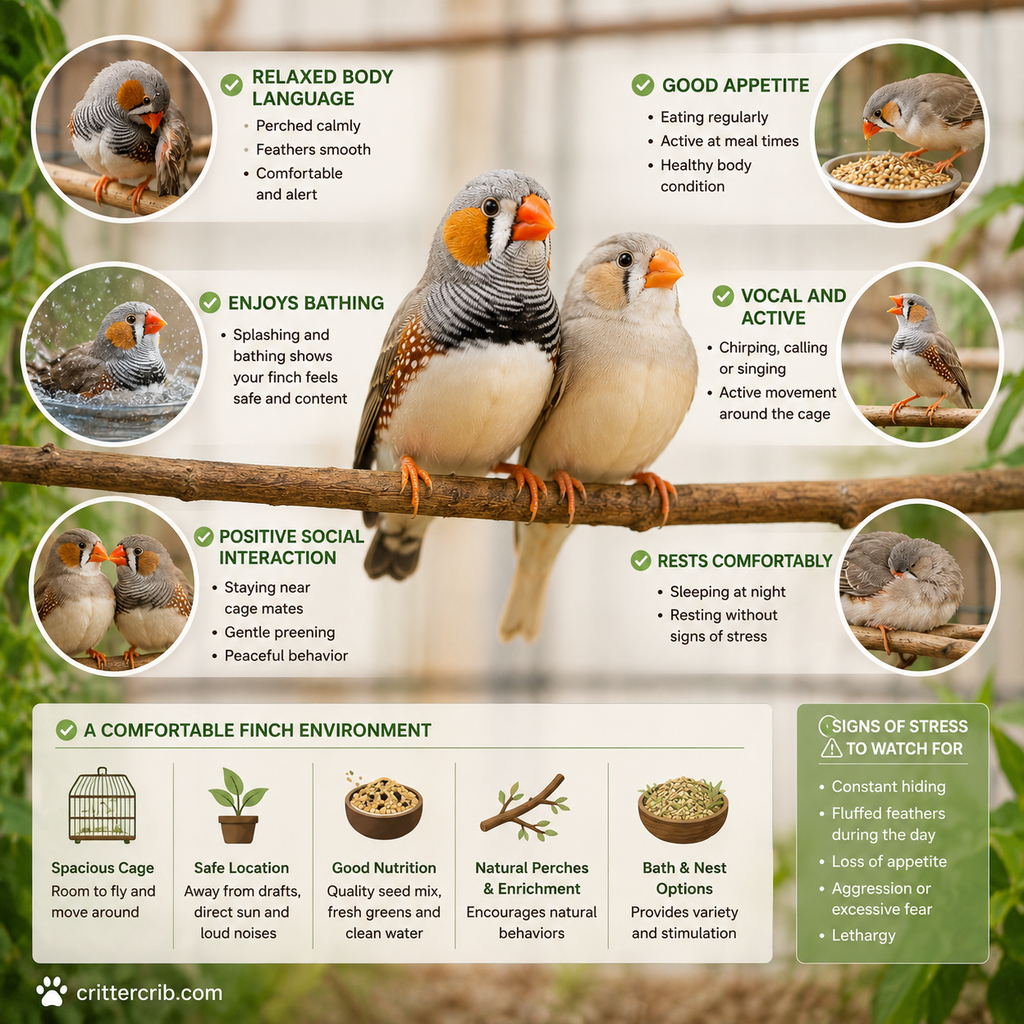
Finch body language can be subtle.
A comfortable bird generally looks alert without appearing constantly tense.
You might see your finch:
- Standing normally on a perch
- Looking around curiously
- Preening
- Stretching its wings or legs
- Resting comfortably
- Moving confidently around the cage
- Interacting calmly with companions
You may also see brief feather fluffing when a finch relaxes or prepares to sleep.
That’s normal.
Persistent fluffing throughout the day is different and can be associated with illness or discomfort.
Stretching Can Be a Positive Sign
Birds commonly stretch after resting.
A finch may extend one wing and one leg on the same side, hold the position briefly, and then repeat it on the other side.
You might also see a full-body stretch or quick feather shake.
These are normal behaviors.
They’re especially reassuring when the bird returns immediately to eating, flying, chirping, or exploring afterward.
Comfortable Finches Rest During the Day
Being active doesn’t mean a finch needs to move every second.
Healthy birds take breaks.
Your finch might sit quietly on a favorite perch, preen for a while, or take a short daytime rest.
A relaxed bird may occasionally stand on one foot while resting.
The difference between normal resting and concerning lethargy is usually found in the rest of the bird’s behavior.
A resting finch should eventually return to normal activity.
A lethargic bird may remain inactive for extended periods and show little interest in food, companions, or its surroundings.
Finches Need Proper Sleep
Good sleep is an important part of keeping finches comfortable.
Most pet finches benefit from a consistent day-and-night schedule with a quiet, dark period at night.
A bird that doesn’t get enough uninterrupted sleep may become stressed or behave differently.
Try to keep nighttime disturbances to a minimum.
Avoid placing the cage somewhere that’s bright, loud, or constantly active late into the night.
A predictable daily routine can help your birds settle naturally when evening arrives.
Social Interaction Is Important for Finches
Most commonly kept pet finches are social birds.
Unlike some companion parrots that can form very close one-on-one relationships with people, finches usually benefit greatly from the company of other compatible finches.
Happy social behavior may include:
- Sitting near each other
- Calling back and forth
- Moving around the cage together
- Mutual preening
- Eating near one another
- Resting close together
- Engaging in courtship behavior
Not every pair will constantly sit side by side.
Some birds are more independent.
What you’re looking for is a generally peaceful social environment.
How to Tell if Finches Are Fighting
Not every interaction between finches is friendly.
Brief disagreements can happen, particularly over favorite perches or food.
Persistent aggression is different.
Watch for:
- Repeated chasing
- Aggressive pecking
- Feather pulling
- One bird constantly fleeing
- Blocking access to food or water
- Preventing another bird from resting
- Injuries
- One bird hiding for long periods
A bird that is constantly being bullied isn’t living in a comfortable environment.
You may need additional cage space, more feeding stations, different cage arrangements, or separation depending on the situation.
If you’re uncertain whether behavior is normal, speak with an avian veterinarian or someone experienced with the particular finch species you keep.
A Spacious Cage Helps Finches Feel Secure
Finches need room to fly.
They’re not birds that should spend most of their lives climbing around a tiny decorative cage.
Horizontal space is particularly valuable because it allows them to make short flights between perches.
A good cage should provide enough room for:
- Flying
- Multiple perches
- Food and water
- Bathing
- Social interaction
- Resting areas
- Appropriate enrichment
Don’t overcrowd the cage with accessories.
A cage filled with toys may look entertaining to us, but finches still need clear flight paths.
Cage Placement Can Affect Finch Comfort
Where you put the cage matters.
Finches generally appreciate being somewhere they can observe normal household activity without being surrounded by constant chaos.
Avoid placing the cage:
- Directly in front of heating vents
- Under air-conditioning vents
- In strong drafts
- In intense direct sunlight
- In a constantly noisy location
- Near cooking fumes
- Where other pets can stalk the birds
Many birds feel more secure when at least part of the cage is positioned near a wall rather than completely exposed from every direction.
The goal is to provide both stimulation and security.
Your Finches Should Feel Safe Around You
Your finches don’t need to sit on your finger to trust you.
In fact, many finches prefer not to be handled at all.
A better sign of trust is that they continue behaving normally when you’re nearby.
For example, your birds may:
- Eat while you’re standing near the cage
- Chirp in your presence
- Bathe while you’re nearby
- Continue preening when you approach
- Watch you without panicking
- Approach the front of the cage
These behaviors suggest they’ve learned that you’re part of their normal environment rather than a threat.
Avoid chasing or grabbing finches unless handling is necessary.
What Does a Stressed Finch Look Like?
Learning the signs of stress is just as important as recognizing happy behavior.
Possible signs of stress include:
- Frantic flying
- Repeated attempts to escape
- Constant hiding
- Excessive aggression
- Feather damaging behavior
- Reduced vocalization
- Changes in eating
- Unusual fearfulness
- Repetitive behaviors
- Difficulty settling down
- Frequent alarm calls
Stress can have many causes.
A new cage, another bird, loud noises, frequent handling, predators outside a window, other household pets, poor cage placement, overcrowding, or an unpredictable environment can all contribute.
Look at the entire situation rather than focusing on one behavior.
Signs That Could Indicate Illness
One of the challenges of caring for birds is that they often hide illness.
In the wild, visibly weak animals can attract predators, so birds may continue appearing relatively normal during the early stages of a health problem.
By the time symptoms become obvious, the bird may already be quite sick.
Contact an avian veterinarian if you notice concerning changes such as:
- Persistent feather fluffing
- Sitting at the bottom of the cage
- Significant decrease in activity
- Loss of appetite
- Weight loss
- Changes in droppings
- Difficulty perching
- Open-mouth breathing
- Noticeable tail bobbing while breathing
- Discharge around the eyes or nostrils
- Weakness
- Sudden major behavioral changes
Don’t assume that a quiet bird is simply “sad” or that a fluffed bird is just cold.
Behavioral changes can sometimes be the first visible sign of a medical problem.
Monitor Droppings as Part of Daily Care
Checking droppings isn’t particularly glamorous, but it’s useful.
Once you become familiar with what’s normal for your finches, significant changes may alert you to a problem.
Droppings can vary somewhat depending on diet and hydration.
You’re primarily looking for persistent changes in:
- Amount
- Frequency
- Color
- Consistency
- Liquid content
A single unusual dropping doesn’t necessarily indicate illness.
Repeated abnormalities combined with changes in appetite, activity, or behavior deserve more attention.
Watch for Normal Feather Condition
Healthy feathers should generally appear smooth and well maintained outside of normal molting periods.
Finches naturally molt and replace feathers, so temporary changes in appearance can be normal.
However, investigate:
- Bald patches
- Broken feathers
- Excessive feather loss
- Feather plucking
- Damage caused by cage mates
- Persistently dirty feathers
Feather condition can reflect grooming, nutrition, social problems, environmental conditions, parasites, or health issues.
Give Your Finches Enrichment
Finches don’t need the same type of intensive human interaction that many parrots require, but they still benefit from an interesting environment.
Depending on the species, enrichment might include:
- Natural bird-safe perches
- Opportunities to forage
- Safe greenery
- Bathing
- Appropriate nesting materials when suitable
- Space to fly
- Social interaction with compatible birds
- Occasional changes to the environment
Don’t change everything at once.
Finches can be cautious about unfamiliar objects.
Introduce new items gradually and observe how the birds react.
Maintain a Predictable Routine
Finches often become comfortable with routines.
They learn when food appears, when lights go off, when the cage is cleaned, and when people normally enter the room.
You don’t have to run your household according to a minute-by-minute bird schedule.
Simply keeping major parts of the day reasonably predictable can reduce unnecessary stress.
Try to maintain consistency with:
- Feeding
- Lighting
- Sleep
- Cleaning
- Bathing opportunities
- General household activity
Predictability helps birds understand what happens next.
Changes Can Temporarily Affect Behavior
Don’t panic if your finches seem quieter immediately after something changes.
Moving to a new home, changing cages, adding a companion, rearranging perches, or even moving the cage across the room can temporarily alter behavior.
Give the birds time to adjust.
Continue monitoring eating, drinking, droppings, activity, and breathing.
If the change is severe, lasts longer than expected, or comes with signs of illness, contact an avian veterinarian.
Create a Daily Finch Happiness Checklist
You don’t need to formally record every movement your birds make.
A quick daily check can help you notice problems early.
Ask yourself:
- Are my finches eating normally?
- Are they drinking?
- Are they active during their usual active periods?
- Are they vocalizing normally?
- Are their droppings generally normal?
- Are they preening and maintaining their feathers?
- Are they interacting peacefully?
- Are they breathing normally?
- Are they moving and perching normally?
- Is anything noticeably different from yesterday?
The final question is particularly important.
You know your birds’ routines better than anyone else.
A change that seems insignificant to another person may immediately stand out to you.
Don’t Expect Finches to Behave Like Parrots
This is one of the biggest misconceptions new finch owners can have.
A finch doesn’t have to seek human attention to be happy.
It doesn’t need to sit on your shoulder, accept head scratches, learn words, or play directly with you.
Many finches are happiest when they’re able to fly, socialize with compatible birds, eat, bathe, sing, and observe their environment without excessive interference.
Their independence is part of their appeal.
Learning to appreciate finches on their own terms makes it much easier to recognize when they’re thriving.
Frequently Asked Questions About Happy Finches
How Can I Tell if My Finch Likes Me?
A finch that feels safe around you may continue eating, chirping, preening, and behaving normally when you approach.
Some may become curious and move closer to you, but they don’t need to seek physical contact to trust you.
Do Finches Sing When They’re Happy?
Singing and vocalizing can be associated with normal, comfortable behavior, but singing alone isn’t a perfect measure of happiness.
Species, sex, age, season, and individual personality all influence how vocal a finch is.
Why Are My Finches Suddenly Quiet?
Finches may temporarily become quiet because they’re resting, molting, adjusting to a change, frightened, or responding to something in their environment.
Sudden quietness combined with lethargy, loss of appetite, persistent fluffing, or other unusual behavior can indicate illness and should be taken seriously.
Is It Normal for Finches to Sit Together?
Yes. Compatible social finches often sit near each other and may rest, communicate, or preen together.
However, individual behavior varies, and not every healthy pair will constantly sit side by side.
Why Is My Finch Fluffed Up?
Brief feather fluffing during preening, resting, or sleeping is normal.
A finch that remains fluffed up for extended periods during the day, especially while appearing sleepy or inactive, may be cold, stressed, or sick.
Persistent fluffing should be evaluated alongside other symptoms.
Do Finches Get Lonely?
Many commonly kept finch species are highly social and benefit from compatible bird companionship.
A finch’s social requirements depend somewhat on its species, but keeping social finches completely isolated can negatively affect their quality of life.
Do Finches Like Their Owners?
Finches can become accustomed to their caregivers and learn that they’re safe.
Their relationship with people is generally different from that of companion parrots. A finch may show trust simply by remaining relaxed and continuing its normal activities while you’re nearby.
How Do I Make My Finches Happier?
Start with the fundamentals: appropriate companionship, enough space to fly, a nutritious diet, clean water, proper lighting and sleep, safe perches, bathing opportunities, enrichment, a clean cage, and a calm environment.
You don’t need to constantly entertain your finches. Giving them opportunities to perform natural behaviors is often more valuable.
Final Thoughts
Learning how to tell if your finches are happy and comfortable comes down to knowing what normal life looks like for your birds.
Happy, healthy finches are generally active, alert, curious, and engaged with their surroundings. They eat regularly, maintain their feathers, vocalize according to their normal habits, rest comfortably, and interact appropriately with compatible companions.
You don’t need your finches to become hand-tame to know they trust you.
If they comfortably eat, sing, bathe, preen, and socialize while you’re nearby, that’s meaningful. It shows they’ve learned that their environment—and the people in it—is safe.
Pay particular attention to changes.
A finch that’s normally active but suddenly becomes quiet, fluffed up, uninterested in food, or reluctant to move may be telling you something important.
The better you know your birds when they’re healthy and comfortable, the easier it becomes to recognize when something is wrong.
Give your finches space to fly, compatible companionship, good nutrition, clean surroundings, enrichment, plenty of rest, and a predictable environment. Then spend some time simply watching them.
Finches may be small and subtle, but once you learn their routines, they have plenty to say without ever needing to sit on your shoulder.