
Corydoras catfish spend much of their time close to the bottom of the aquarium, searching through the substrate for bits of food. That makes keeping their environment clean especially important.
The good news is that cleaning a Corydoras habitat doesn’t mean tearing the aquarium apart every week.
In fact, aggressive cleaning can do more harm than good. A healthy aquarium depends on beneficial bacteria living throughout the system, especially in the filter media and substrate. Completely replacing the water, scrubbing everything spotless, or changing all the filter media at once can disrupt that biological balance.
A better approach is regular, gentle maintenance.
For many established Corydoras aquariums, that means performing partial water changes, removing accumulated waste from the substrate, maintaining the filter when needed, and regularly checking water quality.
Here’s how to build a safe cleaning routine that keeps the aquarium clean without constantly disturbing your Corydoras.
Why Corydoras Tank Cleaning Matters
Corydoras are bottom-dwelling fish.
They’re often seen moving along the substrate, using their sensitive barbels to investigate sand, gravel, plants, and other surfaces for food.
Because they spend so much time at the bottom, accumulated debris matters.
Uneaten food, fish waste, decaying plant material, and other organic matter can settle into the substrate. If too much accumulates, it can contribute to deteriorating water quality.
Regular maintenance helps control:
- Fish waste
- Uneaten food
- Decaying plant material
- Excess algae
- Nitrate accumulation
- Organic debris
- Clogged filter media
Cleaning also gives you an opportunity to inspect the aquarium and notice problems before they become more serious.
How Often Should You Clean a Corydoras Tank?
For many established aquariums, weekly maintenance is a practical starting point.
That doesn’t mean completely cleaning the tank every seven days.
A typical weekly routine might include:
- Testing important water parameters
- Changing approximately 20–30% of the water
- Removing visible debris from the substrate
- Cleaning the aquarium glass when necessary
- Inspecting plants and decorations
- Checking the filter and heater
- Observing the fish
The exact schedule depends on your aquarium.
A lightly stocked, heavily planted tank may behave differently from an aquarium containing a large group of fish that are fed frequently.
Water testing should help determine whether your routine is working.
What Water Parameters Should You Check?
Before focusing on how clean the aquarium looks, consider what’s happening in the water.
Clear water isn’t automatically healthy water.
Important parameters to monitor include:
- Ammonia
- Nitrite
- Nitrate
- pH
- Temperature
In a properly cycled aquarium, ammonia and nitrite should generally remain at 0 ppm.
Nitrate gradually accumulates and is controlled through water changes, plant growth, and appropriate stocking and feeding.
Corydoras species have somewhat different preferences depending on where they originate, so research the requirements of the specific species you’re keeping.
Stable conditions are generally more important than constantly trying to manipulate the water to reach a supposedly perfect number.
What You’ll Need to Clean a Corydoras Aquarium
You don’t need an enormous collection of aquarium-cleaning equipment.
A basic maintenance kit can include:
- Aquarium siphon or gravel vacuum
- Dedicated aquarium bucket
- Water conditioner
- Water-testing kit
- Algae scraper or aquarium-safe cleaning pad
- Clean towels
- Small aquarium brush
- Thermometer
- Optional long aquarium tweezers or plant scissors
Keep aquarium equipment separate from household cleaning supplies.
Never use a bucket that previously contained soap, detergent, bleach, household cleaners, or other potentially harmful chemicals unless you know it has been made completely safe for aquarium use.
The simplest approach is to dedicate a bucket exclusively to aquarium maintenance.
Should You Remove Corydoras While Cleaning the Tank?
Usually, no.
For routine maintenance, Corydoras can normally remain in the aquarium.
Catching them every week would create unnecessary stress and carries some risk of injury.
Instead, move slowly while cleaning.
Corydoras may initially swim away from the siphon, although curious individuals sometimes investigate whatever you’re doing.
Pay attention to where the fish are before moving equipment around the substrate.
Never allow the siphon to pull in a fish.
Young Corydoras are particularly small, so extra caution is necessary if fry are present.
How to Clean a Corydoras Tank Step by Step
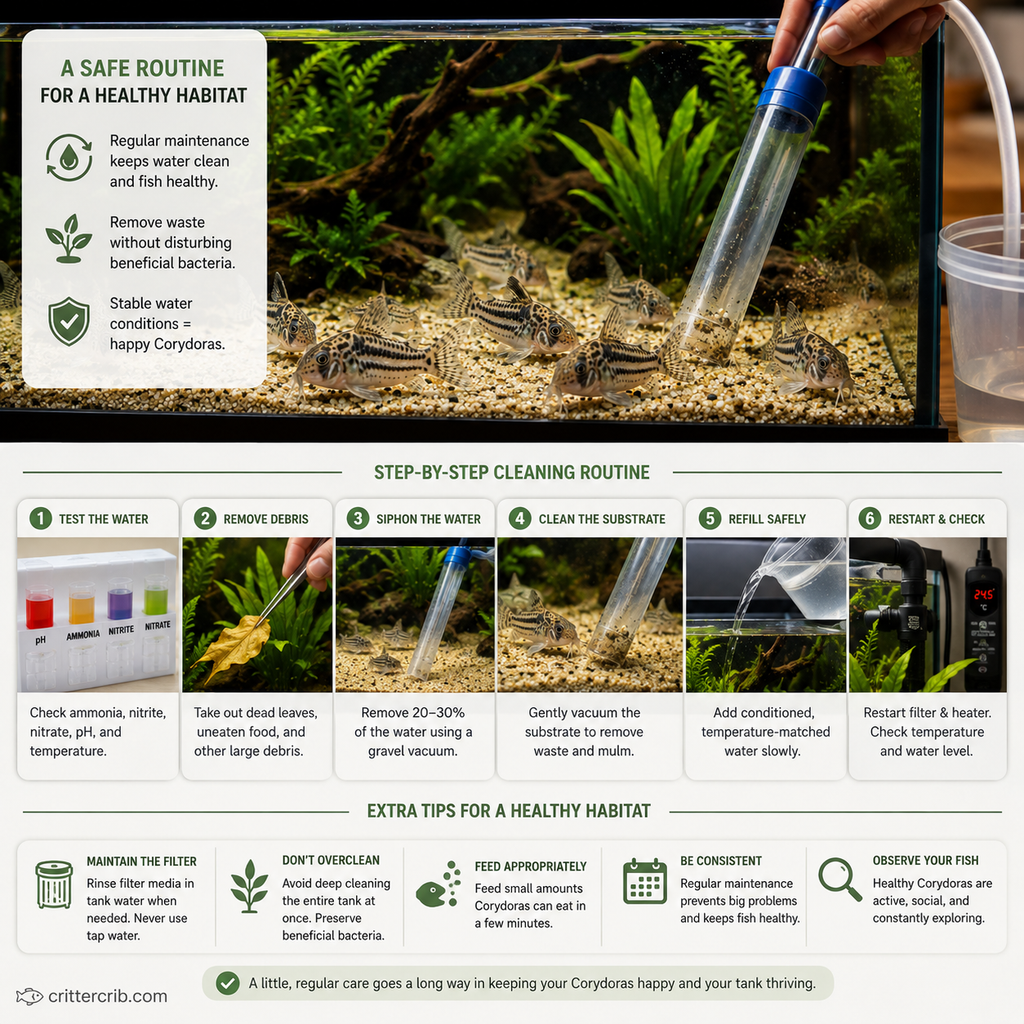
A regular cleaning doesn’t need to be complicated.
The goal is to remove excess waste while preserving the aquarium’s biological stability.
1. Observe Your Corydoras Before You Start
Spend a minute looking at the fish before disturbing the aquarium.
Are they behaving normally?
Check for:
- Normal swimming
- Normal breathing
- Healthy-looking barbels
- Normal appetite
- Fin condition
- Unusual spots or injuries
- Lethargy
- Rapid breathing
This gives you a baseline before maintenance begins.
If the fish are already acting strangely, test the water before assuming the aquarium simply needs routine cleaning.
2. Test the Aquarium Water
Testing before the water change can tell you how well your current maintenance schedule is controlling waste.
At minimum, periodically monitor ammonia, nitrite, and nitrate.
If ammonia or nitrite is detectable in an established aquarium, investigate the cause.
Potential problems can include:
- Overfeeding
- Too many fish
- A disrupted biological filter
- A dead fish or other decaying material
- Insufficient filtration
- Improper filter cleaning
Don’t simply perform a water change and forget about an ongoing ammonia or nitrite problem.
Find the underlying cause.
3. Turn Off Equipment When Necessary
Before lowering the aquarium’s water level, determine whether the heater and filter need to be switched off.
Many aquarium heaters shouldn’t operate while partially exposed to air.
Some filters may also run dry or lose their prime when the water level drops.
Follow the manufacturer’s instructions for your specific equipment.
If you unplug anything, make sure you remember to restart it when maintenance is finished.
4. Remove Dead Leaves and Large Debris
Before siphoning, remove obvious debris such as:
- Dead plant leaves
- Large pieces of uneaten food
- Detached plant material
- Other visible waste
This prevents larger debris from breaking apart and spreading through the aquarium while you’re cleaning.
5. Siphon Out a Portion of the Water
Use an aquarium siphon to remove approximately 20–30% of the water as a general starting point.
You may need more or less depending on water-test results and the aquarium’s maintenance needs.
Avoid routinely draining the entire tank.
Corydoras benefit from stable water conditions, and enormous unnecessary changes can produce sudden shifts in temperature or chemistry.
Partial water changes are generally much gentler.
6. Clean the Substrate While Siphoning
This is particularly important in a Corydoras aquarium because these fish spend so much time on the bottom.
How you clean depends partly on the substrate.
How to Clean Sand in a Corydoras Tank
Sand is a popular substrate for Corydoras.
Their natural feeding behavior involves searching through soft substrate, and fine aquarium sand allows them to sift through it with their barbels.
Fortunately, much of the waste in a sand aquarium tends to collect on or near the surface.
You usually don’t need to plunge the siphon deeply into the sand.
Instead:
- Hold the siphon slightly above the surface.
- Move it slowly over areas containing visible debris.
- Allow lightweight waste to be pulled upward.
- Avoid sucking large amounts of sand into the siphon.
- Work in sections rather than disturbing the entire substrate.
If sand starts traveling up the siphon, lift the siphon slightly higher.
With practice, you can remove debris while leaving most of the substrate in place.
Should You Stir Corydoras Sand?
Gentle maintenance of the upper layer can help prevent debris from becoming trapped.
However, don’t aggressively churn the entire substrate every week.
Plants, fish, snails, and aquarium maintenance naturally disturb portions of the surface.
If your sand bed is particularly deep, its maintenance requirements may differ, so take substrate depth and aquarium design into account.
How to Clean Gravel in a Corydoras Tank
Waste can fall between pieces of gravel, so cleaning it may require pushing the gravel vacuum slightly into the substrate.
The siphon lifts lightweight debris while heavier gravel falls back down.
Work across portions of the aquarium rather than obsessively vacuuming every square inch during every water change.
Is Gravel Safe for Corydoras?
Substrate selection matters for Corydoras because of their bottom-feeding behavior and sensitive barbels.
Smooth, appropriately sized gravel can be used in some setups, but rough or sharp substrate should be avoided.
Fine, smooth sand is often preferred because it allows Corydoras to perform their natural sifting behavior.
If you notice worn or damaged barbels, don’t assume the substrate is automatically the only cause. Poor water conditions and accumulated organic waste can also contribute to problems.
Evaluate the entire environment.
Don’t Try to Remove Every Speck of Debris
An aquarium is an ecosystem, not a surgical operating room.
You don’t need to remove every tiny particle.
Some organic material is normal in an established aquarium, especially in planted tanks.
Your goal is to prevent excessive accumulation.
Trying to make the aquarium completely sterile often leads owners to overclean filters and substrate, potentially disrupting beneficial bacteria in the process.
Clean enough to maintain healthy conditions without constantly resetting the system.
How to Clean Aquarium Decorations
Decorations can develop algae and biofilm over time.
A little algae isn’t necessarily harmful, and you don’t need to scrub decorations every week simply because they’re no longer spotless.
When cleaning is necessary, remove one or two items rather than stripping the entire aquarium.
Use:
- Removed aquarium water
- A dedicated aquarium brush
- An aquarium-safe cleaning pad
Avoid soap and household cleaners.
If algae is difficult to remove, resist the temptation to reach for whatever cleaning chemical is under the kitchen sink.
Anything returned to the aquarium needs to be fish-safe.
How to Clean Live Plants
Live plants generally don’t need much “cleaning.”
During regular maintenance:
- Remove dead leaves
- Trim damaged growth
- Remove excessive algae when necessary
- Replant anything your fish have disturbed
- Thin plants if they become overcrowded
Some Corydoras enjoy resting underneath broad leaves and exploring planted areas.
Try to maintain a combination of cover and open substrate where the fish can forage.
How to Clean Aquarium Glass
Algae growing on the aquarium glass is mostly an appearance issue unless growth becomes excessive.
Use an aquarium-safe algae scraper, magnetic cleaner, or cleaning pad designed for aquarium use.
Be careful near the substrate.
Small pieces of sand or gravel can become trapped between a cleaning tool and the glass and potentially cause scratches.
For acrylic aquariums, use tools specifically designed for acrylic because it scratches more easily than glass.
How to Clean a Corydoras Tank Filter
Filter maintenance is one of the areas where well-intentioned aquarium owners often clean too aggressively.
Your filter doesn’t need to look brand new.
Beneficial bacteria colonize filter media and help process ammonia and nitrite.
If you replace or sterilize too much filter media at once, you can potentially reduce the aquarium’s biological filtration.
When Should You Clean the Filter?
Clean or service the filter when:
- Water flow has noticeably decreased
- Mechanical media is clogged with debris
- The manufacturer’s maintenance schedule calls for it
- You notice excessive buildup inside the filter
You don’t necessarily need to dismantle the filter during every water change.
How to Rinse Filter Media Safely
If reusable sponge or biological media becomes dirty, gently swish or squeeze it in a bucket of aquarium water you just removed during the water change.
This can remove accumulated debris without unnecessarily exposing the bacterial colony to untreated chlorinated tap water.
Avoid washing biological filter media under untreated tap water.
Should You Replace Filter Cartridges Every Month?
Not automatically.
Some filter manufacturers recommend frequent cartridge replacement, but replacing all established media at once can remove a substantial amount of beneficial bacteria.
If your filter uses disposable cartridges, consider how biological filtration is being maintained before replacing them.
Depending on the filter design, reusable sponge and dedicated biological media may provide a more stable long-term setup.
Follow the equipment manufacturer’s safety instructions while also making sure the aquarium retains adequate biological filtration.
Preparing New Water for a Corydoras Tank
Replacement water needs to be safe before it enters the aquarium.
If you’re using municipal tap water, treat it with an aquarium water conditioner appropriate for chlorine or chloramine in your water supply.
Follow the product’s dosing instructions.
Also try to match the replacement water reasonably closely to the aquarium temperature.
You don’t need laboratory-level precision, but pouring significantly colder or hotter water into the aquarium can cause unnecessary temperature changes.
How to Add Water Without Disturbing the Substrate
After cleaning, add replacement water slowly.
Pouring a bucket directly onto the substrate can create a miniature underwater sandstorm.
Instead, you can:
- Pour water slowly against the aquarium glass
- Pour onto a clean plate or shallow container
- Direct the water onto a decoration
- Use a pump or hose for controlled refilling
The goal is to avoid blasting the substrate and frightening the fish.
Restart the Filter and Heater
Once the aquarium is refilled, restart any equipment you turned off.
Check:
- Filter flow
- Heater operation
- Water temperature
- Air pump operation, if used
- Aquarium water level
It’s surprisingly easy to finish cleaning and forget that something is still unplugged.
Make equipment checks part of your routine before walking away.
Should You Do a 100% Water Change?
Under normal circumstances, no.
Routine complete water changes are unnecessary in a properly maintained aquarium.
Large, sudden changes can stress fish and destabilize conditions.
There are unusual circumstances in which very large water changes may be appropriate, such as certain emergencies or contamination events, but that’s different from routine maintenance.
For normal Corydoras care, consistent partial water changes are generally preferable.
Should You Completely Replace the Substrate?
Not as part of regular cleaning.
There’s normally no reason to throw away all the sand or gravel every few weeks or months.
Substrate contains microorganisms and contributes to the established aquarium ecosystem.
If you’re changing substrate for another reason, plan the transition carefully to avoid unnecessarily disrupting the aquarium.
Why You Should Never Use Soap in a Fish Tank
Soap, detergents, glass cleaners, disinfectants, and other household cleaning products don’t belong in an occupied aquarium.
Residues can be harmful to fish.
This applies to:
- Aquarium glass
- Decorations
- Filter components
- Buckets
- Nets
- Siphons
- Other equipment that contacts aquarium water
Use aquarium-safe cleaning methods instead.
Often, plain water, a brush, and a little elbow grease are all you need.
Cleaning Around Corydoras Barbels
The whisker-like structures around a Corydoras’ mouth are called barbels.
They help the fish explore the substrate while searching for food.
Healthy barbels are one reason substrate cleanliness deserves attention.
Accumulated organic waste and poor water conditions aren’t ideal for fish that spend much of their time with their faces against the bottom.
During daily observation, look for:
- Shortened barbels
- Redness
- Erosion
- Swelling
- Mouth injuries
If you notice problems, investigate water quality, substrate condition, cleanliness, and possible injuries.
Don’t automatically blame one factor without checking the others.
How Feeding Affects Tank Cleanliness
One of the easiest ways to keep a Corydoras habitat cleaner is to avoid putting excessive food into it.
Corydoras are sometimes incorrectly treated as aquarium janitors.
They’re not.
They need an appropriate diet just like other fish.
They may eat food that reaches the bottom, but they shouldn’t be expected to survive entirely on scraps from other tank inhabitants.
At the same time, excessive sinking food can remain in the substrate and decompose.
Feed an appropriate amount and observe whether the food is actually being consumed.
Remove substantial leftovers when necessary.
Corydoras Are Not a Substitute for Cleaning
Another common misconception is that bottom-dwelling fish keep an aquarium clean.
Corydoras forage for edible material.
They don’t remove fish waste from the aquarium, clean the filter, or make water changes unnecessary.
In fact, Corydoras themselves produce waste.
Adding them to an aquarium increases the biological load rather than reducing it.
Think of Corydoras as pets, not cleaning equipment.
A Simple Weekly Corydoras Cleaning Routine
Once the aquarium is established, maintenance can become fairly straightforward.
A typical weekly routine might look like this:
Before the Water Change
- Observe the fish
- Check the temperature
- Test water parameters as appropriate
- Inspect the filter
- Look for uneaten food or debris
During the Water Change
- Turn off equipment if necessary
- Remove dead plant material
- Siphon roughly 20–30% of the water
- Vacuum visible substrate debris
- Clean algae from the glass when needed
- Trim plants if necessary
While Refilling
- Condition tap water
- Match the temperature reasonably closely
- Add replacement water slowly
- Avoid disturbing the substrate
After the Water Change
- Restart the heater and filter
- Verify normal filter flow
- Check the temperature
- Observe your Corydoras
- Make sure no fish were injured or trapped during maintenance
The whole process becomes much quicker once you’ve established a routine.
Monthly and Occasional Maintenance
Not every aquarium task needs to happen weekly.
Periodically, you may need to:
- Clean filter sponges
- Inspect filter tubing
- Remove buildup from equipment
- Trim plants more heavily
- Check heater condition
- Inspect air stones and tubing
- Clean decorations
- Check the aquarium lid
- Inspect cords and electrical equipment
Avoid scheduling every major cleaning task for the same day.
Spreading maintenance out can help prevent excessive disruption to the aquarium ecosystem.
Common Corydoras Tank Cleaning Mistakes
A few maintenance habits cause more problems than they solve.
Cleaning Everything at Once
Avoid simultaneously replacing all filter media, deeply cleaning all substrate, scrubbing every decoration, and performing a complete water change.
That’s unnecessary for normal maintenance.
Washing Filter Media Under Untreated Tap Water
Chlorine or chloramine can harm the beneficial bacteria you’re trying to preserve.
Rinse reusable biological media in removed aquarium water when appropriate.
Removing the Fish Every Week
Routine catching and transferring creates unnecessary stress.
Leave Corydoras in the aquarium during normal water changes.
Overcleaning the Substrate
Remove accumulated waste without trying to sterilize the entire substrate.
Using Household Cleaning Products
Never use soap, detergent, or household cleaners on equipment that will return to the aquarium unless a specific aquarium-safe procedure calls for it.
Changing Too Much Water Unnecessarily
Regular partial water changes are generally preferable to routinely draining the aquarium completely.
Forgetting to Restart Equipment
Always check the heater and filter after refilling.
Overfeeding After Cleaning
Your fish don’t need a bonus meal because the aquarium is clean.
Resume the normal feeding routine.
Signs Your Corydoras Habitat Needs More Frequent Maintenance
Your current routine may need adjustment if you regularly notice:
- Rapid nitrate accumulation
- Large amounts of substrate debris
- Persistent cloudy water
- Excessive uneaten food
- Clogged filter media
- Strong unpleasant odors
- Poor fish behavior
- Detectable ammonia or nitrite
Rather than simply cleaning harder, determine why the aquarium is becoming dirty so quickly.
Possible causes include overfeeding, overcrowding, inadequate filtration, insufficient water changes, or decaying organic material.
Addressing the source is more effective than constantly treating the symptom.
Can You Clean a Corydoras Tank Too Much?
Yes.
Aquarium maintenance is about balance.
You need to remove excess waste and maintain good water quality, but an established aquarium isn’t supposed to be sterile.
Beneficial microorganisms are part of a functioning aquatic ecosystem.
Excessive cleaning can disturb those populations and create unnecessary environmental changes.
The ideal aquarium isn’t spotless.
It’s stable.
Corydoras Tank Cleaning FAQ
How Often Should I Clean a Corydoras Tank?
For many established aquariums, weekly partial water changes and substrate maintenance are a good starting point.
Adjust the schedule based on stocking, feeding, filtration, and water-test results.
How Much Water Should I Change?
A partial change of approximately 20–30% weekly works as a general starting point for many aquariums.
Your actual needs may differ based on nitrate accumulation and overall water quality.
Should I Remove Corydoras During a Water Change?
Usually not.
Corydoras can generally remain in the aquarium during routine maintenance. Move the siphon carefully and watch where the fish are while cleaning.
Is Sand Better Than Gravel for Corydoras?
Fine, smooth sand is widely preferred because it allows Corydoras to sift through the substrate naturally.
Smooth gravel can work in some setups, but avoid rough or sharp material that could potentially contribute to injury.
How Do I Vacuum Sand Without Removing It?
Hold the siphon slightly above the sand and allow lightweight debris to rise into the vacuum.
If sand begins traveling too far up the siphon, raise it slightly.
Should I Clean Corydoras Poop From the Substrate?
Remove excessive visible waste during regular substrate maintenance.
You don’t need to chase every individual particle around the aquarium.
Can Corydoras Keep the Bottom of the Tank Clean?
No.
Corydoras search for edible food on the bottom, but they don’t remove fish waste or replace the need for aquarium maintenance.
How Often Should I Clean the Filter?
Clean the filter when flow decreases, media becomes clogged, or maintenance is otherwise necessary.
You generally don’t need to thoroughly clean biological filter media every week.
Can I Wash Aquarium Decorations With Soap?
No.
Avoid soap and household cleaning products on aquarium decorations and equipment. Use aquarium-safe cleaning methods instead.
Why Does My Corydoras Tank Get Dirty So Quickly?
Common causes include overfeeding, overcrowding, insufficient filtration, excessive organic debris, or an inadequate maintenance schedule.
Water testing and careful observation can help identify the cause.
Should I Change All the Water if the Tank Is Dirty?
Usually not.
A dirty aquarium is better addressed through appropriate partial water changes, substrate cleaning, filtration, and correcting the cause of excessive waste.
Final Thoughts on Cleaning a Corydoras Habitat
Keeping a Corydoras aquarium clean isn’t about making everything look brand new.
It’s about maintaining stable, healthy water while preventing excessive waste from accumulating where these bottom-dwelling fish spend most of their time.
For many aquariums, a simple routine works well: perform regular partial water changes, siphon debris from the substrate, remove dead plant material, clean the glass when necessary, and service the filter only when it actually needs attention.
Most importantly, don’t overdo it.
You don’t need to remove your Corydoras, replace all the water, throw away the substrate, or scrub every surface each week. Those aggressive cleaning habits can create more disruption than a little harmless debris ever would.
Keep an eye on your water parameters and watch your fish.
If ammonia and nitrite remain at zero, nitrate is being controlled, the substrate isn’t accumulating excessive waste, and your Corydoras are active and behaving normally, your maintenance routine is probably doing its job.
Consistency beats deep cleaning.
A little careful maintenance each week is usually much better for Corydoras than periodically tearing their entire habitat apart.