Millipedes aren’t exactly expressive pets. They won’t greet you when you walk into the room, wag a tail, or make a sound when they want something.
That can leave new keepers wondering: how do you tell if a millipede is happy?
With millipedes, “happy” is really shorthand for comfortable, healthy, and behaving normally. You can’t measure a millipede’s emotions the way you might interpret a dog or cat, but you can look for signs that its basic needs are being met.
A comfortable millipede will generally eat, explore, burrow, rest, and molt without constantly trying to escape unsuitable conditions. The enclosure itself can also tell you a lot.
Here’s what to watch for.
What Does a Happy Millipede Look Like?
There isn’t one behavior that proves a millipede is happy.
Instead, look at the overall pattern.
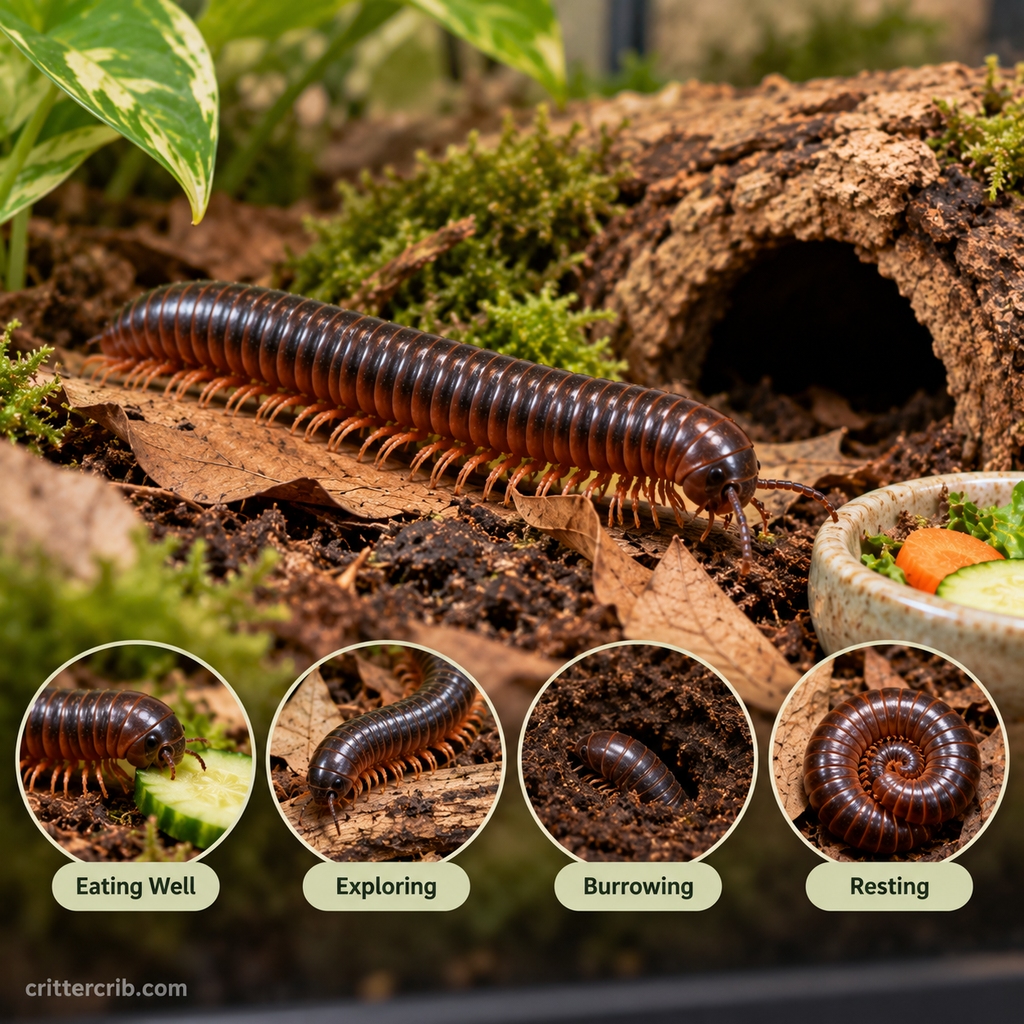
Signs that a pet millipede is likely comfortable include:
- Regular feeding
- Normal exploration
- Burrowing into the substrate
- Resting beneath hides or leaf litter
- Smooth, coordinated movement
- Normal antenna movement
- A healthy-looking exoskeleton
- Successful molts
- Periods of activity followed by periods of hiding
- No persistent attempts to escape the enclosure
Don’t worry if you don’t see all of these behaviors every day.
Millipedes can spend surprisingly long periods underground, particularly when preparing to molt. A millipede disappearing into the substrate doesn’t automatically mean something is wrong.
Your Millipede Is Eating Regularly
Eating is one useful sign that your millipede is functioning normally.
Depending on the species, much of a millipede’s diet consists of decomposing plant material. In captivity, the substrate itself can be an important source of food when it contains suitable decaying organic matter.
Leaf litter and decaying hardwood are staples for many commonly kept species.
Supplemental foods may include small amounts of:
- Squash
- Cucumber
- Carrot
- Sweet potato
- Zucchini
- Mushroom
- Other appropriate vegetables and occasional fruits
Don’t judge your millipede’s health solely by whether you see it eating from a food dish.
It may be consuming decomposing leaves, wood, and other organic material throughout the enclosure when you aren’t watching.
Food can also disappear slowly because millipedes don’t necessarily eat large quantities at once.
Exploring Is Usually a Good Sign
A comfortable millipede may wander around its enclosure, particularly during its more active periods.
You might see it:
- Walking across the substrate
- Climbing over pieces of bark
- Investigating food
- Moving its antennae as it explores
- Traveling around the enclosure after dark
- Moving between moist and drier areas
Many millipedes are more active at night, so an enclosure that seems quiet during the day may become surprisingly busy after the lights go out.
Normal exploration should look deliberate and coordinated.
Persistent frantic movement is different. If your millipede spends long periods repeatedly climbing the walls or searching the perimeter, check the enclosure conditions.
Burrowing Is Normal Millipede Behavior
One of the easiest mistakes new keepers make is assuming a hidden millipede must be unhappy.
Usually, that’s not true.
Burrowing is a completely natural part of millipede behavior.
Millipedes may burrow to:
- Rest
- Find suitable moisture
- Avoid light
- Feel secure
- Feed within the substrate
- Prepare for molting
- Regulate their exposure to environmental conditions
Some individuals spend much more time underground than others.
This is why deep, suitable substrate is so important. The substrate isn’t merely flooring for a millipede enclosure. It’s part shelter, part feeding area, and part molting environment.
If your millipede disappears underground, don’t immediately dig it up.
A Millipede That Hides Isn’t Necessarily Unhappy
Along with burrowing, millipedes naturally seek cover.
Cork bark, decaying wood, leaf litter, and other safe hiding places allow them to retreat from light and disturbance.
A good enclosure should give your millipede the option to be invisible.
It might sound strange to design a pet enclosure specifically so you can’t always see the pet, but that’s part of responsible millipede keeping.
An animal shouldn’t have to remain exposed simply for our convenience.
If your millipede spends the day beneath a hide and emerges later to explore or feed, that’s generally normal behavior.
Healthy Millipede Movement
Watch how your millipede moves when it’s active.
A healthy millipede typically moves with a coordinated wave-like motion as its many legs work together.
Its antennae may sweep around as it explores the environment.
You shouldn’t expect constant activity, but when the millipede does move, look for smooth and purposeful locomotion.
Potential reasons for concern include:
- Persistent inability to coordinate its legs
- Repeatedly falling over without recovering
- Severe weakness
- Obvious injuries
- Legs that aren’t functioning normally across large areas of the body
A brief period of stillness isn’t necessarily a problem. Millipedes rest too.
Look at the overall behavior rather than interpreting a single moment.
A Healthy Exoskeleton Is Another Good Sign
A millipede’s exoskeleton should generally appear intact and appropriate for its species.
Exact coloration varies enormously. Depending on the species, millipedes can be dark brown, black, reddish, orange, patterned, or other colors.
Get familiar with what your particular species normally looks like.
Pay attention to significant changes such as:
- Visible wounds
- Unusual discoloration
- Damaged body segments
- Extensive leg loss
- Abnormal lesions
- A body that appears severely shriveled or dehydrated
Minor damage doesn’t always mean there’s an emergency, but substantial changes deserve closer attention.
Comfortable Millipedes Spend Time Underground
If your millipede has been underground for days, you may be tempted to check on it.
Try not to.
Extended periods underground can be completely normal, especially when a molt is approaching.
Digging through the substrate can destroy a molting chamber and potentially injure a vulnerable millipede.
As long as the enclosure conditions remain appropriate and you don’t have another reason to suspect a serious problem, patience is usually safer.
Continue maintaining the habitat without disturbing the area where the millipede has buried itself.
Successful Molting Is an Important Health Sign
Millipedes must molt as they grow.
Before molting, a millipede may become less active and retreat underground. It can remain hidden for an extended period.
During this time, the animal is vulnerable.
A millipede may construct a protected space within the substrate where it can shed its old exoskeleton and allow the new one to harden.
This is another reason proper substrate depth and moisture are so important.
Never intentionally dig up a millipede because you haven’t seen it recently.
If it is molting, disturbing it can cause serious problems.
Once the millipede eventually reappears and resumes normal activity, a successful molt is a positive sign that the environment is supporting its growth.
What Does an Uncomfortable Millipede Look Like?
Normal millipede behavior varies, so one unusual action doesn’t automatically indicate poor health.
Repeated patterns are more informative.
Possible signs that something in the enclosure needs attention include:
- Constant attempts to climb the walls
- Persistent wandering without settling
- Spending excessive time in an unusually exposed location
- Repeated attempts to escape
- Uncoordinated movement
- Significant loss of appetite combined with other symptoms
- A visibly dry or damaged body
- Remaining curled tightly for unusually long periods while exposed
- Unexplained weakness
If you notice these behaviors, start by checking husbandry.
Temperature, substrate moisture, ventilation, substrate quality, food, and enclosure cleanliness can all influence behavior.
Is Climbing the Walls a Bad Sign?
Not necessarily.
A millipede may occasionally investigate the walls or lid simply because it’s exploring.
The concern is persistent behavior.
If your millipede spends much of its active time repeatedly circling the enclosure or trying to climb out, check whether something is making the habitat uncomfortable.
Possible issues include:
- Substrate that’s too dry
- Substrate that’s excessively wet
- Inappropriate temperature
- Insufficient substrate depth
- Poor ventilation
- Lack of hiding places
- An unsuitable substrate
- Overcrowding
- Excessive disturbance
Don’t automatically change everything at once.
Check the basics first and make gradual corrections where necessary.
Curling Up Can Be Completely Normal
Millipedes are famous for curling into a spiral.
This is a defensive behavior that protects their softer underside and legs.
A millipede may curl when:
- Frightened
- Touched
- Picked up
- Disturbed
- Resting
Brief curling isn’t necessarily a sign of illness or unhappiness.
If you pick up your millipede and it immediately curls tightly, however, that’s a pretty good indication that the interaction isn’t something it’s seeking.
Place it back gently and allow it to relax.
Frequent handling isn’t necessary for a millipede to become a good pet.
Your Millipede’s Substrate Matters More Than You Might Think
If you want a comfortable millipede, start from the ground up—literally.
Millipedes spend enormous amounts of time interacting with their substrate. Many species burrow, molt, hide, and feed within it.
A suitable substrate may contain materials such as:
- Organic soil components appropriate for invertebrates
- Decaying hardwood
- Decomposed leaves
- Leaf litter
- Other species-appropriate organic material
Avoid assuming that plain decorative bedding is enough.
The substrate should be deep enough for your millipede to completely bury itself, with additional depth whenever possible.
For larger species, this can mean providing several inches of usable substrate rather than a thin layer across the bottom.
Moisture Is Essential
Millipedes require a humid microenvironment and can be vulnerable to drying out.
However, that doesn’t mean the enclosure should be waterlogged.
Aim for moist substrate appropriate for the species rather than saturated mud.
A moisture gradient can be useful because it allows the millipede to choose among slightly different conditions.
You may maintain one portion of the enclosure more moist while allowing another area to remain somewhat drier.
Watch how your millipede uses these areas.
If it consistently avoids one side of the enclosure, the conditions there may be worth checking.
Ventilation Matters Too
Moisture and ventilation need to work together.
An enclosure that’s constantly soaked with almost no airflow can become stagnant.
Proper ventilation helps maintain healthier conditions while you keep the substrate appropriately moist.
If you notice persistent heavy condensation, unpleasant odors, excessive mold growth, or waterlogged substrate, investigate rather than simply adding more moisture because millipedes “like humidity.”
The goal is a humid, biologically appropriate habitat—not a swamp.
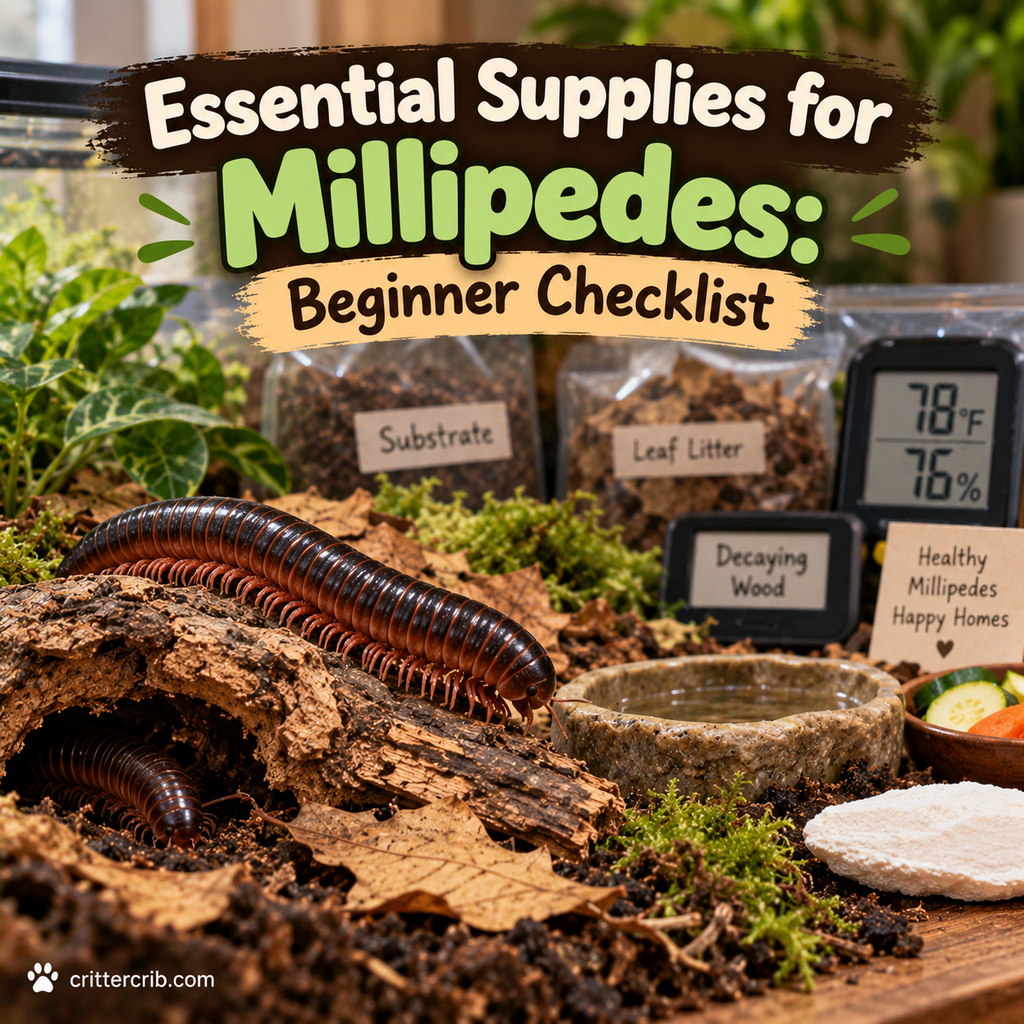
Provide Plenty of Leaf Litter
Leaf litter does several jobs at once.
It provides:
- Food
- Cover
- Moisture retention
- A natural surface to explore
- Additional habitat for beneficial microorganisms
Use suitable leaves collected from pesticide-free areas or purchased from a reliable source intended for animal enclosures.
Leaf litter will gradually break down and disappear as the enclosure inhabitants consume it.
Replenish it regularly.
For a millipede, a messy-looking forest floor can be much more useful than a perfectly tidy enclosure.
Decaying Wood Is Valuable
Many millipede species feed on decomposing wood as part of their natural diet.
The important word is decomposing.
Fresh decorative wood isn’t nutritionally equivalent to soft, decayed hardwood.
When appropriate for the species, adding rotten hardwood can help make the enclosure both more natural and more useful as a food source.
Avoid wood that may have been treated with pesticides, preservatives, paint, or other chemicals.
How Temperature Affects Millipede Comfort
Temperature requirements vary by species.
Many commonly kept tropical millipedes do well at moderate household temperatures, but you should research the needs of your particular species rather than relying on a universal number.
Avoid:
- Direct sunlight
- Sudden temperature swings
- Excessive heat
- Cold drafts
- Placing the enclosure directly beside heaters or air-conditioning vents
Stable conditions are generally preferable to constantly changing temperatures.
If supplemental heating is required, it should be carefully controlled to prevent overheating or drying the enclosure.
A Comfortable Millipede Doesn’t Need Constant Handling
Millipedes can be fascinating to hold, but they don’t require handling for socialization.
They aren’t dogs or parrots.
Handling should be gentle and occasional.
If you do handle your millipede:
- Make sure your hands are clean and free of lotions or chemical residue.
- Keep your hands low over a table or enclosure.
- Allow the millipede to walk onto you rather than pulling it from a surface.
- Never grab or squeeze its body.
- Keep the interaction brief.
- Wash your hands afterward.
Some millipedes can release defensive secretions when threatened. Depending on the species, these chemicals may irritate skin and can be particularly unpleasant if transferred to the eyes or mouth.
If your millipede repeatedly curls up or produces defensive secretions during handling, give it some space.
Signs Your Millipede Enclosure Is Working Well
Sometimes the best way to judge your millipede’s comfort is to look at the entire habitat rather than the animal itself.
A well-functioning enclosure generally has:
- Moist but not waterlogged substrate
- Appropriate ventilation
- Plenty of leaf litter
- Suitable decaying organic material
- Hiding places
- Enough substrate for burrowing
- Species-appropriate temperatures
- No persistent foul odor
- No excessive buildup of uneaten fresh food
- Normal millipede activity
You may also notice the millipede choosing different areas at different times.
That’s a good reason to provide variety rather than trying to make every inch of the enclosure identical.
Common Mistakes That Can Make Millipedes Uncomfortable
Even well-meaning keepers can accidentally create poor conditions.
Common mistakes include:
Using Substrate That’s Too Shallow
Millipedes need room to burrow, especially when molting.
Allowing the Enclosure to Dry Out
Inadequate moisture can be dangerous for millipedes.
Keeping Everything Soaked
Constantly saturated substrate and poor ventilation aren’t healthy alternatives to dryness.
Digging Up a Hidden Millipede
A buried millipede may be molting. Leave it alone unless there’s a compelling reason to intervene.
Cleaning Too Aggressively
A millipede enclosure isn’t supposed to be sterile. Decaying organic matter is part of the habitat and food supply.
Remove problematic waste and spoiled supplemental food without constantly replacing the entire substrate.
Handling Too Often
Your millipede doesn’t need regular physical interaction to “bond” with you.
Using Unsafe Materials
Avoid substrate, wood, leaves, or decorations contaminated with pesticides, fertilizers, preservatives, or other potentially harmful chemicals.
Learn Your Individual Millipede’s Routine
One of the best things you can do is simply pay attention.
After keeping your millipede for a while, you’ll start recognizing its normal routine.
Maybe it emerges shortly after the room gets dark. Perhaps it spends several nights eating beneath the same piece of bark. It might disappear underground periodically and then reappear days later.
Knowing what’s normal for your animal makes unusual behavior much easier to notice.
A change doesn’t always mean something is wrong, but it gives you a reason to check the enclosure conditions.
Frequently Asked Questions
How do I know if my millipede is happy?
You can’t directly measure whether a millipede feels happiness, but regular feeding, normal exploration, burrowing, coordinated movement, successful molts, and the absence of persistent escape behavior are good indications that its needs are being met.
Why is my millipede always hiding?
Hiding is normal. Millipedes naturally spend time beneath leaf litter, wood, and substrate. Some are also more active at night, so your millipede may be exploring while you’re asleep.
Why did my millipede bury itself?
Millipedes burrow for several reasons, including resting, feeding, maintaining moisture, avoiding light, and preparing to molt. Don’t dig it up simply because you haven’t seen it recently.
Why is my millipede curled into a ball?
Curling is a natural defensive behavior and may happen when a millipede is touched or frightened. Some millipedes also rest in a curled position.
How can I make my millipede more comfortable?
Provide deep, nutritious substrate, suitable moisture, good ventilation, leaf litter, decaying hardwood when appropriate, hiding places, suitable food, and species-appropriate temperatures. Avoid unnecessary disturbance.
Does my millipede need a friend?
Millipedes aren’t generally kept for social companionship in the same sense as social mammals or birds. Whether multiple millipedes can be housed together depends on species, enclosure size, available resources, and breeding considerations.
Is it normal for my millipede to disappear for weeks?
It can be. A millipede may remain underground for an extended period, particularly around molting. Avoid digging it up unless there’s a serious reason to believe intervention is necessary.
Should I wake my millipede up during the day?
No. Let your millipede follow its natural activity cycle. If it prefers hiding during daylight hours, provide suitable cover and observe it when it naturally becomes active.
Final Thoughts
You probably won’t ever know whether your millipede is “happy” in quite the same way you’d judge the mood of a dog or cat.
What you can determine is whether it appears healthy, comfortable, and able to behave naturally.
A millipede that eats, explores, burrows, hides, moves normally, and molts successfully is giving you several encouraging signs. Just remember that hiding is part of normal millipede life. Sometimes the best sign of a good enclosure is a millipede that feels perfectly comfortable disappearing into it.
Focus less on trying to make your millipede interact with you and more on giving it choices.
Deep substrate, plenty of leaf litter, decaying wood, appropriate moisture, good ventilation, hiding places, and stable temperatures allow your millipede to decide where it wants to be.
For such a quiet little animal, that’s one of the best ways to provide a comfortable home.