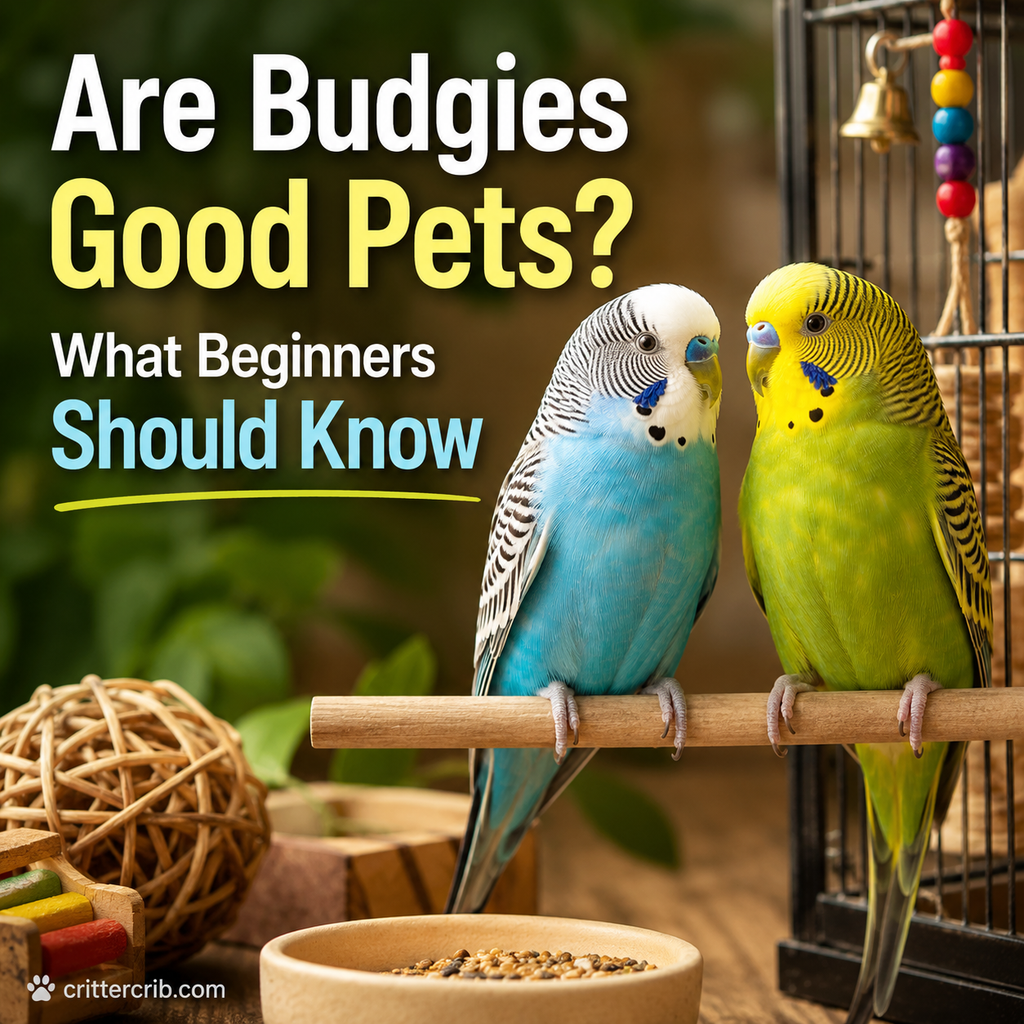
Budgies are small, colorful, social birds that have been popular pets for generations. They don’t require as much physical space as many larger parrots, they can learn to interact closely with their owners, and some even become surprisingly good talkers.
But their small size can also give people the wrong impression.
Budgies aren’t decorations that simply need a cage, food, and an occasional cleaning. They’re intelligent parrots with social, physical, and mental needs. A well-cared-for budgie can become an entertaining and affectionate companion, but keeping one happy requires daily attention and a long-term commitment.
So, are budgies good pets?
For many people, yes. Budgies can be excellent pets for beginners, provided you’re prepared for the care, interaction, cleaning, noise, and responsibility that come with owning a bird.
Here’s what you should know before bringing one home.
What Is a Budgie?
A budgie, short for budgerigar, is a small parrot native to Australia. You may also hear budgies called parakeets, particularly in the United States.
However, “parakeet” is actually a broader term used for various small and medium-sized parrots with long tail feathers. A budgie is one particular species of parakeet.
Wild budgies are primarily green and yellow, but selective breeding has produced pet budgies in many different colors, including blue, white, yellow, gray, violet, and combinations of these colors.
Despite their small size, budgies have many of the same qualities people associate with larger parrots. They’re curious, social, playful, vocal, and capable of learning.
Are Budgies Good Pets for Beginners?
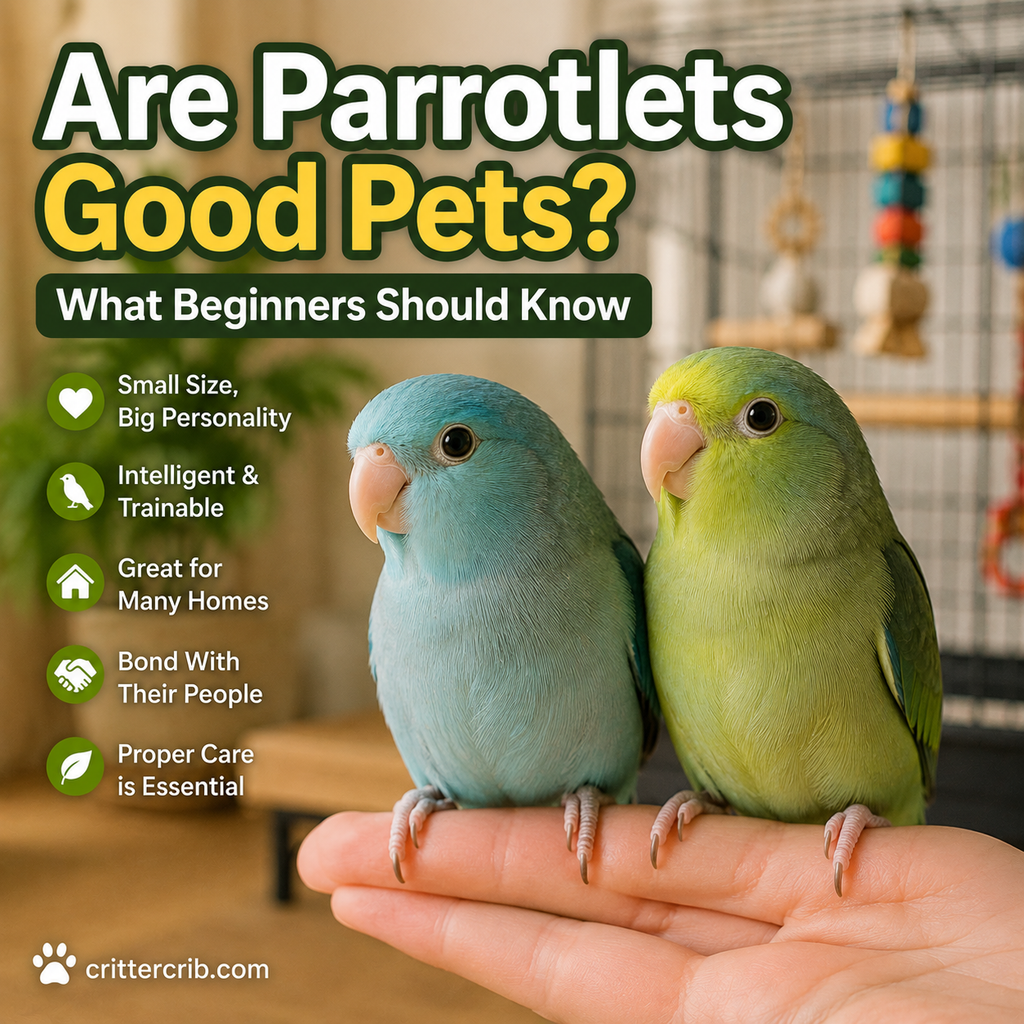
Yes, budgies are generally considered one of the better pet birds for beginners.
They’re relatively small, their care requirements are manageable compared with many larger parrots, and their personalities can be extremely engaging.
That doesn’t mean they’re effortless pets.
A beginner still needs to learn about proper nutrition, cage setup, socialization, bird-safe household practices, grooming, enrichment, and veterinary care.
Budgies are a particularly good fit for people who:
- Want an interactive pet rather than a bird they simply observe
- Can provide attention every day
- Don’t mind chirping and other bird sounds
- Have room for an appropriately sized cage
- Are willing to clean regularly
- Can provide toys and enrichment
- Are prepared to find an avian veterinarian
- Understand that owning a bird is a multi-year commitment
If you’re looking for a pet that can be left alone most of the time with minimal interaction, a budgie probably isn’t the right choice.
What Are Budgies Like as Pets?
Budgies can pack a lot of personality into a very small bird.
Individual personalities vary considerably. One budgie might quickly approach people and investigate everything nearby, while another may be cautious and need weeks or months to become comfortable.
Budgies Are Social
Budgies naturally live in social groups, so companionship is an important part of their lives.
A single budgie can form a strong relationship with its owner, but you’ll need to provide regular interaction. Someone who works long hours and leaves a single budgie alone every day should think carefully about whether another budgie would provide better companionship.
Keeping two budgies doesn’t necessarily mean they’ll never bond with you. It can simply require more patience and individual interaction when taming them.
Budgies Are Curious
A comfortable budgie will often investigate toys, perches, food, household sounds, and whatever its favorite human happens to be doing.
That curiosity is part of what makes them entertaining pets.
It also means their environment shouldn’t remain exactly the same forever. New toys, safe objects to explore, foraging opportunities, and supervised time outside the cage can help keep life interesting.
Budgies Can Be Affectionate
Budgies aren’t usually cuddly in the same way a dog or cat might be, but they can develop close relationships with people.
A tame budgie may:
- Step onto your finger
- Sit on your hand or shoulder
- Chirp when you enter the room
- Follow you around during supervised out-of-cage time
- Play with you
- Respond to your voice
- Seek your attention
Some enjoy gentle head scratches, while others prefer interaction without much touching.
Respecting your bird’s individual boundaries is an important part of building trust.
Can Budgies Talk?
Yes. Budgies are capable of learning human speech, and some become remarkably talented mimics.
They may learn individual words, phrases, whistles, household sounds, and other noises they hear regularly.
However, talking ability varies from bird to bird.
Some budgies develop surprisingly large vocabularies. Others may learn only a few sounds, and some never imitate human speech at all.
If having a talking bird is your main reason for getting a budgie, remember that there’s no guarantee your particular bird will talk.
It’s better to consider speech a fun possibility rather than an expectation.
Are Budgies Noisy?
Budgies are vocal, but they’re generally much quieter than large parrots such as cockatoos or macaws.
Typical budgie sounds include:
- Chirping
- Chattering
- Singing
- Whistling
- Contact calls
- Occasional squawks
A happy budgie may spend a significant portion of the day making noise.
Fortunately, their normal chatter is usually relatively soft. The bigger question is whether you enjoy having frequent background bird sounds in your home.
Budgies may become louder when they’re excited, calling for another bird or person, reacting to activity, or trying to get attention.
They’re not silent pets, but their volume is one reason they’re often considered more manageable than larger parrots.
Do Budgies Need a Lot of Space?
Their bodies are small, but budgies still need room to move.
One common beginner mistake is buying the smallest cage advertised for budgies.
A bird shouldn’t spend its life sitting on one perch.
Choose a cage that provides enough horizontal space for movement and allows room for multiple perches, food and water dishes, and toys without making the interior overcrowded.
Wider cages are particularly useful because budgies tend to move and fly horizontally.
Whenever possible, budgies should also receive regular supervised time outside their cage in a bird-safe room.
What Should a Budgie Cage Include?
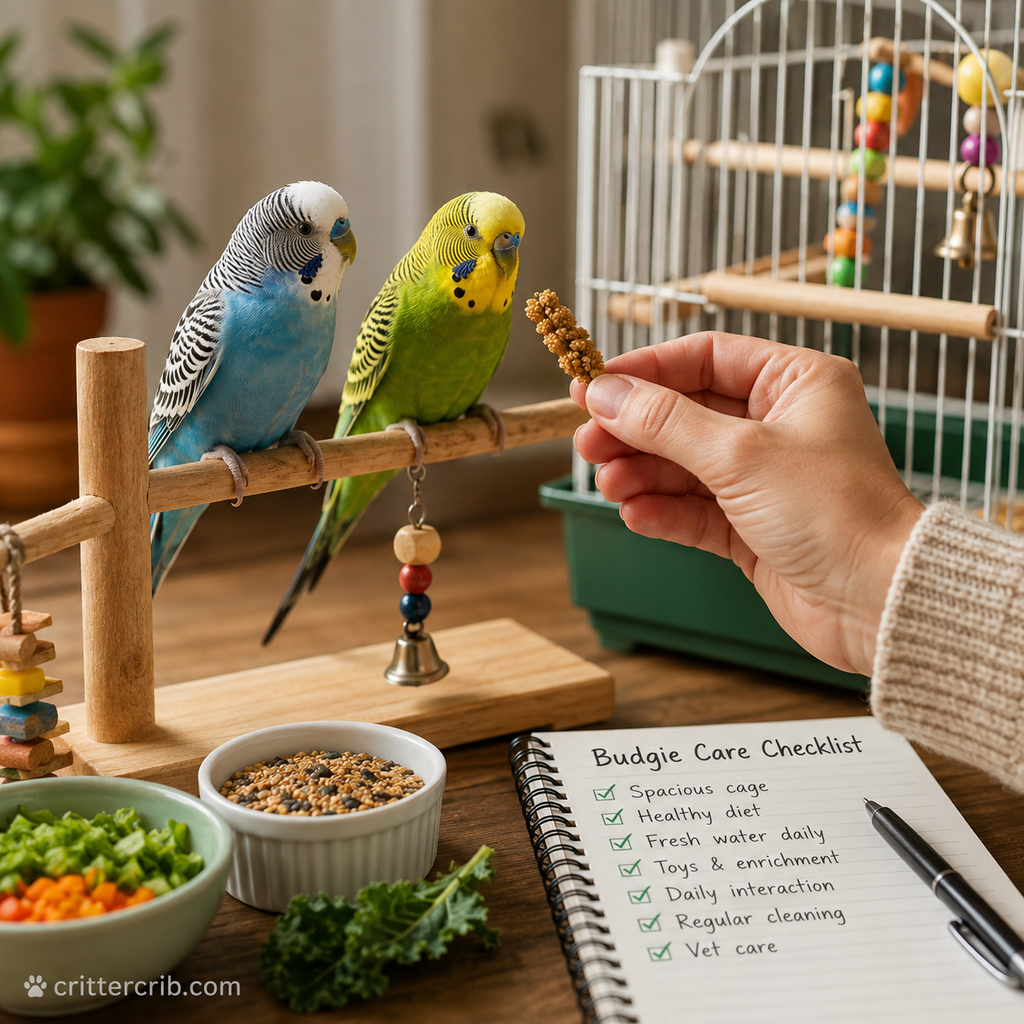
A good cage setup gives your budgie opportunities to climb, move, play, rest, and explore.
Useful cage essentials include:
- Several appropriately sized natural perches
- Food and water dishes
- Bird-safe toys
- Chewing and shredding materials
- Foraging opportunities
- Swings or climbing toys
- A removable cage liner or other easy-to-clean bottom setup
Avoid filling every inch of the cage with accessories. Your budgie still needs open space to move comfortably.
Use Different Types of Perches
Perches with different shapes and diameters allow a budgie’s feet to rest in different positions.
Natural branches made from bird-safe wood can work particularly well.
Avoid relying exclusively on smooth, identical dowel perches throughout the cage.
What Do Budgies Eat?
Nutrition is one of the most important parts of budgie care.
A common outdated approach is feeding budgies nothing but a bowl of seeds. Budgies certainly enjoy seeds, but an all-seed diet can be nutritionally unbalanced.
A healthier diet typically includes an appropriate formulated bird food along with suitable fresh foods. The exact diet should be discussed with an avian veterinarian, particularly if you’re transitioning a bird that has previously eaten mostly seeds.
Budgies may be offered appropriate vegetables and leafy greens such as:
- Broccoli
- Carrots
- Bell peppers
- Leafy greens
- Peas
- Other bird-safe vegetables
Fresh, clean water should always be available.
Introduce unfamiliar foods gradually. Some budgies are suspicious of anything new and may need repeated exposure before deciding that a vegetable is actually edible.
Foods Budgies Shouldn’t Eat
Not everything humans eat is safe for birds.
Potentially dangerous foods and substances include:
- Avocado
- Chocolate
- Alcohol
- Caffeine
- Very salty foods
- Foods containing unsafe ingredients or toxic plants
When you’re unsure whether something is safe, check with an avian veterinarian before offering it.
How Much Attention Do Budgies Need?
Budgies need daily interaction and stimulation.
For a single budgie, human companionship becomes especially important. That doesn’t mean you must entertain your bird every waking minute, but it shouldn’t spend day after day isolated in a cage.
Daily life can include:
- Talking to your budgie
- Training
- Supervised out-of-cage time
- Playing
- Offering foraging activities
- Rotating appropriate toys
- Simply spending time nearby
Budgies often enjoy being part of normal household activity.
Are Budgies Easy to Tame?
Many budgies can become very comfortable around people, but taming requires patience.
A bird that has just arrived in your home may be frightened. Everything around it is unfamiliar, including you.
Trying to grab or force interaction can make the process harder.
Instead, allow trust to develop gradually.
You might begin by:
- Spending quiet time near the cage.
- Talking softly to your budgie.
- Offering treats without forcing contact.
- Gradually introducing your hand.
- Teaching the bird to step onto your finger or a handheld perch.
- Keeping training sessions short and positive.
Some budgies progress quickly. Others need considerably more time.
The goal isn’t to rush the process. It’s to teach your bird that interacting with you is safe.
Are Budgies Messy?
Yes.
They’re tiny birds, but they’re surprisingly talented at distributing debris around a room.
Expect to find:
- Seed hulls
- Food crumbs
- Feathers
- Shredded toy material
- Droppings
- Bits of vegetables
Some mess around the cage is normal.
Fortunately, budgie mess is usually manageable with routine cleaning. Cage liners can be changed frequently, dishes should be washed regularly, and the cage and surrounding area will need periodic deeper cleaning.
If you expect the area around a bird cage to remain spotless all day, budgie ownership may test your patience.
Do Budgies Smell?
Healthy budgies themselves generally don’t have a strong unpleasant odor.
A dirty cage certainly can.
Old food, wet cage liners, droppings, and dirty water can produce smells and encourage unhealthy conditions. Regular cleaning keeps odors under control while also creating a healthier environment for your bird.
A sudden unusual odor or other physical change in your budgie should be discussed with an avian veterinarian.
How Long Do Budgies Live?
A budgie shouldn’t be considered a short-term pet.
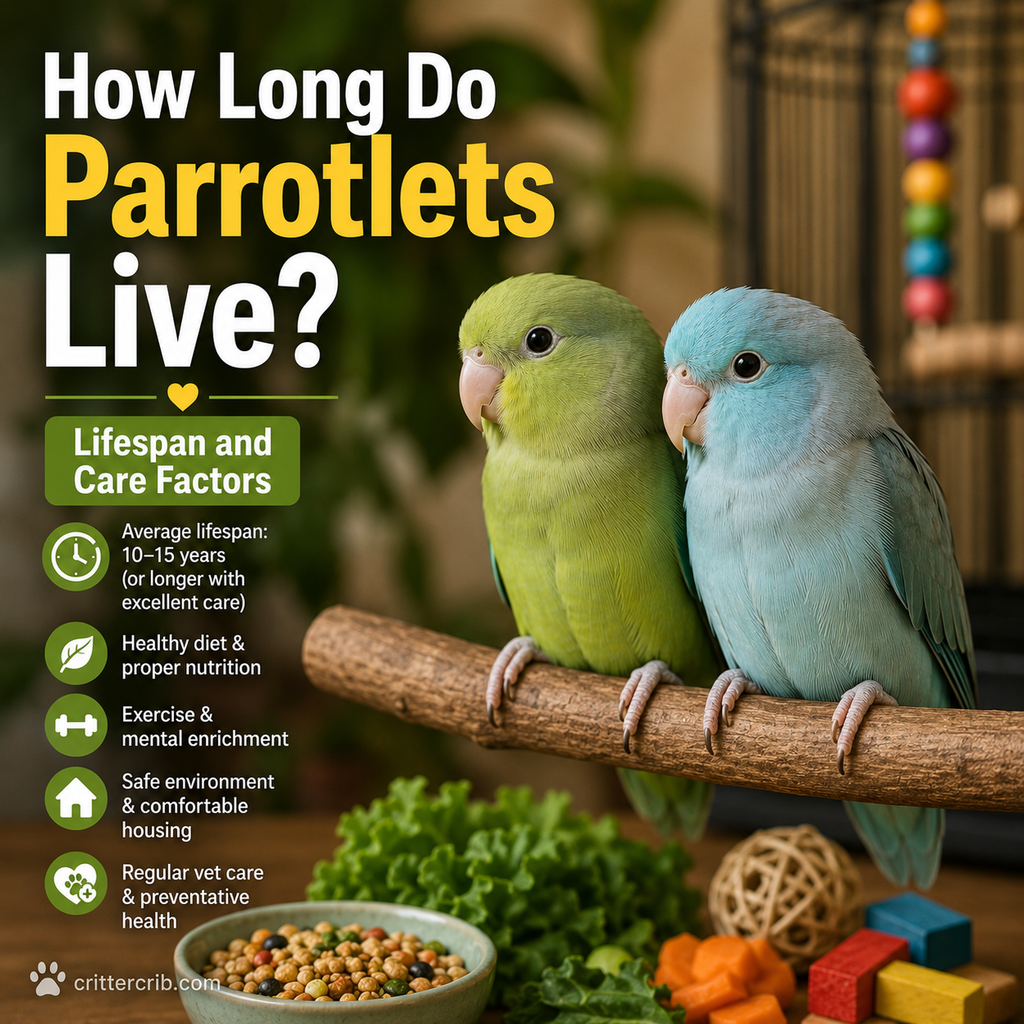
With proper care, budgies can live for many years, and some reach 10 years or longer.
Lifespan varies depending on genetics, nutrition, housing, veterinary care, accidents, illness, and overall lifestyle.
Before getting one, think about whether you’re prepared to provide consistent care for potentially a decade or more.
Do Budgies Need Veterinary Care?
Yes.
Birds need veterinary care just like other pets, and ideally your budgie should be seen by a veterinarian experienced with avian medicine.
This is worth investigating before you bring your bird home because not every general veterinary clinic treats birds.
Birds can also hide signs of illness surprisingly well.
Possible warning signs include:
- Unusual lethargy
- Sitting fluffed up for long periods
- Changes in appetite
- Changes in droppings
- Difficulty breathing
- Tail bobbing while breathing
- Spending unusual amounts of time on the cage floor
- Sudden changes in behavior
- Weakness or difficulty perching
A bird showing concerning symptoms should be evaluated promptly by an avian veterinarian rather than waiting to see whether the problem disappears.
Are Budgies Expensive Pets?
Budgies themselves are often relatively inexpensive compared with larger parrots, but the purchase or adoption price is only a small part of the actual cost.
You’ll also need to budget for:
- A suitable cage
- Perches
- Toys
- Quality food
- Fresh vegetables and other appropriate foods
- Cleaning supplies
- Replacement accessories
- Routine veterinary care
- Unexpected veterinary expenses
You may spend considerably more setting up your budgie’s environment than you spend acquiring the bird.
That’s normal. A good setup is an investment in the bird’s quality of life.
Are Budgies Good Pets for Children?
Budgies can live successfully in families with children, but adults should remain responsible for the bird’s welfare.
Young children may not understand how fragile a small bird is. A budgie can easily be injured by squeezing, grabbing, chasing, or careless handling.
Children should be taught to interact calmly and gently.
Budgies can also bite when frightened or uncomfortable, although their bites are generally much less powerful than those of larger parrots.
A budgie is therefore better considered a family pet that children can help care for rather than a pet for which a young child has sole responsibility.
Can Budgies Live With Other Pets?
Budgies can live in homes that also have dogs or cats, but interaction between species requires extreme caution.
Cats are natural predators, and even a friendly cat can seriously injure a small bird in seconds.
Dogs can also injure birds accidentally or intentionally.
Don’t assume that a pet is safe around your budgie simply because it has never shown aggression.
When a budgie is outside its cage, other animals should be securely separated or carefully controlled so the bird cannot be chased, bitten, pawed at, or accidentally stepped on.
Budgie-Proofing Your Home
Budgies can encounter household hazards that aren’t obvious to new bird owners.
Before allowing your budgie to fly outside its cage, check the room carefully.
Potential hazards include:
- Open doors and windows
- Ceiling fans
- Hot stovetops
- Open toilets
- Deep containers of water
- Electrical cords
- Toxic plants
- Mirrors and large windows
- Small spaces where a bird could become trapped
- Other pets
Birds are also extremely sensitive to certain airborne fumes.
Smoke, aerosols, strong chemical fumes, and overheated nonstick cookware can pose serious risks. Learn about bird-safe cooking and cleaning practices before bringing a budgie into your home.
Should You Get One Budgie or Two?
There isn’t one correct answer for every household.
A single budgie can thrive when it receives plenty of appropriate human companionship and enrichment.
Two compatible budgies can provide each other with valuable social interaction, particularly when their owner is away for significant portions of the day.
The tradeoff is that two birds mean additional expenses, cleaning, veterinary care, and potentially more noise.
If your primary goal is developing a close relationship with a single bird and you have plenty of time to interact with it, one budgie may work well.
If your schedule means your bird would regularly spend long periods alone, keeping compatible budgies together may deserve serious consideration.
Pros and Cons of Keeping Budgies
Budgies have many qualities that make them appealing first birds, but it’s important to consider both sides.
Advantages of Budgies
Budgies are:
- Intelligent and curious
- Social and interactive
- Relatively small
- Usually quieter than large parrots
- Capable of learning tricks
- Sometimes excellent talkers
- Available in many colors
- Entertaining to watch
- Able to form close relationships with people
Their combination of manageable size and big personality is a major reason they’ve remained such popular pets.
Disadvantages of Budgies
Potential challenges include:
- Daily cleaning
- Frequent chirping and chatter
- Regular social needs
- Veterinary expenses
- Finding an avian veterinarian
- Food and feathers around the cage
- The need for supervised exercise
- Household bird-proofing
- Long-term responsibility
They also aren’t the best choice for someone who wants a pet that can comfortably be ignored for several days.
Questions to Ask Before Getting a Budgie
Before making the decision, consider your everyday lifestyle rather than simply how appealing a budgie looks at the pet store.
Ask yourself:
- Can I interact with my bird every day?
- Am I comfortable with daily chirping?
- Can I clean the cage and surrounding area regularly?
- Can I afford appropriate food, housing, toys, and veterinary care?
- Is there an avian veterinarian reasonably accessible to me?
- Can I make my home safe for a free-flying bird?
- Do I have other pets that could create a safety risk?
- Am I prepared to care for this bird for many years?
- Will my future housing situation allow birds?
- Do I actually want an interactive parrot rather than simply a colorful animal to watch?
If most of those answers are yes, a budgie could be an excellent fit.
Are Budgies Low-Maintenance Pets?
Budgies are sometimes described as low-maintenance because they’re small.
That’s somewhat misleading.
They’re certainly easier to house than a giant parrot, and their food consumption and physical space requirements are relatively modest. But they still require daily feeding, fresh water, cleaning, social interaction, enrichment, exercise, and health monitoring.
A better description would be that budgies can be more manageable than many larger parrots.
They’re still living, intelligent animals with real needs.
Are Budgies Good Apartment Pets?
Budgies can be a good choice for apartments because they don’t require a huge amount of floor space and are usually much quieter than larger parrots.
However, apartment living introduces a few things to consider.
Walls may be thin, and budgies can become noisy during active periods. You’ll also need enough room for a proper cage and a safe area where the bird can exercise.
Check your lease or building rules before getting any pet, including birds.
Is a Budgie the Right Pet for You?
Budgies can be wonderful pets for the right person.
They’re cheerful, intelligent, playful, social, and often much more interactive than first-time bird owners expect. Watching a nervous new budgie gradually learn to trust you can be especially rewarding.
But small doesn’t mean disposable or effortless.
Your budgie will depend on you for proper nutrition, a safe environment, companionship, enrichment, exercise, cleanliness, and veterinary care throughout its life.
If you’re willing to provide those things, a budgie can be an excellent first bird and a surprisingly engaging companion.
If you want a pet that requires very little daily attention, doesn’t make noise, and can regularly be left alone, you may be happier choosing a different animal.
The best reason to get a budgie isn’t simply that they’re cute or inexpensive. It’s because you genuinely want to share your home with a small, intelligent parrot and are ready for everything that comes with it.
Frequently Asked Questions About Budgies as Pets
Are budgies good first pets?
Budgies can be good first birds and are often suitable for beginner bird owners. However, children and first-time owners still need to understand their daily care, social, dietary, safety, and veterinary needs.
Are budgies friendly?
Many budgies become friendly and comfortable with people, especially when they’re handled patiently and consistently. Personality varies, though, and some birds take longer to develop trust.
Do budgies like being held?
Some tame budgies enjoy sitting on a person’s hand, finger, or shoulder. Most don’t enjoy being physically restrained or grabbed. Allowing the bird to choose to interact usually produces a much better relationship.
Can a budgie be left alone during the day?
A budgie can spend some time alone, but a single bird shouldn’t be socially isolated for long periods on a regular basis. Provide toys and enrichment, and make sure it receives plenty of interaction when you’re home.
Do budgies recognize their owners?
Budgies can learn to recognize familiar people, voices, routines, and interactions. A well-socialized budgie may become visibly excited when a favorite person approaches.
Do budgies bite?
Yes, budgies can bite when they’re frightened, territorial, overstimulated, or simply don’t want to be handled. Learning your bird’s body language and avoiding forced interaction can reduce biting.
Are male or female budgies better pets?
Both male and female budgies can make excellent pets. Individual personality, socialization, health, and previous experiences are generally more useful considerations than choosing a bird solely based on sex.
Is it better to have one or two budgies?
Both arrangements can work. A single budgie needs plenty of human interaction, while two compatible budgies can provide companionship for each other. Your schedule, available space, budget, and ability to provide care should all factor into the decision.
Final Thoughts
So, are budgies good pets?
For many beginners, absolutely.
They offer many of the things people love about parrots—intelligence, personality, social interaction, vocalization, playfulness, and even the possibility of talking—in a much smaller package.
Just don’t mistake their size for simplicity.
Give a budgie proper care, patience, companionship, enrichment, and a safe home, and you may discover that one of the smallest commonly kept parrots can have one of the biggest personalities.