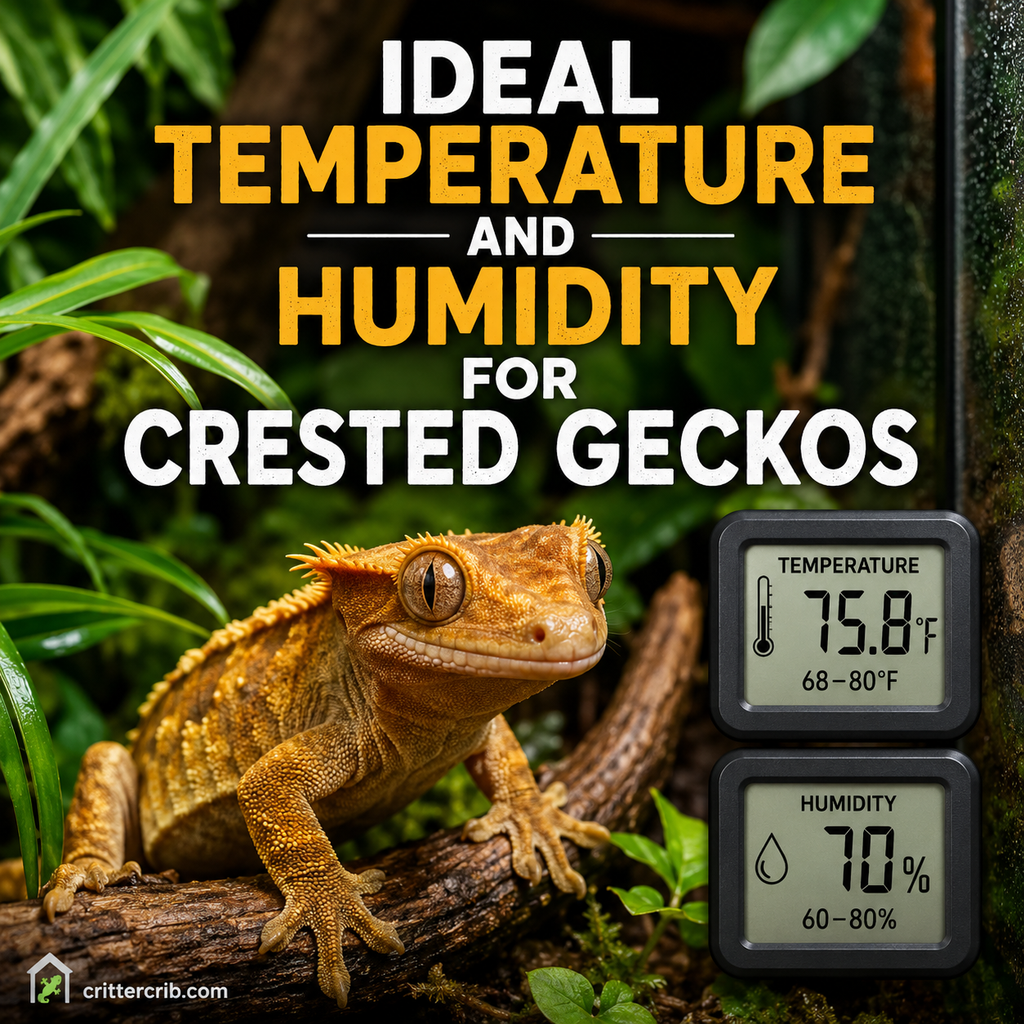
Getting the temperature and humidity right is one of the most important parts of keeping a crested gecko healthy. Fortunately, crested geckos don’t require the intense heat that many other reptiles do. Their needs are relatively moderate, which is one reason they’re often considered beginner-friendly reptiles.
That doesn’t mean you can simply put a crested gecko in a room-temperature enclosure and forget about the environment, though.
Crested geckos are ectothermic, meaning they depend on their surroundings to regulate their body temperature. They also come from the humid forests of New Caledonia, so moisture plays an important role in hydration, shedding, and overall health.
The goal isn’t to keep the enclosure at one exact temperature and humidity level around the clock. Instead, you want to create natural fluctuations, including a temperature gradient and a humidity cycle that rises after misting and falls as the enclosure dries.
Here’s how to get those conditions right.
What Temperature Do Crested Geckos Need?
A crested gecko enclosure should provide a range of temperatures rather than staying at one temperature from top to bottom.
A practical target for most enclosures is:
- Upper/warm area: approximately 75–80°F (24–27°C)
- Middle and cooler areas: approximately 68–75°F (20–24°C)
- Nighttime: temperatures can generally fall into the mid-to-upper 60s°F
- Avoid prolonged excessive heat: temperatures above roughly 80–85°F deserve close attention, particularly if the gecko has nowhere cooler to retreat
Different husbandry sources recommend somewhat different temperature ranges. PetMD, for example, recommends a warm area around 72–75°F and cautions against prolonged exposure above 80°F, while ReptiFiles recommends providing a warmer upper basking zone along with cooler areas lower in the enclosure.
The important takeaway is the same: give your crested gecko choices and protect it from overheating.
Why a Temperature Gradient Matters
Crested geckos are arboreal, so they spend much of their time climbing through branches, vines, cork, and foliage.
In a properly arranged enclosure, the upper portion can be somewhat warmer while lower areas remain cooler. Your gecko can then move between different temperatures depending on what it needs.
This is known as thermoregulation.
For example, your gecko may spend time in a warmer area before becoming active in the evening, then move into a cooler hiding place later.
A completely uniform enclosure removes those choices.
Tall enclosures make establishing a gradient easier because the heat source is generally above the enclosure. Branches, vines, plants, and hides at several heights allow the gecko to choose its preferred microclimate.
Do Crested Geckos Need a Heat Lamp?
Not every home will require additional heating.
If the room naturally stays within an appropriate temperature range throughout the year, supplemental heat may be minimal or unnecessary. However, homes that become cool during winter may require a controlled heat source.
The decision should be based on actual thermometer readings rather than how warm the room feels to you.
If supplemental heating is necessary, use a reptile-appropriate heat source that allows you to create a gentle warm zone without heating the entire enclosure excessively.
Any heat source should be carefully controlled and monitored.
A thermostat is particularly valuable because it can regulate the heat source and reduce the chance of accidental overheating. PetMD recommends attaching heat sources to a thermostat for this reason.
Avoid Overheating the Enclosure
Crested geckos tolerate cooler conditions much better than extreme heat.
An enclosure sitting beside a sunny window, for example, can heat up surprisingly quickly. The same can happen during a summer heat wave or when an oversized heating element is used.
Never rely on guesswork.
Monitor the enclosure throughout the day, especially when:
- Summer temperatures increase
- The enclosure receives indirect or direct sunlight
- You install a new heat source
- You move the enclosure to another room
- Your home’s heating or air conditioning changes
- You change the enclosure’s ventilation
If temperatures regularly climb too high, reduce or discontinue supplemental heating and find ways to safely cool the room.
What Is the Ideal Humidity for a Crested Gecko?
Humidity is just as important as temperature, but there’s a common misconception that crested geckos should live in an enclosure that’s constantly wet.
They shouldn’t.
A useful overall humidity range is approximately 60–80%, with natural rises and falls throughout the day. ReptiFiles recommends an average range of 60–80%, while PetMD recommends approximately 70–80%.
Rather than trying to hold the enclosure at exactly 70% all day, aim for a cycle.
For example:
- Mist the enclosure in the evening.
- Humidity rises substantially.
- Water droplets remain on leaves and enclosure surfaces for the gecko to drink.
- Humidity gradually decreases overnight and into the following day.
- Allow the enclosure to partially dry before misting heavily again.
This drying period is important.
ReptiFiles specifically recommends allowing humidity to drop to approximately 40–50% before misting again rather than keeping the enclosure continuously saturated.
Why Crested Gecko Humidity Should Fluctuate
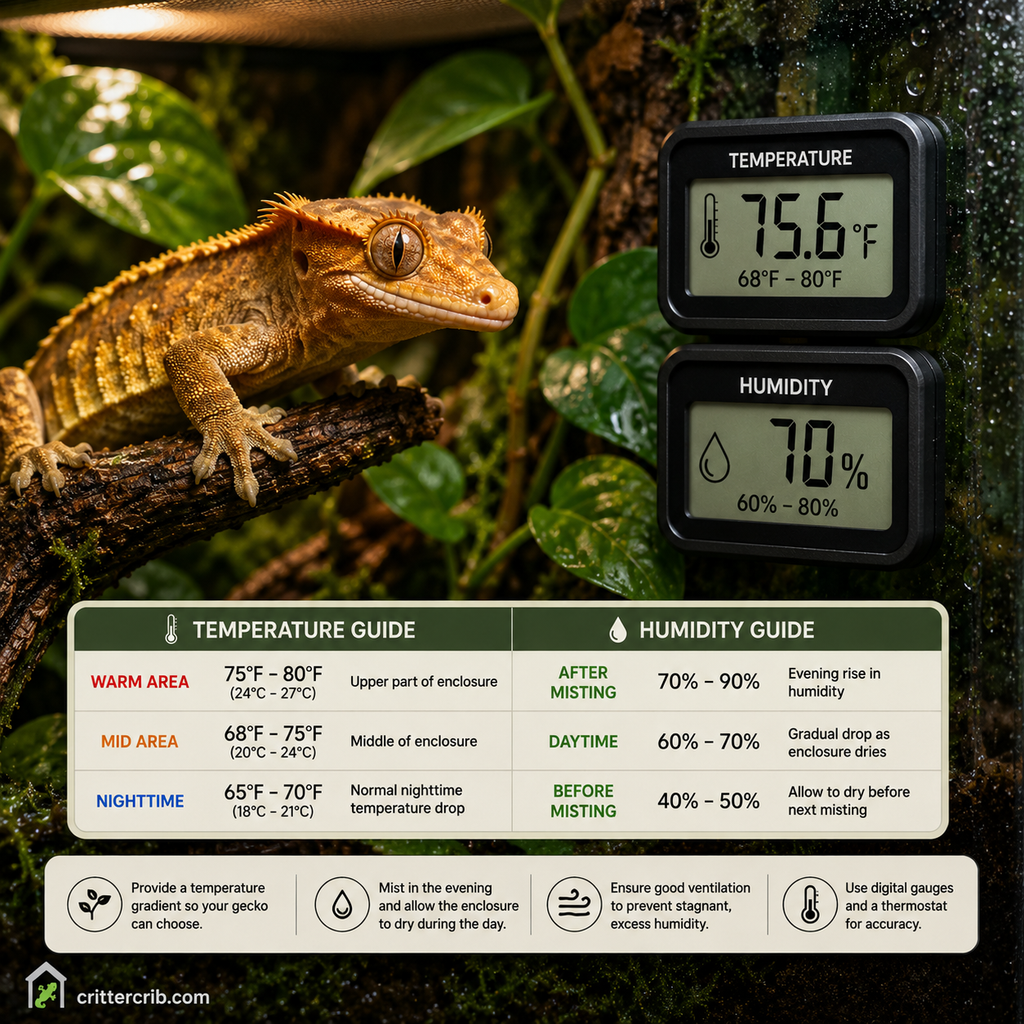
Think of humidity as a cycle rather than a fixed number.
In nature, humidity changes with rainfall, temperature, airflow, and time of day. Your terrarium should also experience some variation.
Constantly keeping the enclosure at 80–100% humidity can leave surfaces and substrate wet for long periods. That can encourage mold, mildew, and bacterial growth.
On the other hand, an enclosure that stays extremely dry can contribute to dehydration and shedding difficulties.
The goal is therefore a humid environment with enough ventilation and drying time to prevent stagnant conditions.
A good daily pattern often looks something like this:
Evening: High humidity after misting
Overnight: Humidity remains moderately high but gradually decreases
Morning: Moderate humidity
Daytime: Humidity continues dropping as the enclosure dries
Evening: Mist again and restart the cycle
Exact numbers will vary depending on your enclosure, climate, ventilation, plants, substrate, and room conditions.
How Often Should You Mist a Crested Gecko Enclosure?
For many setups, one thorough evening misting is a good starting point.
You may need a lighter morning misting as well if the enclosure dries too quickly.
However, don’t follow a misting schedule blindly. Watch the hygrometer.
An enclosure in a humid coastal climate may hold moisture much longer than one in a dry, air-conditioned house. Glass terrariums may also retain humidity differently depending on their ventilation.
Your enclosure should determine your misting frequency.
A Simple Misting Routine
In the evening, mist:
- Leaves
- Branches
- Vines
- Enclosure walls
- Selected areas of the substrate
You want to create plenty of droplets without turning the enclosure into a swamp.
Crested geckos commonly lick droplets from plants and enclosure surfaces, so misting also provides an additional opportunity to drink. Fresh drinking water should still be available in the enclosure.
How to Measure Temperature and Humidity
You can’t reliably judge temperature or humidity by putting your hand inside the enclosure.
Use digital instruments.
At minimum, a crested gecko setup should include:
- Digital thermometer
- Digital hygrometer
- Thermostat if supplemental heating is used
A thermometer/hygrometer combination unit can be convenient, but placing multiple sensors at different heights provides a better picture of conditions throughout a tall enclosure.
Where Should the Sensors Go?
Avoid putting every sensor in one place.
Because crested gecko enclosures are vertical, conditions near the top may be noticeably different from conditions near the substrate.
Ideally, monitor at least:
- The warmer upper portion
- The middle of the enclosure
- A cooler lower area
A hygrometer around the middle portion of the enclosure can provide a useful general humidity reading.
An infrared temperature gun is also useful for spot-checking surfaces such as branches, hides, and basking areas.
How to Increase Humidity in a Crested Gecko Tank
If humidity drops too quickly, don’t automatically solve the problem by misting constantly.
First, determine why the enclosure isn’t retaining moisture.
Mist More Effectively
A thorough evening misting may work better than several tiny sprays throughout the day.
Wet foliage and enclosure surfaces enough to create drinking droplets while allowing the habitat to gradually dry afterward.
Use Moisture-Retaining Substrate
Suitable tropical substrates can help stabilize humidity.
Common options include:
- Coconut fiber-based substrates
- Reptile-safe tropical soil mixtures
- Sphagnum moss
- Bioactive tropical substrates
A deeper substrate layer generally retains moisture longer than a very thin layer.
Add Live Plants
Live tropical plants can help create a more humid microclimate while providing cover and climbing opportunities.
They can also make a naturalistic crested gecko enclosure look much more attractive.
Just make sure any plants you use are reptile-safe and haven’t been treated with harmful pesticides.
Adjust Ventilation Carefully
If the enclosure dries almost immediately after misting, excessive ventilation may be contributing to the problem.
Reducing airflow slightly may help, but don’t seal the enclosure.
Ventilation is essential for preventing stagnant, constantly damp conditions.
Use an Automatic Misting System
Automatic misting systems can be useful for larger enclosures or owners who want more consistent humidity cycles.
They’re especially convenient when you’re away from home.
However, automation doesn’t eliminate the need for monitoring. You’ll still need to check humidity and adjust misting duration and frequency when necessary.
How to Lower Humidity in a Crested Gecko Tank
Excessive humidity is often caused by too much water combined with insufficient airflow.
If your enclosure remains wet all day, try:
- Misting less frequently
- Shortening misting sessions
- Increasing ventilation
- Allowing the substrate surface to dry
- Removing standing water
- Checking whether drainage is functioning properly
- Increasing room airflow without creating a strong draft
Don’t focus exclusively on the hygrometer number.
Look at the enclosure itself.
If the glass, plants, decorations, and substrate remain soaked around the clock, your setup is probably retaining too much moisture.
What Happens If Humidity Is Too Low?
Occasional dips in humidity aren’t necessarily a problem. In fact, a drying period is part of a healthy humidity cycle.
Chronic dryness is different.
A consistently dry environment may contribute to:
- Dehydration
- Difficult or incomplete sheds
- Skin appearing unusually dry
- Reduced access to drinking droplets
Pay particular attention during shedding.
Crested geckos normally remove and eat much of their shed skin, so you may not always notice that a shed happened. Check the toes and tail area for retained skin.
What Happens If Humidity Is Too High?
High humidity isn’t automatically dangerous. Crested geckos naturally experience very humid conditions.
The problem is constant excessive moisture without adequate drying or ventilation.
A perpetually wet enclosure can encourage:
- Mold
- Mildew
- Bacterial growth
- Fungus
- Substrate deterioration
- Stale or stagnant conditions
That’s why misting and ventilation need to work together.
You want moisture followed by evaporation—not a permanently soaked habitat.
Temperature and Humidity at Night
Nighttime is when crested geckos become most active, and it’s normal for conditions to change after the lights go out.
Temperatures can decrease while humidity rises.
That combination closely matches the kind of daily environmental rhythm these geckos experience naturally.
An evening misting works particularly well because it creates fresh water droplets at approximately the same time your gecko is becoming active.
You may see your crested gecko emerge shortly afterward to explore, feed, and lick droplets from leaves.
Temperature and Humidity During Winter
Seasonal changes inside your home can dramatically affect a reptile enclosure.
During winter, indoor heating can make the air surprisingly dry.
Watch for:
- Faster humidity loss
- Lower nighttime temperatures
- Substrate drying more quickly
- Increased need for misting
If temperatures fall below your target range, supplemental heating may become necessary.
Any additional heat should be regulated and carefully monitored because heating can also dry the enclosure more quickly.
Temperature and Humidity During Summer
Summer often presents the opposite problem.
Instead of struggling to keep your crested gecko warm enough, you may need to prevent overheating.
Air conditioning can help keep the room stable during heat waves.
You should also keep the enclosure away from direct sunlight. A glass enclosure exposed to sunlight can warm much faster than the surrounding room.
Check temperatures more frequently during unusually hot weather.
If you live somewhere with hot summers, having a plan for extreme heat is worthwhile before temperatures rise.
Common Temperature and Humidity Mistakes
Even experienced reptile owners occasionally need to adjust their setups.
Some of the most common mistakes include:
Keeping the Tank Constantly Wet
High humidity doesn’t mean everything should remain soaked.
Let the enclosure partially dry between mistings.
Using an Analog Gauge
Cheap stick-on analog thermometers and hygrometers can provide unreliable readings.
Digital equipment gives you much more useful information.
Measuring Only One Location
A single reading doesn’t tell you what’s happening throughout a tall enclosure.
Measure different levels whenever possible.
Using Too Much Heat
Crested geckos don’t require the intense basking temperatures used for desert reptiles.
More heat isn’t better.
Placing the Enclosure Near a Window
Sunlight can dramatically increase temperatures inside a glass terrarium.
Choose a location with stable room temperatures instead.
Chasing an Exact Humidity Number
Humidity doesn’t need to stay at 70% every minute of the day.
Natural fluctuation is desirable.
Watch the overall daily cycle rather than reacting every time the hygrometer changes by a few percentage points.
Quick Crested Gecko Temperature and Humidity Guide
For easy reference:
- General temperature: roughly 68–78°F depending on enclosure level and time of day
- Warm upper zone: approximately 75–80°F
- Night: a drop into the mid-to-upper 60s°F can generally be tolerated
- Humidity: approximately 60–80% overall
- After misting: temporary higher humidity is normal
- Drying period: allow humidity to fall substantially before the next heavy misting
- Misting: usually once in the evening, with additional misting if readings show it’s needed
- Monitoring: use digital thermometers and a digital hygrometer
- Supplemental heat: regulate it with a thermostat
- Major concern: prolonged excessive heat or an enclosure that stays constantly saturated
Frequently Asked Questions
Is 70% Humidity Good for a Crested Gecko?
Yes. Around 70% falls comfortably within commonly recommended humidity ranges for crested geckos.
However, don’t try to keep the enclosure locked at exactly 70%. Allow humidity to rise after misting and gradually fall as the enclosure dries.
Is 50% Humidity Too Low for a Crested Gecko?
Not necessarily.
A temporary drop to around 40–50% during the enclosure’s drying period can be normal. ReptiFiles specifically recommends allowing humidity to fall to approximately this level before misting again.
Consistently low humidity without regular humid periods is more concerning.
Is 80°F Too Hot for a Crested Gecko?
It’s near the upper end of the range commonly recommended for this species.
An upper area around 80°F can be acceptable in a properly designed enclosure if cooler areas are readily available, but you should monitor it closely. Some veterinary guidance recommends avoiding prolonged exposure above 80°F, while other husbandry guidance provides a somewhat warmer localized basking zone.
Avoid allowing the entire enclosure to become that warm.
Do Crested Geckos Need Heat at Night?
Usually not if your home remains within a safe nighttime temperature range.
A natural nighttime temperature drop is appropriate. If your room becomes unusually cold, however, controlled supplemental heat may be necessary.
Avoid using bright nighttime lighting just to provide heat, since geckos benefit from a normal light-dark cycle.
Should I Mist My Crested Gecko Every Day?
Most enclosures benefit from daily misting, particularly in the evening.
The exact frequency should depend on your humidity readings and how quickly the enclosure dries.
Should a Crested Gecko Tank Be Humid All the Time?
It should generally be a humid habitat, but it shouldn’t remain wet constantly.
Regular drying periods provide healthier conditions than keeping every surface permanently damp.
Final Thoughts
The ideal temperature and humidity for a crested gecko aren’t about maintaining two perfect numbers around the clock.
What matters more is creating a stable environment with natural variation.
Give your gecko warmer and cooler areas so it can regulate its body temperature. Mist the enclosure enough to create a humid nighttime environment and drinking droplets, then let humidity gradually decrease during the day.
Most importantly, measure the conditions instead of guessing.
Once you understand how your particular enclosure responds to heating, misting, ventilation, and seasonal changes, maintaining the right crested gecko temperature and humidity becomes a straightforward part of everyday care.