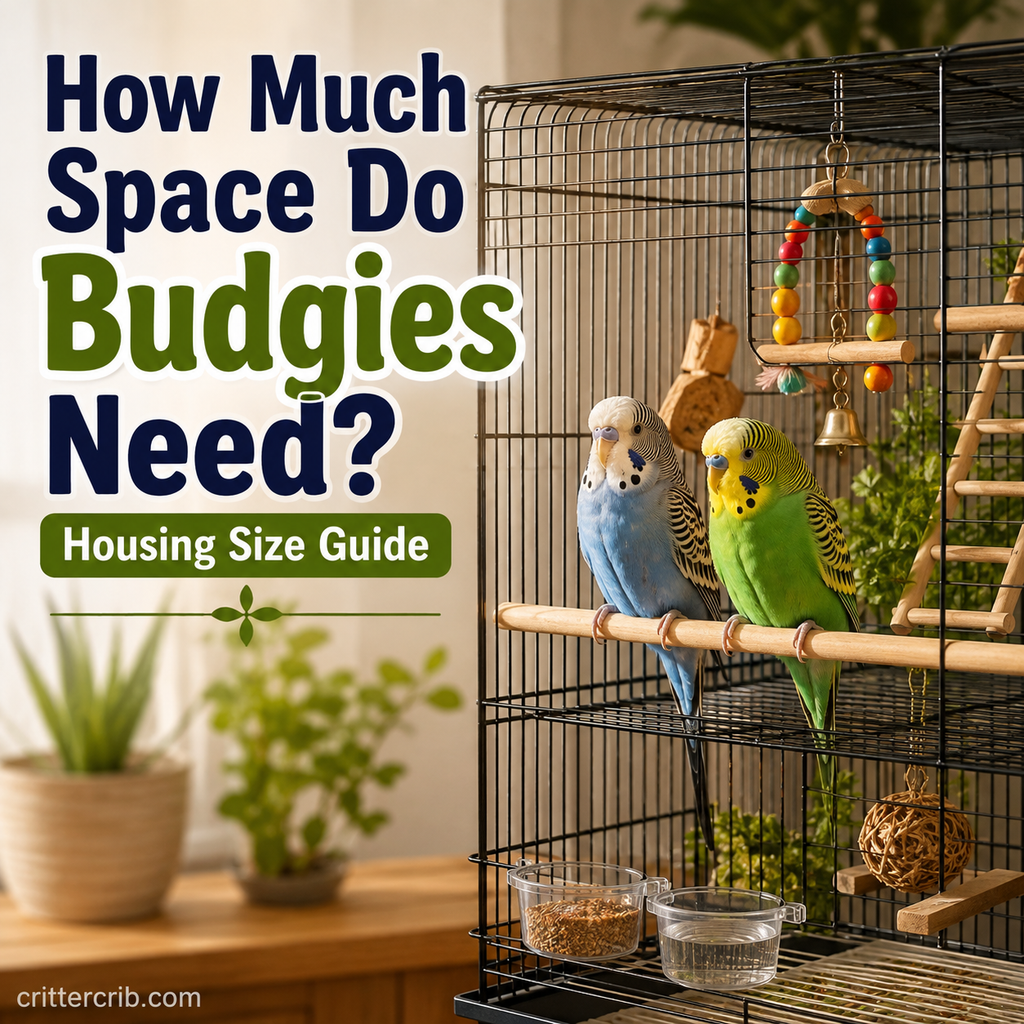
Budgies may be small birds, but they need more room than their size might suggest. These active little parrots spend much of the day climbing, hopping, playing, stretching their wings, and flying whenever space allows.
A cage that looks large compared with a budgie can still become cramped once you add perches, food dishes, toys, and other accessories. And if you keep two budgies together, providing enough usable space becomes even more important.
So, how much space do budgies actually need?
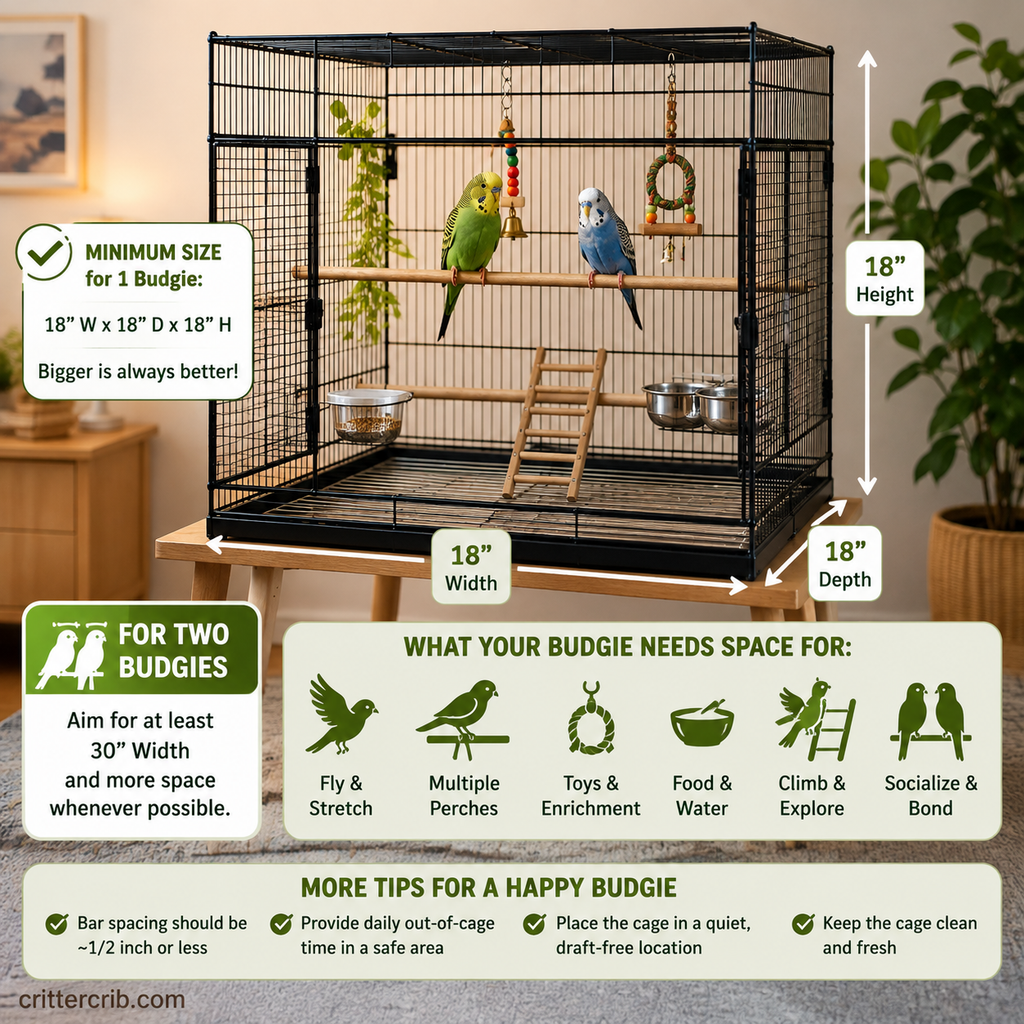
As a general rule, a budgie should have a cage that is at least about 18 inches wide, 18 inches deep, and 18 inches high, although larger is strongly preferable. For two budgies, aim for at least 30 inches of horizontal width and as much additional room as you can reasonably provide.
Those measurements are only a starting point. The shape of the cage, bar spacing, interior setup, number of birds, and amount of supervised time outside the cage all affect how suitable a home really is.
This guide explains how to choose a comfortable cage and create a living space that gives your budgie room to move, play, and behave naturally.
Why Budgies Need More Space Than You Might Think
Budgies, also known as budgerigars or parakeets, are naturally active birds. In the wild, they can travel considerable distances while searching for food and water.
A pet budgie obviously isn’t going to cover those distances inside your home, but the instinct to move remains.
A good enclosure should allow your bird to:
- Stretch both wings completely
- Move between several perches
- Climb around the cage
- Play with toys without constantly bumping into objects
- Access food and water comfortably
- Make short flights when the cage is large enough
- Move away from another bird when it wants some personal space
This is why simply asking whether a budgie can physically fit inside a cage isn’t enough.
The better question is whether the bird can comfortably live and move inside it.
Minimum Cage Size for One Budgie
For a single budgie, a commonly used minimum starting point is approximately:
- 18 inches wide
- 18 inches deep
- 18 inches high
However, this should be viewed as a minimum rather than an ideal target.
If you have room for a cage that’s 24, 30, or even 36 inches wide, your budgie can benefit from that extra space.
Horizontal space is especially useful because budgies generally fly from side to side rather than straight up and down.
A wide rectangular cage will usually provide more practical exercise space than a tall, narrow cage with the same overall volume.
Bigger Is Usually Better
There isn’t a strict maximum cage size for a healthy budgie as long as the cage is safe and appropriately designed.
A larger enclosure gives you more flexibility when arranging:
- Perches
- Swings
- Food and water stations
- Foraging activities
- Climbing toys
- Chewing toys
It also leaves open areas where your budgie can move without navigating an obstacle course.
If your budget and available space allow it, choosing a cage larger than the minimum is usually worthwhile.
How Much Cage Space Do Two Budgies Need?
Two budgies need more than simply enough room to sit next to each other.
They should be able to move independently and get away from one another when necessary.
For two budgies, consider a cage approximately 30 inches wide or wider, with sufficient depth and height for comfortable movement.
Something around 30 inches wide, 18 inches deep, and 18 inches high can serve as a starting point, but a larger flight-style cage is preferable when possible.
Additional space becomes particularly important because two birds mean more:
- Perches
- Food access
- Toys
- Movement
- Droppings and debris
- Potential competition over favorite spots
Even budgies that are closely bonded don’t necessarily want to be beside each other every minute of the day.
Providing several comfortable perching areas lets each bird choose where it wants to spend time.
Cage Width vs. Height: Which Matters More?
When comparing cages, it’s easy to assume that taller automatically means better.
For budgies, that’s not necessarily true.
Horizontal width is generally more valuable than excessive vertical height.
Budgies tend to fly horizontally. A cage that’s 36 inches wide and moderately tall may therefore offer more useful movement space than a cage that’s extremely tall but only 18 inches wide.
Imagine the difference between these two shapes:
- A tall, narrow tower
- A long, rectangular flight cage
The second option gives a budgie a better opportunity to travel from one side to the other using its wings.
Height is still useful because it allows multiple perch levels, but it shouldn’t come at the expense of width.
Don’t Forget About Bar Spacing
Cage dimensions aren’t the only measurements that matter.
The distance between the bars is extremely important for small birds.
For most budgies, cage bar spacing should generally be around 1/2 inch, with appropriately narrow spacing being important for preventing the bird from getting its head or body caught between the bars.
A cage designed for a much larger parrot may look wonderfully spacious but have gaps that are too wide for a budgie.
Always check the manufacturer’s listed bar spacing before buying a cage.
What Shape of Cage Is Best for a Budgie?
Rectangular cages are usually the most practical choice.
They provide clear horizontal movement space and make it easier to arrange perches and accessories without overcrowding the center.
Round cages are generally less desirable.
They can offer less usable space than their dimensions suggest, and arranging perches, toys, dishes, and open flight areas can be more difficult.
For most homes, look for a cage that is:
- Rectangular
- Wider rather than unusually tall
- Easy to access for cleaning
- Equipped with secure doors
- Made from bird-safe materials
- Designed with appropriate bar spacing
A large flight cage can be an excellent option if you have enough room.
How Much Room Should Be Left Inside the Cage?
One of the most common mistakes is buying a decent-sized cage and then filling almost every inch of it.
Your budgie needs enrichment, but it also needs empty space.
Think of the cage as a room. Furniture makes a room functional, but filling the entire floor with furniture makes it difficult to walk around.
The same idea applies to a bird cage.
Your budgie should be able to travel between major perches without running directly into:
- Toys
- Swings
- Food dishes
- Ladders
- Ropes
- Other accessories
Try to maintain an open area through the middle of the cage whenever possible.
How to Arrange Perches Without Wasting Space
Perches are essential, but their placement can dramatically change how much usable space remains.
Use several perches with different diameters and textures to give your budgie opportunities to move and exercise its feet.
Natural wood perches can work particularly well because their irregular surfaces provide variety.
Avoid arranging every perch directly above another one. Besides restricting movement, this can result in lower perches becoming covered with droppings.
A simple setup might include:
- A higher resting perch.
- A perch near the food and water area.
- A perch or natural branch toward the opposite side of the cage.
- An open pathway between the major perching areas.
You can then add toys around these areas without completely blocking movement.
How Many Toys Should a Budgie Have?
Budgies benefit from toys that encourage climbing, chewing, exploring, and foraging.
But more toys aren’t automatically better.
A smaller number of thoughtfully placed toys can be more useful than filling the cage with everything you own.
Good enrichment options can include:
- Shreddable toys
- Bird-safe chewing toys
- Foraging toys
- Swings
- Climbing accessories
- Bells designed specifically for birds
Rotate some toys periodically rather than keeping every toy in the cage at once.
This can make familiar items interesting again while preserving valuable movement space.
Does Time Outside the Cage Replace the Need for a Large Cage?
Regular supervised time outside the cage can provide valuable exercise and enrichment, but it doesn’t mean the cage can be tiny.
Your budgie will still spend time inside its enclosure.
That may include periods when you’re:
- Working
- Sleeping
- Cooking
- Away from home
- Cleaning
- Unable to supervise the bird
The cage should therefore function as a comfortable home on its own rather than simply as a place to store the bird between play sessions.
Out-of-cage exercise should complement a suitable cage, not compensate for an inadequate one.
How Much Out-of-Cage Time Do Budgies Need?
Budgies benefit from regular opportunities to exercise and explore outside their cage in a bird-safe environment.
The exact routine will depend on your household, your bird’s temperament, and how safely you can supervise it.
Consistency matters more than trying to meet an arbitrary number of minutes.
A safe exercise area should have potential hazards addressed before the cage door is opened.
That means checking for things such as:
- Open windows and exterior doors
- Ceiling fans
- Hot cooking surfaces
- Unsafe plants
- Accessible electrical cords
- Other pets
- Open toilets or deep containers of water
- Small gaps where a bird could become trapped
Windows and mirrors can also be difficult for birds to recognize as solid surfaces, particularly when they’re unfamiliar with a room.
Supervision is important whenever your budgie is exploring outside its cage.
Where Should You Put a Budgie Cage?
Even an excellent cage won’t work as well if it’s placed in a poor location.
Budgies are social animals and generally enjoy being around normal household activity. At the same time, constantly placing them in the busiest or noisiest area of the house can make it difficult for them to relax.
Look for a location that offers a balance between social interaction and security.
A good cage location should generally be:
- Away from direct drafts
- Away from kitchens and cooking fumes
- Protected from extreme temperature changes
- Away from constant direct sunlight
- Somewhere the bird can interact with the household
- Quiet enough for uninterrupted sleep at night
Having at least part of the cage near a wall can also give a budgie a greater sense of security compared with placing the enclosure completely exposed in the middle of a room.
Why the Kitchen Is a Poor Place for a Budgie Cage
The kitchen may seem convenient because people spend a lot of time there, but it presents several hazards for birds.
Cooking can expose a budgie to smoke, steam, airborne grease, and other fumes.
Certain overheated nonstick cookware and appliances can also release fumes that are particularly dangerous to birds.
For that reason, keeping the cage away from the kitchen and cooking area is the safer choice.
Signs Your Budgie May Need More Space
Every bird is different, so pay attention to how your budgie actually uses its enclosure.
A cage may be too cramped if your bird can’t comfortably:
- Fully stretch its wings
- Travel between perches
- Play without hitting other objects
- Move around toys
- Choose between different resting areas
You may also notice that accessories occupy nearly all available space.
With multiple birds, crowding can create additional problems if one bird repeatedly blocks another from accessing a perch, food dish, or preferred area.
Behavior alone can’t tell you whether cage size is the problem, since changes in activity or behavior can have many causes. However, the physical layout itself should make it obvious whether the birds have adequate room to move.
Setting Up a Cage for Two Budgies
When housing two budgies together, design the cage so important resources aren’t concentrated in one tiny area.
Consider providing:
- Multiple comfortable perches
- More than one desirable resting location
- Adequate access to food
- Easy access to water
- Multiple toys or activities
- Plenty of unobstructed movement space
Watch how the birds interact after they’re housed together.
Occasional disagreements can happen, but persistent aggression, resource guarding, or one bird preventing another from eating or resting deserves attention.
You may need to adjust the cage layout or, in some situations, house the birds separately.
What About Three or More Budgies?
As the flock grows, cage requirements increase significantly.
Adding another bird doesn’t simply mean squeezing another perch into the existing setup.
Each bird needs access to resources and enough room to move away from flockmates.
For several budgies, a large flight cage or appropriately designed indoor aviary may make more sense than a conventional small bird cage.
When evaluating the enclosure, consider whether all birds can:
- Move comfortably at the same time
- Reach food and water
- Find suitable resting spots
- Fly or hop between areas
- Avoid a dominant flockmate
More birds also mean you’ll need to clean the enclosure more frequently.
Is a Flight Cage Worth It?
If you have the room, a flight cage can be an excellent upgrade for budgies.
These cages are designed with greater horizontal space, giving small birds more opportunity to move between perches and potentially make short flights.
They’re particularly useful for:
- Pairs of budgies
- Small groups
- Birds that spend significant time inside their enclosure
- Owners who want more flexibility with enrichment
You don’t necessarily need the largest enclosure available, but giving a budgie meaningful horizontal space can make cage setup much easier.
Common Budgie Cage Size Mistakes
Choosing a cage can be confusing, especially because many products marketed for small birds are surprisingly small.
Try to avoid these common mistakes.
Choosing a Cage Based Only on the Bird’s Size
A budgie’s body is small, but its housing needs are based on movement, not simply body dimensions.
The bird needs enough room to fully extend its wings and travel around the enclosure.
Buying a Tall but Narrow Cage
Extra height looks impressive, but width usually provides more practical movement space for budgies.
Overcrowding the Cage With Toys
Enrichment is important, but your bird shouldn’t have to squeeze around toys just to move from one perch to another.
Ignoring Bar Spacing
A huge cage isn’t safe if the gaps between the bars are inappropriate for a small bird.
Assuming Out-of-Cage Time Makes Cage Size Unimportant
Exercise outside the cage is valuable, but your budgie still needs suitable housing for the hours it spends inside.
Buying for One Bird When You Plan to Get Two
If you already know you may eventually keep a pair, buying a larger cage from the beginning can save you from replacing the enclosure later.
Budgie Cage Size Checklist
Before buying or upgrading your budgie’s home, ask yourself:
- Is the cage at least around 18 × 18 × 18 inches for one budgie?
- Could I reasonably choose something larger?
- Is there plenty of horizontal width?
- Is the bar spacing appropriate for a budgie?
- Can the bird fully stretch its wings?
- Will there still be open space after adding perches and toys?
- Can food and water be reached easily?
- Are the doors secure?
- Is the cage easy to clean?
- Is there enough space for every bird living inside it?
- Can I place the cage somewhere safe and comfortable?
If you’re choosing between two suitable cages and have enough room for either, the larger one will often give you more flexibility.
Frequently Asked Questions
What Is the Minimum Cage Size for a Budgie?
A cage around 18 inches wide, 18 inches deep, and 18 inches high is often treated as a basic minimum starting point for one budgie. Larger housing is preferable whenever possible, particularly if the bird spends substantial time inside the cage.
Is a 24-Inch Cage Big Enough for a Budgie?
A 24-inch-wide cage can provide considerably more usable space than a very small cage, assuming it also has adequate depth, height, safe construction, and appropriate bar spacing.
The overall dimensions and layout matter, so don’t judge suitability by width alone.
Do Budgies Prefer Tall or Wide Cages?
Budgies generally benefit more from horizontal width because their natural flight movement is primarily side to side.
A cage can certainly have good height, but it shouldn’t be extremely narrow.
How Big Should a Cage Be for Two Budgies?
For two budgies, consider at least around 30 inches of horizontal width, with additional space strongly preferred. A larger flight cage is often an excellent choice for a pair.
Can a Budgie Cage Be Too Big?
For a healthy budgie, a properly designed larger cage is generally an advantage rather than a problem.
The important factors are safety, appropriate bar spacing, accessibility, and sensible interior arrangement.
Can Two Budgies Live in the Same Cage?
Yes, compatible budgies can often live together, provided they have sufficient space and access to necessary resources.
Their interactions should still be monitored, particularly when they’re first introduced.
How Far Apart Should Budgie Cage Bars Be?
Around 1/2-inch bar spacing is generally appropriate for budgies. Avoid cages with large gaps designed for bigger parrots.
Final Thoughts
Budgies don’t take up much physical space themselves, but that doesn’t mean they should live in tiny cages.
For one budgie, approximately 18 × 18 × 18 inches should be considered a minimum starting point rather than the ideal goal. For two budgies, look for at least around 30 inches of horizontal width, and choose a larger flight-style enclosure whenever practical.
More importantly, look beyond the numbers.
A good budgie cage provides usable horizontal space, safe bar spacing, appropriately positioned perches, enrichment, access to food and water, and enough open room for the bird to move naturally.
Combine that with regular supervised exercise outside the cage, social interaction, good nutrition, and a safe environment, and you’ll be giving your budgie a much more comfortable home.