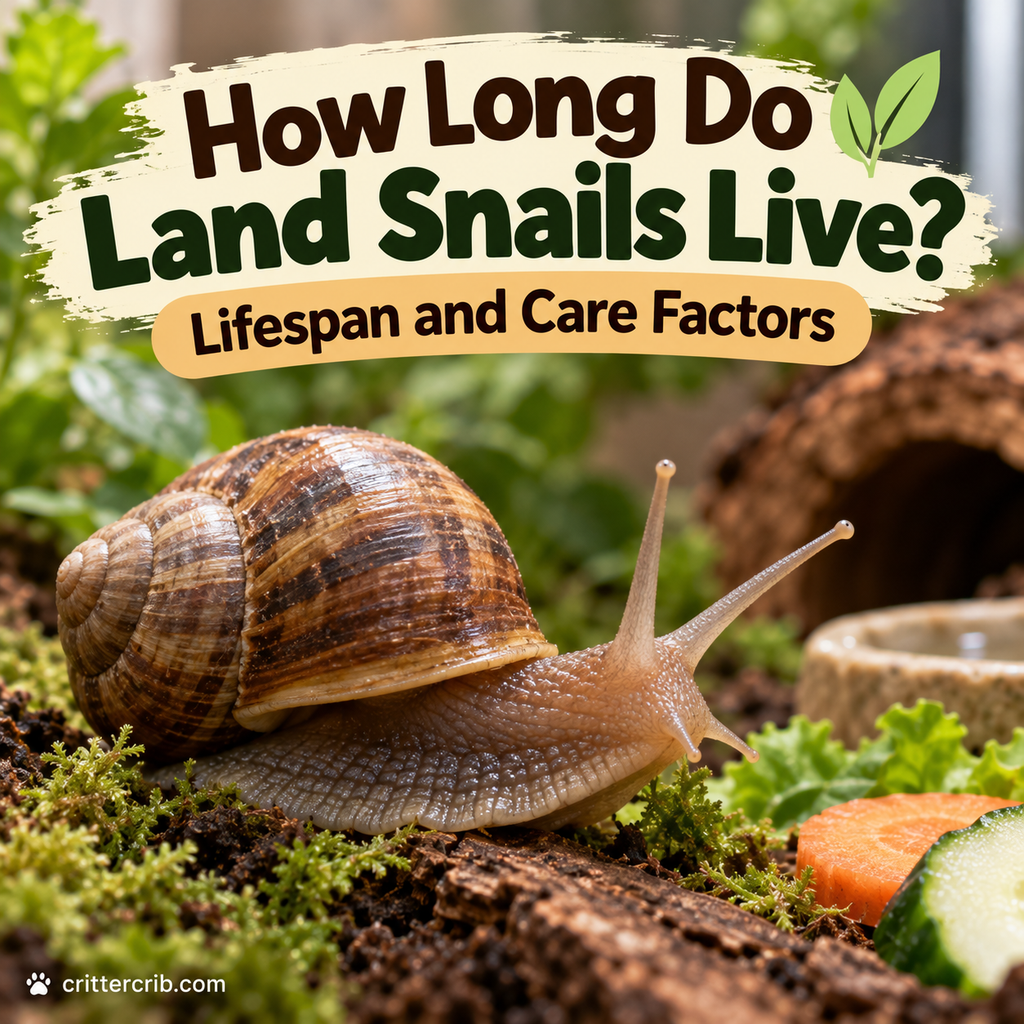
Land snails may move slowly, but some of them stick around for a surprisingly long time.
Depending on the species, a land snail can live anywhere from a couple of years to well over a decade. Many commonly kept pet land snails live roughly 2–7 years, while some larger or particularly long-lived species may survive 10 years or more under favorable conditions.
There’s no single lifespan that applies to every snail.
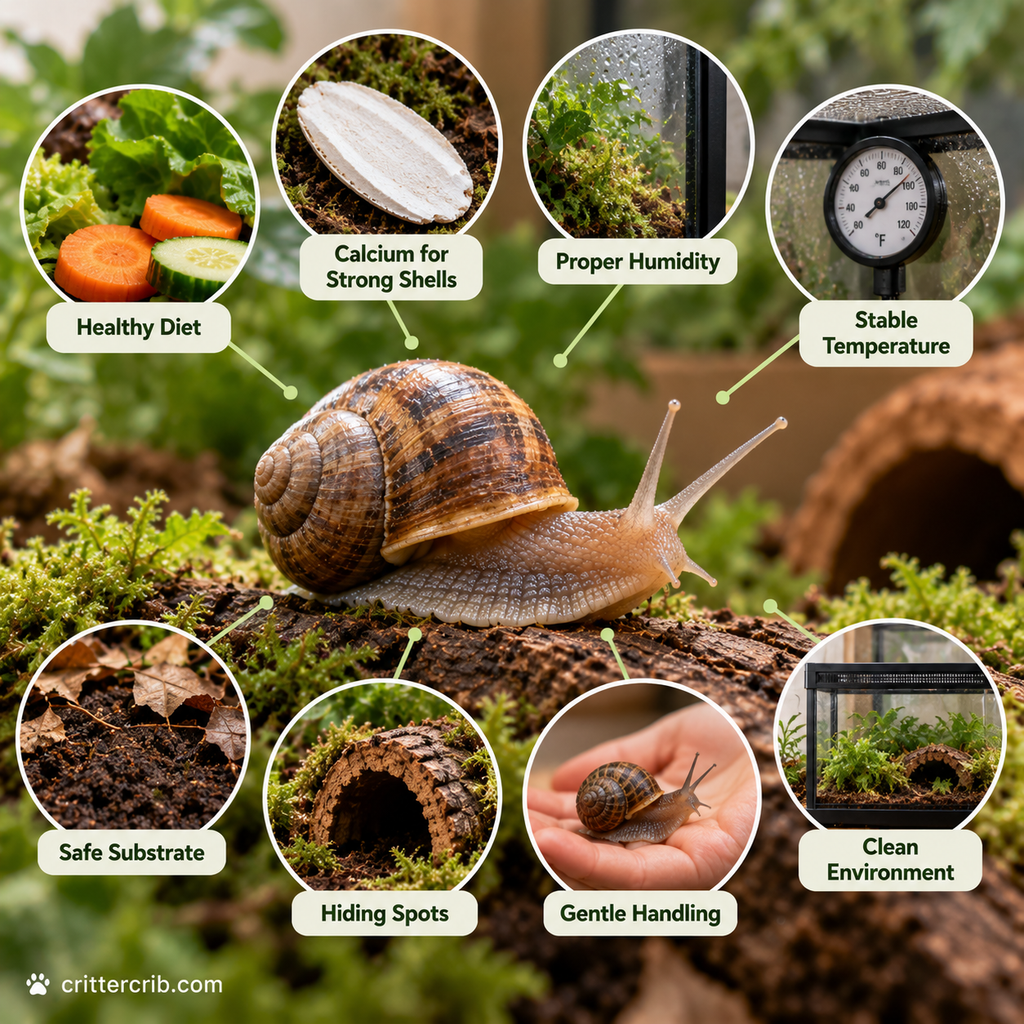
Species and genetics play a major role, but captivity introduces factors you can control. Diet, calcium, moisture, temperature, enclosure safety, cleanliness, and handling can all affect a snail’s health and potentially influence how long it lives.
If you’re keeping land snails as pets—or thinking about bringing some home—understanding their lifespan helps you plan for more than just the first few months.
Here’s what determines how long land snails live and how good care can give them the best chance at reaching their natural lifespan.
How Long Do Land Snails Live?
The lifespan of a land snail varies considerably between species.
As a general guideline:
- Some small land snails may live only 1–3 years.
- Many commonly kept pet species can live roughly 2–7 years.
- Some larger species may live 5–10 years or longer.
- Exceptionally long-lived land snails can potentially survive beyond 10 years.
These ranges shouldn’t be treated as guarantees.
Two snails of the same species kept under similar conditions may not live exactly the same length of time. Genetics, early development, disease, injury, reproduction, and environmental conditions can all make a difference.
When possible, identify the exact species you’re keeping. “Garden snail” isn’t precise enough to predict lifespan or provide species-specific care.
How Long Do Garden Snails Live?
The term “garden snail” can refer to several species, depending on where you live.
One of the species commonly associated with this name is the brown garden snail, Cornu aspersum.
These snails may live for several years, with captive individuals potentially surviving longer when protected from predators, drought, extreme weather, and other hazards.
In the wild, many snails never reach their maximum biological lifespan.
They face threats such as:
- Birds
- Rodents
- Beetles
- Parasites
- Drought
- Freezing temperatures
- Habitat disturbance
- Pesticides
- Vehicles and foot traffic
Captivity removes many of those threats, but only if the enclosure itself is safe and appropriate.
How Long Do Giant Land Snails Live?
Some of the larger land snail species kept internationally can have comparatively long lifespans.
Depending on species and conditions, giant land snails may live around 5–10 years, with some individuals potentially surviving longer.
However, there’s an important consideration before acquiring one: legality.
Certain giant land snails are invasive agricultural pests and are illegal to possess or transport in some countries and regions.
In the United States, for example, giant African land snails are subject to strict federal restrictions because of the agricultural and environmental risks they pose.
Never purchase an exotic land snail until you’ve confirmed that the species is legal to own where you live.
Why Do Some Land Snails Live Longer Than Others?
Species is one of the biggest factors.
Land snails occupy environments ranging from humid forests to dry Mediterranean habitats. Their growth rates, adult sizes, reproductive strategies, dormancy patterns, and environmental tolerances can be very different.
Genetics also matter.
Even with excellent care, you can’t make a naturally short-lived species live indefinitely. Good husbandry is about helping the snail reach its biological potential, not overriding it.
Other important factors include:
- Diet quality
- Calcium availability
- Hydration
- Humidity
- Temperature
- Enclosure conditions
- Disease and parasites
- Injuries
- Reproductive stress
Fortunately, many of these are things a keeper can influence.
Does Captivity Help Land Snails Live Longer?
Potentially, yes.
A well-maintained captive environment can remove many of the dangers wild snails face.
Pet snails don’t have to deal with predators, long periods without food, pesticide exposure, or being accidentally crushed by a lawn mower.
They can also have consistent access to:
- Food
- Calcium
- Moisture
- Shelter
- Stable temperatures
But captivity isn’t automatically safer.
An unsuitable enclosure can introduce its own hazards, including poor ventilation, excessive heat, mold, inappropriate substrate, nutritional deficiencies, and shell damage.
A snail lives longer in captivity only when the captive environment actually meets its needs.
Diet and Land Snail Lifespan
Nutrition is one of the most important parts of long-term snail care.
Most commonly kept terrestrial snails consume a variety of plant material, although exact dietary needs vary by species.
Suitable foods for many pet land snails may include:
- Leafy greens
- Carrot
- Sweet potato
- Squash
- Zucchini
- Mushroom
- Broccoli
- Other species-appropriate vegetables
Variety matters.
Feeding one food exclusively may result in nutritional gaps, even if the snail eagerly eats it.
Research the diet of your particular species rather than assuming every land snail should receive the same menu.
Don’t Rely on Cucumber Alone
Cucumber is often associated with pet snail feeding because many snails readily eat it.
The problem is that cucumber contains a lot of water and isn’t nutritionally complete.
It can be offered as part of a varied diet, but it shouldn’t become the only thing your snails eat.
A better approach is to rotate suitable vegetables and greens.
You might offer different foods throughout the week rather than filling the enclosure with the same favorite every day.
Snails can be enthusiastic about certain foods without those foods being nutritionally ideal as a staple.
Calcium Is Essential for Shell Health
A snail’s shell isn’t simply a protective object it carries around.
It’s a living part of the animal.
Land snails need access to calcium for shell growth, maintenance, and repair.
A convenient calcium source for many captive snails is cuttlebone.
Place a plain piece in the enclosure so the snails can rasp at it as needed.
Other appropriate calcium sources may be used depending on your husbandry approach, but avoid assuming that sprinkling random supplements over every meal is necessary.
Continuous access to a safe calcium source allows the snail to consume it as needed.
Signs of Shell Problems
Shell appearance varies by species and age, but potential concerns can include:
- Unusually thin new growth
- Cracking
- Severe pitting
- Significant erosion
- Breakage
- Weak or malformed growth
Shell problems can have multiple causes, so calcium alone isn’t always the answer.
Diet, environmental conditions, injury, age, and other factors may also contribute.
Hydration and Humidity Matter
Land snails need moisture.
Their bodies lose water readily, and a dry enclosure can lead to inactivity, dehydration, or dormancy.
At the same time, the habitat shouldn’t necessarily resemble a swamp.
The correct moisture level depends on the species.
A suitable enclosure generally provides:
- Moist substrate
- Appropriate humidity
- Access to fresh food
- Good ventilation
- Areas where the snail can retreat
Misting may be used to maintain moisture, but frequency depends on how quickly the enclosure dries.
Rather than spraying according to a rigid schedule, monitor the actual conditions.
Too Much Moisture Can Cause Problems
It’s easy to think that because snails like moisture, more water must be better.
Not necessarily.
Constantly saturated substrate combined with poor ventilation can encourage:
- Mold
- Unpleasant odors
- Excessive bacterial growth
- Fungus gnats
- Other unwanted organisms
The goal is moist—not permanently flooded.
Good airflow helps balance humidity while preventing the enclosure from becoming stagnant.
Temperature Can Affect Snail Health
Land snails are ectothermic, meaning environmental temperature influences their activity and metabolism.
Temperature requirements vary by species.
Some commonly encountered snails tolerate normal indoor temperatures reasonably well, while tropical species may require warmer conditions.
Avoid exposing a snail enclosure to:
- Direct sunlight
- Radiators
- Heating vents
- Air-conditioning vents
- Extreme temperature fluctuations
Direct sunlight is particularly risky.
A clear plastic or glass enclosure can heat up rapidly, even when the room itself feels comfortable.
If supplemental heating is necessary for your species, use appropriate temperature control and monitoring rather than uncontrolled heat.
Substrate Is More Important Than It Looks
Snails spend a lot of time crawling across and burrowing into their substrate.
It needs to be safe.
Suitable substrates vary by species and keeper preference, but they should generally:
- Retain appropriate moisture
- Allow burrowing
- Be free from pesticides
- Be free from chemical fertilizers
- Avoid harmful additives
- Provide enough depth for natural behavior
Be cautious with garden soil unless you know exactly what’s in it.
Commercial soils may contain fertilizers, pesticides, wetting agents, or other additives that aren’t appropriate for a snail enclosure.
Avoid Hard Decorations
Shell damage is one of the more preventable risks in captive snail care.
Land snails climb.
They climb the walls, lid, branches, plants, and almost anything else available.
Eventually, one may lose its grip.
If the enclosure floor is covered with hard rocks, ceramic dishes, or heavy decorations, a falling snail can strike them and crack its shell.
Safer enclosure materials include:
- Cork bark
- Leaf litter
- Soft substrate
- Moss
- Lightweight hides
- Suitable plants
You don’t need a bare enclosure.
Just think about what would happen if a snail fell from the lid onto each object below.
Shell Injuries Can Be Serious
Minor shell damage isn’t always fatal.
Snails can sometimes repair limited shell damage when the underlying tissues remain healthy and they have appropriate nutrition and calcium.
Severe damage is another matter.
A badly crushed shell, significant injury near the shell’s central structures, or exposed internal tissues can be life-threatening.
Prevention is far easier than dealing with a major shell injury.
Keep heavy, hard objects to a minimum and handle snails carefully.
Handle Land Snails Gently
Pet land snails don’t need frequent handling.
If you do pick one up, avoid pulling it forcefully from a surface.
A snail can adhere surprisingly well using its muscular foot. Pulling directly upward can injure the animal.
Instead, gently encourage it to release while supporting the body and shell.
Before handling:
- Wash your hands thoroughly.
- Rinse away soap residue.
- Wet your hands with clean water.
- Handle the snail over a low, safe surface.
- Return it to the enclosure afterward.
Avoid lotions, hand sanitizers, cleaning chemicals, and other residues that could transfer to the snail.
Wash your hands again after handling the animal or cleaning its enclosure.
Keep the Enclosure Secure
Snails are talented escape artists.
If there’s a gap, they’ll eventually find it.
A secure lid should prevent escape while still providing appropriate ventilation.
Check that:
- The lid closes properly.
- Ventilation openings aren’t large enough for small snails.
- There are no sharp edges.
- The enclosure remains secure after cleaning.
Escaped snails can become dehydrated, injured, lost, or accidentally stepped on.
A secure enclosure is one of the simplest ways to prevent an avoidable accident.
Cleanliness Without Over-Cleaning
Snail enclosures need maintenance, but they don’t need to be sterile.
Routine cleaning may involve:
- Removing spoiled food
- Wiping excessive waste from surfaces
- Checking for mold
- Refreshing substrate when needed
- Cleaning feeding areas
- Monitoring for pests
Avoid using household cleaning chemicals inside the enclosure.
Soap residue, disinfectants, fragrances, and sprays can be harmful.
Plain water and appropriate husbandry methods are usually safer for routine enclosure maintenance.
Don’t Replace All the Substrate Constantly
A complete substrate replacement every few days isn’t usually necessary.
It can also repeatedly disrupt the environment.
Instead, spot-clean and replace substrate when there’s an actual reason to do so.
How often a larger change is needed depends on:
- Number of snails
- Enclosure size
- Substrate type
- Moisture
- Feeding habits
- Waste accumulation
Monitor the habitat rather than following an arbitrary calendar.
Dormancy Can Affect What Looks Like Lifespan
Land snails may become inactive under unfavorable environmental conditions.
Depending on the species and situation, this may involve aestivation during hot or dry periods or dormancy during colder conditions.
A dormant snail may:
- Stop eating
- Become inactive
- Retract deeply into its shell
- Seal the shell opening with a temporary membrane
This can make an inexperienced keeper worry that the snail has died.
Don’t assume prolonged inactivity means death.
First check the species’ normal behavior and environmental conditions.
Reproduction Can Influence Care
Many land snails are hermaphrodites, meaning an individual possesses both male and female reproductive organs.
That doesn’t necessarily mean one snail can never reproduce alone. Reproductive biology varies among species, and some can retain sperm after mating for extended periods.
If you keep multiple snails, eggs are a real possibility.
Producing eggs requires resources, including calcium.
Make sure breeding animals continue to have appropriate nutrition and calcium availability.
You’ll also need a plan for offspring.
Depending on species, one clutch can contain many eggs.
Check the Substrate for Eggs
Snails often bury eggs in the substrate.
If you’re keeping mature snails, occasionally check during routine maintenance.
Eggs may look like small pale or translucent spheres clustered beneath the surface.
Before allowing eggs to hatch, consider:
- Whether you can house the offspring
- Whether the species is legal to breed
- Whether you can responsibly rehome them
- How many juveniles you can realistically maintain
Never release unwanted pet snails outdoors.
Parasites and Pests
Wild-caught snails may carry parasites or other organisms.
Outdoor materials can also introduce unwanted inhabitants into an enclosure.
Possible hitchhikers include:
- Mites
- Fly larvae
- Nematodes
- Small insects
- Other invertebrates
Not every tiny organism you see is necessarily harmful, but sudden changes in behavior or unexplained decline deserve attention.
If you’re adding new snails to an established group, quarantine can help reduce the chance of introducing problems.
Wild-Caught vs. Captive-Bred Snails
A wild snail comes with an unknown history.
You may not know:
- Its age
- Previous environmental exposure
- Whether it carries parasites
- Whether it has reproduced
- Whether it was exposed to pesticides
- How much of its lifespan has already passed
A captive-bred snail with a known hatch date makes age and lifespan easier to track.
Whenever possible, obtain pet snails legally and responsibly from a reputable source rather than collecting unfamiliar species from the wild.
How Can You Tell How Old a Land Snail Is?
Usually, you can’t determine a snail’s exact age simply by looking at it.
Size isn’t a perfect indicator.
Growth rates can vary with:
- Species
- Diet
- Temperature
- Calcium availability
- Genetics
- Environmental conditions
Once a snail reaches adult size, estimating age becomes even harder.
If knowing your pet’s age matters to you, purchasing a captive-bred juvenile with a known hatch date is the best option.
Signs of a Healthy Land Snail
Healthy behavior varies somewhat between species, but generally positive signs can include:
- Regular feeding
- Normal movement
- Firm attachment to surfaces
- Exploration during active periods
- Normal shell growth
- Interest in appropriate foods
- Normal responses to moisture
Don’t expect constant activity.
Many land snails are more active at night or after misting and may spend large portions of the day resting.
Warning Signs to Watch For
A single quiet day isn’t necessarily a problem.
More concerning changes may include:
- Persistent unusual inactivity
- Significant unexplained weight or body loss
- Severe shell deterioration
- Major shell damage
- Inability to retract normally
- Unusual swelling
- Repeated failure to eat despite appropriate conditions
- Strong unpleasant odors associated with the animal
If you’re concerned about a pet snail, first check the basics: temperature, moisture, food, calcium, substrate, and enclosure conditions.
Specialized veterinary care for terrestrial gastropods may be difficult to find, but an exotic-animal veterinarian may be able to provide guidance in some cases.
How to Help Your Land Snail Live Longer
You can’t guarantee how long an individual snail will live, but good care can reduce many avoidable risks.
Focus on these basics:
- Identify the species.
- Learn its expected temperature and moisture range.
- Provide a varied, appropriate diet.
- Keep a safe calcium source available.
- Maintain moist but well-ventilated conditions.
- Use a suitable, chemical-free substrate.
- Avoid hard objects that could crack the shell.
- Keep the enclosure securely covered.
- Remove spoiled food regularly.
- Handle gently and only when necessary.
- Watch for eggs if keeping mature snails.
- Never expose the enclosure to pesticides or household chemicals.
Snail care is often less about doing more and more about maintaining stable conditions.
Are Land Snails Good Long-Term Pets?
They can be.
Land snails are quiet, require relatively little space, and can be fascinating to observe.
You’ll see behaviors that are easy to overlook outdoors, including:
- Feeding with the radula
- Climbing
- Burrowing
- Exploring after misting
- Resting beneath hides
- Growing new shell material
- Laying eggs
They don’t need walks, toys, or social interaction with people.
But “low maintenance” doesn’t mean disposable.
A snail that lives five years is still a five-year commitment. A species capable of living a decade deserves the same long-term planning you’d give any other pet.
Frequently Asked Questions About Land Snail Lifespan
How long do pet land snails live?
Many pet land snails can live roughly 2–7 years, although lifespan varies significantly by species. Some larger or longer-lived species may survive for 10 years or more with appropriate care.
How long do garden snails live?
Garden snail lifespan depends on the species. Common garden species may live for several years, with captive individuals potentially surviving longer when protected from predators, extreme weather, pesticides, and food shortages.
Can a snail live for 10 years?
Yes. Some land snail species are capable of living around 10 years or longer, particularly under favorable captive conditions. This isn’t typical of every species.
Do pet snails live longer than wild snails?
They can. Captivity can remove predators, extreme weather, pesticide exposure, and food shortages. Poor captive husbandry, however, can shorten lifespan, so keeping a snail as a pet doesn’t automatically make it live longer.
Does a snail’s shell grow throughout its life?
The shell grows as the snail develops, with new material added around the opening. Once the snail reaches maturity, major size growth slows or stops, although the shell remains an important living structure that requires proper mineral support.
Do snails need calcium every day?
Land snails should generally have reliable access to an appropriate calcium source such as plain cuttlebone so they can consume calcium as needed.
How do I know if my snail is dead or sleeping?
A resting or dormant snail may remain withdrawn for an extended period. Check environmental conditions and look for normal signs of dormancy before assuming the snail has died. A strong foul odor and obvious tissue decomposition are more concerning signs.
Why is my snail staying inside its shell?
Snails may retract while resting or when conditions are too dry, hot, cold, or otherwise unfavorable. Prolonged inactivity is a reason to check temperature, humidity, hydration, and other enclosure conditions.
Do land snails need a companion?
Not necessarily. Social requirements vary, and snails don’t need human-style companionship. Keeping multiple mature snails together can also result in eggs, so reproduction should be considered before adding more animals.
Final Thoughts
So, how long do land snails live?
For many commonly kept species, a lifespan of roughly 2–7 years is a reasonable general expectation. Some live for less time, while larger and longer-lived species can potentially reach 10 years or beyond.
Species and genetics set much of that timeline. Your job as a keeper is to remove as many avoidable risks as possible.
Provide a varied diet, constant access to calcium, appropriate moisture, good ventilation, safe substrate, and an enclosure without hard objects that could damage the shell. Keep temperatures stable, avoid pesticides and household chemicals, and don’t handle your snail more than necessary.
Most importantly, learn about the particular species you’re keeping.
A land snail may be tiny and inexpensive, but several years is a meaningful commitment. With a safe habitat and consistent care, you’ll have plenty of time to discover that these slow-moving little animals are much more interesting than they first appear.