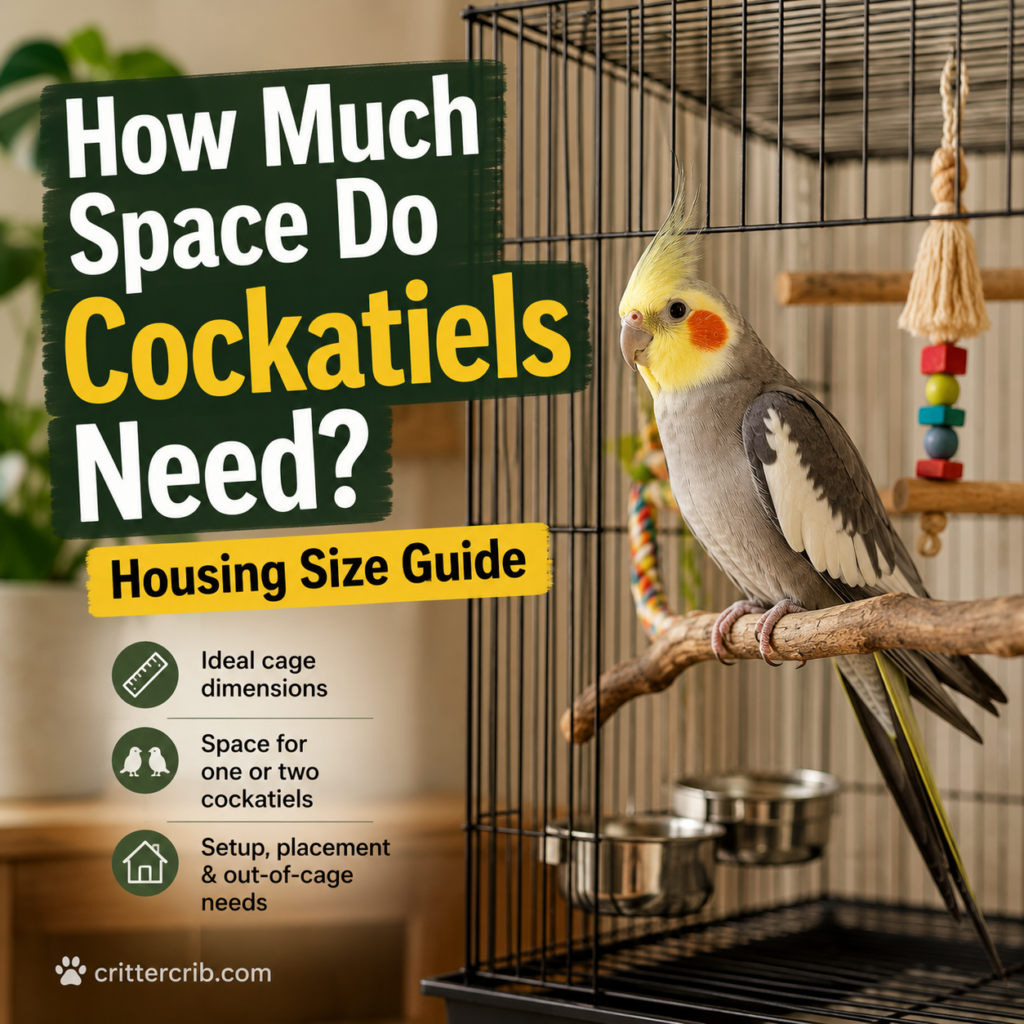
Cockatiels aren’t huge birds, but that doesn’t mean they’re happy living in a tiny cage. These active, curious parrots need enough room to stretch, climb, play, and move between perches without constantly bumping into toys, food dishes, or cage bars.
So, how much space does a cockatiel actually need?
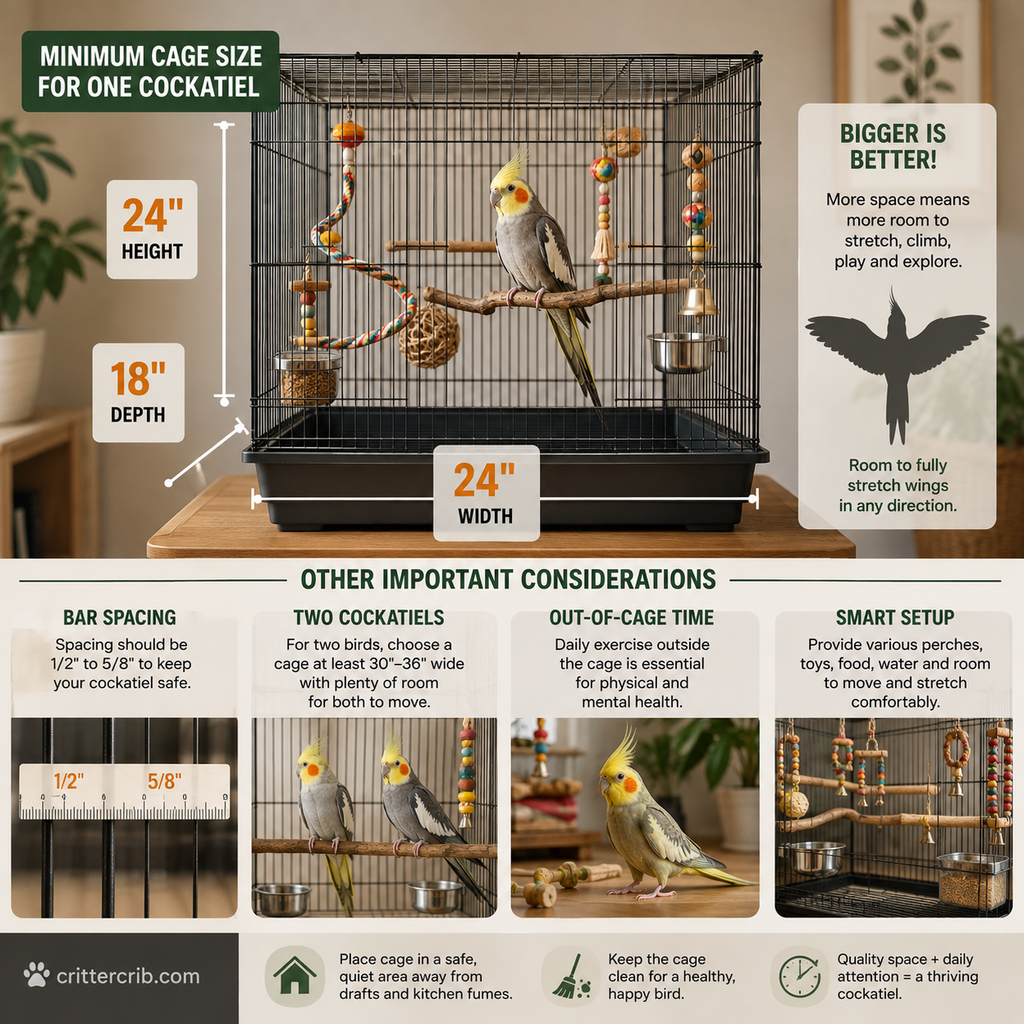
For one cockatiel, a cage around 24 inches wide by 18 inches deep by 24 inches high is a reasonable minimum starting point, but larger is better whenever your space and budget allow. Width is especially important because cockatiels move horizontally and need room to fully extend their wings.
The cage itself is only part of the picture. Daily exercise outside the cage, appropriate bar spacing, good cage placement, and enough usable interior space all contribute to a healthy living environment.
Here’s how to choose the right amount of space for your cockatiel.
What Is the Minimum Cage Size for a Cockatiel?
A single cockatiel should generally have a cage measuring at least approximately:
- 24 inches wide
- 18 inches deep
- 24 inches high
Think of those dimensions as a practical minimum rather than the ideal cage size.
If you can comfortably fit a larger cage in your home, your cockatiel will usually benefit from the additional space. A cage around 30 to 36 inches wide can provide considerably more room for movement, toys, and varied perch placement.
The bird should be able to fully extend and flap its wings without hitting the sides of the cage or constantly colliding with accessories.
A cage can technically meet minimum measurements and still feel cramped if it’s overloaded with toys and perches.
Usable space matters just as much as the dimensions printed on the box.
Why Cockatiels Need More Space Than You Might Expect
Cockatiels are members of the parrot family and are naturally active birds.
In the wild, they don’t spend their entire day sitting on one branch. They fly, forage, interact socially, groom themselves, investigate their surroundings, and move between different locations.
A pet cockatiel still has those instincts.
Even a bird that receives plenty of attention needs enough room inside its cage to:
- Stretch both wings completely
- Climb along the cage bars
- Move easily between perches
- Play with toys
- Eat and drink comfortably
- Preen without obstruction
- Rest away from busy activity
- Change position throughout the day
A cage should function as a safe home, not simply a place where the bird fits.
Bigger Is Usually Better
When choosing between two suitable cages, the larger one is usually the better choice.
There are limits, of course. The cage still needs appropriate bar spacing, safe construction, and a practical location in your home.
But once those requirements are met, additional interior space gives you more flexibility.
A larger cage allows you to create different areas for:
- Feeding
- Playing
- Climbing
- Foraging
- Resting
It also makes it easier to rotate toys and provide enrichment without turning the cage into an obstacle course.
If you have the room, buying a larger cage from the beginning can also save you from upgrading a few months later.
Width Matters More Than Height
Tall cages often look impressive, but height alone doesn’t necessarily give a cockatiel more useful space.
Cockatiels benefit greatly from horizontal room.
A cage that is 36 inches wide and moderately tall may provide more usable movement space than a narrow cage that’s several feet high.
Why?
Birds don’t move through cages the way humans move through rooms. Cockatiels often travel from side to side between perches and use horizontal space for wing movement.
When comparing cages, prioritize:
- Adequate width
- Adequate depth
- Safe bar spacing
- Enough height for varied perch placement
Don’t choose a cage based only on total height.
How Much Space Do Two Cockatiels Need?
Two cockatiels need considerably more room than one.
You shouldn’t simply place a second bird into a cage that was already the minimum size for a single cockatiel.
For two compatible cockatiels, consider a cage at least around 30 to 36 inches wide, with generous depth and height. Larger is strongly preferable, particularly if the birds spend substantial portions of the day inside.
A larger shared cage allows each bird to move away from the other when desired.
That’s important even when two cockatiels get along well.
Companion birds may eat together, preen each other, and sleep near one another, but they still benefit from having personal space.
A cage for two cockatiels should also provide multiple:
- Perches
- Feeding locations
- Water access points
- Resting areas
- Toys and enrichment opportunities
This helps reduce competition over favorite resources.
Don’t Assume Two Cockatiels Will Immediately Share a Cage
Introducing another cockatiel isn’t as simple as buying a bird and placing it beside your existing pet.
New birds may require quarantine and gradual introductions, and not every pair will immediately be comfortable sharing territory.
It’s useful to have separate housing available, especially during introductions.
If you’re planning to keep multiple birds, consider their housing requirements before bringing another cockatiel home.
What Bar Spacing Is Best for Cockatiels?
Cage dimensions aren’t the only measurements that matter.
Bar spacing is extremely important.
For cockatiels, spacing of roughly 1/2 inch to 5/8 inch is commonly appropriate. Some cages designed for similarly sized birds may have spacing approaching 3/4 inch, but you should be particularly careful with wider gaps.
Bars that are spaced too far apart can create a safety hazard if a cockatiel attempts to put its head through them.
A cage intended for a much larger parrot may look wonderfully spacious but still be inappropriate because the bar spacing is too wide.
Always check both:
- Overall cage dimensions
- Distance between individual bars
Don’t assume that a larger cage is automatically safer.
What Cage Shape Is Best for a Cockatiel?
A rectangular cage is generally the most practical choice.
Rectangular cages provide clear usable corners, straightforward perch placement, and plenty of horizontal movement when properly sized.
Avoid choosing a cage primarily because it has an unusual decorative shape.
Highly ornate cages can have:
- Narrow sections
- Awkward corners
- Reduced usable space
- Difficult-to-clean areas
- Complicated bar arrangements
A simple, roomy rectangular cage is often more useful to the bird than an elaborate cage designed mainly to look attractive in a room.
Should a Cockatiel Cage Have Horizontal Bars?
Horizontal bars can be useful because cockatiels enjoy climbing.
A cage with at least some horizontal bar sections gives your bird additional opportunities to use its feet and beak while moving around.
Cockatiels are surprisingly capable climbers and may scale the sides of their cage rather than simply flying or hopping between perches.
A combination of useful bar orientation, strategically positioned perches, and climbing toys can make the interior more interesting.
How Much Room Does a Cockatiel Need to Stretch Its Wings?
Your cockatiel should be able to fully extend both wings without touching the cage walls.
This sounds obvious, but accessories can dramatically reduce usable space.
Imagine a cage that’s technically wide enough for your cockatiel’s wingspan. Now add:
- Four large toys
- Several thick perches
- A swing
- Food dishes
- A ladder
- Hanging ropes
Suddenly, the bird may have very little unobstructed space remaining.
After setting up the cage, look at it from your bird’s perspective.
Is there an open area where your cockatiel can stretch and flap comfortably?
If not, remove or reposition some accessories.
How Many Perches Should a Cockatiel Cage Have?
There’s no perfect number because cage size and perch dimensions vary.
The goal is to provide several useful perching options without filling every open area.
Different perch sizes and textures can encourage natural foot movement.
Natural wood perches are particularly useful because branches don’t have perfectly uniform diameters.
Arrange perches so your cockatiel can move comfortably between different areas of the cage.
Avoid creating a dense network where the bird must squeeze through obstacles every time it moves.
Avoid Placing Every Perch at the Same Height
Cockatiels often have favorite sleeping or resting locations, but giving them several height options makes the cage more interesting.
You might provide:
- A comfortable upper resting perch
- A middle perch near a play area
- Lower climbing or activity areas
Keep food and water placement in mind so droppings from higher perches don’t land in dishes below.
Don’t Overcrowd the Cage With Toys
Enrichment is important, but more toys aren’t always better.
A cockatiel cage doesn’t need to resemble a packed toy store.
Your bird needs room to interact with its toys, not simply room for the toys themselves.
A better strategy is to keep a manageable selection available and rotate appropriate toys periodically.
Cockatiels may enjoy:
- Shredding toys
- Foraging toys
- Bird-safe chewable materials
- Climbing toys
- Swings
- Bells designed safely for birds
Leave open areas between accessories.
A spacious cage can quickly become a cramped cage when every available inch is filled.
How Much Out-of-Cage Time Does a Cockatiel Need?
A large cage doesn’t eliminate the need for exercise and interaction outside it.
Cockatiels benefit from regular opportunities to move around in a safe environment outside their cage.
Ideally, provide supervised out-of-cage time every day when practical.
How long will depend on your household, the bird, and the safety of the environment, but several hours of safe activity outside the cage can provide valuable exercise, enrichment, and social interaction.
The cage should remain your cockatiel’s secure home base rather than becoming the only environment it experiences.
Make the Room Bird-Safe First
Before opening the cage, check the room carefully.
Potential hazards include:
- Open windows and exterior doors
- Ceiling fans
- Hot cookware
- Open flames
- Other pets
- Electrical cords
- Toxic houseplants
- Uncovered mirrors or large windows that the bird doesn’t recognize
- Small objects that could be swallowed
- Unsafe household chemicals
Cockatiels are curious and can reach places you didn’t expect surprisingly quickly.
Can a Smaller Cage Work With Lots of Out-of-Cage Time?
Daily exercise helps tremendously, but it shouldn’t be used to justify an undersized cage.
There will inevitably be times when your cockatiel needs to remain inside longer than usual.
You may be:
- Working
- Sleeping
- Cleaning
- Cooking
- Away from home
- Having visitors
- Dealing with an emergency
Your bird should still have enough space to move comfortably during those periods.
Think of out-of-cage time as additional exercise and enrichment rather than compensation for inadequate housing.
Where Should You Put a Cockatiel Cage?
Choosing the right cage is only half the job.
Placement can have a major impact on how comfortable your cockatiel feels.
Cockatiels are social birds and generally enjoy being part of household activity, but that doesn’t mean the cage belongs in the busiest possible location.
Choose an area where your bird can see and hear household activity without being constantly disturbed.
A living room, family room, or frequently occupied home office may work well depending on your routine.
Avoid Constant Drafts
Don’t position the cage directly in the path of strong drafts from:
- Air-conditioning vents
- Heating vents
- Frequently opened exterior doors
- Powerful fans
Normal household air circulation is different from exposing the bird to a constant direct draft.
Keep the Cage Away From the Kitchen
The kitchen is generally a poor location for a bird cage.
Cooking creates heat, steam, smoke, aerosols, and fumes. Some cookware and appliances with nonstick coatings can release fumes when overheated that are extremely dangerous to birds.
It’s safer to house your cockatiel away from cooking areas.
Give Your Cockatiel Some Security
Many birds feel more comfortable when at least one side of their cage is near a wall rather than having every side exposed.
This can create a greater sense of security while still allowing the bird to observe the room.
Avoid constantly relocating the cage unless there’s a reason to do so.
How Much Space Around the Cage Do You Need?
Don’t measure only the cage itself when deciding whether it will fit in your home.
You also need room around it.
Allow enough space to:
- Open doors completely
- Remove the bottom tray
- Replace food and water
- Attach toys
- Clean behind and underneath the cage
- Move the cage if necessary
- Interact comfortably with your bird
Cockatiels also create debris.
Seed hulls, pellets, feathers, bits of shredded toys, and occasional droppings can end up outside the cage.
Leaving some clearance around the cage makes routine cleaning much easier.
Do Cockatiels Need a Separate Sleeping Cage?
Not necessarily.
Many cockatiels sleep perfectly well in their regular cage as long as they have a quiet, comfortable environment and an appropriate light-dark schedule.
Some owners use a separate sleeping cage because their bird’s main cage is located in a busy room that remains active late at night.
Whether that’s necessary depends on your household.
What’s important is that your cockatiel has a consistent opportunity for uninterrupted sleep in a calm environment.
Travel Cages Are Different From Everyday Cages
A travel carrier or temporary cage doesn’t need to provide the same amount of space as your cockatiel’s permanent home.
Travel housing is designed for short-term transportation and safety.
A smaller carrier can actually be easier to manage during transportation than a large everyday cage.
However, don’t confuse a travel cage with appropriate permanent housing.
If your cockatiel will be staying somewhere for an extended period, provide more substantial accommodations whenever possible.
Signs Your Cockatiel’s Cage May Be Too Small
Sometimes it’s easier to evaluate a cage after it’s set up.
Take a close look at how your bird actually moves through the space.
Potential signs that the setup needs improvement include:
- Wings repeatedly hitting cage bars or toys
- Difficulty moving between perches
- Very little unobstructed interior space
- Tail feathers constantly rubbing against bars
- Toys occupying most available space
- Food and water dishes blocking movement
- The bird having almost no opportunity to climb or change location
Behavioral issues such as excessive pacing or repetitive movements can have many causes, so you shouldn’t automatically blame cage size.
But housing and enrichment should certainly be evaluated when a bird appears frustrated or understimulated.
Common Cockatiel Cage Size Mistakes
Choosing housing can be confusing, especially for first-time bird owners.
Here are several mistakes worth avoiding.
Buying Based on the Picture
Product photos can make cages appear much larger than they actually are.
Always read the measurements.
Better yet, use a tape measure to visualize the dimensions in your home before ordering.
Counting the Stand as Cage Height
Some cage listings advertise the total product height, including the stand.
A cage advertised as 60 inches tall may only provide 30 inches of actual interior height.
Look specifically for the dimensions of the bird’s usable enclosure.
Choosing a Tall but Narrow Cage
Vertical height doesn’t compensate for inadequate width.
Prioritize horizontal movement space.
Ignoring Bar Spacing
A huge cage with inappropriate bar spacing isn’t a good cockatiel cage.
Check spacing before purchasing.
Filling Every Inch With Accessories
Toys and perches should enrich the cage, not consume it.
Leave open areas for movement and wing stretching.
Assuming the Starter Cage Will Last Forever
Small starter cages are often marketed toward new bird owners because they’re inexpensive and convenient.
Your cockatiel may quickly outgrow the setup.
If possible, invest in appropriately sized permanent housing from the beginning.
How to Set Up a Spacious Cockatiel Cage
Once you have an appropriately sized cage, focus on making the space usable.
A simple setup works surprisingly well.
1. Create an open movement area
Don’t place a toy or perch in every available gap.
Your cockatiel should have an obvious area where it can stretch and move freely.
2. Use several appropriate perches
Provide different positions, sizes, and natural textures while keeping pathways open.
3. Position food and water carefully
Make dishes easy to access and avoid placing them directly beneath favorite perches.
4. Add a few enrichment items
Choose toys that encourage chewing, shredding, climbing, or foraging.
You can rotate some toys instead of displaying everything at once.
5. Include a comfortable resting area
Give your cockatiel a higher, secure perch where it can settle down comfortably.
6. Watch your bird use the cage
Your cockatiel will tell you whether the layout works.
If it struggles to reach something, constantly bumps into a toy, or never uses a particular section, rearrange the setup.
A cage doesn’t have to remain exactly the way you initially designed it.
Is a Flight Cage Better for a Cockatiel?
A suitably designed flight cage can be an excellent option for cockatiels because it provides additional horizontal room.
Just remember that the words “flight cage” don’t automatically guarantee that a particular product is appropriate.
Check:
- Interior dimensions
- Bar spacing
- Construction quality
- Door security
- Ease of cleaning
- Available horizontal space
A wide flight-style cage with appropriate bar spacing can provide considerably more freedom of movement than a traditional narrow bird cage.
How Much Space Does a Cockatiel Really Need?
If you’re deciding how much room to provide, think beyond the minimum dimensions.
For one cockatiel, approximately 24 inches wide by 18 inches deep by 24 inches high is a reasonable minimum starting point, but a wider cage in the 30-to-36-inch range gives your bird considerably more usable space.
For two cockatiels, move up to a substantially larger enclosure rather than trying to fit both birds into a cage intended for one.
Whatever size you choose, make sure your cockatiel can fully stretch its wings, move between perches, climb, play, and access food and water without navigating a maze of accessories.
And remember: cage size isn’t a substitute for activity outside the cage.
A good cockatiel setup combines spacious housing with regular exercise, enrichment, social interaction, and a safe environment.
Frequently Asked Questions About Cockatiel Cage Size
Is a 24 x 18 x 24-inch cage big enough for a cockatiel?
It’s a reasonable minimum starting point for a single cockatiel, provided the cage has appropriate bar spacing and isn’t overcrowded with accessories. A larger cage is preferable whenever possible.
What is the best cage size for one cockatiel?
There’s no single perfect measurement, but going beyond the minimum is beneficial. A cage approximately 30 to 36 inches wide with generous depth and height provides more flexibility for perches, toys, and movement.
Can two cockatiels live in one cage?
Compatible cockatiels can share a cage, but they need considerably more room than a single bird. They should also have multiple perches, feeding areas, and places to move away from one another.
Is a tall cage good for cockatiels?
Height can be useful, but width is particularly important. A wide cage usually provides more practical movement space than a very tall but narrow cage.
What bar spacing should a cockatiel cage have?
Around 1/2 inch to 5/8 inch is commonly suitable for cockatiels. Be cautious with wider spacing, particularly cages designed for larger parrots.
Does a cockatiel need to come out of its cage every day?
Regular supervised out-of-cage activity is beneficial for exercise, enrichment, and social interaction. When possible, give your cockatiel safe opportunities to spend time outside its cage each day.
Can a cockatiel cage be too big?
Generally, additional space is beneficial as long as the cage remains safe for the bird. The bigger concern with cages designed for larger parrots is often inappropriate bar spacing rather than the overall dimensions.
Final Thoughts
When it comes to cockatiel housing, think of minimum cage dimensions as the starting line rather than the goal.
A cage around 24 inches wide by 18 inches deep by 24 inches high can provide a baseline for one cockatiel, but going larger—especially wider—gives your bird more room to move naturally.
Pay attention to the entire setup as well. Correct bar spacing, sensible perch placement, a few well-chosen toys, safe cage positioning, and open movement areas can make a substantial difference.
Most importantly, don’t judge a cage by whether your cockatiel can simply fit inside it.
Your bird should be able to live comfortably inside it.
Give your cockatiel room to stretch, climb, explore, rest, and play, along with regular opportunities for safe exercise outside the cage. That’s what turns a cage from a container into a comfortable home.