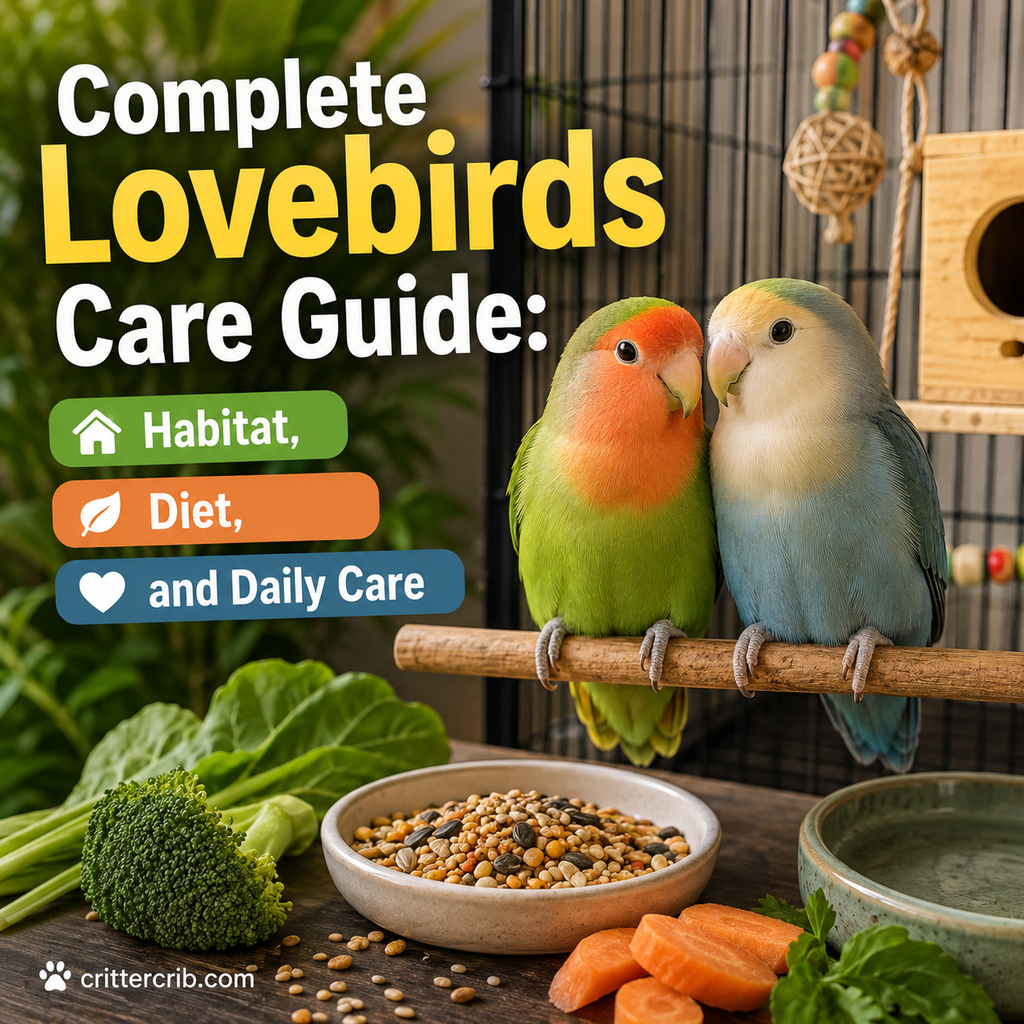
Lovebirds have a reputation for being affectionate, colorful little parrots, but there’s much more to caring for them than their name suggests.
They’re active, intelligent, social birds that need space to move, things to chew and explore, a balanced diet, regular interaction, and a predictable daily routine. They’re also surprisingly bold for their size. A well-socialized lovebird can have enough personality to make you forget you’re dealing with such a small bird.
That combination makes lovebirds wonderful companions for the right household, but they aren’t necessarily low-maintenance pets.
Whether you’re preparing for your first lovebird or trying to improve your current setup, this guide covers the essentials: habitat, cage size, diet, social needs, enrichment, sleep, cleaning, grooming, and everyday care.
Lovebirds at a Glance
Lovebirds belong to the genus Agapornis and are native to Africa and nearby regions.
Several species are kept as pets, with peach-faced, Fischer’s, and masked lovebirds among the most familiar.
Although individual birds vary, lovebirds are generally:
- Active and energetic
- Highly social
- Curious and intelligent
- Strong chewers
- Vocal
- Playful
- Capable of forming close social bonds
- Small but confident parrots
Most lovebirds measure roughly 5 to 7 inches long, depending on the species.
Their small size can be misleading. They still require many of the same basic care considerations as larger parrots, just on a smaller scale.
How Long Do Lovebirds Live?
A lovebird isn’t a short-term commitment.
With appropriate care, many pet lovebirds can live around 10 to 15 years, and some may live longer.
Genetics, nutrition, veterinary care, exercise, housing, and overall environment can all influence lifespan.
Before bringing one home, consider whether you’re prepared to provide consistent care for potentially well over a decade.
What Kind of Cage Does a Lovebird Need?
If you’re preparing an enclosure from scratch, our lovebird habitat setup guide goes deeper into cage size, bar spacing, perches, toys, food and water placement, enrichment, and choosing a safe location in your home.
For a single lovebird, a cage around 24 inches wide by 18 inches deep by 24 inches high is a reasonable minimum starting point. Larger is preferable whenever practical.
For two lovebirds, provide substantially more room.
A cage around 30 to 36 inches wide or larger gives a pair more opportunities to move around and get some distance from each other when they choose.
Prioritize Width Over Height
A tall, narrow cage may look large without providing much useful movement space.
Lovebirds benefit from horizontal room.
When comparing cages, prioritize:
- Width
- Depth
- Appropriate bar spacing
- Useful height
Your bird should be able to fully extend its wings without hitting the cage sides, perches, or toys.
Lovebird Cage Bar Spacing
For most lovebirds, approximately 1/2-inch bar spacing is a good target.
Avoid cages with gaps intended for larger parrots. A lovebird may attempt to squeeze its head through excessively wide spacing, creating a serious safety hazard.
Always check the actual bar spacing before purchasing.
Where Should You Put a Lovebird Cage?
Lovebirds are social and generally enjoy being where they can observe household activity.
A living room, family room, or home office may work well, depending on your routine.
Choose a location that provides social contact without constant disruption.
Avoid placing the cage:
- Directly beside heating or air-conditioning vents
- In persistent drafts
- In intense direct sunlight without shade
- Beside frequently opened exterior doors
- In areas where other pets can constantly approach the cage
- In the kitchen
Why the Kitchen Is a Poor Location
Birds have sensitive respiratory systems.
Cooking can produce smoke, fumes, steam, and airborne particles. Overheated cookware or appliances containing certain nonstick coatings can also release fumes that are extremely dangerous to birds.
Keeping your lovebird away from the kitchen is the safer choice.
Give the Cage Some Security
Many birds feel more comfortable when at least one side of their cage is positioned near a wall.
This allows them to observe the room without feeling exposed from every direction.
How to Set Up a Lovebird Cage
A good cage setup should be interesting without being cluttered.
Lovebirds need opportunities to climb, chew, forage, play, and rest, but they also need open space to move.
Include:
- Several appropriately sized perches
- Food and water dishes
- Chewable toys
- Foraging opportunities
- Climbing toys
- A swing if your bird enjoys one
- An open area for wing stretching and movement
Don’t fill every available inch.
A huge collection of toys isn’t useful if your bird has to squeeze around them just to reach its food.
Choosing Perches for Lovebirds
Perches aren’t simply furniture.
Your lovebird spends a large portion of its life standing on them, so variety matters.
Natural wood perches are useful because branches naturally vary in diameter and texture.
Provide several perch sizes appropriate for your bird’s feet.
You can also use certain bird-safe manufactured perches for additional variety.
Avoid relying entirely on identical smooth dowels.
Perch Placement Matters
Arrange perches so your lovebird has multiple locations to sit without blocking the entire cage.
Avoid putting a perch directly above:
- Food dishes
- Water dishes
- Frequently used toys
Otherwise, droppings can quickly contaminate those areas.
A comfortable higher perch can also provide a preferred resting or sleeping location.
What Should Lovebirds Eat?
For a deeper look at pellets, seeds, vegetables, fruit, treats, unsafe foods, and feeding routines, see our complete lovebird feeding guide.
A lovebird’s everyday diet can include a combination of:
- High-quality formulated pellets
- Fresh vegetables
- Leafy greens
- Smaller amounts of appropriate fruit
- Limited seeds and healthy treats
Exact proportions can vary depending on the bird and the recommendations of your avian veterinarian.
Pellets
A quality formulated pellet can provide a more consistent nutritional foundation than allowing a bird to select only its favorite seeds.
If your lovebird currently eats an all-seed diet, don’t suddenly remove familiar food and expect the bird to immediately eat pellets.
Diet transitions should be gradual.
Some birds take time to recognize new foods as edible.
Vegetables and Leafy Greens
Fresh produce can add variety and important nutrients.
Depending on what your bird accepts, appropriate options may include:
- Bell pepper
- Carrot
- Broccoli
- Dark leafy greens
- Peas
- Squash
- Green beans
Wash fresh produce thoroughly and remove leftovers before they spoil.
Offering vegetables repeatedly can be worthwhile even if your lovebird initially ignores them.
Parrots can be suspicious of unfamiliar foods.
Fruit
Fruit can be offered in moderation.
Because many fruits contain considerable natural sugar, they generally shouldn’t make up the majority of the fresh-food portion of the diet.
Small pieces of suitable fruits can provide variety.
Seeds
Lovebirds enjoy seeds, and seeds can still have a place in their diet.
The problem comes when a bird eats little else.
Seeds are often highly appealing, which means a lovebird offered unlimited access may selectively eat favorite high-fat seeds while ignoring more nutritious foods.
Seeds can be particularly useful as training rewards or controlled treats.
Foods Lovebirds Should Never Eat
Some human foods are unsafe for birds.
Avoid giving your lovebird:
- Avocado
- Chocolate
- Alcohol
- Caffeine
- Foods containing excessive salt
- Highly processed sugary foods
- Foods containing unsafe ingredients or seasonings
Also be cautious with fruit pits and seeds from certain fruits.
If you’re unsure whether a particular food is safe, check with an avian veterinarian before offering it.
Fresh Water Is Essential
Your lovebird should always have access to fresh, clean drinking water.
Change the water at least daily and sooner if it becomes contaminated.
Lovebirds may drop:
- Food
- Toy fragments
- Feathers
- Droppings
into open water dishes.
Wash the container regularly instead of simply adding fresh water on top of old water.
Do Lovebirds Need Cuttlebone or Mineral Blocks?
Cuttlebones and mineral products are commonly marketed for pet birds.
Whether your particular bird requires additional supplementation depends on its overall diet and individual needs.
A cuttlebone may provide calcium and an additional object to peck at, but it isn’t a substitute for balanced nutrition.
Avoid adding multiple vitamin or mineral supplements without a reason.
Excessive supplementation can create its own problems.
Discuss nutritional supplements with an avian veterinarian, especially for egg-laying females or birds with specific dietary concerns.
Do Lovebirds Need a Companion?
This is one of the most common questions about lovebird care.
Despite their name, a lovebird doesn’t automatically need to be kept as part of a bonded pair.
A single lovebird can live successfully when it receives substantial daily social interaction, enrichment, and attention.
However, lovebirds are highly social animals.
If you keep one alone, you become an important part of its social environment.
Keeping Two Lovebirds
A compatible pair can provide each other with social interaction throughout the day.
They may:
- Vocalize together
- Play
- Preen one another
- Rest near each other
- Explore their environment together
But keeping two birds doesn’t eliminate your responsibilities.
They still need proper housing, enrichment, cleaning, nutrition, observation, and veterinary care.
Not Every Pair Gets Along
Never assume that two lovebirds will automatically become friends.
Introductions should be gradual.
A new bird may also need an appropriate quarantine period before being introduced to an existing bird. Ask your avian veterinarian about quarantine procedures and health screening.
Separate cages may be necessary during the introduction process or permanently if the birds aren’t compatible.
Do Lovebirds Bond With People?
Yes.
A well-socialized lovebird can form a strong relationship with a person.
Some lovebirds enjoy:
- Sitting on a shoulder
- Stepping onto a hand
- Training sessions
- Exploring near their owner
- Gentle head scratches
- Interactive play
Personality varies considerably, though.
Some birds are naturally more independent or less interested in being touched.
Don’t force physical affection.
Trust develops more effectively when your bird has some control over interactions.
How Much Attention Do Lovebirds Need?
Lovebirds aren’t decorative cage pets.
A single lovebird in particular needs regular social engagement.
Plan to interact with your bird every day through some combination of:
- Training
- Talking
- Supervised play
- Out-of-cage activity
- Foraging activities
- Simply spending time nearby
You don’t have to entertain the bird every waking minute.
Teaching a lovebird to interact independently with toys and enrichment is healthy, too.
The goal is a balanced environment with both social interaction and opportunities for independent activity.
How Much Out-of-Cage Time Do Lovebirds Need?
Regular out-of-cage activity provides exercise, mental stimulation, and social opportunities.
When possible, give your lovebird several hours of supervised time outside its cage each day.
The exact amount will depend on your household and bird, but the cage shouldn’t be the only environment your lovebird experiences.
A large cage is beneficial, but it doesn’t replace exercise.
Bird-Proof the Room First
Before opening the cage, make sure the environment is safe.
Check for:
- Open windows
- Open exterior doors
- Moving ceiling fans
- Hot surfaces
- Open flames
- Electrical cords
- Toxic plants
- Unsafe household chemicals
- Other pets
- Open toilets or deep containers of water
- Small objects the bird might chew or swallow
Close windows and doors before releasing your lovebird.
Never assume a bird with clipped wings can’t escape. Flight feathers can regrow, and even partially flighted birds may travel farther than expected.
Lovebird Toys and Enrichment
Lovebirds are active chewers.
If you don’t provide appropriate things to destroy, your bird may select something you would rather keep intact.
Useful enrichment can include:
- Shreddable toys
- Bird-safe wood
- Paper-based toys
- Foraging toys
- Swings
- Climbing ropes made from appropriate materials
- Bells designed safely for birds
- Natural branches
Inspect toys regularly.
Remove anything that becomes damaged in a way that could trap toes, entangle the bird, or expose unsafe materials.
Rotate Toys Instead of Overcrowding the Cage
You don’t need 20 toys hanging inside the cage simultaneously.
Keep a manageable selection available and rotate appropriate toys periodically.
Rotation can make familiar objects interesting again while preserving open space.
Foraging Is Important
Wild parrots spend substantial time searching for food.
A bowl filled with food takes only a few minutes to investigate.
Simple foraging activities can give your lovebird something productive to do.
You might:
- Hide small amounts of appropriate food in bird-safe paper
- Use beginner-friendly foraging toys
- Place healthy foods in different safe locations
- Encourage the bird to manipulate objects to obtain treats
Start easy.
If a puzzle is so difficult that your bird never succeeds, it isn’t providing useful enrichment.
How Much Sleep Do Lovebirds Need?
Lovebirds benefit from a consistent sleep schedule.
Aim for roughly 10 to 12 hours of quiet, uninterrupted darkness each night.
A bird kept in a living room where lights, televisions, and conversations continue late into the night may not receive enough rest.
If necessary, consider:
- Moving the cage to a quieter room at night
- Using an appropriate cage cover
- Using a separate sleeping cage
A cover isn’t mandatory if the room is already dark and quiet.
Whatever method you choose, maintain adequate ventilation.
Should Lovebirds Have a Nest or Sleeping Hut?
A nest isn’t required for normal sleep.
Lovebirds can sleep comfortably on perches.
Providing enclosed nests, huts, or nesting materials may encourage hormonal and breeding behavior in some birds.
Certain fabric huts can also create safety concerns if a bird chews loose fibers or becomes entangled.
Don’t assume your lovebird needs a tiny bedroom simply because a product is marketed as a bird bed.
A secure sleeping perch in an appropriate environment is generally sufficient.
Bathing and Grooming
Many lovebirds enjoy bathing.
You can offer a shallow bird bath or another safe bathing opportunity several times per week or according to your bird’s preferences.
Use plain clean water.
Bird shampoo isn’t normally necessary.
Bathing helps birds maintain their feathers and provides another form of enrichment.
Nail Care
Lovebird nails naturally grow and may eventually become too long.
Appropriate natural perches can help provide normal wear, but they don’t guarantee that trimming will never be needed.
If you’re unsure how to trim nails safely, have an avian veterinarian or experienced professional show you.
Avoid attempting aggressive trimming without knowing where the blood supply inside the nail is located.
Beak Care
A healthy lovebird normally maintains its beak through eating, chewing, climbing, and normal use.
Bird-safe wood and chewable materials provide useful opportunities for beak activity.
An overgrown or unusually shaped beak can sometimes indicate an underlying problem.
Don’t attempt to reshape the beak yourself. Have an avian veterinarian evaluate it.
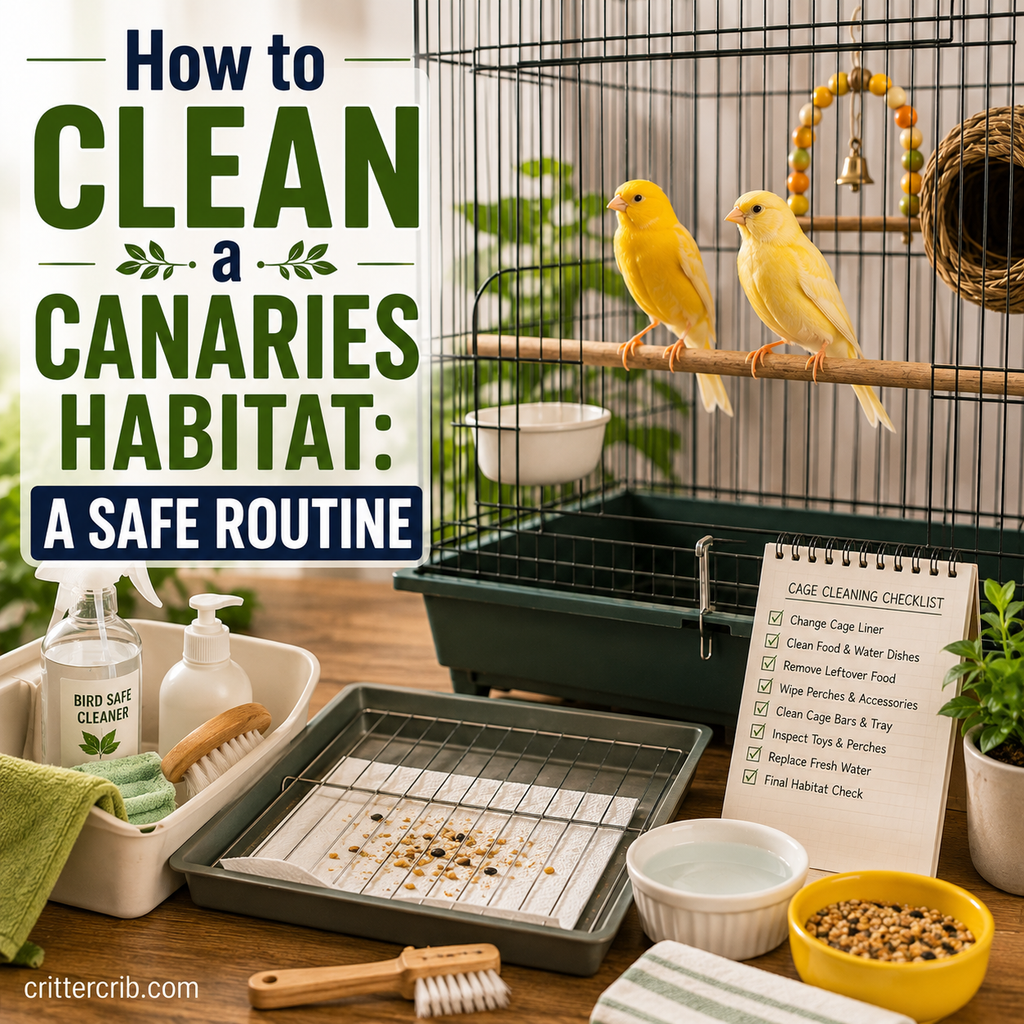
How Often Should You Clean a Lovebird Cage?
A little daily cleaning prevents the cage from becoming a major project.
Daily
Try to:
- Replace drinking water
- Remove spoiled fresh food
- Check food dishes
- Remove obvious debris
- Inspect the cage liner
- Check toys and perches for hazards
Several Times Per Week
Depending on how messy your bird is:
- Replace cage liners
- Wash dirty dishes
- Wipe obvious buildup from cage surfaces
- Clean heavily soiled perches
Regular Deep Cleaning
Periodically give the entire enclosure a more thorough cleaning.
Clean:
- Cage bars
- Bottom tray
- Grate
- Perches
- Toys where appropriate
- Food and water containers
- Areas underneath and around the cage
Use bird-safe cleaning methods and rinse surfaces thoroughly when necessary.
Avoid exposing your lovebird to harsh fumes or aerosolized cleaning products.
Lovebird Daily Care Routine
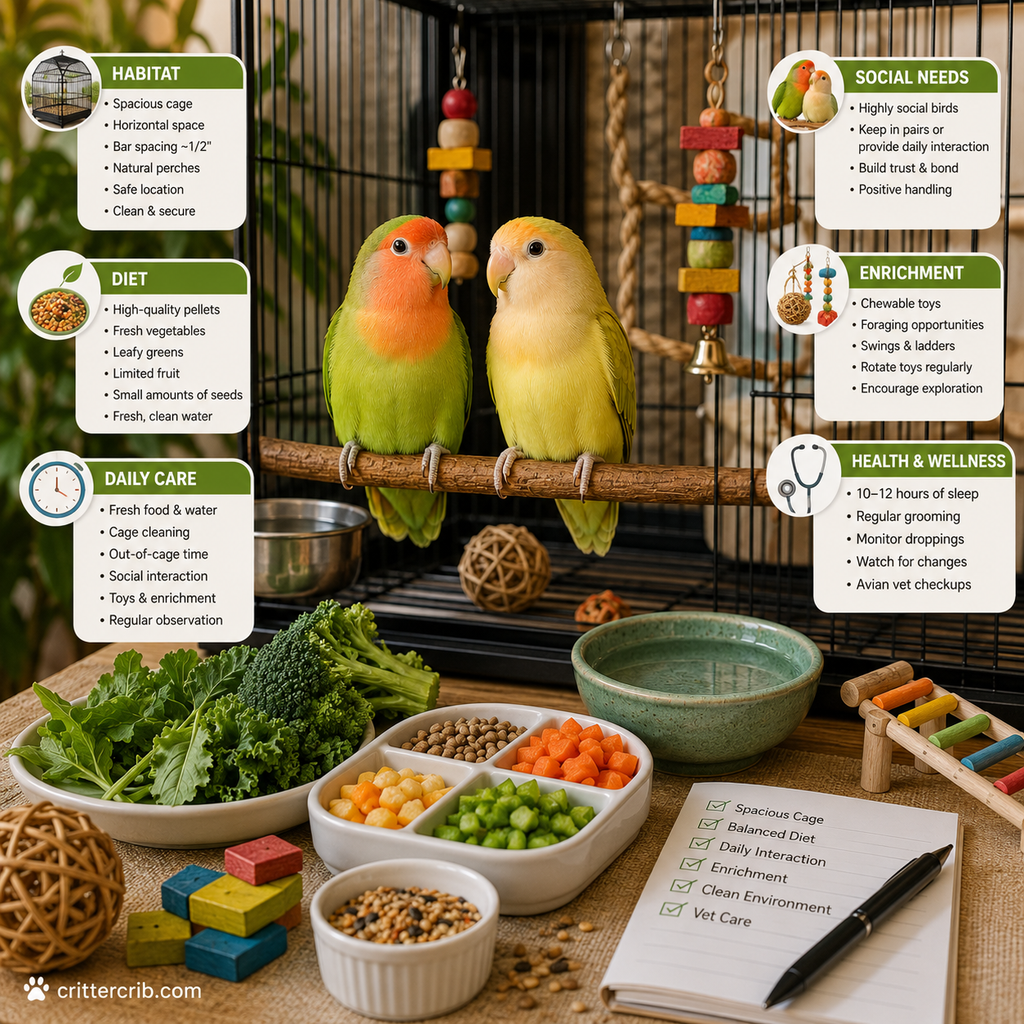
Lovebird care becomes much easier when it follows a predictable routine.
A typical day might look something like this.
Morning
- Uncover or wake your bird
- Replace drinking water
- Check food
- Offer fresh vegetables or greens
- Inspect droppings and cage condition
- Spend a few minutes observing behavior
During the Day
- Provide social interaction
- Allow safe supervised out-of-cage activity
- Offer enrichment or foraging
- Encourage movement and exercise
- Check that food and water remain available
Evening
- Remove spoiled fresh foods
- Perform basic cage cleanup
- Spend quiet social time together
- Make sure the sleeping environment is comfortable
- Maintain a consistent bedtime
The routine doesn’t need to happen at exactly the same minute every day.
Consistency simply helps you remember essential care while giving your bird a predictable environment.
Signs of a Healthy Lovebird
Learning your bird’s normal behavior is one of the most useful things you can do. Our guide to signs that your lovebird is happy and comfortable takes a closer look at relaxed body language, vocalizations, play, preening, curiosity, social behavior, and other signs of comfort.
A healthy lovebird will typically be alert and responsive during its active periods.
Normal behaviors may include:
- Eating regularly
- Drinking normally
- Climbing
- Playing
- Chewing
- Vocalizing
- Preening
- Exploring
- Interacting socially
- Resting comfortably
Individual personalities vary.
One lovebird may chatter constantly while another is naturally quieter.
Changes from your bird’s normal routine are often more informative than comparing it with someone else’s bird.
Signs Your Lovebird May Be Sick
Birds can sometimes hide illness until they’re significantly unwell.
Take sudden behavioral or physical changes seriously.
Potential warning signs include:
- Staying puffed up for long periods
- Unusual daytime sleepiness
- Loss of appetite
- Significant changes in droppings
- Weakness
- Difficulty balancing
- Sitting on the cage floor
- Labored breathing
- Pronounced tail bobbing while breathing
- Discharge around the eyes or nostrils
- Repeated vomiting
- Sudden dramatic changes in behavior
These symptoms can have many possible causes.
Don’t try to diagnose a sick lovebird from an online symptom list.
Contact an avian veterinarian promptly when you’re concerned.
Find an Avian Veterinarian Before You Need One
Don’t wait for an emergency to discover that your nearest veterinary clinic doesn’t treat birds.
Find an avian veterinarian or veterinarian experienced with birds before bringing your lovebird home.
Save:
- Clinic name
- Phone number
- Address
- Normal opening hours
- Emergency instructions
Regular wellness examinations can also help establish a health baseline and give you an opportunity to discuss nutrition, weight, grooming, and preventive care.
Common Lovebird Care Mistakes
Even well-intentioned owners can make mistakes when they’re starting out. Our guide to common lovebird care mistakes and how to avoid them goes deeper into problems involving cage size, diet, enrichment, sleep, cleaning, veterinary care, and other everyday husbandry issues.
Here are some of the most common ones.
Choosing Too Small a Cage
Lovebirds need room to move.
Buy the largest appropriately designed cage you can reasonably accommodate rather than the smallest enclosure advertised for the species.
Feeding Only Seeds
Lovebirds may love seed mixtures, but preference doesn’t equal nutritional completeness.
Work toward a varied, balanced diet.
Providing Too Little Enrichment
A bored parrot will find something to do.
You may not appreciate what it chooses.
Provide chewing, foraging, climbing, and exploration opportunities.
Assuming a Pair Doesn’t Need Attention
Two lovebirds may entertain each other, but they still depend on you for care, enrichment, observation, and a safe environment.
Keeping the Cage in the Kitchen
Cooking fumes and other airborne hazards make kitchens inappropriate permanent housing areas for birds.
Forcing Interaction
Chasing, grabbing, or repeatedly touching a frightened bird can damage trust.
Use gradual positive interactions instead.
Ignoring Small Behavioral Changes
You see your bird every day.
If something suddenly seems different, pay attention.
Changes in appetite, activity, droppings, breathing, posture, or vocalization can provide useful clues that something is wrong.
Beginner Lovebird Supplies Checklist
Before bringing your bird home, have the basics ready.
Essential Supplies
- Spacious cage with appropriate bar spacing
- Natural perches
- Food dishes
- Water dish or dispenser
- Quality lovebird food
- Fresh-food supplies
- Chewable toys
- Foraging toys
- Cage liners
- Cleaning supplies
- Secure travel carrier
Helpful Extras
- Bird bath
- Swing
- Spare food and water dishes
- Play stand
- Food storage containers
- Training treats
- Small gram scale for monitoring weight
A gram scale can be particularly useful because weight changes may be difficult to notice visually in a feathered bird.
Frequently Asked Questions About Lovebird Care
Are lovebirds good pets for beginners?
Lovebirds can be good pets for committed beginners who are willing to learn about parrot care. They require daily interaction, enrichment, cleaning, proper nutrition, and regular veterinary care, so they shouldn’t be considered low-maintenance pets.
Can you keep one lovebird by itself?
Yes. A single lovebird can do well when it receives plenty of appropriate social interaction and enrichment. Because lovebirds are social animals, an owner keeping one bird should be prepared to provide regular companionship.
Do lovebirds need to be kept in pairs?
No. They don’t absolutely have to live in pairs. Compatible pairs can benefit from each other’s companionship, but a well-cared-for single lovebird can also thrive.
What size cage does a lovebird need?
For one lovebird, approximately 24 inches wide by 18 inches deep by 24 inches high is a reasonable minimum starting point. Larger is better, particularly in horizontal width.
What should lovebirds eat every day?
A balanced lovebird diet can include quality formulated pellets as a nutritional foundation along with appropriate vegetables, leafy greens, and controlled amounts of seeds and fruit. Ask an avian veterinarian for recommendations tailored to your individual bird.
How much attention does a lovebird need?
Lovebirds benefit from daily social interaction and mental stimulation. A single lovebird generally requires particularly consistent interaction because it doesn’t have another lovebird providing companionship throughout the day.
How long should a lovebird sleep?
Aim for roughly 10 to 12 hours of quiet, uninterrupted darkness each night.
Do lovebirds need baths?
Regular opportunities to bathe are beneficial. Many lovebirds enjoy bathing in shallow clean water and will groom themselves afterward.
Are lovebirds noisy?
Lovebirds can be quite vocal despite their small size. They chirp, chatter, call, and may produce sharp vocalizations, especially when excited or seeking attention. They’re generally not silent apartment pets.
How long can lovebirds live?
Many pet lovebirds live around 10 to 15 years with appropriate care, and some can live longer. Bringing one home should be considered a long-term commitment.
Final Thoughts
Lovebirds pack a remarkable amount of personality into a very small parrot.
Their basic needs aren’t complicated, but they do require consistency.
Provide a spacious cage, balanced nutrition, clean water, varied perches, safe chewing opportunities, daily enrichment, regular exercise, social interaction, adequate sleep, and routine veterinary care.
Just as importantly, pay attention to the individual bird in front of you.
You’ll gradually learn which foods your lovebird gets excited about, which toys it destroys first, where it prefers to sleep, how it asks for attention, and what its normal daily rhythm looks like.
That familiarity isn’t just part of building a relationship. It also makes you much more likely to notice when something changes.
With the right environment and attentive daily care, a lovebird can be an active, entertaining companion for many years.