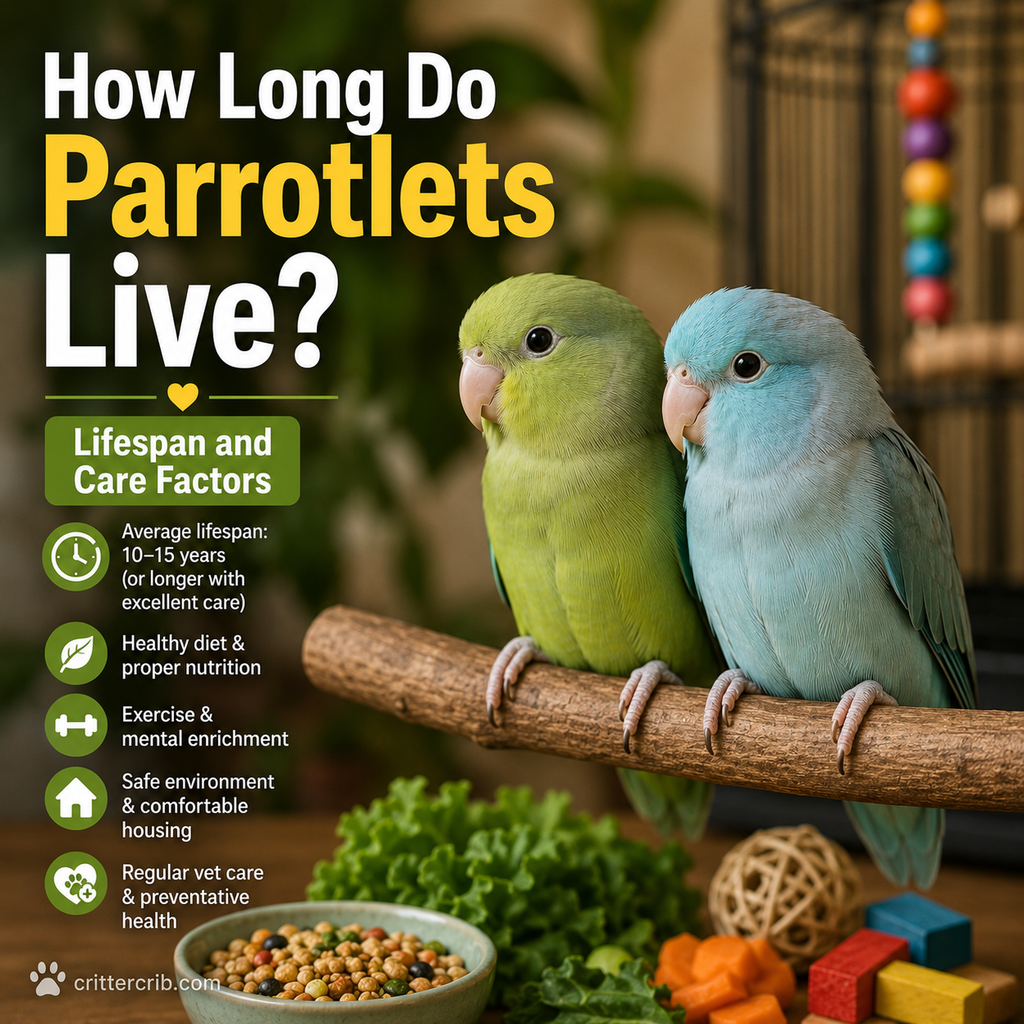
Parrotlets may be among the smallest parrots kept as pets, but they’re anything but a short-term commitment. These tiny, energetic birds can potentially share your home for well over a decade.
So, how long do parrotlets live?
A pet parrotlet can commonly live around 10 to 15 years, while some well-cared-for birds may reach 15 to 20 years or potentially longer. There’s considerable individual variation, and no particular age is guaranteed.
Genetics play a role, but everyday care matters too. Diet, exercise, body weight, sleep, cage setup, mental stimulation, household safety, and access to an avian veterinarian can all influence a bird’s health and quality of life.
If you already have a parrotlet—or you’re considering bringing one home—here’s what you should know about their lifespan and the factors that can help support a long, healthy life.
What Is the Average Lifespan of a Parrotlet?
A reasonable expectation for many pet parrotlets is roughly 10 to 15 years.
However, lifespan estimates vary depending on the species and source, and individual birds can fall outside that range.
Some parrotlets don’t reach 10 because of illness, accidents, poor nutrition, genetic problems, or other health issues. Others remain active and healthy into their late teens.
Occasionally, you’ll hear about birds living even longer.
Rather than viewing a specific number as a guarantee, think of parrotlet lifespan as a broad range influenced by both genetics and care.
Can Parrotlets Live 20 Years?
Yes, it’s possible for some parrotlets to reach around 20 years of age.
That would represent a long life rather than something every owner should expect.
A bird’s potential longevity depends on many factors, including:
- Genetics
- Breeding history
- Nutrition
- Exercise
- Body condition
- Veterinary care
- Housing
- Stress
- Disease
- Accidents
- Exposure to household toxins
There’s also an element of chance.
You can provide excellent care without being able to guarantee that a particular bird will reach 15 or 20.
Do Parrotlets Live Longer in Captivity?
Pet parrotlets have several advantages that wild birds don’t.
They generally have consistent access to:
- Food
- Clean water
- Shelter
- Stable temperatures
- Protection from predators
- Veterinary treatment
They also don’t have to spend their lives searching for resources or escaping predators.
But captivity introduces different risks.
Pet birds may encounter poor diets, obesity, lack of exercise, household toxins, other pets, accidents, and inappropriate housing.
Captivity creates the potential for a long life. Good care is what helps make that potential possible.
Which Parrotlet Species Are Commonly Kept as Pets?
Several parrotlet species exist, although the Pacific parrotlet is among the most commonly kept companion species.
Another species you may encounter is the green-rumped parrotlet.
Lifespan estimates can vary somewhat between species, individuals, and breeding lines.
If you know exactly which parrotlet species you have, discuss species-specific health and care needs with an avian veterinarian.
What Determines How Long a Parrotlet Lives?
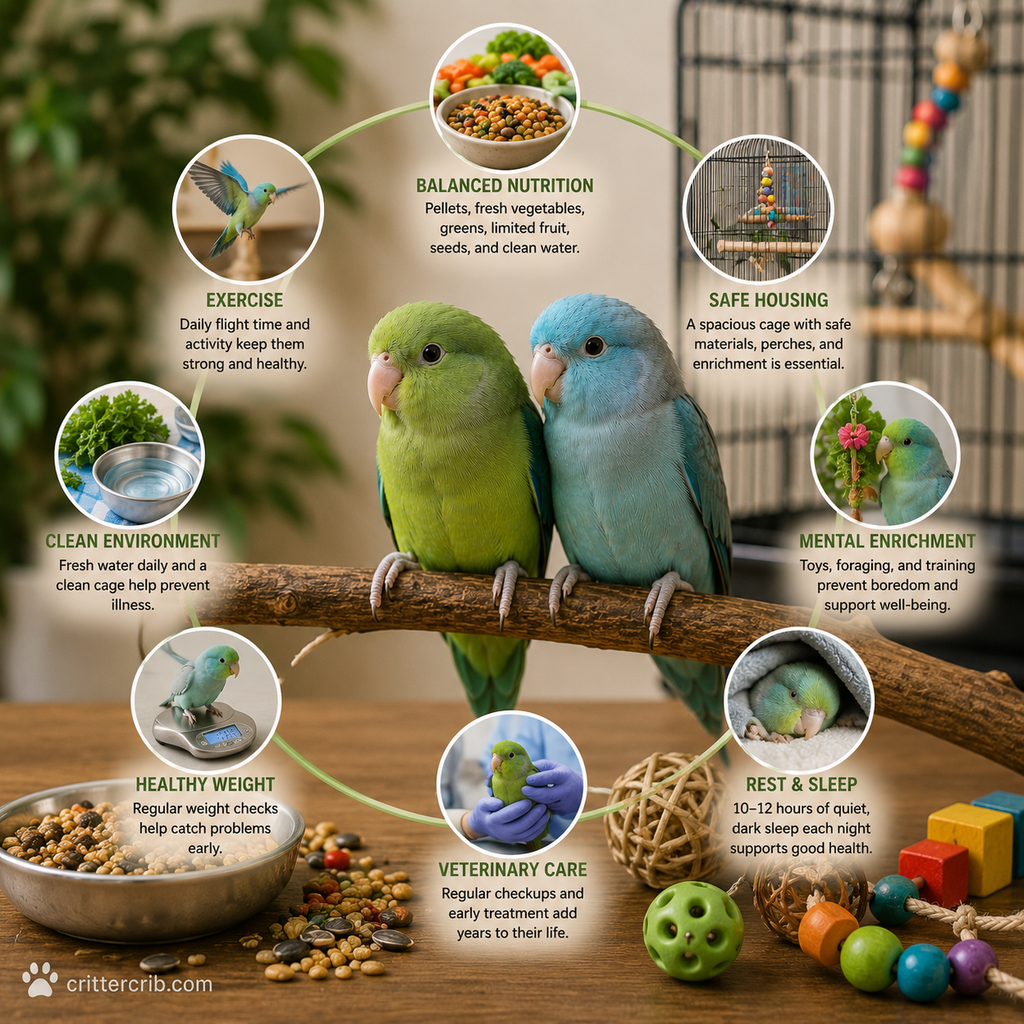
There’s no single trick for making a parrotlet live longer.
Longevity is influenced by multiple factors working together.
Some of the most important include:
- Genetics
- Balanced nutrition
- Healthy body weight
- Regular exercise
- Appropriate housing
- Mental enrichment
- Social interaction
- Consistent sleep
- Good air quality
- Household safety
- Preventive veterinary care
- Early treatment of illness
You can’t control every one of these factors, but you can control many of them.
Genetics and Breeding Can Affect Longevity
Two parrotlets raised in nearly identical homes may still experience very different health outcomes.
Genetics matter.
Responsible breeding aims to produce healthy birds rather than selecting solely for appearance, color, or quantity.
If you’re purchasing a young parrotlet from a breeder, consider asking about:
- Parent health
- Age of the parents
- Known hereditary problems
- Veterinary history
- Breeding practices
- How chicks are raised and weaned
A high purchase price doesn’t automatically mean a bird is genetically healthier.
Look at the quality of care and breeding practices rather than price alone.
Nutrition Plays a Major Role in Long-Term Health
Diet is one of the areas where owners have considerable influence.
Parrotlets need more than an unlimited bowl of seeds.
Seeds can be part of a diet, but relying on them exclusively may result in nutritional imbalances and excessive fat intake.
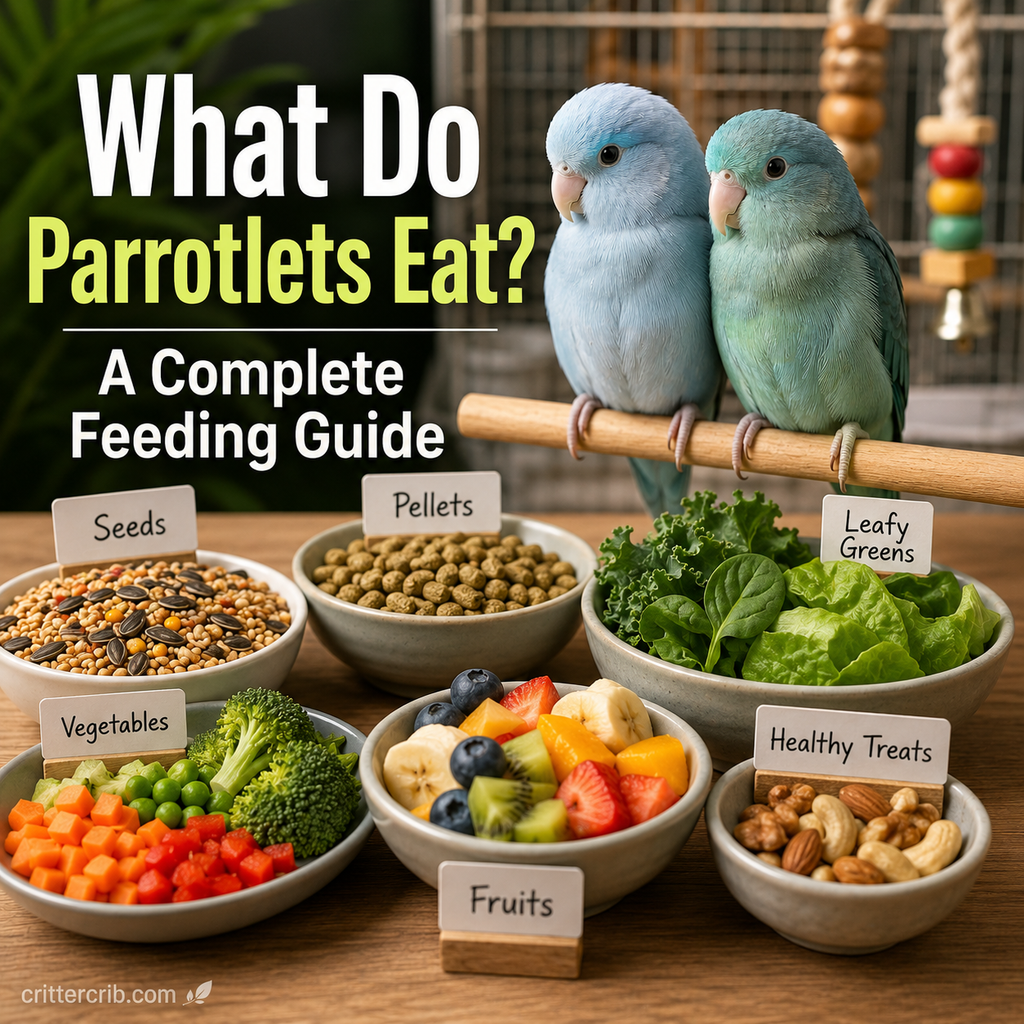
A balanced diet for many pet parrotlets may include:
- An appropriate formulated pellet
- Fresh vegetables
- Leafy greens
- Limited fruit
- Appropriate portions of seeds
- Small amounts of suitable nuts
- Fresh water
Your avian veterinarian can recommend proportions based on your individual bird.
Avoid Sudden Diet Changes
If your parrotlet currently eats only seeds, don’t remove them one morning and replace the bowl with pellets.
Your bird may not recognize the new food as edible.
Small birds can become seriously ill if they stop eating.
Diet conversions should happen gradually while you monitor food intake and body weight.
Keep Your Parrotlet at a Healthy Weight
Parrotlets are tiny.
That means a weight change that looks insignificant to us can represent a meaningful percentage of the bird’s total body weight.
Obesity may contribute to long-term health problems, while unexplained weight loss can be an early warning sign of illness.
A small digital gram scale can be useful for monitoring trends.
Ask your avian veterinarian:
- What your bird should weigh
- How to assess body condition
- How often to weigh your bird
- What amount of change is concerning
Don’t compare your parrotlet with a random weight from the internet and assume something is wrong.
Individual body size varies.
Changes from your bird’s normal baseline are often more useful.
Exercise Is Important for Parrotlet Health
Parrotlets are energetic little parrots.
A bird that spends nearly its entire life sitting on one perch isn’t getting much opportunity for physical activity.
A good environment should encourage:
- Flying
- Climbing
- Playing
- Foraging
- Moving between perches
- Exploring
Choose a cage that provides plenty of usable horizontal space.
Supervised out-of-cage time in a properly bird-proofed room can provide additional exercise and stimulation.
Don’t Let the Cage Become the Bird’s Entire World
Even a good cage has limits.
When it’s safe and practical, regular supervised time outside the cage allows your parrotlet to move more naturally and interact with its surroundings.
Provide safe destinations such as:
- Play stands
- Natural perches
- Training stations
- Bird-safe climbing areas
Before letting your bird out, secure the room.
A few minutes of bird-proofing can prevent an accident that permanently affects lifespan.
Household Accidents Are a Serious Risk
Some threats to parrotlet longevity have nothing to do with disease.
These birds are extremely small and can get into dangerous situations quickly.
Common household hazards include:
- Open windows
- Exterior doors
- Ceiling fans
- Hot stovetops
- Boiling water
- Open toilets
- Deep water containers
- Electrical cords
- Toxic plants
- Small gaps
- Reclining furniture
- Heavy objects
- Dogs and cats
Never assume your bird understands that something is dangerous.
Supervision matters.
Cats and Dogs Should Be Kept Separate
A dog or cat that has always behaved calmly around your parrotlet can still injure it in seconds.
Predatory behavior can be instinctive.
Even playful contact can be dangerous to such a small bird.
Keep other pets securely separated during out-of-cage time.
Don’t allow a cat to sit on top of the cage or repeatedly stalk the bird through the bars.
The absence of an attack doesn’t necessarily mean the situation isn’t stressful.
Air Quality Can Affect Parrotlet Health
Bird respiratory systems are highly efficient and sensitive to airborne contaminants.
Potential household hazards include:
- Cigarette smoke
- Vaping aerosols
- Aerosol sprays
- Scented candles
- Incense
- Essential oil diffusers
- Paint fumes
- Strong cleaning chemicals
- Cooking smoke
- Overheated nonstick cookware
Don’t keep your parrotlet in the kitchen.
Cooking areas contain too many potential hazards, including fumes, heat, hot surfaces, and boiling liquids.
Clean air should be treated as a basic part of bird care.
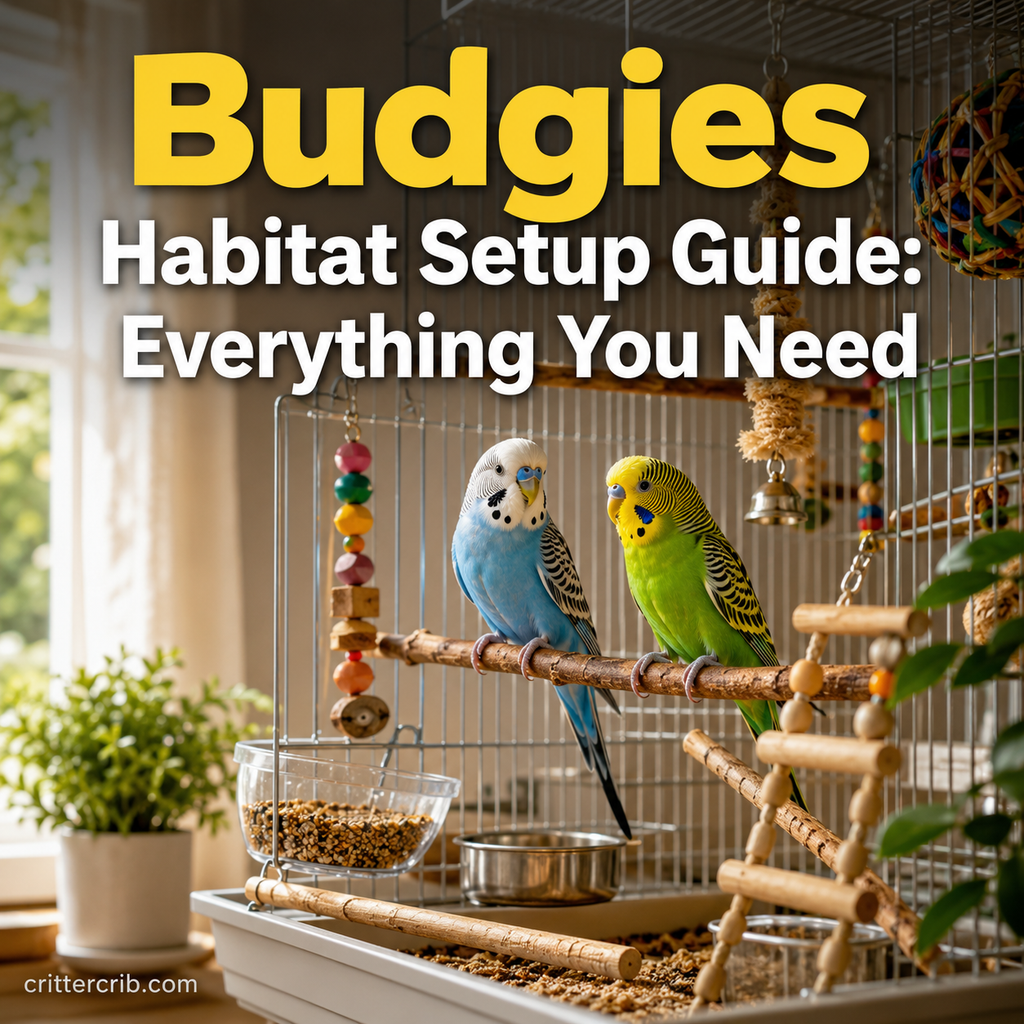
Provide an Appropriate Cage
A parrotlet’s cage needs to provide both security and activity.
Despite the bird’s tiny size, avoid miniature cages.
A good cage should offer:
- Horizontal movement space
- Safe bar spacing
- Secure doors
- Bird-safe materials
- Multiple perches
- Food and water stations
- Toys
- Foraging opportunities
- Open space for movement
Approximately 1/2-inch bar spacing or smaller is generally appropriate for these tiny parrots, although you should inspect the entire cage for larger gaps around doors and feeding ports.
Bigger is usually better as long as the bar spacing and design remain safe.
Use Appropriate Perches
Your parrotlet spends a great deal of time standing.
Avoid relying exclusively on smooth dowel perches of identical diameter.
Instead, provide appropriately sized natural bird-safe perches with varied shapes and diameters.
This creates more natural foot positions and also makes moving around the cage more interesting.
Arrange perches so they don’t:
- Block movement
- Sit directly above food dishes
- Force the bird’s tail against cage bars
- Create overcrowding
A thoughtful layout is more useful than simply adding as many perches as possible.
Mental Enrichment Matters
Parrotlets are intelligent.
A cage containing food, water, and one perch may technically keep a bird alive, but it doesn’t provide much of a life.
Give your parrotlet opportunities to:
- Chew
- Shred
- Forage
- Climb
- Explore
- Solve simple problems
- Train
- Play
Rotate some toys periodically while leaving familiar favorites available.
Inspect toys regularly for loose threads, sharp edges, broken pieces, or other hazards.
Social Interaction Supports Quality of Life
Parrotlets are social parrots.
A single bird may develop a close relationship with people and benefit from daily interaction.
That doesn’t mean you need to entertain your bird every waking minute.
A healthy routine can include:
- Talking
- Training
- Playing
- Supervised out-of-cage time
- Independent toy play
- Foraging
- Quiet time near you
If you keep multiple birds, make sure they’re compatible and have enough space and resources.
Don’t assume two parrotlets will automatically become friends.
Sleep Is Part of Good Parrotlet Care
Sleep often gets overlooked when people think about bird health.
Many parrots benefit from approximately 10 to 12 hours of quiet, dark, uninterrupted rest each night.
A bird kept in the living room while televisions, lights, and conversations continue until late at night may not have a consistent sleep schedule.
Create a predictable nighttime routine.
A cage cover can be useful in some homes, but it isn’t mandatory if the room already becomes appropriately dark and quiet.
Make sure any cover allows adequate ventilation and can’t become an entanglement hazard.
Stable Temperature and Humidity Help Keep Parrotlets Comfortable
Healthy parrotlets generally do well at comfortable household temperatures.
Avoid:
- Sudden temperature changes
- Cold drafts
- Direct airflow from vents
- Excessive heat
- Constantly dry air
- Extremely humid conditions
The cage shouldn’t sit directly beside an air conditioner, heater, or drafty exterior door.
If your parrotlet is elderly, sick, very young, or recovering from illness, ask your avian veterinarian whether it needs different environmental conditions.
Cage Hygiene Matters
A dirty cage can expose your bird to spoiled food, mold, excessive waste, and other problems.
Basic maintenance should include:
- Fresh water daily
- Clean food dishes
- Removal of spoiled fresh food
- Regular cage-liner changes
- Cleaning dirty perches
- Removing accumulated droppings
- Periodic deeper cage cleaning
Use cleaning methods that don’t expose your bird to strong fumes.
Clean doesn’t need to smell like perfume.
Veterinary Care Can Make a Big Difference
Don’t wait until your parrotlet is obviously sick to start searching for a veterinarian.
Find an avian veterinarian when your bird is healthy.
An initial examination can establish a health baseline and give you an opportunity to discuss:
- Diet
- Weight
- Body condition
- Housing
- Behavior
- Preventive care
- Appropriate testing
Routine veterinary care becomes particularly important because birds often hide signs of illness.
Learn Your Parrotlet’s Normal Behavior
You see your bird every day.
That puts you in an excellent position to notice subtle changes.
Learn what’s normal for your parrotlet, including:
- Appetite
- Weight
- Activity level
- Droppings
- Vocalizations
- Sleeping habits
- Favorite perches
- Social behavior
A small change doesn’t automatically mean your bird is sick.
But several changes happening together deserve attention.
Signs Your Parrotlet May Be Sick
Possible warning signs include:
- Persistent feather fluffing
- Reduced appetite
- Unexplained weight loss
- Unusual droppings
- Weakness
- Reduced activity
- Sitting on the cage floor
- Difficulty perching
- Open-mouth breathing
- Tail bobbing while breathing
- Discharge around the eyes or nostrils
- Sudden personality changes
Don’t assume a quiet, fluffed-up bird is simply tired.
Contact an avian veterinarian promptly if you’re concerned.
Small birds can deteriorate quickly.
Does a Male or Female Parrotlet Live Longer?
There isn’t a simple rule that male parrotlets always live longer than females or vice versa.
Both can live long, healthy lives.
Females do face reproductive risks that males don’t, particularly those associated with egg production.
A female parrotlet can potentially lay eggs even without a male.
If your bird begins laying repeatedly or shows signs of reproductive difficulty, contact an avian veterinarian.
Do Different Parrotlet Colors Have Different Lifespans?
Color alone isn’t a reliable predictor of lifespan.
Selective breeding can influence genetics, and some breeding lines may have particular health concerns, but you shouldn’t assume that one color automatically lives longer than another.
Health history and responsible breeding practices are much more useful considerations.
How Can You Tell How Old a Parrotlet Is?
Determining the exact age of an adult parrotlet by appearance can be difficult.
If you obtained the bird from a breeder, adoption organization, or previous owner, you may have:
- Hatch records
- Veterinary records
- A dated leg band
- Purchase documentation
Without records, you may only be able to estimate whether a bird is relatively young or mature.
A veterinarian can evaluate general health but usually can’t provide an exact birthday based on appearance alone.
What Happens When a Parrotlet Gets Older?
Aging looks different in every bird.
As your parrotlet becomes a senior, you may notice gradual changes such as:
- Lower activity
- More resting
- Less frequent flying
- Changes in mobility
- Changes in feather quality
- Difficulty gripping certain perches
Don’t automatically attribute every change to old age.
Many signs associated with “getting older” can also be symptoms of treatable medical problems.
Regular veterinary care becomes increasingly useful as your bird ages.
Adjusting the Cage for a Senior Parrotlet
Older birds sometimes benefit from simple cage modifications.
Depending on your bird’s mobility, you may need to:
- Lower favorite perches
- Make food easier to reach
- Add easier routes between cage areas
- Reduce long fall distances
- Provide comfortable perch options
- Move water closer to resting areas
Don’t remove all opportunities for activity.
The goal is to keep your bird moving safely while adapting to its changing abilities.
How to Help Your Parrotlet Live a Long, Healthy Life
There’s no guaranteed formula for longevity.
But you can give your bird a strong foundation.
Focus on these habits:
- Feed a balanced diet.
- Maintain a healthy body weight.
- Provide a spacious, safe cage.
- Encourage regular exercise.
- Offer daily enrichment.
- Provide appropriate social interaction.
- Maintain a consistent sleep schedule.
- Keep the cage clean.
- Protect your bird from fumes and toxins.
- Bird-proof out-of-cage areas.
- Keep cats and dogs separated.
- Establish care with an avian veterinarian.
- Monitor weight and behavior.
- Respond quickly when something changes.
Good bird care isn’t about doing one extraordinary thing.
It’s about doing the ordinary things consistently.
Frequently Asked Questions About Parrotlet Lifespan
How Long Do Parrotlets Usually Live as Pets?
Many pet parrotlets may live around 10 to 15 years.
With excellent care, some can reach 15 to 20 years or potentially longer.
Can Parrotlets Live Longer Than 20 Years?
Exceptional individuals may potentially reach or exceed 20 years, but owners shouldn’t consider that a typical lifespan.
A commitment of 10 to 15 years or more is a more practical expectation when considering ownership.
How Can I Make My Parrotlet Live Longer?
You can’t guarantee lifespan, but you can support long-term health through balanced nutrition, exercise, healthy body weight, enrichment, good sleep, clean air, safe housing, veterinary care, and protection from household accidents.
What Shortens a Parrotlet’s Lifespan?
Potential factors include poor nutrition, obesity, lack of exercise, disease, genetic problems, household accidents, toxic fumes, reproductive complications, and delayed veterinary treatment.
Do Parrotlets Live Longer Alone or in Pairs?
There’s no simple evidence that being single or paired determines lifespan.
What matters is appropriate social interaction.
A single parrotlet needs meaningful companionship and enrichment, while multiple birds need sufficient space, resources, and compatible relationships.
At What Age Is a Parrotlet Considered Old?
There’s no exact age at which every parrotlet becomes a senior.
A bird entering the later portion of its expected lifespan—often somewhere around 10 years and beyond—may benefit from closer monitoring for age-related changes.
Individual birds age differently.
Is 10 Years Old for a Parrotlet?
A 10-year-old parrotlet is entering a mature stage of life but isn’t necessarily extremely old.
Many can remain active for years beyond 10 with appropriate care.
Do Parrotlets Hide Illness?
Yes.
Like many birds, parrotlets may conceal signs of weakness or illness.
Changes in weight, appetite, activity, breathing, droppings, or behavior should be taken seriously.
Final Thoughts
So, how long do parrotlets live?
Many pet parrotlets can live approximately 10 to 15 years, while some well-cared-for birds may reach 15 to 20 years or potentially longer.
That’s a significant commitment for a bird small enough to sit comfortably in the palm of your hand.
Genetics will always influence longevity, and no owner can guarantee a particular lifespan. But many of the factors affecting long-term health are things you can influence every day.
Feed a balanced diet. Keep your bird active. Provide a spacious cage and plenty of enrichment. Protect it from household accidents and airborne hazards. Make sure it gets enough sleep, monitor its weight, and establish a relationship with an avian veterinarian.
Most importantly, learn what’s normal for your individual bird.
A subtle change in appetite or behavior may be easy for someone else to miss. You’ll notice it because you know that your parrotlet normally attacks breakfast immediately, chatters at a certain time, or always chooses the same sleeping perch.
Those everyday observations matter.
A parrotlet may be tiny, but bringing one home can mean committing to well over a decade of daily care.
Providing that care consistently gives your bird the best opportunity to remain healthy, active, and part of your life for many years.