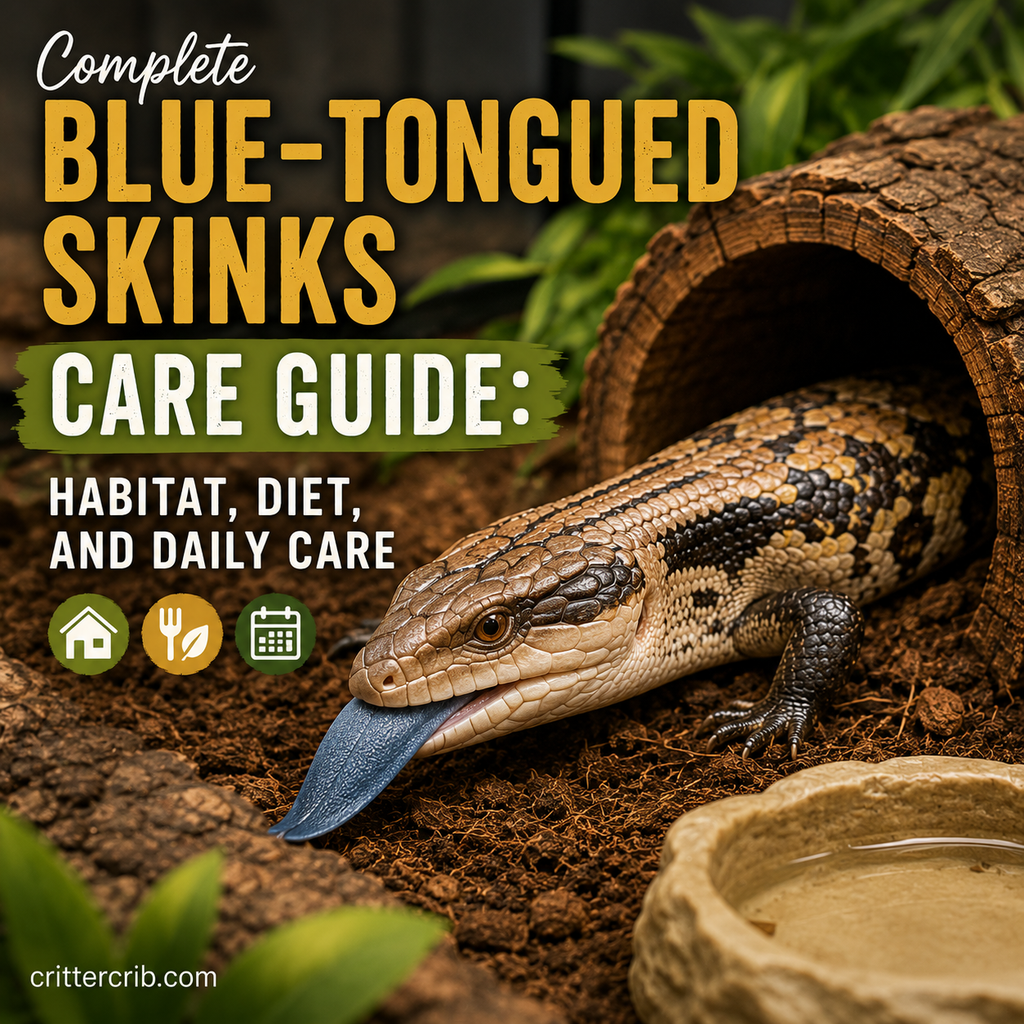
Blue-tongued skinks are hard to mistake for anything else. They have long, sturdy bodies, short legs, broad heads, and, of course, that striking blue tongue.
They’re also surprisingly personable reptiles.
Many captive blue-tongued skinks become comfortable with routine handling and learn to recognize the patterns around feeding and enclosure maintenance. Their relatively calm temperament and manageable daily care can make them appealing pets, even for someone who hasn’t kept a large lizard before.
But there’s an important catch: not every blue-tongued skink has exactly the same care requirements.
Several species and subspecies are kept as pets, and their humidity needs in particular can differ considerably. Before setting up an enclosure, it’s important to know which type of blue-tongued skink you have.
This guide covers the fundamentals of blue-tongued skink care, including habitat size, heating, lighting, humidity, substrate, diet, handling, cleaning, and everyday care.
Blue-Tongued Skink Care at a Glance
Here’s a quick overview of what to expect:
- Adult length: Often around 18–24 inches, depending on type
- Lifespan: Commonly 15–20 years or longer with good care
- Diet: Omnivorous
- Activity: Primarily active during the day
- Housing: Generally best kept individually
- Adult enclosure: Approximately 4 x 2 x 2 feet as a practical minimum target
- Heating: Warm basking area with a cooler retreat
- UVB: Recommended as part of a well-designed setup
- Substrate: Deep enough for digging and burrowing
- Handling: Many individuals tolerate gentle handling well
- Care level: Moderate
If you’re considering one as a pet, our guide to how long blue-tongued skinks live takes a closer look at lifespan and the care factors that can influence longevity.
Know What Type of Blue-Tongued Skink You Have
“Blue-tongued skink” doesn’t refer to just one type of lizard.
The pet trade includes several forms originating from Australia, Indonesia, and surrounding regions.
Commonly encountered types include:
- Northern blue-tongued skinks
- Eastern blue-tongued skinks
- Indonesian blue-tongued skinks
- Merauke blue-tongued skinks
- Halmahera blue-tongued skinks
- Irian Jaya-type blue-tongued skinks
Identification matters because climate requirements vary.
An Australian blue-tongued skink and a tropical Indonesian form shouldn’t automatically be given identical humidity conditions.
If you don’t know which type you have, try to determine its origin before finalizing the habitat.
This is also one reason buying from a knowledgeable, reputable breeder or seller is valuable.
Choosing the Right Blue-Tongued Skink Enclosure
Blue-tongued skinks spend most of their time on or near the ground.
Unlike arboreal geckos, they don’t need a towering vertical habitat. They benefit much more from horizontal floor space.
For an adult, an enclosure around 4 feet long, 2 feet deep, and 2 feet tall is a good minimum target.
Larger is even better when you can maintain the environment properly.
If you’re building an enclosure from scratch, our blue-tongued skink habitat setup guide goes deeper into enclosure size, heating, UVB, humidity, substrate, hides, and enrichment.
Why Floor Space Matters
Blue-tongued skinks are active explorers.
A larger footprint provides room for:
- Walking
- Burrowing
- Foraging
- Basking
- Hiding
- Environmental enrichment
- A useful temperature gradient
A long enclosure also makes it easier to create clearly separated warm and cool areas.
Front-Opening vs. Top-Opening Enclosures
Front-opening enclosures are particularly convenient for larger reptiles.
They make it easier to:
- Feed
- Spot-clean
- Replace water
- Handle your skink
- Maintain substrate
- Rearrange decorations
Approaching from the front can also feel less threatening than repeatedly reaching down from above.
Whatever enclosure you choose, make sure it closes securely.
Blue-tongued skinks are strong animals and can push against poorly secured doors or lids.
Do Blue-Tongued Skinks Need to Live Together?
No.
Blue-tongued skinks are generally best housed individually.
They don’t need another skink for companionship, and cohabitation can introduce competition, stress, breeding, and injuries.
Two skinks lying together isn’t necessarily a sign of friendship. They may simply be trying to use the same desirable warm or sheltered location.
Individual housing also makes it much easier to monitor:
- Food intake
- Body weight
- Feces
- Shedding
- Activity
- Health
One appropriately sized enclosure per skink is the safest general approach.
Temperature Requirements
Like other reptiles, blue-tongued skinks rely on external heat to regulate their body temperature.
The enclosure should provide a warm basking area at one end and a cooler retreat at the other.
Basking Temperature
A basking surface around 100°F is a reasonable starting point for many commonly kept blue-tongued skinks, although the ideal range can vary somewhat depending on the type.
Some keepers provide basking surfaces in approximately the 95–105°F range.
The important thing is to measure the actual surface where the skink sits.
Use an infrared temperature gun for this.
Warm and Cool Areas
The air temperature away from the basking surface should be lower.
The cool end of the habitat may generally fall somewhere around the mid-70s to low-80s°F during the day, depending on species and conditions.
This gradient allows your skink to choose where it wants to be.
A single uniform enclosure temperature removes that choice.
Nighttime Temperature
Temperatures can drop at night.
If your home remains reasonably warm, additional nighttime heat may not be necessary.
If supplemental heat is needed, use an appropriate non-light-producing heat source controlled safely.
Avoid leaving bright basking lights on overnight.
Blue-tongued skinks need a regular day-and-night cycle.
Use a Thermostat With Heating Equipment
A thermostat regulates heating equipment to help prevent dangerous overheating.
It’s different from a thermometer.
A thermometer measures temperature.
A thermostat controls the heat source.
Use thermostatic control appropriate for your heating equipment and enclosure.
You should still monitor temperatures independently with digital thermometers and an infrared temperature gun.
The thermostat is a safety and control device, not a replacement for actually checking the habitat.
UVB Lighting for Blue-Tongued Skinks
Providing appropriate UVB lighting is recommended.
UVB contributes to vitamin D3 synthesis and calcium metabolism and allows you to create a more complete daytime environment.
A linear UVB fixture is generally more useful for covering an appropriate portion of a large enclosure than a tiny compact bulb.
Correct placement depends on:
- Bulb strength
- Fixture design
- Reflector
- Distance
- Screen or mesh
- Basking platform height
Follow the manufacturer’s guidance for your particular UVB system.
The goal isn’t to blast the entire enclosure with maximum UVB.
Your skink should be able to move between areas with different levels of exposure.
How Long Should the Lights Stay On?
A consistent light cycle helps establish a predictable daily rhythm.
Around 12 hours of light and 12 hours of darkness is a simple starting schedule for many homes, although seasonal adjustments can be made.
Use outlet timers.
Timers are inexpensive and eliminate the need to manually switch the enclosure lights on and off every day.
At night, provide darkness rather than colored “night” bulbs.
Humidity Requirements Depend on the Skink
Humidity is one area where generic blue-tongued skink advice can cause problems.
Different types come from different climates.
Australian Blue-Tongued Skinks
Northern and some other Australian forms generally do well in comparatively moderate or drier conditions.
Constantly wet tropical conditions would be inappropriate.
Indonesian Blue-Tongued Skinks
Indonesian forms generally require higher humidity.
Some, particularly skinks associated with more humid environments, may need considerably more moisture than Australian varieties.
This is why identifying your skink matters.
Don’t choose a humidity target simply because a care sheet says “blue-tongued skink.”
Research the requirements of your specific species or locality.
Measure Humidity
Use a digital hygrometer.
Don’t rely on touching the substrate or looking at condensation.
Humidity is influenced by:
- Substrate
- Ventilation
- Heating
- Water bowl placement
- Misting
- Room conditions
- Enclosure material
Adjust the habitat based on measured conditions.
Choosing Substrate
Blue-tongued skinks like to dig and burrow, so substrate should provide enough depth to support that behavior.
Suitable choices depend partly on the humidity requirements of your particular skink.
Options may include:
- Cypress mulch
- Coconut husk
- Coconut fiber
- Reptile-safe soil mixtures
- Species-appropriate naturalistic substrate blends
Aspen may be suitable for some drier setups but isn’t appropriate for habitats that need consistently higher humidity because it doesn’t handle moisture well.
Avoid substrates with sharp pieces or materials that could be hazardous if swallowed.
How Deep Should the Substrate Be?
Provide several inches when possible.
A deeper layer allows the skink to push underneath the surface, partially bury itself, and create resting areas.
You may occasionally look into the enclosure and wonder where your lizard went.
Then the substrate moves.
That’s normal blue-tongued skink behavior.
Furnishing the Enclosure
Blue-tongued skinks benefit from an environment that’s more interesting than an empty floor with a heat lamp.
Provide Multiple Hides
At minimum, provide secure hiding opportunities on both the warm and cool sides.
The skink should be able to regulate its temperature without choosing between comfort and security.
Hides should be:
- Stable
- Large enough for the skink
- Snug enough to feel secure
- Free of sharp edges
Add Environmental Cover
You can also use:
- Cork bark
- Artificial plants
- Reptile-safe live plants
- Low branches
- Rocks
- Logs
- Leaf litter
Blue-tongued skinks aren’t graceful climbers, so keep elevated structures relatively low and stable.
A heavy rock balanced precariously over a burrowing animal is a bad idea.
What Do Blue-Tongued Skinks Eat?
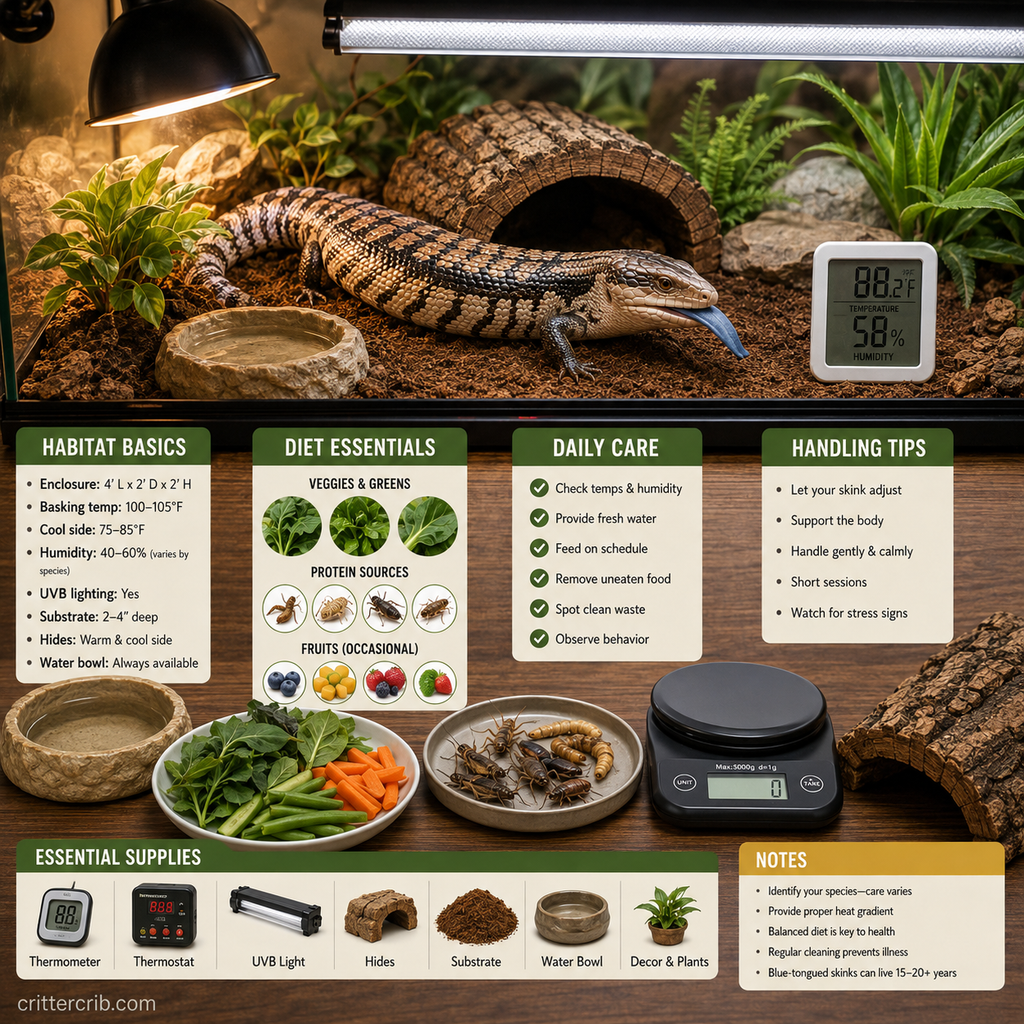
Blue-tongued skinks are omnivores.
They eat a combination of animal and plant foods, and variety is important.
A balanced diet can include appropriate portions of:
- Leafy greens
- Vegetables
- Insects
- Other suitable animal protein
- Occasional fruit
The proportions can vary with age.
Growing juveniles generally require proportionally more protein than mature adults.
Good Vegetables and Greens
Plant foods should make up a meaningful portion of an adult blue-tongued skink’s diet.
Good options can include:
- Collard greens
- Mustard greens
- Turnip greens
- Dandelion greens
- Endive
- Escarole
- Squash
- Green beans
- Bell pepper
Rotate ingredients.
Feeding the exact same mixture every week isn’t necessary and may limit nutritional variety.
Protein Sources
Appropriate animal-based foods can include:
- Dubia roaches
- Crickets
- Black soldier fly larvae
- Silkworms
- Snails from safe sources
- Cooked egg occasionally
- Other appropriately selected protein sources
Some keepers also use high-quality prepared foods as part of a varied diet.
Whole-prey insects provide both nutrition and an opportunity for natural foraging behavior.
Can Blue-Tongued Skinks Eat Dog Food?
High-quality wet dog food is commonly used by some experienced blue-tongued skink keepers as one component of the diet.
If you use it, choose carefully.
Look for an appropriate formulation without unnecessary ingredients and use it as part of a varied feeding plan rather than assuming every canned dog food is equally suitable.
The nutritional needs of a blue-tongued skink aren’t identical to those of a dog.
If you’re uncertain about building a balanced long-term diet, discuss it with a reptile veterinarian or qualified reptile nutrition professional.
Foods to Avoid
Don’t assume every human food is safe.
Avoid:
- Avocado
- Rhubarb
- Wild insects exposed to pesticides
- Fireflies
- Highly processed human foods
- Foods containing unsafe seasonings
- Excessive fruit
Fruit can be offered sparingly as part of a varied diet rather than becoming a major component.
Calcium and Supplements
Calcium and vitamin supplementation may be appropriate depending on your skink’s diet, age, and UVB exposure.
Feeder insects can be gut-loaded and dusted when appropriate.
However, more supplementation isn’t always better.
Excessive amounts of certain vitamins and minerals can cause problems.
Your supplementation plan should complement the actual diet and lighting setup rather than being treated as a universal schedule for every blue-tongued skink.
Fresh Water
Provide clean drinking water at all times.
Choose a sturdy bowl that the skink can’t easily tip while digging or walking around.
Blue-tongued skinks aren’t particularly delicate when moving through their enclosure.
Check the bowl daily because substrate often ends up in it.
Wash it regularly rather than simply topping off old water.
How Often Should You Feed a Blue-Tongued Skink?
Feeding frequency depends on age, size, health, and meal composition.
Young skinks generally eat more frequently because they’re growing.
Healthy adults can usually be fed less often.
Instead of focusing only on the number of feeding days, monitor body condition.
Blue-tongued skinks can become overweight when offered calorie-dense foods too frequently.
A small digital kitchen scale can help you track changes objectively.
Record your skink’s weight periodically rather than relying entirely on visual impressions.
Handling a Blue-Tongued Skink
Many blue-tongued skinks become quite tolerant of handling.
That doesn’t mean a newly acquired skink should immediately be carried around the house for long periods.
Give it time to adjust first.
How to Pick Up a Blue-Tongued Skink
Approach calmly.
Support the entire body, including the front and rear portions.
Because blue-tongued skinks have long, heavy bodies and relatively short legs, they should feel supported rather than dangling.
Keep early sessions short.
As your skink becomes more comfortable, handling can gradually become part of the routine.
Understanding the Blue Tongue Display
The famous blue tongue isn’t just decorative.
When threatened, a blue-tongued skink may open its mouth widely and display the bright tongue.
It may also:
- Hiss
- Flatten its body
- Puff up
- Turn toward the threat
- Attempt to bite
The sudden flash of blue can help startle or warn a potential predator.
If your skink displays defensively when you approach, don’t force an interaction.
Give it space and work on building familiarity gradually.
Learning to read blue-tongued skink body language can make it much easier to tell when your skink is simply investigating its surroundings and when it feels stressed or defensive.
Do Blue-Tongued Skinks Bite?
They can.
Blue-tongued skinks are often calm, but they’re strong lizards with powerful jaws.
Bites can happen when a skink:
- Feels threatened
- Is grabbed suddenly
- Mistakes fingers for food
- Is stressed
- Is in pain
- Hasn’t become accustomed to handling
Learn your skink’s body language and avoid putting your hands directly in front of an animal displaying defensive behavior.
Wash your hands after handling food so your fingers don’t smell like something edible.
Shedding
Blue-tongued skinks shed as they grow.
Unlike snakes, they generally shed in pieces rather than leaving behind one complete skin.
You may notice:
- Duller coloration
- Loose patches of skin
- Increased rubbing
- Temporary changes in activity
- Mild irritability
Proper humidity and access to textured surfaces can help normal shedding.
Don’t pull skin off before it’s ready.
Pay attention to retained shed around the toes and tail.
Repeated shedding problems may indicate that humidity or other husbandry conditions need adjustment.
Daily Blue-Tongued Skink Care Routine
Once the habitat is established, everyday maintenance is fairly manageable.
A basic routine might look like this:
- Confirm that lights and heating equipment are operating.
- Check warm and cool temperatures.
- Check humidity.
- Observe your skink’s behavior.
- Replace dirty water.
- Feed according to its schedule.
- Remove leftover fresh food.
- Spot-clean feces, urates, or wet substrate.
You don’t need to disturb your skink constantly.
A quick visual check can tell you a lot.
Cleaning the Enclosure
Spot-clean whenever you see waste.
Remove:
- Feces
- Urates
- Spoiled food
- Heavily contaminated substrate
- Shed skin
- Mold
- Other debris
Wash the water and food bowls regularly.
Periodically perform more extensive cleaning based on the enclosure setup and substrate you’re using.
During a deeper cleaning:
- Move the skink to a secure temporary container.
- Remove furnishings.
- Remove substrate that needs replacement.
- Physically clean dirty surfaces.
- Disinfect appropriate surfaces with a reptile-safe product.
- Follow the required contact time.
- Rinse when necessary.
- Allow surfaces to dry.
- Rebuild the enclosure.
- Confirm temperature and humidity before returning the skink.
Bioactive habitats require a different maintenance approach and generally aren’t completely stripped during routine cleaning.
Common Blue-Tongued Skink Behaviors
Getting familiar with normal behavior helps you recognize changes. Our guide to common blue-tongued skink behaviors and what they mean goes deeper into tongue flicking, burrowing, hiding, hissing, basking, exploring, defensive displays, and other behaviors owners commonly notice.
Burrowing
Burrowing is normal.
A blue-tongued skink may spend significant time beneath its substrate.
Basking
Your skink may spend part of the morning warming beneath its heat source before becoming more active.
Exploring
Healthy skinks often patrol their enclosures, investigate objects, and search for food.
Hissing
Hissing is usually defensive.
Some individuals are naturally more vocal than others.
A skink that hisses doesn’t necessarily hate you. It’s communicating that it doesn’t feel comfortable with what’s happening.
Tongue Flicking
Like many reptiles, blue-tongued skinks use their tongues to investigate their surroundings.
Frequent tongue flicking while exploring is generally normal.
Brumation and Seasonal Changes
Some blue-tongued skinks, particularly Australian varieties, may show seasonal reductions in activity associated with cooler periods.
However, care around brumation depends heavily on species, health, and circumstances.
Don’t automatically assume that a lethargic or non-eating skink is brumating.
Illness can cause similar symptoms.
If you’re considering intentionally brumating an animal or your skink unexpectedly becomes inactive for an extended period, consult a veterinarian experienced with reptiles.
Signs Your Blue-Tongued Skink May Be Unwell
Changes in behavior or appearance can sometimes be the first indication of a problem.
Watch for:
- Significant weight loss
- Persistent refusal to eat
- Severe lethargy
- Difficulty walking
- Swollen limbs or joints
- Tremors
- Abnormal jaw shape
- Persistent diarrhea
- Labored breathing
- Mucus or discharge
- Eye swelling
- Repeated shedding problems
- Wounds
- Unusual lumps or swelling
These symptoms don’t diagnose a particular condition.
They mean it’s time to investigate further.
A veterinarian experienced with reptiles is the best person to evaluate persistent or concerning symptoms.
Preventive Veterinary Care
Locate a reptile veterinarian before you have an emergency.
Not every general veterinary practice treats reptiles regularly.
A newly acquired skink may benefit from an initial wellness examination, particularly if its history is uncertain.
Your veterinarian may recommend fecal testing depending on the animal’s origin and condition.
This can be especially relevant for imported animals.
Captive-Bred vs. Imported Blue-Tongued Skinks
Where your skink comes from matters.
Many Australian blue-tongued skinks in the pet trade are captive-bred.
Some Indonesian animals may be imported or have less certain histories.
Imported reptiles can arrive with:
- Parasites
- Dehydration
- Stress
- Injuries
- Uncertain feeding histories
This doesn’t mean every imported animal is unhealthy.
It does mean that knowing the animal’s origin and arranging appropriate veterinary screening can be particularly important.
When possible, purchase from a reputable source that can clearly explain the skink’s species, origin, feeding history, and health.
Common Blue-Tongued Skink Care Mistakes
Many problems are preventable with good husbandry.
Common mistakes include:
- Using an enclosure that’s too small
- Not knowing which type of blue-tongued skink you own
- Using the wrong humidity for the species
- Providing inadequate temperature gradients
- Measuring only air temperature and ignoring basking surfaces
- Keeping multiple skinks together
- Providing substrate that’s too shallow for burrowing
- Feeding too much high-calorie food
- Providing little dietary variety
- Using unstable heavy decorations
- Ignoring gradual weight changes
- Pulling off retained shed
- Buying the skink before setting up the habitat
The best time to solve enclosure problems is before your skink moves in.
Supplies You’ll Need
A basic blue-tongued skink setup generally includes:
- Large horizontal enclosure
- Secure doors or lid
- Appropriate heat source
- Thermostat
- Linear UVB fixture
- Digital thermometers
- Infrared temperature gun
- Digital hygrometer
- Species-appropriate substrate
- Warm-side hide
- Cool-side hide
- Water bowl
- Food dish
- Stable décor
- Reptile-safe cleaning supplies
- Calcium and supplements as appropriate
- Digital scale
- Outlet timers
You’ll probably add more enrichment over time.
Prioritize the enclosure, heating, lighting, monitoring equipment, and basic furnishings before decorative extras.
Are Blue-Tongued Skinks Good Pets for Beginners?
They can be.
Blue-tongued skinks have several characteristics that appeal to newer reptile keepers:
- They’re generally sturdy
- Many tolerate handling well
- They’re active during the day
- They eat a varied omnivorous diet
- They don’t require live prey for every meal
- Their body language can be relatively easy to observe
However, they require a large enclosure and specialized heating and lighting.
They’re also a long-term commitment.
Perhaps the biggest beginner challenge is correctly identifying the skink and matching humidity to its natural requirements.
Do that homework before bringing one home.
Final Thoughts on Blue-Tongued Skink Care
Blue-tongued skinks can make fascinating, interactive reptile companions, but successful care begins with understanding exactly what kind of skink you have.
Give an adult plenty of horizontal floor space, create a proper temperature gradient, provide appropriate UVB, and match humidity to the species or locality. Use deep substrate for burrowing, secure hides for resting, and stable furnishings for exploration.
Diet matters just as much. Offer a varied combination of suitable vegetables, greens, and animal protein while monitoring portions and body condition.
Then pay attention to the animal in front of you.
Learn when your skink normally basks, burrows, explores, eats, and rests. Track its weight. Notice changes in appetite or behavior.
Good blue-tongued skink care isn’t about endlessly adjusting the enclosure or following a rigid checklist.
It’s about getting the fundamentals right and providing a stable environment where your skink has the space and choices to behave naturally.
Do that consistently, and you’ll have a strong foundation for keeping your blue-tongued skink healthy for many years.