Bringing home finches is exciting, but walking through the bird aisle for the first time can be surprisingly confusing. There are dozens of cages, feeders, perches, toys, supplements, nesting accessories, and other products all competing for your attention.
Fortunately, finches don’t need everything on the shelf.
What they do need is a safe, spacious cage, appropriate food, clean water, comfortable perches, opportunities to bathe and forage, and an environment that allows them to behave naturally.
Because many commonly kept finches are social birds, their setup can also be a little different from what you’d choose for a larger companion parrot.
If you’re preparing for your first finches, this beginner checklist covers the essential supplies to have ready before your birds arrive, along with a few optional items that can make everyday care easier.
Finch Supplies Checklist: What You Need
Before bringing your finches home, make sure you have the basics covered.
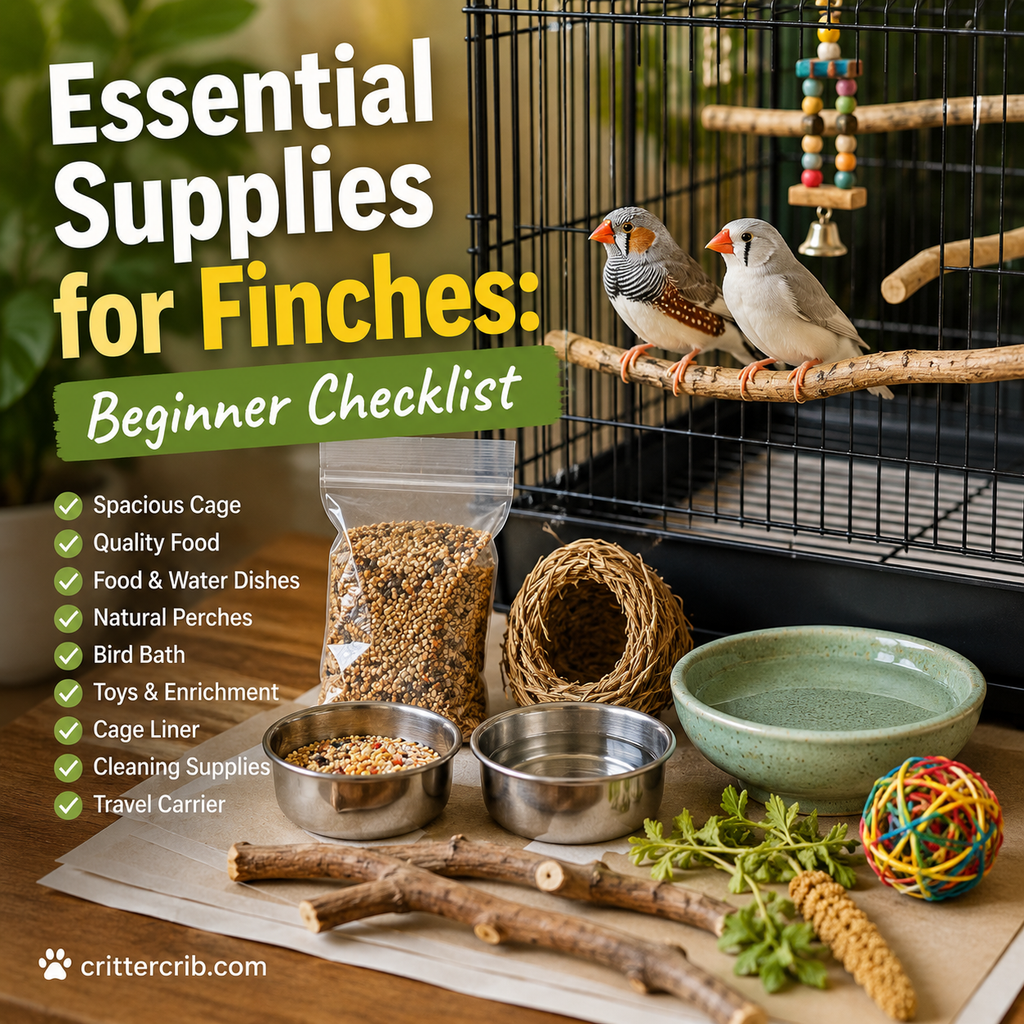
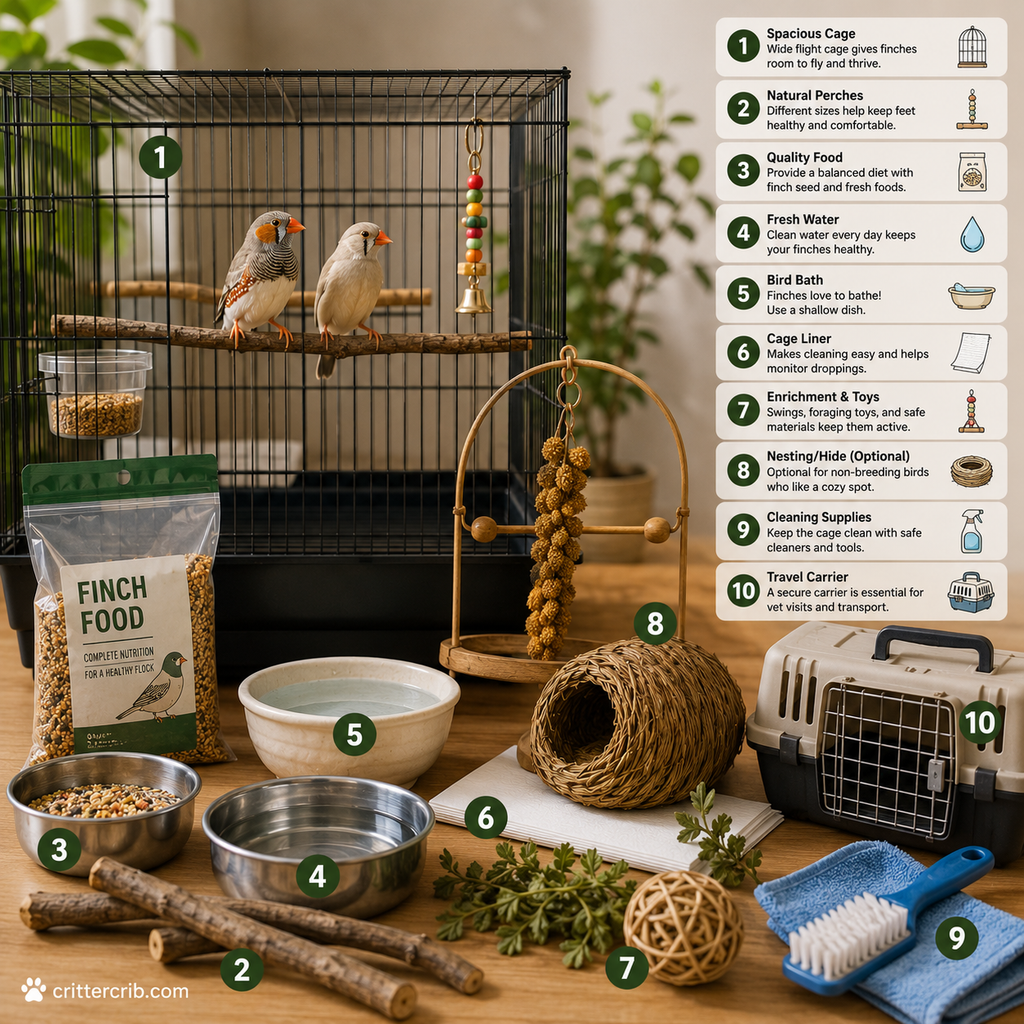
Your essential finch supplies should include:
- Appropriately sized flight cage
- Food dishes or feeders
- Water dish or bird-safe water dispenser
- Quality finch food
- Several natural perches
- Bird bath
- Cage liner
- Safe enrichment and foraging materials
- Cage-cleaning supplies
- Secure travel carrier
- Access to an avian veterinarian
You may eventually add more accessories, but these items provide a solid foundation.
Let’s look at each one more closely.
1. A Spacious Finch Cage
The cage is the most important piece of equipment you’ll buy.
Finches are small, but they’re active flyers. Unlike birds that spend a lot of time climbing around cage bars, finches benefit enormously from having enough horizontal space to fly between perches.
That means a long cage is generally more useful than a tall, narrow one.
For a pair of small finches, look for a cage at least around 30 inches long, 18 inches deep, and 18 inches high as a practical starting point. If you have room for something larger, that’s even better.
Flight-style cages are particularly useful.
Why Cage Width Matters
A tall decorative cage might look spacious to us, but much of that vertical room may go unused.
Finches typically fly horizontally.
A wider cage lets them move naturally from one side to the other instead of simply hopping between closely positioned perches.
When comparing cages, prioritize:
- Horizontal length
- Safe bar spacing
- Adequate depth
- Practical interior height
For finches, usable flight space matters more than impressive-looking cage height.
Check the Bar Spacing
Small finches require relatively narrow bar spacing.
Around 3/8 inch to 1/2 inch is commonly appropriate for many small pet finches, depending on the species.
Avoid buying a cage intended for larger birds simply because it’s roomy. If the gaps between the bars are too wide, a small finch may be able to squeeze through or potentially become trapped.
Always consider the specific finch species you’re keeping when choosing a cage.
2. Food Dishes and Feeders
You’ll need a clean, accessible way to offer your finches their daily food.
Some cages come with built-in dishes, while others require separate feeders.
Either approach can work.
Choose feeders that are:
- Easy for the birds to access
- Easy for you to remove
- Simple to wash thoroughly
- Made from bird-safe materials
- Positioned away from droppings
Stainless steel and sturdy bird-safe dishes are often practical because they’re easy to clean.
Consider More Than One Feeding Station
If you’re keeping multiple finches, providing more than one feeding location can be useful.
Even birds that generally get along may occasionally compete over a favorite dish.
Multiple feeding areas give a less dominant bird another place to eat.
Position dishes where you can easily check them every day.
Finch seed hulls can make a food bowl look full even when much of the edible food underneath has already been consumed, so don’t judge the amount of available food by appearance alone.
3. A Clean Water Source
Fresh water should always be available.
You can use a traditional open water dish or a bird-safe water dispenser designed for small birds.
Whichever system you choose, cleanliness matters more than style.
Finches may:
- Drop food into water
- Bathe in open dishes
- Leave feathers in the water
- Contaminate dishes with droppings
Check drinking water at least daily and replace it whenever it’s dirty.
Water containers should be washed regularly rather than simply topped off.
If you use a bottle-style system, make sure it’s functioning correctly and that your birds know how to drink from it.
4. Quality Finch Food
Food is obviously essential, but choosing what to feed can be more complicated than buying a bag labeled “finch seed.”
Different finch species can have somewhat different dietary requirements.
Many commonly kept pet finches eat a diet that may include a combination of:
- Species-appropriate formulated food
- Finch seed mixtures
- Fresh leafy greens
- Appropriate vegetables
- Other fresh foods suitable for the species
Seed is commonly associated with finches, but an all-seed diet may not provide ideal nutrition by itself.
Ask an avian veterinarian about an appropriate everyday diet for the species you keep, particularly if you’re transitioning birds from whatever they were eating before you acquired them.
Don’t Change the Diet Overnight
When bringing home new finches, find out what they’re currently eating.
A sudden switch to unfamiliar food can be problematic if the birds don’t recognize the new food as edible.
Diet changes are generally better made gradually while ensuring that the birds continue eating enough.
5. Natural Wood Perches
Most cages include a couple of smooth wooden dowels.
They’re usable, but they shouldn’t necessarily be the only perches your finches have.
Natural branches provide more variation in diameter and texture.
This encourages the feet to grip in slightly different positions throughout the day rather than remaining in exactly the same position on identical dowels.
Choose bird-safe natural perches in several suitable diameters.
Arrange them so your finches can fly between them.
Don’t Fill the Center of the Cage With Perches
This is an easy beginner mistake.
You buy a spacious flight cage and then install so many perches that the birds can no longer fly through it.
Keep the central portion relatively open.
Position useful perches toward opposite sides of the cage so the finches are encouraged to make short flights between them.
Avoid placing perches directly over food and water dishes where droppings can contaminate them.
6. A Finch Bird Bath
Many finches enthusiastically bathe.
A shallow bird bath gives them an opportunity to splash, clean their feathers, and engage in normal grooming behavior.
You can use:
- A shallow bird-safe bathing dish
- A bath that attaches to the cage
- A suitable external cage bath designed for small birds
Make sure the bath is stable and appropriately shallow.
Use clean water without soap, shampoo, or other additives.
Expect a Mess
Finches don’t necessarily understand the concept of keeping bath water inside the bath.
Some birds splash enthusiastically.
Placing the cage somewhere that’s easy to clean around can save you frustration later.
Remove or clean dirty bath water after use rather than leaving it sitting in the cage indefinitely.
7. Cage Liners
The bottom of the cage needs something that makes routine cleaning manageable.
Plain paper is one of the simplest options.
Depending on your cage design, you may use:
- Plain paper
- Paper towels
- Appropriate cage-liner paper
A simple liner makes it easy to see droppings and replace the soiled material frequently.
Avoid materials that produce unnecessary dust or make it difficult to monitor what’s happening on the cage floor.
Why Simple Cage Liners Are Useful
A plain liner isn’t glamorous, but it serves an important purpose.
When you change it, you can quickly notice changes in:
- Dropping quantity
- Dropping appearance
- Uneaten food
- Feathers
- Unusual debris
Changes in droppings can occur for many reasons, including diet, but consistently monitoring the cage floor can help you notice when something has changed.
8. Safe Toys and Enrichment
Finches don’t usually interact with toys exactly the way larger parrots do.
You probably won’t see a zebra finch enthusiastically solving a complicated puzzle toy designed for a cockatoo.
But finches still need stimulation.
Useful enrichment may include:
- Swings
- Bird-safe grasses
- Foraging opportunities
- Small hanging toys
- Natural branches
- Safe shreddable materials
- Bird-safe greenery
- Opportunities to explore different perch locations
The goal is to encourage natural activity rather than filling the cage with colorful plastic.
Keep Flight Paths Open
Enrichment shouldn’t interfere with movement.
When setting up the cage, imagine an invisible flight path running from one side to the other.
Keep that area relatively clear.
A few well-positioned accessories are better than dozens of items hanging everywhere.
9. Safe Foraging Opportunities
Foraging gives birds something productive to do.
Instead of always presenting every piece of food in exactly the same location and format, you can occasionally encourage your finches to search for appropriate foods.
Simple foraging can involve offering safe greens or other suitable foods in different bird-safe locations.
You don’t need complicated equipment.
Start with easy opportunities and observe how your birds respond.
Never make essential food difficult to access simply for the sake of enrichment.
10. Cleaning Supplies
Finches may be tiny, but they can make an impressive mess.
Food hulls, feathers, droppings, bits of greens, and bath water all accumulate around the cage.
Keep dedicated cleaning supplies nearby.
Useful items include:
- Paper towels
- Cage liners
- Small cleaning brushes
- Scrub brush for perches
- Bird-safe cleaning products when needed
- Spare food and water dishes
Having spare dishes is especially convenient.
You can replace a dirty dish immediately and wash it thoroughly rather than waiting before giving it back.
Avoid Strong Fumes Around Birds
Birds have sensitive respiratory systems.
Don’t use strongly scented cleaners, aerosols, air fresheners, or other harsh fumes around the cage.
Move birds safely away from any area where potentially harmful cleaning products must be used.
11. A Secure Travel Carrier
A travel carrier may not seem important when you’re setting up a permanent home, but you’ll want one before you actually need it.
At some point, your finches may need transportation for:
- Veterinary appointments
- Moving
- Emergencies
- Temporary relocation
A small secure bird carrier or appropriately designed travel cage is much safer than trying to improvise at the last minute.
Make sure doors and openings close securely.
Because finches are small and fast, even a seemingly minor gap can become an escape route.
12. A Reliable Avian Veterinarian
You can’t put a veterinarian in your shopping cart, but finding one belongs on your setup checklist.
Not every veterinary clinic regularly treats birds.
Before your finches come home, locate an avian veterinarian or a veterinarian experienced with pet birds.
Save the clinic’s:
- Phone number
- Address
- Regular hours
- Emergency instructions
Doing this ahead of time means you won’t have to start researching veterinary clinics while dealing with a sick bird.
An initial wellness examination is also worth discussing with the veterinarian.
Do Finches Need a Cuttlebone?
Cuttlebones are commonly sold for pet birds and can provide a source of calcium while giving birds something to peck at.
Whether your finches specifically need one depends partly on their overall diet and nutritional needs.
A cuttlebone shouldn’t be used as a substitute for a balanced diet.
If you’re unsure whether calcium supplementation is appropriate for your birds—particularly breeding or egg-laying females—ask an avian veterinarian rather than adding multiple supplements without guidance.
Do Finches Need Grit?
This is an area where outdated bird-care advice can cause confusion.
Many pet finches that hull their seeds before eating generally don’t need insoluble grit to mechanically grind their food in the way some other birds do.
Providing unnecessary grit can potentially lead to excessive consumption.
Don’t assume you need a bag of grit simply because it’s displayed next to the finch food.
Ask an avian veterinarian whether any specific mineral supplement is appropriate for the species and diet you’re providing.
Do Finches Need a Nest?
Not necessarily.
A nest may look like an obvious finch-cage essential, but providing nesting materials or enclosed nests can encourage breeding behavior.
If you aren’t intentionally and responsibly breeding your finches, a nest usually doesn’t need to be part of the everyday setup.
Finches can sleep perfectly well on suitable perches.
This is an important distinction because pet stores frequently display nests as though they’re the finch equivalent of a bed.
They’re not necessarily required for ordinary sleep.
Do Finches Need Toys?
Yes, but think more broadly about enrichment rather than traditional parrot toys.
Finches are often more interested in:
- Flying
- Socializing
- Bathing
- Foraging
- Exploring branches
- Investigating safe natural materials
A giant collection of chew toys isn’t necessary.
Observe your birds and provide enrichment that encourages the activities they naturally enjoy.
Do Finches Need a Mirror?
A mirror isn’t an essential finch supply.
If your finches already have appropriate social companionship, there is little reason to rely on a mirror as a substitute for another bird.
Some birds may interact with mirrors, but they don’t understand reflections the way people do.
Prioritize a spacious environment, appropriate companionship, natural activities, and enrichment instead.
Do Finches Need a Cage Cover?
A cage cover is optional rather than universally necessary.
Finches need a regular day-and-night cycle and a quiet environment for sleeping.
Depending on your home, partially or fully covering the cage at night may help reduce visual disturbance.
However, the cage still needs appropriate ventilation.
If your birds already sleep in a dark, quiet room without interruption, a cover may not be necessary.
How Many Finches Should a Beginner Keep?
Many commonly kept finches are highly social.
Zebra finches and society finches, for example, are generally kept with compatible companions rather than living completely alone.
A pair is often a practical starting point for a beginner.
However, species, sex, compatibility, cage size, and breeding behavior all matter.
Don’t simply buy several birds and assume they’ll automatically form a peaceful group.
Larger groups require considerably more cage space and careful attention to social dynamics.
Where Should You Put a Finch Cage?
The best supplies won’t help much if the cage is positioned poorly.
Choose a location where your birds can experience normal household activity without being exposed to constant disturbance.
Avoid placing the cage:
- Directly beside heating or cooling vents
- In strong drafts
- In direct intense sunlight for long periods
- Beside exterior doors that constantly open
- In the kitchen
- Where other pets can harass the birds
A stable location with some visual security can help finches settle into their environment.
Keep Finches Away From Kitchen Fumes
Birds have highly sensitive respiratory systems.
Cooking fumes, smoke, aerosols, and overheated nonstick coatings can pose serious hazards.
A kitchen isn’t an appropriate permanent location for a finch cage.
What Supplies Don’t You Need Right Away?
One of the easiest ways to overspend is buying everything before you’ve even observed your birds.
You probably don’t need to immediately purchase:
- Large numbers of toys
- Decorative nesting huts
- Multiple vitamin supplements
- Bags of grit without a specific reason
- Complicated automatic feeders
- Dozens of identical perches
- Expensive decorative cage accessories
Start with the essentials.
Once your finches settle in, you’ll learn what they actually use.
Then you can gradually improve their environment based on real behavior rather than guessing in the pet-store aisle.
Setting Up Your Finch Cage Before Bringing Them Home
Don’t wait until your birds arrive to assemble everything.
Prepare the cage first.
1. Choose the permanent cage location
Find a safe area away from kitchens, drafts, excessive heat, and constant disturbance.
2. Install the main perches
Place natural perches toward opposite areas of the cage while preserving horizontal flight space.
3. Add food and water
Make sure dishes are easy to access and protected as much as possible from droppings.
4. Add a few enrichment items
A swing and several appropriate natural or foraging materials are enough to start.
Don’t overcrowd the cage.
5. Install the cage liner
Use a simple liner that can be changed frequently.
6. Check every door and opening
Make sure feeder doors, access doors, and other openings close securely.
7. Step back and evaluate the flight path
Can your finches fly from one side to the other without navigating around a wall of toys?
If not, rearrange things.
Beginner Finch Supply Checklist
Before bringing your finches home, run through this final list.
Essential
- Spacious horizontal flight cage
- Safe bar spacing
- Multiple appropriate perches
- Food dishes
- Water dish or dispenser
- Species-appropriate finch food
- Bird bath
- Cage liners
- Basic enrichment
- Cleaning supplies
- Secure travel carrier
- Avian veterinarian contact information
Useful but Optional
- Spare food and water dishes
- Cage cover
- Additional natural branches
- Simple foraging accessories
- Cuttlebone when appropriate
- Storage container for food
- Small handheld vacuum for surrounding debris
Usually Not Essential
- Nest or sleeping hut
- Mirror
- Large parrot toys
- Numerous dietary supplements
- Grit unless specifically appropriate
- An excessive number of cage accessories
Frequently Asked Questions About Finch Supplies
What do I need before getting finches?
At minimum, have an appropriately sized cage, safe perches, food, water containers, suitable finch food, a bird bath, cage liners, basic enrichment, cleaning supplies, and a secure travel carrier ready before bringing the birds home.
What size cage do finches need?
For a pair of small finches, a cage around 30 inches long, 18 inches deep, and 18 inches high can serve as a practical minimum starting point. Larger horizontal flight cages are preferable whenever possible.
Species and group size matter, so larger finches or larger groups need additional space.
What should be on the bottom of a finch cage?
Simple paper-based liners are practical because they’re inexpensive, easy to replace, and make it easier to observe droppings and debris.
Do finches need a bird bath?
Providing an appropriate shallow bath is a good idea. Many finches bathe regularly and appear to enjoy the opportunity.
Keep the bath clean and replace dirty water promptly.
Do finches need toys in their cage?
Finches benefit from enrichment, but they don’t necessarily need the same toys as larger parrots. Flight space, swings, natural branches, foraging opportunities, and safe materials to investigate can all provide stimulation.
Do finches need a nest to sleep in?
No. Finches can sleep on perches and don’t require a nest as a bed. Providing a nest can encourage breeding behavior, so it generally isn’t necessary unless breeding is intentional and appropriately managed.
Should finches be kept in pairs?
Many popular pet finches are social and benefit from compatible finch companionship. A pair is often a sensible arrangement, but appropriate pairing depends on species, sex, available space, and individual compatibility.
Final Thoughts
Setting up a home for finches doesn’t require buying every bird product you can find.
Start with the things that matter most: space, safety, nutrition, clean water, appropriate perches, bathing opportunities, enrichment, and good hygiene.
Of all the supplies on your shopping list, don’t underestimate the cage. Finches need horizontal room to fly, and a spacious flight-style cage gives you far more flexibility than a small decorative enclosure packed with accessories.
Keep the setup relatively simple at first.
Watch how your birds move through the cage, which perches they prefer, where they like to bathe, and what forms of enrichment attract their attention. You can adjust the environment as you learn more about them.
A beginner finch setup doesn’t need to be complicated or expensive.
It needs to give your birds enough room and the right resources to behave like finches.