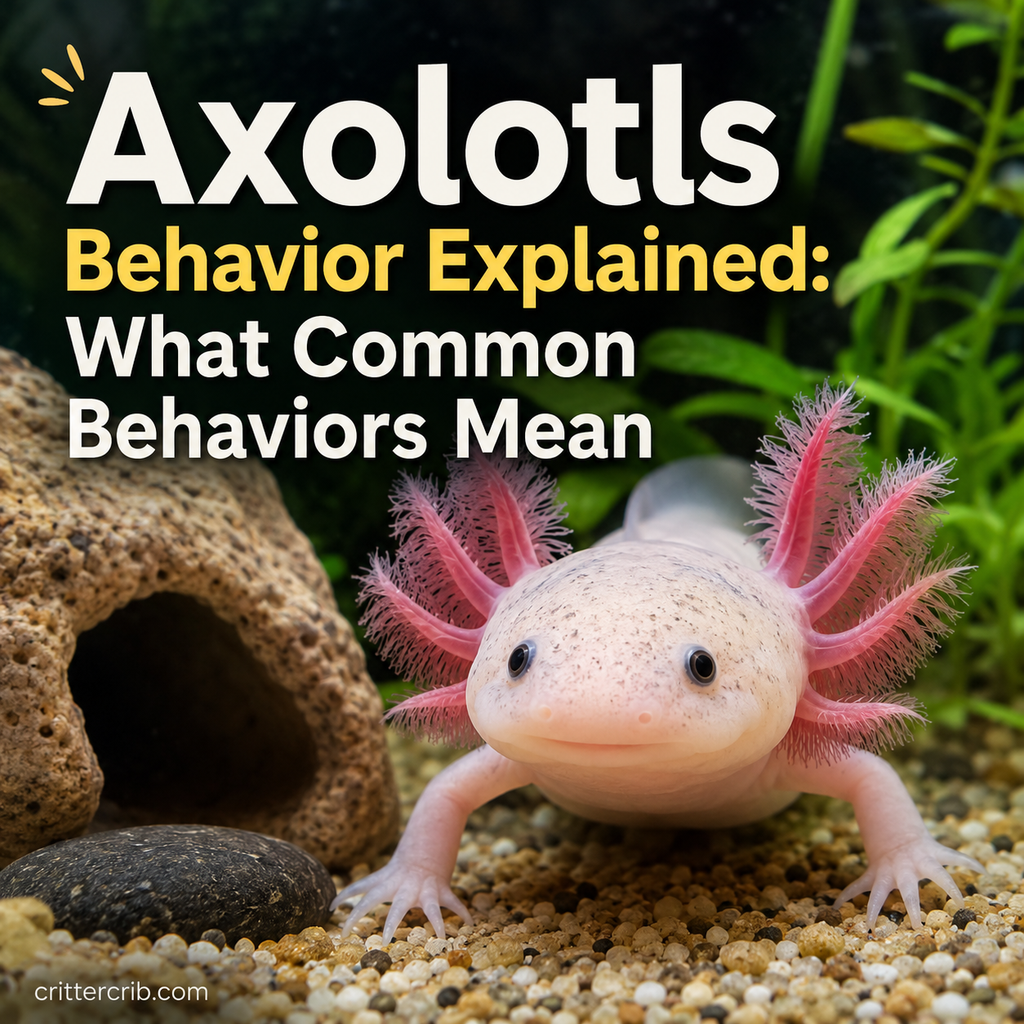
Axolotls can be surprisingly expressive for animals that spend most of their time quietly underwater. One moment, your axolotl may be sitting motionless on the bottom of the tank. A few minutes later, it might be swimming around, floating near the surface, snapping at something invisible, or staring through the glass as if it is watching you.
For a new axolotl owner, some of these behaviors can seem strange. Is your axolotl relaxing, hunting, begging for food, or trying to tell you something is wrong?
Learning what normal axolotl behavior looks like makes caring for these unusual amphibians much easier. It also helps you recognize changes that may indicate stress or a problem with the aquarium.
Below, we’ll look at common axolotl behaviors, what they usually mean, and when a behavior deserves closer attention.
What Is Normal Axolotl Behavior?
Axolotls are generally calm, slow-moving amphibians. They aren’t constantly active like many aquarium fish, and they can spend long periods resting on the bottom of their enclosure.
A healthy axolotl may:
- Rest quietly on the substrate
- Walk slowly along the tank floor
- Swim around periodically
- Become more active when food is nearby
- Investigate movement outside the aquarium
- Float occasionally before returning to the bottom
- Hide in caves or other sheltered areas
- Move its gills gently while resting
Activity can also vary from one axolotl to another. Some individuals are curious and frequently explore their aquarium, while others seem perfectly happy spending much of the day in their favorite hiding place.
Axolotls can also become more active during the evening or when the room becomes darker.
The important thing is learning your axolotl’s usual routine. A sudden change from its normal behavior can sometimes tell you more than any individual behavior by itself.
Why Does My Axolotl Stare at Me?
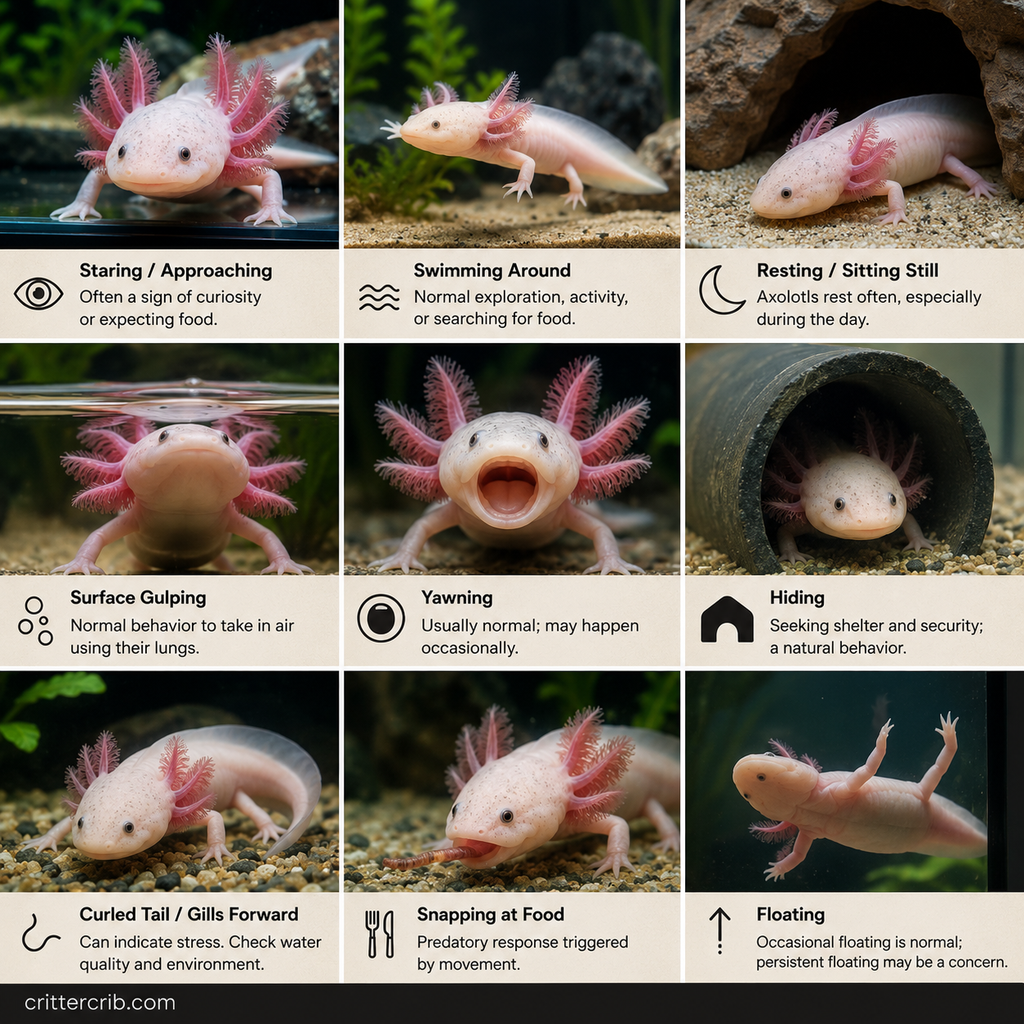
One of the more amusing axolotl behaviors is sitting near the front of the aquarium and appearing to stare directly at you.
Your axolotl probably isn’t contemplating the mysteries of the universe. It may simply have learned that movement near the aquarium often means food is coming.
Axolotls can respond to movement and activity around their enclosure. If you regularly approach the aquarium before feeding, your axolotl may begin moving toward the glass when it sees you.
This can look a lot like begging.
You might notice your axolotl:
- Walking toward the front glass
- Looking upward when you approach
- Following movement outside the aquarium
- Becoming suddenly active around feeding time
This behavior is usually nothing to worry about.
Just don’t let those permanent little smiles convince you to overfeed them.
Why Is My Axolotl Swimming Around the Tank?
Occasional swimming is completely normal.
Axolotls may swim when exploring, searching for food, changing resting locations, or responding to something happening around them.
Some axolotls also have short bursts of activity where they suddenly swim across the aquarium before settling down again.
Young axolotls may be particularly active.
However, there is a difference between normal exploration and frantic swimming.
Normal Swimming
Normal swimming usually appears controlled and purposeful. Your axolotl may swim across the aquarium, investigate an area, and then settle somewhere else.
The animal should still be capable of resting comfortably.
Frantic Swimming
Repeatedly darting around the aquarium, crashing into objects, or constantly swimming without settling may indicate stress.
Possible causes include:
- Poor water quality
- Excessive water current
- Water temperature that is too warm
- Sudden environmental changes
- Bright lighting
- Aggression or disturbance from tank mates
- Irritating substances in the water
If swimming suddenly becomes frantic or unusually frequent, checking the aquarium conditions is a sensible first step.
Why Does My Axolotl Sit Still for So Long?
Axolotls are masters of doing absolutely nothing.
An axolotl may remain almost completely motionless for long periods, especially while resting during the day.
This is generally normal.
Unlike highly active fish, axolotls don’t need to constantly cruise around their aquarium. They often conserve energy by resting on the bottom or inside a hide.
You may even wonder whether your axolotl is asleep.
Axolotls don’t close their eyes because they don’t have eyelids. During periods of rest, they may simply become very still and less responsive to their surroundings.
As long as your axolotl eventually moves normally, eats appropriately, and doesn’t show other concerning signs, periods of inactivity aren’t necessarily a problem.
Why Is My Axolotl Walking Instead of Swimming?
Although axolotls are fully aquatic, they frequently walk along the bottom of their aquarium using their legs.
This is completely normal behavior.
Walking allows an axolotl to explore without expending as much energy as swimming. You may see yours slowly wandering around the tank floor, climbing over decorations, or moving between hiding places.
Their slightly awkward underwater walk is simply part of normal axolotl locomotion.
Why Does My Axolotl Float?
Seeing an axolotl floating can be alarming, but occasional floating isn’t automatically a sign of trouble.
Sometimes an axolotl may swallow a small amount of air and temporarily become more buoyant. It may float near the surface before eventually sinking again.
Some axolotls also seem to float simply because they choose to.
When Floating May Be a Problem
Pay closer attention if your axolotl:
- Cannot return to the bottom
- Continually floats against its will
- Appears tilted or unable to balance
- Has a swollen or unusually shaped abdomen
- Stops eating
- Shows other signs of distress
Persistent buoyancy problems can have several possible causes, including digestive issues or other health problems.
A single short floating episode isn’t necessarily concerning. Repeated or prolonged difficulty controlling buoyancy deserves more attention.
Why Is My Axolotl Swimming to the Surface?
Axolotls have several ways of obtaining oxygen. In addition to their distinctive external gills, they can use their skin and lungs for gas exchange.
Because of this, an axolotl may occasionally swim to the surface, take a gulp of air, and return to the bottom.
An occasional trip to the surface can be normal.
Constantly rushing to the surface, however, is different.
Frequent surface activity may warrant checking:
- Water temperature
- Ammonia
- Nitrite
- Nitrate
- Water movement
- Overall aquarium conditions
Warmer water holds less dissolved oxygen than cooler water, making proper temperature especially important for axolotls.
If surface gulping suddenly becomes much more frequent, investigate rather than assuming your axolotl has simply developed a new habit.
Why Does My Axolotl’s Tail Curl?
A slightly curved tail while turning or resting isn’t unusual. Axolotls are flexible animals, and their tails naturally move into different positions.
A tightly curled tail tip, however, is commonly associated with stress.
Context matters.
If the tail remains noticeably curled and your axolotl is also behaving unusually, examine the aquarium conditions.
Look for possible stressors such as:
- Poor water parameters
- High temperature
- Strong currents
- Excessive light
- Recent tank changes
- Disturbance from another animal
A tail position alone shouldn’t be used to diagnose a problem, but it can be one clue when combined with other changes.
What Do Curled Axolotl Gills Mean?
Axolotl gills naturally move and change position, so not every unusual-looking gill position means something is wrong.
However, gill stalks that are strongly curled forward can sometimes accompany stress.
Before assuming there is a health problem, consider what else your axolotl is doing.
Are the gills only briefly positioned forward while the axolotl is moving? Or are they consistently curled while the animal is behaving unusually?
Persistent changes combined with symptoms such as frantic swimming, loss of appetite, or repeated attempts to escape deserve closer investigation.
Checking water quality and temperature is usually a good place to begin.
Why Does My Axolotl Flick Its Gills?
Gill flicking is one of the most common behaviors owners notice.
Axolotls may periodically move or flick their external gills to help circulate fresh water around the delicate gill filaments.
You might see the gills move every few seconds while your axolotl sits otherwise completely still.
In most cases, gentle periodic gill movement is normal.
Rapid or unusual gill activity accompanied by obvious distress may be different and should prompt you to check the aquarium environment.
Why Does My Axolotl Yawn?
Yes, axolotls can make movements that look remarkably similar to yawning.
An axolotl may suddenly open its mouth wide and then close it again. Owners often describe this as a yawn.
An occasional mouth-opening movement is generally not unusual.
However, repeated gaping or unusual mouth movements shouldn’t automatically be dismissed as cute behavior, particularly if your axolotl is also showing signs of respiratory difficulty, irritation, or other abnormal behavior.
As with many axolotl behaviors, frequency and context are important.
Why Does My Axolotl Snap at Nothing?
Axolotls are predators.
Their feeding response is triggered largely by movement, and they capture prey using a rapid suction-feeding motion.
That means an axolotl may occasionally snap at:
- Moving debris
- Bubbles
- Worms or food
- Another axolotl’s movement
- Shadows
- Objects drifting in the water
Sometimes it may appear to be biting absolutely nothing.
This doesn’t necessarily mean anything is wrong. Your axolotl may simply have detected movement that triggered its feeding response.
Why Does My Axolotl Spit Out Food?
Axolotls sometimes grab food and immediately spit it back out.
There are several possible explanations.
The food might be too large, difficult to swallow, or simply something the axolotl doesn’t want.
An axolotl may also grab substrate or debris while attempting to eat and quickly spit it out.
Occasional food rejection isn’t necessarily concerning.
Repeated refusal of foods that your axolotl normally eats is more significant, especially if it continues for several feedings or occurs alongside other behavioral changes.
Why Does My Axolotl Hide?
Hiding is normal and should be expected.
Axolotls generally prefer dim environments and don’t require bright aquarium lighting. Providing suitable hides gives them somewhere to retreat when they want shelter.
Common hiding areas include:
- Aquarium caves
- PVC-style shelters
- Arches
- Large aquarium-safe decorations
- Shaded areas beneath plants
An axolotl spending part of the day inside a hide isn’t antisocial. It is simply using the environment you’ve provided.
In fact, an aquarium without adequate shelter may leave an axolotl feeling exposed.
Why Does My Axolotl Come Out at Night?
Don’t be surprised if your axolotl seems much more interesting after the lights go out.
Axolotls often become more active under low-light conditions.
You may notice your axolotl exploring the aquarium, walking around, or swimming more frequently in the evening.
This makes sense for an animal that generally prefers dim environments.
If your axolotl spends much of the daytime resting and becomes active after dark, that can be perfectly normal.
Why Does My Axolotl Follow My Finger?
Move your finger slowly along the outside of the aquarium and your axolotl may follow it.
This doesn’t necessarily mean you’ve taught it a trick.
Axolotls respond to movement, particularly when movement has become associated with feeding. An axolotl accustomed to being fed when you approach may investigate anything moving near the glass.
It’s an entertaining behavior, but avoid repeatedly tapping on the aquarium glass to get a reaction. Vibrations and sudden disturbances can unnecessarily stress aquarium animals.
Why Is My Axolotl Digging?
Axolotls may occasionally push against or move loose material on the bottom of their aquarium while walking, feeding, or exploring.
Some apparent “digging” may simply be the result of normal movement.
Substrate choice is important, however, because axolotls feed using suction and can accidentally take material into their mouths.
Any substrate used in an axolotl aquarium should be selected with the animal’s safety in mind rather than purely for appearance.
Why Does My Axolotl Keep Trying to Climb the Glass?
You may occasionally see an axolotl pressing against the aquarium wall or swimming upward along the glass.
Brief episodes can simply be exploration.
Repeatedly swimming against the glass, appearing restless, or constantly trying to move upward may indicate that something about the environment is bothering the animal.
Check for:
- Strong filter flow
- Poor water quality
- Excessive temperature
- Bright lighting
- Lack of hiding places
- Sudden environmental changes
Watch the overall pattern rather than assuming every trip along the glass means your axolotl is trying to escape.
Do Axolotls Recognize Their Owners?
It’s easy to interpret an axolotl approaching the glass as recognition.
What we can say more safely is that axolotls can learn associations. An animal that regularly sees movement followed by food may begin responding when someone approaches its aquarium.
Whether your axolotl recognizes you specifically in the same way a highly social mammal might is much harder to establish.
Still, many owners notice consistent responses around feeding time.
Your axolotl may not be greeting you because it missed you all day.
It may just know you’re the worm person.
Do Axolotls Play?
Some axolotl behaviors certainly look playful from a human perspective.
An axolotl might:
- Swim through bubbles
- Climb onto decorations
- Explore plants
- Follow movement
- Repeatedly investigate parts of the aquarium
It’s tempting to describe these behaviors as play, but we should be careful about assigning human motivations to them.
What matters from a husbandry perspective is that axolotls benefit from an appropriate environment that allows natural exploration while still providing plenty of open floor space and secure hiding areas.
Enrichment should never compromise water quality or introduce objects that could injure or trap the animal.
Why Is My Axolotl Suddenly More Active?
A sudden increase in activity can have both harmless and concerning explanations.
Your axolotl might become active because:
- Food is nearby
- The room became darker
- It noticed movement
- It is exploring
- Something changed in the aquarium
The last possibility is why sudden behavioral changes are worth observing.
If your normally relaxed axolotl suddenly begins swimming continuously, check the tank rather than assuming it has extra energy.
Test the water and verify the temperature. Also look for equipment problems, unusual currents, or anything recently added to the aquarium.
Why Is My Axolotl Suddenly Less Active?
Because axolotls naturally spend plenty of time resting, inactivity can be difficult to interpret.
Instead of asking whether your axolotl is inactive, compare its behavior with what is normal for that individual.
A normally active axolotl suddenly becoming extremely lethargic is more noteworthy than a naturally quiet axolotl spending another afternoon under its favorite hide.
Watch for additional changes such as:
- Refusing food
- Abnormal floating
- Changes in gill appearance
- Unusual body posture
- Skin abnormalities
- Difficulty swimming
- Persistent stress behaviors
Multiple changes occurring together are more concerning than resting by itself.
What Does a Stressed Axolotl Look Like?
There isn’t one single behavior that proves an axolotl is stressed.
Instead, look for combinations or persistent changes.
Possible warning signs can include:
- Frantic or continuous swimming
- Persistent forward-curled gills
- A tightly curled tail tip
- Repeated attempts to move away from strong current
- Unusual loss of appetite
- Difficulty maintaining normal buoyancy
- Sudden changes in normal activity
Water conditions should be among the first things you investigate.
Axolotls depend entirely on their aquatic environment, so changes in water chemistry or temperature can affect them quickly.
What Should You Check When Your Axolotl Acts Strangely?
When your axolotl suddenly starts behaving differently, don’t immediately assume it is sick. Start with the environment.
1. Test the Water
Check important aquarium parameters, particularly ammonia, nitrite, and nitrate.
Ammonia and nitrite should not be allowed to accumulate in an established axolotl aquarium.
2. Check the Temperature
Axolotls are cold-water amphibians and can become stressed when their water becomes too warm.
Temperature problems are particularly important during hot weather.
3. Examine Water Flow
Axolotls generally do better without powerful currents.
If your axolotl constantly struggles against the filter flow or avoids one part of the aquarium, the current may be too strong.
4. Look for Recent Changes
Think about anything that changed recently.
Did you:
- Perform a major water change?
- Replace filter media?
- Add decorations?
- Change the lighting?
- Introduce another animal?
- Move the aquarium?
- Change foods?
Sometimes the timing of a behavioral change provides the best clue.
5. Observe the Axolotl Closely
Don’t focus on one symptom.
Look at appetite, swimming ability, buoyancy, gills, skin, body condition, waste, and overall activity.
The complete picture is much more useful than one isolated behavior.
When Should You Be Concerned About Axolotl Behavior?
Not every unusual movement requires an emergency response.
Axolotls do strange things.
An occasional gulp of air, short floating episode, sudden swim across the tank, or dramatic-looking yawn can all occur without indicating a serious problem.
You should take behavioral changes more seriously when they are persistent, severe, or accompanied by physical symptoms.
Seek advice from a veterinarian experienced with amphibians or exotic animals if your axolotl shows concerning signs such as:
- Persistent inability to control buoyancy
- Significant swelling
- Visible wounds
- Unusual growths or patches on the skin or gills
- Severe lethargy combined with other symptoms
- Ongoing refusal to eat
- Difficulty swimming normally
- Persistent signs of distress despite appropriate aquarium conditions
Behavior is useful information, but it isn’t a substitute for veterinary diagnosis.
Learn Your Axolotl’s Normal Routine
One of the best things you can do as an axolotl owner is simply observe your animal.
After a while, you’ll learn where it likes to rest, when it becomes active, how it behaves before feeding, and which odd little habits are completely normal for that individual.
That baseline makes unusual behavior much easier to recognize.
An axolotl sitting motionless may simply be resting. A quick trip to the surface may just be an air gulp. Following you across the glass might mean dinner is expected.
The key is looking at behavior in context.
When something changes suddenly or several warning signs appear together, check the aquarium conditions and investigate further. Otherwise, many of the strange things axolotls do are simply part of living with one of the world’s most unusual amphibians.
Frequently Asked Questions About Axolotl Behavior
Why does my axolotl stare at me?
Your axolotl may be responding to movement outside the aquarium or associating your approach with feeding. It can look like staring or begging, particularly around mealtime.
Is it normal for an axolotl to stay still all day?
Yes. Axolotls often spend long periods resting, especially during brighter parts of the day. They may become more active when the environment gets darker.
Why is my axolotl floating at the top of the tank?
Temporary floating can occur after an axolotl swallows air and isn’t always a problem. Persistent floating, difficulty sinking, abnormal posture, swelling, or other symptoms should be investigated.
Why does my axolotl keep swimming to the surface?
An occasional trip to gulp air can be normal. Frequent surface trips may justify checking water temperature, water quality, and overall aquarium conditions.
Why are my axolotl’s gills curled forward?
Gill position naturally changes, but persistently forward-curled gills can sometimes occur with stress. Check for other behavioral changes and verify water conditions.
Why does my axolotl flick its gills?
Gentle gill flicking helps move water around the external gills and is commonly observed while an axolotl rests.
Are axolotls active at night?
Axolotls often become more active in dim conditions, so owners may notice increased exploration during the evening or at night.
Do axolotls know who their owners are?
Axolotls can learn associations, including associating movement near the aquarium with feeding. It’s difficult to say whether this amounts to recognizing an owner in the way people commonly mean when discussing dogs or other social animals.
How can I tell if my axolotl is happy?
There isn’t a reliable single “happy axolotl” behavior. Instead, look for normal activity, appropriate feeding, the ability to rest comfortably, normal swimming and buoyancy, and an absence of persistent stress signs. Maintaining suitable water conditions and providing hiding places are more meaningful than trying to interpret an axolotl’s facial expression.
When should unusual axolotl behavior worry me?
Pay closer attention when a behavior is persistent, represents a major change from your axolotl’s normal routine, or appears alongside symptoms such as appetite loss, swelling, skin changes, abnormal buoyancy, wounds, or difficulty swimming. Start by checking the aquarium environment and seek veterinary help when significant symptoms persist.