
Blue-tongued skinks have a lot going for them as pets. They’re sturdy, fascinating to watch, and often become quite tolerant of regular handling. Compared with many smaller, faster lizards, their slower movements can also make them feel much less intimidating to someone who’s new to reptiles.
Then there’s that tongue.
When threatened, a blue-tongued skink can open its mouth and display its striking blue tongue—a defensive behavior that’s made these unusual lizards instantly recognizable.
But does that mean a blue-tongued skink is a good beginner pet?
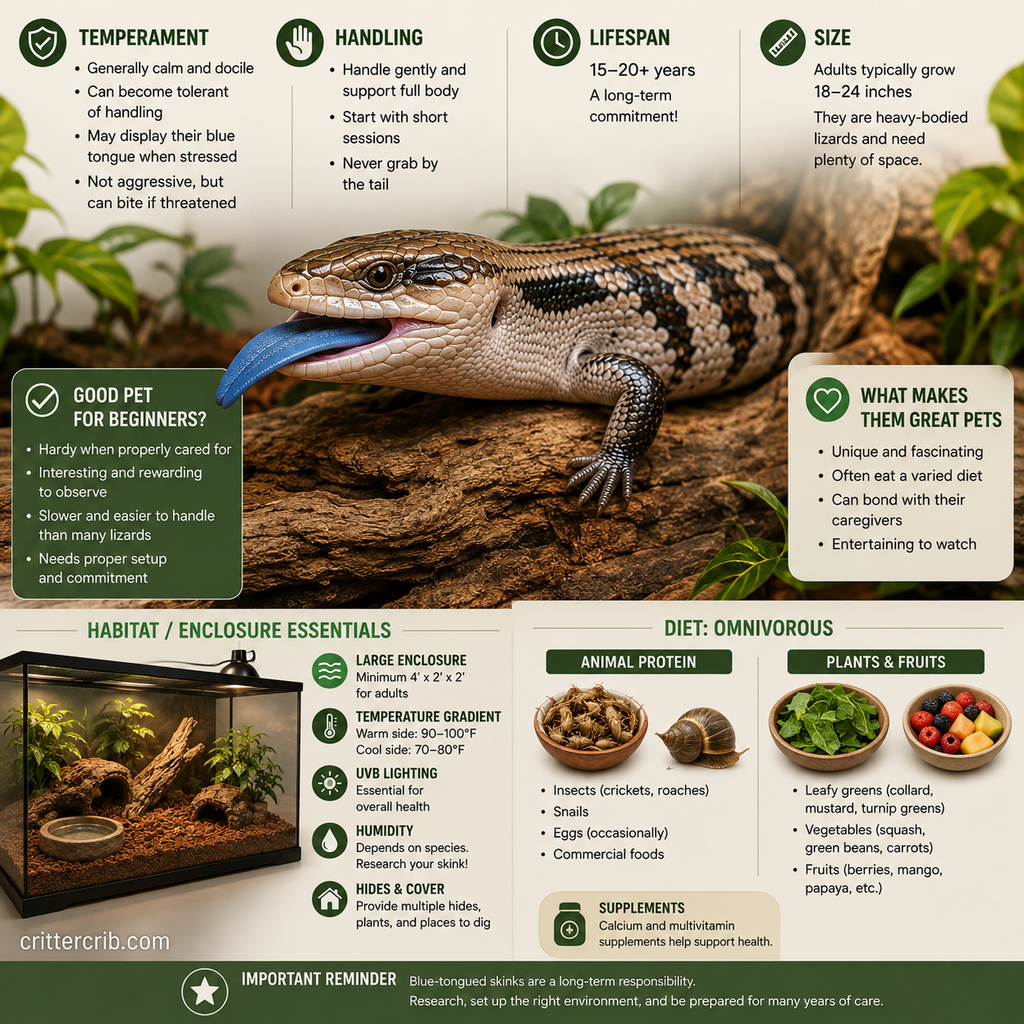
For the right person, absolutely. They can be excellent pet reptiles, including for dedicated beginners. They’re not necessarily “easy,” though. Blue-tongued skinks require a large enclosure, carefully managed heating and lighting, a varied diet, and a commitment that can last well over a decade.
Before bringing one home, it’s worth understanding exactly what you’re signing up for.
What Is a Blue-Tongued Skink?
Blue-tongued skinks are a group of relatively large, heavy-bodied lizards belonging to the genus Tiliqua.
They’re named for their distinctive blue tongues, which they can display when they feel threatened.
Several species and subspecies are kept as pets, including:
- Northern blue-tongued skinks
- Eastern blue-tongued skinks
- Indonesian blue-tongued skinks
- Merauke blue-tongued skinks
- Irian Jaya blue-tongued skinks
The exact care requirements can vary depending on which type you own.
This is especially important when it comes to humidity. An Australian blue-tongued skink and an Indonesian blue-tongued skink shouldn’t automatically be kept under identical conditions.
Before buying one, know exactly which species or subspecies you’re getting.
Are Blue-Tongued Skinks Good for Beginners?
Blue-tongued skinks can be good beginner reptiles, but they’re best suited to beginners who are willing to do some preparation.
They’re often recommended because they’re generally:
- Relatively slow-moving
- Large enough to handle comfortably
- Hardy when properly cared for
- Usually tolerant of gentle handling
- Interesting to observe
- Less fragile than many smaller lizards
- Able to eat a varied omnivorous diet
Their care is also fairly predictable once the enclosure is properly established.
The biggest challenge is that they’re substantial reptiles.
A tiny juvenile can eventually become a thick-bodied adult requiring a large habitat, strong heating equipment, regular cleaning, and considerably more food than a small gecko.
Think of them as beginner-friendly rather than effortless.
What Are Blue-Tongued Skinks Like as Pets?
One reason blue-tongued skinks have become popular is their personality.
Individual temperament varies, but many captive skinks become calm around their keepers and learn that routine interaction isn’t threatening.
They’re also entertaining animals to observe.
A skink may emerge from its hide, investigate its enclosure, dig through substrate, bask, search for food, and rearrange things in ways you didn’t necessarily plan.
They’re not particularly graceful.
That’s part of the charm.
With their short legs and long, heavy bodies, blue-tongued skinks tend to move around with a deliberate, almost lumbering style.
Are Blue-Tongued Skinks Friendly?
“Friendly” is a difficult word to apply to reptiles.
Blue-tongued skinks aren’t social companions in the same sense as dogs. They don’t need human affection or companionship to be emotionally fulfilled.
What many can become is comfortable with people.
A well-socialized skink may:
- Remain calm when you approach
- Accept gentle handling
- Explore your hands or lap
- Take food in your presence
- Show less defensive behavior over time
- Become familiar with regular routines
That makes them rewarding pets for people who want a reptile they can occasionally handle rather than only observe through glass.
Can You Handle a Blue-Tongued Skink?
Yes. Their relatively large size and slower movement make blue-tongued skinks one of the more manageable pet lizards to handle.
But proper technique still matters.
When picking one up:
- Approach calmly rather than grabbing suddenly.
- Support the chest and front portion of the body.
- Support the hindquarters and tail area with your other hand.
- Keep the skink relatively close to your body or another safe surface.
- Allow it to move without squeezing or tightly restraining it.
Blue-tongued skinks have long bodies and relatively short legs, so supporting the entire body helps them feel secure.
Never pick one up by the tail.
Start Slowly With a New Skink
A newly acquired blue-tongued skink may hiss, flatten its body, open its mouth, or display its blue tongue.
That doesn’t automatically mean you’ve purchased an aggressive animal.
Your skink has just been moved into an unfamiliar environment filled with unfamiliar smells, sounds, and people.
Give it time to settle.
Once it’s eating and behaving normally, you can gradually introduce short handling sessions.
Do Blue-Tongued Skinks Bite?
They can.
Any animal with a mouth can bite when frightened or defensive, and blue-tongued skinks have relatively powerful jaws.
Fortunately, many captive individuals rarely attempt to bite once they’re accustomed to handling.
Before biting, a nervous skink may provide warnings such as:
- Hissing
- Flattening the body
- Opening the mouth
- Displaying the blue tongue
- Turning toward your hand defensively
- Trying to move away
Respect those signals.
Repeatedly grabbing a frightened skink isn’t a good way to build trust.
How Big Do Blue-Tongued Skinks Get?
Size depends on the species or subspecies, but many blue-tongued skinks reach roughly 18–24 inches in total length as adults.
Some individuals can become even larger.
They’re also much heavier-bodied than similarly long snakes or slender lizards.
This matters when planning your enclosure.
A habitat that looks enormous for a juvenile may eventually become quite small once the animal reaches adult size.
Blue-Tongued Skinks Need a Large Enclosure
Adult blue-tongued skinks need substantial floor space.
For many adults, an enclosure around 4 feet long by 2 feet deep by 2 feet high is a reasonable starting point, with larger setups offering additional room for exploration.
Floor space is especially important because blue-tongued skinks spend most of their time on or near the ground.
The enclosure should provide:
- A warm side
- A cooler side
- A basking area
- Multiple hiding opportunities
- Deep enough substrate for digging
- Fresh water
- Visual cover
- Room to move around
Don’t assume a larger enclosure will automatically stress a young skink.
A spacious habitat can work when it’s properly furnished with plenty of hides and cover.
A large, empty enclosure is much more likely to make an animal feel exposed.
Temperature and Heating Requirements
Like other reptiles, blue-tongued skinks rely on environmental heat to regulate their body temperature.
They need a temperature gradient rather than one uniform enclosure temperature.
Exact requirements depend somewhat on the type of blue-tongued skink, but a setup generally includes:
- A warm basking area
- Warm ambient conditions on one side
- A cooler retreat on the opposite side
Basking surface temperatures for many commonly kept blue-tongued skinks are often maintained around the upper 90s°F, with some setups reaching approximately 100°F or slightly higher depending on the species and husbandry approach.
The cooler side should remain considerably cooler so the animal can thermoregulate.
Always research temperature requirements for your specific skink.
Don’t Guess Enclosure Temperatures
Use reliable equipment.
A good setup may include:
- Digital thermometers
- An infrared temperature gun
- Properly controlled heating equipment
- Timers for lighting
Measure both surface and ambient conditions where appropriate.
Your hand isn’t an accurate thermometer.
Do Blue-Tongued Skinks Need UVB?
Providing appropriate UVB lighting is generally recommended for blue-tongued skinks.
UVB exposure helps reptiles synthesize vitamin D3, which plays an important role in calcium metabolism.
The correct UVB setup depends on several factors, including:
- Bulb or fixture type
- Distance from the basking area
- Whether light passes through mesh
- Enclosure height
- Manufacturer recommendations
Your skink should also have shaded areas where it can move away from UVB exposure.
UVB bulbs don’t remain equally effective forever, so follow the manufacturer’s replacement recommendations even if the bulb still produces visible light.
Humidity Depends on the Type of Blue-Tongued Skink
This is one of the most important things beginners need to understand.
Not every blue-tongued skink requires the same humidity.
Australian species and subspecies generally come from different environmental conditions than Indonesian varieties.
Some Indonesian blue-tongued skinks require considerably higher humidity than Australian varieties.
That’s why buying a vaguely labeled “blue tongue skink” can create problems.
You need to know what you own.
Use a reliable digital hygrometer and research the humidity requirements of your particular species or subspecies.
Proper humidity supports healthy:
- Skin
- Shedding
- Hydration
- Respiratory function
- General health
Don’t simply copy enclosure settings from another blue-tongued skink owner unless you’re sure they’re keeping the same type.
Choosing Substrate for a Blue-Tongued Skink
Blue-tongued skinks often enjoy digging and partially burying themselves.
Providing a reasonably deep layer of safe substrate gives them an opportunity to perform this natural behavior.
Suitable substrate depends partly on humidity requirements.
Common options can include:
- Cypress mulch
- Coconut husk
- Coconut fiber
- Reptile-safe soil mixtures
- Aspen in appropriate lower-humidity setups
Avoid aromatic woods such as cedar and other materials that may pose respiratory or toxicity concerns.
Substrate should also be monitored for excessive dampness, mold, and waste.
Blue-Tongued Skinks Need Places to Hide
Even a skink that seems confident around people needs somewhere private to retreat.
Provide secure hiding areas throughout the enclosure.
Ideally, your skink shouldn’t have to choose between the correct temperature and feeling safe.
A well-designed habitat might include:
- Warm-side hide
- Cool-side hide
- Cork bark
- Artificial or reptile-safe plants
- Logs
- Leaf litter
- Other visual barriers
Some skinks will also burrow underneath substrate when they want privacy.
That’s normal.
What Do Blue-Tongued Skinks Eat?
Blue-tongued skinks are omnivores.
Their diet includes both animal and plant matter, making feeding more varied than feeding many insect-eating lizards.
A balanced captive diet may incorporate appropriate combinations of:
Animal-Based Foods
Depending on the feeding plan, options can include:
- Appropriately selected insects
- Snails
- Eggs occasionally
- Other suitable animal-based protein sources
- Properly formulated commercial foods used appropriately
Vegetables and Greens
Examples may include:
- Collard greens
- Mustard greens
- Turnip greens
- Squash
- Green beans
- Other reptile-appropriate vegetables
Fruit
Fruit can be offered more sparingly.
Suitable options may include small portions of:
- Berries
- Mango
- Papaya
- Other appropriate fruits
Variety matters.
Don’t build the entire diet around one favorite food simply because your skink enthusiastically eats it.
Calcium and Supplements
Calcium and vitamin supplementation may also be necessary depending on the overall diet and husbandry.
Supplementation shouldn’t be approached as “more is better.”
The amount and frequency should complement the diet and UVB setup.
If you’re uncertain, discuss your feeding plan with a veterinarian experienced with reptiles.
Blue-Tongued Skinks Love Food
One of the fun parts of keeping blue-tongued skinks is that many are enthusiastic eaters.
It’s also one of the easiest ways to accidentally make them overweight.
A skink eagerly approaching food doesn’t necessarily mean it’s starving.
Monitor body condition and adjust meal size and frequency according to:
- Age
- Size
- Activity
- Body condition
- Overall health
Juveniles typically require a different feeding schedule from adults.
Keeping a basic weight record can help you notice gradual changes.
How Long Do Blue-Tongued Skinks Live?
A blue-tongued skink isn’t a short-term pet.
With proper care, they can commonly live around 15–20 years, and some individuals may live beyond that.
That’s a significant commitment.
Before getting one, think about where you might be:
- Five years from now
- Ten years from now
- Fifteen years from now
Moving, changing jobs, starting a family, or relocating doesn’t eliminate the animal’s need for specialized care.
Long lifespan is wonderful when you love the pet.
It’s a problem when it wasn’t considered beforehand.
Are Blue-Tongued Skinks Expensive?
The skink itself is only part of the cost.
A responsible setup may require:
- Large reptile enclosure
- Heating equipment
- UVB fixture and bulb
- Thermometers
- Hygrometer
- Thermostat or heat controller
- Substrate
- Hides
- Water bowl
- Enclosure furnishings
- Food
- Supplements
- Replacement bulbs
- Cleaning supplies
- Veterinary care
Initial setup costs can easily exceed the purchase price of the animal.
You’ll also have recurring expenses for food, substrate, electricity, replacement lighting, and veterinary care.
Before buying the skink, price the entire setup.
Captive-Bred vs. Wild-Caught Blue-Tongued Skinks
Whenever possible, beginners should strongly consider captive-bred animals from reputable breeders.
Captive-bred skinks typically have known histories and may be more accustomed to captive conditions and human interaction.
This is particularly important with some Indonesian varieties, which may appear in the pet trade as imported animals.
Wild-caught or imported reptiles can arrive with additional concerns such as:
- Parasites
- Dehydration
- Stress
- Injuries
- Difficulty adjusting to captivity
- Unknown age or history
Ask the seller directly whether the animal is captive-bred.
Don’t assume.
Can Blue-Tongued Skinks Live Together?
Blue-tongued skinks are generally best housed individually.
Don’t assume that two skinks need companionship.
Keeping reptiles together can introduce competition, stress, aggression, mating pressure, and injuries that aren’t always immediately obvious.
Two animals appearing to “cuddle” may actually be competing for the same preferred basking or hiding location.
For a beginner, one properly housed blue-tongued skink per enclosure is the safest approach.
Are Blue-Tongued Skinks Good Pets for Children?
A calm blue-tongued skink can be an interesting family pet, but an adult should ultimately be responsible for its care.
Their size and relatively slow movement may make them easier for older children to interact with than small, extremely fast lizards.
However, children should always be taught to:
- Support the skink’s entire body
- Never pull the tail
- Avoid squeezing
- Recognize defensive behavior
- Keep the animal away from their face
- Wash their hands after handling
Reptiles can carry Salmonella and other germs even when they appear completely healthy, so proper hygiene is important.
Young children should always be supervised.
What Is Daily Life With a Blue-Tongued Skink Like?
Blue-tongued skinks don’t require constant attention.
A typical day might involve checking:
- Temperatures
- Lighting
- Humidity
- Water
- General behavior
Feeding occurs according to an age-appropriate schedule rather than necessarily every day.
You’ll also need to spot-clean waste and replace contaminated substrate.
Handling can be occasional rather than constant.
Many owners find blue-tongued skinks appealing precisely because they’re interactive enough to be interesting without demanding hours of daily social attention.
Advantages of Keeping a Blue-Tongued Skink
There are plenty of reasons these lizards have devoted fans.
They Can Be Excellent Handling Reptiles
Many become calm and manageable with patient, appropriate interaction.
They’re Relatively Sturdy
Their larger size can make them feel less delicate than tiny geckos and other small reptiles.
They Have Interesting Personalities
Individual skinks often develop recognizable routines and behavioral quirks.
Feeding Is Varied
Their omnivorous diet allows for considerably more variety than the diets of many other reptiles.
They’re Fascinating to Watch
Digging, basking, exploring, foraging, and that famous blue-tongue display make them engaging animals even when you’re not handling them.
They Can Live for Many Years
For someone looking for a long-term reptile companion, their lifespan can be a major advantage.
Disadvantages of Keeping a Blue-Tongued Skink
No pet is perfect.
Before getting one, consider the downsides too.
They Need a Lot of Space
An adult enclosure takes up a significant amount of room.
Initial Setup Can Be Expensive
Large enclosures and quality heating and lighting equipment add up quickly.
Their Diet Requires Planning
Feeding isn’t as simple as dropping the same food into a bowl every day.
They Can Live for Decades
A long lifespan is both an advantage and a major responsibility.
They Can Bite
Although many individuals become very tolerant of handling, defensive bites are possible.
Species Identification Matters
Different types have different environmental requirements, particularly regarding humidity.
Reptile Veterinary Care Can Be Expensive
Not every veterinarian treats reptiles, so you may need to locate an experienced exotic-animal veterinarian before bringing your skink home.
Who Should Get a Blue-Tongued Skink?
A blue-tongued skink may be a great pet for you if:
- You want a larger, relatively calm lizard
- You’d like a reptile you can occasionally handle
- You have space for a large enclosure
- You’re willing to maintain heating, UVB, and humidity
- You enjoy preparing a varied diet
- You’re prepared for a 15–20+ year commitment
- You have access to reptile veterinary care
- You’re interested in observing natural reptile behavior
Who Should Probably Choose a Different Reptile?
A blue-tongued skink may not be ideal if:
- You want a very small enclosure
- You’re looking for an inexpensive pet
- You don’t want to manage specialized heating or lighting
- You want a highly affectionate animal
- You frequently travel without reliable pet care
- You’re uncomfortable feeding a varied omnivorous diet
- You’re unsure about keeping the same reptile for potentially two decades
There’s nothing wrong with deciding another species fits your lifestyle better.
Choosing the right reptile is much easier than trying to make the wrong one fit your situation later.
Frequently Asked Questions About Blue-Tongued Skinks
Are blue-tongued skinks easy to care for?
Their basic care is manageable once the enclosure is properly established, but they aren’t maintenance-free.
Beginners need to understand heating, UVB, humidity, diet, supplementation, and enclosure maintenance.
Are blue-tongued skinks affectionate?
It’s better to describe them as potentially tolerant and comfortable with handling rather than affectionate.
Some individuals become very relaxed around their owners, but reptiles shouldn’t automatically be expected to form mammal-like social bonds.
Do blue-tongued skinks recognize their owners?
They may become familiar with routines, smells, sounds, and repeated interactions. However, this shouldn’t necessarily be interpreted as the same kind of owner recognition or attachment seen in highly social mammals.
Do blue-tongued skinks need to eat every day?
Not necessarily.
Feeding frequency depends heavily on age, size, body condition, and diet. Juveniles generally eat more frequently than adults.
Do blue-tongued skinks smell?
A properly maintained skink and enclosure shouldn’t produce an overwhelming odor.
Waste can certainly smell, though.
Regular spot cleaning, clean substrate, proper ventilation, and washing food and water dishes help keep odors under control.
Can blue-tongued skinks drop their tails?
Blue-tongued skinks can experience tail injuries and some may lose portions of the tail, so you should never grab or restrain one by its tail.
Always support the body during handling.
Do blue-tongued skinks need baths?
Routine bathing generally isn’t necessary for a healthy skink with proper husbandry.
Your skink should have constant access to fresh water, and correct humidity is more important than routinely placing the animal in a bath.
Can I let my blue-tongued skink roam around the house?
Short periods of supervised exploration in a secure, appropriately warm area may be possible, but a room isn’t a substitute for a properly controlled enclosure.
Keep skinks away from:
- Other pets
- Electrical cords
- Small gaps
- Stairs
- Cleaning chemicals
- Unsafe plants
- Cold floors
- Open doors
Never allow unsupervised roaming.
So, Are Blue-Tongued Skinks Good Pets?
For the right owner, blue-tongued skinks can be fantastic pets.
They’re large enough to handle comfortably, generally slower and sturdier than many popular lizards, interesting to observe, and capable of becoming quite relaxed around their keepers.
They’re also a substantial commitment.
You’ll need room for a large enclosure, proper heating and UVB lighting, species-appropriate humidity, a varied diet, regular maintenance, and access to reptile veterinary care. You also need to be prepared to provide all of that for potentially 15–20 years or longer.
If those requirements sound manageable rather than overwhelming, a blue-tongued skink can be an excellent choice—even for a first-time reptile owner.
Just do your homework before bringing one home, identify the exact type you’re getting, and build the enclosure before the skink arrives.
A good experience with reptiles usually starts long before you bring the animal through the front door.