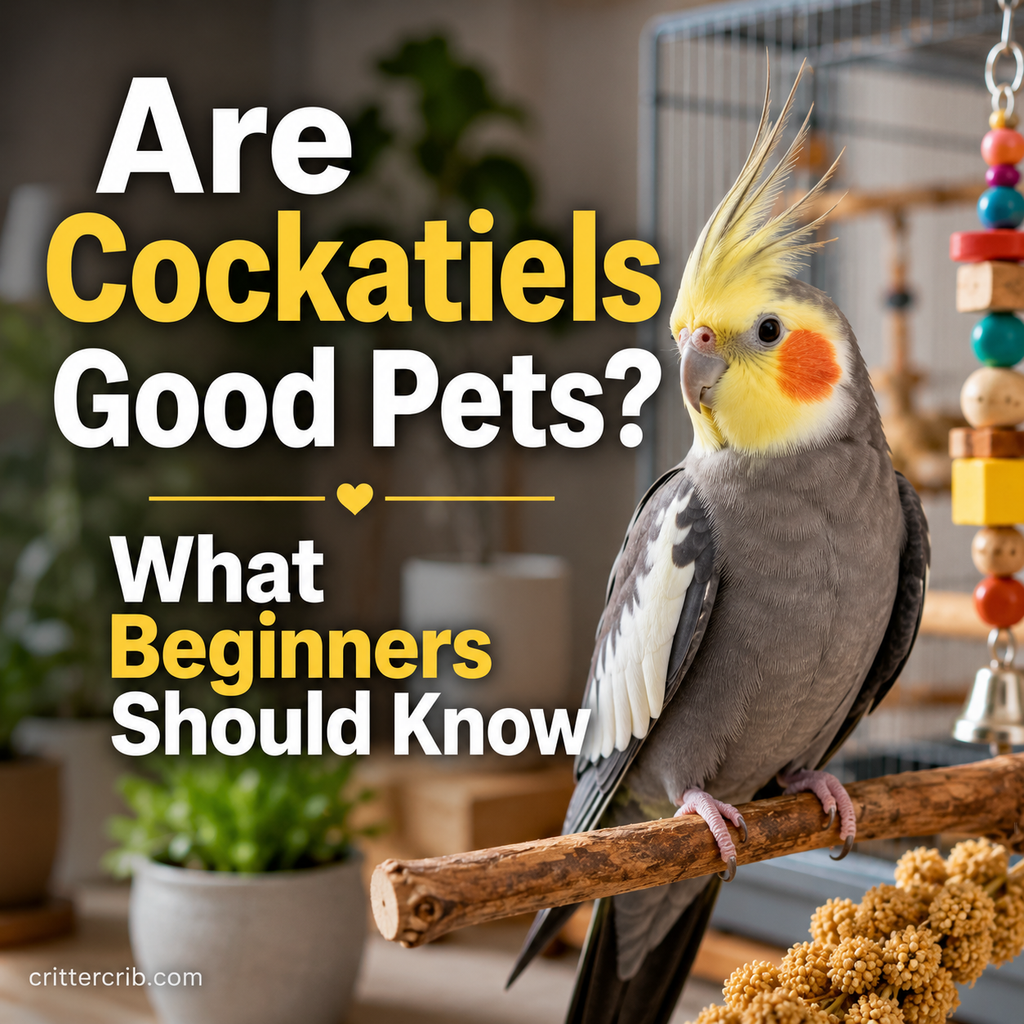
Cockatiels are often recommended as beginner birds, and there are some good reasons why. They’re relatively small, can become incredibly social with their owners, and don’t require the enormous setup associated with larger parrots.
But “beginner-friendly” doesn’t mean effortless.
Cockatiels need daily attention, a properly designed habitat, regular cleaning, enrichment, a balanced diet, and access to veterinary care. They can also be messy, surprisingly loud at times, and capable of living for many years.
If you’re considering bringing home your first bird, understanding both sides of cockatiel ownership is important.
Here’s what beginners should know before deciding whether a cockatiel is the right pet.
What Is a Cockatiel?
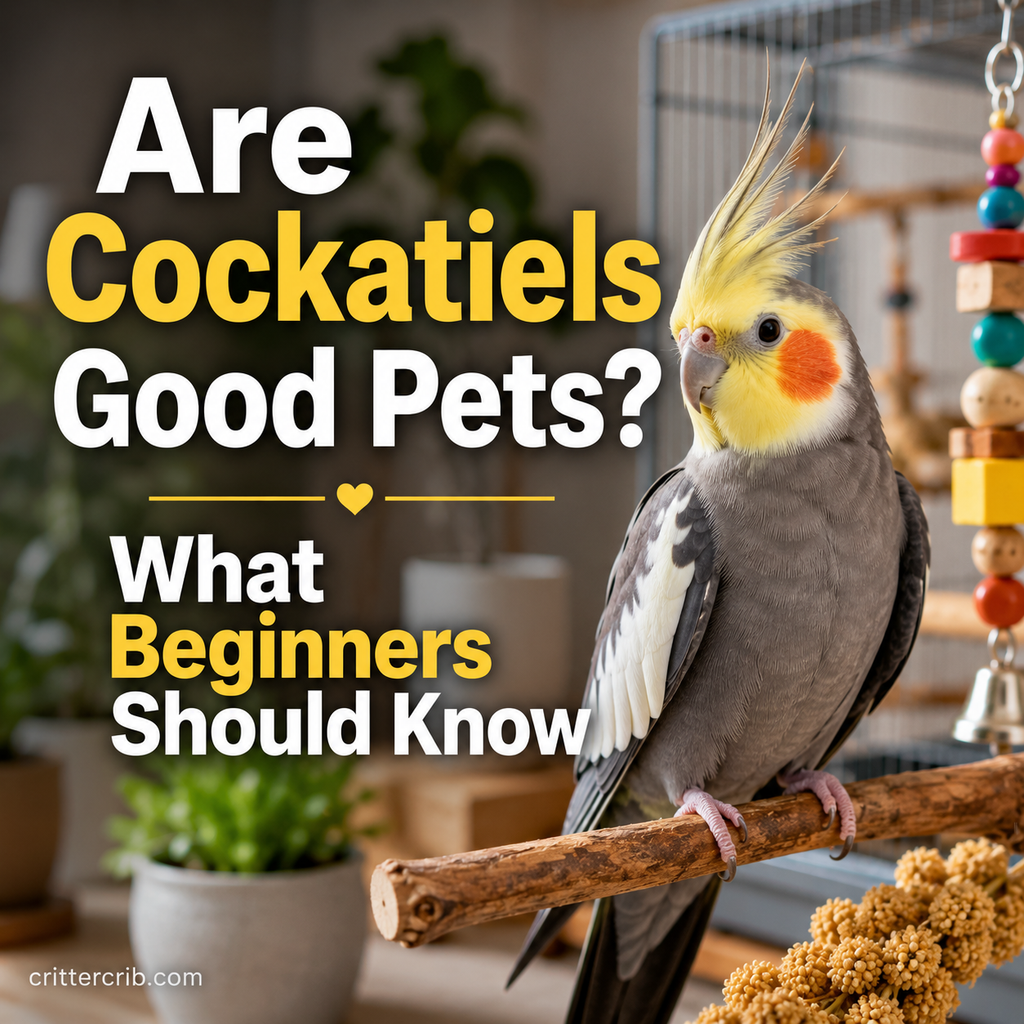
Cockatiels are small parrots native to Australia. They’re recognizable by their long tails, expressive crests, and distinctive cheek patches.
The crest is particularly charming because it can give you clues about how a cockatiel is feeling. Its position can change when the bird is curious, excited, relaxed, frightened, or alert.
Cockatiels come in several color varieties, although the classic gray cockatiel remains one of the most familiar.
Despite their relatively small size, these birds have plenty of personality.
A well-socialized cockatiel may whistle when you enter the room, ask for head scratches, investigate whatever you’re doing, and happily spend time sitting near you.
Are Cockatiels Good Pets for Beginners?
Yes, cockatiels can be excellent pets for first-time bird owners.
They’re generally easier to accommodate than large parrots and can develop strong relationships with their owners. Many have gentle personalities and enjoy human interaction when they’ve been properly socialized.
Cockatiels also tend to be easier to physically handle than much larger parrots.
However, they’re best suited to beginners who understand that birds require specialized care.
A cockatiel may be a good first bird if you’re willing to:
- Provide daily social interaction
- Clean the cage regularly
- Offer enrichment and exercise
- Learn basic bird behavior
- Feed a varied, appropriate diet
- Bird-proof areas used for out-of-cage time
- Accept some noise and mess
- Find an avian veterinarian
- Make a long-term commitment
If you want a pet that can mostly entertain itself while you’re away all day, a cockatiel may not be the best choice.
What Are Cockatiels Like as Pets?
Individual personalities vary considerably.
Some cockatiels are outgoing and adventurous. Others are cautious and need more time to trust unfamiliar people or objects.
Once comfortable, many cockatiels enjoy simply being around their owners.
Your bird might sit on your shoulder while you’re at the computer, whistle from its cage when you enter the room, or lower its head to request scratches.
Cockatiels can also be opinionated.
They may protest when you stop scratching their head, become suspicious of a new toy, or call loudly when you leave the room.
That’s part of living with an intelligent social animal rather than a decorative cage bird.
Are Cockatiels Affectionate?
Many cockatiels can be very affectionate.
Head and neck scratches are particularly popular because birds cannot easily preen these areas themselves.
A relaxed cockatiel may lower its head toward your finger when it wants attention.
Some birds also enjoy sitting on shoulders or staying close to their favorite person.
However, affection shouldn’t be forced.
A new cockatiel may need days or weeks to become comfortable around you. Some birds require considerably longer, particularly if they haven’t had positive experiences with people.
Allow the relationship to develop at the bird’s pace.
Do Cockatiels Like to Be Held?
Cockatiels generally aren’t “held” in the same way you would hold a puppy or guinea pig.
Most prefer to perch on a finger, hand, arm, or shoulder.
Once trained, many cockatiels willingly step onto a person’s hand using the familiar “step up” behavior.
Some enjoy extensive physical interaction, while others prefer simply sitting nearby.
Respecting those individual boundaries is an important part of building trust.
Do Cockatiels Talk?
Cockatiels can learn words and phrases, but talking usually isn’t their greatest strength.
They’re much better known for whistling.
Some cockatiels become talented whistlers and can learn recognizable melodies, household sounds, and short tunes.
Males are often more vocal and may be more likely to imitate whistles and sounds, although individual birds vary.
If having a talking bird is your primary goal, don’t choose a cockatiel expecting guaranteed speech.
Think of talking as a possible bonus rather than a defining characteristic.
Are Cockatiels Loud?
Cockatiels aren’t silent pets.
They whistle, chirp, call, chatter, and occasionally scream.
A cockatiel may call when:
- You leave the room
- It wants attention
- It hears another bird
- Something frightens it
- It’s excited
- It’s looking for a companion
- Morning activity begins
Their calls generally aren’t comparable to the extreme volume produced by some larger parrots, but they’re certainly noticeable.
In a small apartment, even moderate bird calls can travel through walls.
Spend time around cockatiels before getting one if noise is a major concern.
Are Cockatiels Messy?
Yes.
This surprises some first-time bird owners.
Cockatiels scatter seed hulls, food crumbs, feathers, pieces of shredded toys, and other debris around their cages.
They also produce feather dust.
You should expect to regularly clean:
- Cage liners
- Cage bars
- Perches
- Food and water dishes
- Floors surrounding the cage
- Nearby furniture and surfaces
A small handheld vacuum or easy-to-clean floor surface near the cage can make everyday maintenance much easier.
If you want an extremely tidy pet, bird ownership may be frustrating.
Do Cockatiels Produce a Lot of Dust?
Cockatiels are considered powder-down birds.
Their feathers naturally produce a fine powder that helps maintain plumage. This can create noticeable dust around the cage and surrounding room.
Regular cleaning can help control it.
A suitable air purifier may also help reduce airborne particles, but it shouldn’t replace normal cleaning and good ventilation.
Anyone in the household with significant allergies, asthma, or respiratory sensitivities should carefully consider the potential impact of bird dust before bringing home a cockatiel.
How Much Attention Do Cockatiels Need?
Cockatiels are social birds and generally benefit from daily interaction.
That doesn’t mean you need to actively entertain your bird every minute you’re home.
A cockatiel may happily play with toys, eat, preen, nap, and explore independently while you’re nearby.
However, regularly leaving a single cockatiel alone without meaningful interaction or enrichment isn’t ideal.
Plan to incorporate your bird into everyday life.
That might include:
- Talking to your cockatiel
- Training simple behaviors
- Offering supervised out-of-cage time
- Providing new foraging activities
- Whistling together
- Allowing your bird to perch near you
- Rotating toys and enrichment
Consistency matters more than occasionally providing several hours of attention and then ignoring the bird for days.
Can Cockatiels Be Left Alone?
Cockatiels can spend portions of the day alone in an appropriately equipped cage.
Many owners work outside the home.
The bigger question is what happens during the rest of the day.
A single cockatiel should have opportunities for interaction, exercise, and mental stimulation when you’re available.
If your schedule routinely keeps you away from home from early morning until late at night, reconsider whether a highly social bird fits your lifestyle.
Do Cockatiels Need a Companion?
Cockatiels can live successfully as single birds when they receive sufficient human interaction and enrichment.
Keeping two cockatiels can provide valuable bird-to-bird companionship, particularly in households where people are away for significant periods.
However, getting a second bird isn’t automatically easier.
Two birds mean:
- More cage space
- More food
- More cleaning
- Additional veterinary expenses
- More noise
- More potential mess
There’s also no guarantee that two individual birds will immediately become best friends.
If you choose to keep multiple cockatiels, introductions should be handled carefully.
How Long Do Cockatiels Live?
One of the most important things beginners should understand is that cockatiels aren’t short-term pets.
With proper care, many cockatiels live around 15 to 20 years, and some can live longer.
That makes getting a cockatiel a significant commitment.
Before bringing one home, think about how your life might change over the coming years.
Consider:
- Moving
- College
- Career changes
- Relationships
- Children
- Other pets
- Travel
- Housing restrictions
- Veterinary expenses
Nobody can predict everything that will happen over two decades, but you should be prepared to make your bird part of those future plans.
What Size Cage Does a Cockatiel Need?
Cockatiels need enough room to move comfortably, stretch their wings, climb, and travel between perches.
A cage around 24 inches wide, 18 inches deep, and 24 inches tall can be considered a starting point for one cockatiel, although larger is generally better.
Horizontal space is especially valuable.
Make sure the bar spacing is appropriate for cockatiels—typically around 1/2 to 5/8 inch.
The cage should provide enough space for:
- Multiple perches
- Food and water dishes
- Several toys
- Comfortable movement
- Wing stretching
- Short flights when cage dimensions allow
Don’t fill every inch with accessories.
Your bird needs open space as much as it needs enrichment.
What Should Be Inside a Cockatiel Cage?
A good habitat doesn’t need dozens of accessories.
Start with the essentials.
Perches
Provide several perches of different sizes and textures.
Natural bird-safe wood perches are useful because their irregular surfaces allow the feet to grip in different positions.
Avoid relying entirely on identical smooth dowels.
Food and Water Dishes
Food and fresh water should always be easily accessible.
Position bowls where droppings from overhead perches aren’t likely to fall into them.
Wash bowls regularly and replace drinking water at least daily or whenever it becomes contaminated.
Toys
Cockatiels need mental stimulation.
Useful options include:
- Shredding toys
- Chewing toys
- Foraging toys
- Climbing toys
- Swings
- Bird-safe bells
- Simple puzzle toys
Rotate toys periodically rather than packing the cage with everything you own.
What Do Cockatiels Eat?
A balanced cockatiel diet shouldn’t consist exclusively of seeds.
Although cockatiels enjoy seeds, an all-seed diet can be nutritionally inadequate and high in fat.
A more balanced diet commonly includes a quality formulated pellet as the foundation along with appropriate fresh foods.
Depending on your bird and your avian veterinarian’s recommendations, fresh foods may include bird-safe vegetables and leafy greens.
Examples can include:
- Bell peppers
- Carrots
- Broccoli
- Leafy greens
- Squash
- Peas
Small amounts of suitable fruit can also provide variety.
Always research whether a food is safe before offering it.
Foods Cockatiels Should Never Eat
Some human foods can be dangerous to birds.
Avoid giving your cockatiel:
- Avocado
- Chocolate
- Alcohol
- Caffeine
- Foods containing xylitol
- Very salty foods
- Highly processed foods
If you’re uncertain about a particular food, check with an avian veterinarian before offering it.
Do Cockatiels Need Time Outside Their Cage?
Regular supervised out-of-cage time gives cockatiels opportunities to exercise, explore, interact, and fly.
But the room needs to be bird-safe first.
Before opening the cage:
- Close windows and exterior doors.
- Turn off ceiling fans.
- Keep cats and dogs away.
- Remove open containers of water.
- Secure dangerous cords and objects.
- Keep the bird away from hot surfaces.
- Block access to unsafe plants or chemicals.
- Make windows and large mirrors easier for inexperienced birds to recognize when necessary.
Never assume your bird understands every household danger.
Something harmless to a person can be extremely dangerous to a small flying animal.
Are Cockatiels Easy to Train?
Cockatiels can learn basic behaviors quite well.
One of the first skills many owners teach is “step up,” where the bird steps onto a finger or handheld perch.
You can also work on:
- Recall
- Target training
- Going back into the cage
- Entering a carrier
- Simple tricks
Keep sessions short and positive.
Reward behaviors you want rather than frightening or punishing the bird for mistakes.
Training isn’t just entertainment. Behaviors such as stepping up and entering a carrier can make everyday care much easier.
Do Cockatiels Bite?
Cockatiels can bite.
Fortunately, their bites aren’t comparable to those of large parrots, but they can still hurt.
Biting often happens for a reason.
A cockatiel may bite because it is:
- Frightened
- Overstimulated
- Protecting its space
- Hormonal
- Uncomfortable
- Warning you to stop
- Not yet comfortable with handling
Learning your cockatiel’s body language can prevent many bites.
A bird that repeatedly moves away, opens its beak, hisses, or otherwise warns you shouldn’t be forced into interaction.
Respecting those signals helps build trust.
Are Cockatiels Good Pets for Children?
Cockatiels can live successfully in families with children, but an adult should remain responsible for the bird’s care.
Small children shouldn’t handle a cockatiel unsupervised.
Birds have delicate bodies and can be injured accidentally. Children may also react unpredictably if a bird suddenly flies, bites, or lands on them.
Older children who understand gentle handling and respect boundaries may enjoy participating in feeding, training, and supervised interaction.
The decision to get a cockatiel should ultimately be made by an adult who is prepared to care for the bird if the child’s interest fades.
Can Cockatiels Live With Cats or Dogs?
Cockatiels can live in households that also have cats or dogs, but physical interaction between them can be dangerous.
Even a friendly cat retains predatory instincts.
A playful swat or bite can seriously injure a bird. Dogs can also accidentally harm a cockatiel even without aggressive intent.
Don’t rely on cute interactions or assume your animals “know better.”
Separate other pets during out-of-cage time and make sure the cockatiel’s cage is secure.
Do Cockatiels Need Veterinary Care?
Yes.
Before getting a cockatiel, locate an avian veterinarian or veterinarian experienced with birds.
Bird anatomy and medicine differ significantly from dogs and cats, and not every veterinary clinic treats birds.
Routine veterinary care can help establish a baseline for your bird’s health and identify potential problems.
This is particularly important because birds may hide signs of illness.
Contact a veterinarian promptly if your cockatiel develops concerning changes such as:
- Difficulty breathing
- Significant appetite changes
- Unusual weakness
- Persistent abnormal droppings
- Sitting fluffed and inactive for extended periods
- Loss of balance
- Sudden major behavioral changes
Don’t wait for a sick bird to become obviously ill before searching for an avian veterinarian.
How Much Does a Cockatiel Cost?
The price of the bird is only one part of the cost of ownership.
Initial expenses may include:
- The cockatiel
- A suitable cage
- Natural perches
- Food and water dishes
- Toys
- A carrier
- Initial food
- Cleaning supplies
- Veterinary examination
Then there are ongoing expenses for food, replacement toys, cage accessories, cleaning supplies, and veterinary care.
Unexpected medical treatment can be considerably more expensive than routine care.
Create a realistic budget before getting your bird rather than focusing only on its purchase or adoption fee.
What Are the Biggest Advantages of Owning a Cockatiel?
Cockatiels have remained popular companion birds for good reason.
Potential advantages include:
- Friendly and social personalities
- Relatively manageable size
- Strong bonds with owners
- Entertaining whistles and vocalizations
- Ability to learn basic training
- Playful and curious behavior
- Smaller space requirements than large parrots
- Generally manageable beak size
- Plenty of personality in a small package
For someone who genuinely enjoys interacting with birds, a cockatiel can become an engaging everyday companion.
What Are the Downsides of Owning a Cockatiel?
The disadvantages deserve just as much consideration.
Cockatiels can be:
- Messy
- Dusty
- Noisy
- Destructive toward chewable objects
- Needy for social interaction
- Expensive when veterinary care is required
- Difficult to accommodate during travel
- Vulnerable to household fumes and hazards
- A commitment lasting 15 years or longer
You’ll also be cleaning around the cage far more often than you might expect.
None of these things automatically make cockatiels bad pets. They simply mean they aren’t suitable for every household.
Who Should Get a Cockatiel?
A cockatiel may be a great choice if you:
- Want an interactive companion
- Enjoy training and building trust with animals
- Have time for daily interaction
- Don’t mind regular cleaning
- Can tolerate moderate bird noise
- Can provide supervised exercise
- Have access to appropriate veterinary care
- Are prepared for a long-term commitment
Cockatiels can work particularly well for someone who wants the intelligence and personality of a parrot without taking on one of the much larger species.
Who Should Probably Avoid Getting a Cockatiel?
Think carefully before getting one if you:
- Need an extremely quiet home
- Strongly dislike mess or dust
- Travel frequently without reliable pet care
- Can’t provide regular interaction
- Want a low-maintenance cage pet
- Can’t access appropriate veterinary care
- Aren’t prepared for a commitment potentially lasting decades
It’s much better to recognize a mismatch before bringing a bird home.
Questions to Ask Before Getting a Cockatiel
Before making your decision, ask yourself:
- Can I care for this bird for potentially 15 to 20 years or longer?
- Do I have room for an appropriately sized cage?
- Can I provide daily interaction and exercise?
- Am I comfortable with bird noise?
- Am I willing to clean around the cage frequently?
- Can I afford routine and unexpected veterinary care?
- Is there an avian veterinarian accessible to me?
- Can I safely bird-proof part of my home?
- Will my current pets create safety concerns?
- Who will care for the bird when I travel?
If several answers make you uncomfortable, there’s nothing wrong with waiting.
Getting the right pet at the right time is better than choosing one because it looks adorable at a pet store.
Frequently Asked Questions About Cockatiels as Pets
Are Cockatiels Easy Pets?
Cockatiels can be easier to manage than large parrots, but they aren’t low-maintenance pets.
They require daily feeding, fresh water, cleaning, social interaction, enrichment, exercise, and specialized veterinary care.
Are Cockatiels Good First Birds?
Yes, cockatiels are commonly considered a good option for responsible first-time bird owners.
Their manageable size, generally social nature, and trainability make them approachable for beginners willing to learn proper bird care.
Are Male or Female Cockatiels Better Pets?
Neither sex is automatically a better pet.
Males are often associated with more whistling and vocal displays, while females may sometimes be quieter, but personality varies considerably between individual birds.
Choose based on the individual bird rather than assuming sex guarantees a particular temperament.
Do Cockatiels Recognize Their Owners?
Cockatiels can learn to recognize familiar people and may develop strong preferences for particular individuals.
A bonded bird may vocalize when its favorite person enters the room, seek interaction, or choose to sit nearby.
Do Cockatiels Like Being Petted?
Many enjoy gentle scratches around the head and neck.
Avoid routinely petting the back, underneath the wings, or other areas that can encourage hormonal or sexual behavior.
Pay attention to your bird’s body language and stop if it moves away or appears uncomfortable.
Can Cockatiels Learn Their Names?
Cockatiels can learn associations with frequently repeated sounds, including their names.
Consistently using the bird’s name during positive interactions can help it recognize that the sound is relevant to it.
Can a Cockatiel Live in an Apartment?
Potentially, yes.
Cockatiels are generally more apartment-friendly than very large parrots, but they can still produce loud contact calls and whistles.
Consider your building’s noise levels, neighbors, lease restrictions, and the individual bird before deciding.
Are Cockatiels Better Than Budgies for Beginners?
Both can make excellent first birds.
Budgies are smaller and typically require less physical space, while cockatiels are larger and may appeal to people who want a bird that’s somewhat easier to interact with physically.
The better choice depends on the owner’s lifestyle and preferences rather than one species being universally superior.
Final Thoughts: Is a Cockatiel Right for You?
Cockatiels can make wonderful pets for beginners, but the best owners are the ones who understand what they’re signing up for.
These aren’t decorative birds meant to spend their lives sitting quietly inside a cage.
Cockatiels are intelligent, social animals. They whistle, play, explore, make messes, demand attention, develop preferences, and form relationships with the people around them.
They also require a commitment that can last well over a decade.
If you’re prepared to provide a spacious habitat, balanced diet, daily interaction, enrichment, safe exercise, regular cleaning, and proper veterinary care, a cockatiel can be a rewarding companion.
Take your time before deciding. Learn about their needs, meet some cockatiels if possible, locate an avian veterinarian, and think realistically about how a bird would fit into your daily routine.
If that lifestyle sounds enjoyable rather than inconvenient, a cockatiel may be an excellent first bird.