

Tiger salamanders aren’t the most outwardly expressive pets. They don’t wag their tails when they’re excited to see you, and they’re unlikely to spend their days actively exploring every corner of their enclosure.
Most of the time, they’re doing something much simpler.
Hiding.
For a new owner, that can make tiger salamander behavior difficult to read. A salamander that disappears underground for days may seem sick or unhappy when it’s actually behaving normally. At other times, a sudden change in activity, appetite, or posture can provide an early clue that something in the habitat needs attention.
Understanding what’s typical for these terrestrial amphibians makes it much easier to separate normal salamander behavior from potential warning signs.
Here’s what common tiger salamander behaviors usually mean and when you should take a closer look.
What Is Normal Tiger Salamander Behavior?
Adult tiger salamanders are primarily terrestrial and spend much of their time hidden underground or beneath cover.
In nature, burrowing helps them avoid predators, maintain moisture, and escape temperature extremes. That instinct doesn’t disappear just because a salamander lives in a terrarium.
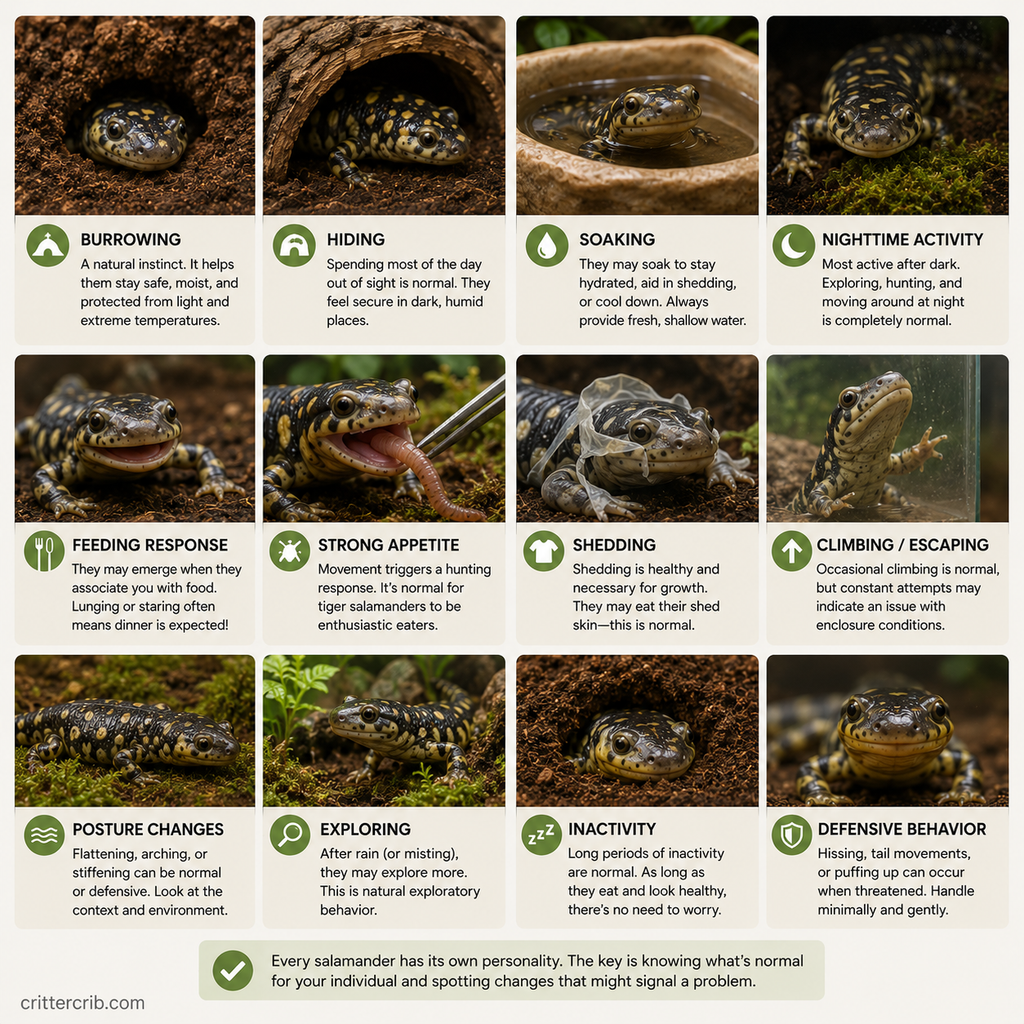
Normal behaviors may include:
- Burrowing into substrate
- Hiding beneath cork bark or other cover
- Remaining inactive for long periods
- Becoming active after dark
- Emerging when food is available
- Sitting near the entrance of a burrow
- Exploring after misting or environmental changes
- Digging new burrows
- Periodically soaking
- Shedding skin
- Snapping quickly at prey
Individual personalities vary.
Some tiger salamanders become surprisingly bold around feeding time, while others spend most of their lives behaving like you purchased an expensive container of dirt.
Both can be normal.
The most useful thing you can do is learn your salamander’s usual routine. Changes from that baseline are often more informative than any single behavior.
Why Does My Tiger Salamander Hide All the Time?
Hiding is one of the most normal things a tiger salamander can do.
These animals aren’t designed to spend the day sitting in an exposed area under bright lighting.
A tiger salamander may hide:
- Beneath the substrate
- Under cork bark
- Inside a hide
- Beneath leaf litter
- Around plant roots
- In another dark, humid part of the enclosure
Don’t assume that a salamander spending most of the day out of sight is unhappy.
Providing secure hiding opportunities is an important part of creating an appropriate habitat.
If your salamander suddenly begins hiding significantly more than usual, however, consider whether anything has changed.
Check the enclosure’s temperature, moisture, lighting, and general conditions.
Why Does My Tiger Salamander Burrow?
Burrowing is a defining tiger salamander behavior.
Adults belong to a group often referred to as mole salamanders, and the name makes sense once you’ve watched one disappear into several inches of substrate.
Burrowing allows a salamander to find conditions that are:
- Darker
- Cooler
- More humid
- Protected
- Less exposed
A salamander may create a burrow and remain inside for extended periods.
This is why substrate depth matters so much.
A thin layer of bedding may technically cover the floor, but it doesn’t allow natural burrowing behavior.
Provide enough appropriate substrate for your salamander to dig and conceal itself comfortably.
Why Is My Tiger Salamander Not Coming Out?
If your tiger salamander has vanished underground, don’t immediately start digging it up.
Healthy salamanders can remain hidden for surprisingly long periods.
How often you see yours can depend on:
- Time of day
- Temperature
- Humidity
- Feeding schedule
- Season
- Individual temperament
- Recent disturbance
Constantly excavating a salamander to make sure it’s still there defeats the purpose of giving it somewhere to hide.
Instead, monitor the enclosure and look for indirect signs of activity.
Food disappearing, disturbed substrate, new burrow openings, or waste can tell you that your secretive pet has been moving around while you weren’t watching.
If the salamander is overdue for feeding, hasn’t shown signs of activity for an unusually long period, or you have other reasons to suspect a problem, a careful health check may be appropriate.
Why Is My Tiger Salamander More Active at Night?
Tiger salamanders are often most active during low-light conditions.
You may see very little activity during the day and then discover your salamander wandering around after the room becomes dark.
That’s normal.
Nighttime activity can include:
- Exploring
- Hunting
- Moving between hides
- Soaking
- Digging
- Waiting near a familiar feeding location
If you want to observe more natural behavior, try checking the enclosure quietly in the evening rather than repeatedly disturbing the salamander during the day.
Why Does My Tiger Salamander Come Out When I Approach?
Some tiger salamanders quickly learn an important fact about humans:
Humans bring worms.
If your salamander regularly receives food when you open the enclosure, it may begin emerging when it detects movement, vibrations, or other cues associated with feeding.
You might notice it:
- Moving toward the front of the enclosure
- Emerging from a burrow
- Raising its head
- Following feeding tongs
- Waiting in an exposed area around feeding time
This can look like recognition or begging.
It’s safer to describe it as learned association rather than assume the salamander has the same type of social relationship with its owner that a dog might.
Still, having a salamander pop out of the dirt when dinner arrives is one of the more entertaining parts of keeping them.
Why Does My Tiger Salamander Stare at Me?
Tiger salamanders sometimes sit motionless and appear to stare through the glass.
They may simply be observing movement.
If you’ve become associated with feeding, your salamander may also be waiting to see whether you’re about to produce food.
Predatory amphibians often remain still while monitoring potential prey.
So the intense stare may be less “I love you” and more “Are you a worm?”
Either way, it’s usually normal.
Why Does My Tiger Salamander Suddenly Lunge?
Tiger salamanders are enthusiastic predators.
They can go from completely motionless to surprisingly fast when something triggers their feeding response.
A salamander may lunge at:
- Earthworms
- Insects
- Feeding tongs
- Moving fingers
- Shadows
- Other movement near the enclosure
This is normal hunting behavior.
Avoid deliberately encouraging the salamander to bite your fingers.
Using feeding tongs can help create some distance between your hands and an animal that becomes extremely enthusiastic at mealtime.
Why Is My Tiger Salamander Trying to Eat Everything?
Tiger salamanders have impressive appetites.
Movement can trigger a feeding response, so they may investigate objects that aren’t actually food.
This is one reason substrate and enclosure furnishings need to be chosen carefully.
Loose materials that can easily be swallowed may pose a risk if the salamander strikes at prey and accidentally takes in surrounding material.
It’s also why feeding directly from appropriate tongs or placing food in a controlled area can be useful.
A strong appetite can be perfectly normal.
That doesn’t mean you should feed endlessly every time your salamander looks interested.
Monitor body condition and adjust feeding based on age, size, and overall health.
Why Is My Tiger Salamander Sitting in Its Water Dish?
An occasional soak can be normal.
Tiger salamanders are terrestrial adults, but they still require moist conditions and may sit in a shallow water dish periodically.
The water dish should be:
- Easy to enter
- Easy to exit
- Shallow
- Large enough for the salamander to sit in
- Filled with appropriately treated water
- Kept clean
Pay attention if your salamander suddenly begins spending nearly all its time in the water.
That can sometimes indicate that conditions elsewhere in the enclosure aren’t suitable.
For example, the substrate may be too dry or the enclosure may be too warm.
Check the habitat rather than assuming your salamander has suddenly decided to become aquatic again.
Why Is My Tiger Salamander Trying to Climb the Glass?
Tiger salamanders aren’t skilled climbers in the way tree frogs or arboreal lizards are.
However, you may occasionally see one pushing against the enclosure wall or attempting to move upward along a corner.
Brief exploration isn’t necessarily concerning.
Repeated glass climbing or persistent attempts to escape deserve more attention.
Check for possible problems such as:
- Excessive temperature
- Substrate that’s too wet
- Substrate that’s too dry
- Inadequate hiding places
- Recent enclosure changes
- Irritating conditions
- Insufficient usable space
Also make sure the lid is secure.
Tiger salamanders may not look like escape artists, but you don’t want to discover how determined yours can be.
Why Is My Tiger Salamander Digging Against the Glass?
A salamander burrowing along the edge of a glass enclosure may end up visible from the outside.
This can create a little underground viewing window.
In most cases, it’s simply normal digging behavior.
The salamander isn’t necessarily trying to escape through the glass. It may have selected that location because the substrate conditions feel suitable.
Avoid constantly collapsing the burrow just because it looks strange from your perspective.
If the burrow is stable and the animal appears comfortable, let it use the habitat.
Why Is My Tiger Salamander Pacing?
Persistent movement around the perimeter of the enclosure is more noteworthy than occasional exploration.
A salamander that repeatedly walks along the walls without settling may be responding to something in its environment.
Review:
- Temperature
- Substrate moisture
- Substrate depth
- Hiding places
- Enclosure size
- Recent changes
- Lighting
Also consider whether the animal has recently been moved into a new enclosure.
Temporary exploration after a habitat change isn’t unusual.
Behavior that continues persistently is more reason to investigate.
Why Does My Tiger Salamander Flatten Its Body?
Body posture can change for several reasons.
A tiger salamander may lower or flatten itself while resting, hiding, responding defensively, or attempting to maintain contact with a moist surface.
Context matters.
Look at what happened immediately before the posture appeared.
Was the salamander being handled?
Was another animal nearby?
Did something suddenly move above it?
Or was it simply settling into the substrate?
A single posture isn’t enough to diagnose stress or illness.
Persistent abnormal positioning combined with other symptoms deserves more attention.
Why Does My Tiger Salamander Puff Up?
Salamanders may sometimes adopt defensive postures that make them appear larger.
A frightened or threatened salamander may raise or arch its body, stiffen, or otherwise change posture.
If this happens while you’re attempting to handle the animal, take the hint.
Handling should be minimized anyway.
Amphibians have sensitive, permeable skin, and unnecessary handling can expose them to oils, lotions, soap residue, and other substances from human hands.
A tiger salamander doesn’t need regular physical interaction to form a healthy relationship with its keeper.
Observation is better.
Why Does My Tiger Salamander Wag or Move Its Tail?
Tail movement can occur during normal locomotion and repositioning.
However, tail movements may also appear during defensive interactions or when the salamander is disturbed.
Look at the whole situation.
A salamander slowly moving its tail while navigating its enclosure is different from an animal reacting dramatically after being grabbed or threatened.
Avoid interpreting every movement as having one universal meaning.
Animal behavior makes much more sense when you consider what happened before and after it.
Why Is My Tiger Salamander Shedding Its Skin?
Shedding is normal.
As salamanders grow and their skin renews, they periodically shed the outer layer.
You may notice the skin looking different shortly before or during a shed.
The salamander may also rub against surfaces or move strangely while removing the old skin.
Then something surprising may happen.
It may eat the shed skin.
That’s normal too.
Why Do Tiger Salamanders Eat Their Shed Skin?
Eating shed skin allows the salamander to recover nutrients rather than leaving the material behind.
It also means you may rarely find a complete salamander-shaped skin sitting in the enclosure.
Your salamander may have already recycled the evidence.
Why Is My Tiger Salamander Rubbing Its Face?
Occasional rubbing can occur during shedding.
A salamander may use its legs or enclosure surfaces to help remove loose skin.
However, repeated rubbing when the animal isn’t shedding can potentially indicate irritation.
If face rubbing becomes persistent, check:
- Substrate condition
- Water quality in the soaking dish
- Recent cleaning products
- Enclosure contaminants
- Skin condition
Never use ordinary household cleaning chemicals inside the habitat unless they’re specifically appropriate for amphibian-care equipment and used correctly.
Why Is My Tiger Salamander Not Eating?
A missed meal doesn’t automatically mean something is wrong.
Appetite can vary with:
- Temperature
- Season
- Age
- Recent feeding
- Stress
- Shedding
- Environmental changes
A salamander that’s been eating heavily may simply not be hungry at the next opportunity.
Persistent appetite loss is different.
If your normally enthusiastic eater suddenly refuses multiple meals, look at the whole animal and habitat.
Check for:
- Weight loss
- Abnormal skin
- Swelling
- Changes in activity
- Difficulty moving
- Unusual waste
- Incorrect temperature
- Poor substrate conditions
- Recent environmental changes
Continued refusal to eat, particularly when accompanied by physical changes, deserves veterinary attention.
Why Is My Tiger Salamander Suddenly Very Active?
A burst of activity can be completely harmless.
Your salamander might be:
- Hunting
- Exploring
- Looking for a new burrow
- Responding to moisture
- Anticipating food
- Active because it’s nighttime
Sudden activity becomes more significant when it appears frantic or continues for an unusual length of time.
If a normally sedentary salamander suddenly seems unable to settle, check the enclosure conditions.
Why Is My Tiger Salamander Not Moving?
Tiger salamanders can remain remarkably still.
Sitting motionless inside a burrow or beneath a hide is usually normal.
They are ambush predators and don’t need to constantly roam around looking for food.
However, extreme lethargy can also accompany health problems.
The difference often comes down to responsiveness and other symptoms.
A resting salamander may still react normally when food appears.
A sick salamander may remain unusually unresponsive and show other changes in appearance, appetite, or movement.
Learn what normal resting looks like for your individual animal.
Does Rain or Misting Make Tiger Salamanders More Active?
You may notice increased activity after misting or when environmental moisture changes.
This isn’t surprising for an amphibian that naturally responds to moisture and seasonal conditions.
A salamander may emerge from its burrow and begin exploring after the habitat becomes more humid.
However, don’t turn the enclosure into a swamp in an attempt to make your salamander more active.
Moist substrate and waterlogged substrate aren’t the same thing.
The habitat should provide appropriate moisture without remaining stagnant and saturated.
Do Tiger Salamanders Recognize Their Owners?
Tiger salamanders can become accustomed to routines.
An individual may learn that movement near the enclosure or the appearance of feeding tongs predicts food.
Over time, a previously shy salamander may begin emerging quickly when you approach.
That’s a form of learning.
Whether the salamander recognizes you as a specific individual in the same sense people often mean when discussing dogs or other highly social animals is much harder to establish.
It’s best not to overinterpret the behavior.
Your salamander probably understands one thing very clearly, though:
You control the worm supply.
Do Tiger Salamanders Like Being Held?
No evidence suggests that tiger salamanders need or enjoy regular handling.
They’re much better treated as observation pets.
Handling introduces several potential problems.
Human skin may carry:
- Natural oils
- Soap residue
- Lotion
- Fragrance
- Cleaning chemicals
- Other contaminants
The salamander may also become stressed or injured if dropped.
If handling is necessary for enclosure maintenance or a health check, keep it brief and use amphibian-safe practices.
Don’t repeatedly pick up your salamander simply because it tolerates being held.
Tolerance isn’t the same thing as enjoyment.
Do Tiger Salamanders Play?
Some behaviors can look playful to us.
A salamander might explore a new object, climb over cork bark, investigate plants, or repeatedly interact with parts of its enclosure.
It’s difficult to confidently label these behaviors as play in the human sense.
What we can say is that providing a varied, appropriate environment gives the animal opportunities to express natural behaviors.
Useful environmental features include:
- Deep substrate
- Multiple hides
- Leaf litter
- Cork bark
- A shallow water dish
- Different sheltered areas
- Appropriate naturalistic furnishings
Enrichment should support natural behavior without introducing injury or ingestion risks.
What Does a Stressed Tiger Salamander Look Like?
There’s no single behavior that proves a tiger salamander is stressed.
Look for persistent changes and combinations of signs.
Possible warning signs may include:
- Repeated escape attempts
- Persistent glass pacing
- Unusual refusal to burrow
- Spending excessive time in the water dish
- Sudden appetite loss
- Abnormal defensive behavior
- Unusual lethargy
- Persistent abnormal posture
Physical symptoms make behavioral changes more concerning.
Watch for:
- Skin abnormalities
- Wounds
- Significant swelling
- Weight loss
- Difficulty moving
- Unusual growths or patches
If something seems wrong, start by checking the habitat.
What Should You Check When Your Tiger Salamander Acts Strangely?
Environmental problems can change amphibian behavior quickly.
Before assuming your salamander has developed a mysterious personality change, check the basics.
1. Check the Temperature
Tiger salamanders generally prefer relatively cool conditions.
Make sure the enclosure isn’t overheating.
2. Check Substrate Moisture
The substrate should support burrowing and moisture retention without becoming permanently waterlogged.
Check below the surface rather than judging only by how the top layer looks.
3. Check the Water Dish
Keep the soaking water clean and appropriately treated.
Salamanders may defecate in their dishes, so inspect them regularly.
4. Check the Hides
Make sure the animal has dark, secure places to retreat.
An exposed enclosure can contribute to stress.
5. Think About Recent Changes
Ask yourself whether you’ve recently:
- Replaced the substrate
- Moved the enclosure
- Added decorations
- Changed foods
- Changed lighting
- Handled the salamander
- Changed the room temperature
A behavior that begins immediately after a major environmental change may be connected.
6. Observe the Whole Animal
Don’t diagnose a problem from one strange movement.
Look at appetite, body condition, skin, posture, activity, waste, and movement together.
Patterns matter.
When Should You Be Concerned About Tiger Salamander Behavior?
Tiger salamanders can be strange little animals.
Hiding for days, eating shed skin, sitting completely motionless, emerging suddenly for food, and burying themselves until only their face is visible can all be normal.
Behavior becomes more concerning when the change is:
- Sudden
- Persistent
- Severe
- Very different from the animal’s usual routine
- Accompanied by physical symptoms
Seek veterinary help from someone experienced with amphibians or exotic animals if your salamander develops significant symptoms such as:
- Persistent appetite loss
- Noticeable weight loss
- Open wounds
- Significant swelling
- Abnormal skin lesions
- Difficulty walking
- Severe lethargy
- Persistent abnormal posture
- Other major changes that don’t improve after environmental problems are corrected
Behavior can tell you that something may be wrong.
It can’t tell you exactly what disease an animal has.
Frequently Asked Questions About Tiger Salamander Behavior
Is it normal for a tiger salamander to hide all day?
Yes. Tiger salamanders naturally spend much of their time underground or beneath cover. Many become more active during the evening and at night.
Why does my tiger salamander bury itself?
Burrowing is normal behavior. It provides darkness, moisture, cooler conditions, and security. A tiger salamander enclosure should include enough suitable substrate for natural digging.
How long can a tiger salamander stay buried?
A healthy tiger salamander may remain hidden for extended periods, and individual behavior varies. Avoid repeatedly digging it up simply because you haven’t seen it for a few days. Monitor feeding and other signs of activity.
Why does my tiger salamander sit in its water bowl?
Occasional soaking can be normal. If the salamander suddenly spends most of its time in the water, check whether the enclosure is too warm or the substrate is too dry.
Why does my tiger salamander stare at me?
It may be monitoring movement or associating your presence with feeding. Tiger salamanders can learn routines and may become noticeably more attentive when they expect food.
Why does my tiger salamander try to bite me?
A strong feeding response can cause a salamander to lunge at moving fingers or feeding tools. This isn’t necessarily aggression. It may simply mistake movement for potential prey.
Why is my tiger salamander eating its skin?
Tiger salamanders commonly consume shed skin. This is normal behavior and allows them to recover some of the nutrients contained in the shed.
Are tiger salamanders active at night?
They often become more active under low-light conditions. Evening is frequently one of the best times to observe natural exploration and hunting behavior.
Do tiger salamanders recognize their owners?
They can learn associations and routines, particularly around feeding. A salamander may begin emerging when its keeper approaches, although this shouldn’t automatically be interpreted as social recognition comparable to that of a dog.
How can I tell if my tiger salamander is happy?
There’s no reliable single “happy salamander” behavior. A better approach is to look for normal appetite, appropriate body condition, normal movement, natural burrowing and hiding, and the absence of persistent stress behaviors or physical symptoms.
Why is my tiger salamander suddenly trying to escape?
Check the enclosure temperature, substrate moisture, hiding areas, and recent environmental changes. Brief exploration may be normal, but repeated escape attempts can indicate that something about the habitat needs attention.
Should I worry if my tiger salamander doesn’t move much?
Not necessarily. Tiger salamanders naturally spend long periods resting or waiting for prey. Concern increases if unusual inactivity occurs alongside appetite loss, abnormal skin, weight loss, difficulty moving, or another significant change.
Learn What’s Normal for Your Tiger Salamander
Tiger salamander behavior becomes much easier to understand once you stop expecting your pet to behave like a more active animal.
A salamander disappearing underground isn’t necessarily bored.
Sitting still for hours isn’t necessarily lethargy.
Emerging at night isn’t unusual.
And staring at you from the entrance of a burrow probably doesn’t mean your salamander is contemplating the nature of your relationship.
It may just want an earthworm.
Spend time observing your salamander without constantly disturbing it. You’ll gradually learn its favorite hiding places, feeding routine, normal activity level, and preferred burrowing spots.
That individual baseline is incredibly useful.
When something changes dramatically, check the habitat and watch for additional symptoms. But when your tiger salamander spends another afternoon completely buried in the dirt, there’s usually no reason to panic.
For a tiger salamander, hiding isn’t avoiding life.
It’s a big part of how it lives.