Lovebirds are expressive little parrots, but they can’t simply tell you when they’re happy, nervous, bored, or uncomfortable. Instead, you have to learn to read their behavior.
Fortunately, lovebirds give us plenty of clues.
A comfortable lovebird may chatter, play with toys, preen, explore its cage, eat enthusiastically, and relax around familiar people or another lovebird. Over time, you’ll also start recognizing your own bird’s habits and personality.
That’s important because not every happy lovebird behaves exactly the same way. One may be constantly active and vocal, while another is quieter and more cautious.
Rather than looking for one specific “happy behavior,” pay attention to the overall picture.
Here are the most common signs that your lovebird feels safe, comfortable, and content—and some behaviors that may indicate something isn’t right.
What Does a Happy Lovebird Look Like?
A happy lovebird is generally alert, active, curious, and engaged with its surroundings.
During the day, you should see a mixture of activities.
Your bird might:
- Eat and drink normally
- Climb around the cage
- Play with toys
- Chew and shred appropriate materials
- Preen its feathers
- Vocalize
- Interact with you or another bird
- Explore new objects
- Take short naps
- Relax comfortably on a perch
Healthy lovebirds don’t spend every waking minute playing.
Resting, quietly observing the room, and taking daytime naps can all be perfectly normal.
What matters is that your bird shows a healthy variety of behaviors rather than remaining inactive or distressed for long periods.
Your Lovebird Is Active and Curious
Curiosity is one of the easiest signs to recognize in a comfortable lovebird.
Lovebirds are intelligent parrots that naturally investigate their surroundings.
A confident bird may inspect a new toy, climb toward you when you approach, investigate fresh food, or immediately begin destroying something you’ve just added to the cage.
That destructive enthusiasm isn’t necessarily bad behavior.
Chewing and shredding are natural activities for parrots.
Providing appropriate outlets for them can help keep your bird occupied and mentally stimulated.
Your Lovebird Plays With Toys
A lovebird that regularly interacts with toys is usually comfortable enough to focus on normal activities rather than constantly watching for danger.
Different birds prefer different types of toys.
Your lovebird might enjoy:
- Shredding toys
- Bird-safe wood
- Foraging toys
- Swings
- Climbing toys
- Paper-based toys
- Bird-safe bells
- Simple puzzle toys
Don’t worry if your bird ignores a new toy at first.
Some lovebirds immediately attack anything new. Others may stare suspiciously at an unfamiliar object for days before deciding it’s safe.
Give cautious birds time.
Your Lovebird Preens Regularly
Preening is normal feather-maintenance behavior.
A relaxed lovebird may spend considerable time carefully running feathers through its beak and arranging its plumage.
This helps keep feathers in good condition.
You may see your bird preening after eating, bathing, playing, or settling down for a rest.
A bird that feels secure may also preen while you’re sitting nearby.
That’s a nice sign because the bird is comfortable enough to focus on feather care rather than constantly monitoring you.
Your Lovebird Makes Relaxed Sounds
Lovebirds aren’t quiet birds.
They chirp, chatter, call, squeak, and sometimes make surprisingly loud sounds for such small parrots.
Normal vocalization is generally a positive sign.
A comfortable lovebird may chatter while playing, call to another bird, respond to household sounds, or vocalize when you enter the room.
Over time, you’ll learn the difference between ordinary chatter and more urgent calling.
Does a Quiet Lovebird Mean an Unhappy Lovebird?
Not necessarily.
Individual birds have different personalities.
Some are extremely vocal. Others are comparatively quiet.
Your lovebird may also become quieter while resting or observing something.
A sudden change is more meaningful than the absolute amount of noise.
If a normally vocal bird suddenly becomes unusually quiet and inactive, pay closer attention to other behaviors.
Your Lovebird Eats Normally
A healthy appetite is another important indicator of overall well-being.
You should become familiar with how much and when your lovebird normally eats.
A happy, comfortable bird may become particularly enthusiastic when favorite foods appear.
You might notice your lovebird:
- Moving toward the food bowl when it’s refilled
- Investigating fresh vegetables
- Holding food with its foot
- Foraging for favorite pieces
- Eating alongside another bird
Monitor actual food consumption rather than simply checking whether the bowl looks full.
Seed hulls can make a dish appear to contain food even after much of it has been eaten.
Sudden appetite loss is more concerning and should be taken seriously.
Your Lovebird Feels Comfortable Eating Around You
Eating requires a bird to temporarily focus attention on something other than potential danger.
If your lovebird continues eating when you’re nearby, that’s often a sign that it feels reasonably secure around you.
A newly adopted bird may initially stop eating whenever you approach.
As trust develops, it may begin continuing normal activities despite your presence.
Eventually, your arrival might even predict something positive, such as fresh food or a favorite treat.
Your Lovebird Has Relaxed Body Language
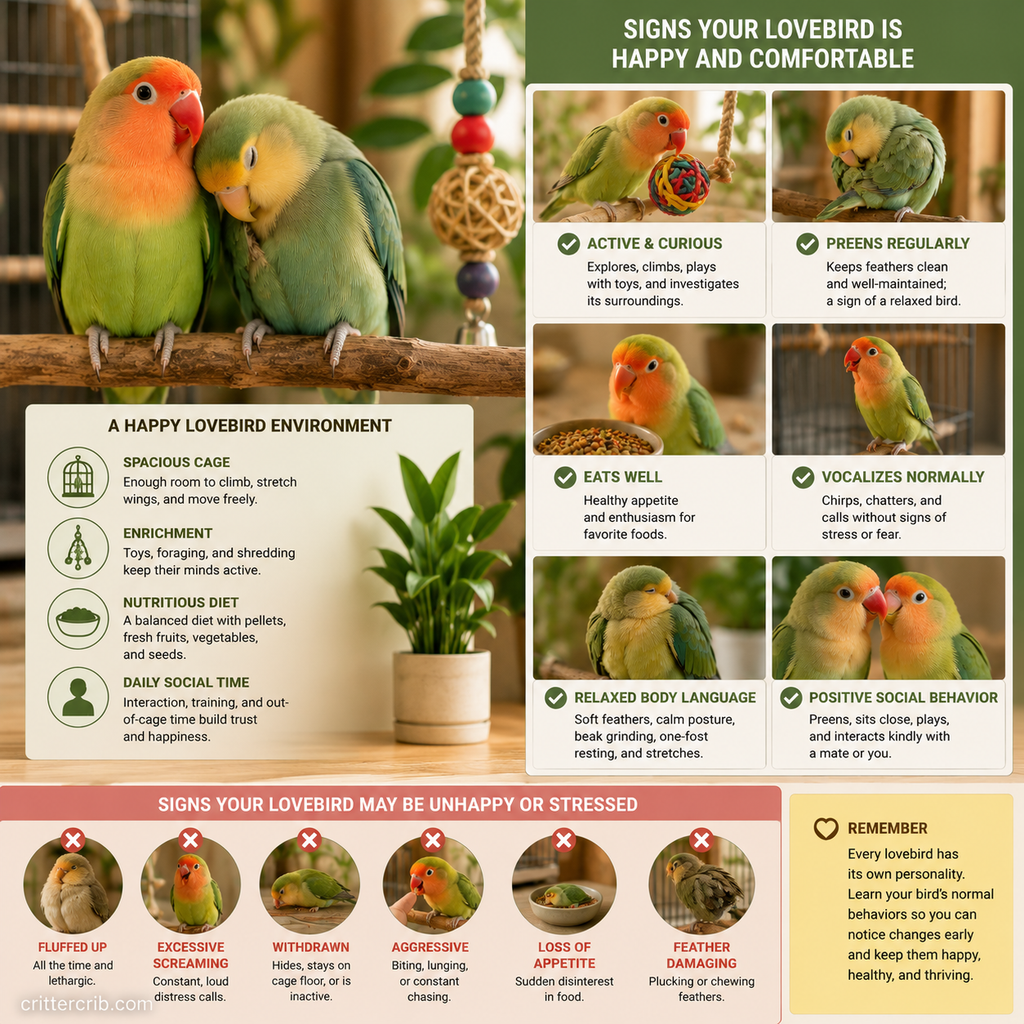
Learning lovebird body language takes time.
A comfortable bird often looks physically relaxed rather than tense and ready to escape.
Depending on the situation, relaxed behavior might include:
- Sitting comfortably on one foot
- Gentle feather fluffing while resting
- Preening
- Stretching
- Beak grinding while settling down
- Relaxed posture
- Resting with the head tucked into the feathers
Context matters.
A bird that’s slightly fluffed while relaxing isn’t the same as a bird that remains heavily puffed up and inactive for hours.
Beak Grinding Can Be a Sign of Contentment
Some lovebirds quietly grind their beaks when they’re relaxed and preparing to rest or sleep.
The sound can be surprising if you’ve never heard it before.
It’s often a soft, repetitive grinding or scraping sound.
When your bird is otherwise relaxed and comfortable, occasional beak grinding is generally considered normal behavior.
You may notice it in the evening as the household becomes quieter.
Your Lovebird Stretches Its Wings and Legs
Stretching is another normal behavior.
A lovebird may extend one wing and the leg on the same side before switching positions or giving both wings a larger stretch.
Birds often stretch after resting.
Seeing normal stretching, climbing, flying, and movement generally suggests that your lovebird feels comfortable using its environment.
Your Lovebird Bathes
Many lovebirds enjoy bathing.
Your bird may splash enthusiastically in a shallow bird bath, dip into a water dish, or show interest when appropriate bathing opportunities are offered.
Bathing supports normal feather maintenance and can also be an enriching activity.
Some birds bathe frequently.
Others may only do it occasionally.
Not bathing every day doesn’t mean your lovebird is unhappy.
Your Lovebird Is Comfortable Around You
One of the most rewarding signs of trust is when your lovebird chooses to be near you.
That doesn’t necessarily mean cuddling.
A comfortable bird might:
- Approach the front of the cage
- Step onto your hand
- Take food from you
- Sit nearby during out-of-cage time
- Preen while you’re present
- Vocalize when you enter
- Follow your movement around the room
- Seek your attention
The important word is “chooses.”
Voluntary interaction is much more meaningful than forcing a nervous bird to remain on your hand.
Your Lovebird Wants to Interact With You
A well-socialized lovebird may actively request interaction.
It might climb toward the cage door when you approach or become excited when it realizes out-of-cage time is coming.
Some lovebirds learn household routines remarkably well.
Your bird may know when you normally return from work, when breakfast arrives, or when it’s time to come out and play.
These predictable interactions can become an important part of the bird’s day.
Your Lovebird Enjoys Head Scratches
Some tame lovebirds enjoy gentle scratches around the head and neck.
A bird that trusts you may lower its head or position itself near your fingers to request scratches.
Respect your bird’s preferences.
Don’t force physical affection if it moves away.
It’s also best to keep petting primarily around the head and neck. Repeatedly stroking the back, under the wings, or other areas can encourage hormonal or sexual behavior in parrots.
Your Lovebird Interacts With Another Lovebird
If you keep compatible lovebirds together, social interaction can provide additional clues about their comfort.
Bonded birds may:
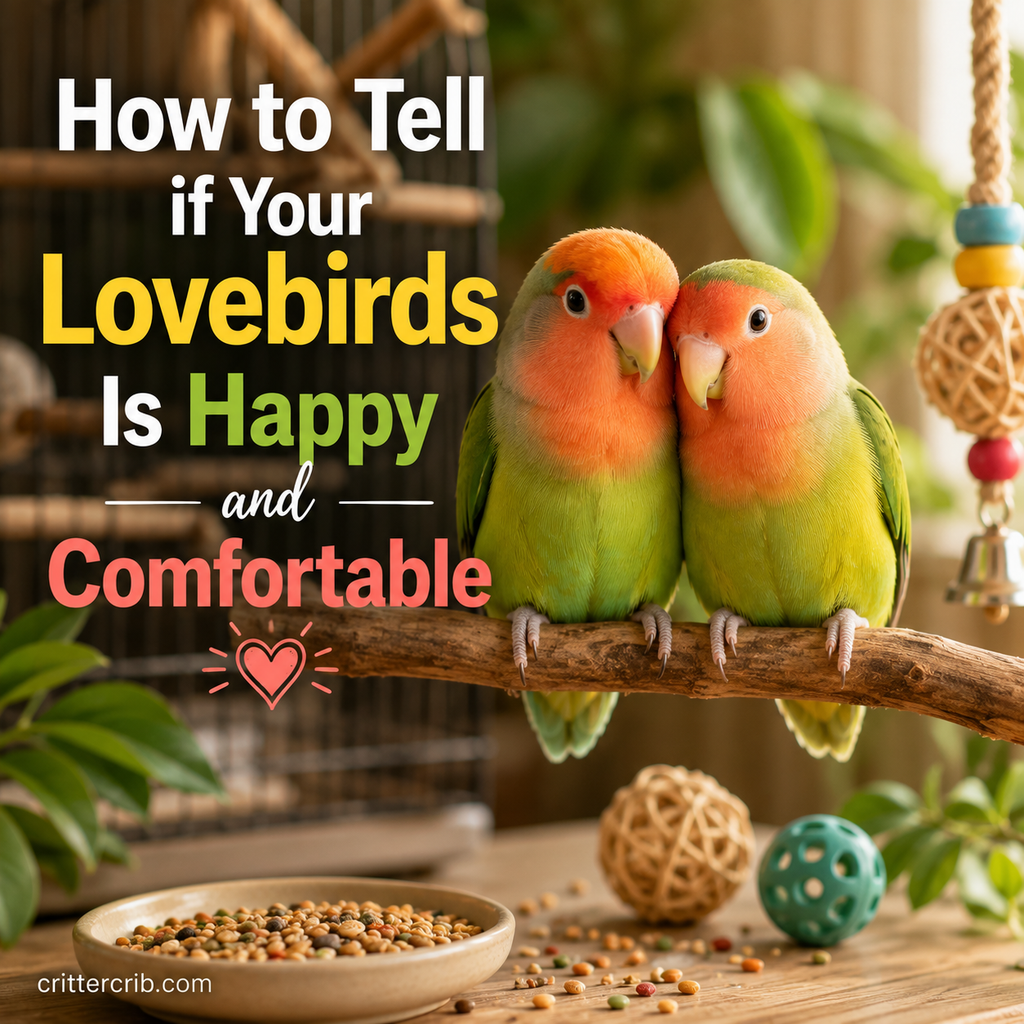
- Sit close together
- Preen each other’s head feathers
- Vocalize back and forth
- Eat near each other
- Play together
- Follow each other around
- Sleep near one another
Mutual preening is particularly easy to recognize.
Birds can’t easily reach every feather on their own heads, so trusted companions often help groom these areas.
However, don’t assume every interaction between two birds is friendly.
Watch for persistent chasing, biting, resource guarding, or preventing another bird from accessing food.
Does a Lovebird Need Another Lovebird to Be Happy?
Not necessarily.
A single lovebird can live a fulfilling life when it receives sufficient social interaction, enrichment, exercise, and attention from its owner.
However, lovebirds are highly social animals.
Keeping compatible birds together can provide bird-to-bird interaction that humans can’t fully reproduce.
If you keep one lovebird, be prepared to provide meaningful daily interaction.
Getting a second bird shouldn’t be treated as an automatic solution to boredom either.
Introductions need to be handled carefully, and individual birds don’t always become immediate friends.
Your Lovebird Is Comfortable Exploring
Confidence often shows through exploration.
A comfortable lovebird may investigate:
- New perches
- Toys
- Foraging activities
- Play stands
- Bird-safe objects
- Fresh foods
- Different areas during supervised out-of-cage time
Some hesitation around unfamiliar objects is normal.
Parrots can be curious and suspicious at the same time.
Let your bird investigate at its own pace rather than pushing unfamiliar objects toward it.
Your Lovebird Uses the Whole Cage
A well-designed cage should encourage movement.
A comfortable lovebird may move between different perches, climb the bars, play in several locations, visit food and water dishes, and choose different resting spots.
If your bird spends virtually all day in one location, consider why.
It could simply have a favorite perch.
But it could also indicate that other areas of the cage feel unsafe or are difficult to access.
Check the arrangement and make sure your bird has comfortable routes between important areas.
Your Lovebird Enjoys Foraging
Wild parrots spend considerable time searching for food.
Pet lovebirds don’t have to work nearly as hard, which can leave a lot of unused time in the day.
Foraging activities provide a healthy outlet for natural curiosity.
Simple options might involve hiding appropriate foods inside bird-safe materials or using commercially available foraging toys.
Start easy.
Your bird needs to understand that food is available before you make the puzzle more difficult.
A Happy Lovebird Still Needs Plenty of Sleep
Activity isn’t the only sign of well-being.
Rest matters too.
Lovebirds generally benefit from around 10 to 12 hours of quiet, darkness, and uninterrupted sleep each night.
A bird that’s constantly exposed to television, conversations, bright lights, or household activity late into the night may not get adequate rest.
Create a consistent nighttime routine.
A well-rested bird is better prepared to play, socialize, and explore during the day.
How to Make Your Lovebird Feel Safe and Comfortable
Happiness isn’t something you can create with one special toy.
It’s the result of meeting the bird’s physical, social, and behavioral needs consistently.
Provide a Spacious Cage
Your lovebird needs enough room to:
- Stretch both wings
- Climb
- Move between perches
- Play with toys
- Access food and water
- Make short flights when cage size permits
Bigger is generally better as long as the bar spacing remains appropriate for lovebirds.
Don’t overcrowd the cage with accessories.
Offer Different Perches
Use several appropriately sized perches with different textures and diameters.
Natural bird-safe wood perches provide more variation than filling the entire cage with identical smooth dowels.
Arrange them so droppings don’t continually fall into food and water dishes.
Provide Enrichment
Lovebirds are intelligent and active.
Give your bird appropriate opportunities to:
- Chew
- Shred
- Climb
- Swing
- Forage
- Explore
- Solve simple puzzles
Rotate toys periodically to keep the environment interesting.
Provide Daily Social Interaction
If your lovebird is comfortable with people, spend time interacting every day.
This can include talking, training, playing, offering treats, or simply allowing the bird to perch nearby.
You don’t need to constantly entertain your bird.
The goal is regular, positive interaction.
Offer Safe Exercise
Supervised out-of-cage time gives your lovebird opportunities to fly, climb, explore, and interact.
Bird-proof the room first.
Close windows and exterior doors, turn off ceiling fans, remove other pets, eliminate access to open water, and keep the bird away from cooking areas and hot surfaces.
How Can You Tell if a Lovebird Is Unhappy?
Occasional nervousness, loud calling, or reluctance to play doesn’t automatically mean your lovebird is unhappy.
Look for persistent patterns.
Potential signs of stress, boredom, or discomfort may include:
- Constant screaming or distressed calling
- Repetitive pacing
- Persistent attempts to escape
- Excessive fear
- Lack of interest in enrichment
- Aggressive behavior that represents a major change
- Feather-damaging behavior
- Remaining withdrawn for long periods
- Repeatedly hiding
- Significant changes in normal activity
Behavioral problems can have many causes.
Before assuming your bird is simply bored, consider health, sleep, diet, hormones, cage setup, environmental stress, and social interaction.
Boredom vs. Illness: Know the Difference
This distinction is extremely important.
A bird that stops playing and becomes unusually quiet isn’t necessarily unhappy.
It may be sick.
Birds often hide signs of illness, so changes in normal behavior deserve attention.
Potential warning signs include:
- Persistent fluffing
- Unusual sleepiness
- Sitting on the cage floor
- Loss of appetite
- Significant changes in droppings
- Difficulty breathing
- Tail bobbing associated with breathing
- Weakness
- Balance problems
- Sudden major personality changes
If your lovebird develops concerning symptoms, contact an avian veterinarian.
Don’t try to solve a possible medical problem by simply adding more toys.
Watch for Changes From Your Bird’s Normal Behavior
One of the best ways to understand your lovebird is to learn what’s normal for that individual.
Suppose your bird normally:
- Chirps every morning
- Eats immediately after you refill the bowl
- Plays with a favorite shredding toy
- Bathes several times per week
- Greets you when you enter
- Sleeps on the highest perch
Those behaviors establish a baseline.
If several suddenly change, you have useful information.
The change itself can be more significant than whether the behavior matches a generic list of “happy lovebird signs.”
Can a Lovebird Be Too Attached to Its Owner?
A strong bond can be wonderful, but encouraging extreme dependence isn’t ideal.
A lovebird should also be able to:
- Play independently
- Eat without you nearby
- Explore toys
- Rest comfortably
- Occupy itself for reasonable periods
If your bird becomes extremely distressed every time you leave the room, consider whether you’ve unintentionally reinforced constant attention-seeking.
Encouraging independent play and foraging can help create a more balanced routine.
Common Mistakes That Can Make Lovebirds Uncomfortable
Even caring owners can accidentally create stress.
Common problems include:
- Keeping the cage too small
- Providing too little enrichment
- Forcing physical interaction
- Chasing the bird with your hands
- Frequently changing routines
- Keeping the cage in an isolated area
- Exposing the bird to constant noise
- Providing inadequate sleep
- Placing the cage near drafts
- Allowing exposure to smoke or strong fumes
- Keeping the cage in the kitchen
- Ignoring warning body language
- Never providing exercise outside the cage
Fortunately, many of these issues are easy to correct.
Lovebird Happiness Checklist
If you’re wondering whether your lovebird is comfortable, look at the overall picture.
A content lovebird will often:
- Eat and drink normally
- Maintain its feathers
- Preen regularly
- Play with toys
- Chew and shred
- Explore the cage
- Vocalize normally
- Show curiosity
- Rest comfortably
- Stretch and move normally
- Interact voluntarily
- Enjoy appropriate social contact
- Show interest in food and enrichment
- Sleep consistently at night
Your bird doesn’t need to display every behavior on this list every day.
You’re looking for a healthy mixture of normal activities.
Frequently Asked Questions About Happy Lovebirds
How Do I Know if My Lovebird Likes Me?
A lovebird that trusts you may voluntarily approach, take treats from your hand, step onto you, remain relaxed while you’re nearby, or seek interaction.
Some birds are naturally more physically affectionate than others.
What Sounds Do Happy Lovebirds Make?
Comfortable lovebirds often chirp, chatter, call, and make various conversational sounds.
There’s no single “happy sound.”
Learn your bird’s normal vocal patterns so you can recognize meaningful changes.
Why Does My Lovebird Grind Its Beak?
Lovebirds may gently grind their beaks while relaxing or preparing to sleep.
When accompanied by otherwise relaxed behavior, this is generally considered normal.
Why Does My Lovebird Stand on One Foot?
Birds commonly rest on one foot while comfortable.
They may pull the other foot into their belly feathers and switch periodically.
Standing on one foot during relaxed rest is usually normal.
Why Does My Lovebird Fluff Its Feathers?
Brief feather fluffing can occur during preening, resting, temperature regulation, or relaxation.
Persistent puffing combined with lethargy or other symptoms can indicate illness and should be taken more seriously.
Is My Lovebird Happy if It Chirps a Lot?
Frequent normal chirping can indicate that your bird is active and engaged, but vocalization alone doesn’t prove happiness.
Consider appetite, activity, posture, play, social behavior, and other signs as well.
Why Does My Lovebird Follow Me Around?
A tame lovebird may follow a trusted person because it enjoys social interaction or has learned that being near you leads to attention, treats, or interesting activities.
Make sure your bird also has opportunities for independent play.
Does My Lovebird Need Toys to Be Happy?
Enrichment is an important part of keeping lovebirds mentally stimulated.
You don’t need dozens of toys, but your bird should have safe opportunities for chewing, shredding, climbing, playing, and foraging.
Rotate toys periodically rather than overcrowding the cage.
How Do I Know if My Lovebirds Like Each Other?
Compatible lovebirds may voluntarily sit together, preen one another, eat nearby, vocalize together, and choose to sleep close to each other.
Watch for persistent aggression, chasing, biting, or resource guarding, which may indicate conflict.
Final Thoughts
Figuring out whether your lovebird is happy isn’t about identifying one magical behavior.
Look at the whole bird.
A comfortable lovebird typically eats well, maintains its feathers, plays, explores, vocalizes, rests normally, and interacts with its environment. A bird that trusts you may also voluntarily approach, take treats, request head scratches, or simply relax while you’re nearby.
Most importantly, learn your individual lovebird’s routine.
Once you know what’s normal, you’ll become much better at recognizing both positive behavior and changes that deserve attention.
Provide a spacious habitat, varied enrichment, opportunities for exercise, a predictable sleep schedule, proper nutrition, and regular social interaction. Then give your bird some choice in how it spends its time.
A happy lovebird doesn’t need to be constantly cuddling, chirping, or playing.
Sometimes one of the clearest signs of comfort is much quieter: a little parrot calmly preening or dozing on its favorite perch because it feels completely safe in its home.