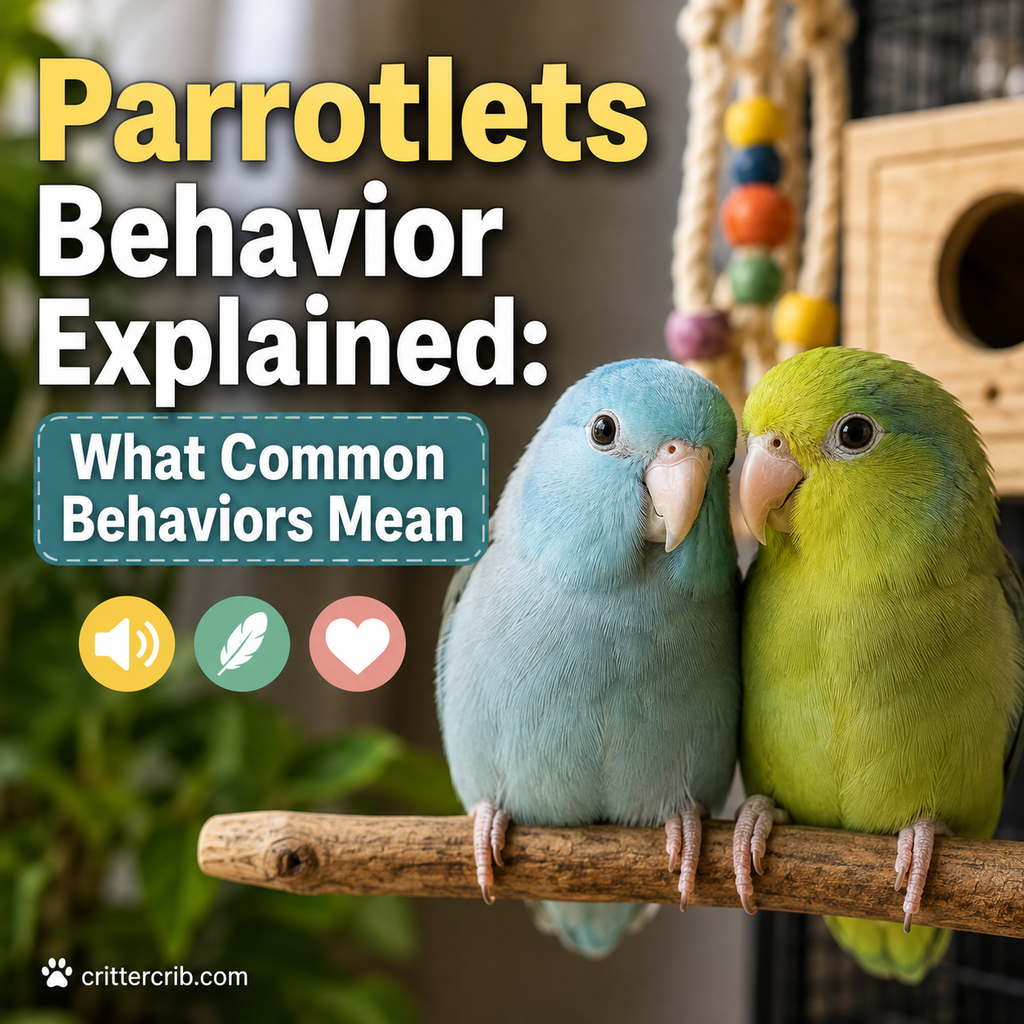
Parrotlets may be among the smallest parrots you can keep as pets, but nobody seems to have told them that.
These tiny birds are curious, energetic, social, and often remarkably confident. A parrotlet may happily climb onto your hand one minute, fiercely defend a favorite toy the next, and then settle down to quietly grind its beak before bed.
Understanding those changes becomes much easier when you learn how parrotlets communicate.
Like other parrots, parrotlets use a combination of vocalizations, feathers, posture, eyes, wings, beak movements, and everyday habits to express themselves. No single behavior has exactly the same meaning every time, though. Context matters.
Here’s how to interpret some of the most common parrotlet behaviors and recognize the difference between normal personality, excitement, fear, territorial behavior, and signs that something may be wrong.
Understanding Parrotlet Body Language
Parrotlets communicate constantly.
Some signals are obvious, such as flying away when frightened. Others are much more subtle.
A change in feather position, posture, or eye expression can happen moments before a bite or excited interaction.
When reading your parrotlet’s body language, pay attention to:
- Feather position
- Body posture
- Eyes
- Tail position
- Wings
- Beak movements
- Vocalizations
- What happened immediately beforehand
Most importantly, learn what’s normal for your individual bird.
One parrotlet may chatter all day while another is naturally quieter. Changes from your bird’s usual behavior often tell you more than comparing it with another parrotlet.
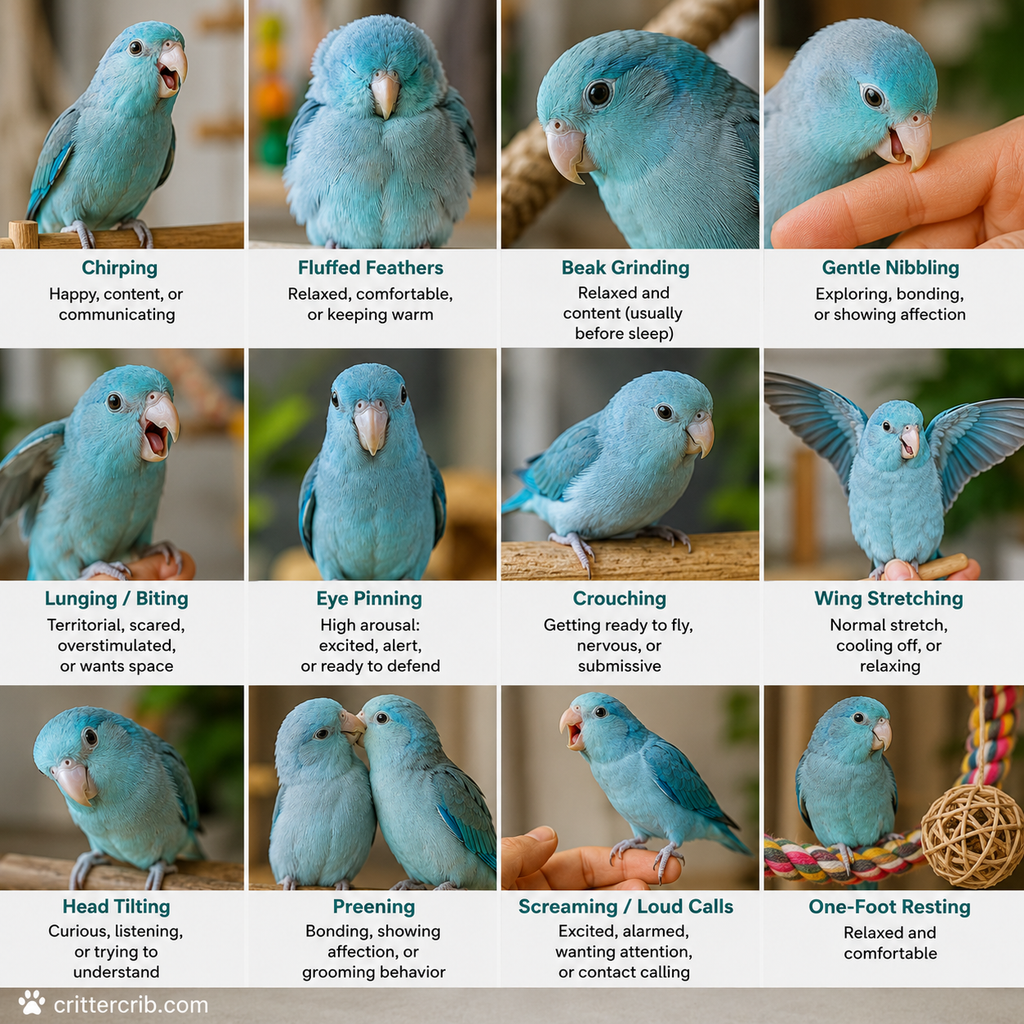
Why Does My Parrotlet Chirp?
Chirping is a normal part of parrotlet communication.
A relaxed bird may chirp while playing, exploring, interacting with you, or responding to sounds around the house.
Parrotlets can use different chirps for different situations.
You may notice chirping when your bird is:
- Content
- Excited
- Looking for attention
- Responding to you
- Communicating with another bird
- Exploring its surroundings
Over time, you’ll probably begin recognizing some of your bird’s individual sounds.
A particular chirp may mean “Where did you go?” while another accompanies excited play.
Why Does My Parrotlet Chatter?
Quiet chatter, muttering, and assorted little noises are common in comfortable parrotlets.
Some birds seem to have lengthy conversations with toys, reflections, household objects, or themselves.
A relaxed parrotlet may also practice sounds it hears frequently.
While parrotlets aren’t generally known as the most accomplished talking parrots, some individuals can learn words and mimic household sounds.
Soft, casual chatter usually indicates that your bird is comfortable enough to vocalize normally.
Why Does My Parrotlet Scream?
For such a tiny bird, a parrotlet can produce an impressive amount of noise.
Loud calls may occur when your bird:
- Wants attention
- Is excited
- Is frightened
- Hears another bird
- Can’t see you
- Is reacting to household noise
- Is frustrated
- Is defending something
Before trying to stop loud vocalizations, figure out what’s triggering them.
If your parrotlet calls every time you leave the room, for example, you may be hearing a contact call rather than random screaming.
Why Does My Parrotlet Call When I Leave the Room?
Parrots are social animals.
A parrotlet that considers you part of its social group may call when you disappear from sight.
This is often called a contact call.
In a natural social setting, vocalizations help birds keep track of one another. Your pet may use a similar behavior when you walk into another room.
Some owners respond with a brief verbal call from elsewhere in the house.
That lets the bird know you’re still nearby without necessarily returning to the cage every time it vocalizes.
Why Does My Parrotlet Grind Its Beak?
Soft beak grinding is usually associated with relaxation.
You may hear a quiet crunching or scraping sound as your parrotlet moves its upper and lower beak together.
This often happens when the bird is:
- Settling down for sleep
- Relaxing on a favorite perch
- Resting after preening
- Sitting comfortably near you
If your parrotlet is slightly fluffy, relaxed, and quietly grinding its beak before bedtime, it’s generally a positive sign.
Why Does My Parrotlet Rub Its Beak on a Perch?
Beak wiping is normal.
After eating, your parrotlet may rub one side of its beak against a perch and then the other.
This can help remove food residue.
Parrotlets also use their beaks constantly while climbing and exploring, so rubbing or tapping the beak against objects isn’t automatically unusual.
The beak functions almost like another hand.
Why Does My Parrotlet Chew Everything?
Because it’s a parrot.
Chewing is a natural behavior, not a bad habit that needs to be eliminated.
Parrotlets use their beaks to:
- Investigate objects
- Manipulate items
- Climb
- Play
- Shred materials
- Maintain normal beak activity
Provide safe outlets for this behavior.
Good options can include bird-safe wood, paper-based toys, shreddable materials, and appropriately sized parrot toys.
If your parrotlet spends time outside the cage, protect electrical cords, furniture, toxic plants, and anything else that shouldn’t meet a determined little beak.
Why Does My Parrotlet Bite?
Biting is one of the behaviors parrotlet owners ask about most.
Despite their size, parrotlets can deliver a surprisingly determined bite.
A parrotlet may bite because it is:
- Afraid
- Territorial
- Overstimulated
- Protecting a favorite object
- Uncomfortable with handling
- Hormonal
- Frustrated
- Trying to make you move away
Sometimes the bite is the final signal in a sequence of warnings that went unnoticed.
Your bird may have already leaned away, changed posture, opened its beak, or attempted to leave.
Watch What Happens Before the Bite
Instead of focusing only on the bite itself, look backward.
Ask yourself:
- Where was the bird?
- What was I doing?
- Was my hand entering the cage?
- Was the bird near a favorite toy or food dish?
- Had the bird already tried to move away?
- Was I touching it?
- Was the bird highly excited?
Patterns often emerge.
Once you identify the trigger, preventing bites becomes much easier.
Why Is My Parrotlet Territorial?
Parrotlets have a reputation for being bold and territorial.
Some birds become particularly protective of their cage, food bowl, favorite toy, sleeping area, or chosen person.
A bird that happily steps onto your hand outside the cage may behave very differently when your hand enters its territory.
Territorial behavior can include:
- Lunging
- Biting
- Chasing
- Open-beak warnings
- Guarding objects
- Refusing to move from a favorite area
Avoid turning every cage interaction into a confrontation.
Positive reinforcement training can help teach useful behaviors such as stepping onto a handheld perch or moving to another location voluntarily.
Why Does My Parrotlet Lunge at My Hand?
A lunge is often a very clear message: back off.
The bird may be frightened, territorial, overstimulated, or protecting something.
If lunging consistently occurs when your hand enters the cage, the cage itself may be the trigger.
Instead of repeatedly testing the bird’s tolerance, look for ways to make interactions more cooperative.
Training your parrotlet to move to a specific perch or step onto a handheld perch can sometimes reduce conflict during routine cage care.
Why Does My Parrotlet Fluff Up?
Fluffing can mean several things.
Healthy parrotlets regularly fluff their feathers when:
- Relaxing
- Preening
- Rearranging feathers
- Sleeping
- Warming themselves
You may see your bird puff up dramatically, shake its feathers, and return to normal within seconds.
That’s ordinary feather maintenance.
A bird that remains puffed up for an extended period while also appearing sleepy, weak, or uninterested in food is different.
Persistent fluffing combined with other behavioral changes may indicate illness.
Why Does My Parrotlet Shake Its Feathers?
A quick feather shake is usually normal.
Parrotlets commonly fluff themselves and then shake everything back into place.
This often occurs:
- After preening
- After bathing
- After stretching
- When waking up
- Before settling onto a perch
Continuous trembling or shaking shouldn’t automatically be interpreted as feather adjustment.
Consider whether the bird appears cold, frightened, weak, or otherwise abnormal.
Why Does My Parrotlet Stand on One Foot?
A relaxed parrotlet may tuck one foot into its belly feathers while resting.
This is normal bird behavior and can help conserve warmth while allowing the tucked leg to rest.
You may notice one-foot resting:
- During naps
- Before bedtime
- While quietly relaxing
- When the bird feels comfortable
Birds often alternate feet.
If your parrotlet suddenly refuses to put weight on one particular foot, appears painful, or has visible swelling, that’s different from ordinary resting behavior.
Why Does My Parrotlet Stretch?
Stretching is normal and healthy.
A typical parrot stretch involves extending one wing and the leg on the same side of the body.
The bird may then repeat the stretch on the opposite side.
You may also see both wings lifted or extended briefly.
Stretching commonly occurs:
- After waking
- Following a nap
- Before activity
- After sitting for a while
- During grooming
A coordinated stretch followed by normal activity is generally nothing to worry about.
Why Does My Parrotlet Preen?
Preening is how your parrotlet maintains its feathers.
The bird carefully runs feathers through its beak to clean, straighten, and organize them.
A normal preening session may involve impressive flexibility as your parrotlet reaches its:
- Chest
- Back
- Wings
- Tail
- Legs
Afterward, the bird may fluff up and shake.
Regular preening is expected.
Excessive feather chewing, damaged feathers, irritated skin, or bald areas deserve closer attention.
Why Does My Parrotlet Preen Me?
A bonded parrotlet may gently nibble your hair, eyebrows, fingers, or other accessible areas.
This can resemble the social grooming parrots perform with trusted companions.
Gentle preening may indicate social bonding and comfort.
However, don’t encourage your bird to explore around your eyes or mouth, and remember that a gentle grooming session can occasionally turn into a harder nip if the bird becomes overstimulated.
Why Does My Parrotlet Want Head Scratches?
Many tame parrotlets enjoy gentle scratches around the head and neck.
Birds can’t easily preen every feather on their own heads, so trusted companions may help groom those areas.
A bird asking for scratches may:
- Lower its head
- Fluff its head feathers
- Position its neck near your finger
- Remain relaxed as you approach
Let the bird initiate whenever possible.
Keep Petting to the Head and Neck
With parrots, stroking the back, belly, under the wings, or near the tail can sometimes be interpreted as courtship-like physical contact.
Keeping petting primarily around the head and neck is a good general rule.
Why Does My Parrotlet Bob Its Head?
Head bobbing can occur during excitement, social interaction, play, or attention-seeking.
Young birds may also display head movements related to feeding behaviors.
Look at what else is happening.
A parrotlet bobbing its head while excitedly chirping and playing may simply be energized.
Unusual repetitive head movements accompanied by poor coordination, vomiting, weakness, or other concerning symptoms should be evaluated differently.
Why Does My Parrotlet Regurgitate?
Regurgitation can be a social or courtship behavior.
A strongly bonded parrotlet may attempt to regurgitate food for:
- Another bird
- A favorite toy
- A mirror
- A person
This behavior should be distinguished from vomiting.
Regurgitation is generally more controlled and directed toward a particular individual or object.
Vomiting may involve forceful head movements and food being scattered unpredictably.
If you’re uncertain whether your bird is regurgitating normally or vomiting because it’s sick, contact an avian veterinarian.
Why Does My Parrotlet Pin Its Eyes?
Parrots can rapidly change the apparent size of their pupils, a behavior commonly called eye pinning.
Eye pinning can occur during heightened excitement.
That excitement isn’t necessarily positive or negative.
A bird may pin its eyes because it’s:
- Excited about a treat
- Interested in an object
- Playing
- Highly stimulated
- Becoming territorial or defensive
This is why eye pinning should never be interpreted by itself.
Look at the rest of the bird.
Pinned eyes combined with relaxed curiosity mean something very different from pinned eyes combined with a rigid posture and open beak.
Why Does My Parrotlet Crouch Down?
Crouching can mean different things depending on context.
A parrotlet preparing to fly may lower its body before taking off.
A frightened bird may crouch or make itself smaller.
Some birds also lower their head when asking for scratches.
Pay attention to:
- Feather position
- Wings
- Eyes
- Vocalizations
- What the bird does next
Body language works as a collection of signals, not a dictionary of individual poses.
Why Does My Parrotlet Spread Its Wings?
Brief wing spreading may simply be a stretch.
A bird can also hold its wings slightly away from its body when it’s warm.
Excited birds sometimes use their wings during energetic displays as well.
Persistent wing positioning combined with open-mouth breathing, weakness, or signs of overheating deserves attention.
Why Does My Parrotlet Pace Back and Forth?
Pacing can occur when a parrotlet is excited or wants access to something.
For example, your bird may pace along a perch near the cage door when it expects to come out.
Repeated pacing can also be associated with frustration or insufficient stimulation.
Evaluate whether your parrotlet has enough:
- Out-of-cage activity
- Social interaction
- Foraging opportunities
- Chewing materials
- Toys
- Exercise
- Variety in its environment
Don’t assume boredom is the only possible explanation, but consider the overall environment if pacing becomes repetitive.
Why Does My Parrotlet Hang Upside Down?
Some parrotlets are enthusiastic acrobats.
Hanging upside down from cage bars, toys, or perches can simply be play.
A healthy bird may climb into positions that look ridiculous to us and then casually continue with its day.
Make sure toys and accessories are securely attached and don’t contain dangerous gaps, loose threads, or other entanglement hazards.
Why Does My Parrotlet Suddenly Fly Around Like Crazy?
Parrotlets can have bursts of energy.
A bird may suddenly fly rapidly around a safe room, climb around the cage, chatter, and behave as though someone flipped an energy switch.
That’s not necessarily a problem.
Frantic flight caused by fear looks different.
A panicked bird may:
- Crash into cage bars
- Fly without an obvious destination
- Attempt desperately to escape
- Breathe rapidly afterward
- Remain visibly frightened
Loud noises, unfamiliar objects, sudden movements, shadows, or other pets can trigger a fear response.
Why Does My Parrotlet Turn Its Back to Me?
Don’t take it personally.
A bird turning around isn’t automatically rejecting you.
Your parrotlet may simply be:
- Looking elsewhere
- Relaxing
- Preening
- Watching something behind it
- Choosing a comfortable position
In fact, a relaxed bird that comfortably turns its back on you may feel secure enough that it doesn’t need to monitor your every movement.
Context matters much more than the direction the bird is facing.
Why Does My Parrotlet Close Its Eyes Around Me?
A relaxed parrotlet may partially or fully close its eyes when it feels comfortable enough to rest.
Look for other relaxation signals such as:
- Slightly fluffed feathers
- Standing on one foot
- Beak grinding
- Relaxed posture
- Quiet vocalizations
Together, these behaviors can suggest that your bird feels safe.
Excessive daytime sleepiness is different.
If a normally active parrotlet suddenly spends much of the day sleeping, especially while puffed up or eating less, pay attention.
Why Is My Parrotlet Suddenly Aggressive?
A sudden increase in biting, lunging, or territorial behavior can have several possible causes.
Consider recent changes such as:
- Increased hormonal behavior
- Changes in sleep
- New toys or cage accessories
- Changes in routine
- Territorial attachment to a location
- Fear
- Overstimulation
- Pain or illness
Don’t immediately label the bird as “mean.”
Behavior usually has a trigger.
If aggression appears suddenly alongside other physical or behavioral changes, a veterinary evaluation may be appropriate.
Hormonal Behavior in Parrotlets
Hormones can influence behavior in mature parrots.
A hormonal parrotlet may become:
- More territorial
- More likely to bite
- Protective of dark spaces
- Interested in nesting areas
- More likely to regurgitate
- Intensely attached to a person or object
Environmental factors can sometimes encourage reproductive behavior.
Avoid Encouraging Nesting Behavior
Unless you’re intentionally and responsibly breeding birds, avoid giving your parrotlet access to cozy nesting locations such as:
- Nest boxes
- Dark enclosed huts
- Drawers
- Cabinets
- Spaces underneath furniture
- Dark boxes
Maintain a consistent sleep schedule and avoid repeatedly touching the bird’s body in ways that may encourage courtship behavior.
What Does a Happy Parrotlet Look Like?
There isn’t one behavior that proves a parrotlet is happy.
Instead, look for a healthy pattern of normal activity.
A comfortable parrotlet may:
- Eat normally
- Explore
- Play
- Chew
- Forage
- Vocalize
- Preen
- Stretch
- Rest comfortably
- Interact voluntarily
- Show curiosity
- Exercise regularly
A bird doesn’t need to constantly sit on your shoulder to be happy.
Independent play and exploration are healthy behaviors, too.
Signs a Parrotlet Is Scared
Fear may be obvious or surprisingly subtle.
Possible signs include:
- Leaning away
- Flying away
- Freezing
- Rapid breathing
- Crouching
- Biting defensively
- Becoming unusually quiet
- Trying to hide
- Refusing to approach
If your bird repeatedly becomes frightened during handling, slow down.
Allowing the parrotlet to make choices and using positive reinforcement generally builds more trust than forcing interaction.
Signs Your Parrotlet Trusts You
Trust develops gradually.
A parrotlet that trusts you may:
- Voluntarily approach you
- Step onto your hand
- Eat in your presence
- Play near you
- Preen while you’re nearby
- Rest comfortably around you
- Request head scratches
- Respond positively to training
Not every trusting bird wants constant physical contact.
Respecting that difference can actually strengthen your relationship.
When Parrotlet Behavior May Signal Illness
Knowing normal behavior helps you recognize abnormal behavior.
Birds may hide signs of illness, so seemingly small changes deserve attention.
Possible warning signs include:
- Remaining puffed up for long periods
- Sleeping much more than usual
- Sudden reduction in vocalization
- Loss of appetite
- Significant changes in droppings
- Weakness
- Poor balance
- Sitting on the cage floor
- Difficulty breathing
- Pronounced tail bobbing with breathing
- Discharge around the eyes or nostrils
- Suspected vomiting
- Sudden major personality changes
One symptom doesn’t automatically reveal what’s wrong.
If your parrotlet appears ill, contact an avian veterinarian rather than trying to diagnose the cause from behavior alone.
How to Understand Your Parrotlet Better
Learning your individual bird is more valuable than memorizing a long list of body-language definitions.
1. Learn the normal routine
Pay attention to when your parrotlet usually:
- Eats
- Sleeps
- Plays
- Vocalizes
- Preens
- Wants attention
Changes become easier to recognize once you know the baseline.
2. Read several signals together
Don’t interpret one movement in isolation.
Pinned eyes, for example, simply indicate heightened excitement.
Pinned eyes plus a relaxed posture while receiving a favorite treat may reflect positive excitement.
Pinned eyes plus a rigid posture, territorial stance, and open beak suggest something quite different.
3. Identify triggers
When behavior changes suddenly, ask what happened immediately beforehand.
Maybe you:
- Reached into the cage
- Touched a favorite toy
- Introduced an unfamiliar object
- Walked away
- Made a sudden movement
Triggers can reveal the meaning behind behavior.
4. Give your bird choices
Whenever safely possible, allow your parrotlet to choose whether to approach, step up, play, or receive scratches.
Choice can reduce defensive behavior and help build trust.
5. Pay attention to sudden changes
A bird’s personality doesn’t usually transform for no reason.
If a normally active, social parrotlet suddenly becomes withdrawn or unusually aggressive, consider both environmental and health-related explanations.
Frequently Asked Questions About Parrotlet Behavior
Are parrotlets naturally aggressive?
Parrotlets can be territorial, assertive, and quick to defend resources, but that doesn’t mean every parrotlet is aggressive. Socialization, environment, individual personality, hormones, and how people respond to the bird’s signals all influence behavior.
Why does my parrotlet bite me and then want attention?
The bite may have been a response to a particular situation rather than a rejection of you. A parrotlet can dislike what you’re doing at one moment and still want social interaction shortly afterward.
Why does my parrotlet puff up when I talk to it?
Brief fluffing can occur during relaxation or feather adjustment. Look at the rest of the body language. A relaxed bird that remains interactive is different from one that stays puffed up and lethargic.
Why does my parrotlet stare at me?
Parrotlets are curious and visually attentive. Your bird may simply be observing you, waiting for interaction, watching for a familiar routine, or trying to figure out what you’re doing.
Why does my parrotlet nibble my fingers?
Gentle nibbling can be exploration, play, or grooming-like social behavior. A hard bite accompanied by defensive body language has a different meaning.
Why does my parrotlet make noises before sleeping?
Quiet vocalizations and beak grinding can occur as a comfortable parrotlet settles down for the night.
How do I know if my parrotlet likes me?
Look for voluntary interaction rather than one particular behavior. Approaching you, stepping up willingly, playing nearby, preening around you, relaxing in your presence, or requesting scratches can all indicate comfort and trust.
Why does my parrotlet suddenly become quiet?
Parrotlets naturally have quiet periods, especially when resting. A sudden, persistent reduction in normal vocalization combined with lethargy, appetite changes, puffed feathers, or other symptoms deserves closer attention.
Final Thoughts
Understanding parrotlet behavior becomes much easier once you stop looking for a single translation for every movement.
A puffed-up bird might be comfortable, cold, or unwell. Eye pinning might signal happy excitement or a warning that a bite is coming. A bird rubbing its beak could simply be cleaning up after lunch.
Context tells the story.
Watch the feathers, posture, eyes, vocalizations, environment, and what happened immediately before the behavior.
Most importantly, learn your own parrotlet’s normal routine.
Once you know how your bird behaves when it’s relaxed, playful, tired, excited, frightened, and annoyed, you’ll begin recognizing its signals almost automatically.
That understanding can help you avoid bites, build trust, provide better enrichment, and notice potentially important health changes sooner.
For such a tiny parrot, a parrotlet has an enormous amount to say. You just have to learn how to listen.