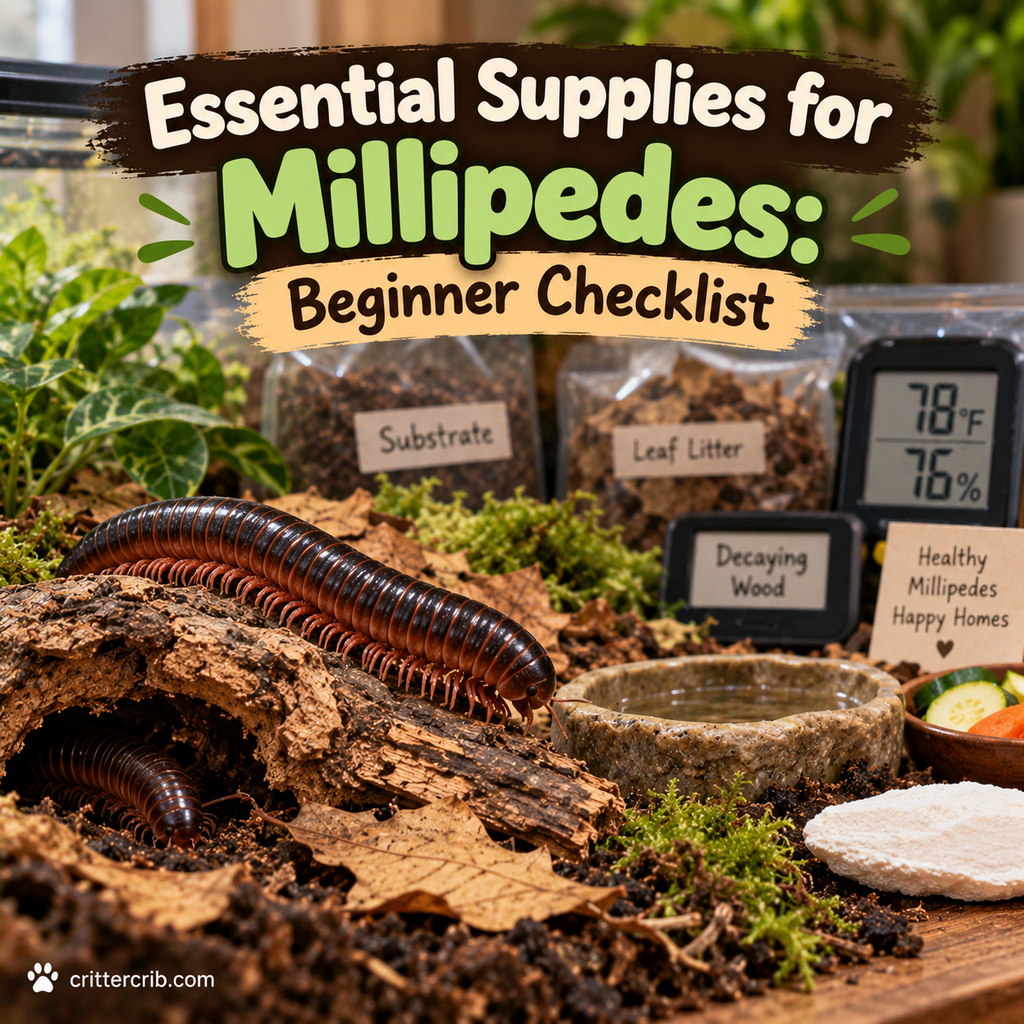
Millipedes don’t need a room full of expensive equipment. Compared with many exotic pets, their setup can be surprisingly simple.
But simple doesn’t mean you can put a millipede in a plastic box with a little potting soil and call it done.
The most important part of a millipede enclosure is actually beneath its feet. Millipedes spend much of their lives crawling through, burrowing into, and eating material from the substrate. Getting that foundation right matters far more than buying fancy decorations.
If you’re preparing for your first pet millipede, this beginner checklist covers the essential supplies you’ll need, what each item does, and which extras are worth considering.
Millipede Supplies at a Glance
Before bringing your millipede home, you’ll want to have the basic enclosure completely set up.
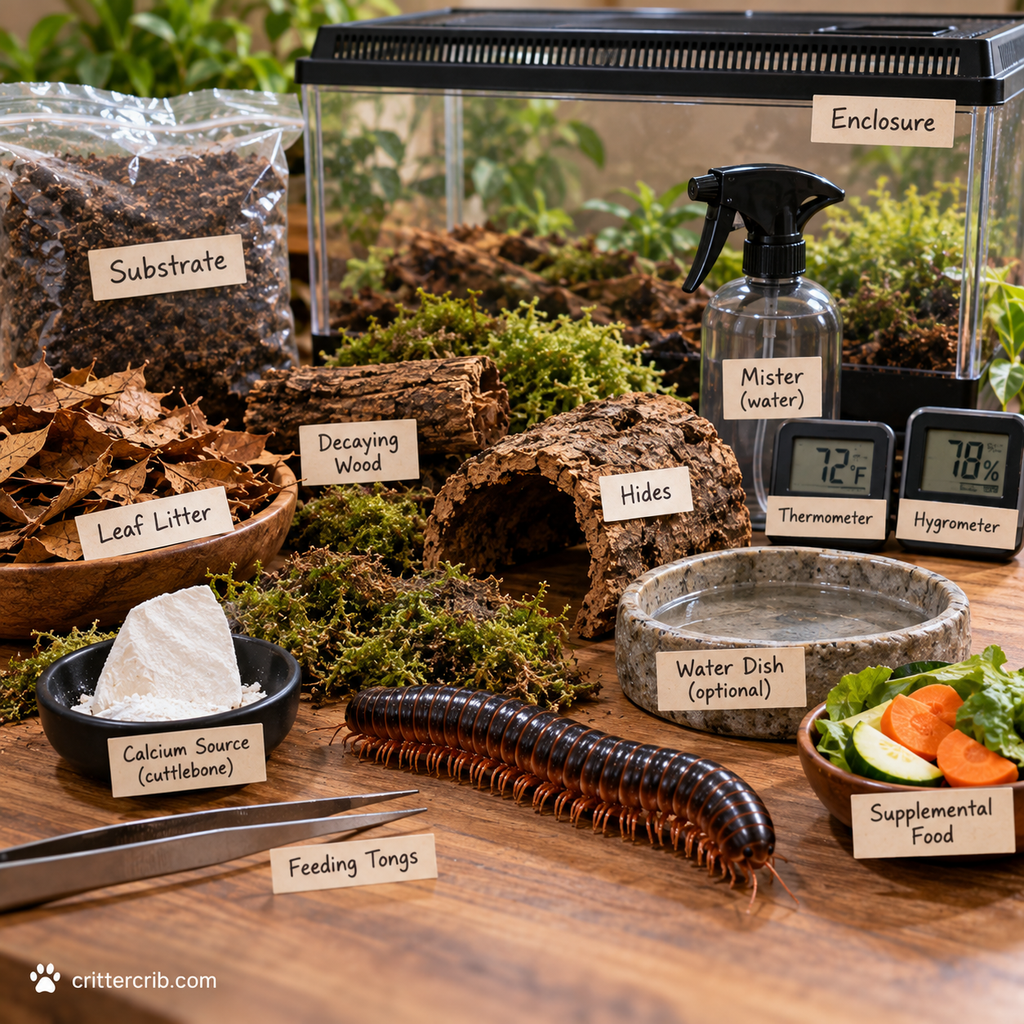
Your essential shopping list includes:
- Secure enclosure
- Suitable substrate
- Decaying hardwood
- Leaf litter
- Moisture source
- Thermometer
- Hygrometer
- Hiding places
- Supplemental food
- Calcium source
- Ventilation
- Safe enclosure decorations
Depending on your home and the species you’re keeping, you may also need equipment for temperature management.
Let’s look at each item more closely.
1. A Secure Millipede Enclosure
The first thing you’ll need is somewhere for your millipede to live.
Glass terrariums and appropriately sized plastic enclosures can both work. What’s more important than the material is whether the enclosure provides enough usable space, substrate depth, ventilation, and security.
Millipedes aren’t exactly known for high-speed escapes, but they are capable climbers.
A secure lid is important.
How Big Should a Millipede Enclosure Be?
Enclosure size depends on the species and the number of millipedes you’re keeping.
A tiny species obviously doesn’t need the same enclosure as a large African giant millipede.
As a general approach, choose an enclosure that gives the millipede enough horizontal room to move comfortably while also allowing substantial substrate depth.
Don’t focus only on gallons.
For millipedes, a large amount of the enclosure’s useful habitat is the substrate itself.
Ventilation Matters
The enclosure should retain enough moisture to support the millipede while still allowing air exchange.
Too little ventilation can encourage stagnant, overly wet conditions.
Too much ventilation can cause the habitat to dry out rapidly.
Look for an enclosure that allows you to maintain a stable, humid environment without keeping everything constantly soaked.
2. Deep, Nutritious Substrate
If you spend extra time researching one millipede supply, make it the substrate.
For millipedes, substrate isn’t just flooring.
It’s:
- A burrowing medium
- A moisture reservoir
- A hiding place
- A molting area
- Part of their food supply
Millipedes naturally consume decomposing plant material. A biologically useful substrate therefore needs organic material rather than simply being an inert bedding.
How Deep Should Millipede Substrate Be?
A commonly used starting point is to provide substrate at least as deep as the millipede is long, with deeper substrate often being beneficial when the enclosure allows it.
The exact depth depends on species and size.
A large millipede needs much more substrate than a small species.
This depth is particularly important because millipedes may burrow underground to molt. During this vulnerable period, they need to be left undisturbed.
What Should Millipede Substrate Contain?
A suitable mix may include components such as:
- Organic topsoil
- Decomposed hardwood
- Crushed or decomposed leaf litter
- Other species-appropriate organic material
Avoid assuming any bag of garden soil is safe.
Products containing fertilizers, pesticides, moisture-retaining chemicals, or other additives may be inappropriate.
When in doubt, use substrate specifically intended for millipedes or prepare a mix using ingredients you know are safe.
3. Decaying Hardwood
Decaying hardwood is another important part of many millipede setups.
Millipedes are detritivores. They consume decomposing plant matter, and rotting wood can make up part of that diet.
The key word here is decaying.
A fresh decorative branch and soft decomposed hardwood aren’t the same thing.
Appropriate decaying wood can be mixed into the substrate and offered in pieces around the enclosure.
What Kind of Wood Is Safe?
Use well-decayed hardwood from a safe, uncontaminated source.
Avoid:
- Chemically treated lumber
- Painted wood
- Pressure-treated wood
- Wood exposed to pesticides
- Unknown decorative wood
- Aromatic woods that may contain potentially irritating compounds
If you’re collecting materials outdoors, make sure you know what you’re bringing into the enclosure.
When you’re unsure, buying prepared material from a reputable invertebrate supplier can be easier.
4. Plenty of Leaf Litter
Dead leaves aren’t just decoration in a millipede enclosure.
They’re food.
A generous layer of suitable leaf litter gives millipedes something to eat, hide beneath, and explore.
As the leaves break down, they also contribute to the enclosure’s natural decomposition cycle.
Hardwood leaves are commonly used.
Depending on what’s safely available, keepers may use leaves from trees such as:
- Oak
- Maple
- Beech
The leaves should come from areas free of pesticides and other contamination.
Don’t Throw Away the “Messy” Leaves
As leaf litter begins breaking down, it may stop looking attractive.
That’s fine.
Millipedes aren’t waiting for you to replace their brown leaves with photogenic ones.
Decomposing leaves are exactly what they want.
Add more as the existing layer gets consumed.
5. A Reliable Moisture Source
Millipedes can lose moisture easily and generally need a humid environment.
That doesn’t mean the enclosure should be swampy.
Your goal is moist substrate, not permanently waterlogged soil.
A spray bottle or mister can make it easy to add moisture when needed.
Use water that’s appropriate for your animals and local water conditions.
Moist Doesn’t Mean Soaked
One of the most common beginner mistakes is assuming more humidity always means more water.
Constantly saturated substrate can create stagnant conditions.
Instead, learn how the substrate feels and how quickly your particular enclosure dries.
Factors affecting moisture include:
- Enclosure ventilation
- Room temperature
- Substrate depth
- Enclosure size
- Species
- Local climate
You may need to mist more or less often depending on those conditions.
6. A Thermometer
Temperature influences millipede activity, feeding, moisture, and general husbandry.
A simple digital thermometer makes it much easier to know what’s actually happening inside the enclosure.
Don’t rely entirely on how the room feels to you.
The correct temperature range depends on the millipede species.
Some commonly kept tropical species require warmer conditions than species adapted to cooler environments.
Research your specific millipede rather than choosing one universal temperature.
7. A Hygrometer
A hygrometer measures humidity.
It’s useful for beginners because it provides another reference point while you’re learning how quickly the enclosure dries.
However, don’t let one humidity reading become the only thing you monitor.
Substrate moisture is extremely important.
An enclosure can show relatively high air humidity while portions of the substrate are becoming too dry.
Use the hygrometer alongside regular visual and physical checks of the habitat.
8. Hides and Cover
Millipedes appreciate dark, protected areas.
Useful hiding materials include:
- Cork bark
- Decaying wood
- Leaf litter
- Pieces of safe bark
- Other naturalistic hides
A hide doesn’t need to be expensive.
A piece of cork bark placed over the substrate can create a perfectly useful retreat.
Millipedes may also simply burrow when they want privacy.
Keep Heavy Decorations Safe
Remember that millipedes dig.
A heavy rock sitting loosely on top of deep substrate can shift if the animal burrows underneath it.
Avoid unstable objects that could collapse.
Lightweight or securely positioned decorations are safer.
9. Supplemental Millipede Food
Much of a millipede’s nutrition should come from the decomposing organic material within its enclosure.
Supplemental foods can add variety.
Depending on the species, small amounts of vegetables and other plant foods may be offered.
Possible options include:
- Squash
- Zucchini
- Sweet potato
- Carrot
- Cucumber
- Other species-appropriate vegetables
Fruit can sometimes be offered in moderation.
Don’t make fresh produce the entire diet.
A millipede enclosure should contain abundant decomposing leaves and wood regardless of how enthusiastically the animal eats cucumber.
Remove Spoiled Food
Fresh foods eventually mold and rot.
Offer small portions and remove leftovers before they become a persistent problem.
You’ll learn how much your millipede eats over time.
Smaller portions also make habitat maintenance easier.
10. A Calcium Source
Many keepers provide a calcium source as part of millipede husbandry.
Common options include:
- Cuttlebone
- Calcium carbonate
- Crushed appropriate calcium sources
Calcium can be made available in the enclosure so the millipede can access it as needed.
If using a commercial calcium product, check the ingredients. You don’t necessarily need a reptile supplement loaded with additional vitamins and additives.
A simple calcium source is usually easier to manage.
11. A Small Food Dish
A food dish isn’t absolutely necessary, but it can make feeding supplemental foods easier.
It keeps fresh food from immediately disappearing into the substrate and makes leftovers easier to remove.
Choose a shallow dish that’s easy for the millipede to access.
You don’t need anything elaborate.
A small, stable feeding dish works fine.
12. A Water Dish: Necessary or Optional?
Whether a separate water dish is needed can depend on the species and how the enclosure is maintained.
Millipedes obtain moisture from their environment and food, and some keepers maintain them successfully through properly hydrated substrate and appropriate humidity.
A shallow water dish can still be provided for many larger species.
If you use one:
- Keep it shallow
- Make sure it’s easy to enter and exit
- Keep it clean
- Avoid creating a drowning hazard for very small millipedes
For tiny species or juveniles, enclosure moisture management may be more practical than a conventional water bowl.
13. A Spray Bottle or Mister
You don’t need an automatic misting system for most basic millipede setups.
A simple hand mister gives you direct control over moisture.
Choose one that’s dedicated to animal care.
Don’t reuse a bottle that previously contained household cleaners, pesticides, or other chemicals.
Labeling the bottle can prevent accidental mix-ups.
14. Safe Décor and Climbing Materials
Millipedes don’t need an elaborate landscaped terrarium, but a few natural materials make the habitat more interesting and functional.
You might add:
- Cork bark
- Safe branches
- Moss
- Leaf litter
- Pieces of decaying wood
- Safe live plants
Keep the enclosure relatively simple.
You still need to monitor the millipede and maintain the substrate.
Decorations should support natural behavior rather than making routine care difficult.
Do Millipedes Need Live Plants?
No. Live plants are optional.
They can make an enclosure look attractive and help create a naturalistic environment, but they’re not a basic requirement for keeping a millipede.
Plants can also complicate things.
You need to make sure they haven’t been treated with pesticides or systemic chemicals that could affect the millipede.
The plant’s moisture and lighting requirements should also be compatible with the enclosure.
For beginners, artificial plants or no plants at all can be perfectly reasonable.
Do Millipedes Need Special Lighting?
Millipedes don’t generally require specialized UVB lighting in the way certain reptiles do.
Normal ambient room lighting can provide a day-night cycle.
Avoid placing the enclosure in direct sunlight.
A glass or plastic enclosure can heat up surprisingly quickly when exposed to strong sun.
If you use a light for live plants or display purposes, make sure it doesn’t overheat or dry out the habitat.
Millipedes also appreciate dark hiding places, so they shouldn’t be exposed to intense light constantly.
Do Millipedes Need a Heat Mat?
Maybe, but not automatically.
Whether supplemental heat is needed depends on:
- Millipede species
- Temperature of your home
- Season
- Enclosure location
If your room naturally stays within the appropriate temperature range, additional heating may be unnecessary.
If supplemental heat is required, it should be carefully controlled.
Avoid creating a situation where a burrowing millipede moves deeper into the substrate to escape heat only to encounter even hotter conditions.
Any heating equipment used around an invertebrate enclosure should be paired with appropriate temperature monitoring and control.
Research species-specific requirements before adding heat.
Are Springtails Useful in a Millipede Enclosure?
Springtails can be useful additions to a millipede habitat.
These tiny decomposers feed on fungi and organic material and can help manage minor mold growth.
They’re commonly used in bioactive enclosures.
Springtails aren’t mandatory, but they can make maintaining a humid, organic enclosure easier.
They also occupy a different niche from your millipede, so you may see them moving around leftover food and damp areas.
Supplies You Probably Don’t Need
Pet stores contain plenty of products that look useful but aren’t necessary for a basic millipede setup.
You generally don’t need:
- Expensive decorative caves
- Exercise equipment
- Bright specialty lighting
- Elaborate automatic misting systems
- Large water features
- Frequent replacement bedding
- Scented enclosure cleaners
Spend your money on the things that matter most: good substrate, leaf litter, decaying wood, an appropriate enclosure, and reliable environmental monitoring.
A naturalistic millipede habitat can be inexpensive and still work extremely well.
Beginner Millipede Shopping Checklist
Before bringing your millipede home, run through this list.
Essential
- Secure, appropriately sized enclosure
- Ventilation
- Deep organic substrate
- Decaying hardwood
- Leaf litter
- Appropriate water for misting
- Spray bottle or mister
- Thermometer
- Hiding area
- Supplemental foods
- Calcium source
Strongly Recommended
- Hygrometer
- Cork bark
- Small food dish
- Springtails
- Extra leaf litter
- Extra substrate ingredients
Depending on the Species and Your Home
- Supplemental heating
- Thermostat or temperature controller
- Shallow water dish
- Live plants
- Additional humidity equipment
Don’t buy heating equipment simply because it’s on a generic exotic-pet checklist. Determine the requirements of your particular millipede first.
Set Up the Enclosure Before Buying the Millipede
It’s much easier to correct habitat problems before an animal is living inside.
Ideally, prepare the enclosure in advance.
Check that:
- The substrate is deep enough.
- Moisture levels are stable.
- The enclosure has adequate ventilation.
- Temperature is appropriate.
- Leaf litter and decaying wood are available.
- Hides are secure.
- The lid closes properly.
- Any heating equipment is working safely.
Once everything is stable, introduce the millipede.
This is less stressful than trying to redesign the enclosure around a new animal.
Common Beginner Millipede Setup Mistakes
Even a simple setup can go wrong if the basics are overlooked.
Using Plain, Nutritionally Empty Bedding
Millipedes interact with and consume their substrate.
A purely decorative or inert bedding doesn’t provide the same function as a decomposer-friendly substrate containing suitable organic material.
Making the Substrate Too Shallow
Millipedes burrow and may molt underground.
Give them enough depth to disappear completely beneath the surface.
Keeping Everything Soaked
Humidity matters, but waterlogged substrate isn’t the goal.
Maintain appropriate moisture while still allowing ventilation.
Feeding Mostly Fresh Produce
Vegetables are supplemental food.
Don’t forget the decomposing leaves and wood that form a fundamental part of the habitat and diet.
Using Materials From Unknown Sources
A beautiful pile of leaves isn’t useful if it has been exposed to pesticides.
Know where natural materials came from.
Disturbing a Buried Millipede
If your millipede disappears underground, leave it alone.
It may simply be resting or burrowing, but it could also be molting.
Digging it up can injure a vulnerable millipede.
Frequently Asked Questions About Millipede Supplies
What do I need before getting a millipede?
At minimum, prepare an appropriately sized ventilated enclosure with deep organic substrate, decomposing hardwood, leaf litter, a hide, appropriate moisture, supplemental food, and a way to monitor temperature.
Can I use regular potting soil for millipedes?
Many commercial potting soils contain fertilizers, moisture-control additives, pesticides, or other ingredients that may not be suitable.
Use a known-safe organic substrate or a mix specifically prepared for millipedes.
Do millipedes need moss?
Moss isn’t essential, but it can help create moist areas and provide additional cover.
It shouldn’t replace nutritious substrate, leaf litter, or decaying wood.
Do millipedes need a food bowl?
No, but a small food dish makes supplemental feeding and cleanup easier.
Leaf litter and decaying wood should still be available throughout the enclosure.
Do millipedes need a water bowl?
Not necessarily in every setup. Proper substrate moisture and humidity are especially important.
For larger species, a very shallow, safely accessible water dish may also be offered.
Do millipedes need a heat lamp?
Usually not.
Heating requirements depend on the species and your room temperature. Strong overhead heat can dry an enclosure quickly, so don’t add a heat lamp without a specific reason.
How much does a basic millipede setup cost?
Costs vary widely depending on the enclosure, species, and whether you buy or safely source natural materials.
A functional setup doesn’t need to be elaborate. Investing in appropriate substrate and habitat materials is more important than buying expensive decorations.
Build the Habitat Around How Millipedes Actually Live
The best millipede setup isn’t necessarily the most expensive or impressive-looking one.
It’s the one that supports natural behavior.
Start with a secure enclosure. Add deep, nutritious substrate filled with decomposing organic material. Provide plenty of leaf litter and decaying hardwood. Maintain appropriate moisture and temperature, and give your millipede somewhere dark to hide.
After that, most supplies are extras.
Remember that millipedes are decomposers. Their ideal home is supposed to contain old leaves, rotting wood, moist soil, and microorganisms.
It may look a little messy.
To a millipede, that’s exactly the point.