
Leopard geckos are often recommended as beginner reptiles, and there’s a good reason for that. They’re relatively small, generally calm, don’t need a huge enclosure, and their care is manageable once you understand the basics.
But “beginner-friendly” doesn’t mean maintenance-free.
A leopard gecko still needs proper heating, a suitable enclosure, nutritious live insects, supplements, hiding places, and regular care. They can also live for well over a decade, so bringing one home is a much longer commitment than many first-time reptile owners expect.
So, are leopard geckos good pets?
For many people, absolutely. They’re especially appealing if you want a quiet reptile that’s interesting to observe, can become comfortable with gentle handling, and doesn’t require the space of a larger lizard.
Before deciding, though, it’s worth understanding what living with one is actually like.
What Are Leopard Geckos Like as Pets?
Leopard geckos are ground-dwelling lizards originally found in dry regions of South and Central Asia.
Unlike many geckos, they don’t have sticky toe pads for climbing smooth walls. They spend most of their time closer to the ground, exploring rocks, hides, and other low structures.
They’re also known for their distinctive appearance.
Leopard geckos typically have:
- Large eyes
- Thick tails
- Spotted or patterned skin
- Movable eyelids
- Relatively short legs
- A compact body
Selective breeding has also produced many different colors and patterns, commonly referred to as morphs.
As pets, leopard geckos tend to be quiet and fairly predictable. They aren’t animals that demand constant interaction, which can be either an advantage or disadvantage depending on what you’re looking for.
Are Leopard Geckos Good for Beginners?
Leopard geckos are generally considered one of the more approachable reptiles for responsible beginners.
Several characteristics make them easier to manage than many exotic pets.
They stay relatively small, their habitat requirements are achievable in most homes, and healthy individuals often tolerate gentle handling once they’ve had time to adjust.
They’re also terrestrial, which simplifies enclosure design compared with species requiring tall, heavily planted climbing habitats.
That said, beginners still need to learn about:
- Proper enclosure size
- Heating
- Temperature gradients
- Lighting
- Humidity
- Supplementation
- Live insect feeding
- Shedding
- Safe handling
The best beginner reptile isn’t necessarily the animal with the fewest requirements. It’s one whose requirements you’re willing and able to meet consistently.
Leopard Gecko Temperament
One of the biggest reasons leopard geckos make popular pets is their generally calm temperament.
A well-adjusted gecko may become comfortable walking across your hands and arms without showing much fear.
Individual personalities vary, though.
Some leopard geckos are curious and readily approach their keeper. Others prefer minimal handling and spend more time hiding.
Young geckos may also be quicker and more nervous than established adults.
Patience matters.
When you first bring a leopard gecko home, give it time to become comfortable with its surroundings before expecting regular handling sessions.
Do Leopard Geckos Like Being Handled?
Leopard geckos can learn to tolerate handling well, but it’s better not to think of them as animals that necessarily crave physical affection.
They’re reptiles, not miniature dogs.
Many become comfortable enough to calmly explore your hands, arms, or lap. Some will voluntarily approach a familiar hand inside the enclosure.
The goal should be low-stress interaction rather than forcing the animal to be handled.
When handling a leopard gecko:
- Move slowly
- Approach from the side rather than grabbing from above
- Support its entire body
- Keep it close to a safe surface
- Allow it to walk between your hands
- Keep sessions relatively short at first
Never grab a leopard gecko by the tail.
Can Leopard Geckos Drop Their Tails?
Yes.
Leopard geckos can intentionally detach their tails as a defense mechanism when they feel threatened or experience trauma.
The tail can eventually regenerate, but it won’t look exactly like the original.
Tail loss is also physically demanding because leopard geckos use their tails to store fat reserves.
This is one reason gentle handling is so important.
Never restrain a leopard gecko by its tail or allow children to pull on it.
How Big Do Leopard Geckos Get?
Leopard geckos remain relatively small compared with many popular pet lizards.
Most adults are roughly 7–10 inches long, although size varies with sex, genetics, and individual development.
Their manageable size is one of their biggest advantages as pets.
They don’t require the enormous habitat that an adult iguana or other large reptile would need, but that doesn’t mean they should be kept in tiny tanks.
Even small reptiles benefit from room to explore and choose between different areas of their habitat.
What Size Tank Does a Leopard Gecko Need?
Modern leopard gecko husbandry generally favors more space than the small tanks historically recommended for the species.
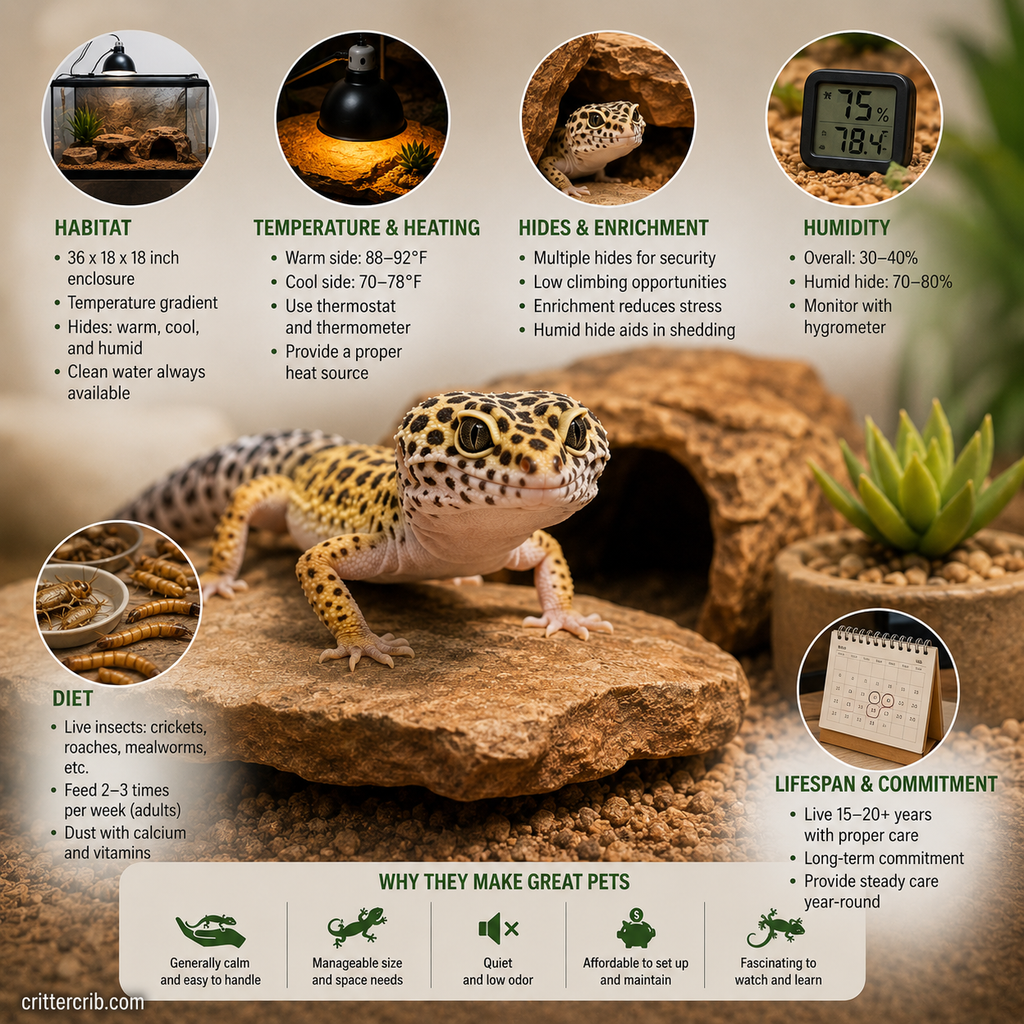
For an adult leopard gecko, an enclosure with roughly 36 x 18 inches of floor space is a good starting point. An enclosure around 36 x 18 x 18 inches gives plenty of room for hides, a temperature gradient, enrichment, and movement.
Larger can be even better when the habitat is designed correctly.
Floor space is more important than extreme height because leopard geckos are primarily terrestrial.
However, they can and do climb low rocks, branches, ledges, and other structures, so some usable vertical enrichment is worthwhile.
What Does a Leopard Gecko Habitat Need?
A good enclosure should offer more than an empty floor and one plastic cave.
At minimum, plan for:
- Warm hide
- Cool hide
- Humid hide
- Appropriate heat source
- Temperature monitoring
- Suitable substrate
- Water dish
- Calcium access when appropriate
- Low climbing structures
- Rocks, cork, or other enrichment
The different hides allow your gecko to regulate its temperature and moisture exposure without sacrificing security.
That’s particularly important because leopard geckos naturally spend a significant amount of time sheltered.
Leopard Gecko Temperature Requirements
Leopard geckos need access to warmth for digestion and normal body function.
Instead of heating the entire enclosure to one temperature, create a thermal gradient.
The warm side should provide an appropriate heated area, while the opposite end remains cooler.
A warm hide with a surface temperature around the upper 80s to low 90s°F is commonly used, while the cool side should generally remain in the 70s°F.
Exact temperatures can vary slightly depending on the setup and how they’re measured.
The important part is giving the gecko choices.
Use reliable digital thermometers and an infrared temperature gun rather than guessing based on how warm the enclosure feels.
What Kind of Heat Do Leopard Geckos Need?
There are several ways to heat a leopard gecko habitat.
Overhead heating can create a more naturalistic warm zone, particularly when using appropriate reptile heating equipment.
Depending on the enclosure and household temperature, options may include:
- Halogen basking lamps
- Deep heat projectors
- Other appropriately controlled reptile heat sources
Whatever heat source you use, temperature control is important.
A compatible thermostat helps prevent overheating and keeps the habitat more stable.
Heating equipment should always be installed so the gecko cannot come into direct contact with dangerously hot bulbs or fixtures.
Do Leopard Geckos Need UVB?
Leopard geckos can survive without strong UVB exposure when nutrition and supplementation are properly managed, but low-level UVB lighting can be beneficial and is increasingly included in well-designed habitats.
Appropriate UVB allows the gecko to regulate some of its own vitamin D3 production.
The key word is appropriate.
Leopard geckos don’t require the same intense UVB exposure as a sun-loving desert basker such as a bearded dragon.
If you provide UVB, choose equipment appropriate for leopard geckos and follow the manufacturer’s recommendations for bulb strength, fixture type, distance, and placement.
The enclosure should also provide shaded areas and hides where the gecko can completely escape the light.
Do Leopard Geckos Need a Humid Hide?
Yes.
A humid hide is one of the most important features of a leopard gecko habitat.
This enclosed area provides higher localized humidity that can help your gecko shed properly.
The hide can contain an appropriate moisture-retaining material that is kept damp rather than soaking wet.
Place it where temperatures support a comfortable humid microclimate.
Check it regularly so it doesn’t completely dry out or become dirty.
Leopard Gecko Humidity
Although leopard geckos come from relatively dry environments, treating their habitat like an extremely dry desert can cause problems.
They should have access to different microclimates.
The overall enclosure can remain relatively dry, while the humid hide provides additional moisture when the gecko needs it.
This is more useful than trying to keep every part of the habitat at exactly the same humidity level.
Use a digital hygrometer to understand what’s happening inside the enclosure.
What Substrate Is Best for Leopard Geckos?
Substrate is another topic that generates plenty of debate among reptile keepers.
For beginners, simple options can make cleaning and monitoring easier.
These may include:
- Paper towels
- Slate or textured tile
- Appropriate solid reptile flooring
Paper towels are particularly useful during quarantine or when monitoring a new gecko’s waste.
More experienced keepers may choose properly prepared naturalistic loose substrates that allow digging and other natural behaviors.
Avoid inappropriate substrates such as:
- Calcium sand
- Crushed walnut shells
- Sharp wood chips
- Gravel
- Materials that are excessively dusty
Good husbandry involves more than blaming or crediting substrate for every issue. Heating, hydration, nutrition, supplementation, health, and feeding methods all matter.
What Do Leopard Geckos Eat?
Leopard geckos are insectivores.
That means you’ll need to be comfortable feeding live insects.
Common feeder insects include:
- Crickets
- Dubia roaches
- Mealworms
- Black soldier fly larvae
- Silkworms
- Other appropriately sized feeder insects
Variety is preferable to relying on one insect for every meal.
Some richer insects can be offered occasionally rather than becoming the entire diet.
Feeder insects should be appropriately sized for your gecko.
Do You Have to Feed Leopard Geckos Live Insects?
Yes, you should expect live insects to be part of leopard gecko ownership.
This is something potential owners sometimes overlook.
If keeping crickets, roaches, worms, or other feeder insects in your home makes you extremely uncomfortable, a leopard gecko may not be the ideal pet for you.
Live prey provides both nutrition and opportunities for natural hunting behavior.
Feeder insects should also be properly cared for rather than treated as disposable objects sitting in a container for weeks.
Calcium and Vitamin Supplements
Leopard geckos need appropriate calcium and vitamin supplementation.
The exact schedule depends on factors such as:
- Gecko age
- Diet
- UVB exposure
- Supplement formulation
- Feeding frequency
Some feedings may involve insects dusted with calcium, while others may require a reptile multivitamin according to an appropriate schedule.
Avoid randomly combining supplements or assuming that more is always better.
Both deficiencies and excessive supplementation can create problems.
If you’re uncertain, discuss your feeding and supplement routine with an experienced reptile veterinarian.
How Often Do Leopard Geckos Eat?
Feeding frequency changes as a leopard gecko matures.
Young, rapidly growing geckos generally eat more frequently than adults.
Adults may eat only a few times per week, depending on body condition, prey size, health, and other factors.
Rather than focusing exclusively on a rigid number of insects, monitor:
- Body condition
- Tail condition
- Weight
- Activity
- Appetite
- Stool
An overweight leopard gecko isn’t healthier simply because it has an enormous tail.
How Long Do Leopard Geckos Live?
This is one of the most important things beginners should know.
Leopard geckos are long-term pets.
With proper care, they can commonly live 15–20 years, and some individuals may live even longer.
That’s wonderful if you’re looking for a long-term companion.
It’s a serious consideration if you’re choosing a gecko because it seems like an easy temporary pet.
Before bringing one home, consider where you might be in:
- 5 years
- 10 years
- 15 years
You should have a realistic plan for continuing its care through moves, job changes, school, relationships, and other life changes.
Are Leopard Geckos Expensive Pets?
The gecko itself may be relatively inexpensive, but the purchase price is only part of the cost.
Initial expenses can include:
- Enclosure
- Heating equipment
- Thermostat
- Lighting
- Thermometers
- Hygrometer
- Hides
- Substrate
- Decorations
- Food dishes
- Supplements
Then there are ongoing expenses such as feeder insects, replacement bulbs, substrate, electricity, supplements, and veterinary care.
A properly equipped habitat may cost considerably more than the gecko.
That’s normal.
It’s better to spend money creating an appropriate environment than buy an inexpensive animal and try to keep it with inadequate equipment.
Do Leopard Geckos Smell?
Healthy leopard geckos themselves generally don’t produce a strong odor.
A properly maintained enclosure shouldn’t smell particularly bad either.
Odor usually becomes noticeable when waste, dead feeder insects, spoiled food, or dirty substrate is allowed to accumulate.
Spot cleaning regularly makes a major difference.
Leopard geckos also often choose a particular area of the enclosure as their bathroom, which can make routine cleaning easier.
Are Leopard Geckos Noisy?
Leopard geckos are generally very quiet pets.
They don’t bark, chirp constantly, or make the kind of noise associated with many mammals and birds.
They can make sounds, including squeaks or vocalizations when frightened or defensive, but this isn’t usually a major part of everyday ownership.
You may hear more noise from feeder crickets than from the gecko itself.
For apartments, bedrooms, or households where noise is a concern, this can be a significant advantage.
Are Leopard Geckos Good Pets for Kids?
Leopard geckos can be good family pets, but an adult should ultimately be responsible for their care.
They’re small and relatively delicate.
Children need to understand that they cannot:
- Grab the gecko
- Pull its tail
- Squeeze it
- Chase it around the enclosure
- Drop it
- Handle it without supervision
Reptiles can also carry bacteria such as Salmonella even when they appear completely healthy.
Everyone should wash their hands thoroughly after handling the gecko, its enclosure, equipment, substrate, or waste.
Young children and people at higher risk from infection require additional precautions.
Can Leopard Geckos Live Together?
It’s generally safest to house leopard geckos individually.
They don’t need another leopard gecko for companionship.
Housing multiple animals together can lead to:
- Competition for food
- Competition for heat
- Stress
- Bullying
- Injuries
- Breeding
- Difficulty monitoring individual health
Two geckos appearing to “cuddle” under the same hide doesn’t necessarily mean they’re enjoying each other’s company. They may simply be competing for the same preferred resource.
For a beginner, one gecko per enclosure is the simplest and safest approach.
Are Leopard Geckos Active During the Day?
Leopard geckos aren’t typically most active during the middle of a bright day.
They’re often described as crepuscular, meaning much of their activity occurs around dawn and dusk, although captive individuals may establish their own routines.
Don’t be surprised if your gecko spends substantial daytime hours resting inside a hide.
As evening approaches, you may see it:
- Exploring
- Hunting
- Climbing
- Moving between hides
- Investigating the enclosure
If you want a pet that’s constantly visible throughout the daytime, a leopard gecko may not always meet that expectation.
How Much Attention Do Leopard Geckos Need?
Leopard geckos don’t require constant social interaction.
That’s one of their advantages for people who want an interesting animal without the attention demands of a dog or highly social bird.
They still need daily observation.
Even on days when you’re not feeding or handling your gecko, check:
- Temperatures
- Water
- Behavior
- Equipment
- Enclosure security
- General condition
Regular observation helps you notice problems early.
Advantages of Keeping a Leopard Gecko
Leopard geckos have a lot going for them as pets.
Some of their biggest advantages include:
- Manageable adult size
- Generally calm temperament
- Quiet behavior
- Relatively modest space requirements
- No daily walks
- Interesting natural behavior
- Potential for gentle handling
- Many colors and patterns
- Straightforward habitat design
- Minimal odor when properly maintained
They’re particularly appealing to people who enjoy observing animals and creating well-designed habitats.
Disadvantages of Keeping a Leopard Gecko
There are downsides too.
Before buying one, consider whether you’re comfortable with:
- Feeding live insects
- Maintaining heating equipment
- Monitoring temperatures
- Buying supplements
- Cleaning insect waste
- Finding a reptile veterinarian
- A potentially 15–20+ year commitment
- An animal that may spend much of the day hiding
- Limited emotional interaction compared with many mammals
None of these automatically make leopard geckos difficult pets.
They simply mean they’re not the right pet for everyone.
Common Beginner Leopard Gecko Mistakes
Most beginner mistakes come from outdated information or trying to simplify the habitat too much.
Using an Enclosure That’s Too Small
A gecko may physically fit inside a small tank, but that doesn’t mean it has enough usable space.
Provide room for multiple hides, a temperature gradient, and exploration.
Providing Only One Hide
Your gecko shouldn’t have to choose between feeling secure and regulating its body temperature.
Provide warm, cool, and humid hiding opportunities.
Guessing Temperatures
Use digital measuring equipment.
Don’t rely on your hand or a single analog dial stuck to the enclosure wall.
Forgetting the Humid Hide
Localized humidity is particularly useful during shedding.
Keep an appropriate humid retreat available.
Feeding Only One Type of Insect
Dietary variety can improve nutrition and enrichment.
Rotate suitable feeder insects when possible.
Grabbing the Tail
Never use the tail as a handle.
Tail dropping is a natural defense mechanism and should be avoided whenever possible.
Housing Multiple Geckos Together
Individual housing makes feeding, monitoring, and preventing conflict much easier.
Assuming Beginner-Friendly Means No Veterinary Care
Leopard geckos can still become sick or injured.
Locate a veterinarian who treats reptiles before you urgently need one.
What to Buy Before Getting a Leopard Gecko
Have the habitat ready before bringing the animal home.
A basic checklist includes:
- Appropriately sized enclosure
- Safe heat source
- Compatible thermostat
- Digital thermometers
- Infrared temperature gun
- Hygrometer
- Warm hide
- Cool hide
- Humid hide
- Appropriate substrate
- Water dish
- Appropriate lighting
- Calcium and vitamin supplements
- Feeder insect supplies
- Enrichment and climbing structures
Set everything up and test the temperatures before your gecko arrives.
That way, you’re troubleshooting an empty enclosure rather than experimenting while an animal is already living inside it.
Frequently Asked Questions About Leopard Geckos
Are leopard geckos easy to take care of?
Compared with many exotic pets, leopard geckos have relatively manageable care requirements.
However, they still require proper heating, housing, live insects, supplements, humidity management, and regular cleaning.
Are leopard geckos friendly?
Many leopard geckos have calm temperaments and can become comfortable with gentle handling.
Individual personalities vary, and some prefer less interaction than others.
Do leopard gecko bites hurt?
Leopard geckos can bite, but healthy, well-socialized adults generally aren’t aggressive toward people.
Bites may occur if a gecko feels threatened, mistakes a finger for food, or is handled in a way that causes stress.
Do leopard geckos recognize their owners?
They can become accustomed to familiar routines, scents, movements, and interactions.
It’s better not to interpret this in exactly the same way we would describe recognition or attachment in a dog or another highly social animal.
Can you hold a leopard gecko every day?
Some established leopard geckos tolerate regular gentle handling well.
Handling should always be based on the animal’s behavior and comfort rather than a requirement to hold it every day.
New geckos should generally be given time to settle before frequent handling begins.
Do leopard geckos need baths?
Routine bathing generally isn’t necessary for a healthy leopard gecko.
Proper habitat conditions, hydration, and access to a humid hide are more important than regularly soaking the animal.
Can leopard geckos be left alone?
They don’t require constant human interaction, but they shouldn’t simply be abandoned for extended periods.
Their water, temperatures, equipment, health, and enclosure should be checked regularly, and feeding needs must still be met.
So, Are Leopard Geckos Good Pets?
For the right person, leopard geckos are excellent pets.
They’re small, quiet, fascinating to observe, generally manageable to handle, and don’t require an enormous enclosure. Their care is also relatively straightforward once you’ve established the correct habitat and feeding routine.
They’re particularly well suited to someone who wants a reptile they can observe and occasionally handle without needing constant social interaction.
But don’t choose one simply because you’ve heard they’re “easy.”
You’ll still need to maintain proper temperatures, provide multiple hides, feed live insects, use appropriate supplements, clean the enclosure, monitor the animal’s health, and potentially care for it for 15–20 years or longer.
If those responsibilities sound reasonable rather than inconvenient, a leopard gecko can be an excellent introduction to reptile keeping—and a fascinating pet in its own right.