Chinchillas aren’t always as obvious about their feelings as dogs or cats. They won’t wag their tails when you walk into the room, and many aren’t interested in sitting still for long cuddling sessions.
Instead, a happy chinchilla tends to show it through everyday behavior.
You might notice your chinchilla exploring its enclosure, jumping between platforms, eating normally, taking enthusiastic dust baths, or relaxing comfortably in a favorite hiding spot. As you become familiar with your pet’s personality, these little behaviors become much easier to recognize.
The important thing is knowing what’s normal for your individual chinchilla. A sudden change in appetite, activity, posture, grooming, or social behavior can sometimes be more meaningful than any single “happy” behavior.
So, how can you tell if your chinchilla is happy and comfortable? Here are the signs to look for, along with behaviors that may indicate stress or discomfort.
What Does a Happy Chinchilla Act Like?
A comfortable chinchilla is generally alert, curious, active during its normal waking hours, and interested in its surroundings.
Chinchillas are naturally most active during the evening, night, and early morning. It’s completely normal for your pet to spend much of the daytime resting.
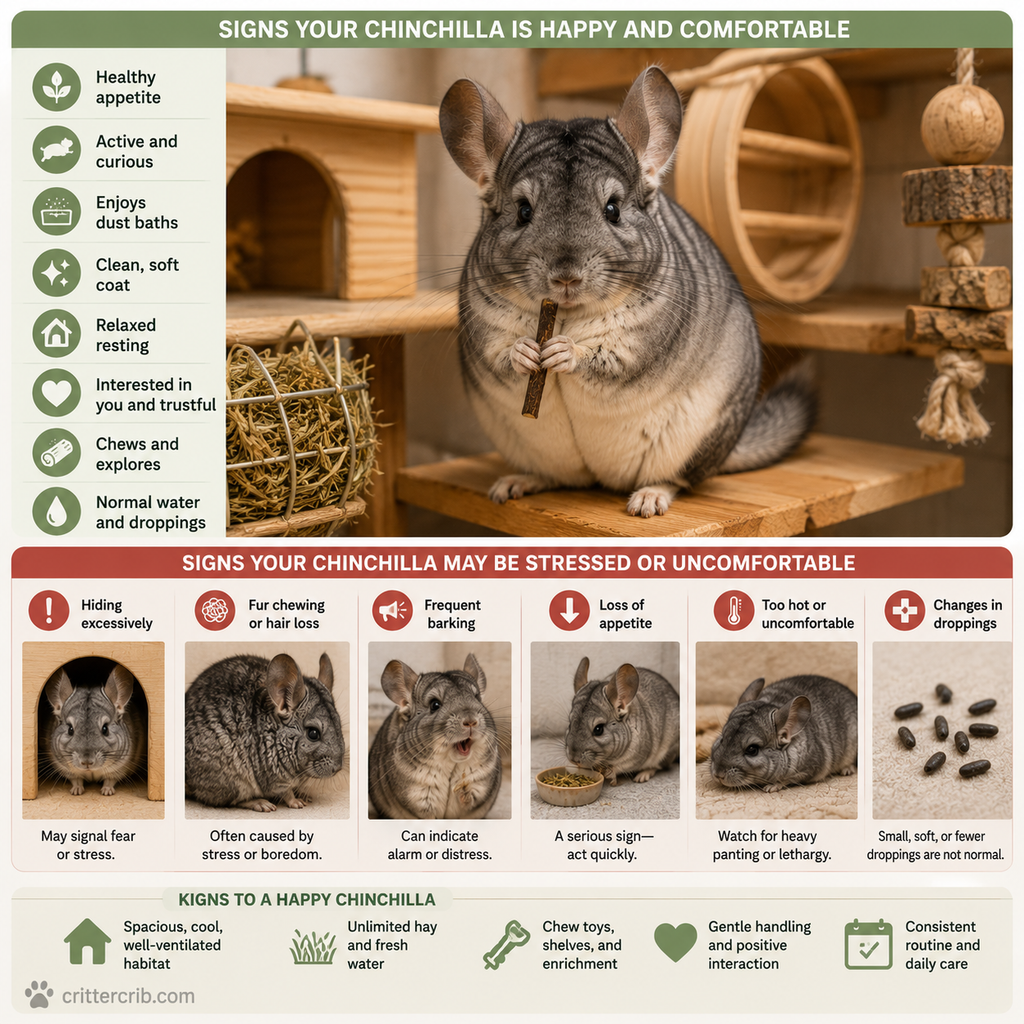
When awake, a healthy and content chinchilla may:
- Explore its enclosure
- Jump between shelves and platforms
- Eat hay regularly
- Drink normally
- Chew appropriate toys
- Take dust baths
- Investigate new objects
- Rest in relaxed positions
- Interact comfortably with you
- Show interest in enrichment
Personality matters.
Some chinchillas are outgoing and immediately investigate everything. Others are cautious and prefer observing something new before approaching.
A shy chinchilla isn’t necessarily an unhappy chinchilla.
Look at the overall pattern of behavior rather than judging your pet based on a single personality trait.
1. Your Chinchilla Has a Healthy Appetite
Regular eating is one of the most important signs that things are going well.
Chinchillas should have constant access to appropriate grass hay, which supports both digestion and dental health.
A comfortable chinchilla will typically eat hay throughout its active periods and show normal interest in its regular food.
You may hear munching during the evening or notice your chinchilla repeatedly returning to the hay supply.
That’s a good sign.
Pay Attention to Changes in Eating
Because chinchillas need to eat regularly, a sudden decrease in appetite shouldn’t be dismissed as your pet simply being picky.
Watch for changes such as:
- Eating considerably less hay
- Refusing normal food
- Dropping food while chewing
- Showing interest in food but struggling to eat
- Producing fewer droppings
- Losing weight
Dental problems, digestive issues, pain, and other medical conditions can affect appetite.
If your chinchilla stops eating or shows a significant change in appetite, contact an exotic-animal veterinarian promptly.
2. Your Chinchilla Is Active and Curious
Chinchillas are athletic animals.
A comfortable chinchilla usually spends part of its waking time moving around, climbing, jumping, chewing, and investigating its environment.
You may see your chinchilla leap from one platform to another or suddenly race around the enclosure with a burst of energy.
Some owners refer to energetic jumps and twists as “popcorning.”
These playful movements can be a sign that your chinchilla is feeling energetic and comfortable.
Not every chinchilla will behave exactly the same way, though.
Age, personality, health, and time of day all influence activity levels.
When Are Chinchillas Most Active?
Don’t worry if your chinchilla isn’t particularly energetic in the middle of the afternoon.
Chinchillas are generally crepuscular and may also be active at night, meaning much of their activity occurs around dawn and dusk or during nighttime hours.
Their schedule can vary somewhat in captivity.
Instead of expecting constant daytime activity, learn when your chinchilla normally wakes up and becomes interested in exploring.
3. Your Chinchilla Takes Dust Baths
Watching a chinchilla take a dust bath is one of the more entertaining parts of owning one.
They may dive into the bath, roll rapidly, flip onto their sides, and emerge looking incredibly pleased with themselves.
Dust bathing isn’t just entertainment.
Chinchillas have extremely dense fur, and specialized chinchilla bathing dust helps remove excess oil and moisture from their coat.
A chinchilla enthusiastically using its dust bath is displaying normal grooming behavior.
Provide a suitable commercial chinchilla dust rather than ordinary household sand or products not intended for chinchillas.
Dust baths should generally be offered periodically rather than left inside the enclosure constantly, since excessive bathing may contribute to dry skin and prolonged exposure can create unnecessary airborne dust.
4. Your Chinchilla Has a Healthy-Looking Coat
A comfortable, healthy chinchilla should generally have dense, soft fur without obvious wetness, heavy matting, or large unexplained bald areas.
Chinchillas naturally keep their coats in good condition through dust bathing.
Regular observation can help you notice changes.
Look for:
- Dense, even fur
- Clean skin
- No unusual damp areas
- No excessive scratching
- No obvious sores
- No significant unexplained fur loss
Chinchillas may occasionally release patches of fur when frightened or grabbed. This is known as fur slip and is a natural defensive mechanism.
Frequent fur slip, however, may indicate that your chinchilla is being handled too roughly or experiencing repeated stress.
5. Your Chinchilla Feels Safe Enough to Rest
One of the quieter signs of a comfortable chinchilla is simply being willing to relax.
A chinchilla that feels safe in its environment should eventually settle into regular resting habits.
It may sleep inside a hideout, on a favorite shelf, or in another protected area of the enclosure.
Some chinchillas become comfortable enough to rest in more exposed locations.
That can be a positive sign because the animal doesn’t feel the need to remain constantly alert.
Don’t worry if your chinchilla prefers sleeping inside a hide.
Hiding is normal behavior too.
The important thing is whether your pet appears comfortable rather than constantly frightened or tense.
6. Your Chinchilla Shows Interest in You
Trust develops differently with every chinchilla.
Some become very interested in their owners and will approach the front of the enclosure whenever someone enters the room.
Others are more reserved.
Signs your chinchilla is becoming comfortable with you may include:
- Approaching when you come near
- Sniffing your hands
- Taking appropriate treats gently
- Climbing onto your hands or arms voluntarily
- Remaining nearby instead of immediately hiding
- Allowing gentle scratching or petting
- Showing curiosity about what you’re doing
Don’t assume your chinchilla needs to enjoy being picked up to have a bond with you.
Many chinchillas prefer interacting while keeping control of their own movement.
Respecting that preference can actually help strengthen trust.
7. Your Chinchilla Plays and Explores
A good chinchilla enclosure should provide more than food and a place to sleep.
Chinchillas need opportunities to climb, chew, explore, and interact with their environment.
A happy chinchilla may spend time investigating:
- Wooden chew toys
- Safe branches
- Platforms
- Ledges
- Tunnels
- Hideouts
- Foraging activities
- Other chinchilla-safe enrichment
Rotate enrichment occasionally so your chinchilla has something new to investigate.
You don’t need to completely rearrange the enclosure every few days. Constant changes can be stressful for some animals.
Small changes are usually enough to add variety while keeping the environment familiar.
8. Your Chinchilla Chews Regularly
Chewing is normal and necessary for chinchillas.
Their teeth grow continuously, so appropriate chewing opportunities are an important part of their environment.
A comfortable chinchilla may spend plenty of time chewing safe wooden toys and other suitable materials.
Hay is especially important because its fibrous texture helps support natural tooth wear.
Provide multiple safe chewing options and replace them as they become worn.
Avoid assuming that every type of wood is safe.
Only provide chinchilla-safe materials that haven’t been treated with pesticides, paint, preservatives, or other potentially harmful substances.
9. Your Chinchilla Produces Normal Droppings
It’s not glamorous, but droppings can tell you quite a bit about a small pet’s health.
A chinchilla eating normally should produce plenty of firm, dry droppings.
You don’t need to inspect every dropping individually.
Instead, become familiar with what’s typical for your pet.
Changes worth paying attention to include:
- A noticeable decrease in droppings
- Very small droppings
- Unusually soft stool
- Diarrhea
- No droppings
- A sudden change combined with reduced appetite
Digestive changes can become serious in small herbivores.
Contact a veterinarian if your chinchilla develops significant or persistent changes in stool, especially when accompanied by poor appetite or lethargy.
10. Your Chinchilla Makes Relaxed Sounds
Chinchillas can be surprisingly vocal.
They may bark, squeak, chirp, or make other sounds depending on what’s happening around them.
Some quiet vocalizations can occur during comfortable social interaction or exploration.
However, interpreting sounds requires context.
A bark, for example, may indicate alarm or concern rather than happiness.
Instead of trying to translate every noise into a specific emotion, observe what your chinchilla is doing at the same time.
Ask yourself:
- Is its body relaxed?
- Is it eating or exploring normally?
- Did something suddenly frighten it?
- Is another chinchilla nearby?
- Does it appear defensive?
- Is the sound unusual for this individual?
Over time, you’ll become familiar with your chinchilla’s normal vocal habits.
Signs Your Chinchilla Trusts You
Trust is one of the strongest indicators that a chinchilla feels comfortable in its home.
A chinchilla that trusts you may willingly approach rather than retreating.
It may also climb onto you during supervised interaction or calmly accept gentle scratches.
Other signs can include:
- Taking food from your hand
- Sitting near you voluntarily
- Exploring while you’re nearby
- Climbing onto your lap or arms
- Allowing gentle handling
- Remaining relaxed when you move around the room
Trust often develops gradually.
If you’ve recently brought your chinchilla home, don’t expect immediate affection.
Give it time to learn your voice, scent, movements, and routine.
How to Help Your Chinchilla Feel Comfortable Around You
You don’t need to force interaction to build a relationship.
In fact, forcing it usually makes the process harder.
Start by spending quiet time near the enclosure.
Speak softly and allow your chinchilla to approach you.
When your pet seems curious, offer your hand and allow it to sniff you.
Appropriate treats can also help create positive associations.
A simple trust-building routine might look like this:
- Sit quietly near the enclosure.
- Speak softly when you approach.
- Offer your hand without grabbing.
- Reward voluntary interaction.
- Introduce gentle petting gradually.
- Allow your chinchilla to retreat when it wants to.
- Keep interactions calm and predictable.
Avoid chasing your chinchilla around its enclosure simply because you want to hold it.
Being able to choose whether to approach can make your pet much more confident around you.
Signs a Chinchilla May Be Stressed
Recognizing stress is just as important as recognizing happiness.
Occasional nervousness is normal. A sudden noise, unfamiliar person, new enclosure accessory, or change in routine might temporarily startle your chinchilla.
Persistent stress is different.
Possible signs include:
- Frequent hiding beyond what’s normal for your pet
- Repeated alarm barking
- Excessive chewing of cage bars
- Fur chewing
- Frequent fur slip
- Sudden aggression
- Constant attempts to escape
- Reduced appetite
- Unusual inactivity
- Avoiding interaction that was previously tolerated
Some of these behaviors can also indicate medical problems.
If your chinchilla’s behavior changes suddenly or you can’t identify an environmental reason, consider having it examined by an exotic-animal veterinarian.
Make Sure Your Chinchilla Isn’t Too Hot
A chinchilla’s physical environment has a major influence on comfort.
Chinchillas developed in the cool, dry environment of the Andes and have extremely dense coats.
That makes overheating a serious concern.
A room that feels merely warm to you may already be uncomfortable for a chinchilla.
Keep the enclosure in a cool, dry, well-ventilated part of the home away from direct sunlight.
Air conditioning may be necessary during warm weather, depending on your climate.
Watch for possible signs of overheating such as:
- Red or unusually warm ears
- Rapid breathing
- Lethargy
- Weakness
- Lying unusually flat or stretched out
- Reduced responsiveness
Heatstroke can become life-threatening.
If you believe your chinchilla is overheating, move it to a cooler environment and contact a veterinarian promptly.
A Comfortable Enclosure Makes a Big Difference
Even a friendly chinchilla can become stressed in an unsuitable environment.
A well-designed enclosure should give your pet opportunities to move vertically and horizontally.
Important features include:
- Plenty of usable space
- Secure platforms and ledges
- Hiding places
- Constant access to appropriate hay
- Fresh water
- Safe chew toys
- Comfortable resting areas
- Chinchilla-safe enrichment
- Good ventilation
The enclosure should also be located somewhere relatively calm.
That doesn’t necessarily mean complete silence.
Chinchillas can become accustomed to ordinary household activity. The bigger concern is constant loud noise, sudden disturbances, excessive heat, or other conditions that prevent them from relaxing.
Does a Happy Chinchilla Need a Companion?
Chinchillas can be social animals, but pairing them isn’t as simple as placing two unfamiliar animals together.
Some bonded chinchillas enjoy resting, playing, and interacting with each other.
Others may be territorial or incompatible.
Introductions should be gradual and carefully supervised.
If you’re considering adding another chinchilla, research proper bonding techniques first and make sure you have the ability to house them separately if necessary.
Never assume two chinchillas will automatically become friends.
A chinchilla living alone can still receive enrichment, interaction, and attention from its owner, but you’ll need to make sure its behavioral and social needs aren’t being overlooked.
Signs Your Chinchilla May Be Uncomfortable or Sick
Not every change in behavior is emotional.
Sometimes a chinchilla that seems unhappy is actually ill or in pain.
Contact a veterinarian if you notice concerning changes such as:
- Refusing food
- Significant reduction in appetite
- Fewer or no droppings
- Difficulty breathing
- Excessive drooling
- Wet fur around the mouth
- Sudden weight loss
- Severe lethargy
- Difficulty moving
- Persistent diarrhea
- Discharge from the eyes or nose
- Unusual swelling
- Signs of overheating
Chinchillas can hide illness surprisingly well.
Regularly weighing your chinchilla with an appropriate digital scale can help you detect weight changes that aren’t immediately visible beneath its dense coat.
Keep a simple record so you can recognize meaningful trends.
Common Things That Can Make a Chinchilla Unhappy
Sometimes improving a chinchilla’s comfort means identifying what’s making life stressful.
Common problems can include:
- An enclosure that’s too small
- Lack of hiding places
- Too little enrichment
- Excessive heat
- Constant loud noise
- Rough or frequent handling
- Being chased around the enclosure
- An incompatible cage mate
- Lack of appropriate chewing opportunities
- An inconsistent routine
- Poor enclosure hygiene
- Health problems
Consider the entire environment rather than focusing on one toy or behavior.
A chinchilla needs opportunities to exercise, hide, chew, eat, rest, groom, and interact at its own pace.
Learn What’s Normal for Your Chinchilla
There’s no single behavior that proves a chinchilla is happy.
Instead, look at the whole picture.
A comfortable chinchilla generally eats and drinks normally, produces regular droppings, explores during its active hours, uses its dust bath, chews appropriate objects, rests comfortably, and shows curiosity about its environment.
It may also become increasingly interested in interacting with you.
The most valuable thing you can do is learn your individual chinchilla’s routine.
Once you know what’s normal, changes become much easier to spot.
Maybe your chinchilla always comes to the front of the enclosure when it hears the hay bag. Perhaps it has a particular shelf where it sleeps every afternoon. Maybe it climbs onto your arm every evening but doesn’t like being picked up.
Those individual habits matter.
If your normally enthusiastic chinchilla suddenly stops eating, hides constantly, becomes unusually lethargic, or behaves very differently, pay attention.
Happiness in a chinchilla isn’t necessarily dramatic.
More often, it looks like an animal that feels secure enough to eat, play, explore, sleep, groom, and simply behave like a chinchilla.
And when you regularly see those behaviors, you’re probably doing quite a few things right.