

Tiger salamanders aren’t flashy pets that spend all day climbing, swimming, or exploring their enclosure. In fact, you may spend a surprising amount of time looking at what appears to be an empty habitat.
That’s usually because your salamander is underground.
Tiger salamanders are stocky, terrestrial amphibians that naturally spend much of their time burrowing beneath soil, leaf litter, logs, and other cover. When they do emerge—often around feeding time—their large heads, rounded bodies, and surprisingly enthusiastic appetites give them plenty of personality.
They’re also potentially long-lived pets, so bringing one home shouldn’t be an impulse decision.
Successful tiger salamander care starts with a secure terrestrial enclosure, deep moisture-retaining substrate, moderate temperatures, clean water, appropriate humidity, and a varied carnivorous diet.
This guide covers the essentials from initial habitat setup through everyday maintenance.
Tiger Salamander Care at a Glance
Here’s a quick overview of the basic requirements for keeping a tiger salamander.
- Scientific group: Ambystoma species and related populations commonly called tiger salamanders
- Animal type: Terrestrial salamander
- Adult size: Often approximately 6–10 inches, with some individuals growing larger
- Lifespan: Commonly 10 years or more with good care
- Enclosure type: Terrestrial with deep substrate
- Minimum enclosure: Around a 20-gallon-long footprint for one adult is a useful starting point
- Temperature: Generally moderate to cool rather than tropical
- Humidity: Moist environment without constantly waterlogged substrate
- Diet: Carnivorous
- Staple foods: Earthworms and appropriately sized invertebrates
- Activity: Often most active in the evening or at night
- Handling: Keep to a minimum
- Difficulty: Beginner to intermediate
Exact needs can vary somewhat among species and individuals, so knowing which tiger salamander you have is useful.
What Is a Tiger Salamander?
Tiger salamanders are large, heavy-bodied members of the mole salamander family.
They occur across much of North America and are associated with a variety of habitats, including grasslands, woodlands, prairies, and areas near seasonal or permanent bodies of water.
Adults are primarily terrestrial.
Rather than spending their lives swimming around an aquarium, they typically spend substantial amounts of time underground.
That burrowing lifestyle is one of the most important things to understand when designing their habitat.
Your salamander doesn’t need an elaborate climbing enclosure.
It needs somewhere safe to dig.
How Big Do Tiger Salamanders Get?
Tiger salamanders are among the larger terrestrial salamanders commonly encountered in the pet trade.
Many adults reach roughly 6–10 inches in total length, although size varies by species, population, sex, and individual.
Some can grow larger.
Their chunky build also makes them look substantial compared with slender salamander species of similar length.
When choosing an enclosure, plan around the animal’s adult size rather than its size when purchased.
How Long Do Tiger Salamanders Live?
Tiger salamanders can be surprisingly long-lived.
With appropriate care, they may live 10 years or longer, and some individuals can potentially live well beyond that.
This makes them a significant commitment.
The good news is that their daily care isn’t especially complicated once the habitat is established correctly.
Most of the work involves maintaining appropriate environmental conditions, feeding a nutritious diet, removing waste, and making sure the substrate stays appropriately moist.
Choosing a Tiger Salamander Enclosure
Tiger salamanders are terrestrial, so floor space matters more than height.
A tall arboreal terrarium wastes much of its volume.
Instead, choose a secure enclosure with enough horizontal space for the salamander to move, burrow, and establish different resting areas.
If you’re preparing an enclosure from scratch, our tiger salamander habitat setup guide goes deeper into enclosure size, substrate depth, moisture, hides, water, temperature, ventilation, and creating a habitat that supports natural burrowing.
What Size Tank Does a Tiger Salamander Need?
For one adult, an enclosure with approximately the floor space of a 20-gallon-long aquarium can provide a reasonable starting point.
Larger is welcome when you have the space.
A bigger enclosure allows you to provide:
- Deeper substrate
- Multiple hides
- More environmental variation
- A larger water dish
- More room for natural movement
Don’t focus exclusively on gallons.
A low, wide enclosure is generally more useful than a tall enclosure with similar total volume.
Do Tiger Salamanders Need a Lid?
Yes.
The enclosure should have a secure lid.
Salamanders may appear slow and unmotivated until they discover a gap you didn’t realize was large enough to use.
A secure top also helps you manage ventilation and humidity.
Inspect openings around:
- Cables
- Thermometer probes
- Tubing
- Decorations
- Lid corners
Preventing an escape is far easier than searching the house for a dehydrating salamander.
The Best Substrate for Tiger Salamanders
Substrate is one of the most important parts of a tiger salamander habitat.
These animals naturally burrow.
The substrate should therefore be:
- Deep enough for digging
- Soft
- Moisture-retentive
- Free from fertilizers
- Free from pesticides
- Safe for amphibians
A depth of several inches gives the salamander room to bury itself.
Larger adults may appreciate even deeper substrate.
Suitable Substrate Options
Depending on your setup, appropriate materials may include mixtures containing:
- Organic topsoil without fertilizers or pesticides
- Coconut fiber
- Sphagnum moss used appropriately
- Leaf litter
A naturalistic soil-based mixture often provides good burrowing structure.
Make sure any soil product is genuinely free from added fertilizers, wetting agents, pesticides, or other chemicals.
Substrates to Avoid
Avoid materials that can create impaction risks, irritation, or unsuitable conditions.
Poor choices include:
- Small gravel
- Sharp stones
- Calcium sand
- Wood shavings from aromatic species
- Fertilized potting soil
- Substrates treated with pesticides
- Very dusty material
When in doubt, choose a simple amphibian-safe substrate rather than something decorative.
How Moist Should the Substrate Be?
Tiger salamanders need moist conditions because amphibian skin plays an important role in water balance and respiration.
However, moist doesn’t mean swampy.
A useful comparison is damp soil rather than mud.
When you squeeze a handful of substrate, it should feel moist without pouring water.
Constantly saturated substrate can create stagnant conditions and may contribute to skin problems.
Create a Moisture Gradient
The entire enclosure doesn’t have to be identical.
You can allow one section to remain somewhat more moist while another stays slightly less damp.
This gives the salamander some ability to choose where it wants to burrow.
Check conditions regularly because substrate can dry unevenly.
Tiger Salamander Temperature Requirements
Tiger salamanders generally prefer moderate to cool conditions.
They’re not tropical amphibians.
For many commonly kept tiger salamanders, temperatures in approximately the mid-60s to low-70s°F are a reasonable general range, with excessive heat being more concerning than slightly cool conditions.
Exact requirements vary, so research your particular species.
Avoid Excessive Heat
Prolonged high temperatures can stress tiger salamanders.
Keep the enclosure away from:
- Direct sunlight
- Radiators
- Heating vents
- Hot electronics
- Unventilated rooms that become very warm
An aquarium thermometer or digital enclosure thermometer makes monitoring easy.
If your home becomes hot during summer, plan ahead.
Do Tiger Salamanders Need a Heat Lamp?
Usually, no.
In many homes, normal room temperature is adequate.
A heat lamp can easily make a small enclosure too warm and may also dry the substrate.
If additional heating is genuinely necessary because your home becomes unusually cold, use carefully controlled equipment and monitor the temperature closely.
Don’t add heat simply because tiger salamanders are sold in the reptile section of a pet store.
Tiger Salamander Humidity
Humidity matters, but there isn’t one magic percentage that replaces good substrate management.
A tiger salamander spends much of its time in direct contact with moist soil.
Maintaining appropriately damp substrate, adequate ventilation, and access to clean water is therefore extremely important.
A hygrometer can help you observe general conditions, but the substrate itself deserves just as much attention.
Signs the Habitat May Be Too Dry
Possible clues include:
- Substrate drying rapidly
- Salamander spending excessive time in the water dish
- Difficulty maintaining normal skin moisture
- Repeatedly seeking the wettest part of the enclosure
If the habitat continually dries out, look at ventilation, room temperature, substrate depth, and moisture retention.
Providing Hides
Even with deep substrate, tiger salamanders benefit from surface-level hiding places.
Good options include:
- Cork bark
- Half logs
- Amphibian-safe caves
- Pieces of driftwood
- Smooth, stable rocks
- Dense leaf litter
Provide more than one option when space allows.
Hides should be large enough for the salamander to enter comfortably without squeezing through a tiny opening.
Check decorations for sharp edges.
Leaf Litter and Natural Cover
A layer of leaf litter can make the habitat feel more natural.
It provides:
- Surface cover
- Additional hiding opportunities
- Moisture retention
- Environmental complexity
Use clean leaves from a known safe source.
Avoid collecting material from areas exposed to pesticides, herbicides, heavy traffic pollution, or other contaminants.
Commercial leaf litter intended for terrariums is another option.
Does a Tiger Salamander Need a Water Dish?
Yes.
Provide a shallow dish containing clean, treated water.
The dish should be:
- Large enough for the salamander to enter
- Shallow enough for easy access
- Easy to climb out of
- Stable
- Easy to clean
Tiger salamanders aren’t aquatic adults and don’t need a deep swimming area.
A shallow soaking dish is sufficient.
What Water Should You Use?
Municipal tap water may contain chlorine or chloramine.
Use an appropriate aquarium or amphibian-safe water conditioner when needed.
Avoid distilled water as the routine water source unless specifically directed by a qualified veterinarian or husbandry expert.
Replace the water regularly and immediately if it becomes contaminated with substrate or waste.
Do Tiger Salamanders Need UVB?
Tiger salamander lighting requirements are less demanding than those of many reptiles.
They naturally spend substantial amounts of time underground and under cover.
A normal day-and-night cycle is important, but intense lighting isn’t necessary.
Low-level UVB is sometimes incorporated into modern amphibian husbandry, although appropriate exposure needs to account for the species’ secretive lifestyle and access to shade.
If using UVB, make sure the salamander can retreat completely from the light.
Avoid turning the enclosure into a brightly illuminated display with nowhere to hide.
What Do Tiger Salamanders Eat?
Tiger salamanders are carnivorous.
They’re often enthusiastic feeders and may attempt to eat almost anything appropriately sized that moves nearby.
A good captive diet should focus on nutritious invertebrates rather than fatty treats.
Good Tiger Salamander Foods
Appropriate options may include:
- Earthworms
- Nightcrawlers
- Crickets
- Dubia roaches where legal
- Other suitable captive-raised roaches
- Appropriate larvae
- Occasional other nutritious feeder invertebrates
Earthworms are particularly useful as a staple.
They’re nutritious, easy to portion, and naturally appealing to many salamanders.
Large worms can be cut into smaller pieces when necessary.
How Often Should You Feed a Tiger Salamander?
Feeding frequency depends on age, size, temperature, and body condition.
Juveniles generally need food more frequently because they’re growing.
Healthy adults can often be fed several times per week rather than every day.
Instead of feeding automatically whenever the salamander appears interested, monitor its body condition.
Tiger salamanders can become overweight.
Their enthusiastic feeding response doesn’t necessarily mean they need another meal.
How Much Should You Feed?
Offer an appropriate amount that the salamander can consume without leaving substantial uneaten food in the enclosure.
Individual appetite varies.
Watch for:
- Healthy body condition
- Normal growth in juveniles
- Consistent appetite
- Excessive weight gain
- Uneaten feeders
Remove uneaten prey rather than leaving it in the enclosure indefinitely.
Crickets and similar insects may bother a resting salamander if left loose for long periods.
Do Tiger Salamanders Need Supplements?
The need for supplementation depends partly on the diet.
A varied diet based heavily on nutritionally complete prey such as earthworms may require a different supplementation strategy than one relying heavily on commercially raised insects.
Feeder insects such as crickets should be appropriately gut-loaded.
Calcium and vitamin supplementation may also be used according to an appropriate amphibian husbandry plan.
Avoid randomly coating every meal in large quantities of supplements.
More isn’t automatically better.
Foods to Avoid
Avoid feeding tiger salamanders:
- Wild insects from pesticide-treated areas
- Fireflies
- Processed human food
- Seasoned meat
- Large prey that could cause injury
- Vertebrate prey as a routine staple
- Insects of unknown origin
Wild-caught prey can expose your salamander to pesticides, parasites, or other contaminants.
Captive-raised feeders from reputable sources are generally safer.
Daily Tiger Salamander Care
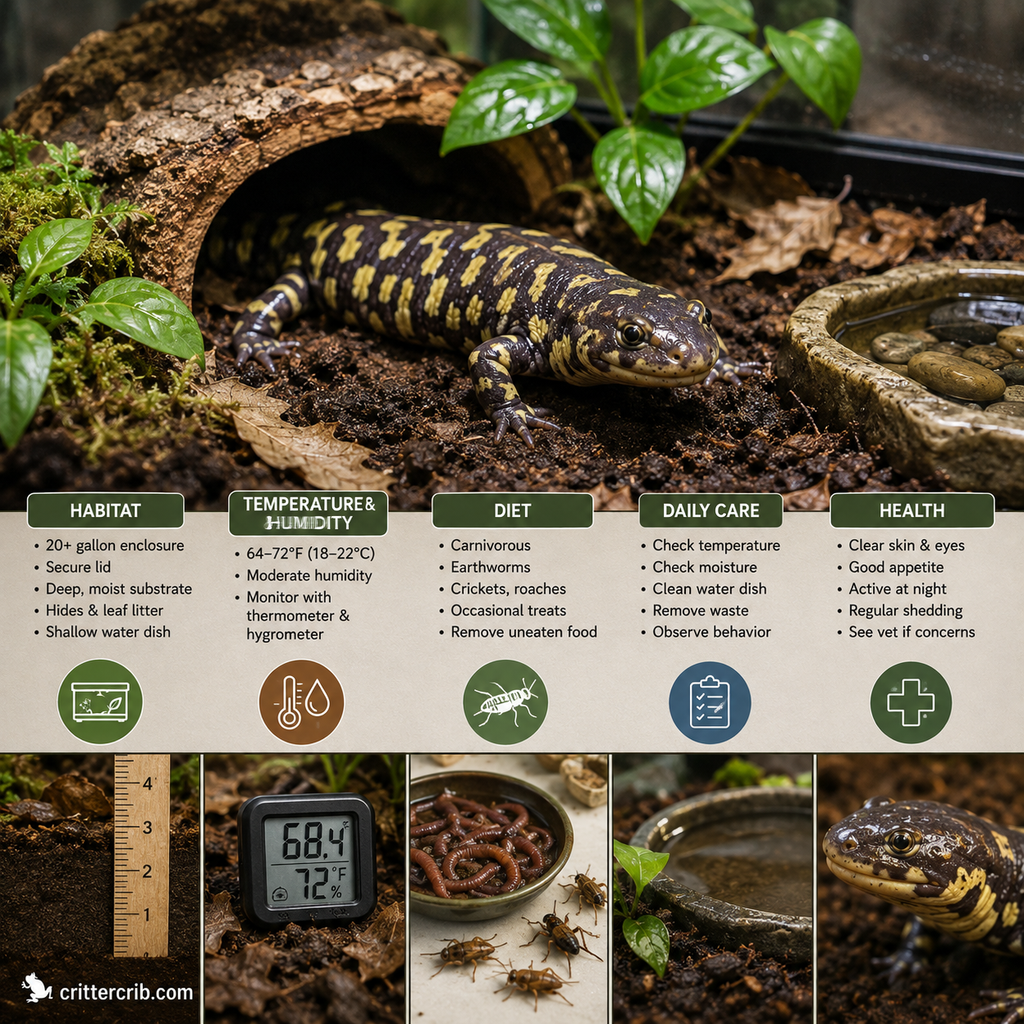
Once the enclosure is established, daily care is straightforward.
You don’t need to dig your salamander up every morning.
Instead, perform a quick habitat check.
Daily Checklist
Each day:
- Check the enclosure temperature.
- Inspect substrate moisture.
- Check the water dish.
- Remove visible waste.
- Remove uneaten food.
- Look for mold or spoiled organic material.
- Make sure the enclosure remains securely closed.
- Observe the salamander when it’s naturally visible.
If the salamander is buried, let it be unless you have a specific reason to check it.
Weekly Habitat Maintenance
A more thorough inspection can be performed regularly.
Weekly tasks may include:
- Replacing dirty water
- Cleaning the water dish
- Removing waste
- Removing spoiled food
- Removing moldy or decaying material
- Checking hides
- Inspecting substrate condition
- Moistening dry areas
- Cleaning dirty glass
The goal is to maintain a clean habitat without constantly dismantling it.
How Often Should You Replace the Substrate?
There’s no need to replace all substrate on an arbitrary weekly schedule.
Spot cleaning is less disruptive.
Remove contaminated substrate whenever you find waste or spoiled food.
Depending on your setup, portions of the substrate may eventually need replacing.
A naturalistic or bioactive habitat will have a different maintenance routine than a simple enclosure.
Whatever system you use, don’t allow waste, mold, or foul-smelling substrate to accumulate.
Can You Keep a Tiger Salamander in a Bioactive Enclosure?
Yes, a properly designed bioactive setup can work for tiger salamanders.
A bioactive enclosure typically incorporates:
- Natural substrate
- Live plants
- Leaf litter
- Beneficial microorganisms
- Cleanup organisms such as springtails
- Sometimes suitable isopods
However, “bioactive” doesn’t mean maintenance-free.
You’ll still need to:
- Monitor moisture
- Remove large waste
- Maintain water
- Feed appropriately
- Check plants
- Monitor the cleanup crew
- Observe the salamander
For a first-time keeper, a simple naturalistic enclosure can be easier to monitor while learning basic husbandry.
Why Is My Tiger Salamander Always Buried?
Because it’s a tiger salamander.
Burrowing is one of their most natural behaviors.
Tiger salamanders belong to a group often called mole salamanders because of their largely underground lifestyle.
Burrowing is only one part of their normal routine. Our guide to common tiger salamander behaviors and what they mean takes a closer look at hiding, nighttime activity, soaking, feeding responses, burrowing, and other behaviors owners may notice.
A salamander may remain buried for substantial periods and emerge primarily:
- At night
- After environmental changes
- When hungry
- During humid conditions
- When disturbed
- When repositioning itself
Don’t assume a hidden salamander is unhappy.
Providing enough substrate to disappear completely is actually an important part of good husbandry.
Why Is My Tiger Salamander Not Eating?
Occasionally refusing food isn’t automatically an emergency.
Appetite can be influenced by:
- Temperature
- Stress
- Recent meals
- Seasonal changes
- Prey preference
- Age
- Illness
Check the enclosure conditions first.
If your salamander continues refusing food and begins losing weight or showing other symptoms, veterinary evaluation may be appropriate.
Keeping occasional weight records can help you detect gradual changes that are difficult to notice visually.
Can You Handle a Tiger Salamander?
Tiger salamanders can appear calm and may tolerate brief handling, but regular handling isn’t recommended.
Amphibian skin is delicate and permeable.
Oils, soaps, lotions, sanitizers, and other substances on human hands may irritate or harm them.
Handling can also cause unnecessary stress.
If you must handle your salamander, clean, damp, powder-free gloves are a good option.
Keep handling brief and support the animal securely.
Never handle an amphibian immediately after applying:
- Hand sanitizer
- Lotion
- Sunscreen
- Insect repellent
- Cleaning products
- Other chemicals
Tiger salamanders are better pets for observing than holding.
Can Tiger Salamanders Live Together?
Keeping multiple tiger salamanders together introduces additional risks.
They have strong feeding responses and may bite at moving objects, including other salamanders.
Size differences can increase the risk of injury or attempted predation.
For many keepers, housing tiger salamanders individually is the simplest and safest option.
If multiple animals are housed together, they need considerably more space and close monitoring.
Can Tiger Salamanders Live With Other Animals?
A species-only enclosure is generally the safest choice.
Avoid adding:
- Frogs
- Other salamander species
- Reptiles
- Fish
- Small vertebrates
- Random invertebrates not intended as feeders or cleanup crew
Different animals may have incompatible environmental needs and can introduce parasites, competition, injuries, or predation risks.
Your tiger salamander doesn’t need a companion to live a healthy life.
Signs of a Healthy Tiger Salamander
A healthy salamander will generally display:
- Good body condition
- Clear skin
- Normal movement
- Strong feeding response
- Regular burrowing
- Normal posture
- Clear eyes
- No obvious injuries
Remember that inactivity and hiding are normal. Becoming familiar with your tiger salamander’s normal behavior and activity patterns can make genuine changes easier to recognize.
Judge health based on the entire animal rather than how often you see it moving.
Warning Signs to Watch For
Potential problems may include:
- Persistent refusal to eat
- Significant weight loss
- Unusual swelling
- Skin lesions
- Persistent redness
- Abnormal shedding
- Difficulty moving
- Weakness
- Open wounds
- Abnormal posture
- Persistent unusual behavior
Some symptoms can result from husbandry problems, while others may indicate illness.
Check temperature, substrate condition, moisture, water quality, and feeding practices whenever something changes.
For persistent or serious symptoms, contact a veterinarian experienced with amphibians or exotic animals.
Common Tiger Salamander Care Mistakes
Many problems are easier to prevent than correct.
Using Too Little Substrate
Tiger salamanders need to burrow.
A thin layer of soil doesn’t allow normal behavior.
Provide several inches of suitable substrate.
Keeping the Habitat Too Warm
These aren’t tropical salamanders.
Monitor temperatures, especially during summer.
Making the Substrate Waterlogged
Moisture is necessary.
Standing water throughout the substrate isn’t.
Aim for damp, well-structured soil rather than mud.
Using Small Gravel
Loose gravel can create an ingestion risk during feeding.
Use a safer substrate.
Overfeeding
Tiger salamanders often have excellent appetites.
That doesn’t mean they need food every time they look interested.
Monitor body condition.
Handling Too Frequently
They’re not pets that benefit from being held regularly.
Enjoy observing natural behaviors instead.
Using Untreated Tap Water
Chlorine or chloramine may be present in municipal water.
Treat water appropriately.
Digging Up the Salamander Constantly
A buried tiger salamander is usually displaying normal behavior.
Give it some privacy.
Tiger Salamander Habitat Setup Step by Step
Preparing the enclosure before bringing the salamander home makes everything easier.
A simple setup process looks like this:
- Choose a low, wide, secure enclosure.
- Add several inches of amphibian-safe substrate.
- Moisten the substrate appropriately.
- Add multiple hides.
- Add leaf litter and natural cover.
- Provide a shallow water dish.
- Install a thermometer.
- Add appropriate lighting if used.
- Check temperature and substrate moisture for several days.
- Confirm that the lid is secure.
- Introduce the salamander only after conditions are stable.
You’ll learn a lot simply by running the enclosure before an animal lives in it.
Tiger Salamander Supplies Checklist
Before bringing your salamander home, gather the essentials.
Habitat Supplies
- Low, wide enclosure
- Secure lid
- Deep amphibian-safe substrate
- Hides
- Leaf litter
- Shallow water dish
- Thermometer
Feeding Supplies
- Earthworms or nightcrawlers
- Appropriate feeder insects
- Feeding tongs
- Suitable supplements when needed
- Feeder insect storage supplies
Maintenance Supplies
- Water conditioner
- Spray bottle or appropriate misting method
- Dedicated cleaning tools
- Waste-removal tools
- Replacement substrate
- Disposable powder-free gloves
Having everything ready makes routine care considerably easier.
Frequently Asked Questions About Tiger Salamander Care
Are Tiger Salamanders Good Pets for Beginners?
They can be.
Their care is relatively straightforward once you understand amphibian husbandry.
The biggest requirements are appropriate temperature, deep moist substrate, clean water, a nutritious diet, and minimal handling.
Do Tiger Salamanders Need Water?
Yes, but adult tiger salamanders don’t need a full aquatic aquarium.
Provide a shallow water dish large enough for soaking and keep the terrestrial substrate appropriately moist.
Do Tiger Salamanders Need to Swim?
Adult tiger salamanders are primarily terrestrial.
They don’t require a deep swimming area in a normal terrestrial enclosure.
Do Tiger Salamanders Need Heat?
Often, normal indoor temperatures are sufficient.
They generally prefer moderate or cool conditions, and excessive heat can be dangerous.
Always monitor the enclosure with a thermometer.
How Deep Should Tiger Salamander Substrate Be?
Provide several inches of substrate so the salamander can burrow completely.
Larger adults benefit from additional depth when enclosure dimensions allow.
How Often Do Tiger Salamanders Eat?
Juveniles generally eat more frequently than adults.
Healthy adults can often be fed several times per week, with the exact schedule adjusted according to size, temperature, diet, and body condition.
Why Is My Tiger Salamander Hiding?
Hiding and burrowing are normal behaviors.
Tiger salamanders naturally spend substantial periods underground.
Do Tiger Salamanders Like Being Held?
Regular handling isn’t necessary and can stress the animal or expose its permeable skin to contaminants.
Handle only when necessary.
Can Tiger Salamanders Bite?
They have strong feeding responses and may accidentally bite a finger mistaken for food.
Using feeding tongs can help keep hands away from the mouth during feeding.
Do Tiger Salamanders Need a Companion?
No.
A tiger salamander can live perfectly well by itself, and individual housing avoids potential competition and injury between animals.
Final Thoughts on Tiger Salamander Care
Tiger salamanders are fascinating pets precisely because they don’t behave like many other animals people keep at home.
They’re burrowers.
A healthy tiger salamander may spend much of its life hidden beneath the substrate, emerging to explore briefly or enthusiastically grab an earthworm before disappearing underground again.
Good care means allowing that natural behavior.
Provide a spacious terrestrial enclosure with deep, moist substrate, secure hides, moderate temperatures, clean treated water, and a nutritious carnivorous diet. Keep the habitat clean without constantly tearing it apart, monitor your salamander’s body condition, and limit handling.
Once those fundamentals are in place, daily maintenance is relatively simple.
You may not see your tiger salamander every time you walk past the enclosure.
But underneath the soil, that’s often exactly where it wants to be.