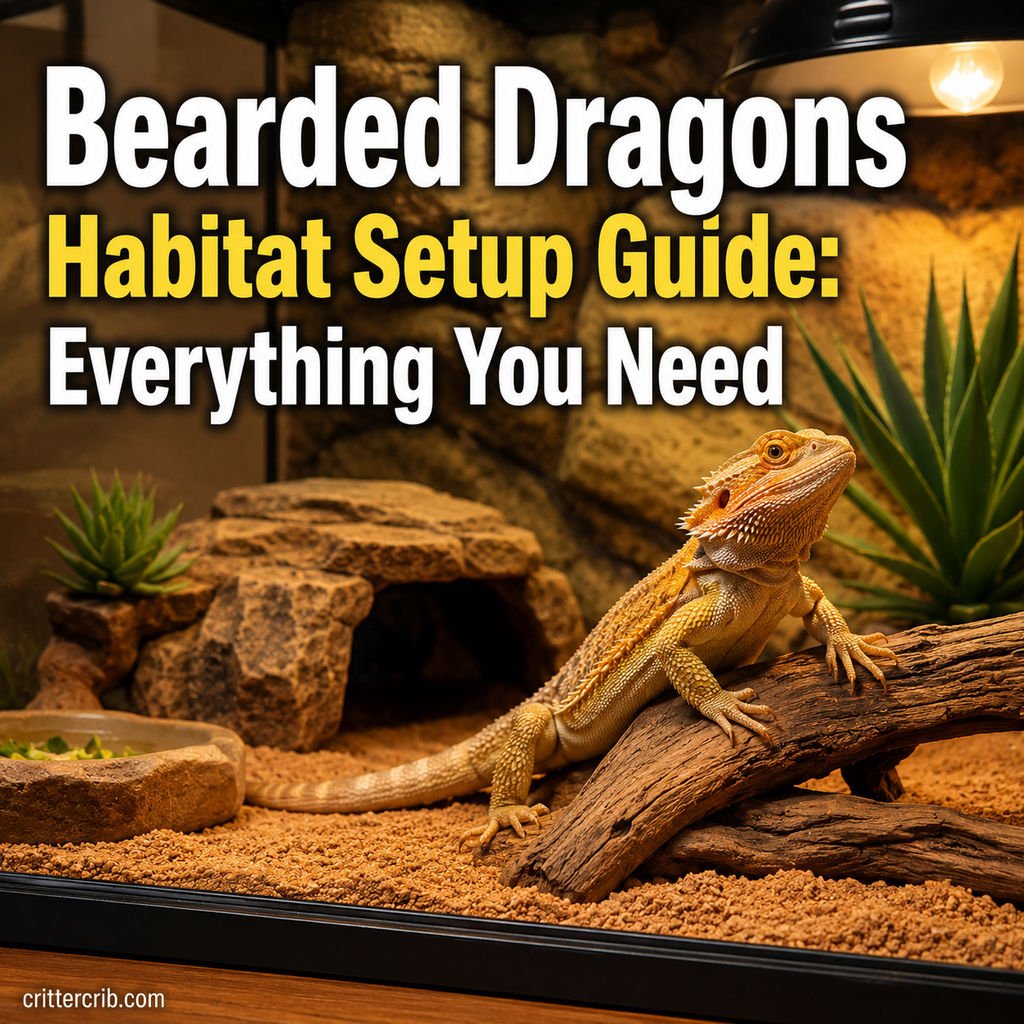
Setting up a bearded dragon habitat isn’t difficult once you understand what these reptiles actually need. The challenge is getting the important details right from the beginning.
Bearded dragons come from hot, relatively dry regions of Australia, so their enclosure needs to provide strong lighting, access to UVB, a warm basking area, cooler places to retreat, and enough room to move around. Simply putting a heat lamp over a small glass tank isn’t enough.
A good habitat allows your bearded dragon to choose where it wants to be throughout the day. It can warm up under the basking light, move to a cooler area when necessary, climb onto a branch, hide when it wants privacy, and comfortably explore its surroundings.
Whether you’re preparing for your first bearded dragon or upgrading an existing enclosure, this guide covers the essentials you’ll need to build a safe, practical habitat.
What Does a Bearded Dragon Need in Its Habitat?
A basic bearded dragon setup should include:
- An appropriately sized enclosure
- A basking heat source
- Proper UVB lighting
- A warm basking zone
- A cooler side of the enclosure
- Safe substrate
- At least one secure hide
- Branches, rocks, or other climbing opportunities
- Food and water dishes as appropriate
- Digital thermometers
- A hygrometer for monitoring humidity
The individual pieces matter, but how they work together is even more important.
Your goal is to create different zones within the habitat rather than keeping the entire enclosure at one temperature.
What Size Tank Does a Bearded Dragon Need?
Bearded dragons need considerably more space than their small size as babies might suggest.
A juvenile may look tiny inside a large enclosure, but healthy adults commonly reach roughly 18–24 inches in total length. They need enough room to walk, turn around, climb, bask, and move between different temperature zones.
For an adult bearded dragon, an enclosure around 4 feet long by 2 feet deep by 2 feet high is a commonly recommended minimum starting point.
That’s roughly equivalent to a 120-gallon enclosure, although physical dimensions are more useful than gallon ratings when evaluating reptile habitats.
Larger enclosures can be even better when they’re properly heated and illuminated.
Should You Start a Baby Bearded Dragon in a Large Enclosure?
You don’t necessarily need to start with a tiny tank.
A baby or juvenile bearded dragon can often live successfully in a larger enclosure as long as it can easily find:
- Food
- Water
- The basking area
- Hiding places
- Cooler areas
Starting with an adult-sized habitat can also save you from purchasing several enclosures as the dragon grows.
If you do use a large habitat for a young dragon, keep the layout relatively straightforward at first and make sure you’re able to monitor feeding and behavior.
Choosing the Right Bearded Dragon Enclosure
Glass aquariums are commonly used, but they’re not your only option.
Purpose-built reptile enclosures made from PVC, wood-based materials, or combinations of glass and other materials can also work well.
A good enclosure should provide:
- Adequate ventilation
- Secure doors or a secure top
- Enough room for a temperature gradient
- Safe installation of heating and UVB equipment
- Easy access for cleaning
- Enough height for furnishings and lighting
- Protection against escapes
Front-opening enclosures are particularly convenient because you don’t have to reach down from above every time you feed, clean, or handle your dragon.
Whatever enclosure you choose, make sure it’s designed to safely handle the heating and lighting equipment you plan to use.
Creating a Proper Temperature Gradient
Temperature is one of the most important parts of a bearded dragon habitat.
Instead of heating the entire enclosure equally, create a gradient.
One end should contain the primary basking area. The opposite end should remain cooler.
This allows your bearded dragon to regulate its body temperature by moving around the habitat.
A basic layout looks like this:
Warm side → middle zone → cool side
The basking surface itself will be the hottest location.
The surrounding warm side should be cooler than the basking surface, and temperatures should continue dropping toward the opposite end of the enclosure.
Bearded Dragon Basking Temperature
The ideal basking temperature can vary somewhat depending on the dragon’s age, setup, and how the temperature is being measured.
For many bearded dragons, a basking surface temperature somewhere around 100–110°F is a useful general target, with younger dragons often using the warmer end of that range.
Adult dragons may prefer basking surfaces closer to roughly 95–105°F.
These aren’t numbers you should blindly chase, however.
Observe your dragon’s behavior while accurately monitoring temperatures. A dragon that never uses the basking area may be telling you something about the setup.
Warm and Cool Side Temperatures
The warm side should be significantly cooler than the hottest point directly beneath the basking lamp.
The cool side is equally important.
A general daytime cool-side range around 75–85°F gives the dragon somewhere to retreat when it no longer wants intense heat.
Room conditions and enclosure design will influence the exact temperatures.
The important thing is maintaining a meaningful gradient rather than turning the entire habitat into one uniformly hot box.
How to Measure Bearded Dragon Temperatures Correctly
Don’t estimate enclosure temperatures by touching a rock with your hand.
Use actual measuring equipment.
Ideally, your setup should include:
- Digital thermometer on the warm side
- Digital thermometer on the cool side
- Infrared temperature gun for checking surfaces
An infrared temperature gun is particularly useful for checking the actual basking surface.
This distinction matters because the air temperature near a basking area and the surface temperature of the basking rock aren’t necessarily the same.
Avoid relying exclusively on inexpensive analog dial thermometers stuck to the enclosure wall. They give you limited information about what’s happening throughout the habitat.
Bearded Dragon UVB Lighting
UVB lighting is essential for bearded dragons.
UVB exposure allows the body to produce vitamin D3, which plays an important role in calcium metabolism and healthy bone development.
Inadequate UVB exposure can contribute to serious health problems, including metabolic bone disease.
For this reason, UVB isn’t an optional accessory.
What Type of UVB Light Does a Bearded Dragon Need?
A linear fluorescent UVB tube is generally preferable for providing broad, consistent UVB coverage across part of a bearded dragon enclosure.
T5 high-output UVB fixtures are commonly used in modern setups.
The appropriate bulb strength and placement depend on several factors:
- Fixture type
- Bulb type
- Distance from the basking area
- Whether the bulb is inside or above the enclosure
- Whether light passes through mesh
- Manufacturer recommendations
Mesh screens can reduce the amount of UVB reaching the animal, so you shouldn’t choose placement based solely on visual brightness.
Follow the manufacturer’s distance recommendations for the specific UVB bulb and fixture you’re using.
UVB and the Basking Area Should Work Together
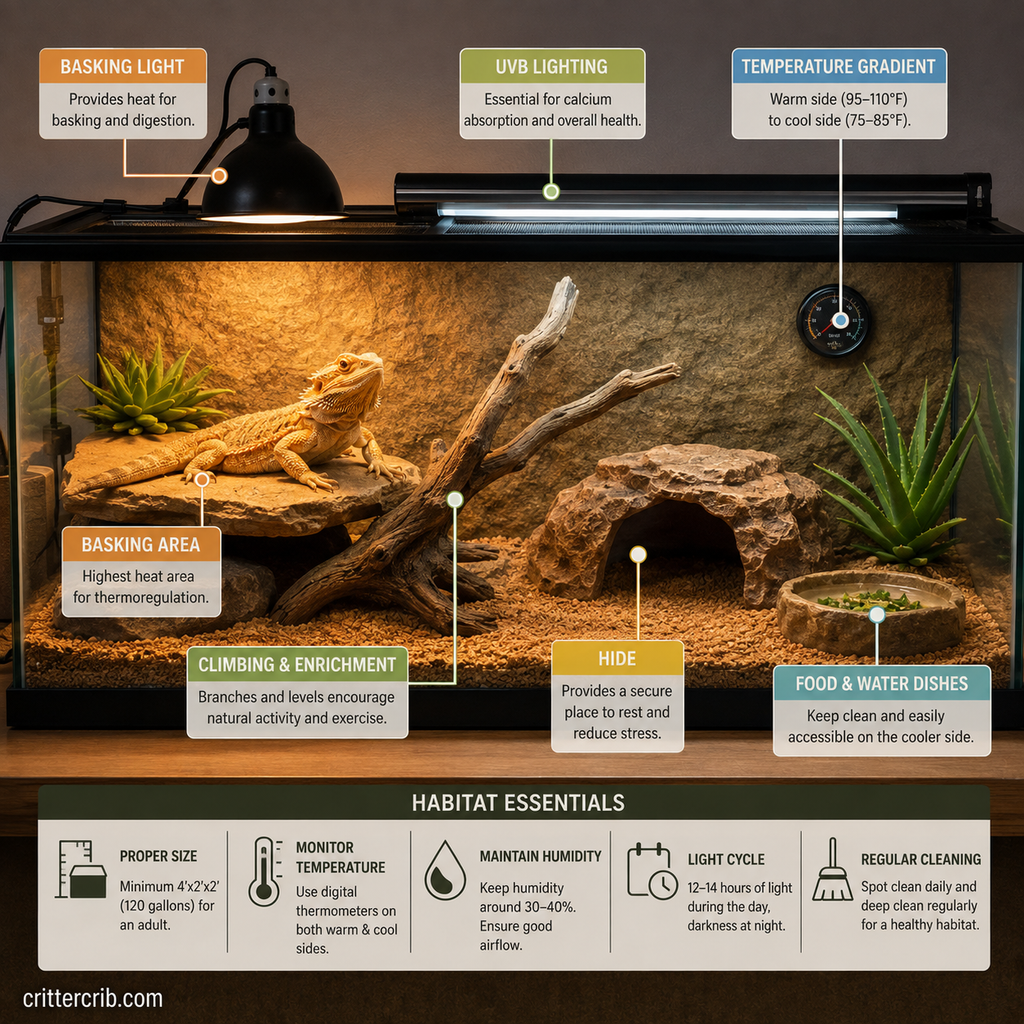
Your bearded dragon should receive useful UVB exposure while basking.
In nature, heat and ultraviolet light come from the sun at the same time. Your enclosure should imitate that relationship.
Position the basking area so the dragon receives both appropriate heat and UVB exposure while using it.
The UVB tube should generally cover a significant portion of the enclosure rather than the entire habitat. Your dragon should also have places where it can move away from intense light.
How Long Should Bearded Dragon Lights Stay On?
Bearded dragons need a consistent day-and-night cycle.
A schedule of approximately 12–14 hours of daytime lighting is commonly used, with darkness at night.
A timer makes maintaining this schedule much easier.
Instead of manually switching several lights on and off every morning and evening, connect the appropriate daytime lights to a reliable timer.
Consistency helps establish a predictable daily rhythm.
Do Bearded Dragons Need Heat at Night?
Many homes don’t require supplemental nighttime heat for a healthy bearded dragon.
Temperatures naturally drop after sunset, and a moderate nighttime temperature decrease is normal.
If the room remains around the mid-60s°F or warmer, additional nighttime heating is often unnecessary.
If temperatures become excessively cold, a non-light-emitting heat source may be appropriate.
Avoid using red, blue, purple, or other colored nighttime bulbs simply to keep the enclosure illuminated and warm overnight.
Your bearded dragon needs darkness to maintain a normal day-night cycle.
Choosing a Basking Bulb
A bright white basking bulb can provide the concentrated heat needed for the warm end of the habitat.
The correct wattage isn’t universal.
A bulb that works perfectly in one enclosure may be far too hot or too cool in another because temperature depends on:
- Enclosure dimensions
- Distance from bulb to basking surface
- Room temperature
- Ventilation
- Fixture design
- Basking material
Choose wattage based on the temperatures you actually achieve rather than assuming every 120-gallon enclosure needs the same bulb.
A dimming thermostat or appropriate temperature-control system can help regulate heat safely when compatible with the equipment being used.
Bearded Dragon Substrate Options
Substrate is one of the most debated parts of bearded dragon care.
You’ll find recommendations ranging from completely solid flooring to carefully prepared naturalistic substrate mixtures.
There isn’t one flooring material that’s perfect for every keeper and every dragon.
Solid Substrate Options
Common solid options include:
- Ceramic or slate tile
- Textured, reptile-safe solid surfaces
- Paper towels
- Non-adhesive shelf liner designed from safe materials
Paper towels can be especially useful for temporary setups, quarantine, or situations where closely monitoring waste is important.
Tile is easy to clean and can provide a durable surface.
What About Sand?
Loose substrate is more complicated than simply saying that all sand is good or all sand is dangerous.
Healthy bearded dragons naturally interact with loose ground and may dig. Properly designed naturalistic substrates can provide enrichment.
However, inappropriate loose substrates can create problems, particularly when husbandry conditions are poor.
Avoid materials such as:
- Calcium sand
- Crushed walnut shells
- Sharp wood chips
- Corn cob bedding
- Other loose materials that are dusty, sharp, or inappropriate if swallowed
If you’re a new keeper and aren’t yet confident with temperatures, UVB, nutrition, and overall husbandry, a simple solid substrate can make the habitat easier to manage while you’re learning.
Do Bearded Dragons Need Sand to Dig?
Bearded dragons may dig for several reasons, including exploration, shelter-seeking, temperature regulation, and egg laying.
You can provide digging opportunities without necessarily making the entire enclosure loose substrate.
A dig box containing an appropriate substrate can add enrichment while allowing the rest of the enclosure to remain easy to clean.
Adult females may have additional digging and egg-laying needs, including females that have not been housed with a male.
Bearded Dragon Humidity Requirements
Bearded dragons come from relatively dry environments, but that doesn’t mean their habitat needs to be completely devoid of humidity.
For many household setups, keeping general humidity somewhere around 30–40% works well, although natural fluctuations can occur.
Monitor humidity with a digital hygrometer.
Excessively damp conditions combined with poor ventilation can create an unhealthy environment.
At the same time, don’t become obsessed with maintaining one exact percentage every minute of the day.
Focus on a generally dry, well-ventilated habitat.
What Should You Put Inside a Bearded Dragon Tank?
A completely empty enclosure may be easy to clean, but it doesn’t give your bearded dragon much to do.
A well-designed habitat should encourage natural behaviors while still leaving enough open space for movement.
Useful furnishings include:
- Basking rocks
- Sturdy branches
- Cork bark
- Reptile-safe hides
- Platforms
- Climbing structures
- Digging areas
- Artificial or safe live plants where appropriate
Everything should be stable.
A heavy rock balanced precariously on another object can become dangerous if your dragon digs underneath it.
Place heavy structures securely before adding loose substrate around them.
Building the Basking Area
The basking area is one of the habitat’s main features.
Choose a broad, stable surface that comfortably fits your dragon’s entire body.
Slate, stone, or other reptile-safe surfaces can work well because they absorb warmth from the basking lamp.
Your dragon should be able to climb onto the basking area easily without getting dangerously close to the heat bulb.
Position it so that the animal receives the intended combination of heat and UVB.
Then measure the surface temperature before introducing your dragon.
Bearded Dragon Hides
Even a confident bearded dragon benefits from having somewhere sheltered to retreat.
Provide at least one secure hide.
If space allows, offering hiding opportunities in different temperature zones gives the dragon more choice.
A hide should be:
- Large enough for the dragon
- Stable
- Easy to access
- Free of sharp edges
- Easy enough to inspect and clean
Don’t be concerned if your bearded dragon doesn’t use its hide constantly.
The important thing is giving it the option.
Climbing and Enrichment
Bearded dragons are often more active climbers than new owners expect.
Branches, rocks, ledges, and elevated platforms add usable space and encourage exploration.
Try creating several levels without making the enclosure cluttered.
Your dragon should still have open areas where it can comfortably walk around.
You can occasionally change safe enrichment items to introduce novelty, but avoid completely rearranging the habitat constantly. Familiarity is valuable too.
Food and Water Bowls
A shallow food dish can help contain greens and other plant foods.
Water bowls are somewhat more situational.
Some bearded dragons drink from bowls regularly, while others rarely do. A small, clean water dish can be offered as long as it doesn’t create excessive humidity or become a constant source of spilled water.
Replace the water regularly and clean the dish whenever it’s contaminated.
Avoid allowing food and water dishes to become permanent collection points for waste and substrate.
Where Should You Put the Bearded Dragon Enclosure?
Where you place the habitat inside your home matters.
Choose a stable location away from:
- Cold drafts
- Heating vents
- Air-conditioning vents
- Constant direct sunlight
- Excessive household traffic
- Loud speakers
- Areas where other pets can constantly harass the dragon
Direct sunlight through a window is particularly important to consider.
A glass enclosure exposed to strong sunlight can heat rapidly, making temperatures difficult to control.
Window glass also isn’t a substitute for proper reptile UVB lighting.
Can Bearded Dragons Live Together?
Bearded dragons are generally best housed individually.
They don’t need a roommate to be happy.
Keeping multiple dragons in one enclosure can create competition for:
- Heat
- UVB exposure
- Food
- Hides
- Space
- Basking positions
One animal may dominate resources even if you don’t witness obvious fighting.
Adult males can be particularly territorial, and male-female pairings can create reproductive stress.
The safest general approach is one bearded dragon per enclosure.
Bearded Dragon Habitat Setup: Step by Step
If you’re building a habitat from scratch, setting things up in the right order makes the process easier.
1. Choose the Enclosure
Select an enclosure large enough for the dragon’s adult size.
For an adult, approximately 4 x 2 x 2 feet is a useful minimum starting point.
2. Install the UVB Fixture
Position the UVB tube according to its manufacturer’s recommendations.
Consider whether mesh will sit between the bulb and your dragon.
3. Install the Basking Light
Place the basking heat source toward one end of the enclosure.
Don’t center it.
You need enough distance between the warm and cool ends to create a temperature gradient.
4. Add the Substrate
Choose a safe flooring option appropriate for your experience level and setup.
Keep it clean and dry.
5. Build the Basking Zone
Add a stable rock, platform, or branch beneath the basking and UVB area.
Make sure your dragon cannot touch the bulb or fixture.
6. Add Hides and Climbing Structures
Create opportunities for shelter, climbing, and exploration without overcrowding the habitat.
7. Install Temperature and Humidity Monitoring
Place digital temperature probes where they’ll provide useful information about the warm and cool sides.
Keep a digital hygrometer inside the enclosure.
Use an infrared thermometer to measure basking surfaces.
8. Run the Habitat Before Adding Your Dragon
Don’t set up the enclosure and immediately put your new bearded dragon inside.
Turn everything on and monitor it.
Check:
- Basking surface temperature
- Warm-side temperature
- Cool-side temperature
- Humidity
- Lighting schedule
Make adjustments before the animal arrives.
Bearded Dragon Habitat Shopping Checklist
Before bringing your dragon home, you’ll generally need:
- 4 x 2 x 2-foot or larger adult enclosure
- UVB tube and compatible fixture
- Bright basking heat bulb
- Heat-safe lamp fixture
- Digital thermometers
- Infrared temperature gun
- Digital hygrometer
- Timer
- Appropriate substrate
- Basking platform
- Hide
- Branches or climbing structures
- Food dish
- Cleaning supplies
Depending on your home and enclosure, you may also need temperature-control equipment and additional fixtures.
It’s much easier to troubleshoot a habitat when you have all the basic equipment before the dragon arrives.
Cleaning a Bearded Dragon Habitat
Routine cleaning keeps waste, leftover food, and bacteria from accumulating.
Daily
Remove:
- Feces
- Urates
- Uneaten fresh food
- Shed skin when appropriate
- Contaminated substrate
- Dirty water
Clean visibly soiled surfaces as needed.
Regularly
Wash food and water dishes and inspect hides, rocks, branches, and other furnishings.
The exact deep-cleaning schedule depends on your enclosure style and substrate.
A simple solid-floor enclosure may be maintained differently from a well-established bioactive habitat.
Use reptile-safe cleaning methods and make sure surfaces are appropriately rinsed and dried before the dragon is exposed to them again.
Common Bearded Dragon Habitat Mistakes
Even attractive enclosures can have husbandry problems.
Here are some of the most important mistakes to avoid.
Using an Enclosure That’s Too Small
Small tanks make it difficult to establish proper temperature zones and limit exercise.
Plan around adult size.
Using Inadequate UVB
A visually bright enclosure isn’t necessarily providing useful UVB.
Use appropriate reptile UVB equipment and install it at the correct distance.
Guessing the Temperature
Don’t judge heat by how warm the enclosure feels to your hand.
Measure it.
Heating the Entire Tank
Your bearded dragon needs somewhere cooler to retreat.
A temperature gradient is essential.
Using Colored Night Bulbs
Dragons benefit from darkness at night.
If supplemental nighttime heating is truly necessary, use an appropriate heat source that doesn’t produce visible light.
Overcrowding the Habitat
Decorations are useful, but your dragon still needs room to move.
Balance enrichment with open floor space.
Keeping Two Dragons Together
Even apparently peaceful dragons may compete for resources.
Individual housing is the safer default.
Ignoring Bulb Age
UVB bulbs don’t necessarily stop producing visible light when their useful UVB output declines.
Follow the manufacturer’s replacement guidance for your specific bulb and fixture.
How to Tell if Your Bearded Dragon Likes Its Setup
No single behavior tells you that a habitat is perfect.
Instead, look at patterns.
A healthy dragon in an appropriate environment may:
- Bask regularly
- Move between warm and cool zones
- Explore the enclosure
- Climb
- Rest in different locations
- Eat normally
- Display normal alert behavior
- Retreat when it wants privacy
Constant glass surfing, persistent hiding, refusing to bask, unusual lethargy, or dramatic changes in appetite can have many causes.
Don’t immediately assume every unusual behavior is a habitat problem, but do recheck temperatures, UVB, lighting, and other husbandry conditions.
Persistent behavioral or health changes warrant attention from a veterinarian experienced with reptiles.
Frequently Asked Questions About Bearded Dragon Habitats
Is a 40-gallon tank big enough for a bearded dragon?
A 40-gallon enclosure may work temporarily for a young bearded dragon, but it generally doesn’t provide enough room for a full-grown adult.
An adult habitat around 4 x 2 x 2 feet provides considerably more usable space.
Is a 120-gallon tank good for a bearded dragon?
An enclosure approximately equivalent to 120 gallons, particularly one measuring around 4 x 2 x 2 feet, is a commonly recommended minimum starting size for an adult bearded dragon.
When comparing reptile enclosures, prioritize actual dimensions over the gallon label.
What temperature should a bearded dragon tank be?
Create different temperature zones rather than maintaining one temperature throughout the habitat.
The basking surface may be around 100–110°F for many dragons, while the cool end should be substantially cooler, often around 75–85°F during the day.
Exact needs can vary with age and individual behavior.
Do bearded dragons need UVB?
Yes.
Appropriate UVB exposure is an essential part of bearded dragon husbandry and supports vitamin D3 production and calcium metabolism.
Do bearded dragons need a heat lamp and UVB light?
Typically, yes.
The basking heat source and UVB fixture serve different purposes, although they should work together to create an effective basking zone.
Should I turn my bearded dragon’s lights off at night?
Yes.
Provide a normal period of darkness at night.
If nighttime temperatures remain within a safe range, additional heat may not be necessary.
What should bearded dragons sleep on?
Bearded dragons may sleep on the substrate, inside a hide, against enclosure furnishings, or even on branches.
Provide stable, safe resting options and let your dragon choose.
Do bearded dragons need a hide?
Yes, providing a secure hiding area gives your dragon somewhere to retreat when it wants privacy or shelter.
Even if the hide isn’t used every day, it should remain available.
Final Thoughts on Setting Up a Bearded Dragon Habitat
A good bearded dragon habitat doesn’t need to be complicated or packed with expensive decorations.
It needs to get the fundamentals right.
Start with a spacious enclosure—around 4 x 2 x 2 feet or larger for an adult—and build a clear temperature gradient from a warm basking zone to a cooler retreat. Provide appropriate linear UVB lighting, accurate temperature monitoring, safe substrate, secure hiding areas, and opportunities to climb and explore.
Most importantly, test everything before your bearded dragon moves in.
A beautiful enclosure isn’t much use if the basking surface is dangerously hot, the cool side isn’t cool enough, or the UVB isn’t reaching the animal effectively.
Once those essentials are dialed in, you can focus on making the habitat more interesting with rocks, branches, hides, platforms, and other enrichment.
The result should be an enclosure that doesn’t just contain your bearded dragon. It gives your dragon choices—where to warm up, cool down, hide, climb, rest, and explore—which is exactly what a well-designed reptile habitat should do.