Bearded dragons are one of the most popular pet reptiles, and it’s easy to understand why. They’re generally calm, curious, and much more interactive than many people expect from a lizard. With proper care, a bearded dragon can become comfortable with regular handling and settle into a predictable daily routine.
That doesn’t mean they’re effortless pets, though.
A healthy bearded dragon needs the right enclosure, carefully controlled temperatures, appropriate UVB lighting, a varied diet, and regular cleaning. Small husbandry mistakes can become much bigger problems when they continue for weeks or months.
This bearded dragon care guide covers the essentials, from setting up a habitat to feeding, handling, cleaning, and establishing a practical daily routine.
Bearded Dragon Care at a Glance
Before getting into the details, here are the basics most owners need to plan for:
- Adult size: Usually around 18–24 inches long
- Lifespan: Commonly 8–12 years with good care, with some living longer
- Diet: Omnivorous
- Activity: Primarily active during the day
- Adult enclosure: At least 4 x 2 x 2 feet is a widely recommended starting point
- Heating: A warm basking area plus a cooler side of the enclosure
- Lighting: Proper UVB lighting is essential
- Social needs: Generally best housed individually
- Handling: Usually tolerant of gentle handling once accustomed to it
- Care level: Beginner-friendly compared with many reptiles, but requires specialized equipment and consistent husbandry
Bearded dragons can also be a surprisingly long-term commitment. Our guide to how long bearded dragons live explains how nutrition, UVB lighting, habitat conditions, genetics, and veterinary care can influence lifespan.
The initial habitat setup is one of the most important parts of owning a bearded dragon. Getting the enclosure right from the beginning makes everyday care much easier.
Understanding Bearded Dragons
The most commonly kept pet bearded dragon is the central bearded dragon, Pogona vitticeps, which originates from dry and semi-arid regions of Australia.
Their natural environment helps explain many of their captive care requirements.
Bearded dragons spend their days moving between sunny basking areas, shaded locations, rocks, branches, and places where they can retreat from excessive heat. In captivity, their enclosure should give them similar choices.
Rather than keeping the entire enclosure at one temperature, you create a temperature gradient. The dragon can then move around to regulate its body temperature.
Because bearded dragons are ectothermic, this ability to move between warmer and cooler areas is essential.
Choosing the Right Bearded Dragon Enclosure
One of the most common mistakes new owners make is starting with an enclosure that the dragon will quickly outgrow.
Baby bearded dragons may look tiny in a large habitat, but they grow quickly.
If you’re building an enclosure from scratch, our bearded dragon habitat setup guide goes deeper into enclosure size, basking temperatures, UVB lighting, substrate, hides, climbing areas, and environmental monitoring.
Enclosure Size
For an adult bearded dragon, an enclosure measuring approximately 4 feet long, 2 feet deep, and 2 feet tall is a good minimum target.
More space can be beneficial when the habitat is designed properly.
A larger enclosure provides room for:
- A defined basking zone
- A cooler retreat
- Hides
- Climbing structures
- Feeding areas
- Natural movement and exploration
A front-opening enclosure can also make routine maintenance and handling easier than reaching down from above.
Should Bearded Dragons Live Together?
In most home setups, bearded dragons should be housed individually.
They do not need another bearded dragon for companionship. Keeping multiple dragons together can create competition for food, basking spots, and other resources.
Even animals that initially appear to tolerate each other may develop problems later.
Separate housing gives each bearded dragon complete control over its own resources and makes it easier to monitor eating, bowel movements, activity, and overall health.
Creating the Proper Temperature Gradient
Heat is essential for digestion, activity, and normal physiological function.
However, simply making the enclosure “hot” isn’t enough. A bearded dragon needs different temperature zones.
Basking Area
Create a basking area at one end of the enclosure using an appropriate overhead heat source.
The basking surface should become warm enough for the dragon to raise its body temperature after climbing onto it.
Juveniles may use somewhat warmer basking conditions than adults, but exact requirements can vary with age, enclosure design, and how temperatures are measured.
As a practical starting range, many setups aim for a basking surface around:
- 100–110°F for younger dragons
- Roughly 95–105°F for adults
The surrounding warm side will be cooler than the basking surface itself.
Cool Side
The opposite end should remain considerably cooler, commonly somewhere around the upper 70s to low 80s°F during the day.
This gradient allows your bearded dragon to decide how much heat it needs.
If every part of the habitat is equally hot, the animal has nowhere to cool down.
Nighttime Temperatures
Bearded dragons do not normally need daytime basking temperatures around the clock.
Temperatures should naturally drop at night. In a reasonably warm home, supplemental nighttime heating may not be necessary.
If the enclosure becomes unusually cold, a non-light-producing heat source may be appropriate.
Avoid leaving bright basking lights on overnight. Bearded dragons need a normal day-and-night cycle.
Measure Temperatures Accurately
Don’t rely on touching a rock or guessing how warm the enclosure feels.
Use reliable digital thermometers to monitor the habitat, and use an infrared temperature gun when appropriate to check basking surface temperatures.
This is especially useful because surface temperature and surrounding air temperature aren’t necessarily the same.
UVB Lighting for Bearded Dragons
UVB lighting is one of the most important parts of bearded dragon husbandry.
Bearded dragons use UVB exposure as part of the process that allows their bodies to produce vitamin D3 and properly utilize calcium.
Insufficient UVB exposure, poor calcium intake, or a combination of husbandry problems can contribute to serious skeletal disease.
Choosing UVB Lighting
A high-quality linear UVB fixture is generally preferable to relying on a small compact bulb to illuminate a large enclosure.
The UVB should cover a useful portion of the habitat so the dragon can receive exposure while still having opportunities to move away from it.
Placement matters.
The strength of UVB reaching your dragon can be affected by:
- Distance from the bulb
- Fixture type
- Bulb strength
- Reflectors
- Mesh screens
- Enclosure height
- Basking platform height
Follow the manufacturer’s recommendations for the specific UVB bulb and fixture you’re using rather than assuming every bulb can be installed at the same distance.
How Long Should the Lights Stay On?
A consistent day-and-night cycle works well for most bearded dragons.
Approximately 12 hours of light and 12 hours of darkness is a simple schedule for many households, although the schedule can be adjusted seasonally.
Using outlet timers makes this much easier.
Your dragon receives a consistent routine, and you don’t have to remember to switch multiple lights on and off every day.
Replace UVB Bulbs When Needed
A UVB bulb can continue producing visible light even after its useful UVB output has declined.
Follow the manufacturer’s replacement schedule for your specific bulb.
If you use a UV meter, you can monitor UV output more directly instead of relying entirely on a calendar.
Best Substrate for a Bearded Dragon
Substrate is one of the more debated parts of bearded dragon care.
There isn’t one material that every experienced keeper agrees is best, so it helps to consider cleanliness, safety, maintenance, and the dragon’s age and health.
Solid Substrate Options
Simple solid surfaces can be practical, particularly for beginners.
Options may include:
- Paper towels
- Non-adhesive shelf liner designed for safe enclosure use
- Appropriate tile
- Other easy-to-clean reptile-safe solid surfaces
Paper towels are especially useful for new animals, quarantine situations, or when you’re monitoring bowel movements.
What About Loose Substrate?
Loose substrate is more complicated than the simple claim that bearded dragons should “never touch sand.”
Healthy bearded dragons encounter loose material in natural environments, and carefully designed naturalistic enclosures can provide digging opportunities.
The bigger issue is the entire husbandry setup.
Poor temperatures, dehydration, inappropriate substrate, nutritional problems, and other husbandry mistakes can increase risk.
If you’re a first-time owner, beginning with an easy-to-monitor solid substrate can simplify care while you learn how to maintain proper temperatures, lighting, diet, and hydration.
Avoid materials such as calcium sand, crushed walnut shells, and other substrates that may be hazardous if swallowed.
Furnishing the Habitat
A bearded dragon enclosure shouldn’t be an empty box with a food bowl and heat lamp.
Give your dragon several usable areas.
Basking Platform
Provide a stable rock, branch, or platform beneath the basking lamp.
The structure should allow the dragon to position its body comfortably under both heat and appropriate UVB exposure.
Make sure heavy decorations cannot shift or collapse.
Hides
Provide at least one secure hiding area, and ideally offer options in different parts of the temperature gradient.
A hide gives your bearded dragon somewhere to retreat when it wants privacy or reduced stimulation.
Climbing Opportunities
Bearded dragons frequently climb.
Sturdy branches, rocks, ledges, and platforms provide exercise and make better use of the enclosure’s vertical space.
Everything should be firmly secured.
What Do Bearded Dragons Eat?
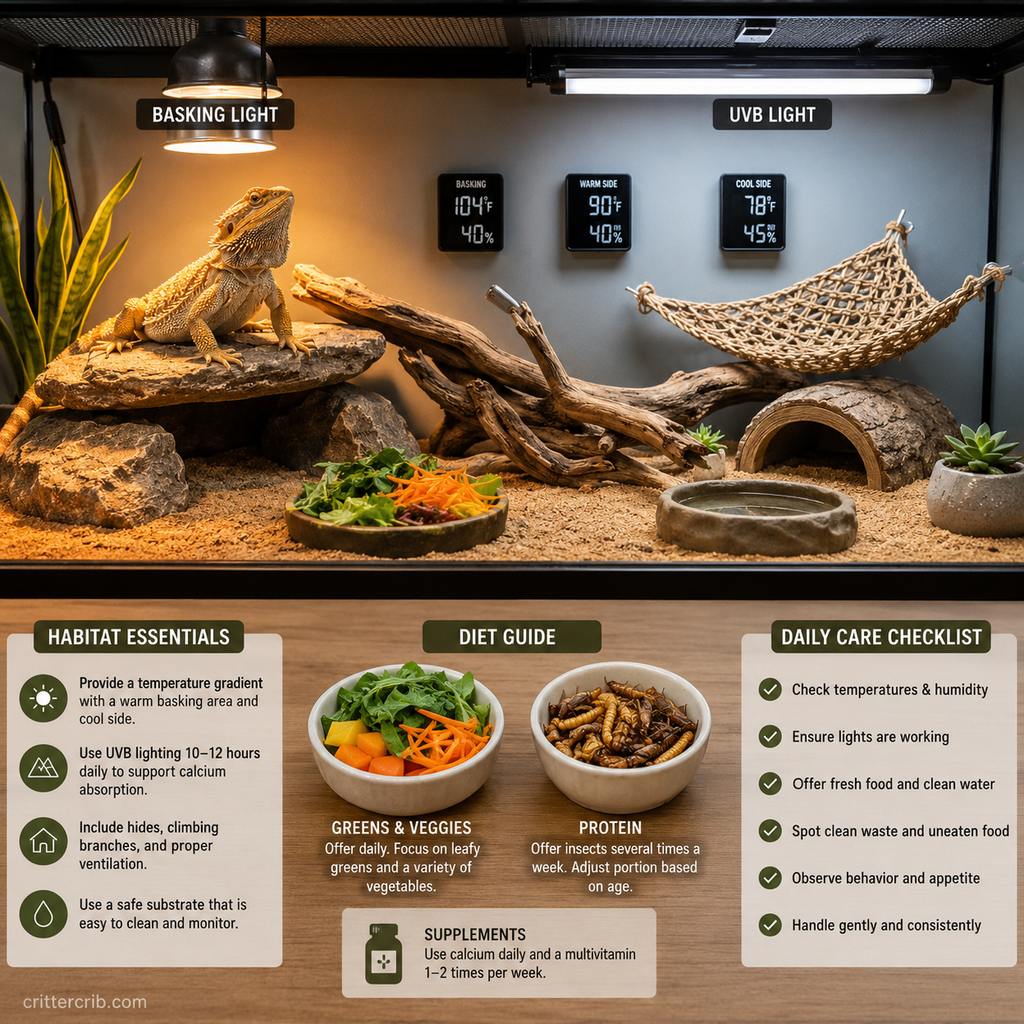
Bearded dragons are omnivores, meaning they eat both animal and plant foods.
The balance changes as they mature.
Young dragons generally consume proportionally more insects because they’re growing rapidly. Adults typically eat a larger proportion of leafy greens and vegetables.
Feeding Baby and Juvenile Bearded Dragons
Young bearded dragons require frequent access to nutritious food to support rapid growth.
Their diet should include appropriately sized live insects along with fresh greens so they become familiar with plant foods early.
Good feeder insects can include:
- Dubia roaches
- Crickets
- Black soldier fly larvae
- Silkworms
- Appropriately sized hornworms as part of a varied diet
Feeder insects should be no larger than an appropriate size for the individual dragon.
Rather than depending heavily on one insect species, variety helps provide a broader nutritional profile.
Feeding Adult Bearded Dragons
As bearded dragons mature, plant foods become increasingly important.
A healthy adult diet should emphasize suitable leafy greens while insects are offered in controlled amounts.
Good greens and vegetables can include:
- Collard greens
- Mustard greens
- Turnip greens
- Dandelion greens
- Endive
- Escarole
- Squash
- Bell pepper in moderation
Rotating foods is preferable to feeding the exact same salad every day.
Foods to Limit or Avoid
Not everything that seems like a healthy vegetable for humans is ideal as a staple for bearded dragons.
Avoid feeding:
- Avocado
- Rhubarb
- Wild-caught insects exposed to pesticides
- Fireflies
- Foods treated with unsafe chemicals
- Large amounts of fruit
- Highly processed human foods
Spinach doesn’t necessarily need to be treated as though a tiny accidental bite is poisonous, but it isn’t an ideal primary green. A varied selection of more suitable leafy greens makes a better staple diet.
Fruit can generally be treated as an occasional food rather than a major part of the diet.
Calcium and Vitamin Supplements
Calcium is particularly important for growing bearded dragons.
The animal’s calcium intake works together with appropriate UVB exposure and overall nutrition to support healthy bones and normal body function.
Feeder insects are often dusted with an appropriate reptile calcium supplement according to the animal’s age, diet, UVB setup, and veterinarian’s recommendations.
A reptile multivitamin may also be used periodically.
More supplementation isn’t automatically better. Excessive intake of certain vitamins and minerals can cause problems too.
If you’re uncertain about the correct supplement schedule for your individual dragon, discuss the diet and lighting setup with a veterinarian experienced with reptiles.
Gut-Loading Feeder Insects
The quality of the insects your dragon eats matters.
Gut-loading means feeding insects nutritious foods before offering them to your reptile.
Think of feeder insects as part of the nutritional delivery system. Poorly fed insects aren’t equivalent to well-fed insects simply because they’re the same species.
Keep feeder colonies properly fed and hydrated, or purchase feeders from reputable suppliers.
Hydration and Water
Bearded dragons come from relatively dry environments, but they still need adequate hydration.
Provide access to clean water when it can be done without creating excessive humidity or sanitation problems.
Bearded dragons can also receive moisture through fresh vegetables and properly hydrated feeder insects.
Some individuals readily drink from bowls while others rarely seem interested.
Do Bearded Dragons Need Baths?
Bathing isn’t a substitute for proper hydration or enclosure hygiene.
Some dragons tolerate or enjoy shallow baths, while others find them stressful. Baths may occasionally be useful when appropriate, but routine bathing isn’t required simply because you own a bearded dragon.
Never leave a bearded dragon unattended in water.
Humidity Requirements
Bearded dragons generally do best in a relatively dry enclosure.
You don’t want to create constantly damp, tropical conditions.
At the same time, extremely low humidity isn’t a goal in itself. Some natural fluctuation is normal.
A digital hygrometer can help you monitor conditions instead of guessing.
Good ventilation, sensible water placement, and avoiding constantly wet substrate will help maintain an appropriate environment.
Handling a Bearded Dragon
One reason bearded dragons have become such popular pets is their generally manageable temperament.
Many learn to tolerate regular handling well.
How to Pick Up a Bearded Dragon
Approach calmly and avoid grabbing the dragon suddenly from above.
Slide your hand beneath its body and support:
- The chest
- Abdomen
- Hindquarters
- Tail base when necessary
The goal is to make the dragon feel supported rather than suspended.
Begin with short handling sessions and gradually increase them as the animal becomes comfortable.
Signs Your Bearded Dragon Wants Space
Watch its body language. Learning to recognize bearded dragon body language can help you tell the difference between normal communication, thermoregulation, stress, and defensive behavior.
Possible signs of stress or defensiveness include:
- A darkened beard
- Puffing the beard
- Flattening the body
- Hissing
- Repeated attempts to escape
- Open-mouth defensive displays
An open mouth isn’t always aggression, though. Bearded dragons also gape while basking to help regulate body temperature.
Context matters.
Daily Bearded Dragon Care Routine
Once the enclosure is properly established, everyday care becomes relatively straightforward.
A typical morning routine might look like this:
- Make sure the heat and UVB lights have turned on.
- Check enclosure temperatures.
- Observe your dragon’s behavior and appearance.
- Provide fresh food according to its age and feeding schedule.
- Replace dirty water if necessary.
- Remove leftover food and visible waste.
Later in the day, take another quick look at temperatures and your dragon’s behavior.
These small daily checks can reveal developing problems much earlier than a major weekly cleaning.
Cleaning a Bearded Dragon Enclosure
Keeping the enclosure clean reduces odors and limits the buildup of waste and microorganisms.
Daily Cleaning
Spot-clean whenever you see:
- Feces
- Urates
- Shed skin
- Spoiled greens
- Dead insects
- Dirty water
Remove uneaten insects rather than allowing them to remain loose in the enclosure indefinitely.
Deeper Cleaning
Periodically clean the enclosure more thoroughly.
Depending on your setup, this can include:
- Removing decorations
- Cleaning food and water dishes
- Disinfecting appropriate surfaces
- Cleaning hides and basking structures
- Replacing disposable substrate
- Inspecting fixtures and equipment
Use reptile-appropriate cleaning products and follow their instructions carefully.
Always rinse surfaces when required and allow them to dry before returning your dragon.
Shedding
Young bearded dragons shed frequently because they’re growing quickly.
Adults shed less often and may shed in sections rather than removing their skin all at once.
During shedding, you may notice:
- Duller coloration
- Whitish patches
- Loose skin
- Reduced appetite
- Mild irritability
Don’t pull off skin that isn’t ready to come away.
Proper husbandry usually allows shedding to occur naturally.
Pay particular attention to toes and the tip of the tail, where retained shed can sometimes become problematic.
Understanding Bearded Dragon Behavior
Learning what’s normal for your individual dragon makes unusual behavior easier to recognize. Our guide to common bearded dragon behaviors and what they mean takes a closer look at head bobbing, arm waving, beard puffing, glass surfing, digging, gaping, hiding, and other behaviors you may notice.
Head Bobbing
Head bobbing can be associated with territorial, social, or breeding behavior.
Arm Waving
A bearded dragon may slowly raise and rotate one front leg in a waving motion. This is generally considered a social signal and is often associated with submissive or non-threatening behavior.
Glass Surfing
“Glass surfing” describes repeatedly scratching or running along the enclosure walls.
Potential causes include:
- Seeing a reflection
- Stress
- Boredom
- Breeding behavior
- An unsuitable enclosure
- Temperature issues
- Wanting to explore
Occasional glass surfing doesn’t automatically mean something is seriously wrong. Frequent behavior should prompt you to review the habitat and routine.
Basking With the Mouth Open
A bearded dragon sitting calmly beneath its heat source with its mouth slightly open may simply be thermoregulating.
This behavior is commonly called gaping.
If the dragon shows other symptoms such as mucus, wheezing, unusual breathing, or persistent distress, the situation is different and should be evaluated.
Brumation in Bearded Dragons
Adult bearded dragons may become less active during cooler parts of the year.
This reptile dormancy-like behavior is called brumation.
A dragon entering brumation may:
- Eat less
- Spend more time hiding
- Sleep longer
- Become less active
However, illness can produce some of the same symptoms.
Don’t automatically assume that a lethargic dragon is brumating, especially if it is losing significant weight or showing other signs of poor health.
A reptile veterinarian can help rule out parasites or illness before a prolonged period of inactivity.
Common Signs of Health Problems
Bearded dragons often hide illness until a problem has progressed, so knowing your animal’s normal behavior is important.
Watch for changes such as:
- Persistent lack of appetite
- Significant weight loss
- Weakness or unusual lethargy
- Swollen limbs or joints
- Soft or abnormal jaw structure
- Tremors
- Difficulty walking
- Persistent diarrhea
- Blood in the stool
- Labored breathing
- Mucus around the mouth or nose
- Sunken eyes
- Persistent abnormal swelling
- Inability to use the limbs normally
These symptoms aren’t specific to one disease and shouldn’t be diagnosed solely through an online care guide.
Contact a veterinarian experienced with reptiles when your dragon shows persistent or concerning symptoms.
Preventive Veterinary Care
It’s a good idea to locate a reptile or exotic-animal veterinarian before you actually need one.
Not every general veterinary clinic regularly treats reptiles.
A veterinarian may recommend an initial wellness examination for a newly acquired bearded dragon and, depending on its history and symptoms, may suggest fecal testing for parasites.
Keep basic records such as:
- Weight
- Feeding habits
- Bowel movements
- Shedding
- Supplement schedule
- UVB bulb installation and replacement dates
A small digital kitchen scale can make tracking weight easy.
A gradual change becomes much easier to notice when you have previous measurements for comparison.
Common Bearded Dragon Care Mistakes
Many health problems can be traced back to husbandry rather than bad luck.
Some common mistakes include:
- Using an enclosure that’s too small
- Providing inadequate UVB exposure
- Measuring temperatures inaccurately
- Keeping the entire enclosure too warm
- Leaving bright lights on overnight
- Feeding adults too many insects and too few greens
- Feeding young dragons an inadequate diet
- Using inappropriate substrate
- Providing little enrichment or climbing space
- Housing multiple dragons together
- Ignoring early changes in weight or behavior
Another common mistake is buying the dragon first and figuring out the enclosure afterward.
Set up the habitat before bringing the animal home.
Run the lights and heating equipment long enough to confirm that you can maintain the correct temperature gradient. This gives you time to make adjustments without experimenting while the animal is already inside.
How Much Time Does Bearded Dragon Care Take?
Bearded dragons need daily attention, but a well-designed habitat doesn’t require hours of maintenance every day.
Most days involve a combination of feeding, removing waste, checking water, observing the dragon, and making sure temperatures and lighting are functioning correctly.
Deeper cleaning and habitat maintenance take additional time periodically.
The equipment does much of the environmental work automatically once the enclosure is properly configured. Timers control lighting, thermostatic controls can improve the safety of appropriate heating equipment, and digital monitoring devices make it easier to spot changes.
The important part is consistency.
Supplies You’ll Need Before Bringing a Bearded Dragon Home
It’s much easier to prepare everything before your new reptile arrives.
A basic setup typically includes:
- Appropriately sized enclosure
- Basking heat source
- Linear UVB fixture and suitable UVB bulb
- Digital thermometers
- Infrared temperature gun
- Hygrometer
- Secure basking platform
- Hides
- Climbing structures
- Safe substrate
- Food dish
- Water dish if appropriate for the setup
- Calcium supplement
- Appropriate reptile multivitamin
- Nutritious feeder insects
- Fresh leafy greens
- Reptile-safe cleaning supplies
- Outlet timers
You may add more enrichment and naturalistic features later, but heating, UVB, space, nutrition, and accurate environmental monitoring should come first.
Are Bearded Dragons Good Pets for Beginners?
Bearded dragons can be excellent reptiles for beginners who are willing to learn their care requirements before buying one.
Their advantages include a generally calm temperament, daytime activity, manageable adult size, and the ability to become accustomed to handling.
The biggest challenge is that they’re sometimes marketed as easier pets than they actually are.
A bearded dragon isn’t a pet that can simply live in a small glass tank with a heat lamp and occasional crickets. Proper UVB exposure, temperature gradients, enclosure size, nutrition, supplementation, sanitation, and veterinary care all matter.
The setup can also cost considerably more than the dragon itself.
Once those requirements are understood and the enclosure is correctly established, however, everyday care becomes much more manageable.
Final Thoughts on Bearded Dragon Care
Good bearded dragon care comes down to creating an environment where the animal can behave like a bearded dragon.
Give it room to move. Provide a proper basking area and cooler retreat. Use appropriate UVB lighting. Feed a varied diet that changes as the dragon matures. Keep the enclosure clean and pay attention to changes in behavior, appetite, and weight.
Most importantly, don’t treat any single part of husbandry in isolation.
Temperature affects digestion. UVB exposure works alongside calcium and nutrition. Enclosure design influences exercise and thermoregulation. Cleanliness, hydration, and diet all contribute to overall health.
Get those fundamentals right, establish a consistent routine, and you’ll have a much stronger foundation for keeping your bearded dragon healthy for years to come.