Ball pythons are known for their calm personalities, manageable size, and tendency to tolerate handling well. But even a naturally docile snake needs time to become comfortable with a new home and the person caring for it.
Building trust with a ball python isn’t quite the same as bonding with a dog or cat. Snakes experience interactions differently. Your goal is to help your ball python learn that your presence and handling aren’t threats.
That happens through patience, predictable interactions, and proper handling.
Whether you’ve just brought home your first ball python or you’re trying to make an established snake more comfortable around you, here’s how to handle a ball python safely while keeping stress to a minimum.
Are Ball Pythons Easy to Handle?
Ball pythons are generally considered one of the more manageable pet snakes to handle.
They’re nonvenomous constrictors and usually rely on hiding or curling into a defensive ball when they feel threatened rather than immediately striking. This characteristic is actually where the “ball python” name comes from.
Individual personalities still vary.
One ball python may confidently explore your hands within a few weeks, while another may remain cautious for much longer. Age, previous handling experiences, enclosure conditions, feeding, shedding, and general temperament can all influence how comfortable a snake is with handling.
Don’t judge your progress against another owner’s snake.
Consistency matters more than speed.
Give a New Ball Python Time to Settle In
One of the easiest mistakes to make with a new ball python is handling it immediately.
It’s understandable. You just brought home a new snake and naturally want to interact with it.
But moving into a new enclosure is already stressful.
Your snake is dealing with unfamiliar smells, hides, temperatures, sounds, movement, and people. Immediately adding regular handling can make the adjustment more difficult.
Give your new ball python time to settle into its enclosure before beginning routine handling.
A conservative approach is to leave the snake mostly undisturbed for at least the first week, aside from necessary enclosure maintenance. Many keepers prefer to wait until the snake has successfully eaten one or more meals before beginning regular handling.
During this period:
- Keep handling to a minimum
- Maintain proper temperature and humidity
- Provide secure hides
- Keep fresh water available
- Avoid repeatedly moving decorations
- Allow the snake to explore on its own
- Keep unnecessary activity around the enclosure low
A snake that feels secure in its environment is much easier to work with.
How to Pick Up a Ball Python Safely
Once your ball python has settled in and is ready for handling, your approach matters.
Avoid reaching directly toward the snake’s face or grabbing it suddenly.
Instead, approach calmly from the side.
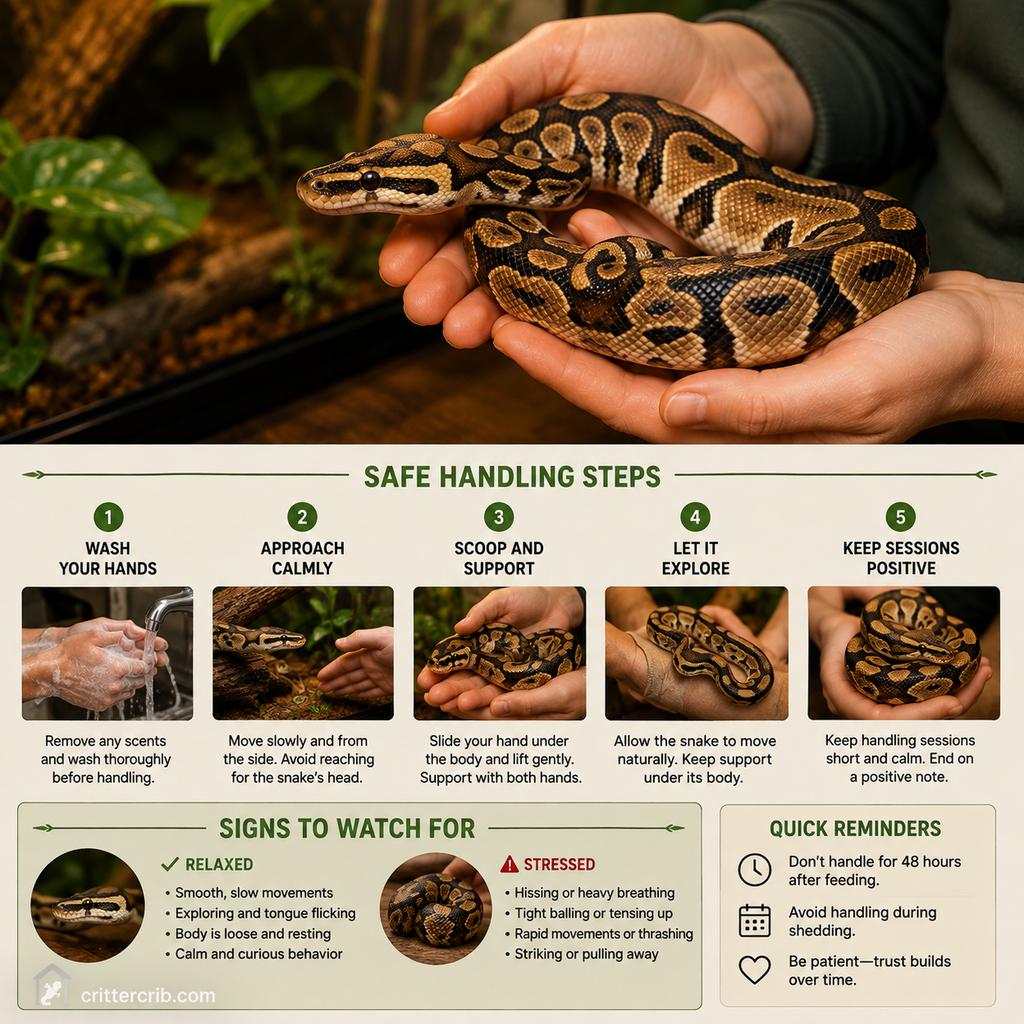
Step 1: Wash Your Hands
Wash and dry your hands before handling your snake.
This is good hygiene, but it also removes food odors that could potentially confuse the snake during an interaction.
This is particularly important if you’ve recently handled rodents or prepared your snake’s meal.
Step 2: Approach Calmly
Open the enclosure without sudden movements.
Let your snake become aware of your presence.
If it’s awake and relaxed, move your hand toward the middle portion of its body rather than directly toward its head.
Step 3: Scoop Instead of Grab
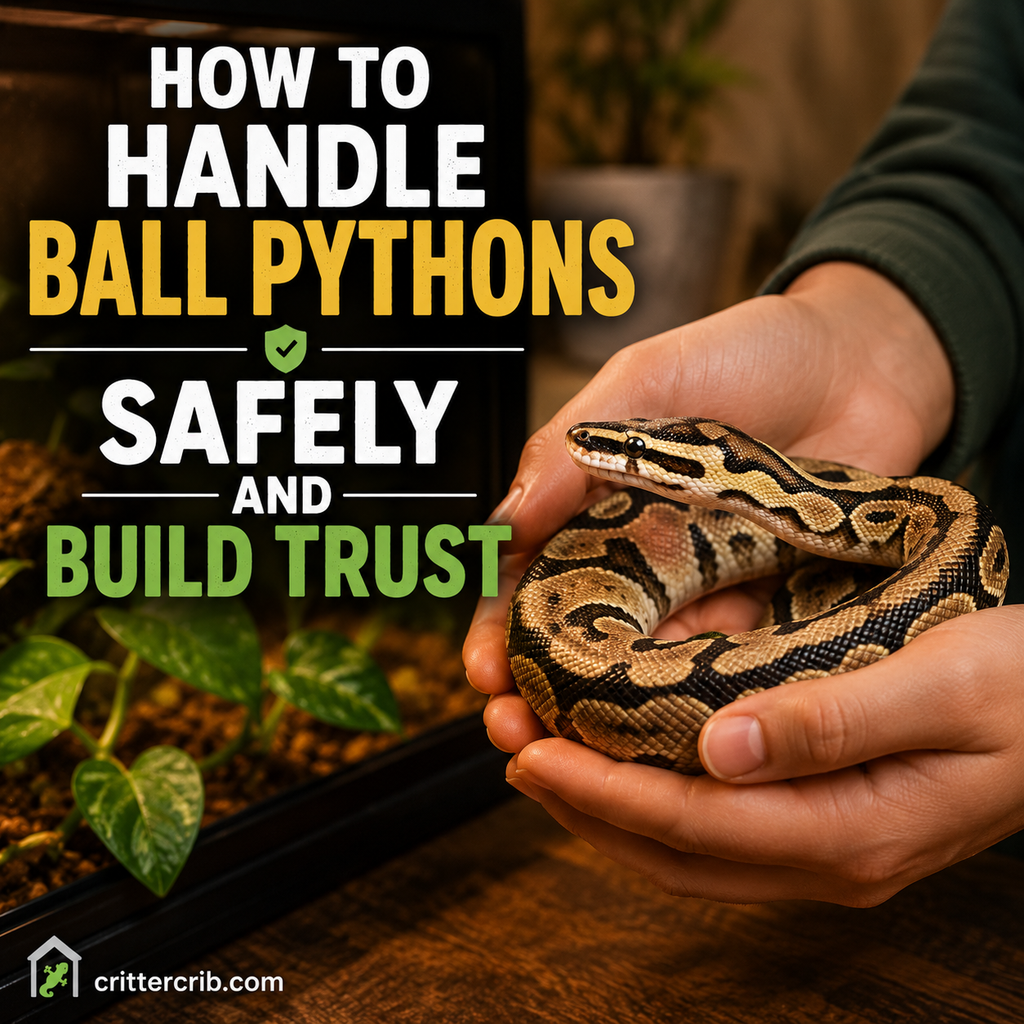
Slide your hand underneath the snake and gently lift it.
Think of the movement as scooping rather than grabbing.
A hand suddenly closing around the snake from above can feel threatening.
Step 4: Support the Body
Use both hands once the snake is out of the enclosure.
Ball pythons have muscular bodies, but they should still be supported rather than left dangling.
Allow the snake’s body to rest across your hands and forearms.
Step 5: Let the Snake Move
Don’t tightly restrain a relaxed ball python.
Allow it to slowly move across your hands while you continually reposition your support underneath its body.
The snake should feel supported without feeling trapped.
How to Hold a Ball Python
A comfortable ball python will often wrap loosely around your hand, arm, or wrist while exploring.
This is normal.
It isn’t trying to constrict you.
Ball pythons naturally use their bodies to hold onto branches and other surfaces. Your arm is simply another stable object.
Keep at least two points of support under the snake whenever possible.
You can allow it to move between your hands by placing one hand in front of the other as it explores.
Avoid:
- Squeezing the snake
- Pulling on its body
- Holding it by the head
- Holding it only by the tail
- Allowing most of its body to hang unsupported
- Making sudden movements
- Passing it rapidly between people
The more stable you feel, the safer your snake is likely to feel.
How Often Should You Handle a Ball Python?
There’s no single handling schedule that works for every ball python.
For a healthy snake that’s already comfortable in its home, handling a few times per week is usually plenty for maintaining familiarity with human interaction.
You don’t need to handle your ball python every day.
In fact, daily handling may be unnecessary and could become stressful for some individuals.
When you’re first building trust, start slowly.
You might begin with approximately 5–10 minutes at a time. If the snake remains relaxed, handling sessions can gradually become longer.
A simple progression could look like:
- Begin with short handling sessions.
- Handle the snake a couple of times during the week.
- Watch its behavior during and after each interaction.
- Gradually increase the length of sessions if it remains comfortable.
- Reduce handling if you notice repeated signs of stress.
Let the snake’s behavior guide you.
How to Build Trust With a Ball Python
You can’t force a ball python to trust you.
Instead, trust develops when repeated interactions end without anything frightening happening.
Over time, your snake can become accustomed to your scent, movements, and handling routine.
Move Slowly and Predictably
Sudden movements can trigger defensive behavior.
Move calmly whenever you’re working around the enclosure.
This is especially important when approaching the snake’s head.
Spend Time Near the Enclosure
Not every interaction needs to involve handling.
Perform routine care calmly. Change the water, spot-clean the enclosure, and spend time nearby without constantly reaching for the snake.
This allows your ball python to become accustomed to normal activity around its enclosure.
Keep Handling Sessions Positive
Don’t wait until your snake becomes obviously stressed before ending every handling session.
Short, calm interactions are better for building confidence than long sessions that eventually become uncomfortable.
Let the Snake Explore
Once your ball python is comfortable being held, allow it some freedom to explore your hands and arms.
You’re still controlling the situation, but the snake gets to determine where it moves.
That can make handling feel less restrictive.
Be Consistent
Handling once and then leaving the snake untouched for several months won’t provide the same familiarity as occasional, consistent interactions.
You don’t need a strict schedule.
Just aim for calm interactions regularly enough that handling remains familiar.
Learn Your Ball Python’s Body Language
Understanding body language makes handling much easier.
Rather than following a rigid schedule, you can decide whether handling is appropriate based on what your snake is communicating.
Signs of a Relaxed Ball Python
A comfortable snake may:
- Move slowly and deliberately
- Explore its surroundings
- Flick its tongue regularly
- Maintain loose body positioning
- Rest comfortably across your hands
- Gently grip your arm for support
Tongue flicking is especially common during exploration. Snakes use their tongues to collect chemical information about their surroundings.
Signs Your Ball Python May Be Stressed
Watch for behaviors such as:
- Repeatedly trying to escape
- Very tense body posture
- Hiding its head
- Curling tightly into a ball
- Sudden defensive movements
- Hissing
- Striking or preparing to strike
- Frantic movement
A ball python curling into a tight ball is giving you a pretty obvious message: it doesn’t feel secure.
If that happens during handling, calmly return the snake to its enclosure and give it some space.
What Does a Ball Python Look Like Before Striking?
Understanding defensive posture can help prevent bites.
A defensive ball python may pull its head and neck backward into an S-shaped position.
That posture allows the snake to quickly extend forward.
You may also notice:
- A tense body
- Focused attention on your hand
- Reduced exploratory movement
- Hissing
- Repeated repositioning toward you
Not every S-shaped neck position means a strike is definitely coming, but you should pay attention to the rest of the snake’s behavior.
If the snake appears defensive, handling can wait.
When Should You Not Handle a Ball Python?
Knowing when to leave your snake alone is just as important as knowing how to hold it.
After Feeding
Avoid handling your ball python immediately after it eats.
Snakes need time to digest their meals. Excessive activity and stress soon after feeding can increase the risk of regurgitation.
A common rule is to wait approximately 48 hours after feeding before routine handling.
Larger meals or individual circumstances may justify waiting longer.
During Shedding
Ball pythons become more vulnerable during the shedding process.
Before shedding, their skin may appear dull and their eyes often become cloudy or bluish. Their vision is temporarily impaired during part of this process, which can make them more defensive.
Handling isn’t always dangerous during shedding, but it’s generally better to minimize unnecessary interaction.
Let your snake rest until the shed is complete.
When the Snake Is Defensive
If your snake is hissing, striking, tightly balled up, or clearly distressed, don’t force a handling session.
Give it time and try again another day.
When the Snake Is Sick or Injured
A sick or injured snake may need to be handled for veterinary care, but recreational handling should generally stop until the problem has been addressed.
Contact an experienced reptile veterinarian if you notice concerning symptoms.
Can a Ball Python Bite You?
Yes.
Ball pythons can bite, even though they’re generally known for being docile.
Bites are more likely when a snake:
- Mistakes your hand for food
- Smells prey on your skin
- Feels cornered
- Is startled
- Is already stressed
- Is handled incorrectly
- Is in feeding mode
The best strategy is prevention.
Learn your snake’s behavior, wash your hands before handling, and avoid handling when the animal is showing obvious defensive behavior.
If a bite occurs, don’t panic or violently pull the snake away. Sudden pulling can worsen the injury.
Once you’re safely separated, wash the area thoroughly with soap and water and seek medical attention if the wound is significant, won’t stop bleeding, or develops signs of infection.
Feeding Response vs. Defensive Behavior
Learning the difference between feeding behavior and defensive behavior can make you much more confident around your ball python.
A snake expecting food may become extremely focused on movement around the enclosure.
This is one reason it’s useful to create predictable routines.
Some keepers use target training or other consistent signals to help their snakes distinguish feeding time from routine enclosure access.
You don’t necessarily need an elaborate training system, but consistency can help.
Avoid teasing the snake with food or putting your hands unnecessarily close to prey during feeding.
Should You Handle a Ball Python Before Feeding?
It’s generally better not to schedule a long handling session immediately before feeding.
Handling may temporarily change the snake’s behavior or make a nervous animal less interested in eating.
If feeding day has arrived, you can simply feed the snake and save handling for another day after it has had enough time to digest.
For ball pythons that are inconsistent eaters, reducing unnecessary disturbances around feeding time can be especially useful.
Handling Young Ball Pythons
Juvenile ball pythons can sometimes be more nervous than established adults.
From a small snake’s perspective, almost everything around it is enormous.
Don’t interpret nervous behavior as aggression.
Start with short sessions and focus on making each interaction uneventful.
Young ball pythons also require more careful physical support simply because they’re smaller and easier to lose track of.
Never handle a small snake while standing somewhere it could fall a significant distance.
Sitting on the floor, a couch, or another safe area can reduce the consequences of an accidental drop.
Handling a Shy Ball Python
Some ball pythons remain shy even after they’ve lived with their owners for a long time.
That’s okay.
Your goal isn’t to transform every snake into an animal that constantly wants to be handled.
For a particularly shy ball python:
- Keep sessions short
- Approach from the side
- Avoid touching the head unnecessarily
- Provide plenty of physical support
- Handle in a quiet environment
- Return it before stress becomes excessive
- Give it recovery time between sessions
Progress may be gradual.
A snake that initially curls into a ball every time it’s touched may eventually begin exploring your hands after learning that nothing harmful happens during these interactions.
Does Enclosure Setup Affect Handling?
Absolutely.
A ball python that doesn’t feel secure in its enclosure may already be experiencing chronic stress before you even open the door.
Proper husbandry supports better handling.
Make sure your snake has:
- Appropriate warm and cool areas
- Suitable humidity
- Secure hides
- Fresh water
- Enough cover to feel protected
- An appropriately sized enclosure
- A consistent day-night cycle
Secure hides are particularly important.
Ball pythons naturally seek tight, sheltered spaces. A large, exposed enclosure without adequate hiding opportunities can make a snake feel vulnerable.
Correcting husbandry problems should come before trying to “fix” a snake’s handling behavior.
Common Ball Python Handling Mistakes
Many handling problems come from trying to move too quickly.
Handling Too Soon After Bringing the Snake Home
Give a new ball python time to adjust before introducing another potential source of stress.
Grabbing From Above
Predators often approach snakes from above.
Whenever possible, scoop the snake gently from underneath or from the side.
Touching the Head Repeatedly
Many ball pythons are uncomfortable with having their heads touched.
There’s usually no reason to force it.
Handling for Too Long
Longer isn’t automatically better.
Ten calm minutes can be more productive than an hour-long session with an increasingly stressed snake.
Ignoring Defensive Signals
Hissing, striking, tightly curling up, and obvious attempts to escape shouldn’t be treated as bad behavior that the snake needs to “get over.”
They’re communication.
Respond accordingly.
Handling Immediately After Feeding
Give your snake adequate time to digest before handling it.
Letting Too Many People Handle the Snake
Passing a ball python from person to person can be overwhelming, especially if the snake is already nervous.
Introduce new handlers gradually.
How Long Does It Take for a Ball Python to Trust You?
There’s no reliable timeline.
Some ball pythons settle into handling relatively quickly, while others may require weeks or months of patient interaction.
Instead of asking whether your snake “trusts” you yet, watch for progress.
Maybe your snake used to curl into a ball immediately but now begins tongue flicking and exploring after a minute.
Maybe it used to hide whenever you entered the room but now remains visible.
Those small behavioral changes can indicate that your snake is becoming more comfortable with its environment and routine.
Ball Python Handling Safety for Children
Children can interact with calm ball pythons, but adult supervision is important.
Teach children to:
- Wash their hands before and after handling
- Sit down while holding the snake
- Support the snake’s body
- Avoid squeezing
- Keep the snake away from their face
- Avoid touching its head
- Move slowly
- Never handle the snake without permission
An adult should remain close enough to take control of the snake if necessary.
Ball pythons aren’t toys, and handling should always prioritize the animal’s welfare.
Young children and other people at higher risk from reptile-associated germs may require additional precautions. Reptiles can carry Salmonella even when they appear completely healthy, so good hygiene is important.
Wash Your Hands After Handling
Always wash your hands thoroughly with soap and water after:
- Handling your ball python
- Cleaning the enclosure
- Touching substrate
- Handling water bowls
- Cleaning snake waste
- Handling enclosure decorations
Avoid touching your mouth or eating while handling reptiles.
Also keep reptile equipment away from areas where human food is prepared whenever possible.
These simple hygiene habits protect both you and other people in your household.
Frequently Asked Questions
Do Ball Pythons Like Being Held?
It’s difficult to say that ball pythons “like” handling in the same way a social mammal might enjoy physical affection.
However, many ball pythons learn to tolerate handling extremely well and will calmly explore while being held.
The better question is whether your snake appears comfortable.
A relaxed, exploratory snake is very different from one that’s tightly curled, hissing, or constantly attempting to escape.
How Often Should I Hold My Ball Python?
A few short handling sessions per week can be plenty for a ball python that’s comfortable with handling.
There’s no requirement to handle your snake every day.
Pay attention to feeding, shedding, health, and the snake’s behavior when deciding when to handle it.
How Long Should I Hold My Ball Python?
Beginners can start with sessions of around 5–10 minutes.
If your snake remains calm, you can gradually extend the sessions.
There’s no need to hit a specific duration. The quality of the interaction matters more than the clock.
Can I Handle My Ball Python Every Day?
You can interact regularly with a well-adjusted snake, but daily handling isn’t necessary.
Rest days give the snake time to behave normally without disturbance.
Never prioritize a handling schedule over your snake’s behavior.
Why Does My Ball Python Curl Into a Ball When I Pick It Up?
Curling into a tight ball is a defensive behavior.
Your snake is trying to protect its head and make itself less vulnerable.
If this happens frequently, shorten handling sessions and evaluate whether something about your approach or husbandry is causing unnecessary stress.
Why Is My Ball Python Suddenly Hissing at Me?
A normally calm snake can become defensive for many reasons.
It may be preparing to shed, expecting food, feeling exposed, experiencing environmental stress, or simply not want to interact at that moment.
Look at the entire situation rather than assuming your snake has suddenly become aggressive.
Can Ball Pythons Recognize Their Owners?
Ball pythons can become accustomed to familiar scents, routines, and repeated experiences, but this shouldn’t be confused with human-style emotional recognition.
It’s more useful to think in terms of familiarity and learned safety.
Your snake can learn that interactions with you aren’t threatening, which is exactly what you’re trying to accomplish when building trust.
Final Thoughts
Learning how to handle a ball python safely is mostly about learning to read the snake.
Approach calmly, scoop rather than grab, support its body, and let it explore your hands without tightly restraining it. Keep early handling sessions short and gradually increase interaction as the snake becomes more comfortable.
Just as importantly, know when not to handle.
Leave your snake alone after feeding, minimize disturbances during shedding, and don’t force interaction when it’s showing obvious signs of stress.
Trust doesn’t come from handling your ball python as often as possible. It comes from repeated, predictable experiences in which the snake learns that being around you doesn’t result in anything frightening.
Be patient, pay attention to body language, and let your individual snake set the pace.