White’s tree frogs aren’t particularly small frogs. Adults have chunky bodies, strong legs, and a natural tendency to spend much of their time above the ground.
That makes choosing the right enclosure about more than simply looking at the number of gallons on the box.
A White’s tree frog needs enough room to climb, move between perches, rest comfortably, and choose different areas of its habitat. If you’re keeping more than one frog, space becomes even more important.
So, how much space do White’s tree frogs actually need?
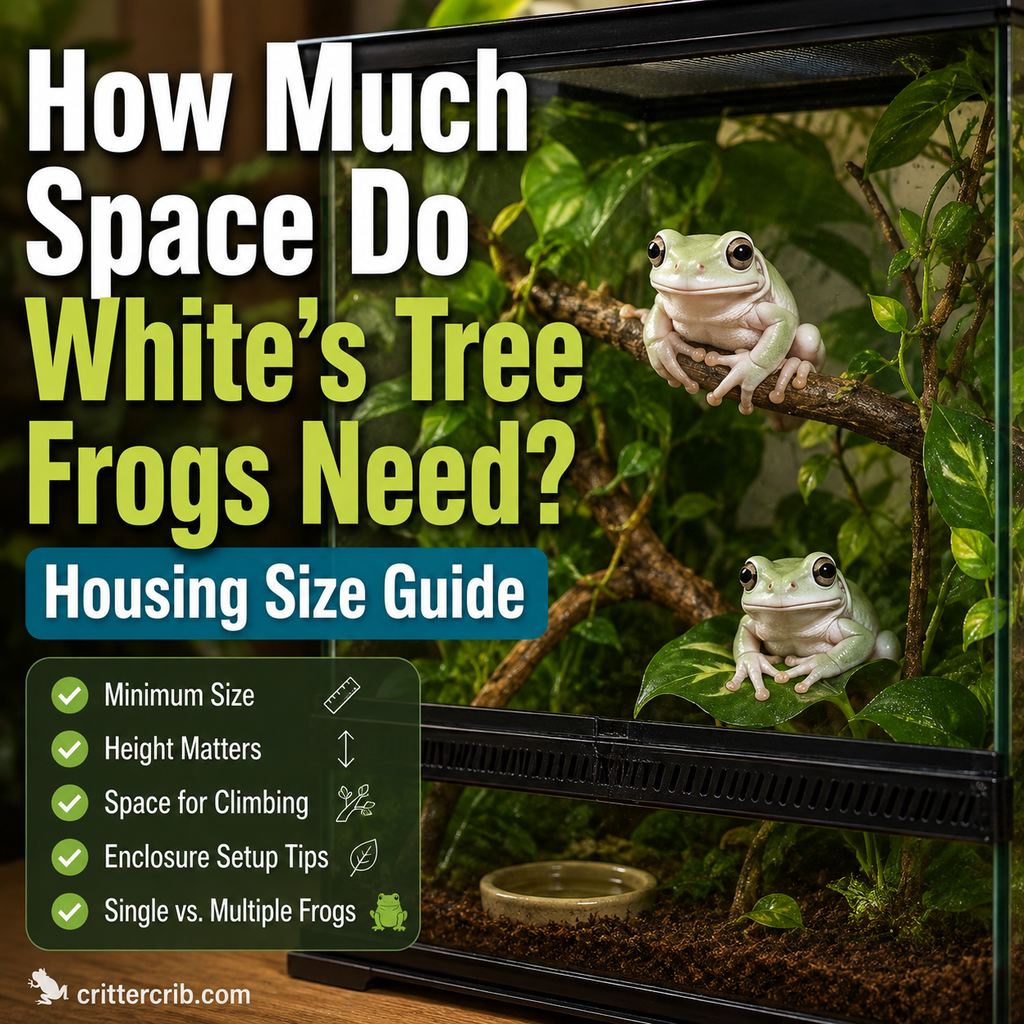
For a single adult, an enclosure around 18 × 18 × 24 inches is a practical minimum starting point, with larger vertical enclosures offering even more usable space. Multiple adults require additional room, climbing structures, and resting areas.
Here’s how to choose the right setup.
White’s Tree Frog Enclosure Size at a Glance
A useful starting point for adult White’s tree frogs is:
- One adult: Around 18 × 18 × 24 inches or larger
- Two adults: Approximately 24 × 18 × 24 inches or larger
- Three or more: Consider a substantially larger enclosure, particularly one with additional width and height
- Juveniles: Can temporarily live in smaller setups but will need an adult enclosure as they grow
These measurements aren’t rigid rules.
Enclosure design matters just as much as dimensions.
A tall enclosure that’s technically large enough but almost completely empty provides less useful habitat than one filled with sturdy branches, elevated resting areas, foliage, and accessible climbing routes.
Why White’s Tree Frogs Need Vertical Space
White’s tree frogs are arboreal.
In simple terms, they’re built to spend a significant amount of time climbing and resting above ground level.
Their enclosure should reflect that.
While terrestrial frogs such as Pacman frogs benefit greatly from floor space and deep substrate, White’s tree frogs make use of branches, vines, foliage, and elevated surfaces.
That’s why a tall terrarium is usually preferable to a low, wide aquarium of similar volume.
Height Creates Usable Habitat
Think of the enclosure in three dimensions.
The bottom provides room for substrate, plants, water, and ground-level movement.
The middle can contain:
- Branches
- Vines
- Cork bark
- Plant leaves
- Climbing structures
The upper portion provides additional resting and climbing opportunities.
When all three levels are used effectively, the frog has considerably more functional space than the enclosure’s floor measurements might suggest.
Is an 18 × 18 × 24 Enclosure Big Enough for a White’s Tree Frog?
For one adult White’s tree frog, an 18 × 18 × 24-inch enclosure is commonly used as a reasonable minimum.
It provides approximately 33 gallons of total volume before substrate and decorations are added.
More importantly, the 24-inch height provides useful vertical space.
That doesn’t mean you shouldn’t go larger.
If you have room for a larger enclosure, your frog can benefit from additional climbing opportunities and more flexibility in how the habitat is arranged.
For a particularly large adult, a bigger enclosure may also feel much less cramped once branches, plants, and other furnishings are installed.
Is a 20-Gallon Tank Big Enough for a White’s Tree Frog?
This depends heavily on the dimensions.
A conventional 20-gallon aquarium is often designed for fish and may prioritize horizontal space rather than height.
That isn’t ideal for an arboreal frog.
A tall enclosure with similar volume can provide more useful climbing space.
Instead of focusing entirely on gallon capacity, compare:
- Height
- Width
- Depth
- Ventilation
- Door placement
- Available climbing area
For White’s tree frogs, dimensions are usually more informative than gallons alone.
Is a 10-Gallon Tank Big Enough?
A standard 10-gallon aquarium isn’t an appropriate permanent enclosure for an adult White’s tree frog.
There simply isn’t much room once you add the necessities.
The enclosure needs space for:
- A water dish
- Substrate
- Branches
- Plants
- Hides
- Feeding activity
- Climbing
- Normal movement
A 10-gallon setup may sometimes be used temporarily for a small juvenile, quarantine, or another short-term purpose, but plan for a considerably larger adult enclosure.
Buying the adult habitat from the beginning can often save money in the long run.
How Much Space Do Two White’s Tree Frogs Need?
If you’re keeping two adult White’s tree frogs, give them more room than you would a single frog.
An enclosure around 24 × 18 × 24 inches or larger provides a better starting point for a pair.
Going larger is worthwhile when possible.
Two frogs don’t simply require enough physical space to fit inside the enclosure.
Each animal should have access to:
- Comfortable resting locations
- Climbing structures
- Food
- Water
- Cover
- Different temperature and humidity zones
Providing multiple desirable resting areas reduces competition for the same perch.
How Much Space Do Three White’s Tree Frogs Need?
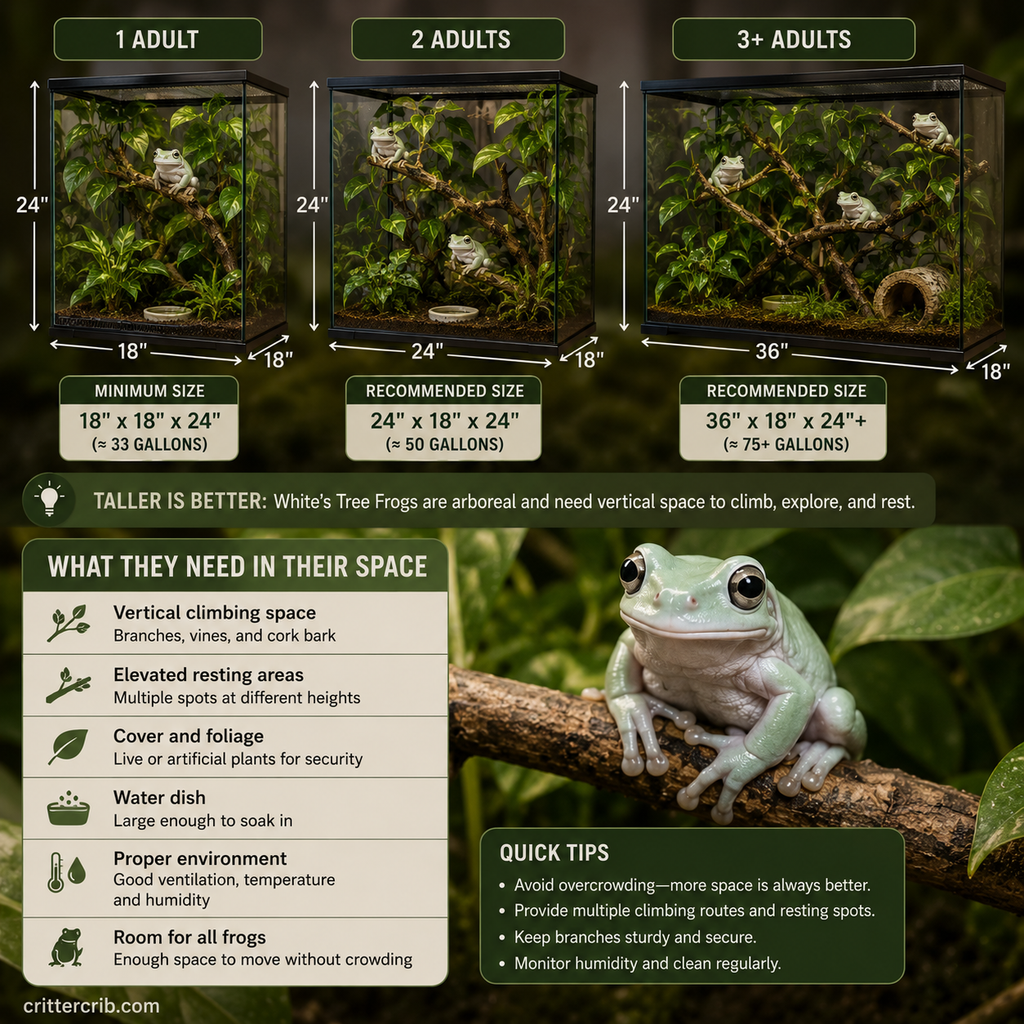
For three adults, move beyond the minimum setup used for one or two frogs.
An enclosure around 36 × 18 × 24 inches or similarly spacious dimensions can provide considerably more usable room.
Larger is generally preferable when keeping groups, assuming you can still maintain appropriate environmental conditions.
With three frogs, width becomes increasingly valuable.
You still want vertical climbing space, but additional horizontal room allows you to create multiple climbing zones and resting areas rather than forcing every frog onto the same branches.
How Many White’s Tree Frogs Can Live Together?
White’s tree frogs can sometimes be kept in compatible groups.
However, the enclosure needs to scale with the number and size of frogs.
There isn’t a perfect formula where you simply add a certain number of gallons for every additional frog.
Instead, consider whether each frog has sufficient access to:
- Elevated perches
- Hides and cover
- Feeding opportunities
- Water
- Comfortable environmental conditions
- Space away from the other frogs
Overcrowding makes it harder to maintain cleanliness and can increase competition.
More frogs also produce more waste.
That means a group enclosure may require more frequent cleaning even when it appears spacious.
Size Differences Matter When Housing Frogs Together
Avoid housing significantly different-sized White’s tree frogs together.
White’s tree frogs are opportunistic feeders with surprisingly large mouths.
A substantial size difference can create a risk that the smaller frog will be mistaken for prey.
Similar-sized frogs are generally safer group candidates.
Size isn’t the only consideration, though.
Monitor feeding closely to make sure every frog receives an appropriate amount of food rather than one animal consistently getting everything first.
Do White’s Tree Frogs Prefer Tall or Wide Enclosures?
If choosing between a short aquarium and a taller terrarium with comparable volume, the taller enclosure is generally the better option.
White’s tree frogs climb.
However, don’t take this to mean that width doesn’t matter.
The ideal enclosure provides both:
- Adequate height for climbing
- Enough width for horizontal movement and multiple perches
A very tall but extremely narrow enclosure can still feel restrictive.
For multiple frogs, additional width becomes particularly useful.
Making Vertical Space Actually Usable
A tall glass box isn’t automatically a good White’s tree frog habitat.
You need to furnish that vertical space.
Imagine buying a three-story house but discovering there are no stairs.
Technically, the space exists. You just can’t use most of it.
Your frog needs climbing routes that connect different levels of the enclosure.
Useful furnishings include:
- Sturdy branches
- Cork bark
- Frog-safe vines
- Broad-leaved plants
- Elevated ledges
- Secure climbing structures
Arrange these so the frog can move naturally between the lower, middle, and upper sections.
Use Different Branch Thicknesses
Branches don’t all need to be identical.
Using several thicknesses and orientations creates more varied climbing opportunities.
Make sure every branch is sturdy enough to support a full-grown White’s tree frog.
These are chunky frogs.
A decorative twig that works perfectly for a tiny tree frog may bend or collapse under an adult White’s tree frog.
Create Elevated Resting Areas
White’s tree frogs often spend long periods resting on elevated surfaces.
Provide several options.
Good resting areas may include:
- Horizontal branches
- Cork bark
- Large leaves
- Frog-safe ledges
- Secure vines
A frog shouldn’t have to cling to the glass simply because there aren’t any comfortable elevated places to sit.
If you’re housing several frogs, provide multiple high-quality resting spots rather than one ideal perch everyone wants to use.
Don’t Overcrowd the Enclosure With Decorations
There’s a balance between creating an enriching habitat and filling every inch with decorations.
Your frog needs climbing structures, but it also needs room to move.
Avoid creating an enclosure so dense that the frog can’t comfortably jump between surfaces or reposition itself.
Try to provide a mixture of:
- Open space
- Dense cover
- Vertical climbing routes
- Horizontal resting surfaces
This gives the frog choices.
The Importance of Ventilation
Enclosure size isn’t the only consideration.
Good ventilation matters too.
White’s tree frogs require appropriate humidity, but that doesn’t mean the enclosure should remain stagnant and soaking wet.
Airflow helps prevent the habitat from becoming excessively damp and stale.
A suitable terrarium should provide enough ventilation to allow air exchange while still making it possible to maintain appropriate humidity.
Screened sections are common in enclosures designed specifically for reptiles and amphibians.
Where Should the Water Dish Go?
White’s tree frogs should have access to a clean, appropriately sized water dish.
The frog should be able to enter and exit easily.
Because the water dish occupies valuable floor space, account for it when choosing an enclosure.
In a very small habitat, a properly sized dish can consume a substantial portion of the available ground area.
That’s another reason minimum-size enclosures can quickly feel cramped once they’re fully furnished.
Keep the water clean and replace it regularly, especially if your frog uses the dish as a bathroom.
How Much Floor Space Does a White’s Tree Frog Need?
Although vertical space gets most of the attention, don’t ignore the bottom of the enclosure.
White’s tree frogs may spend time on the ground, particularly while moving around, feeding, or soaking.
Floor space is also needed for:
- Water
- Plants
- Substrate
- Hides
- Feeding areas
A wider base makes arranging these features considerably easier.
For multiple frogs, adequate floor space also helps prevent the entire habitat from becoming congested.
Enclosure Size and Temperature Gradients
A larger enclosure can make it easier to create slightly different environmental zones.
Your frog shouldn’t be forced to sit in one exact location because it’s the only area with comfortable conditions.
A properly arranged habitat allows the frog to choose between areas that vary somewhat in:
- Temperature
- Humidity
- Light
- Cover
- Height
That ability to choose is an important part of good enclosure design.
Monitor conditions with appropriate thermometers and hygrometers rather than guessing based on how the enclosure feels.
Enclosure Size and Humidity
Larger enclosures may behave differently from smaller ones when it comes to humidity.
A small enclosed tank can become overly damp quickly.
A larger, well-ventilated terrarium may dry more gradually or require adjustments to your misting routine.
Plants, substrate depth, ventilation, room humidity, and temperature can all affect conditions.
Don’t choose a tiny enclosure simply because it’s easier to keep humid.
The goal is to create suitable conditions inside an appropriately sized habitat.
When Should a Juvenile White’s Tree Frog Move Into an Adult Enclosure?
Juvenile frogs don’t necessarily need their permanent adult enclosure immediately, but there’s no requirement that they remain in a tiny habitat until fully grown.
The important considerations are whether you can:
- Monitor the frog easily
- Ensure it’s finding food
- Maintain proper environmental conditions
- Keep the enclosure clean
- Prevent escapes
As the frog grows, it should have enough room to climb and move comfortably.
If your juvenile begins looking crowded among the furnishings, don’t wait until it physically outgrows the enclosure before upgrading.
Can a White’s Tree Frog Enclosure Be Too Big?
A properly designed larger enclosure isn’t inherently a problem.
The bigger issue is whether the habitat is functional.
A huge enclosure with very little cover may leave a frog feeling exposed.
Likewise, a juvenile placed in an enormous, densely planted habitat may be more difficult for you to monitor and feed reliably.
A larger enclosure works best when it contains:
- Plenty of secure cover
- Accessible food
- Multiple climbing routes
- Suitable environmental conditions
- Easy-to-find water
- Appropriate resting locations
Think in terms of usable habitat rather than simply maximum dimensions.
Signs a White’s Tree Frog Enclosure May Be Too Small
There’s no single behavior that proves an enclosure is undersized.
However, look at the habitat as a whole.
Possible signs that an upgrade would be beneficial include:
- Very limited climbing space
- Few elevated resting areas
- Most of the enclosure being occupied by basic equipment
- Multiple frogs constantly using the same perch
- Difficulty creating environmental variation
- Frogs repeatedly interfering with each other
- Little open space for normal movement
Sometimes the easiest test is simply looking at the enclosure after it’s fully furnished.
If an adult frog takes up a large percentage of the usable space, upgrading is probably worthwhile.
Common White’s Tree Frog Housing Mistakes
Choosing an enclosure based only on gallon capacity is one of the most common mistakes.
There are several others worth avoiding.
Using a Short Fish Aquarium
A long aquarium may hold plenty of water, but that doesn’t mean its dimensions are ideal for an arboreal frog.
Prioritize vertical climbing room.
Choosing the Absolute Minimum Size
Minimum dimensions tell you what’s workable, not necessarily what’s ideal.
If your budget and available space allow it, giving an adult frog additional room provides more flexibility for furnishing the habitat.
Leaving the Upper Half Empty
A 24-inch-tall enclosure isn’t useful if everything is sitting on the floor.
Add sturdy climbing structures throughout the vertical space.
Adding Too Many Frogs
Don’t keep adding frogs simply because there’s technically room for another animal.
Consider usable space, cleanliness, feeding competition, and the number of quality resting locations.
Housing Different-Sized Frogs Together
Large size differences can create feeding and safety concerns.
House frogs of similar size whenever keeping them together.
Using Unstable Decorations
Branches, vines, and ledges should be securely positioned.
White’s tree frogs are heavier than their appearance sometimes suggests, and decorations should remain stable when an adult jumps or climbs onto them.
Choosing the Best White’s Tree Frog Enclosure
When shopping for an enclosure, look beyond the gallon number printed on the packaging.
Consider these factors:
- Is it tall enough for climbing?
- Is there enough width for comfortable movement?
- Can you fit multiple sturdy perches?
- Is there space for an appropriately sized water dish?
- Does it provide adequate ventilation?
- Can you maintain appropriate temperature and humidity?
- Is it secure against escapes?
- Can you access the enclosure easily for feeding and cleaning?
- Will it still be appropriate when the frog reaches adult size?
Front-opening terrariums can be particularly convenient because they make routine maintenance easier without requiring you to reach down from directly above the frog.
A Simple Setup for One Adult White’s Tree Frog
For one adult, an enclosure around 18 × 18 × 24 inches or larger gives you enough room to create a functional vertical habitat.
A basic layout could include:
- Several inches of appropriate substrate
- A large water dish
- One sturdy diagonal branch
- Several horizontal perches
- Cork bark
- Live or artificial frog-safe plants
- Dense cover in at least one section
- More open climbing space elsewhere
Don’t worry about making every inch look decorated.
The goal is to create a habitat your frog can actually use.
A Simple Setup for Two White’s Tree Frogs
For a pair, start with something closer to 24 × 18 × 24 inches or larger.
Then increase the number of usable resources.
Instead of one excellent upper perch, provide several.
Instead of one climbing route, create multiple ways to move through the enclosure.
This allows both frogs to use the habitat without constantly competing for the exact same locations.
Monitor feeding as well.
One frog shouldn’t consistently outcompete the other simply because it happens to sit closest to the feeding area.
Frequently Asked Questions About White’s Tree Frog Enclosure Size
What Is the Minimum Tank Size for One White’s Tree Frog?
An enclosure around 18 × 18 × 24 inches is a practical minimum starting point for one adult White’s tree frog.
Larger is generally preferable when you have the available space.
What Size Tank Do Two White’s Tree Frogs Need?
For two adults, consider an enclosure around 24 × 18 × 24 inches or larger.
Provide multiple climbing routes, resting areas, and enough space for both frogs to move comfortably.
What Size Tank Do Three White’s Tree Frogs Need?
A group of three adults benefits from a substantially larger habitat, such as approximately 36 × 18 × 24 inches or comparable dimensions.
Going larger provides more flexibility for creating multiple climbing and resting zones.
Do White’s Tree Frogs Need a Tall Tank?
Yes. White’s tree frogs are arboreal and benefit from vertical climbing space.
A tall terrarium is generally more appropriate than a low aquarium of similar volume.
Is a 10-Gallon Tank Enough for a White’s Tree Frog?
Not as a permanent adult habitat.
A 10-gallon enclosure doesn’t provide enough usable space for an adult once water, substrate, plants, branches, and other necessities are added.
Is a 20-Gallon Tank Enough?
It depends on the dimensions.
A tall enclosure may work better than a conventional horizontal 20-gallon aquarium, but an 18 × 18 × 24-inch or larger vertical terrarium provides a more practical adult setup.
Can Two White’s Tree Frogs Live Together?
Compatible, similarly sized White’s tree frogs can sometimes be housed together when provided with sufficient space and resources.
Monitor feeding, cleanliness, body condition, and interactions between the frogs.
Is a Bigger Tank Always Better?
More space is generally beneficial when the enclosure is properly designed.
A larger habitat still needs appropriate cover, climbing routes, environmental conditions, water, and accessible feeding opportunities.
Empty space by itself isn’t useful habitat.
Final Thoughts on White’s Tree Frog Housing Size
White’s tree frogs need more than a tank that’s simply large enough to contain them.
They need usable vertical space.
For one adult, an enclosure around 18 × 18 × 24 inches is a sensible minimum starting point. For two adults, look toward 24 × 18 × 24 inches or larger, and groups of three or more should have substantially more room.
But dimensions only tell part of the story.
Fill the enclosure with sturdy branches, elevated resting areas, foliage, secure climbing routes, and enough open space for comfortable movement. Provide clean water, good ventilation, and appropriate environmental conditions throughout the habitat.
Most importantly, think like an arboreal frog.
If most of the usable habitat is sitting on the ground while the upper half of the enclosure is empty, you’re wasting some of the most valuable space available.
Build upward, provide choices, and give your White’s tree frog a habitat it can actually climb through and use.