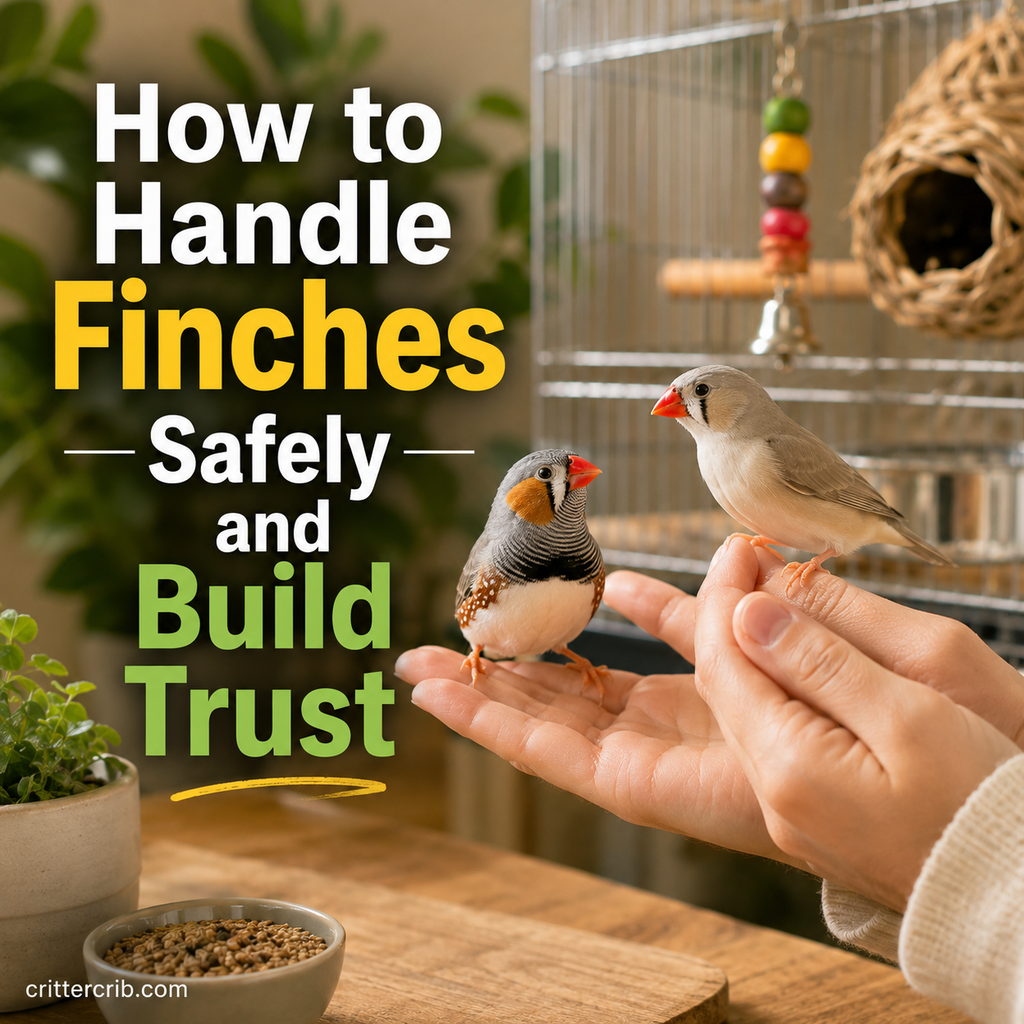
Finches are small, active birds that can be fascinating to watch, but handling them is very different from handling a cockatiel, budgie, or other companion parrot.
Most finches aren’t naturally interested in sitting on a person’s finger or being petted. They’re generally happier flying, interacting with other finches, bathing, foraging, and observing what’s happening around them from a comfortable distance.
That doesn’t mean your finches have to be frightened of you.
With patience and a predictable routine, finches can learn that your presence isn’t a threat. Some may become comfortable eating while you’re nearby, approaching when you bring food, or investigating your hand inside the cage. A particularly confident bird might eventually take a treat from you.
The key is adjusting your expectations. Building trust with a finch is usually less about physical affection and more about helping the bird feel relaxed and secure around you.
Here’s how to do that while keeping handling to a safe minimum.
Do Finches Like to Be Handled?
Most pet finches don’t enjoy routine handling.
Unlike many parrots, common pet finches such as zebra finches and society finches haven’t typically been bred for close physical interaction with humans.
Their instincts encourage them to move away quickly when something large approaches.
From a finch’s perspective, a human hand entering the cage can initially look much more like a predator than a friend.
This is why trying to grab or pet a finch usually doesn’t build trust. It tends to accomplish the opposite.
Instead, your goal should be to make your bird comfortable with your presence while allowing it to choose how close it wants to get.
Can Finches Become Tame?
Finches can become accustomed to people, although “tame” means something different with finches than it does with many parrots.
A comfortable finch may:
- Remain relaxed when you enter the room
- Continue eating while you’re nearby
- Sing or vocalize normally around you
- Approach the front of the cage
- Watch your hand without immediately fleeing
- Investigate treats you’re holding
- Become comfortable with routine cage maintenance
Some individuals may progress further.
Young finches that have had extensive positive human contact can occasionally become quite comfortable around hands. Individual temperament also matters.
However, you shouldn’t purchase a finch expecting it to become a cuddly or highly interactive pet.
Why Finches Are Easily Frightened
Finches are prey animals.
Being alert to movement is part of how small birds survive.
Several things humans do without thinking can seem threatening to them:
- Reaching down from above
- Moving suddenly toward the cage
- Staring directly at them
- Chasing them with a hand
- Making loud noises
- Rearranging their environment
- Cornering them
Imagine something many times your size suddenly reaching through your front door and trying to pick you up.
That’s roughly the kind of situation you’re trying to avoid creating.
Slow, predictable movements make a major difference.
Start Building Trust Before Trying to Handle Your Finch
The best way to handle a finch safely is to avoid unnecessary handling in the first place.
Start by teaching your birds that you’re part of their normal environment.
When you first bring finches home, give them time to adjust.
They’re processing an entirely new world: cage, room, sounds, people, lighting, feeding routine, and possibly other animals.
Don’t immediately start reaching into the cage repeatedly unless necessary.
Spend Quiet Time Near the Cage
Sit near the cage while doing something calm.
You could:
- Read
- Work on a laptop
- Watch television quietly
- Talk softly
- Listen to music at a reasonable volume
At first, you don’t need to interact with the birds at all.
You’re simply allowing them to observe you without anything frightening happening.
Eventually, your presence becomes ordinary.
That’s an important first step.
Approach the Cage Slowly
Pay attention to how you walk toward the cage.
If your finches suddenly scatter every time you approach, slow down.
Walk normally but calmly. Avoid rushing directly toward them.
Speaking softly before you reach the cage can also help prevent surprising them.
Over time, they may begin associating your approach with predictable events such as receiving fresh food or bath water.
Establish a Consistent Routine
Finches tend to do well with predictable routines.
Try to perform everyday tasks in roughly the same way.
For example:
- Approach calmly.
- Speak softly.
- Open the cage door slowly.
- Replace food and water.
- Make necessary adjustments.
- Close the cage securely.
- Step away.
When the same sequence happens repeatedly without anything frightening occurring, the birds learn what to expect.
Predictability helps build confidence.
Use Food to Build Positive Associations
Food can be a useful trust-building tool.
The goal isn’t to make your finch hungry enough to approach you. Instead, offer something desirable in addition to the bird’s normal diet.
Depending on the species and individual bird, a favorite treat might include a small amount of millet or another appropriate food.
Start by placing the treat in the cage and stepping away.
Later, you can remain nearby.
As your finches become comfortable, gradually reduce the distance between yourself and the treat.
Eventually, a particularly confident bird may be willing to approach food while your hand remains nearby.
Don’t rush this process.
Getting a Finch Comfortable With Your Hand
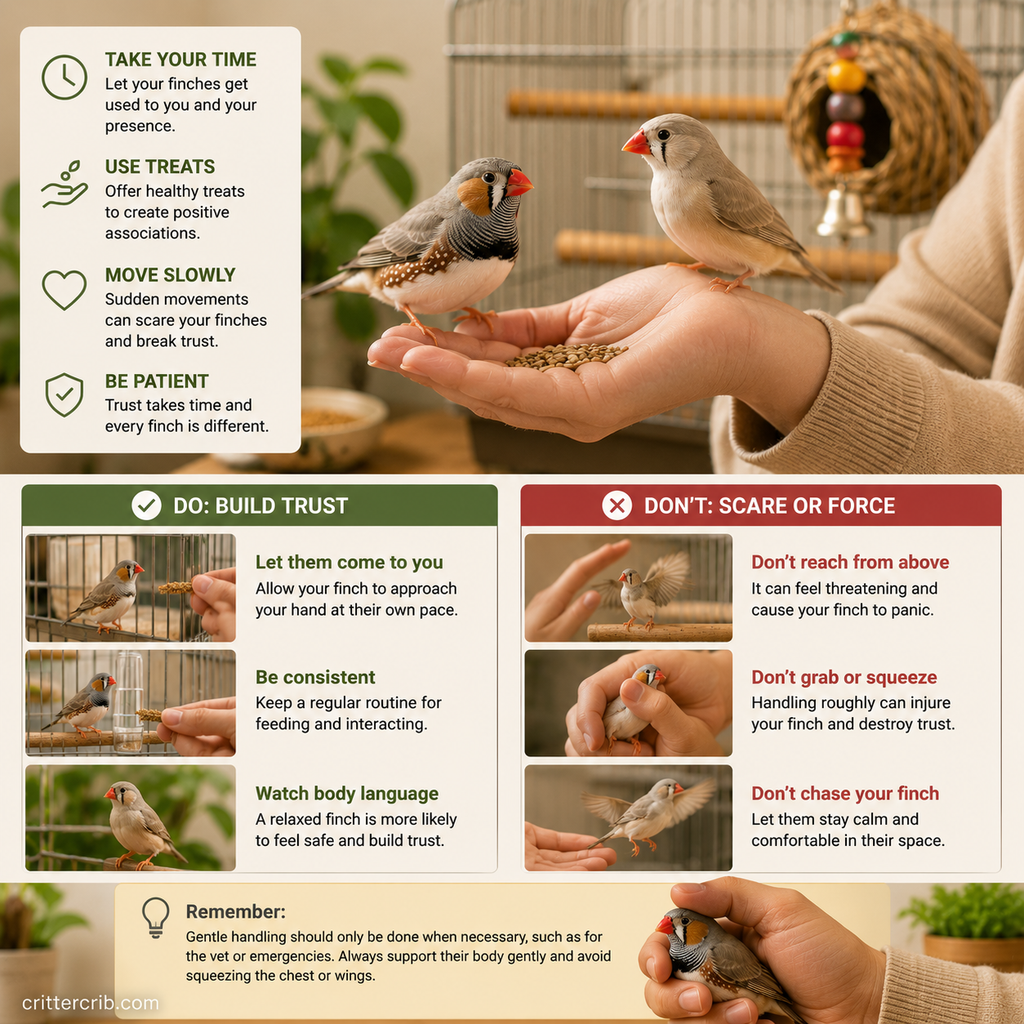
Once your birds are relaxed around you, you can begin making your hand less threatening.
Start outside the cage.
Rest your hand near the cage for a short period without tapping the bars or following the birds around.
When they stop reacting strongly, progress to routine tasks inside the cage.
Move slowly and deliberately.
Don’t chase the birds with your hand.
Your finches should learn:
“That hand comes into the cage sometimes, but nothing bad happens.”
That’s much more useful than forcing physical contact.
Can You Train a Finch to Eat From Your Hand?
Some finches can learn to take food from a person’s hand.
It requires patience, and not every bird will be comfortable doing it.
A gradual approach works best:
- Identify a favorite bird-safe treat.
- Offer it regularly in a predictable location.
- Stay nearby while the bird eats.
- Gradually position your hand closer over multiple sessions.
- Eventually hold the treat without moving toward the bird.
- Let the finch decide whether to approach.
The important part is that the bird closes the distance.
Don’t follow a retreating finch around the cage with food.
If it backs away, give it space.
Can Finches Learn to Step Up?
Some unusually tame finches can learn to perch on a finger or hand, but this shouldn’t be considered a standard expectation.
A handheld perch can sometimes be less intimidating.
If you’re working with a confident bird, you can introduce a small perch gradually and reward curiosity.
Again, don’t force the bird onto it.
For most finch owners, having birds that remain calm during feeding and cage maintenance is already a successful level of trust.
When Is Handling a Finch Necessary?
Although routine handling should usually be minimized, there are situations where you may need to physically catch a finch.
Examples include:
- Veterinary visits
- Moving the bird to another enclosure
- Emergencies
- Inspecting an injury
- Administering treatment under veterinary direction
- Escapes into unsafe areas
In these situations, safety matters more than maintaining a completely hands-off relationship.
The goal is to catch and restrain the bird as quickly and calmly as possible.
How to Catch a Finch Safely
Catching a tiny, fast-moving bird can be stressful for both the finch and the owner.
Preparation makes the process easier.
Before You Start
Make sure all doors and windows are closed.
Turn off ceiling fans.
Keep cats, dogs, and other animals out of the room.
If you’re transferring the bird, have the carrier or destination cage ready before you begin.
You don’t want to catch the finch and then realize you still need to assemble the carrier.
Reduce the Available Space
If possible, catch the bird inside its cage rather than releasing it into a large room.
A smaller environment usually allows you to complete the process more quickly.
Removing a few obstacles may help, but avoid dismantling the entire cage while the bird is frantically flying around.
Lower the Lighting
Slightly dimming the room can sometimes make a finch calmer and easier to catch.
You still need enough light to clearly see what you’re doing.
Never work in complete darkness where you could accidentally injure the bird.
Move Calmly and Deliberately
Avoid repeatedly chasing the bird around the cage.
Wait for an opportunity to gently secure it rather than making dozens of unsuccessful grabs.
The longer the chase continues, the more stressful the experience becomes.
How to Hold a Finch Safely
Finches are extremely delicate.
Never squeeze the bird’s chest.
Birds need movement of the chest and sternum to breathe effectively. Excessive pressure around the body can interfere with respiration and cause serious injury.
If physical restraint is necessary, the bird should be held securely enough that it can’t escape while avoiding compression of the chest.
The head should be controlled carefully so the bird doesn’t injure itself.
Because safe restraint is difficult to learn from written instructions alone, ask an avian veterinarian to demonstrate the proper technique if you expect to handle your finch for medication or ongoing care.
Never Grab a Finch by Its Wings, Legs, or Tail
Don’t attempt to stop an escaping finch by grabbing whichever body part you can reach.
The wings and legs are small and vulnerable to injury.
Tail feathers can also pull free.
Instead, use proper whole-body restraint when handling is genuinely necessary.
If you’re uncomfortable doing this, an avian veterinarian can help.
Using a Small Towel for Handling
A small soft towel can sometimes help with bird restraint, particularly when directed by a veterinarian.
However, the same rules still apply.
Don’t squeeze the bird’s body or obstruct its breathing.
A towel doesn’t make rough handling safe.
For routine trust-building, towels shouldn’t be used to capture a finch simply because you want to interact with it.
Reserve restraint for situations where it’s actually needed.
How Long Should You Hold a Finch?
Keep necessary handling as brief as practical.
Finches can become stressed during restraint, particularly when they aren’t accustomed to human contact.
If you’re moving the bird into a carrier, complete the transfer efficiently.
If you’re administering medication, have everything prepared before catching the bird.
Don’t catch a finch and continue holding it simply because you have the opportunity.
Recognizing Stress in Finches
Learning your birds’ normal behavior helps you recognize when you’re pushing them too far.
Signs of fear or stress may include:
- Frantic flying
- Repeatedly crashing against cage bars
- Rapid breathing
- Open-mouth breathing
- Trying desperately to escape
- Freezing in place
- Alarm calls
- Hiding
- Refusing to approach an area after a frightening experience
If a trust-building session causes panic, you’ve moved too quickly.
Return to an earlier stage where the birds remain comfortable.
What to Do After Necessary Handling
After catching or restraining your finch, return it to a familiar environment and give it time to settle.
Keep the room calm.
Avoid immediately trying to interact again.
Provide normal access to food and fresh water and observe the bird from a distance.
A necessary handling experience doesn’t mean you’ve permanently destroyed your bird’s trust.
Return to your normal predictable routine afterward.
How Long Does It Take for Finches to Trust You?
There’s no universal timeline.
One finch may become comfortable with your presence within a couple of weeks, while another may remain cautious for months.
Several factors can affect the process:
- Species
- Age
- Previous handling
- Individual temperament
- Environment
- Whether the bird lives with other finches
- Frequency of positive interactions
- Previous frightening experiences
Don’t measure success by how quickly someone else’s finch became tame.
Pay attention to your own birds.
Signs Your Finch Is Starting to Trust You
Trust with finches is often subtle.
You might notice that your birds:
- Stop flying away when you enter the room
- Remain on a perch when you approach
- Continue eating in your presence
- Resume singing while you’re nearby
- Watch you with curiosity rather than panic
- Approach the front of the cage
- Stay calm during routine feeding
- Investigate treats near your hand
These may seem like small changes, but they’re meaningful.
A prey animal choosing not to flee from you is showing increasing confidence.
Common Mistakes That Damage Trust
Trust can take weeks to build and seconds to disrupt.
Avoid these common mistakes.
Chasing the Bird With Your Hand
Following a finch around the cage teaches it that your hand is something worth escaping.
Only catch the bird when necessary.
Forcing Interaction
Your finch doesn’t need to sit on your finger to have a good relationship with you.
Allow the bird to set the pace.
Moving Too Quickly
If your bird was comfortable eating while you stood three feet away yesterday, that doesn’t necessarily mean it’s ready to eat from your hand today.
Progress gradually.
Reaching From Above
A hand descending from overhead can be particularly frightening to a small prey bird.
Whenever practical, approach from the side rather than looming over the bird.
Making Sudden Noises
Slamming cage doors, shouting nearby, or abruptly moving objects around the cage can make cautious birds more nervous.
Punishing Fearful Behavior
Never punish a finch for trying to escape.
The bird isn’t being stubborn or disobedient.
It’s frightened.
Don’t Separate Finches Just to Make Them Bond With You
Finches are highly social birds and many species benefit from companionship with other finches.
Don’t isolate a social finch simply because you hope loneliness will make it more dependent on you.
Your relationship with the bird shouldn’t come at the expense of its normal social needs.
For many finches, another compatible finch provides a type of companionship humans simply can’t replace.
Create an Environment That Encourages Confidence
Trust isn’t only about what your hands are doing.
A secure habitat can make a bird more confident overall.
Provide:
- An appropriately sized cage
- Multiple comfortable perches
- Space for flight
- Fresh food and water
- Opportunities for bathing
- Species-appropriate enrichment
- A predictable light and sleep schedule
- Protection from household hazards
- Appropriate companionship
A bird that feels secure in its environment is generally in a better position to become comfortable with the people around it.
What About Out-of-Cage Time?
Finches can benefit from flight and exercise, but allowing them to fly freely in a room requires careful preparation.
Unlike a trained parrot, a finch may not readily step onto your finger when it’s time to return to the cage.
Before allowing free flight, make the room safe.
Finch-Proof the Room
Before opening the cage:
- Close all doors and windows.
- Turn off ceiling fans.
- Remove cats and dogs.
- Cover or otherwise make dangerous glass surfaces apparent when necessary.
- Remove open containers of water.
- Block dangerous gaps behind furniture.
- Remove toxic plants.
- Eliminate access to hot surfaces.
- Make sure everyone knows the birds are loose.
Ideally, allow plenty of time for the finches to return to their cage voluntarily rather than chasing them around the room.
Food, water, and familiar surroundings can make the cage an attractive place to return.
Should Children Handle Finches?
Finches generally aren’t ideal birds for young children to physically handle.
They’re small, fast, and fragile.
A child can accidentally squeeze or drop a finch even with good intentions.
Children can still enjoy finches by helping with appropriate tasks under adult supervision, such as:
- Preparing food
- Providing bath water
- Watching behavior
- Learning different calls
- Helping with cage maintenance
- Observing nesting or social behaviors when appropriate
Adults should remain responsible for catching and physically restraining the birds.
When to Contact an Avian Veterinarian
Handling sometimes reveals something unusual about a bird, but you shouldn’t repeatedly catch your finch to perform home health examinations.
Instead, watch daily behavior.
Contact an avian veterinarian if you notice concerning changes such as:
- Persistent puffing
- Unusual inactivity
- Difficulty breathing
- Sitting on the cage floor
- Significant appetite changes
- Abnormal balance
- Injured wings or legs
- Bleeding
- Major changes in droppings
- Sudden behavioral changes
Birds can hide illness, so significant changes shouldn’t be ignored.
Finch Trust-Building Checklist
If you want your finches to become more comfortable around you, keep the process simple:
- Spend calm time near the cage
- Move slowly around the birds
- Establish predictable routines
- Speak gently
- Associate your presence with positive experiences
- Introduce your hand gradually
- Offer appropriate treats
- Let the birds approach voluntarily
- Avoid unnecessary grabbing
- Respect signs of fear
- Keep training sessions short
- Accept each bird’s individual personality
Progress doesn’t have to end with a finch sitting on your finger.
A relaxed bird that confidently eats, sings, and plays while you’re nearby is already demonstrating considerable trust.
Frequently Asked Questions About Handling Finches
Can You Hold a Pet Finch?
You can physically hold a finch when necessary, but most pet finches don’t enjoy routine handling.
Because they’re small and delicate, physical restraint should generally be limited to situations such as veterinary care, transfers, medication, or emergencies.
Do Finches Bond With Humans?
Finches can learn to recognize and trust familiar people, although their relationship with humans is usually different from the close physical bonds associated with many parrots.
A finch may become comfortable approaching you, eating nearby, or interacting without fear.
Can Finches Sit on Your Finger?
Some exceptionally tame finches may learn to perch on a finger, but this isn’t typical behavior for many pet finches.
Don’t consider finger-perching a requirement for successful trust-building.
How Do You Get a Finch to Stop Being Scared of You?
Spend quiet time nearby, move slowly, establish a predictable routine, and associate your presence with positive experiences such as fresh food or treats.
Avoid chasing, grabbing, or forcing interaction.
Should I Catch My Finch Every Day to Get It Used to Me?
No.
Repeatedly catching a frightened finch is more likely to increase fear than build trust.
Allow your bird to become accustomed to you gradually without forced physical contact.
How Do You Pick Up a Finch Without Hurting It?
If handling is necessary, secure the bird gently without squeezing its chest, wings, legs, or tail.
Because finches are extremely delicate, ask an avian veterinarian to demonstrate safe restraint if you’ll need to handle your bird regularly for medical reasons.
Can I Pet My Finch?
Most finches don’t seek petting from humans and may find it frightening.
It’s usually better to interact through calm presence, feeding routines, treats, and observation rather than physical petting.
Will My Finch Trust Me Again After I Catch It?
Usually, yes.
A necessary capture may temporarily make your bird more cautious, but one experience doesn’t automatically destroy your relationship.
Return to a calm, predictable routine and give the bird time to settle.
Final Thoughts
Building trust with finches requires a different mindset from taming many companion parrots.
The goal isn’t necessarily to create a bird that wants to be held.
For most finches, success means creating an environment where they feel safe enough to behave naturally around you.
Start slowly. Spend time near the cage, establish predictable routines, use food to create positive associations, and let the birds decide when they’re comfortable getting closer.
When physical handling is necessary, keep it brief and gentle. Never squeeze a finch’s chest or grab it by the wings, legs, or tail.
Most importantly, respect the kind of animal you’re caring for.
A finch that happily sings, bathes, eats, and flies while you’re standing nearby may not be sitting on your shoulder—but it has learned something just as valuable: you’re someone it doesn’t need to fear.