
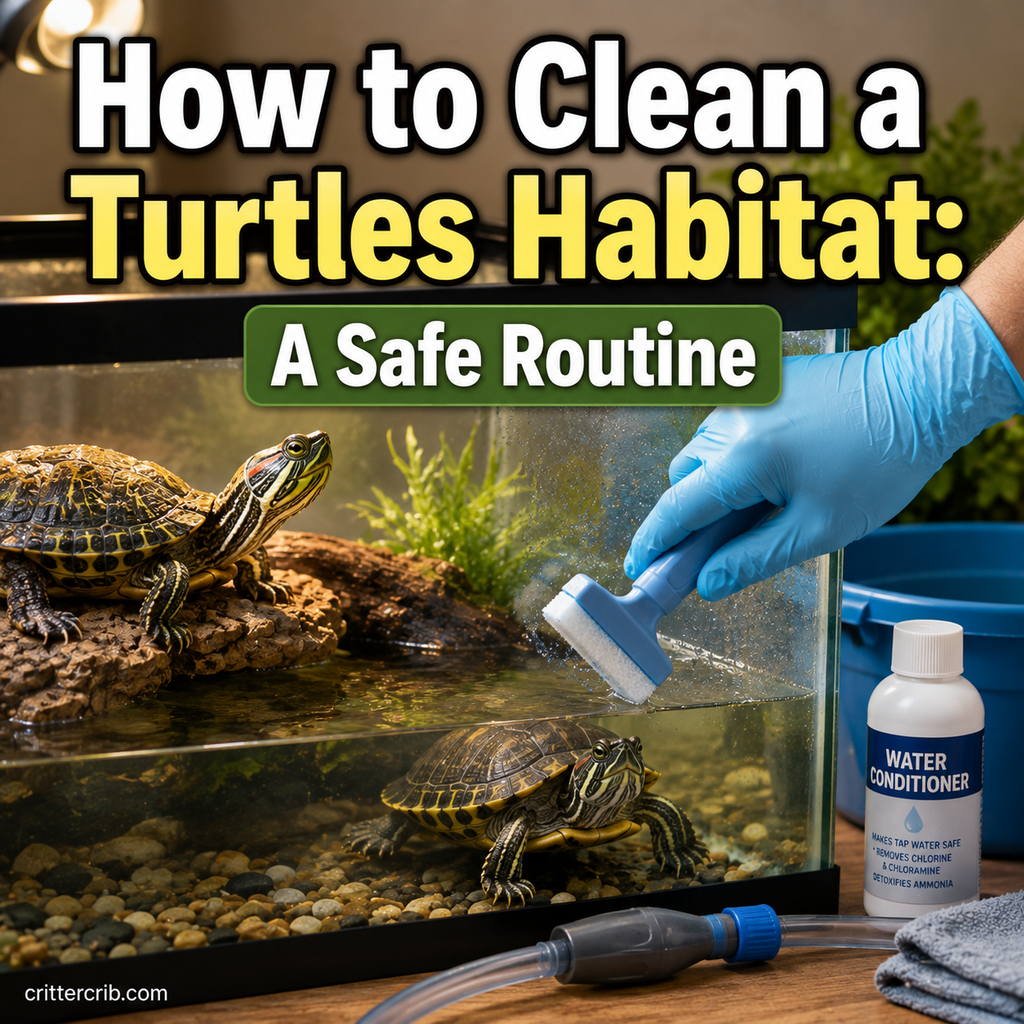
Keeping a turtle’s habitat clean isn’t just about making the tank look nice. Water quality, leftover food, waste, algae, and dirty equipment can all affect the environment your turtle lives in every day.
The good news is that turtle habitat cleaning doesn’t have to mean completely tearing apart the enclosure every weekend.
A better approach is to use a routine: remove obvious waste regularly, perform partial water changes, maintain the filter, clean surfaces as needed, and periodically give the habitat a more thorough cleaning.
The exact schedule depends on your turtle, enclosure size, filtration, feeding habits, and whether you’re caring for an aquatic, semi-aquatic, or terrestrial species.
Here’s how to clean a turtle habitat safely without making the process more complicated than it needs to be.
Why Turtle Habitats Get Dirty So Quickly
Aquatic turtles can be messy.
They eat, swim, and produce waste in the same water. Bits of food may sink between rocks or collect around decorations, while waste eventually breaks down and contributes to declining water quality.
A turtle habitat may also accumulate:
- Uneaten food
- Feces
- Shed skin
- Algae
- Organic debris
- Waste trapped in substrate
- Buildup on decorations
- Debris inside the filter
Warm water and strong lighting can make algae particularly noticeable.
This doesn’t mean you should try to create a completely sterile habitat. The goal is a clean, stable environment with good water quality, not an enclosure that has been disinfected constantly.
How Often Should You Clean a Turtle Tank?
There isn’t one cleaning schedule that works for every turtle enclosure.
A heavily stocked or undersized habitat may become dirty much faster than a spacious enclosure with strong filtration.
As a general routine, think of turtle habitat maintenance in four levels:
- Daily or every few days: remove leftover food and visible waste.
- Weekly: inspect the habitat, clean obvious buildup, and check equipment.
- Every 1–2 weeks: perform a partial water change as needed based on water quality.
- Periodically: perform more thorough cleaning of surfaces, substrate, and equipment when buildup requires it.
You don’t necessarily need to completely drain and disinfect the entire enclosure on a fixed schedule.
In fact, repeatedly sterilizing everything can disrupt the beneficial bacteria involved in biological filtration.
Water testing and the actual condition of the habitat are better guides than the calendar alone.
What You Need to Clean a Turtle Habitat
Having dedicated cleaning supplies makes maintenance much easier.
Useful supplies include:
- Aquarium siphon or gravel vacuum
- Clean buckets
- Algae scraper or aquarium-safe cleaning pad
- Soft brushes
- Paper towels or reusable cleaning cloths
- Water conditioner
- Aquarium water test kit
- Disposable gloves
- Small brush for equipment
- Temporary turtle container when necessary
Keep turtle-cleaning supplies separate from household cleaning equipment.
A bucket used for aquarium maintenance shouldn’t later become the bucket you use with household cleaners.
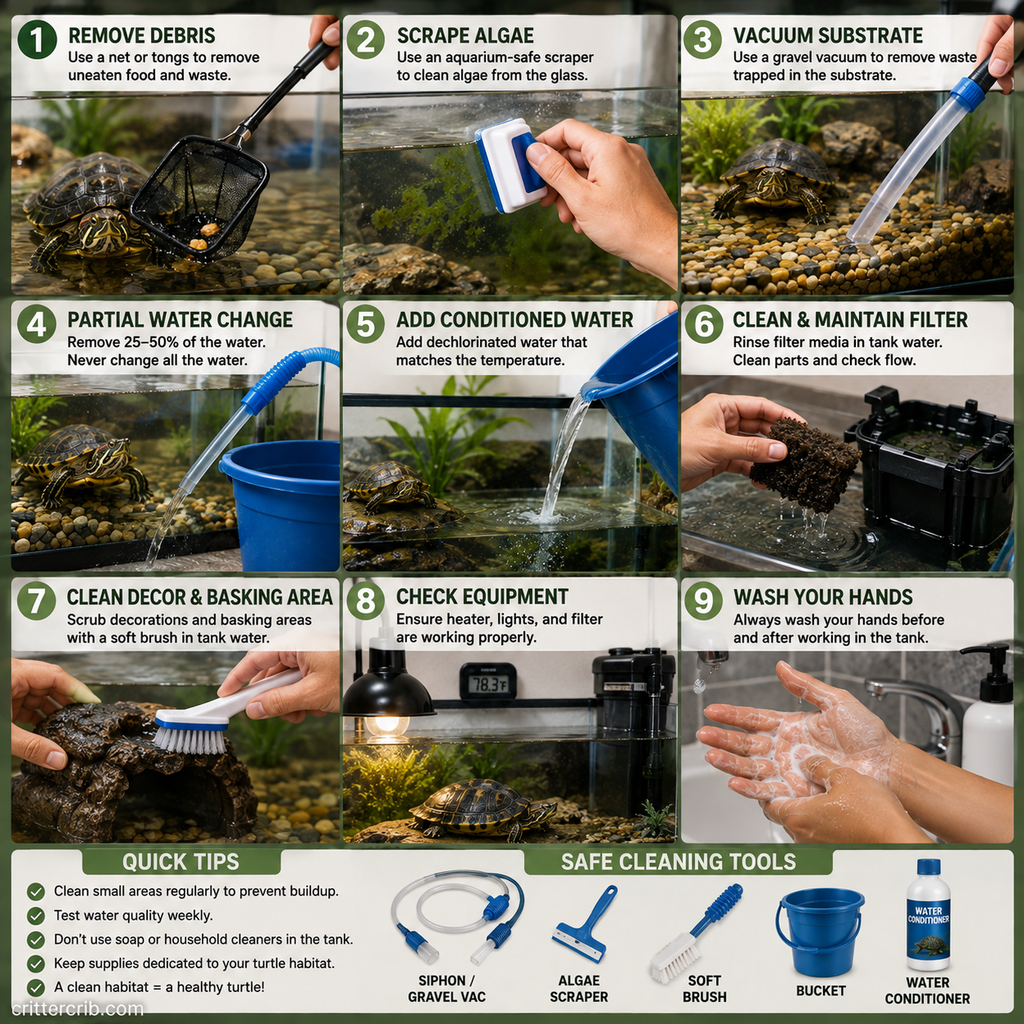
Wash Your Hands Before and After Turtle Habitat Cleaning
Turtles and their environments can carry Salmonella and other microorganisms even when the animals appear perfectly healthy.
Good hygiene is therefore an important part of turtle care.
Wash your hands thoroughly with soap and water after:
- Handling your turtle
- Touching tank water
- Cleaning the filter
- Handling substrate
- Cleaning decorations
- Touching turtle waste
- Working with enclosure equipment
Children should be supervised carefully around turtles and turtle habitats.
Avoid cleaning turtle equipment in areas used for preparing food. If a sink or bathtub is used for cleaning animal equipment, clean and disinfect the area afterward.
Should You Remove Your Turtle While Cleaning?
For small maintenance jobs, you may be able to leave your turtle in the habitat.
For example, removing a piece of uneaten food or wiping a small area usually doesn’t require relocating the animal.
For larger water changes or deep cleaning, temporarily moving the turtle can make the process safer and easier.
Use a secure container that:
- Prevents escape
- Provides adequate ventilation
- Keeps the turtle at an appropriate temperature
- Cannot be knocked over
- Is free from cleaning chemicals
Keep the cleaning process efficient so the turtle doesn’t remain in temporary housing longer than necessary.
How to Clean a Turtle Habitat Safely
A routine cleaning doesn’t need to involve stripping the enclosure down completely.
The following process works well as a general framework for many aquatic turtle habitats.
1. Gather Your Supplies
Prepare everything before starting.
You’ll want your siphon, bucket, scraper, brushes, water conditioner, towels, and replacement water ready to go.
This is much easier than discovering halfway through the job that your aquarium bucket is in the garage.
2. Unplug Electrical Equipment When Necessary
Water and electricity aren’t a good combination.
Before removing or cleaning electrical equipment, unplug items such as:
- Filters
- Heaters
- Pumps
- Other submerged electrical equipment
Follow the manufacturer’s instructions for your specific equipment.
Some aquarium heaters can be damaged if they’re allowed to operate while exposed to air.
3. Remove Uneaten Food and Large Debris
Start with the obvious mess.
Remove leftover food, feces, shed material, and other debris that can be easily collected.
A net or dedicated tool can make this quick.
Getting into the habit of removing uneaten food soon after feeding can significantly reduce the amount of material that breaks down in the water.
4. Clean Algae From the Glass
Use an aquarium-safe algae scraper or pad to remove buildup from viewing panels.
Don’t use a household sponge unless you know it has never been exposed to soap, detergent, disinfectant, or other chemicals.
Dedicated aquarium-cleaning tools are safer.
A small amount of algae isn’t automatically dangerous, but excessive growth can make the enclosure difficult to monitor and may signal that lighting, nutrients, or maintenance practices deserve attention.
5. Siphon the Substrate
If your turtle habitat contains gravel or another substrate that can be safely vacuumed, use an aquarium siphon to remove trapped waste.
Work through sections of the bottom rather than simply removing water from the top of the tank.
You’ll often be surprised by how much debris collects underneath seemingly clean substrate.
Be careful around your turtle if it remains inside the enclosure.
6. Perform a Partial Water Change
Rather than replacing all of the water during routine maintenance, remove a portion of it.
Partial water changes help reduce accumulated waste while maintaining greater environmental stability.
The amount and frequency depend on factors such as:
- Turtle size
- Enclosure volume
- Filtration capacity
- Feeding routine
- Number of animals
- Water test results
Water that looks clear isn’t necessarily clean.
Testing is the best way to understand what’s happening chemically.
7. Prepare the Replacement Water
Tap water may contain chlorine or chloramine, depending on your municipal water supply.
Use an aquarium water conditioner appropriate for your water source and follow the product directions.
Replacement water should also be reasonably close to the habitat’s normal water temperature.
Suddenly adding a large volume of dramatically colder or hotter water can create unnecessary stress.
8. Refill the Habitat
Add conditioned water gradually.
Avoid blasting substrate, decorations, or your turtle with a strong stream of water.
Once the habitat has been refilled to the correct level, check that basking areas and other features remain safely accessible.
9. Restart and Check the Equipment
Restart filters, heaters, and other equipment according to their instructions.
Then verify that everything is actually working.
Check for:
- Filter flow
- Correct heater operation
- Proper water level
- Leaks
- Shifted decorations
- Stable basking platforms
- Correct temperatures
A cleaning session is a good opportunity to inspect equipment for wear or damage.
How to Clean a Turtle Tank Filter
The filter is one of the most important parts of an aquatic turtle habitat.
It’s also one of the easiest things to clean too aggressively.
Aquarium filters may provide mechanical, biological, and chemical filtration. Beneficial bacteria colonize biological filter media and help process waste compounds.
If you sterilize all of the media at once, you can disrupt that biological community.
Rinse Filter Media Carefully
When reusable filter media becomes dirty, gently rinse it according to the filter manufacturer’s recommendations.
For biological media, using removed tank water is often preferable to aggressively washing it under chlorinated tap water.
The goal is to remove excessive debris without trying to make every piece of media sterile.
Don’t Replace Everything at Once
Some filter components need periodic replacement, particularly certain chemical media or disposable cartridges.
However, avoid replacing all established biological media simultaneously unless the manufacturer or circumstances specifically require it.
Staggering maintenance can help preserve biological filtration.
Clean the Impeller and Intake
Debris can collect around the filter intake and impeller, reducing water flow.
Inspect these areas periodically and clean them according to the manufacturer’s directions.
Reduced filter output doesn’t always mean the filter is broken. Sometimes it simply needs maintenance.
How Powerful Should Turtle Tank Filtration Be?
Turtles generally produce more waste than similarly sized aquarium fish, so strong filtration is valuable.
A filter rated only for the exact volume of your turtle tank may struggle with the waste load.
Many turtle keepers use filtration rated for substantially more water than the enclosure actually contains.
However, filter ratings vary between manufacturers and don’t guarantee good water quality by themselves.
Proper filtration still needs to be combined with:
- Adequate enclosure size
- Regular water changes
- Waste removal
- Appropriate feeding
- Water testing
- Filter maintenance
Think of the filter as part of the cleaning system, not a replacement for cleaning.
How to Clean Turtle Tank Decorations
Rocks, hides, artificial plants, basking platforms, and other decorations can collect algae and organic material.
Remove them when they need more thorough cleaning.
Scrub surfaces with:
- Warm water
- A dedicated brush
- An aquarium-safe cleaning method appropriate for the material
Avoid casually using household cleaning chemicals.
Decorations with cracks and textured surfaces may require extra attention because waste can become trapped in them.
Before returning anything to the habitat, inspect it for:
- Sharp edges
- Cracks
- Loose pieces
- Instability
- Areas where the turtle could become trapped
A decoration that was safe six months ago may no longer be appropriate for a turtle that has grown.
How to Clean a Turtle’s Basking Area
Basking platforms can accumulate waste, algae, food debris, and mineral deposits.
Remove loose debris regularly and scrub the platform when necessary.
Make sure it is completely secure when returned to the enclosure.
The basking area should allow an aquatic turtle to leave the water and dry off appropriately.
Cleaning is also a good time to check that the platform hasn’t become too small.
As turtles grow, basking areas that once worked perfectly can become difficult to climb onto or too cramped for comfortable use.
How to Clean Turtle Tank Substrate
The cleaning method depends on what you use at the bottom of the enclosure.
Gravel
If gravel is appropriate for your setup, use a gravel vacuum to pull waste from between the pieces.
Be cautious with gravel small enough for a turtle to swallow.
Sand
Sand can trap debris along the surface.
A siphon can be held just above the sand to remove waste without sucking out large amounts of substrate.
Some sand will inevitably be lost over time.
Bare Bottom
Bare-bottom turtle habitats are easier to clean because waste remains visible and can be siphoned directly.
They may not look as natural, but maintenance is straightforward.
Large Stones
Large stones can trap significant amounts of debris underneath them.
Lift and clean beneath rocks periodically rather than assuming the visible surface represents the condition of the entire tank.
Any heavy objects should be positioned securely so digging or movement can’t cause them to fall onto the turtle.
What Cleaning Products Are Safe for Turtle Habitats?
For routine cleaning, plain water, physical scrubbing, aquarium-safe tools, and proper water maintenance are often all you need.
Avoid introducing household cleaning residues into the habitat.
Products that may be dangerous when improperly used include:
- Dish soap
- Household detergents
- Glass cleaner
- Scented cleaners
- General-purpose sprays
- Bathroom cleaners
- Products containing fragrances or other residues
If disinfection is necessary because of illness, quarantine, or another specific situation, use a method appropriate for reptiles and follow veterinary or product instructions carefully.
Never mix cleaning chemicals.
And never return your turtle to an enclosure that still contains cleaning-product residue.
Can You Use Vinegar to Clean a Turtle Tank?
Diluted white vinegar is sometimes used outside an occupied aquarium to help remove mineral deposits from glass or equipment.
It can be particularly useful for hard-water buildup.
If you use it, the item should be thoroughly rinsed before it returns to the habitat.
Vinegar isn’t a substitute for proper water maintenance, filtration, or veterinary-grade disinfection when actual disinfection is required.
For routine cleaning, physical removal of waste remains the priority.
Should You Use Soap to Clean a Turtle Tank?
It’s generally best to avoid soap and household detergents on aquarium surfaces, decorations, and equipment.
Residues can be difficult to remove completely and may enter the water when the enclosure is refilled.
Dedicated aquarium tools and appropriate cleaning methods are a safer choice.
How to Deep Clean a Turtle Habitat
Routine partial cleaning should handle most maintenance.
Occasionally, however, a habitat may need more extensive cleaning because of heavy buildup, a major equipment issue, or another specific problem.
A deep clean may involve:
- Moving the turtle to secure temporary housing.
- Unplugging and removing equipment.
- Removing decorations.
- Draining most or all of the water when necessary.
- Cleaning accumulated debris from the enclosure.
- Cleaning substrate or replacing it if appropriate.
- Scrubbing decorations and basking areas.
- Servicing filter components.
- Rinsing cleaned surfaces thoroughly.
- Refilling with properly conditioned water.
- Restoring appropriate temperatures.
- Restarting and checking all equipment.
- Returning the turtle once conditions are appropriate.
Avoid automatically sterilizing established biological filter media during the process.
A deep clean should leave the habitat cleaner, not accidentally destroy the biological filtration you’ve spent months establishing.
How to Keep a Turtle Tank Cleaner Between Water Changes
The easiest habitat to clean is one that isn’t allowed to become extremely dirty in the first place.
A few habits make a major difference.
Remove Leftover Food
Don’t leave uneaten food sitting in the habitat indefinitely.
Remove leftovers before they have time to break down.
Use Adequate Filtration
A properly sized filter helps capture debris and process waste continuously.
Avoid Overfeeding
More food isn’t necessarily better.
Excess food eventually becomes excess waste, whether the turtle eats it or not.
Use a Large Enough Habitat
More water volume can provide greater dilution and environmental stability than a very small volume of water.
A larger habitat also gives you more room to position equipment effectively.
Maintain the Filter
A clogged filter can’t operate efficiently.
Check flow and clean components as needed.
Test the Water
Don’t judge water quality only by appearance or smell.
Regular testing provides information you can’t get by simply looking into the tank.
Should You Feed a Turtle in a Separate Container?
Some owners feed aquatic turtles in a separate container to reduce food debris in the main habitat.
This can work for some animals, but it isn’t necessary for every turtle.
Moving the turtle back and forth may also create additional handling and stress.
If your turtle eats cleanly in its primary enclosure and your filtration and maintenance routine keep up with the waste, separate feeding may offer little benefit.
Choose the approach that works best for the individual turtle and your husbandry routine.
What About Cleaning a Terrestrial Turtle Habitat?
Not every turtle lives primarily in water.
Terrestrial and semi-terrestrial species require a somewhat different cleaning routine.
Instead of focusing heavily on water changes and aquarium filtration, maintenance may involve:
- Spot-cleaning feces
- Removing uneaten food
- Replacing soiled substrate
- Cleaning water dishes
- Cleaning hides
- Removing moldy material
- Maintaining appropriate substrate moisture
- Inspecting the enclosure for pests
Avoid replacing all substrate unnecessarily if spot cleaning and partial replacement are sufficient.
The correct approach depends on the species and habitat design.
Common Turtle Habitat Cleaning Mistakes
A few well-intentioned cleaning habits can create problems.
Completely Sterilizing the Tank Too Often
A turtle habitat doesn’t need to be sterile.
Repeatedly stripping and disinfecting everything can disrupt biological filtration and create unnecessary instability.
Cleaning the Filter Too Aggressively
Making biological filter media look brand new isn’t the goal.
Preserving beneficial bacteria matters.
Replacing All Filter Media at Once
This can remove a significant portion of the filter’s established biological community.
Using Household Cleaning Products
Residues from soap, sprays, and detergents can end up in the habitat.
Changing All the Water Every Time
Routine partial water changes are usually more appropriate than repeatedly draining everything.
Ignoring Debris Under Decorations
The visible part of the tank may look spotless while waste accumulates underneath rocks and platforms.
Waiting Until the Tank Smells
A bad smell means you probably waited too long.
Water quality can deteriorate before the habitat becomes visibly filthy.
Signs Your Turtle Habitat Needs More Frequent Maintenance
Every enclosure is different, so adjust your routine based on what you’re observing.
You may need to increase maintenance if you notice:
- Rapid accumulation of waste
- Persistent cloudy water
- Strong odors
- Excessive leftover food
- Reduced filter flow
- Heavy debris in the substrate
- Significant buildup on surfaces
- Water-test results moving outside appropriate ranges
If a large habitat with adequate filtration becomes dirty unusually quickly, review feeding practices and filter maintenance as well.
Cleaning more often isn’t always the only solution.
Cleaning Doesn’t Replace Good Turtle Husbandry
A spotless tank can still be an unsuitable habitat.
Turtles also require species-appropriate:
- Water temperature
- Basking temperature
- UVB lighting
- Basking access
- Diet
- Water depth
- Enclosure size
- Substrate
- Hides
- Humidity where applicable
Habitat cleanliness is one part of the larger care picture.
For aquatic turtles in particular, clean water, appropriate heating, effective filtration, and proper basking conditions all work together.
A Simple Turtle Habitat Cleaning Routine
If all of this sounds complicated, simplify it into a repeatable schedule.
Daily or Every Few Days
- Remove uneaten food.
- Remove obvious waste.
- Check the turtle’s behavior.
- Make sure equipment is operating.
- Check water and basking temperatures.
Weekly
- Inspect the water and habitat.
- Test water quality as appropriate.
- Remove algae and visible buildup.
- Check filter flow.
- Clean the water or feeding area as needed.
Every 1–2 Weeks
Depending on water-test results and the enclosure:
- Perform a partial water change.
- Siphon accumulated debris.
- Clean accessible surfaces.
- Inspect equipment.
As Needed
- Service the filter.
- Clean decorations.
- Remove mineral buildup.
- Replace worn equipment.
- Perform more extensive cleaning when genuinely necessary.
The ideal schedule may be more or less frequent depending on your setup.
Use the condition of the habitat and water-test results to refine your routine.
Frequently Asked Questions About Cleaning a Turtle Habitat
How often should I completely clean my turtle tank?
You usually don’t need to completely sterilize an established turtle habitat on a frequent schedule. Routine waste removal, partial water changes, substrate cleaning, and filter maintenance are generally preferable. More extensive cleaning can be performed when buildup or specific circumstances require it.
How often should turtle water be changed?
Partial water changes are commonly performed every one to two weeks, but the correct frequency depends on enclosure size, filtration, turtle size, feeding, and water-test results. Some setups require more frequent maintenance.
Can I clean a turtle tank with dish soap?
It’s best to avoid dish soap and household detergents on aquarium surfaces and equipment because residues can remain behind. Use dedicated aquarium-cleaning tools and appropriate cleaning methods instead.
Why does my turtle tank smell even after cleaning?
Persistent odors can result from trapped organic debris, inadequate filtration, overfeeding, dirty filter components, waste beneath substrate or decorations, or poor water quality. Identify the source rather than simply masking the smell.
Can I use tap water in my turtle tank?
Tap water can contain chlorine or chloramine. Use an appropriate aquarium water conditioner according to its instructions before adding treated tap water to the habitat.
Should I remove my turtle during a water change?
Small partial water changes may be possible with the turtle remaining inside, provided the process is safe. For extensive cleaning, temporarily moving the turtle to a secure, appropriately maintained container can make the job easier.
Why does my turtle tank turn green?
Green water or algae growth can be influenced by light and available nutrients. Some algae is normal, but excessive growth may warrant reviewing lighting duration, waste accumulation, feeding, filtration, and maintenance.
Can a turtle tank look clean but have bad water quality?
Yes. Clear water isn’t proof of good water quality. Dissolved waste compounds aren’t necessarily visible, which is why water testing is important.
Final Thoughts
Cleaning a turtle habitat is much easier when you treat it as ongoing maintenance rather than waiting for the enclosure to become visibly dirty.
Remove leftover food and waste regularly. Perform partial water changes based on the needs of your setup. Keep the filter working efficiently without unnecessarily sterilizing its biological media. Clean decorations and substrate as waste accumulates, and use water testing to understand what’s happening beyond what you can see.
Most importantly, don’t try to make the habitat sterile.
A healthy turtle environment is clean and well maintained, but it’s also biologically stable.
Once you establish a routine that fits your turtle, enclosure, and filtration system, cleaning becomes a relatively predictable part of turtle ownership rather than a major project every time the tank starts looking dirty.