Getting the temperature and humidity right is one of the most important parts of keeping a leopard gecko healthy.
Fortunately, leopard geckos don’t need a tropical enclosure with complicated misting systems. They come from relatively dry environments and generally do well with moderate ambient humidity. What they do need is a proper temperature gradient, a warm place to digest food, and access to a humid hide when they need additional moisture.
The important word is gradient.
A leopard gecko enclosure shouldn’t be one temperature from end to end. Your gecko needs warmer and cooler areas so it can move around and regulate its body temperature naturally.
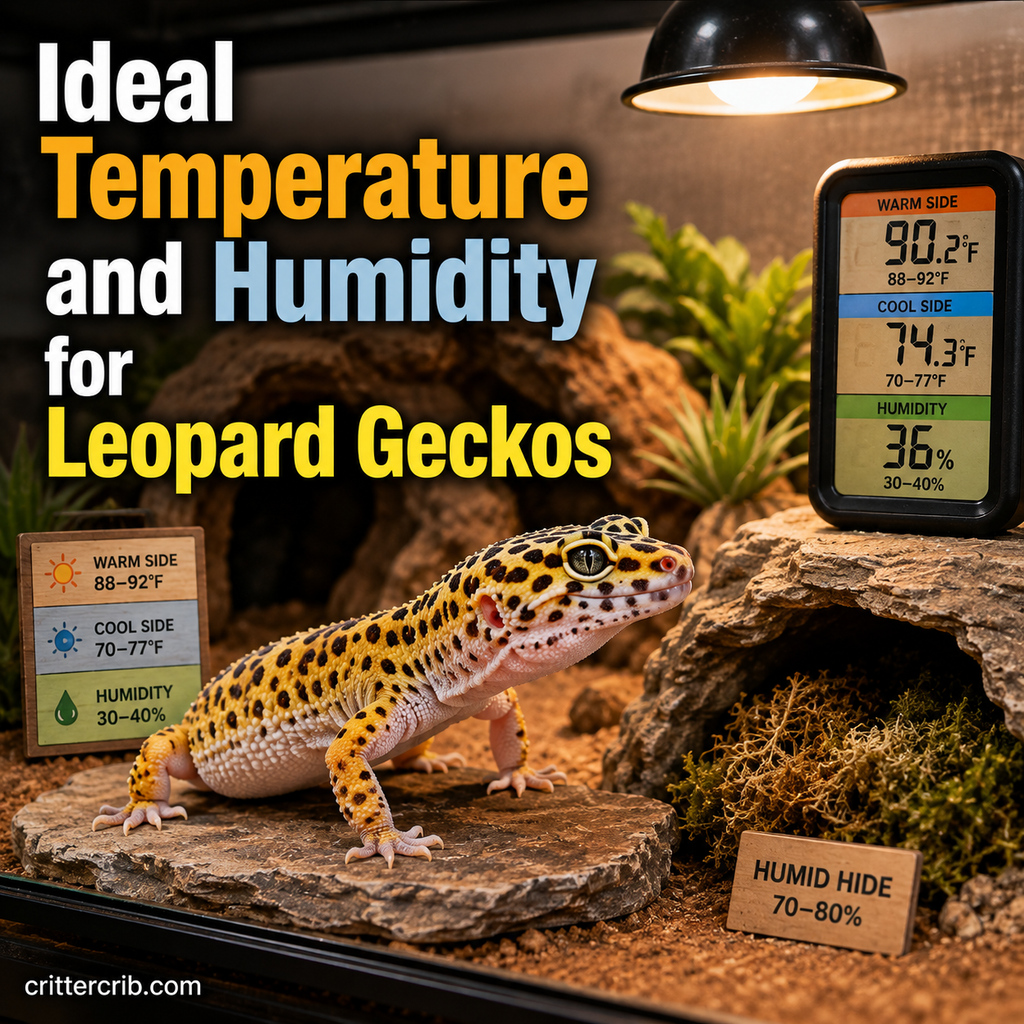
As a general starting point, aim for a warm hide and warm-side surface temperature of roughly 88–92°F (31–33°C), with a cooler side around 70–77°F (21–25°C). General enclosure humidity can usually remain around 30–40%, while the humid hide should be noticeably more humid.
Those numbers are useful targets, but knowing where and how to measure them is just as important.
Here’s how to create and maintain the right temperature and humidity for a leopard gecko.
Leopard Gecko Temperature and Humidity at a Glance
For quick reference, a typical leopard gecko enclosure should provide approximately:
- Warm hide/surface: 88–92°F (31–33°C)
- Warm-side air temperature: roughly 80–85°F (27–29°C)
- Cool side: approximately 70–77°F (21–25°C)
- Nighttime: temperatures can safely drop into the upper 60s to low 70s°F for healthy adults when appropriate
- General humidity: approximately 30–40%
- Humid hide: substantially higher humidity than the rest of the enclosure, often around 70–80%
These aren’t meant to make you panic if your thermometer briefly reads a degree outside the range.
The goal is to create a stable environment with appropriate choices rather than attempting to keep every square inch at one exact number.
Why Temperature Matters So Much for Leopard Geckos
Leopard geckos are ectothermic.
Unlike humans, they don’t maintain their body temperature primarily through internal metabolic heat. Instead, they depend on their environment.
A gecko moves between warmer and cooler areas depending on what its body needs.
Appropriate temperatures influence:
- Digestion
- Activity
- Appetite
- Metabolism
- Immune function
- Rest
- Overall behavior
If the enclosure is consistently too cold, a leopard gecko may become less active and have difficulty digesting meals properly.
If it’s excessively hot and the gecko has nowhere cooler to retreat, overheating becomes a serious concern.
This is why creating a temperature gradient is much more useful than simply trying to make the enclosure “warm.”
What Is the Ideal Warm-Side Temperature?
The warm portion of the enclosure should give your leopard gecko access to temperatures suitable for digestion and thermoregulation.
A useful target for the warm hide and nearby warm surface is approximately 88–92°F.
The surrounding warm-side air may be somewhat cooler, often around 80–85°F.
Don’t confuse surface temperature with air temperature.
A rock or piece of substrate beneath a heat source can be warmer than the air immediately above it.
Both measurements can be useful, but they tell you different things.
Why the Warm Hide Matters
Leopard geckos often prefer to thermoregulate while remaining partially or completely concealed.
Providing a warm hide allows the gecko to access warmth without feeling exposed.
The hide should be positioned so that its interior reaches an appropriate temperature without becoming dangerously hot.
What Is the Ideal Cool-Side Temperature?
The cooler side of the enclosure should generally remain around 70–77°F.
This provides your gecko with somewhere to retreat after warming up.
If the entire enclosure is 90°F, your gecko can’t meaningfully cool itself.
Likewise, if the entire enclosure remains around 70°F, it doesn’t have sufficient access to a warm digestive zone.
A proper enclosure gives the animal choices.
That’s the basic idea behind reptile thermoregulation.
What Temperature Should a Leopard Gecko Enclosure Be at Night?
Leopard geckos don’t require daytime temperatures around the clock.
A nighttime temperature drop is natural.
For healthy adult leopard geckos, temperatures can generally fall into the upper 60s or low 70s°F at night.
If your room remains comfortably within that range, additional nighttime heating may not be necessary.
If temperatures regularly fall significantly lower, supplemental heat may be appropriate.
Do Leopard Geckos Need a Red Heat Lamp at Night?
No.
Red, blue, purple, or other colored “night” bulbs aren’t necessary for leopard geckos.
If nighttime heat is genuinely required, use a heat source that doesn’t produce visible light and control it appropriately with a thermostat.
Keeping visible lights on throughout the night can interfere with a natural day-night cycle.
Your gecko should experience darkness.
Do Leopard Geckos Need a Basking Spot?
Leopard geckos are often described as animals that only need “belly heat,” but that’s an oversimplification.
In nature, reptiles can absorb heat from surfaces that were warmed by the sun, but they can also use radiant heat.
A properly designed overhead heating setup can provide a naturalistic thermal gradient.
Halogen-style basking lamps are commonly used during the daytime because they provide radiant heat.
Whatever heating method you choose, it needs to be:
- Appropriate for the enclosure
- Properly positioned
- Monitored
- Controlled with suitable equipment
- Able to create a safe gradient
The goal isn’t to follow a slogan about belly heat versus overhead heat.
The goal is to provide the gecko with safe, usable thermal choices.
Heat Lamp vs. Heat Mat for Leopard Geckos
Both are commonly encountered in leopard gecko setups, but they work differently.
Overhead Heating
A properly configured overhead heat source can warm surfaces and create a broader thermal zone.
Potential advantages include:
- More naturalistic radiant heating
- A broader basking area
- Better heating of enclosure surfaces
- A clear daytime heat cycle
The heat source should never be allowed to overheat the enclosure.
Heat Mats
Heat mats warm the surface directly above them.
They were historically very common in leopard gecko husbandry and can still provide supplemental heat when used correctly.
However, a heat mat should never be used without appropriate temperature control.
Unregulated heat mats can become dangerously hot.
Which Is Better?
Many modern setups use controlled overhead heating as the primary daytime heat source.
The exact solution depends on enclosure design, room temperature, substrate, and other factors.
Whichever method you use, don’t guess at temperatures.
Measure them.
Why Every Heat Source Needs Proper Control
Reptile heating equipment can produce more heat than expected.
That’s why thermostatic control is so important.
A thermostat monitors temperature and adjusts the heat source to help prevent unsafe overheating.
Different heat sources may work best with different types of thermostatic control, so match the thermostat to the equipment you’re using.
Don’t confuse a thermostat with a thermometer.
A thermometer tells you what the temperature is.
A thermostat helps control the heat source.
Ideally, you need both.
How to Measure Leopard Gecko Temperatures Correctly
Accurate measurement makes husbandry much easier.
Instead of wondering whether the enclosure “feels warm enough,” use appropriate equipment.
Useful tools include:
- Digital thermometers with probes
- Infrared temperature gun
- Digital thermometer/hygrometer combinations
- Thermostat controlling the heat source
Avoid relying solely on inexpensive analog dial gauges.
Using Digital Probe Thermometers
Digital probes are useful for monitoring temperatures continuously in important areas.
Place probes where they accurately represent the conditions you’re trying to measure.
For example, you may monitor the warm hide and cooler side separately.
Using an Infrared Temperature Gun
An infrared temperature gun is excellent for checking surface temperatures.
Point it at:
- Basking surfaces
- Substrate
- Inside accessible hides
- Different points along the temperature gradient
It provides an immediate surface reading.
Remember that it doesn’t measure air temperature.
Using both fixed digital thermometers and an infrared temperature gun gives you a much better picture of the enclosure.
Where Should Thermometers Go in a Leopard Gecko Tank?
One thermometer in the middle of the enclosure doesn’t tell you enough.
Ideally, monitor conditions at both ends.
A practical arrangement includes:
- A probe or sensor near the warm hide
- Another sensor toward the cooler side
- A hygrometer positioned where it reflects general enclosure humidity
You can then use an infrared thermometer to spot-check surface temperatures.
This helps you see whether a genuine gradient exists.
What Is the Ideal Humidity for a Leopard Gecko?
General enclosure humidity can usually remain around 30–40%.
Leopard geckos are adapted to relatively dry conditions, so their entire enclosure shouldn’t feel tropical or constantly damp.
However, “dry species” doesn’t mean “zero humidity.”
Leopard geckos still need access to moisture, particularly during shedding.
That’s where the humid hide becomes important.
What Is a Humid Hide?
A humid hide is an enclosed retreat containing moisture-retaining material.
It creates a small pocket of higher humidity without making the entire habitat wet.
Your gecko can enter the hide when it needs additional moisture.
A humid hide is especially useful during shedding.
Suitable moisture-retaining materials may include:
- Damp paper towel
- Sphagnum moss
- Other appropriate moisture-holding substrate
The material should be damp, not flooded.
Where Should the Humid Hide Go?
The humid hide is commonly positioned toward the middle or warm portion of the enclosure.
Some warmth helps maintain humidity inside the hide.
Avoid placing it where it becomes excessively hot or dries out immediately.
Experiment with positioning while monitoring conditions.
What Humidity Should a Leopard Gecko Humid Hide Be?
The humid hide should be considerably more humid than the general enclosure.
A range around 70–80% can provide the higher-moisture microclimate needed for shedding.
You don’t necessarily need to obsess over maintaining one exact percentage every hour.
Instead, make sure the hide remains appropriately moist without becoming waterlogged, dirty, or moldy.
Your gecko should be able to choose between:
- Warm and relatively dry
- Cool and relatively dry
- Warm or moderate and humid
Those different microclimates allow the animal to select the conditions it needs.
Should You Mist a Leopard Gecko Tank?
Routine heavy misting of the entire enclosure generally isn’t necessary.
Leopard geckos aren’t tropical rainforest reptiles.
Repeatedly soaking the enclosure can push ambient humidity too high and keep substrate unnecessarily wet.
Instead, focus on maintaining the humid hide.
If general humidity becomes excessively low, you can make careful adjustments based on actual hygrometer readings rather than automatically spraying the entire enclosure every day.
How Often Should You Moisten the Humid Hide?
Check it regularly.
How quickly it dries depends on:
- Heat
- Ventilation
- Hide design
- Material used
- Room humidity
- Enclosure size
Some setups may need the hide remoistened every few days, while others retain moisture longer.
Touch the material and inspect it.
It should remain damp enough to create a humid microclimate but shouldn’t smell bad, grow mold, or become saturated with standing water.
Replace dirty material as necessary.
Why Humidity Is Important During Shedding
Leopard geckos periodically shed their skin as they grow and renew the outer layer.
Before a shed, the skin may become:
- Pale
- Dull
- Grayish
- Less vibrant
The gecko may also spend more time inside its humid hide.
Appropriate humidity helps the old skin separate properly.
Problem areas commonly include:
- Toes
- Feet
- Tail tip
- Around the eyes
Retained shed around toes can become especially problematic because it may restrict circulation.
Providing an appropriate humid hide is one of the easiest ways to reduce shedding difficulties.
Is High Humidity Bad for Leopard Geckos?
Persistently high ambient humidity isn’t ideal.
A leopard gecko shouldn’t live in a constantly wet, tropical enclosure.
Excessive moisture can contribute to unsanitary conditions and may increase the risk of health problems.
If general humidity consistently remains too high, investigate why.
Possible causes include:
- Poor ventilation
- Constant misting
- Excessively wet substrate
- A very large water dish
- Humid room conditions
- Water spilling into substrate
- Enclosure design
Don’t respond by trying to make the habitat bone-dry.
Instead, bring the general enclosure back into an appropriate range while maintaining the humid hide.
What If Leopard Gecko Humidity Is Too Low?
If your hygrometer regularly reads below the desired range, first confirm that the reading is accurate.
Very inexpensive or poorly positioned humidity gauges can give misleading information.
If humidity genuinely is very low, consider:
- Ensuring the humid hide stays moist
- Reviewing ventilation
- Checking room humidity
- Adjusting water-dish placement
- Using a substrate appropriate for your husbandry approach
Avoid turning the entire enclosure into a wet environment just to chase a particular number.
For leopard geckos, access to a humid microclimate is particularly important.
Does a Leopard Gecko Need a Water Bowl?
Yes.
Provide fresh water in a stable, shallow dish.
Even if you rarely see your gecko drink, water should remain available.
Clean the dish regularly and replace the water when it becomes contaminated.
Water-bowl placement can have a small effect on humidity.
If humidity is consistently too high, placing the bowl away from the hottest area may reduce evaporation.
How Substrate Affects Humidity
Different substrates hold moisture differently.
Paper towel retains relatively little moisture and is easy to monitor, which can make it useful during quarantine or for certain temporary situations.
Naturalistic substrate mixtures may hold more moisture beneath the surface while remaining relatively dry on top.
Loose substrate requires appropriate husbandry, including correct temperatures, diet, hydration, and enclosure design.
Avoid choosing substrate based only on appearance.
Consider how it interacts with:
- Humidity
- Digging behavior
- Cleaning
- Heating
- Feeding
- Overall enclosure conditions
How Enclosure Ventilation Affects Humidity
Ventilation plays a major role in humidity.
A highly ventilated enclosure loses moisture more quickly.
An enclosure with limited airflow may retain too much.
This is one reason copying someone else’s misting schedule doesn’t always work.
Two seemingly identical leopard gecko enclosures can maintain different humidity levels because they’re located in different homes.
Your local climate matters too.
A home in a dry desert region may require different moisture management than a home in a humid coastal area.
Measure your actual enclosure instead of relying entirely on a generic schedule.
Seasonal Changes in Temperature and Humidity
Your leopard gecko’s enclosure doesn’t exist independently of your home.
Room conditions change throughout the year.
In winter, indoor heating can make household air much drier.
In summer, room temperatures may increase substantially.
Humidity may also rise during rainy periods.
Check enclosure conditions more frequently when seasons change.
A heat source that worked perfectly in January may create excessive temperatures during a summer heat wave.
Likewise, a humid hide that stayed moist for several days during winter may dry much faster under warmer conditions.
What Happens If a Leopard Gecko Gets Too Cold?
A leopard gecko kept consistently below appropriate temperatures may show changes such as:
- Reduced activity
- Reduced appetite
- Spending excessive time in the warm hide
- Slower digestion
- Behavioral changes
Temperature should be one of the first things you check when appetite or activity changes.
Don’t automatically assume temperature is the only possible cause, though.
Persistent appetite loss, lethargy, weight loss, or other abnormal symptoms can also indicate illness and should be evaluated appropriately.
Signs a Leopard Gecko May Be Too Hot
A properly designed enclosure lets the gecko escape excessive heat.
Possible warning signs that conditions deserve checking include:
- Constantly staying on the coolest side
- Avoiding the warm hide entirely
- Repeated attempts to escape
- Unusual restlessness
- Spending abnormal amounts of time in the water dish
Behavior alone can’t tell you the exact temperature.
Use your thermometer and infrared temperature gun.
If the enclosure is genuinely overheating, correct the heat source and thermostat setup immediately.
Why Your Leopard Gecko May Stay in One Hide
Owners sometimes worry when a leopard gecko seems to choose one hide constantly.
That doesn’t necessarily mean something is wrong.
Your gecko may simply prefer:
- The temperature
- The humidity
- The security
- The shape of the hide
- Its location
However, consistent preference for one extreme end of the enclosure can provide useful information.
If the gecko never leaves the cool side, check whether the warm side is too hot.
If it rarely leaves the warm hide, check whether the rest of the enclosure is too cold.
The gecko’s behavior and your measurements work together.
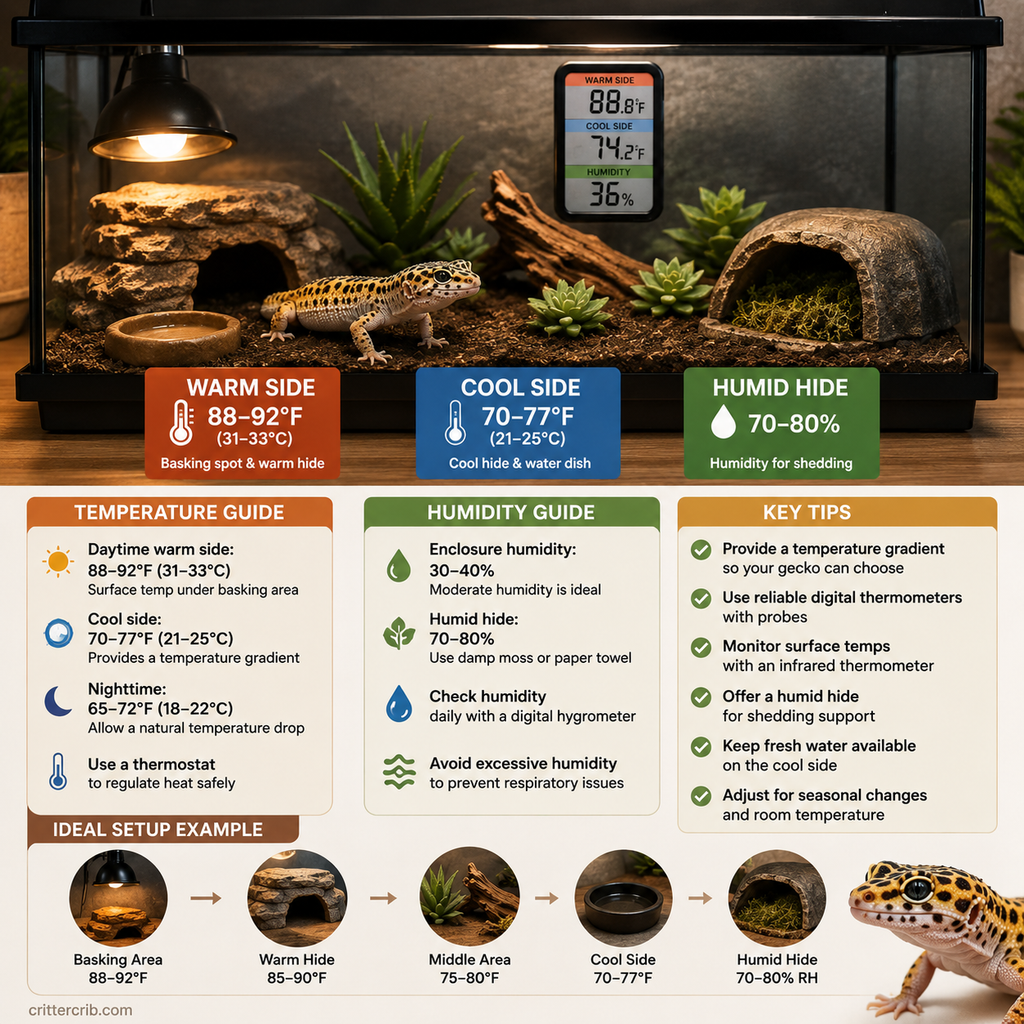
A Simple Leopard Gecko Temperature Setup
A basic thermal arrangement might look like this:
Warm Side
Provide:
- Controlled overhead heat source
- Warm hide
- Warm surface around 88–92°F
- Appropriate daytime lighting
Middle
Provide:
- Humid hide
- Moderate temperatures
- Environmental cover
Cool Side
Provide:
- Cool hide
- Water dish
- Temperatures around 70–77°F
This gives the gecko multiple choices without making the habitat unnecessarily complicated.
A Simple Daily Temperature and Humidity Routine
You don’t need to spend an hour analyzing the enclosure every morning.
A quick routine can keep you informed.
Each Day
- Check the warm-side temperature.
- Check the cool-side temperature.
- Look at the humidity reading.
- Make sure the heat source is operating normally.
- Check the humid hide.
- Replace water as needed.
- Observe where your gecko is spending its time.
Periodically
- Verify surface temperatures with an infrared thermometer.
- Inspect thermostat probes.
- Check lighting and heating equipment.
- Clean thermometer and hygrometer sensors if needed.
- Compare readings between devices if something looks unusual.
- Adjust for seasonal changes.
Consistency is more important than constantly changing the setup.
Common Leopard Gecko Temperature and Humidity Mistakes
Beginners often run into the same few problems.
Keeping the Entire Enclosure the Same Temperature
Your gecko needs a gradient.
Using Heat Without a Thermostat
Uncontrolled heat sources can create unsafe temperatures.
Measuring Only One Spot
One thermometer can’t accurately represent the entire enclosure.
Confusing Air and Surface Temperature
They’re different measurements and can vary significantly.
Keeping Lights on at Night
Leopard geckos need a normal dark period.
Using Colored Night Bulbs
Visible red or blue nighttime lighting isn’t necessary.
Misting the Entire Enclosure Constantly
Focus on an appropriate humid hide rather than creating tropical conditions.
Letting the Humid Hide Dry Completely
Check it regularly, especially around shedding.
Making the Humid Hide Soaking Wet
Humid doesn’t mean flooded.
Trusting Behavior Without Measuring
Your gecko’s behavior provides clues, but actual temperature and humidity readings tell you what the environment is doing.
Frequently Asked Questions About Leopard Gecko Temperature and Humidity
What temperature should a leopard gecko tank be?
Aim for a warm hide and warm surface around 88–92°F, a warm-side air temperature around 80–85°F, and a cooler side around 70–77°F. Providing a gradient is more important than maintaining one temperature throughout the enclosure.
What humidity should a leopard gecko tank be?
General enclosure humidity is commonly maintained around 30–40%, with a separate humid hide providing substantially higher humidity for shedding and hydration.
What humidity should a leopard gecko humid hide be?
Around 70–80% can provide a useful humid microclimate. The material inside should remain damp rather than soaking wet.
How cold is too cold for a leopard gecko at night?
Healthy adult leopard geckos can generally tolerate nighttime temperatures in the upper 60s°F. If your enclosure regularly drops significantly below that, supplemental non-light-emitting heat may be necessary.
Should I turn my leopard gecko’s heat off at night?
If your room remains warm enough, nighttime heating may not be necessary. If temperatures drop too low, provide a suitable non-light-emitting heat source controlled appropriately.
Do leopard geckos need heat at night?
Not necessarily. It depends on your room temperature. A natural nighttime temperature drop is appropriate, but the enclosure shouldn’t become excessively cold.
Do leopard geckos need a heat lamp?
A controlled overhead heat source can provide effective daytime radiant heating and create a useful thermal gradient. Whatever heating method you use should be monitored and regulated appropriately.
Do leopard geckos need a humidifier?
Usually not. General enclosure humidity is relatively low, and a properly maintained humid hide provides the higher-moisture microclimate they need.
Should I spray my leopard gecko with water?
Routine spraying of the animal isn’t generally necessary. Focus on fresh drinking water and maintaining an appropriate humid hide.
Why is my leopard gecko always in the humid hide?
The gecko may be preparing to shed, seeking moisture, or simply prefer the hide. If it remains there constantly, check the temperature and humidity throughout the enclosure to make sure other areas are comfortable.
Final Thoughts
The ideal temperature and humidity for a leopard gecko aren’t about maintaining one perfect number throughout the enclosure.
They’re about providing choices.
A leopard gecko should have access to a warm area around 88–92°F, a cooler side around 70–77°F, moderate general humidity around 30–40%, and a humid hide that provides a much more humid microclimate when needed.
Once those zones are established, good monitoring does most of the work.
Use digital thermometers, a hygrometer, an infrared temperature gun, and appropriate thermostatic control rather than guessing. Check conditions regularly, pay attention to seasonal changes, and observe how your gecko uses the enclosure.
When your leopard gecko can move between warm, cool, dry, and humid areas as needed, you’re giving it something far more useful than a single “perfect” temperature: control over its own environment.