Leopard geckos may be small reptiles, but that doesn’t mean they should live in tiny enclosures.
A good leopard gecko habitat needs enough room for more than simply turning around and finding a food dish. Your gecko needs space to move between warm and cool areas, use multiple hides, explore at night, and choose the conditions that feel comfortable at any given moment.
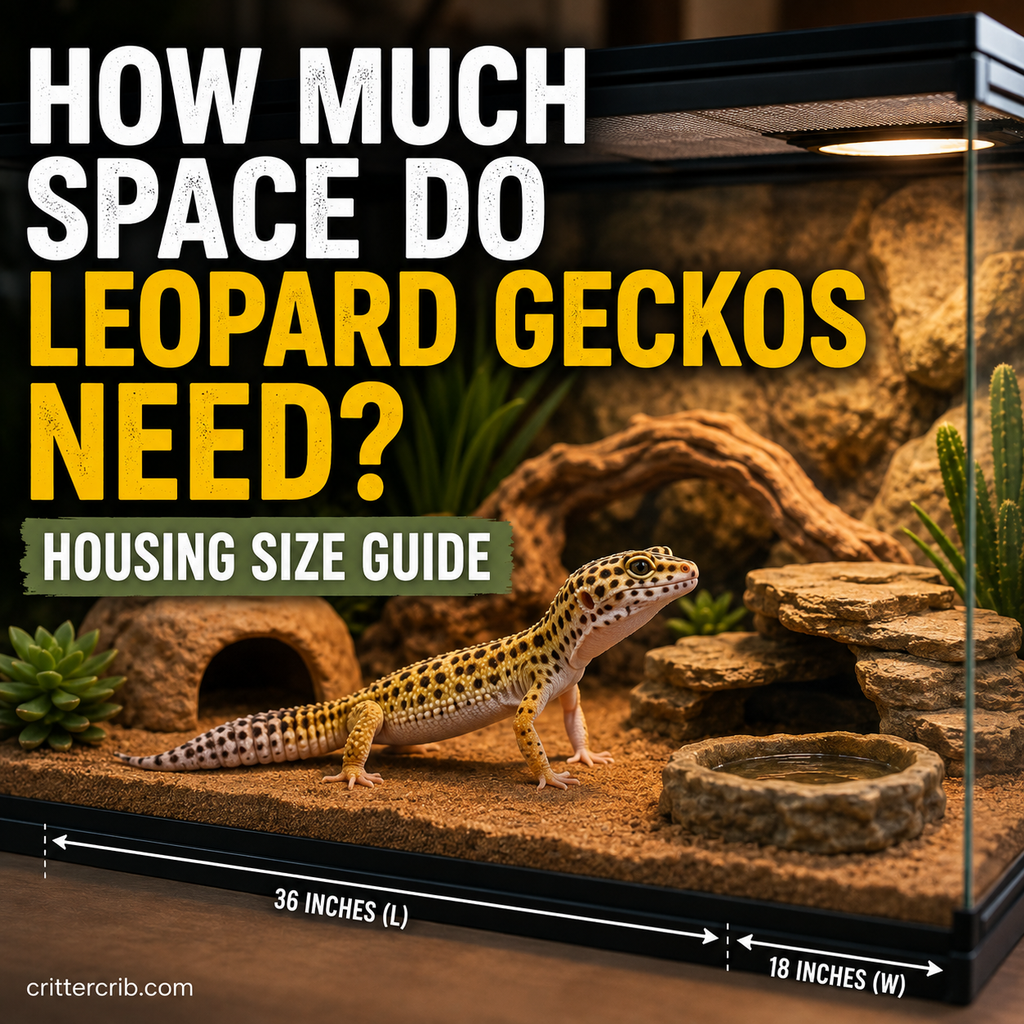
For most adult leopard geckos, an enclosure with roughly a 36-by-18-inch footprint is an excellent target. Smaller enclosures have traditionally been used, but providing more usable floor space makes it much easier to create a proper temperature gradient and a more interesting environment.
The enclosure itself is only part of the equation, though. How you arrange that space matters just as much.
Here’s how to choose the right leopard gecko enclosure size and turn that space into a functional habitat.
How Big of an Enclosure Does a Leopard Gecko Need?
For a single adult leopard gecko, aim for an enclosure measuring approximately:
- 36 inches long
- 18 inches wide
- 16–18 inches tall
An enclosure around these dimensions provides roughly 4.5 square feet of floor space.
Leopard geckos are primarily ground-dwelling animals, so length and width generally matter more than excessive height.
That doesn’t mean vertical space is useless. Low rocks, sturdy branches, cork bark, ledges, and other securely positioned features can create additional opportunities for climbing and exploration.
The priority, however, should be a generous horizontal footprint.
Is a 20-Gallon Tank Big Enough for a Leopard Gecko?
You’ll still find plenty of older leopard gecko care information recommending a 20-gallon aquarium for an adult.
A 20-gallon long aquarium has commonly been used because it provides more horizontal space than a standard tall aquarium. It can physically house a leopard gecko, but it offers less room for creating distinct temperature zones, multiple hides, enrichment, and natural movement.
If you’re purchasing a new permanent enclosure rather than using something you already own temporarily, going larger makes sense.
A habitat with a footprint around 36 by 18 inches gives you considerably more flexibility.
You can provide:
- A warm hide
- A cool hide
- A humid hide
- Open walking space
- Feeding and water areas
- Climbing opportunities
- Additional cover
- A more gradual temperature gradient
Instead of asking whether your gecko can fit inside an enclosure, it’s more useful to ask whether the enclosure provides enough space for everything the animal needs.
Leopard Gecko Enclosure Size by Age
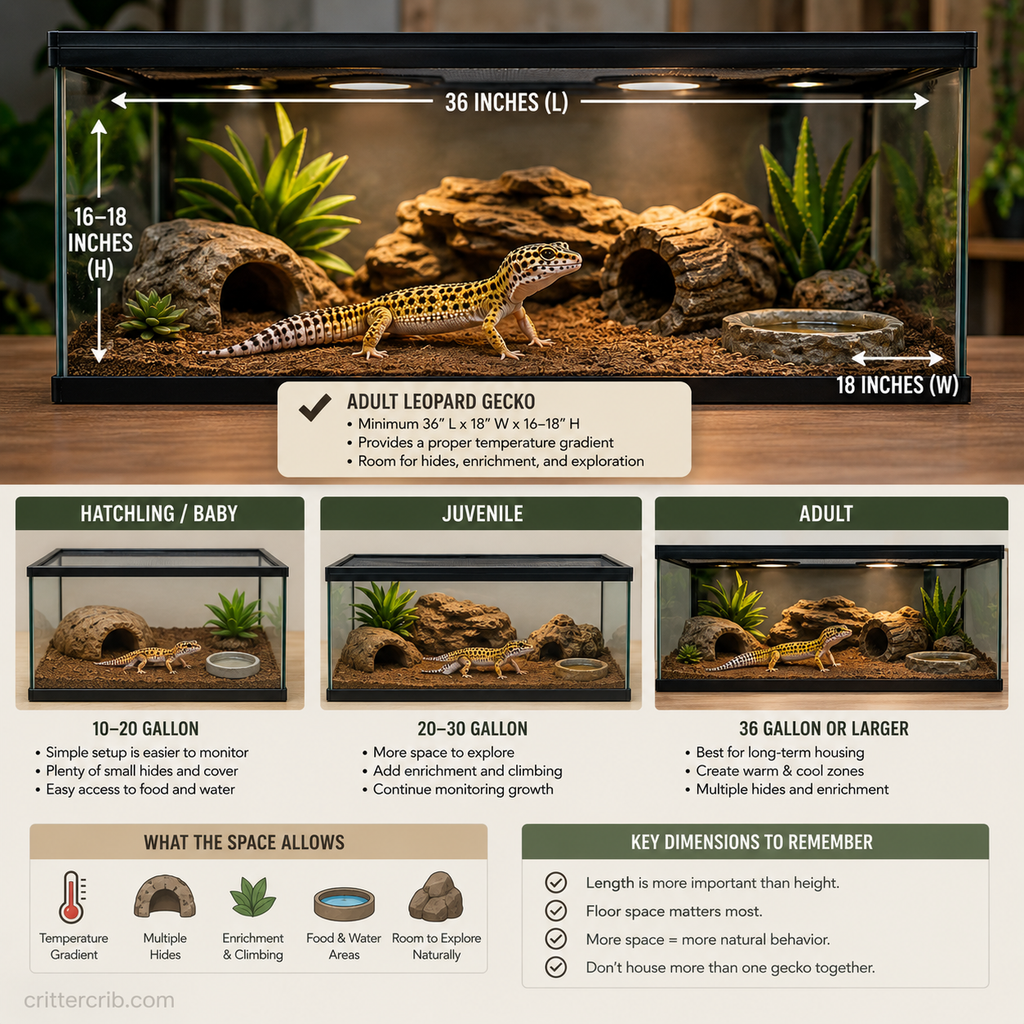
A leopard gecko’s housing needs change as it grows, although young geckos don’t necessarily require extremely small enclosures.
Hatchling and Baby Leopard Geckos
Young leopard geckos are tiny, and some keepers prefer starting them in relatively simple setups.
The advantage isn’t that baby geckos inherently need cramped conditions. A simpler enclosure can make it easier to monitor:
- Eating
- Bowel movements
- Shedding
- Weight
- General activity
Food can also be easier for a young gecko to locate.
However, a properly designed larger enclosure can work for a juvenile as long as it contains plenty of cover and isn’t just a huge empty box.
A young gecko should have easy access to hides, food, water, warmth, and secure areas throughout the habitat.
Juvenile Leopard Geckos
As a leopard gecko grows, its enclosure should provide increasingly more usable space.
If you start with a smaller juvenile enclosure, plan for the adult habitat early. Leopard geckos don’t stay tiny forever.
Purchasing the permanent enclosure from the beginning can also save money compared with repeatedly upgrading tanks.
Adult Leopard Geckos
For an adult, a roughly 36-by-18-inch footprint is a good target for permanent housing.
Going larger is also possible.
A larger enclosure isn’t automatically stressful to a leopard gecko. What can cause problems is an enclosure that is large but exposed and poorly furnished.
Provide enough hides, cover, and structure, and additional space can give the gecko more opportunities to explore and choose where it wants to spend its time.
Why Floor Space Matters More Than Gallons
Aquariums are often marketed by gallon capacity, but gallons aren’t particularly useful when evaluating reptile housing.
Two enclosures can hold similar volumes of water while having completely different dimensions.
For a terrestrial reptile such as a leopard gecko, the footprint tells you much more.
Consider two hypothetical tanks:
- One is long and relatively shallow.
- The other is narrow but very tall.
Even if both have similar total volume, the longer enclosure provides considerably more usable ground area.
That’s why it’s better to shop according to length × width × height rather than gallons alone.
Can a Leopard Gecko Enclosure Be Too Big?
This is a common concern, particularly with young leopard geckos.
The simple answer is that a larger enclosure isn’t inherently a problem.
An empty larger enclosure can be.
Imagine placing a small animal in a huge open area with nowhere to hide. The problem isn’t technically the amount of space—it’s the lack of security.
A well-designed larger enclosure should contain:
- Multiple hides
- Visual barriers
- Plants or artificial foliage
- Cork bark
- Rocks
- Low climbing structures
- Shaded areas
- Open areas mixed with covered areas
Your gecko should be able to move through much of the enclosure without constantly feeling exposed.
This creates usable space rather than empty space.
Leopard Geckos Need a Temperature Gradient
One of the biggest reasons enclosure size matters is temperature control.
Leopard geckos are ectothermic, meaning they rely on environmental conditions to regulate their body temperature.
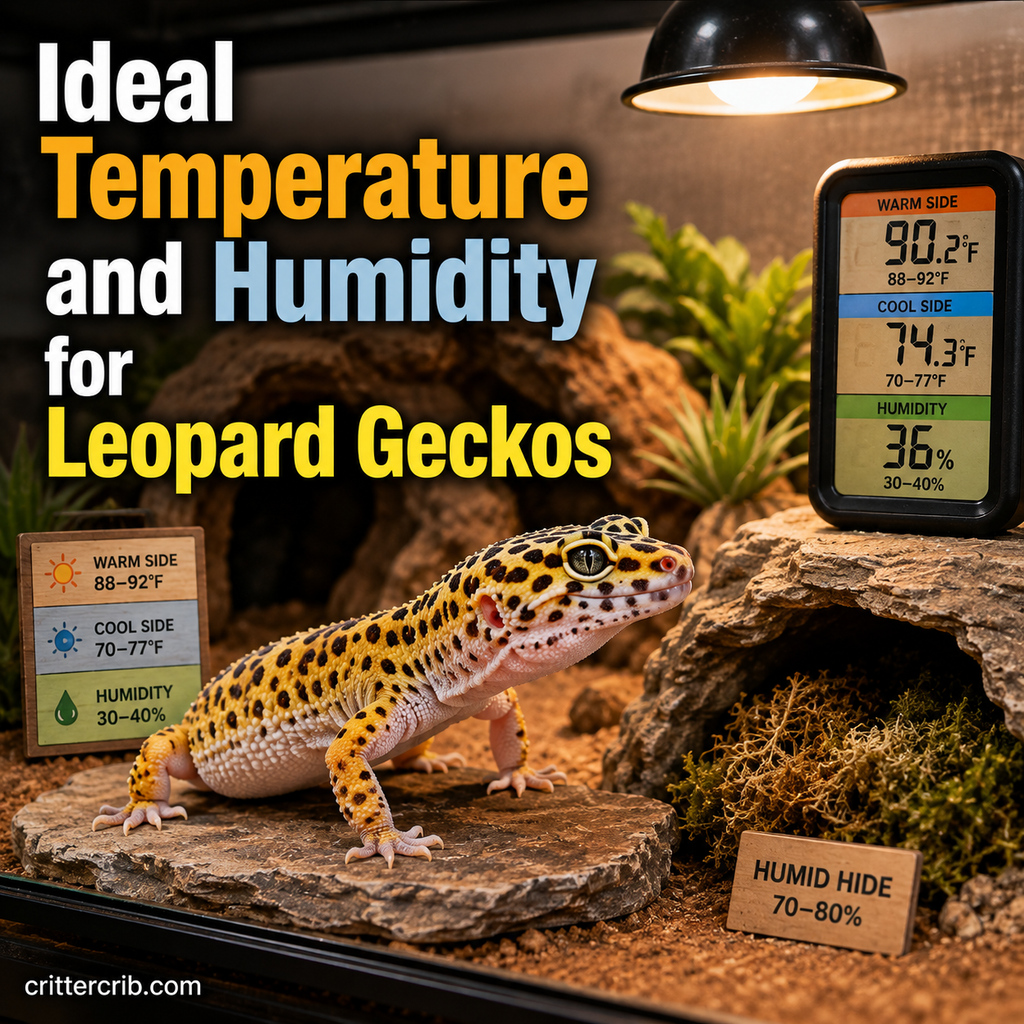
They need access to warmer and cooler areas rather than one uniform enclosure temperature.
A longer enclosure makes this easier.
The heat source can be concentrated toward one end, creating a warm side while allowing the opposite end to remain cooler.
The gecko can then move between these areas as needed.
In a very small enclosure, heat can spread across nearly the entire habitat, making it harder to establish clearly different temperature zones.
How Many Hides Does a Leopard Gecko Need?
A leopard gecko enclosure should generally contain at least three important hiding options:
- A warm hide
- A cool hide
- A humid hide
Each serves a different purpose.
Warm Hide
The warm hide gives your leopard gecko a sheltered place to rest while remaining near the heated portion of the enclosure.
This allows the gecko to access warmth without having to remain completely exposed.
Cool Hide
The cool hide belongs toward the cooler side of the habitat.
Your gecko can retreat here when it wants to move away from the heat while still feeling secure.
Humid Hide
A humid hide provides a localized area with higher humidity.
This is particularly useful during shedding.
It typically contains a moisture-retaining material that can be kept appropriately damp without making the entire enclosure wet.
The enclosure can contain more than three hides. Extra covered areas and shelters can make good use of a larger habitat.
How Much Open Space Should You Leave?
It’s possible to clutter an enclosure too much, just as it’s possible to leave one too empty.
Your leopard gecko needs room to walk between different areas of the habitat.
Try to create a mixture of:
- Sheltered areas
- Open pathways
- Low climbing areas
- Feeding space
- Different textures
- Visual barriers
Avoid packing decorations together so tightly that your gecko has difficulty moving naturally.
Think of the enclosure as a small landscape rather than a box filled with accessories.
Do Leopard Geckos Need Vertical Space?
Leopard geckos aren’t highly arboreal reptiles, so you don’t need a tall enclosure filled with branches.
They can still climb more than their body shape might suggest.
Low, stable climbing opportunities can provide useful enrichment.
You might include:
- Cork bark
- Low rock formations
- Sturdy branches
- Textured backgrounds
- Low platforms
- Secure ledges
Make sure anything heavy is stable.
A gecko should not be able to dig beneath a rock or decoration and cause it to collapse.
Height also needs to accommodate your lighting and heating equipment safely.
Front-Opening vs. Top-Opening Enclosures
Either design can work, but front-opening reptile enclosures have some practical advantages.
With a top-opening aquarium, your hand approaches the gecko from above. Since predators can approach small reptiles from overhead in nature, some geckos may find this more startling.
Front-opening doors allow you to approach the animal from its level.
They also make routine maintenance easier, particularly when the enclosure contains lighting and heating equipment above it.
Front-opening enclosures are convenient for:
- Feeding
- Spot cleaning
- Changing water
- Maintaining the humid hide
- Handling
- Rearranging enclosure items
Just make sure doors and ventilation panels are secure.
Leopard geckos can squeeze through surprisingly small openings.
Choosing the Right Substrate
Enclosure size and substrate go hand in hand because the substrate covers most of your gecko’s usable environment.
The best choice depends partly on the animal and your experience level.
Simple solid surfaces can be useful for new geckos, quarantine situations, or animals that need close monitoring.
Depending on the situation, appropriate options may include:
- Paper towels for temporary or quarantine setups
- Suitable naturalistic substrate mixtures
- Reptile-safe solid surfaces
Loose substrate is a more nuanced subject than simply labeling all loose material as dangerous or safe.
Particle size, husbandry, feeding practices, hydration, temperature, and the specific substrate all matter.
Avoid substrates known to create unnecessary risks, and research any naturalistic substrate carefully before using it.
Where Should the Water and Food Go?
Water should be easy for your leopard gecko to reach without interfering with hides or temperature zones.
Use a shallow, stable water dish and replace the water regularly.
Food placement depends partly on what you’re feeding.
Live insects shouldn’t be left wandering around the enclosure indefinitely. Uneaten feeders can hide under decorations and, depending on the insect, potentially bother the gecko.
A smooth-sided feeding dish can work well for certain feeders, while others may be offered individually.
In a larger enclosure, establishing a consistent feeding area can also help your gecko learn where food usually appears.
Does a Larger Enclosure Need More Heating?
Potentially, but not necessarily in the way people expect.
The goal isn’t to make the entire enclosure hot.
You want a controlled warm area while maintaining an appropriate cooler side.
A larger habitat may require careful selection and positioning of heating equipment, but it can also make establishing a temperature gradient easier.
Whatever heat source you use, temperature should be measured rather than guessed.
Heating equipment should also be properly controlled when appropriate so temperatures don’t climb to unsafe levels.
Never assume that a lamp or heater is correct simply because its packaging recommends it for a certain tank size.
Room temperature, enclosure material, ventilation, distance from the heat source, and equipment placement can all change the results.
Don’t Forget UVB and Lighting
Enclosure size also affects lighting.
As the habitat becomes longer, you need to think about where light reaches and how the gecko can move between brighter and more sheltered areas.
Appropriate UVB lighting is commonly incorporated into modern leopard gecko husbandry.
The exact setup depends on the enclosure dimensions, fixture, lamp output, distance, and whether the light passes through mesh.
The habitat should provide both appropriate exposure and places where the gecko can retreat from light.
This is another reason hides and visual cover are so important.
Should You House Two Leopard Geckos Together?
The safest general approach is to house leopard geckos individually.
Two geckos sharing an enclosure may compete even when you don’t see obvious fighting.
Competition can involve:
- Food
- Warm hides
- Cool hides
- Humid hides
- Preferred resting locations
- Access to heat
One animal may gradually become stressed or receive fewer resources.
Males can also be territorial and may seriously injure one another.
Providing a larger enclosure doesn’t eliminate these risks.
If you have two leopard geckos, giving each animal its own properly equipped habitat makes monitoring feeding, shedding, waste, weight, and general health much easier.
How to Set Up the Space Inside a Leopard Gecko Enclosure
Once you’ve chosen an appropriately sized enclosure, divide it into functional areas.
A basic layout might look like this:
Warm Side
Place the primary heat source toward this end.
Include:
- Warm hide
- Basking or heated area
- Nearby cover
Middle Area
The center acts as a transition between warmer and cooler conditions.
Depending on your setup, this can be a good location for:
- Humid hide
- Cork bark
- Plants
- Low climbing structures
Cool Side
This end should allow the gecko to retreat from the warmer portion of the enclosure.
Include:
- Cool hide
- Water dish
- Additional cover
The exact arrangement doesn’t have to follow a rigid formula. What matters is giving the animal meaningful choices.
Signs Your Leopard Gecko May Need a Better Housing Setup
Your gecko can’t tell you that its enclosure design isn’t working, but behavior can provide clues.
Potential signs worth investigating include:
- Repeated attempts to climb or escape
- Persistent glass surfing
- Constant hiding
- Avoiding one entire section of the enclosure
- Difficulty finding comfortable temperature areas
- Unusual inactivity
- Changes in appetite
- Repeated exposure with nowhere secure to retreat
None of these automatically proves that enclosure size is the problem.
Temperature, lighting, stress, illness, substrate, handling, and other factors can produce behavioral changes too.
Look at the entire setup rather than changing the enclosure based on one behavior.
Common Leopard Gecko Enclosure Size Mistakes
Choosing an enclosure is easier when you know what to avoid.
Choosing by Gallons Alone
Look at the actual dimensions, especially length and width.
Floor space is more informative than total volume for a terrestrial gecko.
Buying a Tall Tank With a Small Footprint
Extra height doesn’t compensate for insufficient ground area.
Prioritize horizontal space first.
Leaving a Large Enclosure Empty
More space works best when it’s usable.
Add hides, cover, visual barriers, textures, and safe enrichment.
Providing Only One Hide
One hide forces your gecko to choose between security and temperature.
Provide warm, cool, and humid hiding options.
Heating the Entire Enclosure
Your leopard gecko needs the ability to move away from heat.
Create a gradient rather than one uniform temperature.
Assuming a Starter Kit Has Everything You Need
Reptile starter kits vary widely.
Evaluate each component separately rather than assuming everything included is appropriate for long-term care.
Is It Worth Buying the Adult Enclosure From the Start?
In many cases, yes.
Buying a suitable adult-sized enclosure for a young leopard gecko can eliminate the cost of upgrading later.
The key is furnishing it properly.
Make sure a juvenile doesn’t have to cross large exposed areas to reach:
- Food
- Water
- Heat
- Hides
- Humidity
Add plenty of cover and keep track of feeding and bowel movements.
If you’re able to monitor the young gecko effectively, starting with its permanent habitat can be a practical option.
Frequently Asked Questions About Leopard Gecko Enclosure Size
What Is a Good Enclosure Size for One Adult Leopard Gecko?
An enclosure around 36 inches long by 18 inches wide is a good target for one adult leopard gecko. This provides considerably more usable floor space than many older minimum-size recommendations.
Is a 40-Gallon Tank Good for a Leopard Gecko?
It can be, but check the dimensions rather than relying on the gallon label.
A tank with approximately a 36-by-18-inch footprint can provide a good amount of floor space for an adult leopard gecko.
Is a 20-Gallon Long Tank Enough?
A 20-gallon long has traditionally been recommended for adult leopard geckos and can physically house one, but larger modern setups provide more room for hides, enrichment, movement, and an effective temperature gradient.
If you’re buying a permanent enclosure, aiming for approximately a 36-by-18-inch footprint gives you more flexibility.
Can I Put a Baby Leopard Gecko in a Large Enclosure?
Yes, provided the enclosure is properly designed.
Give the young gecko plenty of hiding places and cover, and make sure food, water, warmth, and the humid hide are easy to locate.
Do Leopard Geckos Need Tall Tanks?
Not particularly.
They’re primarily terrestrial, so prioritize floor space. Some additional height is useful for low climbing structures, lighting, heating equipment, and enrichment.
Can Two Leopard Geckos Share a Large Enclosure?
Individual housing is the safer general approach. A larger enclosure doesn’t eliminate competition, territorial behavior, or the possibility of injury.
Do Leopard Geckos Like Lots of Space?
It’s more accurate to say that leopard geckos can benefit from plenty of well-designed usable space.
A larger enclosure containing appropriate temperatures, multiple hides, cover, and enrichment gives the animal more choices than a small or sparsely furnished habitat.
Final Thoughts
For a single adult leopard gecko, an enclosure with a footprint of roughly 36 by 18 inches is a strong target for permanent housing.
But dimensions aren’t everything.
A spacious glass box with one hide and a water dish isn’t automatically a good habitat. The enclosure needs to function as an environment, with warm and cool areas, multiple secure hides, a humid retreat, appropriate lighting and heating, safe substrate, and opportunities to explore.
Floor space is especially important because leopard geckos spend most of their time on or near the ground. That’s why enclosure dimensions are generally more useful than gallon ratings when you’re comparing habitats.
If you’re starting with a baby or juvenile, you don’t necessarily need to keep buying progressively larger tanks. A properly furnished adult-sized enclosure can work from an early age as long as the young gecko can easily find everything it needs.
Give your leopard gecko enough room to make choices—where to warm up, where to cool down, where to hide, and where to explore—and you’ll be much closer to creating a habitat that supports natural behavior rather than simply containing the animal.