

Pet mice may be small, but their environment can have a big effect on their comfort.
Temperature, humidity, ventilation, bedding, and cage placement all work together to create a healthy living space. A room that feels comfortable to you may still be too warm, too cold, drafty, or humid for a mouse depending on where the enclosure is located.
Fortunately, you don’t need to turn your home into a climate-controlled laboratory.
For most pet owners, maintaining a stable household temperature, avoiding extremes, providing plenty of appropriate nesting material, and monitoring the enclosure with a simple thermometer and hygrometer will go a long way.
Here’s what you should know about ideal temperature and humidity for mice, including signs that your mice may be too hot or cold and how to keep their habitat comfortable throughout the year.
What Is the Ideal Temperature for Pet Mice?
A comfortable room temperature for pet mice is generally around 65°F to 75°F (18°C to 24°C).
Within this range, healthy adult mice can usually regulate their body temperature comfortably when they have appropriate bedding, nesting material, food, water, and shelter.
That doesn’t mean 64°F or 76°F automatically creates a dangerous situation.
Think of the range as a practical target rather than an exact cutoff.
Factors such as age, health, bedding depth, air movement, humidity, and acclimation can all influence how comfortable an individual mouse feels.
The most important goal is to provide a stable environment without prolonged exposure to excessive heat or cold.
Why Temperature Matters for Mice
Mice have a much higher surface-area-to-body-mass ratio than humans.
Because they’re so small, environmental conditions can affect them relatively quickly.
In cool conditions, mice conserve warmth by nesting, huddling, and reducing exposure. When temperatures rise, they may stretch out, become less active, and seek cooler areas.
A properly designed enclosure should allow mice to make some of these choices for themselves.
Give them:
- Plenty of nesting material
- Enclosed sleeping areas
- Good ventilation
- Access to fresh water
- Areas away from direct sunlight
- Enough space to move between resting locations
The enclosure shouldn’t force them to remain in one temperature condition without options.
What Is the Ideal Humidity for Mice?
For pet mice living indoors, a moderate relative humidity of approximately 40% to 60% is a practical target.
Normal household humidity within this general range is usually appropriate.
Humidity becomes more concerning when conditions remain extremely dry or excessively damp for extended periods.
High humidity can contribute to:
- Damp bedding
- Mold growth
- Increased odors
- Poor air quality
- Reduced comfort during warm weather
Very dry conditions can also contribute to an uncomfortable environment and may irritate sensitive respiratory tissues.
You don’t need to maintain one exact percentage.
Aim for moderate, stable humidity and keep the habitat clean, dry, and well ventilated.
Temperature and Humidity Should Be Considered Together
Temperature and humidity don’t operate independently.
A warm room with high humidity can feel more uncomfortable than the same temperature at moderate humidity.
High humidity can also make it harder for moisture in bedding and other enclosure materials to evaporate.
On the other hand, cold and damp conditions can create an uncomfortable living environment even if the thermometer doesn’t look alarming.
When evaluating your mouse habitat, consider:
- Air temperature
- Relative humidity
- Ventilation
- Bedding condition
- Direct sunlight
- Drafts
- Enclosure type
- Number of mice
- Room conditions
Looking at the complete environment gives you a much better picture than watching temperature alone.
Use a Thermometer and Hygrometer
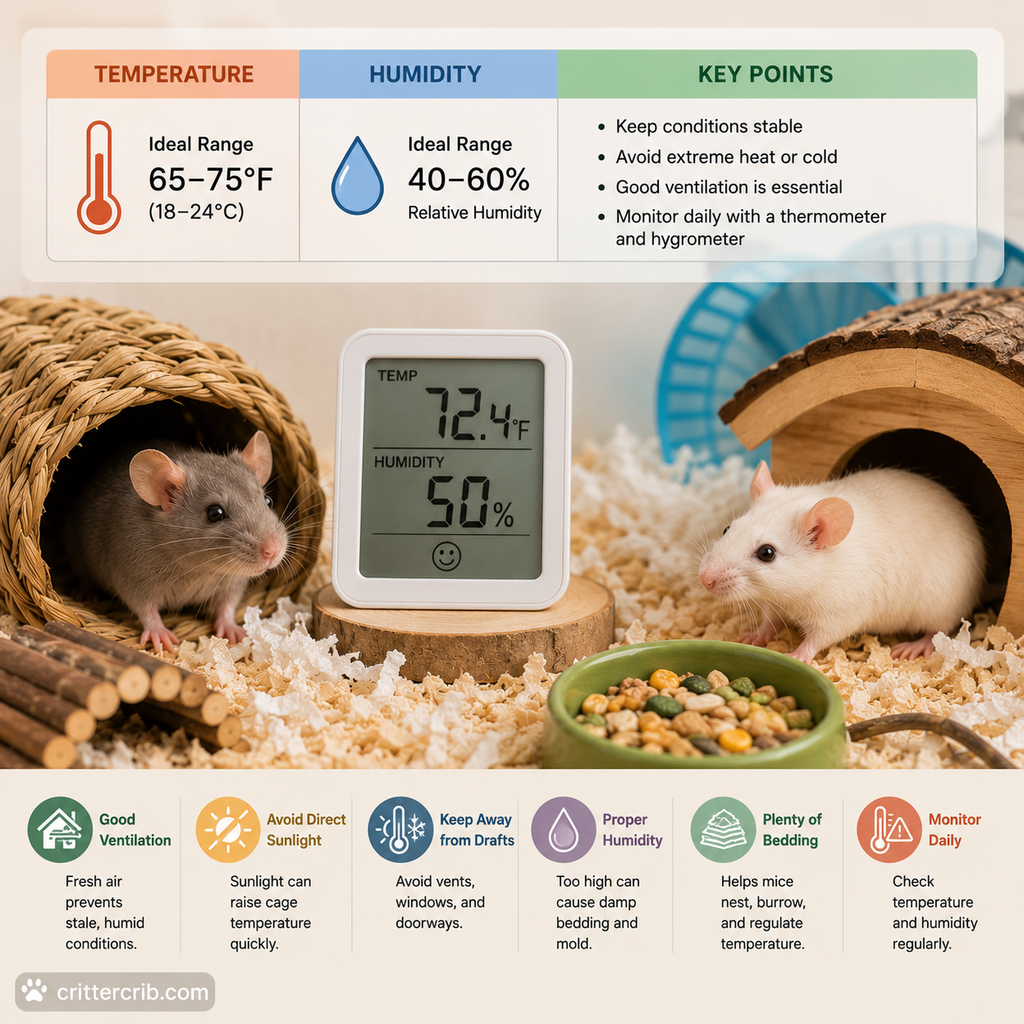
The easiest way to stop guessing is to measure.
A small digital thermometer and hygrometer can display both temperature and relative humidity.
Place the sensor near the enclosure at roughly the same level where your mice spend most of their time.
Avoid positioning it:
- Directly beside a heater
- Against an air-conditioning vent
- In direct sunlight
- Immediately beside a humidifier
- Directly against a cold window
You want a representative reading of the environment inside or immediately around the habitat.
Check Conditions at Different Times
Room temperature can change significantly throughout the day.
A location that seems perfect in the morning may receive strong afternoon sunlight.
Check your readings during:
- Morning
- Afternoon
- Evening
- Particularly hot days
- Cold nights
- Major seasonal changes
You may discover that the enclosure’s location matters just as much as your thermostat setting.
Where Should You Put a Mouse Enclosure?
Choose a stable location away from temperature extremes.
A good location generally provides:
- Comfortable household temperatures
- Good ventilation
- Protection from direct sunlight
- No strong drafts
- Protection from other pets
- Relatively stable humidity
- Normal household activity without constant disturbance
Avoid placing the enclosure directly beside windows, exterior doors, fireplaces, radiators, portable heaters, or air-conditioning vents.
The top of a heating vent may feel pleasantly warm to you.
For a mouse living there continuously, it’s a very different situation.
Keep Mouse Habitats Away From Direct Sunlight
Direct sunlight can heat an enclosure surprisingly quickly.
This is particularly important for glass or plastic-sided habitats, which may retain more heat than an open wire enclosure.
A room may be 72°F while part of the enclosure sitting in direct sunlight becomes considerably warmer.
Don’t rely on the fact that the room itself feels comfortable.
Place the habitat away from prolonged direct sunlight or use curtains and blinds appropriately.
Remember that sunlight moves throughout the day.
Good Ventilation Is Essential
Ventilation helps manage temperature, humidity, odors, and air quality.
Mouse urine can produce ammonia as waste accumulates. Without adequate ventilation and cleaning, air quality around the habitat can deteriorate.
The enclosure should allow sufficient air exchange without exposing mice to a constant strong draft.
This balance is important.
A sealed container may retain excessive moisture and odors, while an enclosure placed directly in front of a powerful fan or air-conditioning vent may become drafty and uncomfortable.
Bedding Helps Mice Regulate Their Comfort
Bedding isn’t only there to absorb waste.
It also gives mice an opportunity to burrow, nest, hide, and adjust their immediate environment.
Mice may move bedding around the habitat and build surprisingly elaborate nests.
That’s normal behavior.
Provide enough appropriate bedding and nesting material for mice to create sheltered resting areas.
Good nesting material can be particularly important when room temperatures are toward the cooler end of the comfortable range.
Give Mice Plenty of Nesting Material
A comfortable nest gives mice a warmer microenvironment within the larger enclosure.
Suitable nesting materials should be safe, soft, and easy for mice to manipulate.
Depending on your setup, appropriate options may include:
- Unscented paper-based nesting material
- Plain shredded paper suitable for pets
- Other safe small-animal nesting materials
Avoid materials that can easily wrap tightly around limbs or create entanglement hazards.
Your mice will arrange the nest themselves.
You don’t need to make the bed for them.
They’ll probably redo your work anyway.
Signs Your Mouse May Be Too Cold
Mice naturally sleep together and build nests, so huddling isn’t automatically a sign of dangerous cold.
Instead, look for unusual changes.
Possible signs that a mouse may be struggling with cold conditions include:
- Persistent tight huddling
- Reluctance to leave the nest
- Reduced activity
- Cold body or extremities
- Unusual lethargy
- Weakness
- Reduced responsiveness
These behaviors can also occur with illness.
If a mouse is unusually weak, lethargic, unresponsive, or not eating, don’t assume temperature is the only explanation.
Contact a veterinarian experienced with small mammals.
How to Keep Mice Comfortable in Winter
Indoor mice usually don’t need elaborate winter heating when the room remains within a comfortable household range.
Instead, focus on preventing sudden cold exposure.
Provide Adequate Bedding
Give your mice enough bedding to burrow and plenty of nesting material.
They can then create a warmer sleeping area when needed.
Move the Enclosure Away From Drafts
Check for cold air around:
- Windows
- Exterior doors
- Vents
- Poorly insulated walls
Remember that the temperature at cage level can differ from the temperature measured by a wall thermostat elsewhere in the room.
Maintain a Stable Room Temperature
If the room becomes very cold overnight, consider safely heating the room rather than placing an uncontrolled heat source directly against the mouse enclosure.
Any heater used in the room should be positioned safely and kept well away from bedding, plastic, electrical-chewing opportunities, and the enclosure itself.
Should You Use a Heating Pad for Mice?
Routine supplemental heating usually isn’t necessary when pet mice live in a comfortably heated home.
Heating pads and similar devices can create hot spots, burns, electrical hazards, or overheating when used incorrectly.
A healthy mouse should also be able to move away from a warmer area.
If supplemental heat is medically necessary, such as for an ill mouse, follow specific instructions from your veterinarian.
Don’t improvise intensive heating for a sick animal without understanding the underlying problem.
Signs Your Mouse May Be Too Hot
Excessive heat can be dangerous for mice.
Possible warning signs include:
- Unusual lethargy
- Reduced activity
- Stretching out in exposed areas
- Rapid or labored breathing
- Weakness
- Reluctance to move
- Reduced responsiveness
- Collapse
Some changes can be subtle at first.
If your mouse appears severely overheated, weak, unresponsive, or has difficulty breathing, treat the situation seriously and contact a veterinarian promptly.
How to Keep Mice Cool in Summer
Warm weather requires extra attention, particularly in homes without air conditioning.
Keep the Enclosure Out of Sunlight
This is one of the simplest and most important steps.
Move the enclosure away from sunny windows before summer temperatures become extreme.
Cool the Room
Air conditioning can provide a stable environment during hot weather.
The goal is to cool the room—not blast cold air directly into the enclosure.
Improve Air Circulation
A fan can help circulate air around a room, but it doesn’t actually reduce the room’s temperature.
Don’t point a strong fan directly at your mice.
Keep Fresh Water Available
Check drinking water frequently during warm weather.
Make sure bottles are functioning properly and haven’t become blocked.
If you use a bowl, ensure it remains clean and hasn’t been filled with bedding.
Provide Temperature Choices
The enclosure should have areas where mice can rest away from warmer surfaces.
Avoid placing cooling objects in a way that makes the entire habitat cold or wet.
Your mice should always be able to move away from any localized temperature adjustment.
Never Use Ice Water to Cool an Overheated Mouse
If you suspect severe overheating, don’t plunge your mouse into ice water.
Rapid, extreme cooling can create additional stress and doesn’t address possible medical complications from heat exposure.
Move the mouse to a cooler environment and seek veterinary advice promptly.
A severely overheated animal requires more than simply making the enclosure cooler.
High Humidity Can Make Heat More Concerning
A warm summer day deserves even more attention when humidity is high.
High humidity can contribute to a stuffy environment and make it harder for moisture to evaporate.
It can also keep bedding damp longer.
During warm, humid weather:
- Check the hygrometer.
- Improve room ventilation.
- Remove damp bedding.
- Monitor water spills.
- Keep the enclosure out of sunlight.
- Use air conditioning when necessary.
- Consider a dehumidifier if the room remains excessively humid.
The goal is to improve the overall room environment rather than trying to manipulate one tiny part of the enclosure.
Should You Use a Dehumidifier Around Mice?
A dehumidifier can be useful when indoor humidity remains consistently high.
Place it in the room rather than directly against the enclosure.
Monitor humidity with a hygrometer so you know whether the device is actually needed and avoid making the room excessively dry.
Keep power cords inaccessible.
Rodents and electrical cords are a combination you never want to test.
Should You Use a Humidifier Around Mice?
Most households don’t need a humidifier specifically for pet mice.
If winter heating makes your indoor air extremely dry, a properly maintained room humidifier may help bring humidity back toward a moderate level.
Don’t direct mist into the enclosure.
Moisture shouldn’t accumulate on bedding, walls, or cage accessories.
Humidifiers also need regular cleaning to prevent microbial growth.
Damp Bedding Should Be Removed
Bedding should remain reasonably dry.
Wet bedding can create an unpleasant environment and contribute to odor and hygiene problems.
Pay particular attention to areas around:
- Water bottles
- Water bowls
- Toilet areas
- Nesting areas
- Enclosure corners
A leaking water bottle can soak a surprising amount of bedding before you notice it.
Check bottles regularly for both proper flow and leaks.
Don’t Confuse Humidity With a Wet Habitat
A room with appropriate relative humidity doesn’t require wet bedding.
These are completely different things.
Mice need access to clean drinking water, but their living surfaces should generally remain dry.
If condensation repeatedly forms inside the enclosure, investigate the cause.
Poor ventilation, excessive humidity, temperature differences, or enclosure design may all contribute.
Cage Type Can Affect Temperature and Humidity
Different enclosure designs manage airflow differently.
Wire Cages
Wire cages generally provide excellent ventilation.
However, they can also expose mice more easily to drafts and allow bedding to scatter.
Glass Tanks
Glass-sided habitats retain bedding well and can provide excellent visibility.
However, ventilation needs careful consideration, particularly when using deep enclosures.
A secure mesh top and appropriate setup can improve airflow.
Plastic Enclosures
Plastic habitats vary considerably.
Some provide appropriate ventilation, while others have limited airflow.
Don’t choose an enclosure based only on how well it contains bedding.
Temperature, humidity, ventilation, security, space, and enrichment all need consideration.
Avoid Sudden Temperature Changes
Stable conditions are generally preferable to rapid swings.
Avoid moving mice directly between dramatically different temperatures unless necessary.
For example, don’t take an enclosure from a warm room and place it beside an open window during a freezing winter night.
Likewise, don’t move mice from an air-conditioned room directly into intense summer heat.
Gradual environmental changes are easier for animals to accommodate.
What About Mice in Garages or Basements?
Garages, basements, enclosed porches, and similar spaces require extra caution.
These areas may experience:
- Large temperature swings
- High humidity
- Poor ventilation
- Drafts
- Vehicle fumes
- Chemical exposure
- Increased pests
- Reduced monitoring
A basement that remains consistently climate controlled may be suitable.
An unconditioned garage that becomes extremely hot in summer and cold in winter generally isn’t.
Measure the actual conditions throughout the day and across seasons before deciding a space is appropriate.
How Cleaning Affects Air Quality
Regular cleaning helps control moisture, odor, and ammonia.
However, you don’t necessarily need to remove every piece of bedding constantly.
Spot clean heavily soiled areas and replace bedding as needed based on your enclosure size, number of mice, and bedding system.
A strong urine or ammonia smell is a sign that the environment needs attention.
Don’t use air fresheners or heavily scented bedding to cover the smell.
Remove the source.
Avoid Strong Fragrances Around Mice
Mice have sensitive respiratory systems.
Avoid exposing them unnecessarily to:
- Air fresheners
- Scented candles
- Aerosol sprays
- Strong cleaning fumes
- Smoke
- Heavily fragranced bedding
- Essential oil diffusers
Good ventilation and appropriate cleaning are better ways to maintain a fresh environment.
If you need to use strong cleaning products in the room, move the mice safely away and ventilate thoroughly according to product instructions before returning them.
Monitor Your Mice, Not Just the Numbers
A thermometer and hygrometer are useful tools, but they don’t replace observation.
Learn your mice’s normal routines.
Healthy, comfortable mice should generally show normal patterns of:
- Eating
- Drinking
- Exploring
- Grooming
- Burrowing
- Nest building
- Social interaction
- Sleeping
If those patterns suddenly change, investigate.
The room temperature might be involved, but behavioral changes can also indicate illness, injury, stress, or social problems.
Young, Older, and Sick Mice May Need Extra Attention
Not every mouse handles environmental conditions equally.
Pay closer attention to:
- Very young mice
- Older mice
- Underweight mice
- Sick mice
- Mice recovering from procedures
- Mice with reduced mobility
- Hairless mice
These animals may have different temperature needs or may be less capable of adjusting their behavior effectively.
If a mouse has a medical condition, ask your veterinarian whether its environment should be modified.
Hairless Mice Have Different Needs
Hairless mice don’t have the insulating coat of typical pet mice.
They may require additional attention to warmth, bedding, and skin condition.
Provide generous safe nesting material and avoid exposing them to drafts.
Don’t simply compensate by making the entire enclosure excessively hot.
The animal should still have options within its environment.
If you’re caring for hairless mice, discuss their specific environmental needs with an experienced veterinarian or knowledgeable breeder or rescue.
Temperature and Humidity Checklist for Mice
A quick environmental check can prevent many avoidable problems.
Make sure your mouse habitat has:
- A room temperature around 65°F to 75°F when possible
- Moderate relative humidity around 40% to 60%
- A thermometer and hygrometer
- Good ventilation
- No prolonged direct sunlight
- No strong drafts
- Dry bedding
- Plenty of nesting material
- Fresh drinking water
- Protection from extreme heat and cold
- A stable location away from heaters and AC vents
- Regular cleaning without strong fragrances
You don’t need perfect numbers every second.
Consistency and avoiding extremes are more important.
Summer Mouse Care Checklist
Before hot weather arrives:
- Check the room’s afternoon temperature.
- Move the enclosure away from direct sunlight.
- Test water bottles for proper flow.
- Make sure the room has adequate ventilation.
- Prepare a safe cooling plan.
- Monitor humidity during muggy weather.
- Keep air conditioning available when conditions require it.
- Know the warning signs of overheating.
Don’t wait until the hottest day of the year to discover that your mouse room becomes much warmer than the rest of your home.
Winter Mouse Care Checklist
When temperatures begin dropping:
- Check for drafts around windows and doors.
- Provide generous bedding and nesting material.
- Keep the enclosure away from exterior doors.
- Avoid direct exposure to heating vents.
- Monitor overnight temperatures.
- Keep bedding dry.
- Watch vulnerable mice more closely.
- Maintain good ventilation even when the house is closed up.
Winter comfort isn’t about making the habitat hot.
It’s about keeping conditions stable and giving mice appropriate ways to stay warm.
Common Temperature and Humidity Mistakes
Most environmental mistakes are easy to avoid once you know what to watch for.
Common problems include:
- Placing the enclosure in direct sunlight
- Positioning it beside an air-conditioning vent
- Keeping mice next to a heater
- Allowing bedding to remain wet
- Ignoring high humidity
- Providing poor ventilation
- Pointing a fan directly at the cage
- Using uncontrolled heating devices
- Keeping mice in an unconditioned garage
- Assuming room temperature is identical everywhere
- Ignoring sudden changes in behavior
- Using strong fragrances to hide enclosure odors
- Failing to check water during hot weather
A $10–$20 thermometer and hygrometer can eliminate much of the uncertainty.
Frequently Asked Questions About Mouse Temperature and Humidity
What Temperature Is Best for Pet Mice?
A room temperature of approximately 65°F to 75°F (18°C to 24°C) is a practical comfort range for many healthy pet mice.
Individual needs can vary based on age, health, coat, bedding, and other environmental factors.
Is 60°F Too Cold for Mice?
Around 60°F (16°C) is cooler than the preferred household range for pet mice.
Healthy mice with adequate bedding and nesting material may tolerate cooler conditions, but prolonged exposure to low temperatures isn’t ideal.
Consider increasing the room temperature and make sure the enclosure isn’t exposed to drafts.
Is 80°F Too Hot for Pet Mice?
Around 80°F (27°C) is warmer than the recommended comfort range and deserves closer monitoring.
The risk becomes more concerning when high temperatures are combined with high humidity, poor ventilation, direct sunlight, or underlying health problems.
Take steps to cool the room before conditions become extreme.
What Humidity Is Best for Mice?
A relative humidity of approximately 40% to 60% is a practical target for most indoor pet mice.
Avoid persistent extremes and keep bedding dry.
Do Mice Need a Heat Lamp?
Healthy pet mice living in a climate-controlled home generally don’t need a heat lamp.
Heat lamps can create dangerously hot areas and introduce other hazards.
If supplemental warmth is medically necessary, follow your veterinarian’s instructions.
Can I Put a Mouse Cage Near a Window?
It’s generally better to keep the enclosure away from direct sunlight and significant drafts.
Temperatures near windows can fluctuate much more than temperatures in the center of a room.
Can I Put a Fan Near My Mouse Cage?
A fan can improve room circulation, but avoid directing strong airflow straight into the enclosure.
Remember that fans move air rather than actually lowering room temperature.
How Do I Know If My Mouse Is Comfortable?
Look at normal behavior as well as environmental measurements.
Comfortable mice should generally eat, drink, groom, explore, burrow, build nests, rest, and interact normally.
Significant behavioral changes deserve attention.
Creating a Comfortable Environment Year-Round
Keeping mice comfortable doesn’t require maintaining one exact temperature and humidity reading around the clock.
Aim for stability.
For most pet mice, a household temperature of approximately 65°F to 75°F and moderate relative humidity around 40% to 60% provide a useful target.
Then focus on the rest of the environment.
Provide good ventilation, dry bedding, plenty of nesting material, fresh water, and protection from direct sunlight and strong drafts. Monitor conditions during heat waves and cold spells rather than assuming the room remains comfortable.
Most importantly, watch your mice.
A thermometer tells you what’s happening in the room. Your mice can tell you—through their activity, nesting, eating, grooming, and other behaviors—how well they’re coping with it.
Combine both, and you’ll have a much better understanding of whether their habitat is truly comfortable.