
Canaries may be small birds, but that doesn’t mean they’re suited to tiny cages. These active little birds need enough room to move between perches, stretch their wings, and make short flights throughout the day.
In fact, the shape and width of a canary cage can be just as important as its overall size.
Unlike parrots that spend a lot of time climbing around cage bars, canaries primarily exercise by flying. A tall, narrow cage might look spacious to us, but it doesn’t necessarily provide the horizontal flight space a canary needs.
So, how much space does a canary actually need?
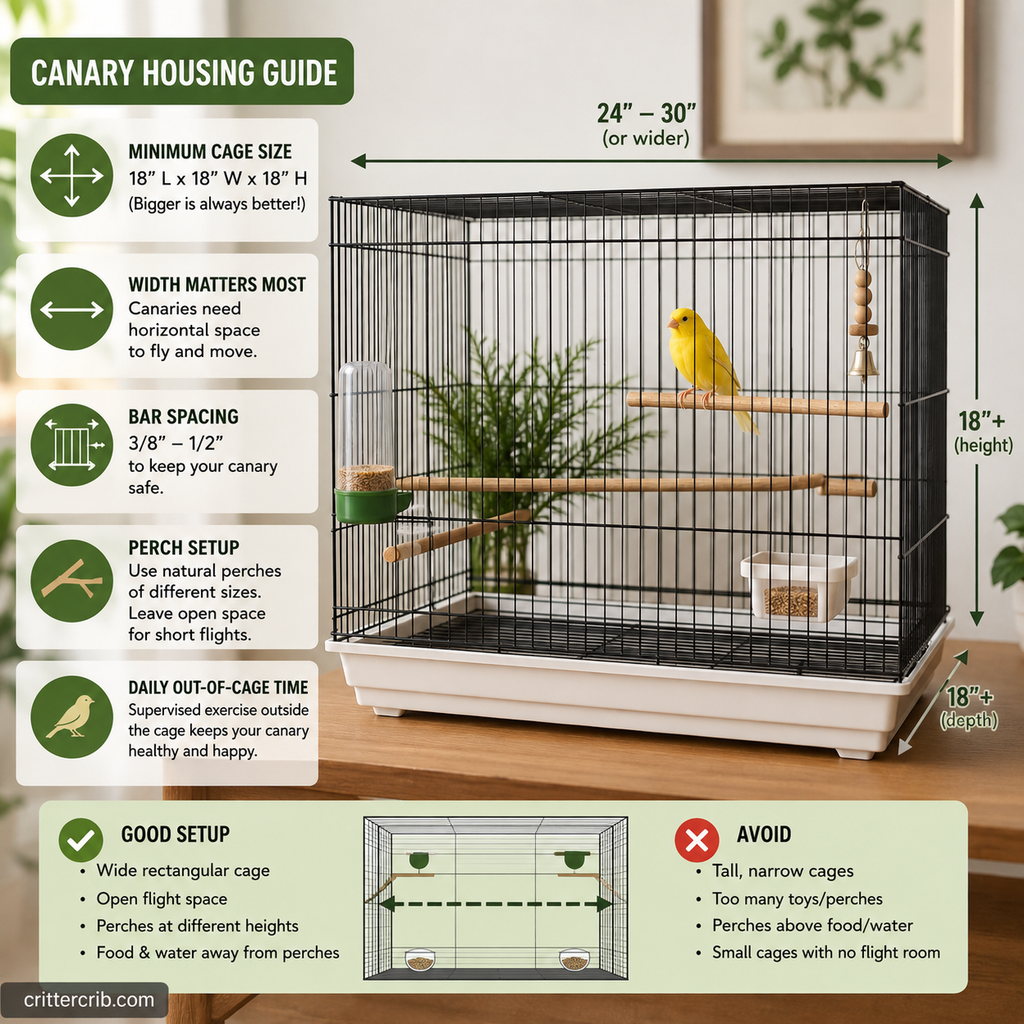
As a general starting point, a single canary should have a cage measuring at least about 18 inches wide, 18 inches deep, and 18 inches high. However, a cage around 24 inches wide or larger is a much better choice when space allows. Wider flight-style cages give canaries more opportunity to move naturally.
Here’s how to choose an appropriate canary cage and set it up without sacrificing valuable flying space.
What Size Cage Does a Canary Need?
For one canary, consider approximately 18 x 18 x 18 inches a practical minimum rather than the ideal cage size.
If you have room for something larger, use it.
A cage approximately 24–30 inches wide gives a canary substantially more horizontal space for movement. Larger flight cages can be even better when they’re appropriately designed and safely constructed.
When comparing cages, prioritize:
- Horizontal width
- Safe bar spacing
- Room for short flights
- Appropriate perch placement
- Easy cleaning
- Secure doors
- Bird-safe materials
Don’t choose a cage based solely on how large it appears.
The dimensions need to suit the way canaries actually move.
Why Cage Width Matters for Canaries
Canaries are members of the finch family and spend much of their active time hopping and flying between locations.
That makes horizontal movement especially important.
Imagine two cages with roughly similar overall volume.
One is extremely tall but narrow. The other is longer and wider.
For a canary, the wider cage will generally provide more useful exercise space because the bird can fly from one side to the other.
A good cage should allow your canary to move comfortably between perches without immediately hitting toys, dishes, or cage bars.
Wider Is Usually Better Than Taller
Canaries certainly use vertical space, but additional height doesn’t compensate for insufficient width.
When choosing between:
- A narrow 36-inch-tall decorative cage
and
- A rectangular 30-inch-wide flight cage
the wider cage will generally be the more practical choice for a canary.
Think of the cage as a miniature flight area rather than simply a container for the bird.
What Is the Best Cage Shape for a Canary?
Rectangular cages are generally the best choice.
They use space efficiently and allow you to position perches at opposite ends, encouraging your canary to fly across the cage.
A rectangular cage also provides predictable corners and usable horizontal space.
Are Round Cages Good for Canaries?
Round cages aren’t generally recommended.
They often provide less usable horizontal flight space than rectangular cages of similar apparent size. They can also make perch placement more awkward.
Decorative cages may look attractive in a room, but your bird’s needs should come before appearance.
Choose a functional rectangular cage with plenty of width.
What Bar Spacing Does a Canary Cage Need?
Bar spacing is an important safety consideration because canaries are small.
For most canaries, cage bars should be spaced approximately 3/8 to 1/2 inch apart.
Avoid cages with openings large enough for the bird to push its head through.
If a canary can get its head between the bars, it could potentially become trapped or injured.
Always check the manufacturer’s actual bar-spacing measurement rather than estimating from product photos.
How Much Space Does a Canary Need to Fly?
Ideally, your canary should be able to make short horizontal flights inside the cage.
You can encourage this by placing important perches toward opposite ends rather than clustering everything together.
For example:
Perch → open flight space → perch
is generally more useful than:
Perch → toy → perch → food bowl → swing → toy → perch
across the middle of the cage.
It’s easy to accidentally fill a cage with so many accessories that very little usable space remains.
Your canary doesn’t need an obstacle course everywhere it flies.
How to Arrange Perches in a Canary Cage
Perch placement can make a large cage either useful or surprisingly cramped.
The goal is to encourage movement.
Place perches at different locations and heights while maintaining an open horizontal path.
Use Different Types of Perches
Natural bird-safe branches are excellent choices because they provide variations in diameter and texture.
A canary cage might include:
- Natural wood branches
- Perches of varying diameters
- A comfortable sleeping perch
- A few strategically positioned activity perches
Avoid relying entirely on identical smooth dowel perches.
Varied surfaces encourage the feet to grip in different positions.
Don’t Use Too Many Perches
More isn’t always better.
If your canary has to squeeze between six perches just to cross the cage, you’ve reduced the value of having a large cage in the first place.
Use enough perches to provide comfortable resting and activity areas while preserving flight space.
Keep Perches Away From Food and Water
Avoid positioning perches directly above:
- Food bowls
- Water dishes
- Bathing dishes
Otherwise, droppings can quickly contaminate them.
A little planning during cage setup can make daily maintenance much easier.
How Many Toys Does a Canary Need?
Canaries benefit from enrichment, but their cage shouldn’t be packed with toys.
They’re generally different from highly manipulative parrots that may spend hours chewing, shredding, and dismantling elaborate toys.
Individual canaries vary, but enrichment might include:
- A swing
- Bird-safe natural materials
- Foraging opportunities
- Bathing opportunities
- Safe greenery where appropriate
- A small number of appropriately sized toys
Leave the central flight area relatively open.
You can rotate enrichment items periodically instead of permanently keeping everything inside the cage.
Do Canaries Need Time Outside Their Cage?
A large cage provides valuable exercise, but some owners also provide supervised flight time in a bird-safe room.
This can offer additional exercise and stimulation.
However, the room must be thoroughly secured.
Before allowing a canary out, check for:
- Open windows
- Open exterior doors
- Ceiling fans
- Mirrors
- Large uncovered windows
- Other pets
- Open toilets
- Containers of water
- Hot surfaces
- Toxic houseplants
- Electrical hazards
- Small spaces where the bird could become trapped
Canaries are fast, lightweight flyers and can disappear through an open door or window very quickly.
Turn ceiling fans completely off before the bird leaves the cage.
If you aren’t able to provide regular out-of-cage exercise, providing a generously sized flight cage becomes even more important.
Where Should You Put a Canary Cage?
Cage location affects your canary’s comfort almost as much as the cage itself.
Choose an area where the bird can observe normal household activity without being exposed to constant disturbance.
A good location should be:
- Free from strong drafts
- Away from heating and cooling vents
- Away from cooking fumes
- Free from cigarette and vape smoke
- Away from aerosol sprays
- Protected from extreme temperature changes
- Away from prolonged intense direct sunlight
- Secure from other pets
Having one side of the cage near a wall can help provide a sense of security.
Should a Canary Cage Be Near a Window?
A nearby window can provide interesting natural light and visual stimulation, but placing the cage directly against a window isn’t always ideal.
Windows can expose birds to:
- Temperature fluctuations
- Drafts
- Intense direct sunlight
- Outdoor predators that may cause stress
If the cage receives sunlight, make sure the canary can move into shade.
Never leave a cage where intense sunlight can heat the entire enclosure.
Can You Keep a Canary in the Kitchen?
The kitchen is generally a poor place for a canary cage.
Birds have highly sensitive respiratory systems.
Cooking can expose them to:
- Smoke
- Steam
- Aerosolized oils
- Cleaning fumes
- Gas combustion byproducts
- Other airborne contaminants
Overheated cookware or appliances containing certain nonstick fluoropolymer coatings can also release fumes that are extremely dangerous to birds.
Keeping the cage away from the kitchen reduces these risks.
How Much Space Do Two Canaries Need?
Housing multiple canaries requires more consideration than simply putting a second bird into a cage designed for one.
You’ll need a substantially larger enclosure with enough room for both birds to:
- Fly
- Eat
- Drink
- Rest
- Move away from each other
Providing multiple feeding and drinking locations can also reduce competition.
A flight cage is generally more appropriate when housing multiple compatible birds.
However, cage size isn’t the only issue.
Can Two Canaries Live Together?
Sometimes, but compatibility matters.
Canaries aren’t automatically peaceful just because they’re the same species.
Sex, individual temperament, season, hormones, cage setup, and available space can all influence aggression.
Male canaries in particular may become territorial toward one another, especially during breeding periods.
Even birds that previously tolerated each other can begin fighting.
If you keep multiple canaries, have a plan for separating them if necessary.
Never assume that providing a large cage guarantees compatibility.
Does a Canary Need a Separate Sleeping Cage?
A separate sleeping cage isn’t usually necessary if the primary cage is appropriately sized and located somewhere the bird can get sufficient uninterrupted rest.
A consistent light-and-dark schedule is important.
Your canary should have a quiet environment at night rather than being kept in a brightly lit room with activity continuing until very late.
If the primary cage is located in a busy room that can’t become quiet at night, some owners may choose a separate sleep setup.
The important factor is providing safe, consistent rest.
How Much Room Should Be Around the Cage?
The space outside the cage matters too.
Don’t wedge a canary cage tightly between furniture where ventilation is poor or access for cleaning is difficult.
Leave enough surrounding room to:
- Open doors safely
- Remove the cage tray
- Replace food and water
- Clean around the cage
- Observe your bird
- Prevent nearby pets from reaching the bars
Canaries scatter seed hulls, feathers, and bits of food, so having easy access around the cage will make cleaning considerably less frustrating.
Choosing a Cage Stand
A secure cage stand or stable piece of furniture can help position the cage at a comfortable height.
The cage shouldn’t wobble whenever someone walks past.
Make sure the supporting surface:
- Can handle the cage’s weight
- Doesn’t tip easily
- Keeps the cage level
- Isn’t accessible to predatory pets
- Allows convenient daily cleaning
Positioning at least part of the cage around eye level can help the bird feel more secure while still allowing easy interaction and observation.
Setting Up a Canary Cage Step by Step
Once you’ve chosen a sufficiently large cage, resist the temptation to immediately fill it.
Start with the essentials.
1. Choose the Cage Location
Place the cage somewhere safe from fumes, drafts, extreme temperatures, and household hazards.
2. Install Perches
Place natural perches at different heights and toward different areas of the cage.
Preserve an open horizontal flight path.
3. Add Food and Water
Position bowls where they won’t constantly collect droppings.
Make sure they’re easy for you to remove and clean.
4. Provide a Bath
Many canaries enjoy bathing.
A shallow bird bath designed for small birds can provide both enrichment and an opportunity for feather maintenance.
Remove or clean dirty bath water promptly.
5. Add Enrichment
Include a few appropriate enrichment items without cluttering the cage.
6. Check the Flight Path
Stand back and look at the finished setup.
Ask yourself:
Can the canary actually fly across this cage?
If the answer is no because there are too many accessories in the way, simplify the arrangement.
Keeping a Canary Cage Clean
A larger cage doesn’t necessarily mean dramatically more work.
In some ways, having additional room can make it easier to separate food, water, resting areas, and messy areas.
Basic maintenance includes:
Daily
- Replace contaminated drinking water
- Remove spoiled fresh food
- Clean visibly dirty dishes
- Check cage liner
- Remove obvious waste
- Inspect the bird’s general condition
Regularly
- Replace cage liner
- Wash the cage tray
- Clean perches
- Wash toys and accessories as appropriate
- Scrub cage bars where needed
- Check for damaged components
Use bird-safe cleaning methods and thoroughly rinse away residues.
A simple paper cage liner also makes it easier to observe droppings, which can provide useful clues about changes in your bird’s health.
Common Canary Housing Mistakes
Providing good housing isn’t complicated, but there are several easy mistakes to make.
Buying a Cage That’s Too Small
Tiny “starter cages” may be inexpensive, but they often provide very little exercise space.
A canary will potentially spend years in its enclosure.
Buying an appropriately sized cage from the beginning is usually a better investment.
Choosing Height Instead of Width
A tall decorative cage can look impressive while offering surprisingly little usable flight space.
Prioritize horizontal dimensions.
Overcrowding the Cage
Perches, swings, toys, food dishes, baths, and decorations all take up room.
Leave open space for movement.
Using Unsafe Bar Spacing
Large gaps can create an escape or entrapment hazard.
Choose spacing appropriate for small birds.
Placing the Cage in the Kitchen
Cooking fumes and airborne contaminants make kitchens unsuitable locations for bird cages.
Putting the Cage in Constant Direct Sunlight
Natural daylight is beneficial, but a bird needs the ability to move away from direct sun.
Never allow the entire cage to become hot.
Using Only Identical Perches
Provide safe variation in perch size and texture instead of relying exclusively on uniform dowels.
Assuming Two Birds Need Only Slightly More Space
Multiple birds need enough room to avoid each other as well as move around.
When adding another canary, increase the enclosure size significantly and monitor compatibility.
Signs Your Canary May Need More Space
Every bird is an individual, but certain patterns may suggest the current environment isn’t providing enough opportunity for activity.
You might notice:
- Repetitive pacing or hopping
- Frequent attempts to leave the cage
- Limited opportunities to fly
- Boredom
- Low activity
- Territorial disputes between multiple birds
- Constantly bumping into cage accessories
Some of these behaviors can have other causes, so cage size isn’t automatically the explanation.
Still, if your canary has almost no room to fly from perch to perch, upgrading the enclosure is worthwhile regardless.
Canary Cage Size Checklist
Before buying a cage, ask:
- Is it at least around 18 inches wide for one canary?
- Could I reasonably choose a 24-inch-wide or larger cage instead?
- Is it wider rather than simply tall?
- Is the bar spacing approximately 3/8 to 1/2 inch?
- Is the cage rectangular?
- Can the bird make short flights?
- Can I position perches without blocking the flight path?
- Are the doors secure?
- Is the cage made from bird-safe materials?
- Can I easily remove and clean the tray?
- Is there enough space for food, water, perches, and a bath without overcrowding?
If you’re deciding between two suitable cages and have room for the larger one, the larger cage is generally the better investment.
Frequently Asked Questions About Canary Cage Size
Is an 18 x 18 x 18-inch cage big enough for a canary?
It can serve as a practical minimum starting point for a single canary, but a wider cage is preferable.
A cage around 24–30 inches wide or larger gives the bird more opportunity for horizontal movement and short flights.
Is a 24-inch cage good for a canary?
A cage around 24 inches wide can provide a much better starting point for a single canary, assuming it also has adequate depth, height, safe bar spacing, and an appropriate interior setup.
Larger is still beneficial when practical.
Do canaries prefer tall or wide cages?
Wide cages are generally more useful.
Canaries exercise primarily by flying horizontally, so prioritize length and width over excessive height.
Can a canary cage be too big?
A properly designed cage isn’t likely to be too large simply because it provides substantial flight space.
The bigger concerns are safety and setup.
Make sure bar spacing is appropriate, the bird can easily locate food and water, the cage is securely constructed, and the environment doesn’t expose the bird to hazards.
How far apart should canary cage bars be?
Approximately 3/8 to 1/2 inch spacing is commonly appropriate for canaries.
Always make sure the individual bird cannot fit its head between the bars.
Should I cover my canary’s cage at night?
Some owners use a breathable cage cover to reduce light and household activity at bedtime.
A cover isn’t always necessary if the room already becomes consistently dark, quiet, and comfortable.
If you use one, make sure ventilation remains adequate and the cage doesn’t become overheated.
How many perches should a canary cage have?
There’s no perfect number.
Provide several useful perching locations with varying safe diameters while maintaining open space for flight.
Placement matters more than simply adding as many perches as possible.
Where is the best place to put a canary cage?
Choose a secure household area with comfortable temperatures and some normal social activity while avoiding drafts, cooking fumes, smoke, aerosols, extreme direct sunlight, and other pets.
Final Thoughts on Canary Housing
When choosing a home for a canary, don’t let the bird’s small size fool you.
Canaries need room to move.
For one bird, approximately 18 x 18 x 18 inches should be viewed as a minimum starting point, not the goal. Whenever possible, choose a wider cage around 24–30 inches or more so your canary has meaningful horizontal flight space.
Then protect that space.
Use appropriately positioned perches, keep toys and accessories from cluttering the center of the cage, provide safe bar spacing, and place the enclosure somewhere free from drafts, fumes, excessive heat, and other household hazards.
A well-designed canary habitat doesn’t need to be complicated.
It simply needs to give the bird enough room to behave like a bird.