Cockatiels have a surprisingly expressive way of communicating. They whistle, hiss, grind their beaks, raise their crests, spread their wings, bob their heads, and sometimes scream for seemingly no reason at all.
Once you know what to look for, many of these behaviors become much easier to understand.
A cockatiel’s crest is particularly useful because it can provide clues about how the bird is feeling. But no single movement tells the whole story. A raised crest might mean excitement, curiosity, or alarm depending on what the rest of the bird is doing.
That’s why understanding cockatiel behavior is less about memorizing individual signals and more about learning to read combinations of posture, sounds, surroundings, and routine.
This guide explains common cockatiel behaviors, what they usually mean, and when a change in behavior deserves closer attention.
Understanding Cockatiel Body Language
Cockatiels communicate constantly through body language.
Their eyes, feathers, wings, posture, movements, and especially their crest can give you information about their mood.
Context matters, though.
For example, a cockatiel sitting quietly with slightly fluffed feathers before bedtime may simply be relaxed. A bird remaining heavily puffed up throughout the day while showing little interest in food or activity could be unwell.
Always consider the entire situation rather than relying on one physical signal.
What Does a Cockatiel’s Crest Mean?
The crest is one of the easiest parts of cockatiel body language to observe.
Think of it as a rough emotional indicator rather than a precise mood gauge.
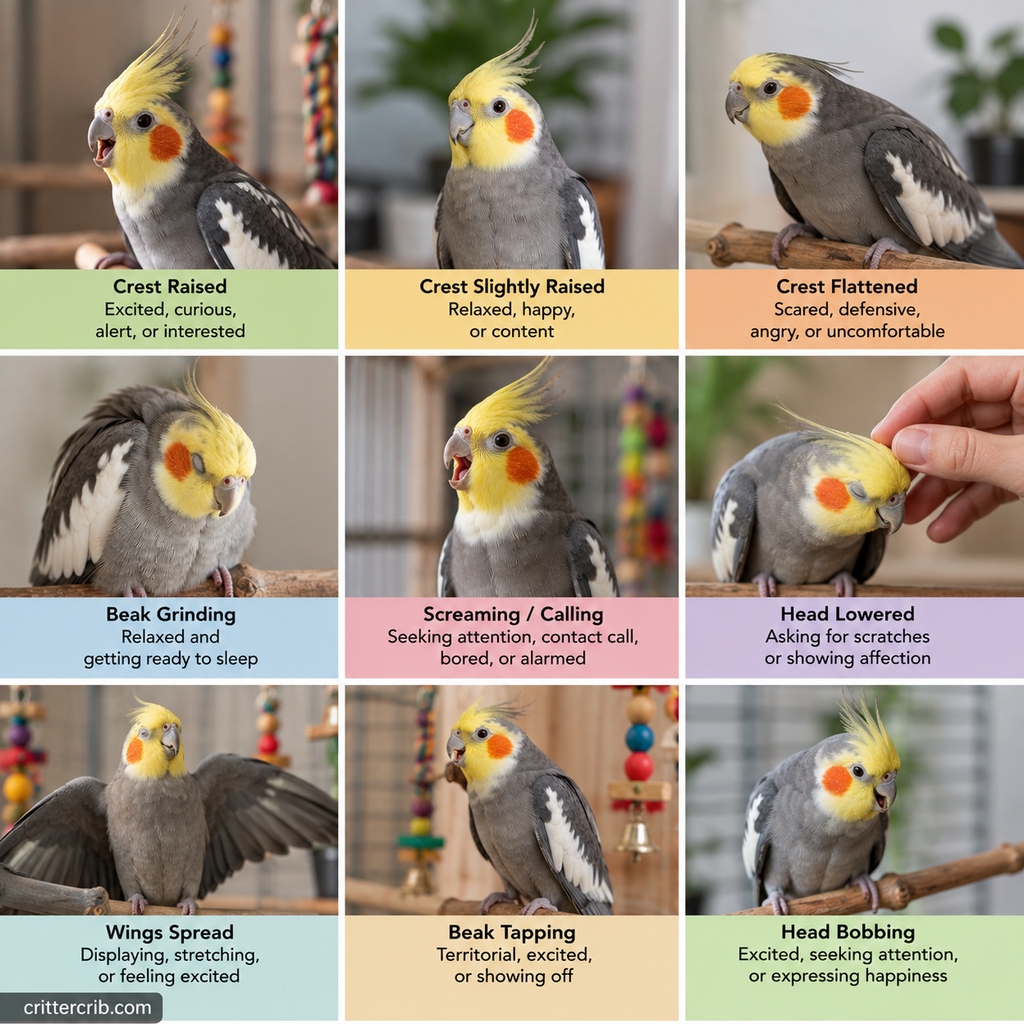
Crest Standing Straight Up
A tall, upright crest usually indicates heightened attention.
Your cockatiel may be:
- Excited
- Curious
- Surprised
- Alert
- Nervous
- Investigating something unfamiliar
You might see this when you enter the room carrying a new toy or when your bird hears an unfamiliar sound.
Look at the rest of the body for additional clues.
An upright crest combined with relaxed posture and curious movement generally suggests interest. An upright crest accompanied by frantic movement or attempts to escape may indicate fear.
Crest Slightly Raised
A moderately raised crest often appears when a cockatiel is relaxed but interested in what’s happening around it.
This is commonly seen during normal interaction and exploration.
Crest Flattened Against the Head
A tightly flattened crest can indicate fear, defensiveness, irritation, or anger.
If the bird also leans forward, opens its beak, hisses, or attempts to bite, it’s giving you a fairly clear warning.
Give the bird some space rather than continuing to approach.
However, cockatiels can also position their crests differently during relaxed activities, so once again, read the entire posture.
Why Do Cockatiels Grind Their Beaks?
Beak grinding can sound strange the first time you hear it.
The bird may gently rub the upper and lower portions of its beak together, creating a quiet grinding or scraping sound.
This is commonly associated with relaxation.
Cockatiels often grind their beaks when they’re:
- Settling down for the night
- Resting comfortably
- Relaxed near someone they trust
- Preparing to nap
If your cockatiel is perched comfortably with relaxed feathers and quietly grinding its beak before bedtime, it’s usually nothing to worry about.
Why Do Cockatiels Puff Up Their Feathers?
Feather fluffing can have several meanings.
A cockatiel may briefly puff its feathers while:
- Relaxing
- Preening
- Adjusting its feathers
- Getting comfortable
- Resting
- Conserving warmth
A quick full-body fluff followed by the feathers returning to normal is common.
Persistent fluffing is different.
If your cockatiel stays puffed up for long periods during the day and is unusually quiet, weak, sleepy, or uninterested in food, contact an avian veterinarian.
Changes from your bird’s normal behavior are particularly important.
Why Do Cockatiels Stand on One Foot?
A cockatiel resting on one foot is usually comfortable.
Birds commonly tuck one foot into their feathers while relaxing or sleeping. They may switch feet periodically.
A cockatiel standing calmly on one foot while grinding its beak and preparing to sleep is displaying several signs of relaxation at once.
However, consistently refusing to put weight on one particular foot can indicate pain or injury.
Check for other signs such as:
- Swelling
- Redness
- Cuts
- Difficulty gripping
- Limping
- Unusual positioning of the toes
Seek veterinary advice if you suspect an injury.
Why Does My Cockatiel Bob Its Head?
Head bobbing is another behavior with multiple possible meanings.
Young cockatiels may bob their heads when begging for food.
Older birds may head bob because they’re:
- Excited
- Seeking attention
- Displaying
- Interacting with a person
- Responding to music or activity
Some particularly enthusiastic cockatiels turn head bobbing into part of a performance involving whistles, movements, and other attention-seeking behavior.
Pay attention to when the behavior happens. Patterns often reveal its purpose.
Why Does My Cockatiel Hiss?
Hissing usually means your cockatiel wants more space.
It’s a warning rather than an invitation to continue interacting.
A cockatiel might hiss when:
- Frightened
- Cornered
- Protecting its cage
- Guarding a favorite area
- Startled
- Uncomfortable with someone’s hand
- Defending eggs or a nesting location
A bird may combine hissing with a flattened crest, open beak, lunging, or attempts to bite.
Don’t punish a cockatiel for hissing.
The bird is communicating discomfort. Respecting that warning can actually reduce the likelihood of being bitten.
Instead, determine what’s making your bird uncomfortable and adjust your approach.
Why Does My Cockatiel Bite?
Cockatiels don’t usually bite simply because they’re “mean.”
Biting often has a reason.
Common triggers include:
- Fear
- Overstimulation
- Territorial behavior
- Hormones
- Protecting a cage or object
- Being forced to interact
- Ignored warning signals
- Pain or illness
- Lack of trust
A cockatiel will often communicate discomfort before delivering a serious bite.
You may notice the bird:
- Lean away.
- Flatten its crest.
- Open its beak.
- Hiss.
- Lunge.
- Bite if the perceived threat continues.
Learning the earlier signals makes biting much easier to avoid.
How to Respond to Biting
Avoid yelling, hitting, flicking the beak, or otherwise punishing the bird.
Instead, try to determine what happened immediately before the bite.
Did you reach into the cage?
Were you trying to touch the bird somewhere it doesn’t like?
Was the bird eating?
Did you ignore hissing?
Was your cockatiel tired?
Understanding the trigger is much more useful than punishing the result.
Why Does My Cockatiel Scream?
Cockatiels are naturally vocal birds.
Occasional loud calls are normal. They may vocalize when the household wakes up, when people leave the room, or during particularly active times of day.
Frequent screaming can have several causes.
Contact Calling
Cockatiels are flock animals.
If you leave the room, your bird may call because it wants to know where you went.
A short whistle or verbal response can sometimes reassure the bird that you’re still nearby.
Attention Seeking
Cockatiels quickly learn which behaviors get a reaction.
If screaming causes you to immediately run into the room every time, your bird may learn:
“Scream, and my person appears.”
Providing attention during calm, desirable behaviors can help prevent screaming from becoming the bird’s primary method of getting interaction.
Boredom
A cockatiel without enough exercise, toys, social interaction, or foraging opportunities may become excessively vocal.
Make sure your bird has:
- Appropriate toys
- Opportunities to chew and shred
- Foraging activities
- Social interaction
- Training
- Safe exercise outside the cage
Fear
Sudden screaming can also indicate alarm.
A bird might react strongly to something humans barely notice, such as a shadow, unfamiliar object, animal outside the window, or unexpected noise.
Why Does My Cockatiel Whistle?
Whistling is one of the most recognizable cockatiel behaviors.
Many cockatiels whistle when they’re content, excited, seeking attention, or interacting socially.
They may learn:
- Simple tunes
- Household whistles
- Repeated sound patterns
- Calls used by family members
- Short melodies
Some birds become enthusiastic performers.
Male cockatiels are often particularly associated with elaborate vocal displays, although individual personality matters and females can be vocal as well.
Responding positively to whistles can turn them into a fun way to interact with your bird.
Why Does My Cockatiel Chirp?
Soft chirping and chatter generally form part of normal cockatiel communication.
A relaxed bird might chirp while:
- Exploring
- Sitting near its owner
- Watching household activity
- Playing
- Interacting with another bird
Over time, you’ll probably begin recognizing specific sounds your cockatiel uses in particular situations.
That familiarity is useful because changes in vocal behavior can sometimes be just as noticeable as changes in physical behavior.
Why Is My Cockatiel Suddenly Quiet?
A quiet cockatiel isn’t automatically sick.
Birds have quieter periods during the day, particularly when resting or preparing to sleep.
Some individuals are naturally less vocal than others.
A sudden and unexplained change, however, deserves attention.
If a normally active, vocal cockatiel becomes unusually quiet and also shows symptoms such as lethargy, appetite loss, persistent feather puffing, abnormal droppings, or breathing difficulty, contact an avian veterinarian.
Knowing what’s normal for your bird makes unusual behavior easier to recognize.
Why Does My Cockatiel Rub Its Head on Me?
A cockatiel gently rubbing its head against you may be seeking interaction or scratches.
Many cockatiels enjoy being scratched around the:
- Head
- Cheeks
- Neck
- Crest area
Birds can’t easily preen every part of their own head, so trusted flock members may help groom these areas.
A cockatiel lowering its head toward you may be requesting scratches.
Where Should You Pet a Cockatiel?
Stick primarily to the head and neck.
Repeatedly stroking the back, under the wings, or around the lower body can be interpreted as courtship or sexual contact and may encourage hormonal behavior.
Head scratches are generally the safer way to provide physical affection.
Why Does My Cockatiel Preen Me?
Preening is an important social behavior among birds.
If your cockatiel gently nibbles your hair, eyebrows, or other appropriate areas, it may be treating you like a trusted member of its social group.
The bird isn’t necessarily trying to bite.
Gentle preening often involves careful nibbling rather than forceful pressure.
Some birds can get a little overenthusiastic, though, particularly around freckles, jewelry, or anything else they decide obviously needs “fixing.”
Redirect the bird if necessary.
Why Does My Cockatiel Preen So Much?
Preening is normal and essential.
Cockatiels spend considerable time maintaining their feathers.
During preening, the bird carefully cleans, aligns, and conditions individual feathers.
Normal preening shouldn’t leave large bald areas or cause obvious skin damage.
Excessive feather damaging or plucking can have behavioral or medical causes and should be taken seriously.
An avian veterinarian should evaluate persistent feather-destructive behavior to rule out underlying health problems before assuming boredom or stress is responsible.
What Does Wing Stretching Mean?
Cockatiels commonly stretch their wings and legs after resting.
You might see the bird extend:
- One wing and one leg on the same side
- Both wings
- The tail
- The entire body
It’s essentially the bird version of stretching after sitting still.
A relaxed stretch followed by normal activity is generally nothing to worry about.
Why Does My Cockatiel Hold Its Wings Away From Its Body?
The meaning depends heavily on context.
A cockatiel may slightly hold its wings away from its body when it’s hot.
More dramatic wing positioning can also occur during excitement, display behavior, stretching, or territorial posturing.
If the bird appears overheated, make sure the environment isn’t excessively warm.
Signs of overheating can include holding the wings away from the body and open-mouth breathing or panting.
Move the bird to a comfortable environment and seek veterinary guidance if you suspect heat stress.
Why Does My Cockatiel Spread Its Wings?
Some cockatiels dramatically spread their wings while perched, sometimes creating a heart-like shape from behind.
This may be a display behavior, especially in males.
A cockatiel may perform the display while:
- Whistling
- Singing
- Showing off
- Claiming a favorite area
- Seeking attention
It can look surprisingly theatrical, which is fitting for a bird that often seems convinced everyone in the room is watching.
Why Does My Cockatiel Tap Its Beak?
Beak tapping can be part of display or territorial behavior.
Some cockatiels tap their beaks against:
- Perches
- Cage bars
- Tables
- Toys
- Other surfaces
The bird may be excited or asserting itself around a particular location.
Observe the behavior surrounding the tapping. A cockatiel that taps while strutting, whistling, or displaying may simply be showing off.
Why Does My Cockatiel Hang Upside Down?
Some cockatiels hang upside down from cage bars, perches, or toys.
This can be normal playful behavior.
An active bird may climb into seemingly ridiculous positions simply because it can.
Provide safe climbing opportunities and regularly inspect toys and cage accessories for hazards.
If upside-down behavior appears alongside loss of balance, falling, weakness, or other neurological symptoms, that’s a different situation and requires veterinary attention.
Why Does My Cockatiel Shake or Tremble?
Occasional trembling can occur for several reasons.
A cockatiel may appear to shake because it is:
- Frightened
- Excited
- Cold
- Adjusting its feathers
- Experiencing stress
Persistent trembling, particularly when accompanied by weakness or other physical symptoms, deserves veterinary attention.
Don’t automatically assume shaking is purely emotional.
Why Does My Cockatiel Wag Its Tail?
A quick tail shake can be part of normal feather adjustment.
Cockatiels may briefly wag or shake their tails after:
- Preening
- Stretching
- Changing position
- Fluffing their feathers
Repeated tail movement synchronized with breathing is different.
Pronounced tail bobbing with each breath can be a sign of respiratory difficulty, particularly if accompanied by open-mouth breathing, unusual sounds, lethargy, or discharge.
Contact an avian veterinarian if you observe breathing-related tail bobbing.
Why Does My Cockatiel Yawn?
Cockatiels yawn occasionally just like many other animals.
An isolated yawn is generally normal.
You may also see repeated opening and closing of the beak when a bird is adjusting its crop or throat.
Persistent yawning, repeated swallowing motions, respiratory symptoms, or unusual head movements may warrant veterinary evaluation, especially if the behavior is new.
Why Does My Cockatiel Make Grinding Sounds at Night?
Quiet beak grinding before sleep is usually a positive sign.
Your cockatiel is probably settling in for the night.
You may notice a relaxed bedtime routine involving:
- Finding a favorite sleeping perch.
- Fluffing slightly.
- Tucking one foot up.
- Quietly grinding the beak.
- Becoming increasingly still.
Learning your bird’s bedtime routine can make it easier to recognize when something is unusual.
Why Does My Cockatiel Have Night Frights?
Cockatiels can sometimes become suddenly frightened at night.
A bird may panic inside the cage, flap violently, fall from a perch, or collide with cage bars.
Possible triggers include:
- Sudden noises
- Moving shadows
- Headlights
- Other pets
- Insects
- Unexpected movement
- Complete darkness combined with a startling event
Night frights can cause injuries.
Some cockatiels do better with a dim night-light nearby so they can orient themselves if startled.
If your bird experiences frequent night frights, investigate the sleeping environment and discuss recurring episodes with an avian veterinarian.
Why Is My Cockatiel Chewing Everything?
Cockatiels explore and manipulate objects with their beaks.
Chewing is normal.
That’s why providing appropriate materials is important.
Offer bird-safe:
- Wood
- Paper
- Shreddable toys
- Foraging materials
- Chew toys
Without suitable options, your cockatiel may choose furniture, books, blinds, cords, or whatever else looks interesting.
Bird-proof out-of-cage areas carefully, especially around electrical wires and potentially toxic materials.
Why Does My Cockatiel Throw Food?
Cockatiels can be messy eaters.
They may toss food while searching for favorite pieces, exploring a dish, or simply eating normally.
Seed hulls can make the mess look even worse.
Some food waste is inevitable with pet birds.
However, excessive selective eating can become a nutritional concern if a bird consistently ignores important parts of its diet.
Monitor what your cockatiel actually consumes rather than judging intake solely by how full the bowl appears.
Why Does My Cockatiel Pace Back and Forth?
Pacing can mean different things depending on when it occurs.
Your bird may pace because it:
- Wants to leave the cage
- Wants your attention
- Sees another person or bird
- Is excited
- Is anticipating food
- Is frustrated
- Is bored
A cockatiel that routinely paces near the cage door when you approach may have simply learned that your arrival means out-of-cage time.
Persistent repetitive pacing combined with inadequate enrichment may indicate that the bird needs more opportunities for exercise and mental stimulation.
Why Does My Cockatiel Follow Me?
If your cockatiel constantly wants to know where you are, you’ve probably become an important part of its social world.
Cockatiels are flock-oriented birds.
A bonded cockatiel may:
- Call when you leave
- Fly toward you
- Sit on your shoulder
- Watch what you’re doing
- Ask for scratches
- Vocalize when you return
Bonding is wonderful, but encourage healthy independence too.
Your bird should also know how to entertain itself with toys, food, foraging activities, and other appropriate enrichment.
Signs Your Cockatiel Trusts You
Trust develops gradually.
Common signs that a cockatiel feels comfortable around you may include:
- Eating while you’re nearby
- Preening in your presence
- Relaxing on one foot
- Beak grinding
- Voluntarily approaching you
- Stepping onto your hand
- Asking for head scratches
- Preening you
- Vocalizing socially
- Sleeping or resting comfortably nearby
Not every cockatiel expresses affection the same way.
Some love physical interaction. Others prefer sitting nearby without being touched.
Respect the individual bird’s personality.
Understanding Hormonal Cockatiel Behavior
Hormonal behavior can cause noticeable changes in adult cockatiels.
A normally easygoing bird may suddenly become territorial, noisy, possessive, or unusually focused on a person or object.
Possible hormonal behaviors include:
- Increased territorial aggression
- Nest seeking
- Regurgitation
- Courtship displays
- Increased screaming
- Possessiveness
- Sexual postures
- Increased biting
- Guarding dark spaces
Environmental factors can encourage reproductive behavior.
Reducing Hormonal Triggers
You can help discourage excessive hormonal behavior by:
- Providing a consistent sleep schedule
- Avoiding nest boxes unless intentionally breeding under appropriate guidance
- Blocking access to dark, enclosed nesting spaces
- Limiting petting to the head and neck
- Redirecting courtship behavior
- Providing exercise and enrichment
- Avoiding inappropriate nesting materials
Don’t punish hormonal behavior. Instead, adjust the environment and interactions that may be reinforcing it.
Persistent or severe reproductive behavior should be discussed with an avian veterinarian.
How to Tell if a Cockatiel Is Scared
A frightened cockatiel may:
- Flatten its crest
- Lean away
- Hiss
- Attempt to escape
- Fly frantically
- Bite
- Freeze
- Become unusually thin-looking as feathers tighten against the body
Common triggers include unfamiliar objects, sudden movements, loud sounds, strangers, and changes in the environment.
Introduce new toys and cage accessories gradually if your bird is cautious.
Something as harmless as a brightly colored toy can look like a terrifying cage monster to a nervous cockatiel.
How to Tell if a Cockatiel Is Relaxed
Relaxed cockatiel behavior is generally easy to recognize once you’re familiar with your bird.
You may see:
- Gentle feather fluffing
- One foot tucked up
- Beak grinding
- Quiet chirping
- Normal preening
- Comfortable stretching
- Relaxed crest position
- Resting near trusted people
The bird should still become alert when something interesting happens.
A bird that appears “relaxed” but barely responds to its surroundings could actually be lethargic.
How to Tell if a Cockatiel Is Happy
There isn’t one universal behavior that proves a cockatiel is happy.
Instead, look for an overall pattern.
A healthy, comfortable cockatiel often:
- Eats normally
- Explores
- Plays
- Preens
- Vocalizes
- Interacts socially
- Exercises
- Sleeps normally
- Shows curiosity
- Maintains normal droppings and body condition
Individual personality makes a difference.
A naturally quiet cockatiel doesn’t need to become a nonstop singer to be content.
When Behavior Changes Could Mean Illness
Behavioral changes are particularly important with birds because they may attempt to conceal weakness.
Pay attention if your cockatiel suddenly:
- Stops eating
- Becomes unusually quiet
- Sleeps much more than normal
- Remains puffed up
- Stops interacting
- Sits on the cage floor
- Loses balance
- Shows breathing difficulty
- Develops abnormal droppings
- Stops performing normal daily behaviors
- Experiences unexplained weight loss
A significant departure from your bird’s normal routine can be more meaningful than any single behavior on a checklist.
If something seems physically wrong, don’t assume it’s merely a mood or behavioral problem.
Contact an avian veterinarian.
How to Better Understand Your Cockatiel
The best way to understand cockatiel behavior is to learn your individual bird.
Pay attention to patterns.
Notice what your cockatiel does:
- Before eating
- Before sleeping
- When excited
- When frightened
- When you leave the room
- When you return
- Around unfamiliar people
- During training
- When asking for attention
Over time, you’ll begin recognizing your cockatiel’s personal communication style.
One bird may whistle when it wants attention. Another may pace near the cage door. Another might simply stare at you until you somehow understand that you’ve been summoned.
Frequently Asked Questions About Cockatiel Behavior
Why does my cockatiel stare at me?
Your cockatiel may be watching you because it’s curious, wants interaction, expects something from you, or simply considers you part of its social environment.
Look at the bird’s posture and what happens immediately afterward for more context.
Why does my cockatiel lower its head toward me?
If your cockatiel calmly lowers its head near your hand, it may be asking for head scratches.
A bird lowering its head while showing defensive body language may mean something different, so always consider the entire posture.
Why does my cockatiel hiss when I put my hand in the cage?
Your bird may feel territorial, frightened, or uncomfortable with your hand entering its personal space.
Avoid forcing interaction. Build trust gradually and consider training your cockatiel to voluntarily approach and step up.
Why does my cockatiel call when I leave the room?
This is often a contact call.
Cockatiels are social birds, and your bird may be trying to locate a member of its perceived flock.
Why does my cockatiel grind its beak when I sit nearby?
Beak grinding commonly occurs when cockatiels are relaxed or preparing to rest.
If the bird is comfortably perched and otherwise behaving normally, it’s generally a positive sign.
Why does my cockatiel suddenly bite me?
Look at what happened immediately before the bite.
Fear, hormones, territorial behavior, overstimulation, pain, or ignored warning signals may all contribute.
Sudden unexplained aggression accompanied by other behavioral or physical changes can also warrant veterinary attention.
Do cockatiels recognize their owners?
Cockatiels can learn to recognize familiar people and develop strong social relationships with them.
A bonded bird may respond differently to a familiar caregiver’s voice, appearance, routines, and presence than it does to strangers.
Can cockatiels get jealous?
Behavior that looks like jealousy can occur when a cockatiel becomes highly attached to a person and reacts negatively when that person’s attention shifts elsewhere.
Rather than assigning a human emotion to every reaction, focus on the observable behavior. Encourage independent play and avoid reinforcing aggression or excessive possessiveness.
Final Thoughts on Cockatiel Behavior
Understanding a cockatiel isn’t about translating every chirp, feather movement, and head bob into a single definition.
Context is what makes the signals meaningful.
An upright crest can indicate curiosity or alarm. Fluffed feathers can mean relaxation or illness. A loud call can be normal flock communication or a sign that your bird is bored and seeking attention.
The more time you spend observing your cockatiel, the easier those distinctions become.
Learn your bird’s normal eating habits, vocal patterns, favorite activities, sleep routine, body language, and ways of asking for interaction. Once you have that baseline, you’ll be much better at recognizing both positive communication and unusual changes.
Most importantly, listen when your cockatiel communicates boundaries. Respect hissing, don’t force handling, reward desirable behavior, provide plenty of enrichment, and pay attention when behavior suddenly changes.
Cockatiels may not speak our language, but they’re rarely short on things to say.