
Betta fish are colorful, curious, and surprisingly interactive pets. They’re also often marketed as fish that can live happily in tiny bowls with very little care. That reputation has led to a lot of confusion about what bettas actually need.
While bettas are relatively beginner-friendly, they still require a properly sized aquarium, warm and clean water, a nutritious diet, and regular maintenance. Give them the right environment and they can become active little pets that recognize feeding routines, explore their surroundings, and show plenty of personality.
This complete betta fish care guide covers the essentials, including tank size, water temperature, filtration, feeding, aquarium setup, cleaning, common health concerns, and daily care.
Betta Fish Care at a Glance
Before getting into the details, here are the basic requirements for keeping a betta fish:
- Tank size: 5 gallons or larger is recommended
- Water temperature: About 78–80°F (26–27°C)
- Water: Freshwater treated with aquarium water conditioner
- Filter: Gentle filtration with low water flow
- Diet: High-quality betta pellets supplemented with appropriate frozen or live foods
- Feeding frequency: Usually once or twice daily in small portions
- Tank maintenance: Regular partial water changes and water-quality testing
- Tank mates: Possible in some setups, but compatibility varies
- Typical lifespan: Often around 3–5 years with proper care
Individual fish and aquarium conditions vary, so these numbers should be treated as practical guidelines rather than rigid rules.
Understanding Betta Fish
Betta fish, scientifically known as Betta splendens, originate from Southeast Asia. Their wild relatives inhabit shallow freshwater environments such as marshes, floodplains, rice paddies, and slow-moving waterways.
Domestic bettas have been selectively bred for generations, producing the dramatic colors and fin shapes commonly found in pet stores today.
One of the most interesting things about bettas is their labyrinth organ. In addition to using their gills, bettas can breathe atmospheric oxygen from the water’s surface.
You may therefore see your betta periodically swim upward and take a gulp of air. This is normal behavior.
However, the ability to breathe atmospheric oxygen doesn’t mean bettas can thrive in dirty water or tiny containers. They still depend on good water quality for long-term health.
Choosing the Right Betta Fish Tank
A good aquarium is the foundation of proper betta care.
Although bettas are frequently displayed in cups and small containers at stores, those temporary conditions shouldn’t be confused with an appropriate permanent home.
What Size Tank Does a Betta Fish Need?
If you’re deciding between different aquarium sizes, our guide to how much space a betta fish needs takes a closer look at tank size, swimming room, water stability, and why larger aquariums can make care easier.
Larger aquariums provide several advantages.
They offer more swimming space, allow for plants and hiding areas, and tend to experience slower changes in water chemistry and temperature.
A tiny container can become polluted surprisingly quickly.
In a larger aquarium, waste products are diluted through a greater volume of water, giving you more room to maintain stable conditions.
A 5- or 10-gallon aquarium also provides much more flexibility when adding equipment such as a heater and filter.
Does a Betta Tank Need a Lid?
A lid is strongly recommended.
Bettas can jump, sometimes through surprisingly small openings. An aquarium lid helps prevent accidental escapes while also reducing evaporation.
Leave appropriate access to the water’s surface because bettas need to breathe atmospheric air.
Setting Up a Betta Fish Habitat
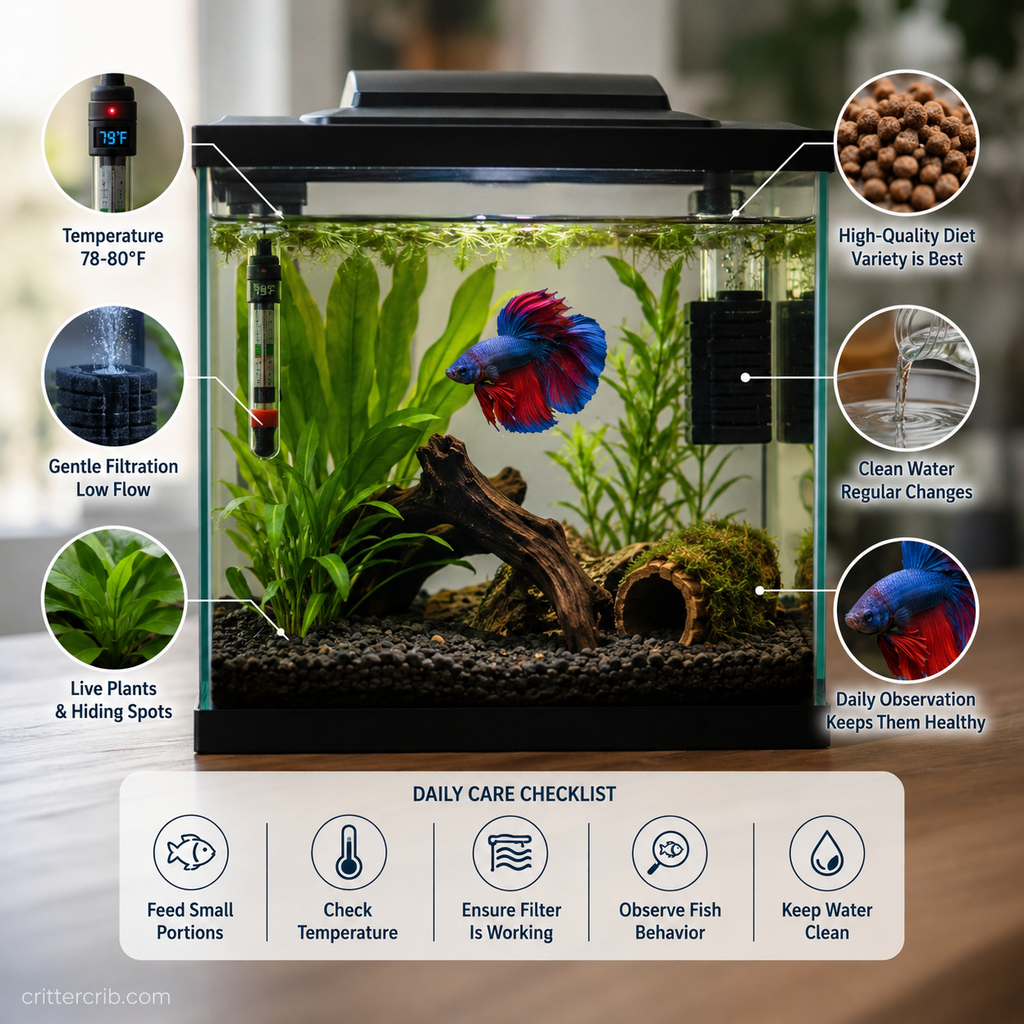
A betta aquarium doesn’t need to be complicated, but it should provide warmth, clean water, swimming space, and places to explore or rest.
If you’re starting from scratch, our betta fish habitat setup guide walks through tank size, filtration, heating, water quality, lighting, substrate, plants, decorations, and the other essentials you’ll need.
A basic setup usually includes:
- Aquarium
- Secure lid
- Adjustable or appropriately sized heater
- Gentle filter
- Thermometer
- Substrate
- Live or soft artificial plants
- Hiding areas
- Water conditioner
- Aquarium water-testing supplies
Once the essentials are covered, you can customize the aquarium with plants, wood, rocks, and other fish-safe decorations.
Choosing Substrate
Gravel and aquarium sand can both work well for betta tanks.
The choice largely depends on the appearance you prefer and the type of plants you plan to keep.
Whatever substrate you choose, make sure it’s intended for aquarium use and doesn’t contain sharp pieces that could injure your fish.
Plants and Hiding Places
Bettas often enjoy environments containing plants and sheltered areas.
Live aquarium plants can provide cover while creating a more natural-looking environment. Beginner-friendly options may include:
- Anubias
- Java fern
- Java moss
- Cryptocoryne
- Floating aquarium plants
Always research the requirements of individual plants before adding them.
Artificial plants can also work, but choose soft aquarium-safe varieties. Rough plastic leaves and sharp decorations can potentially damage a betta’s delicate fins.
A simple test is to gently feel decorations for sharp edges before putting them in the aquarium.
Give Your Betta Places to Rest
Long-finned bettas in particular may appreciate resting spots close to the surface.
Broad plant leaves, floating logs designed for aquarium use, and other smooth resting areas can provide places where the fish can relax without swimming all the way to the bottom.
Do Betta Fish Need a Heater?
In most homes, yes.
Bettas are tropical fish and generally do best with water around 78–80°F.
Room temperature isn’t necessarily the same as aquarium temperature. A house that feels comfortable to you may still leave the aquarium too cool for a betta.
Temperature can also fluctuate between daytime and nighttime.
A properly sized aquarium heater helps maintain a stable temperature.
Use an aquarium thermometer as well. Don’t rely solely on the heater’s setting to determine the actual water temperature.
Why Stable Temperature Matters
Sudden or prolonged temperature changes can stress fish.
Rather than chasing an exact number every minute of the day, aim for a consistently warm aquarium without major fluctuations.
Position the heater according to the manufacturer’s instructions and monitor the thermometer regularly.
Do Betta Fish Need a Filter?
A filter is highly recommended for a betta aquarium.
Filtration helps remove debris and, more importantly, provides a home for beneficial bacteria involved in the aquarium’s nitrogen cycle.
However, bettas aren’t necessarily fans of powerful currents.
Their natural habitats tend to contain relatively calm or slow-moving water, and domesticated long-finned varieties can struggle against strong flow.
Look for gentle filtration appropriate for the size of the aquarium.
Sponge filters are popular for betta tanks because they can provide biological filtration with relatively mild water movement. Some hang-on-back and internal filters can also work if their flow is adjustable or appropriately diffused.
If your betta is constantly being pushed around the aquarium or seems to avoid the area near the filter, the current may be too strong.
Understanding the Aquarium Nitrogen Cycle
One of the most important concepts for new fish owners is the nitrogen cycle.
Fish produce waste. Uneaten food and other organic material also break down inside the aquarium.
This process produces ammonia, which is toxic to fish.
Beneficial bacteria eventually establish themselves in the aquarium and help convert:
- Ammonia into nitrite
- Nitrite into nitrate
Ammonia and nitrite should generally remain at 0 ppm in an established aquarium.
Nitrate is less immediately toxic but still needs to be controlled through aquarium maintenance, plants, and partial water changes.
This bacterial ecosystem is one reason simply filling a new aquarium with tap water and immediately adding a fish isn’t ideal.
Cycling a Betta Tank
Whenever possible, establish the aquarium’s nitrogen cycle before introducing your betta.
This is commonly called a fishless cycle.
During cycling, an ammonia source is introduced without exposing a fish to harmful ammonia and nitrite levels. Water testing is then used to monitor the development of beneficial bacteria.
Cycling can take time, but it creates a much safer environment for your fish.
If you already have a betta in an uncycled aquarium, don’t panic or simply leave the tank alone waiting for it to cycle. You’ll need to carefully monitor ammonia and nitrite and perform water changes as necessary while the biological filter becomes established.
Betta Fish Water Parameters
Water quality has an enormous effect on a betta’s health.
You don’t need to obsess over every tiny fluctuation, but understanding the basics makes aquarium care much easier.
Important parameters to monitor include:
- Temperature
- Ammonia
- Nitrite
- Nitrate
- pH
For an established aquarium, ammonia and nitrite should generally be kept at 0 ppm.
A stable pH is usually more important than constantly trying to adjust the water with chemicals to reach a supposedly perfect number.
If you’re using municipal tap water, always treat replacement water with an aquarium water conditioner that neutralizes chlorine or chloramine as appropriate.
Never assume untreated tap water is safe simply because it looks clear.
How to Acclimate a New Betta Fish
Moving into a new aquarium can be stressful for a fish.
When bringing your betta home, avoid simply dumping the fish and store water directly into the aquarium.
One common approach is:
- Make sure the aquarium is already prepared, heated, and conditioned.
- Allow the sealed transport container or bag to float briefly so temperatures can begin equalizing.
- Gradually acclimate the fish according to an appropriate aquarium acclimation method.
- Transfer the betta carefully into the aquarium.
- Avoid adding unnecessary store water to your tank.
- Keep the environment calm while the fish adjusts.
Don’t be surprised if a new betta initially hides or seems less active. Moving is stressful.
Monitor the fish closely during the first several days.
What Do Betta Fish Eat?
Bettas are primarily carnivorous or insectivorous fish.
In nature, they consume insects, insect larvae, small crustaceans, and other tiny animal prey.
Their captive diet should reflect those nutritional needs.
A high-quality pellet formulated specifically for bettas can serve as the primary food.
For a deeper look at staple foods, frozen and live foods, feeding frequency, portion sizes, and avoiding overfeeding, see our complete betta fish feeding guide.
You can supplement pellets with appropriate foods such as:
- Frozen brine shrimp
- Frozen bloodworms
- Daphnia
- Mysis shrimp
- Suitable live foods from reliable sources
Frozen and live foods should complement a balanced diet rather than automatically replacing a quality staple food.
How Often Should You Feed a Betta?
Most adult bettas can be fed small meals once or twice per day.
The appropriate amount depends on the food you’re using, the size and age of your fish, and its individual condition.
Rather than relying on a universal number of pellets, check the manufacturer’s feeding recommendations and observe your fish.
Feed an amount your betta can consume promptly without leaving significant leftovers.
Avoid Overfeeding
Overfeeding is one of the easiest mistakes to make.
Bettas often behave enthusiastically around food, but begging doesn’t necessarily mean they’re starving.
Excess food can contribute to:
- Digestive problems
- Weight gain
- Uneaten food in the substrate
- Increased aquarium waste
- Poor water quality
If food regularly falls to the bottom and remains uneaten, you’re probably offering too much.
Remove significant leftovers rather than allowing them to decay in the tank.
Daily Betta Fish Care
Once the aquarium is established, daily care is relatively simple.
Spend a few minutes each day observing your fish and aquarium.
Daily Betta Care Checklist
Check:
- Is your betta swimming normally?
- Is it interested in food?
- Are its fins normally positioned?
- Is its breathing normal?
- Are there unusual spots, swelling, injuries, or discoloration?
- Is the water temperature within the normal range?
- Is the filter operating correctly?
- Is the heater functioning?
- Is the aquarium water clear and free of obvious problems?
These quick observations can help you notice changes before they become serious.
You don’t need to disturb the fish every day. Often, simply watching your betta for a few minutes while feeding provides useful information.
Weekly Betta Tank Maintenance
Regular maintenance keeps waste from accumulating and helps maintain stable water conditions.
For many established aquariums, maintenance includes a partial water change every week or on a schedule determined by water testing and the tank’s specific needs.
How Much Water Should You Change?
There isn’t one perfect percentage for every aquarium.
For many established betta tanks, changing roughly 20–30% of the water weekly is a reasonable starting point.
The correct schedule depends on factors such as:
- Tank size
- Filtration
- Nitrate levels
- Feeding
- Plant growth
- Amount of accumulated waste
Water testing should help guide your maintenance schedule.
How to Perform a Partial Water Change
A typical water change looks like this:
- Prepare replacement water.
- Treat tap water with an appropriate water conditioner.
- Make sure the new water is reasonably close to the aquarium’s temperature.
- Remove a portion of the old aquarium water.
- Vacuum debris from the substrate when necessary.
- Slowly add the conditioned replacement water.
- Check that the heater and filter are operating normally afterward.
You generally don’t need to remove your betta during routine partial water changes.
Leaving the fish in the aquarium is often less stressful than repeatedly catching and transferring it.
Don’t Completely Clean the Aquarium Every Week
A common beginner mistake is treating an aquarium like a household container that needs to be completely scrubbed clean.
A healthy aquarium contains beneficial bacteria, particularly on filter media and other surfaces.
Avoid routinely:
- Replacing all aquarium water
- Scrubbing every surface until sterile
- Replacing all filter media at once
- Washing biological filter media under untreated chlorinated tap water
Doing so can disrupt the aquarium’s biological filtration.
If reusable filter media needs cleaning, gently rinsing it in removed aquarium water is often preferable. Always follow the filter manufacturer’s maintenance recommendations as well.
Betta Fish Behavior
Learning what’s normal for your particular betta makes it easier to recognize problems. Our guide to common betta fish behaviors and what they mean goes deeper into flaring, bubble nests, resting, glass surfing, hiding, swimming patterns, territorial displays, and other behaviors you may notice.
Healthy bettas may:
- Explore different areas of the aquarium
- Investigate movement outside the tank
- Swim toward you at feeding time
- Rest on leaves or decorations
- Occasionally flare
- Build bubble nests
- Swim to the surface for air
- Spend periods resting
Not every betta behaves exactly the same way.
Some are constantly exploring, while others are more relaxed.
What Is a Bubble Nest?
Male bettas sometimes create clusters of bubbles at the water’s surface.
These are called bubble nests and are associated with reproductive behavior.
Finding one doesn’t mean your fish needs a mate.
It also isn’t a guaranteed indicator that everything about the aquarium is perfect. It’s simply a normal behavior that some bettas display.
Can Betta Fish Live With Other Fish?
Sometimes, but tank mates require careful planning.
Male bettas should generally not be housed together because they can be highly territorial and aggressive toward one another.
Community setups can sometimes work in appropriately sized aquariums, but compatibility depends on the individual betta, tank size, layout, and other species involved.
Potential tank mates in suitable setups may include certain:
- Peaceful small fish
- Snails
- Shrimp
However, none are automatically guaranteed to be compatible.
Some bettas ignore shrimp. Others hunt them.
Some tolerate peaceful fish. Others become territorial.
Tank mates also increase the aquarium’s biological load, meaning filtration, space, and maintenance requirements change.
A 5-gallon aquarium that works well for a single betta shouldn’t automatically be treated as a community tank.
Research each species separately before combining animals.
Can Male and Female Bettas Live Together?
Male and female bettas should not simply be placed together as permanent companions.
Breeding bettas requires specialized knowledge and preparation, and the process can involve aggressive behavior and injury.
A male betta doesn’t need a female companion to be healthy or happy.
For most pet owners, keeping a single betta is simpler and safer.
Signs Your Betta Fish May Be Sick
Fish naturally have quieter periods, so one unusual moment doesn’t necessarily mean something is wrong.
However, persistent changes deserve attention.
Potential warning signs include:
- Refusing food for an extended period
- Unusual lethargy
- Rapid or labored breathing
- Remaining at the surface or bottom unusually often
- Clamped fins
- Frayed or deteriorating fins
- White spots
- Unusual patches or growths
- Swelling or severe bloating
- Raised scales
- Difficulty swimming
- Rubbing against objects
- Sudden changes in color or behavior
If you notice something unusual, start by checking the aquarium’s water parameters and temperature.
Poor water quality can cause stress and may contribute to health problems.
Don’t immediately add medications without identifying the likely problem. Different illnesses require different treatments, and unnecessary medication can complicate matters.
When possible, consult an aquatic veterinarian for serious or persistent health concerns.
Common Betta Fish Care Mistakes
Many betta problems come from a handful of avoidable mistakes.
Keeping a Betta in a Tiny Bowl
Small containers provide little swimming space and can experience rapid changes in temperature and water quality.
A properly equipped aquarium of at least around 5 gallons provides a much more manageable environment.
Keeping the Water Too Cold
Bettas are tropical fish.
An unheated aquarium in a cool room may remain below their preferred temperature.
Use a heater when necessary and verify the temperature with a thermometer.
Using a Filter With Too Much Flow
Powerful currents can exhaust a betta, particularly varieties with large fins.
Choose gentle filtration or reduce the flow appropriately.
Overfeeding
More food isn’t necessarily better.
Small, appropriate meals help reduce digestive problems and excess aquarium waste.
Skipping Water Testing
Clear water isn’t automatically healthy water.
Ammonia and nitrite are invisible, which is why water testing is an important part of aquarium care.
Replacing All the Water
Routine 100% water changes are generally unnecessary in a properly maintained aquarium and can create sudden changes in water conditions.
Partial water changes are usually preferable.
Adding a Betta to an Uncycled Aquarium
A brand-new aquarium doesn’t immediately contain an established population of beneficial bacteria.
Learning about the nitrogen cycle before getting your fish can prevent one of the most common beginner aquarium problems.
Using Sharp Decorations
Long betta fins can be vulnerable to damage.
Choose smooth decorations and soft or live plants.
How to Keep a Betta Fish Mentally Stimulated
Bettas can be curious fish and often interact with their environment.
A completely empty aquarium doesn’t provide much to explore.
You can create a more interesting habitat using:
- Live plants
- Floating plants
- Caves
- Smooth driftwood
- Resting areas
- Occasional changes to safe aquarium décor
Don’t overcrowd the aquarium. Your betta should still have plenty of open swimming space and easy access to the surface.
Some bettas will also follow your finger outside the aquarium or learn simple feeding routines.
A mirror can cause a betta to flare because it interprets its reflection as another fish. While very brief exposure is sometimes used as enrichment, prolonged exposure can cause unnecessary stress and shouldn’t be a permanent feature.
How Long Do Betta Fish Live?
Betta fish commonly live around 3–5 years in captivity, although individual lifespan varies.
Genetics, age when purchased, previous care, diet, water quality, disease, and long-term aquarium conditions can all influence lifespan.
Our guide to how long betta fish live and the factors that affect their lifespan takes a closer look at how genetics, water quality, diet, stress, tank conditions, and age at purchase can influence longevity.
You may not know exactly how old a pet-store betta is when you purchase it, so lifespan after purchase can vary considerably.
Providing consistently good care gives your fish the best chance of living a long, healthy life.
A Simple Betta Fish Care Routine
Betta care becomes much easier when you turn it into a routine.
Every Day
- Feed an appropriate amount
- Observe your betta’s behavior
- Check the water temperature
- Make sure the filter and heater are working
- Remove obvious uneaten food when necessary
Every Week
- Test important water parameters as needed
- Perform an appropriate partial water change
- Remove accumulated debris
- Inspect plants and decorations
- Check aquarium equipment
Periodically
- Clean reusable filter components when necessary
- Trim live plants
- Inspect equipment for wear or damage
- Check water parameters more frequently if anything seems unusual
The exact schedule will vary from tank to tank.
The goal isn’t to follow a calendar blindly. It’s to create stable conditions and adjust your routine based on what water testing and your fish are telling you.
Betta Fish Care FAQ
Are Betta Fish Good for Beginners?
Yes. Bettas can be good beginner fish when they’re kept in a properly established aquarium.
The misconception is that beginner-friendly means maintenance-free.
New owners still need to understand basic aquarium concepts such as water conditioning, temperature, filtration, the nitrogen cycle, and partial water changes.
If you’re still deciding whether a betta is the right first fish for you, our guide to betta fish as pets for beginners covers what ownership is actually like before you bring one home.
Can a Betta Fish Live in a Bowl?
A betta may survive for some time in a small bowl, but survival isn’t the same thing as providing good long-term care.
A 5-gallon or larger filtered and heated aquarium provides more swimming space and generally makes stable water conditions easier to maintain.
Do Betta Fish Need a Filter?
A filter is strongly recommended.
It helps maintain water quality and provides surface area for beneficial bacteria. Choose a filter with gentle flow suitable for bettas.
Do Betta Fish Need a Heater?
Most betta aquariums need a heater unless the surrounding environment reliably maintains an appropriate and stable water temperature.
Aim for roughly 78–80°F and verify the temperature with an aquarium thermometer.
How Often Should I Feed My Betta Fish?
Adult bettas are commonly fed once or twice per day in small amounts.
Exact portions depend on the food and individual fish. Avoid feeding so much that significant amounts remain uneaten.
How Often Should I Change Betta Fish Water?
Many established betta aquariums benefit from weekly partial water changes, with roughly 20–30% being a useful starting point.
However, tank size, filtration, stocking, feeding, and water-test results should determine the actual schedule.
Can Betta Fish Live Alone?
Yes.
A betta doesn’t need another fish for companionship. In fact, keeping a single betta can eliminate many compatibility and territorial issues.
Can Two Male Bettas Live Together?
No. Male Betta splendens are territorial and shouldn’t be housed together in the same open aquarium.
Why Is My Betta Fish Lying on a Leaf?
Bettas frequently rest on leaves and other surfaces, especially long-finned varieties.
Occasional resting can be completely normal.
If your fish is suddenly resting far more than usual, refusing food, breathing abnormally, or showing other symptoms, check the water temperature and parameters and investigate further.
Why Does My Betta Keep Going to the Surface?
Bettas have a labyrinth organ that allows them to breathe atmospheric oxygen, so occasional trips to the surface are normal.
Constantly gasping at the surface, particularly when accompanied by other unusual behavior, can indicate a problem and warrants checking water quality, temperature, and aquarium conditions.
Final Thoughts on Betta Fish Care
Bettas aren’t difficult pets once you understand what they actually need.
The biggest difference between merely keeping a betta alive and providing good long-term care comes down to the environment.
Start with a properly sized aquarium. Keep the water warm and stable. Use gentle filtration. Establish the nitrogen cycle, monitor water quality, feed a nutritious diet, and perform regular partial water changes.
Just as importantly, pay attention to your fish.
After caring for a betta for a while, you’ll begin recognizing its normal habits: where it likes to rest, how eagerly it approaches food, which areas of the aquarium it explores, and how active it usually is.
Those everyday observations are one of the most useful tools you have. When something changes, you’ll be much more likely to notice it early.
With a little preparation and a consistent routine, a betta can be a colorful, engaging addition to your home for years.