
Guppies are small fish, so it’s easy to assume they don’t need much room. Walk through a pet store and you may even see a large number of them sharing a relatively small display tank.
At home, though, giving guppies enough space matters.
A properly sized aquarium gives them room to swim, makes it easier to maintain stable water conditions, and reduces problems caused by crowding. Tank size becomes even more important when you consider how quickly guppies can reproduce.
So, how much space do guppies actually need?
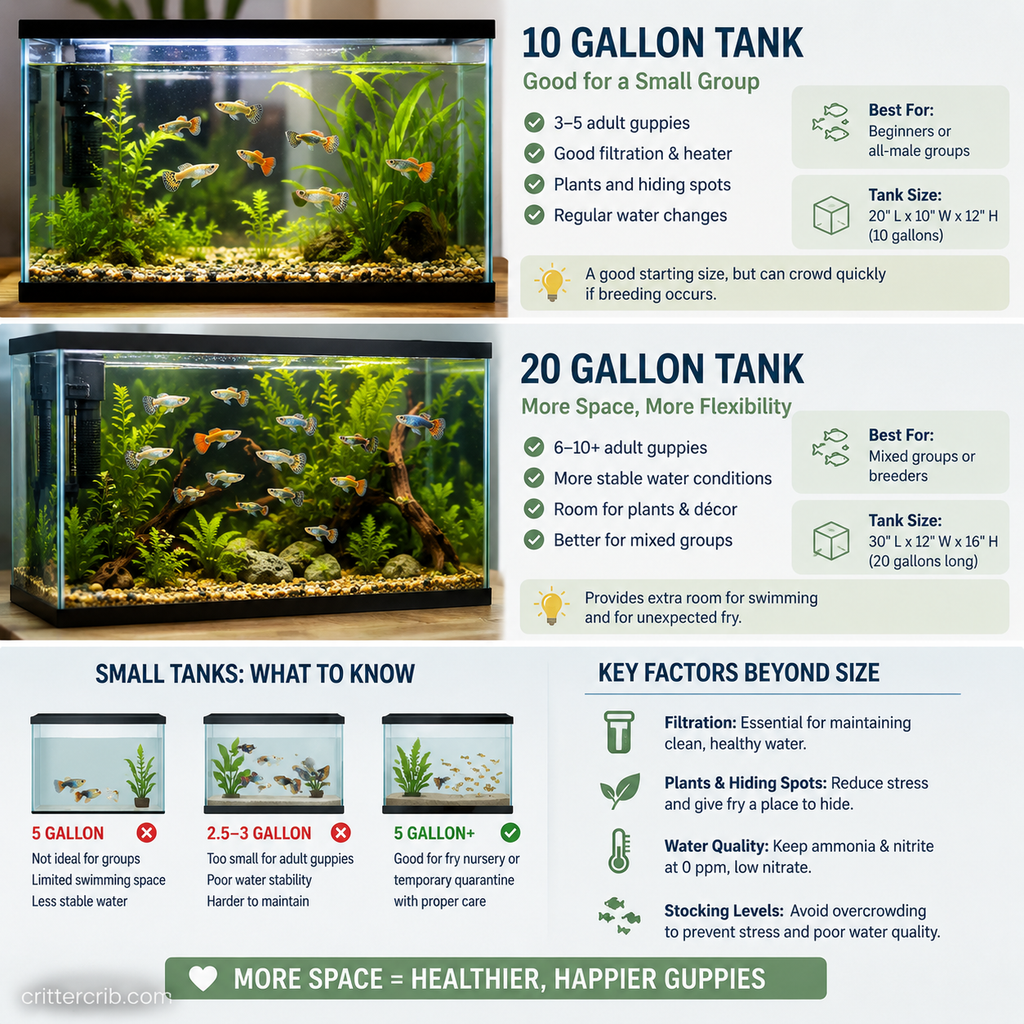
For a small group of guppies, a 10-gallon aquarium is generally a practical starting point. A larger tank, such as a 20-gallon aquarium, gives you considerably more flexibility and can be easier to manage as the group grows.
But tank size alone doesn’t tell the whole story. The number of fish, their sex, filtration, aquarium shape, plants, water quality, and whether you’re keeping males and females together all affect how much space you’ll really need.
This guide explains how to choose an appropriate guppy tank size and avoid some of the most common stocking mistakes.
How Much Space Do Guppies Need?
Guppies are active little fish.
Although an individual guppy doesn’t require a huge aquarium, these fish are generally kept in groups rather than alone. That means you need to think about the space required by the entire group, not just one fish.
For most beginners, a 10-gallon tank is a reasonable minimum starting point for a small group of guppies.
However, a 20-gallon tank is often an even better choice.
The extra water volume provides:
- More swimming space
- Greater flexibility with stocking
- More room for plants and hiding areas
- Better dilution of fish waste
- More stable water conditions
- Additional space if unexpected fry appear
Bigger doesn’t mean maintenance-free, but a larger volume of water generally changes more slowly than a tiny aquarium.
That can be especially helpful when you’re learning how to care for fish.
Is a 5-Gallon Tank Big Enough for Guppies?
A 5-gallon aquarium can physically hold guppies, but it isn’t an ideal choice for a typical guppy group.
The biggest issue isn’t simply whether the fish fit inside.
Guppies are social and active. Keeping several fish in only five gallons leaves relatively little swimming space once you add a filter, heater, plants, substrate, and decorations.
Small tanks also provide less margin for error.
Waste can accumulate quickly, and changes in temperature or water chemistry can have a greater impact.
A 5-gallon tank may have specialized uses, such as temporarily housing fry or serving as a carefully managed quarantine setup, but a larger aquarium is generally preferable as the permanent home for a group of adult guppies.
Is a 10-Gallon Tank Good for Guppies?
Yes. A 10-gallon aquarium can work well for a modest group of guppies when properly maintained.
It’s large enough to provide useful swimming space while remaining manageable for someone new to aquariums.
A 10-gallon setup can accommodate:
- A small guppy group
- Live plants
- A heater
- Appropriate filtration
- Hiding and resting areas
- Open swimming space
The key word is small.
A 10-gallon tank can become overcrowded quickly if you keep both males and females and they begin reproducing.
If you’re interested in breeding guppies or maintaining a larger colony, consider starting with something bigger.
Is a 20-Gallon Tank Better for Guppies?
For many guppy keepers, a 20-gallon aquarium is an excellent size.
You gain considerably more flexibility without moving into an aquarium that’s overwhelmingly large.
A 20-gallon tank provides more space for a larger group, plants, decorations, and potentially compatible tank mates.
More importantly, it gives you a larger water volume.
That can make maintaining stable conditions easier.
A 20-gallon long aquarium can be particularly attractive for guppies because it provides plenty of horizontal swimming room.
If you have the space and budget to choose between a 10-gallon and a 20-gallon aquarium, the larger tank is often worth considering.
How Many Guppies Can Live in a 10-Gallon Tank?
There isn’t a perfect formula for determining exactly how many guppies belong in every aquarium.
You may encounter rules such as “one inch of fish per gallon,” but these rules oversimplify aquarium stocking.
Two fish of similar length can produce different amounts of waste, have different activity levels, and require very different environments.
Instead, stocking should consider:
- Adult fish size
- Number of fish
- Aquarium dimensions
- Filtration
- Water quality
- Planting
- Maintenance schedule
- Sex ratio
- Whether breeding is occurring
- Other aquarium inhabitants
For a 10-gallon aquarium, starting conservatively with a small group of roughly 3–5 guppies can be more manageable than immediately trying to maximize the tank’s capacity.
Monitor water parameters and fish behavior as the aquarium becomes established.
Remember that adding fish also adds waste.
How Many Guppies Can Live in a 20-Gallon Tank?
A 20-gallon aquarium provides significantly more flexibility.
A group of roughly 6–10 adult guppies may be a reasonable starting range for many properly filtered 20-gallon setups, depending on aquarium conditions and whether other animals are present.
That isn’t a target you have to reach.
There’s nothing wrong with keeping fewer fish in a larger aquarium.
In fact, lightly stocked tanks can be easier to maintain.
If you’re keeping males and females together, leave additional room for population growth. A tank that looks lightly stocked today can look completely different after several generations of fry.
Why Guppy Tank Size Isn’t Just About Fish Length
Guppies usually reach only around 1.5–2.5 inches in length, with females generally growing larger than males.
Their small size can make a tiny aquarium seem reasonable.
But aquarium space isn’t determined solely by body length.
Guppies swim throughout the tank and interact frequently with one another. Males may chase females, males may display toward one another, and the entire group needs enough room to move without constantly being crowded together.
Space also has to accommodate:
- Plants
- Filtration equipment
- A heater
- Substrate
- Decorations
- Feeding areas
- Fry
- Other tank inhabitants
Then there’s waste.
Several tiny fish can still create enough waste to overwhelm a small aquarium if stocking and maintenance aren’t appropriate.
Do Guppies Need to Live in Groups?
Guppies are social fish and are generally better suited to group living than solitary housing.
You don’t need an enormous school, but keeping several guppies allows them to display more natural social behavior.
This is another reason a larger aquarium is preferable to a tiny tank.
Rather than asking how small a container one guppy can survive in, it’s more useful to plan an aquarium around a healthy group.
Male Guppies vs. Female Guppies: Space Considerations
Male and female guppies don’t always create the same housing situation.
Males are usually smaller and are famous for their bright colors and elaborate tails.
Females tend to be larger and less dramatically colored, although domestic varieties can still be attractive.
The biggest difference from a housing perspective is reproduction.
Put mature males and females together and you should assume breeding is possible.
Keeping Only Male Guppies
An all-male guppy tank is popular with people who want colorful fish without dealing with constant reproduction.
Males may display toward and chase each other, so provide enough swimming space and visual breaks.
Plants can help create a more interesting environment and give fish opportunities to move away from one another.
Watch the group for persistent bullying.
Keeping Male and Female Guppies Together
Mixed-sex groups require more planning.
Male guppies can persistently pursue females.
If you keep both sexes together, a commonly suggested approach is to maintain more females than males so that attention from males isn’t constantly focused on one female.
A ratio around one male to two or three females is often used as a starting guideline.
However, that introduces another issue: babies.
Potentially lots of them.
Guppies Can Reproduce Very Quickly
This is one of the most important things to understand before choosing a guppy aquarium.
Guppies are livebearers.
Instead of laying eggs that later hatch, females give birth to live fry.
Under suitable conditions, reproduction can occur frequently.
Female guppies can also store sperm after mating, which means a female may produce additional broods even when a male is no longer present.
A small mixed-sex group can therefore turn into a much larger population.
This creates a problem if you originally selected an aquarium based only on the number of adult fish you purchased.
Five guppies may fit comfortably.
Five adults plus dozens of growing fry may not.
If you don’t specifically want to breed guppies, an all-male setup is one of the simplest ways to avoid uncontrolled population growth.
How Much Space Do Guppy Fry Need?
Newborn guppies are tiny, but they grow.
Fry also need good water quality and access to appropriate food.
A small nursery or grow-out tank may work temporarily, but its capacity changes as the fish get larger.
If you’re intentionally breeding guppies, plan ahead for:
- Fry tanks or grow-out space
- Additional filtration
- More frequent feeding
- Increased waste production
- Separating fish when necessary
- Finding appropriate homes for offspring
Don’t wait until dozens of young fish are already swimming around the aquarium to decide what you’re going to do with them.
Breeding fish means taking responsibility for the offspring as well as the adults.
Does Aquarium Shape Matter for Guppies?
Yes.
Gallons tell you how much water an aquarium holds, but they don’t completely describe the usable swimming space.
For guppies, horizontal swimming room is valuable.
A long rectangular aquarium generally provides more useful swimming space than a very tall, narrow tank containing the same amount of water.
Longer tanks can also provide more surface area for gas exchange.
When comparing aquariums of similar capacity, consider their dimensions as well as their gallon rating.
Do Guppies Need a Heater?
Guppies are tropical freshwater fish and generally need warm, stable water.
In most homes, an aquarium heater is recommended.
A temperature around 72–82°F is commonly suitable for guppies, with many keepers maintaining their tanks somewhere in the middle of that range.
Stability is important.
A room may feel warm during the afternoon but become considerably cooler overnight.
Use an aquarium thermometer so you know the actual water temperature rather than relying on how the room feels.
Do Guppies Need a Filter?
Yes, filtration is strongly recommended.
A filter doesn’t simply collect visible debris.
One of its most important jobs is providing surface area where beneficial bacteria can live.
These bacteria help process nitrogenous waste through the aquarium’s nitrogen cycle.
Fish waste and decomposing organic matter produce ammonia.
Beneficial bacteria convert ammonia into nitrite and eventually nitrate.
Ammonia and nitrite are toxic and should generally remain at 0 ppm in a properly cycled aquarium.
This biological filtration becomes especially important as the number of fish increases.
Don’t Use Filtration as an Excuse to Overstock
A powerful filter can help process aquarium waste, but it doesn’t magically create additional swimming space.
This is an important distinction.
You might hear that a heavily filtered aquarium can support more fish.
To some extent, filtration capacity affects how well a system processes waste. But fish still need physical room, and overcrowding can create social stress and maintenance problems.
A bigger filter doesn’t turn a 10-gallon aquarium into a 20-gallon aquarium.
Use adequate filtration while still stocking the tank responsibly.
The Nitrogen Cycle and Guppy Tank Size
Understanding the nitrogen cycle is essential before adding guppies to a new aquarium.
A brand-new tank doesn’t instantly contain enough beneficial bacteria to process fish waste safely.
Ideally, the aquarium should be cycled before fish are introduced.
In a cycled aquarium:
- Ammonia is produced from waste and decomposing organic matter.
- Beneficial bacteria convert ammonia into nitrite.
- Other bacteria convert nitrite into nitrate.
- Nitrate is controlled through plants and regular partial water changes.
Larger aquariums aren’t immune to water-quality problems.
However, their greater water volume can provide more stability than very small tanks.
That’s another reason a 10- or 20-gallon aquarium is generally easier to recommend than a tiny desktop tank.
How Plants Affect a Guppy Aquarium
Guppies do very well in planted aquariums.
Plants create visual barriers, provide cover, and give fry places to hide.
Live plants can also contribute to the aquarium ecosystem by using nutrients from the water.
Good beginner aquarium plants may include:
- Anubias
- Java fern
- Java moss
- Water sprite
- Guppy grass
- Hornwort
- Floating plants
Research each plant before adding it, since lighting and care requirements vary.
Don’t fill every inch of the aquarium with plants.
Guppies still benefit from open areas where they can swim freely.
A combination of planted areas and open swimming space works well.
How Much Swimming Space Should Guppies Have?
There isn’t a specific measurement of open water that every guppy needs.
Instead, look at the aquarium as a whole.
Your fish should be able to move throughout the tank without constantly navigating around decorations or bumping into other fish.
Avoid overdecorating.
A visually impressive aquarium isn’t necessarily a functional one if plants, rocks, wood, and ornaments occupy nearly all the available space.
Try to create:
- Open swimming areas
- Planted sections
- Hiding places
- Visual barriers
- Easy access to food
- Unobstructed surface areas
This provides both activity space and opportunities for fish to retreat.
Can Guppies Live in a Bowl?
A bowl isn’t an appropriate permanent home for guppies.
Traditional fish bowls typically provide very little water volume, limited swimming room, and insufficient space for proper filtration and heating equipment.
Small volumes of water are also vulnerable to rapid changes in water quality and temperature.
Guppies may be small, but they still require a properly established freshwater aquarium.
A rectangular 10-gallon aquarium is a much more suitable starting point for a small group.
Can Guppies Live in a 1-Gallon Tank?
A 1-gallon aquarium is far too small for a permanent group of guppies.
There’s very little room to swim, water conditions can change rapidly, and maintaining appropriate equipment becomes difficult.
Tiny tanks are often marketed as convenient because they occupy little space.
Unfortunately, smaller doesn’t necessarily mean easier.
For beginners, the opposite can be true.
A larger aquarium gives you a much greater margin for maintaining stable conditions.
Can Guppies Live in a 2.5-Gallon Tank?
A 2.5-gallon aquarium is also too restrictive for a normal group of adult guppies as a permanent home.
It may have temporary specialized uses for experienced fish keepers, but it isn’t a good general housing recommendation.
If space is limited, consider whether guppies are the right pet for the available area rather than trying to fit them into the smallest possible aquarium.
Can Guppies Live in a 3-Gallon Tank?
A 3-gallon tank presents many of the same limitations.
Although guppies physically fit inside, the aquarium provides little space for a social group and offers limited water volume for managing waste.
For permanent housing, moving up to at least a 10-gallon aquarium provides a much more practical environment.
What Happens When Guppies Are Overcrowded?
Overcrowding isn’t simply an aesthetic problem.
Adding more fish increases the amount of waste entering the aquarium.
Without sufficient biological filtration and maintenance, water quality can deteriorate.
Overcrowding can also contribute to:
- Increased competition for food
- Persistent chasing
- Stress
- Less swimming space
- Faster nitrate accumulation
- Greater maintenance demands
- Increased disease transmission
- Lower oxygen availability in poorly managed setups
A tank may appear fine shortly after fish are added but become increasingly difficult to maintain as the animals grow or reproduce.
Signs Your Guppy Tank May Be Too Crowded
Water testing provides better information than simply looking at the aquarium.
However, possible warning signs include:
- Nitrate accumulating rapidly between water changes
- Fish constantly competing for space
- Excessive chasing or harassment
- Difficulty maintaining good water quality
- Heavy waste accumulation
- Fish gasping or showing signs of stress
- Maintenance becoming increasingly frequent
- Large numbers of growing fry
Don’t wait for fish to become visibly sick before addressing overcrowding.
If your aquarium population keeps increasing, you’ll eventually need additional space or a responsible plan for rehoming fish.
How Often Should You Change the Water in a Guppy Tank?
There’s no single water-change schedule that works for every aquarium.
For many established guppy tanks, weekly partial water changes are a useful starting point.
The amount and frequency depend on:
- Aquarium size
- Number of fish
- Filtration
- Feeding
- Nitrate accumulation
- Live plants
- Amount of organic waste
A partial change of roughly 20–30% per week may work well in many moderately stocked aquariums, but water testing should help guide your actual routine.
A heavily stocked tank may require more frequent maintenance.
That’s one of the hidden costs of trying to fit too many fish into a small aquarium.
Is a Bigger Guppy Tank Easier to Maintain?
Often, yes.
This sounds counterintuitive.
Surely a smaller aquarium should be easier to clean?
Physically, perhaps. But maintaining stable water conditions can actually be more difficult in a very small volume of water.
Imagine accidentally adding a little too much food.
In a tiny aquarium, that excess organic material represents a relatively large addition compared with the total water volume.
In a larger tank, the same mistake is diluted through more water.
A larger aquarium can also provide more room for:
- Biological filter media
- Live plants
- Substrate
- Beneficial microorganisms
- Gas exchange
You still need regular maintenance, but the aquarium may be more forgiving.
Choosing the Best Guppy Tank Size for Beginners
For someone setting up their first guppy aquarium, consider starting with either a 10- or 20-gallon tank.
Choose a 10-Gallon Tank If:
- You have limited space
- You want a relatively small group
- You’re planning an all-male setup
- You don’t intend to breed guppies
- You’re comfortable keeping stocking conservative
Choose a 20-Gallon Tank If:
- You have enough room
- You want a larger group
- You want more planting options
- You may eventually add compatible tank mates
- You want more flexibility
- You’re concerned about unexpected fry
If both sizes work for your home and budget, a 20-gallon tank provides considerably more room for future decisions.
Planning a Guppy Aquarium Step by Step
Before buying your fish, plan the entire setup.
1. Decide How Many Guppies You Want
Start with a modest group rather than trying to fill the aquarium immediately.
2. Decide Whether You Want Males, Females, or Both
If you don’t want fry, an all-male group can simplify population management.
3. Choose the Aquarium
A 10-gallon tank is a practical starting point, while a 20-gallon gives you more flexibility.
4. Add the Essential Equipment
You’ll generally need:
- Filter
- Heater
- Thermometer
- Aquarium light
- Water conditioner
- Water-testing supplies
5. Add Substrate, Plants, and Hiding Areas
Create an interesting environment without eliminating open swimming space.
6. Cycle the Aquarium
Establish biological filtration before adding the full fish population whenever possible.
7. Add Fish Gradually
Avoid immediately stocking the aquarium to its theoretical maximum.
Monitor water quality as you introduce fish.
8. Watch the Population
If males and females are together, prepare for fry.
Don’t assume you’ll somehow deal with them later.
Guppy Tank Size FAQ
What Is the Minimum Tank Size for Guppies?
For a typical small group of adult guppies, a 10-gallon aquarium is a practical minimum starting point.
Larger tanks provide additional swimming room and more stable water conditions.
How Many Guppies Should Be Kept Together?
Guppies are social fish and are generally kept in small groups rather than alone.
A group of at least three is a common starting point, although the appropriate number depends on aquarium size, sex ratio, and overall stocking.
Can I Keep 3 Guppies in a 5-Gallon Tank?
While three guppies can physically fit in a 5-gallon aquarium, a 10-gallon tank provides a much more appropriate permanent environment with more swimming room and greater water stability.
How Many Guppies Can I Put in a 10-Gallon Tank?
A small group of roughly 3–5 adult guppies is a conservative starting point for many 10-gallon aquariums.
Actual stocking capacity depends on filtration, maintenance, plants, sex, breeding, and other inhabitants.
How Many Guppies Can I Put in a 20-Gallon Tank?
Roughly 6–10 adults can be a reasonable starting range for many appropriately maintained 20-gallon guppy tanks.
There’s no requirement to maximize stocking, and keeping fewer fish can make maintenance easier.
Do Guppies Prefer Long or Tall Tanks?
Guppies benefit from horizontal swimming space, making longer rectangular aquariums particularly useful.
When choosing between tanks of similar volume, consider the actual dimensions rather than gallon capacity alone.
Can I Keep Just One Guppy?
Guppies are social fish and are generally better kept with other guppies.
Plan your aquarium around a small group rather than a single fish.
Do Guppies Need Lots of Plants?
Guppies don’t need an aquarium packed completely with plants, but planted areas can provide useful cover and visual barriers.
Leave open swimming space as well.
Will Guppies Overpopulate a Tank?
They certainly can.
Male and female guppies kept together can reproduce rapidly. Without a population-management plan, a comfortably stocked aquarium can eventually become overcrowded.
Is a 10-Gallon or 20-Gallon Tank Better for Guppies?
Both can work, but a 20-gallon aquarium offers more swimming room, greater stocking flexibility, and additional water volume.
For a beginner who has room for either, the 20-gallon is often the more flexible long-term choice.
Final Thoughts on Guppy Housing
Guppies may be small, but that doesn’t mean they belong in tiny aquariums.
For a small group, a 10-gallon aquarium is a practical starting point. If you have the room, moving up to a 20-gallon tank provides more swimming space and gives you considerably more flexibility.
The biggest mistake is choosing an aquarium based only on how small the fish look at the pet store.
Think about the entire system.
Your guppies need swimming space, clean and stable water, filtration, warmth, plants or other cover, and enough room to interact without being constantly crowded.
You also need to think ahead.
If you’re keeping males and females together, today’s population may not be tomorrow’s population. Guppies reproduce readily, and unexpected fry can turn a lightly stocked aquarium into an overcrowded one surprisingly quickly.
Choose your tank with the adult population in mind, stock conservatively, monitor water quality, and resist the urge to squeeze in “just one more” fish.
A little extra space makes caring for guppies easier—and gives these active, colorful fish a much better environment to explore.