
Betta fish are small, which is probably why they’ve spent decades being displayed in bowls, jars, tiny cubes, and other containers that wouldn’t provide much swimming room for any fish.
But being able to survive in a small amount of water doesn’t mean a betta should permanently live that way.
So, how much space do betta fish actually need?
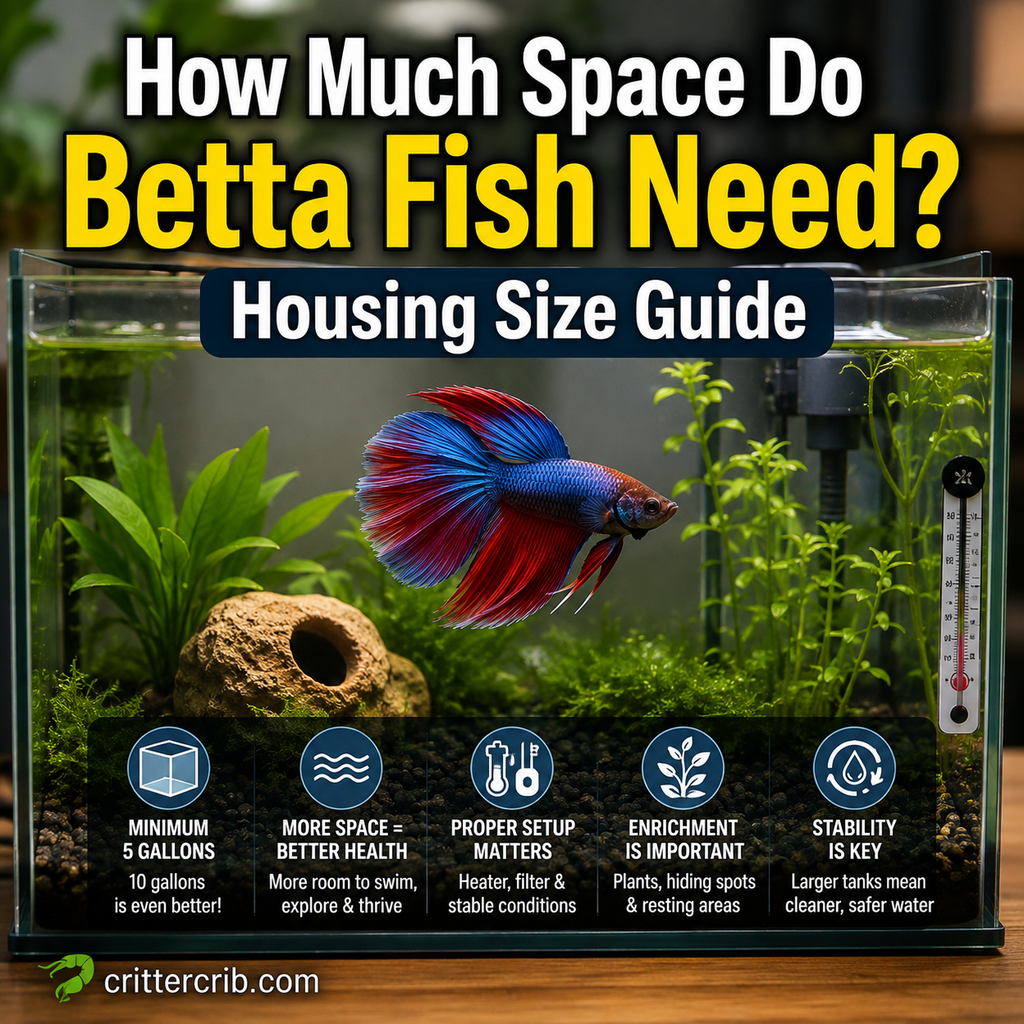
For a single adult betta, a 5-gallon aquarium is a good practical minimum for long-term housing, while a 10-gallon tank can provide even more swimming room and greater water stability. Larger tanks can work very well too, provided they’re properly heated, filtered, and designed so the betta can easily reach the surface.
Tank size isn’t just about giving your fish more room to swim. Water volume affects temperature stability, waste concentration, filtration, enrichment, and how forgiving the aquarium is when something changes.
Here’s how to choose an appropriate home for your betta.
What Is the Minimum Tank Size for a Betta Fish?
For most pet bettas, 5 gallons is a sensible minimum target.
Could a betta physically fit inside something smaller?
Of course.
But that’s not a useful way to determine appropriate housing.
A proper aquarium needs enough space for:
- Normal swimming
- A heater
- Gentle filtration
- Plants and enrichment
- Resting areas
- Routine maintenance
- Stable water conditions
A 5-gallon aquarium gives you enough room to provide those basics without the fish spending its entire life in a cramped container.
If you have room for a 10-gallon tank, that’s often an even better choice.
Why Do Bettas Need More Space Than a Bowl?
Tiny containers create several problems at once.
The most obvious is limited swimming space, but water quality may be an even bigger concern.
Imagine adding a small amount of waste to a cup of water compared with adding the same amount to a bucket.
The concentration changes much more quickly in the cup.
Aquariums work similarly.
In a very small container:
- Ammonia can become dangerous quickly
- Temperature can fluctuate rapidly
- Uneaten food has a greater effect on water quality
- Filtration can be difficult to install
- Heaters may be difficult to use safely
- There’s little room for enrichment
- Maintenance mistakes have less margin for error
A larger aquarium doesn’t eliminate the need for maintenance, but it usually provides a more stable environment.
Can a Betta Fish Live in a Bowl?
A betta may survive in a bowl for some time, but a traditional small, unfiltered and unheated bowl isn’t ideal permanent housing.
Bettas are tropical fish.
They need warm, stable water, and most small bowls aren’t designed to accommodate a proper heater and filter.
There’s also very little room for plants, resting areas, and natural exploration.
If you like the appearance of a simple aquarium, you can still create a clean, minimalist setup in a 5- or 10-gallon tank.
The fish gets the space and equipment it needs without sacrificing the look you’re after.
Is a 1-Gallon Tank Big Enough for a Betta?
A 1-gallon aquarium is generally too small for permanent betta housing.
It may look considerably larger than the cups used to display bettas at stores, but it still provides very little usable water volume.
Small tanks also require surprisingly intensive maintenance.
Water parameters can change quickly, and finding appropriate filtration and heating becomes more difficult.
A 1-gallon container may have temporary uses—for example, holding a fish briefly during certain situations—but it isn’t a good choice for a betta’s primary long-term home.
Is a 2.5-Gallon Tank Big Enough for a Betta?
A 2.5-gallon tank is an improvement over a bowl or 1-gallon container, but it’s still smaller than the 5-gallon minimum commonly recommended for long-term betta care.
Space becomes especially tight once you add:
- Heater
- Filter
- Plants
- Decorations
- Resting areas
Remember that the advertised tank capacity isn’t necessarily the amount of water the fish actually gets.
Substrate, rocks, decorations, and leaving space at the top all reduce the aquarium’s true water volume.
When possible, move up to a 5-gallon or larger setup.
Is a 5-Gallon Tank Good for a Betta?
Yes.
A properly equipped 5-gallon aquarium can make an excellent home for a single betta.
It provides enough space for a simple but interesting environment while remaining compact enough for many homes.
A good 5-gallon setup might include:
- Adjustable heater
- Gentle filter
- Thermometer
- Aquarium light
- Live or soft artificial plants
- Smooth decorations
- Resting areas near the surface
- Open swimming space
Five gallons is also widely available as a standard aquarium size, making it relatively easy to find compatible equipment.
Is a 10-Gallon Tank Better for a Betta?
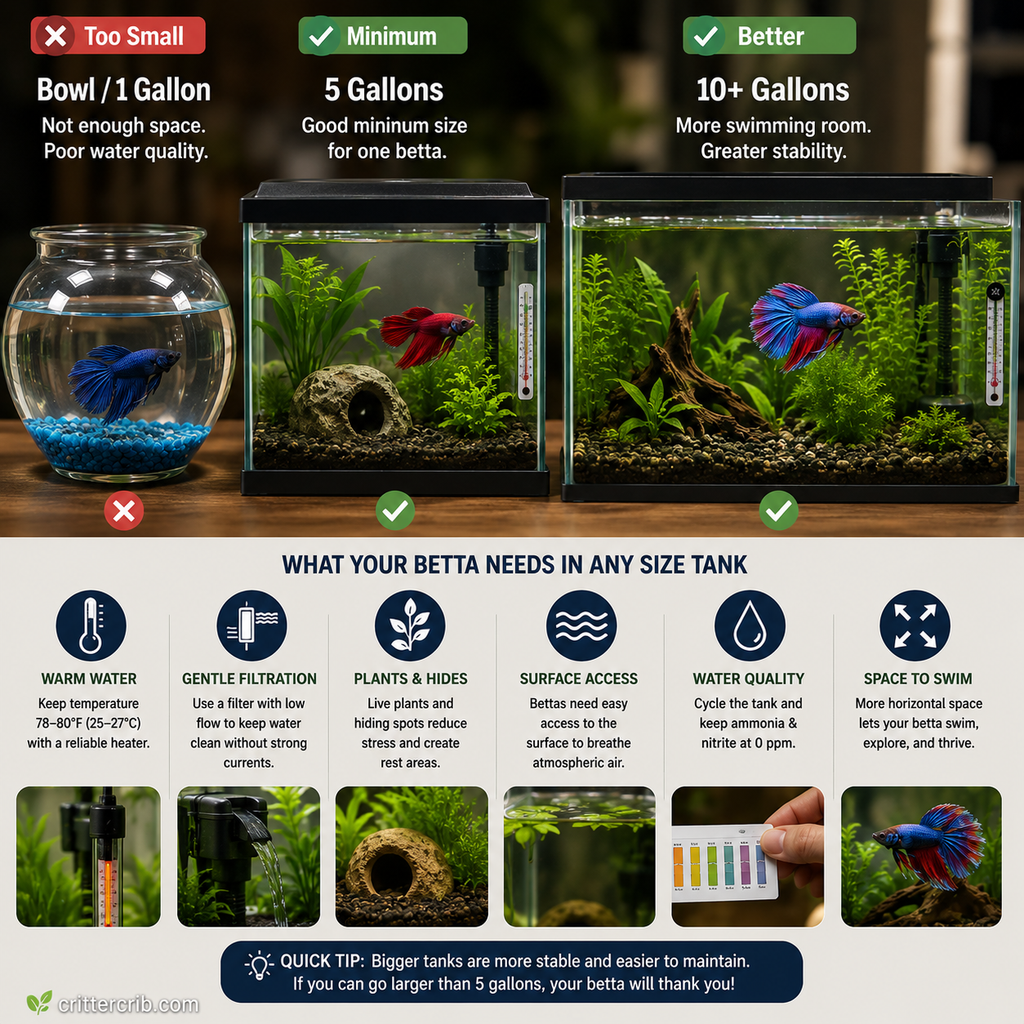
If you have the space, a 10-gallon aquarium is an excellent option.
Compared with a 5-gallon tank, it offers:
- More swimming room
- More room for plants
- Greater water volume
- More aquascaping possibilities
- More stable temperature and water chemistry
- More flexibility when designing enrichment
A 10-gallon tank isn’t necessarily twice as difficult to maintain.
In some ways, it can actually be easier because the additional water volume makes environmental changes less abrupt.
You still need regular maintenance, but you have more room for error.
Can a Betta Tank Be Too Big?
There’s no simple gallon limit beyond which an aquarium suddenly becomes too large for a betta.
The more important question is whether the aquarium is designed appropriately.
Bettas are labyrinth fish and regularly access the surface to breathe atmospheric air.
In a large aquarium, make sure your fish can easily reach the surface.
This is particularly important for:
- Long-finned bettas
- Older fish
- Fish with swimming difficulties
- Bettas recovering from illness
A very deep tank with strong currents and nowhere to rest near the surface may be less suitable than a shallower aquarium with a generous horizontal footprint.
For bettas, usable space matters more than simply chasing the largest gallon number possible.
Tank Shape Matters Too
Two aquariums can hold the same number of gallons while providing very different environments.
A tall, narrow aquarium and a long, shallow aquarium may have identical volume.
For a betta, the longer footprint is often more useful.
Bettas generally benefit from horizontal swimming space and easy access to the surface.
When comparing tanks, look at:
- Length
- Width
- Height
- Surface area
- Available swimming room
Don’t focus exclusively on gallons.
How Much Swimming Space Does a Betta Need?
There’s no exact measurement of swimming space that every betta requires.
Instead, design the aquarium so the fish can move comfortably through multiple areas.
A good setup should allow your betta to:
- Swim horizontally without immediately reaching a wall
- Explore around plants
- Move between shaded and open areas
- Reach the surface easily
- Rest near the surface
- Turn comfortably
- Avoid constantly fighting water current
Decorations should add interest without turning the aquarium into an obstacle course.
Leave open areas between plants and structures.
Bettas Need a Heater
Tank size isn’t the only housing consideration.
Bettas are tropical fish and generally do best at approximately 78–80°F (26–27°C).
Unless your aquarium naturally remains within an appropriate, stable temperature range, you’ll likely need a heater.
Choose a heater designed for the aquarium’s volume and monitor it with a separate thermometer.
Small bowls make temperature control particularly difficult.
Another advantage of a proper aquarium is having enough water volume and physical space to operate a heater safely.
Bettas Benefit From Gentle Filtration
A filter helps maintain aquarium water quality and provides surface area for beneficial bacteria.
But bettas don’t necessarily appreciate powerful water movement.
Long-finned varieties in particular can struggle against strong currents.
Good options may include:
- Sponge filters
- Adjustable hang-on-back filters
- Filters with baffled output
- Other low-flow aquarium filters
Watch your fish.
If the betta is constantly being pushed around or avoids part of the aquarium because of the current, reduce the flow.
The goal is filtration without turning the tank into a treadmill.
Why Aquarium Cycling Matters
Even a large aquarium isn’t safe simply because it contains more water.
A betta tank should have an established biological cycle.
Fish waste and other organic material produce ammonia, which is toxic.
Beneficial bacteria process that waste through the nitrogen cycle.
In simplified form:
- Waste produces ammonia.
- Beneficial bacteria convert ammonia into nitrite.
- Other bacteria convert nitrite into nitrate.
- Water changes and plant growth help control nitrate accumulation.
In an established aquarium, ammonia and nitrite should generally remain at 0 ppm.
Understanding aquarium cycling is one of the most valuable things a new betta owner can learn.
How Much Space Do Betta Fish Need for Plants and Decorations?
Plants and decorations are useful, but don’t fill every inch of the aquarium.
Bettas often enjoy exploring planted areas and resting on broad leaves.
You can include:
- Live aquarium plants
- Silk or soft artificial plants
- Smooth caves
- Driftwood prepared for aquarium use
- Smooth rocks
- Betta resting leaves or platforms
Avoid sharp plastic plants or rough decorations that could catch delicate fins.
An easy test for questionable decorations is to gently feel every surface and opening.
If something feels sharp to you, it may not belong next to a betta’s fins.
Why Bettas Need Access to the Surface
Bettas have a specialized labyrinth organ that allows them to breathe atmospheric air.
You’ll regularly see a healthy betta swim to the surface for a breath.
That means surface access should never be blocked.
Plants can provide cover near the top, but leave open areas where your fish can breathe comfortably.
Resting spots near the surface are especially helpful for long-finned or older bettas.
Do Betta Fish Need a Tank Lid?
A lid is strongly recommended.
Bettas can jump.
A fish that seems perfectly content one day can unexpectedly launch itself through an opening.
Keep the aquarium securely covered while still allowing appropriate air exchange.
Check gaps around:
- Filters
- Heater cords
- Airline tubing
- Lighting
- Feeding openings
A larger aquarium doesn’t help if your betta ends up on the floor.
How Much Space Does a Betta Need With Tank Mates?
Adding tank mates changes the space calculation considerably.
A 5-gallon aquarium that works well for one betta doesn’t suddenly become suitable for a community simply because the other animals are small.
Every additional animal adds:
- Waste
- Competition
- Territorial pressure
- Space requirements
- Filtration demands
If you’re considering tank mates, a larger aquarium is usually necessary.
Compatibility also depends heavily on the individual betta.
Some tolerate other animals reasonably well. Others chase anything that moves.
Possible companions in appropriately sized setups may include certain snails or shrimp, although even these aren’t guaranteed to be safe with every betta.
Research each combination carefully.
Can Two Male Bettas Share a Tank?
Two male bettas should not simply be placed together in the same aquarium.
Male bettas are territorial and can seriously injure one another.
A larger tank doesn’t automatically solve this problem.
Even when physical dividers are used, the setup needs careful planning so fish can’t reach one another or remain constantly stressed by visual contact.
For most owners, separate aquariums are the safer and simpler approach.
What About Female Betta Sororities?
Groups of female bettas are sometimes kept together in setups known as sororities.
These arrangements are considerably more complicated than keeping a single betta.
Aggression can still occur between females, sometimes seriously.
A sorority requires:
- Much more space
- Heavy planting and visual barriers
- Careful observation
- Appropriate group composition
- Backup housing if fish need to be separated
- Experience recognizing aggression and stress
It’s not a setup I’d recommend simply because someone wants multiple bettas in one aquarium.
A single well-housed betta is much easier to manage.
How Often Should You Clean a Betta Tank?
A larger aquarium still requires regular maintenance.
Avoid completely emptying and scrubbing the aquarium every week.
Instead, routine care generally involves partial water changes and targeted cleaning.
Your maintenance schedule depends on:
- Aquarium size
- Filtration
- Feeding
- Plant growth
- Water-test results
- Stocking
Use a siphon to remove debris where necessary and treat replacement tap water with an appropriate conditioner.
Clean filter media according to the manufacturer’s instructions while preserving the beneficial bacteria supporting the nitrogen cycle.
Is a Bigger Betta Tank Easier to Maintain?
Often, yes.
This surprises new fish keepers.
A tiny aquarium looks easier because there’s less water, but that smaller water volume means problems can develop more quickly.
In a larger tank:
- Waste is more diluted
- Temperature changes tend to happen more slowly
- Water chemistry can be more stable
- There’s more room for plants and filtration
- Small mistakes may have less immediate impact
Of course, a 100-gallon aquarium requires more work than a 10-gallon tank.
But when comparing a 1-gallon bowl with a properly equipped 5- or 10-gallon aquarium, the larger setup can actually be easier to keep stable.
A Simple Betta Tank Setup
For someone bringing home their first betta, a straightforward setup is often best.
Start with:
- A 5- to 10-gallon aquarium
- A secure lid
- Gentle filtration
- An appropriately sized heater
- A thermometer
- Water conditioner
- Water-testing supplies
- Smooth substrate
- Live or soft artificial plants
- A few smooth hiding and resting areas
Cycle the aquarium before adding the fish whenever possible.
Once everything is established, concentrate on maintaining stable conditions rather than constantly changing the setup.
Common Betta Housing Mistakes
Even with a suitable tank size, poor setup choices can create problems.
Avoid:
- Tiny bowls as permanent housing
- Unheated tanks in cool rooms
- Strong filter currents
- Sharp plastic decorations
- Overcrowding
- Blocking access to the surface
- Keeping the aquarium without a secure lid
- Adding incompatible tank mates
- Skipping the nitrogen cycle
- Assuming clear water means safe water
Tank size matters, but it’s only one piece of good betta care.
Frequently Asked Questions About Betta Tank Size
What size tank does a betta fish need?
A 5-gallon aquarium is a good practical minimum for a single adult betta, while a 10-gallon aquarium provides additional swimming space and water stability.
Is 2.5 gallons enough for a betta?
A 2.5-gallon aquarium is better than a tiny bowl, but it provides limited swimming room and less stable water conditions than a 5-gallon or larger aquarium. When possible, choose at least 5 gallons for permanent housing.
Is 5 gallons enough for one betta?
Yes. A properly heated, filtered, cycled, and maintained 5-gallon aquarium can make a good home for a single betta.
Is 10 gallons too big for a betta?
No. A 10-gallon aquarium can be an excellent betta habitat when it has gentle filtration, suitable plants and resting areas, and easy access to the surface.
Do bettas prefer tall or long tanks?
A longer aquarium with good horizontal swimming space and easy surface access is generally preferable to an unusually tall, narrow tank.
Can a betta live without a filter?
It’s possible to maintain some aquariums without conventional filtration using specialized methods, but filtration makes maintaining stable water quality much easier for most owners. A gentle filter is recommended for a typical betta setup.
Can betta fish live in bowls?
Bettas may survive in bowls, but small unheated and unfiltered bowls don’t provide ideal long-term housing. A properly equipped aquarium of at least around 5 gallons is a much better choice.
Final Thoughts
So, how much space do betta fish need?
For most adult bettas, start with at least a 5-gallon aquarium. If you have room for a 10-gallon setup, even better.
The extra space isn’t just for swimming.
More water volume can provide greater environmental stability while giving you room for proper filtration, heating, plants, hiding areas, and enrichment.
Most importantly, don’t let a betta’s small size fool you into thinking it needs a tiny home.
These fish spend their entire lives inside the environment we provide for them. Giving a betta enough room to swim, explore, rest, and behave naturally is one of the simplest ways to make that environment a better one.