Getting the temperature right is one of the most important parts of keeping a pet turtle healthy. Humidity matters too, although exactly how much depends heavily on the type of turtle you’re keeping and whether it’s aquatic, semi-aquatic, or primarily terrestrial.
That’s the first thing every turtle owner should understand: there isn’t one perfect temperature and humidity level that works for every turtle.
A red-eared slider has different environmental needs from a box turtle. Even turtles that appear similar may come from very different habitats.
Still, there are useful starting points.
Many commonly kept aquatic turtles need water in roughly the mid-70s°F, along with a much warmer, completely dry basking area. Terrestrial and semi-terrestrial turtles often require more attention to substrate moisture and humidity.
Here’s how to create the right environment without getting lost in the numbers.
Why Temperature Is So Important for Turtles
Turtles are ectothermic.
Instead of producing enough internal body heat to maintain a constant temperature like humans do, they rely heavily on their environment.
That’s why you see wild aquatic turtles climbing onto logs and rocks to bask in the sun.
They’re actively regulating their body temperature.
A properly designed turtle habitat gives your pet the same opportunity.
Depending on the species, that may include:
- Warm water
- A cooler water zone
- A dry basking platform
- Overhead heat
- UVB lighting
- Cooler retreat areas
The turtle chooses where it needs to be.
This process is called thermoregulation.
What Is the Ideal Temperature for a Turtle?
There’s no universal turtle temperature.
For many popular aquatic species, however, a useful general starting point is:
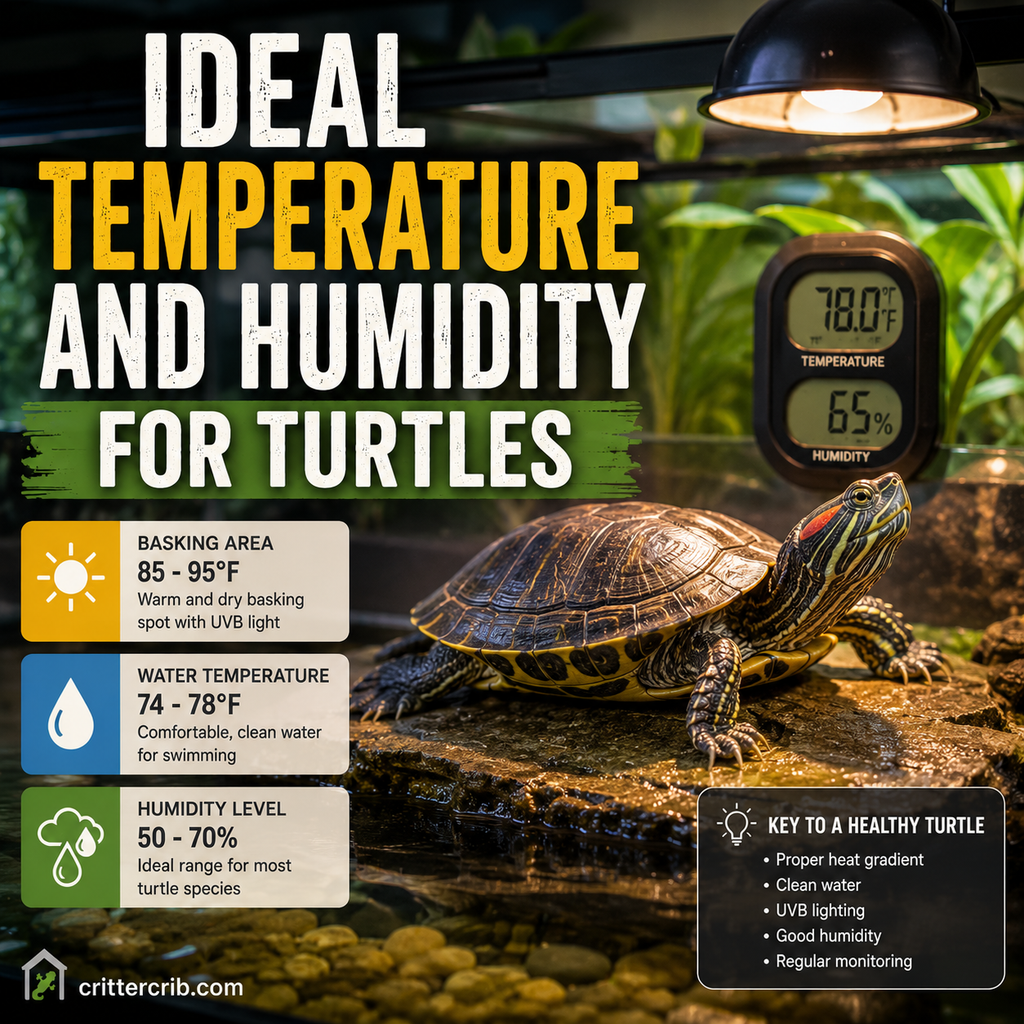
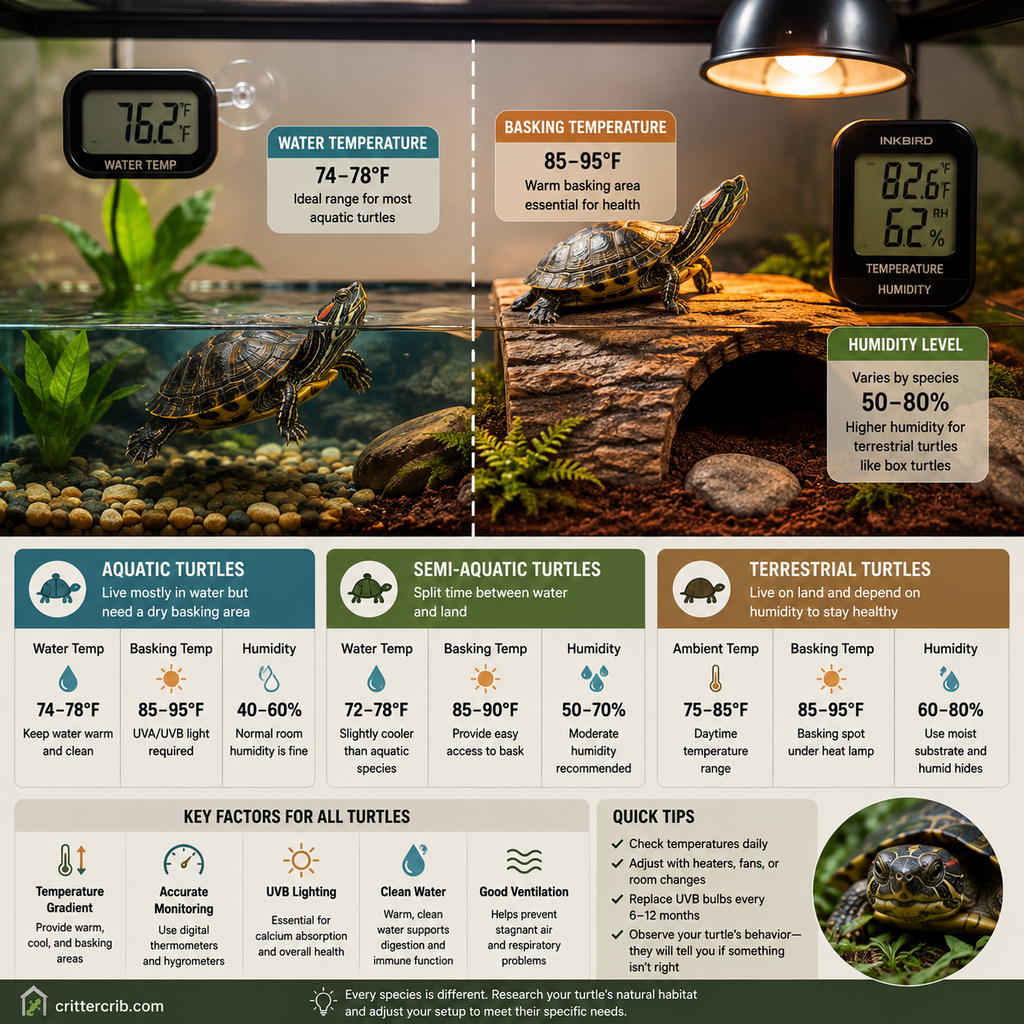
- Water temperature: approximately 74–78°F (23–26°C)
- Basking area: approximately 85–95°F (29–35°C)
- Ambient air: generally somewhere between the water and basking temperatures
Juveniles, sick turtles, and particular species may require different temperatures.
Always research the exact species you own rather than treating these numbers as universal requirements.
Common Pet Turtle Temperature Examples
For common aquatic and semi-aquatic turtles, you may encounter recommendations similar to these:
- Red-eared sliders: water generally in the mid-70s°F with a basking area around 90°F
- Painted turtles: water generally in the 70s°F with a warmer basking area
- Map turtles: typically require warm water and a significantly warmer basking zone
- Musk turtles: usually maintained with water in the 70s°F and access to a warm basking area
- Box turtles: require a terrestrial temperature gradient rather than heated aquarium water
These are general examples, not precise prescriptions.
Age, health, subspecies, enclosure design, and veterinary recommendations can change the appropriate range.
Aquatic Turtle Water Temperature
For aquatic turtles, water temperature deserves careful attention because the animal may spend most of its day submerged.
Water that’s consistently too cold can reduce activity, appetite, and digestion.
Water that’s excessively warm creates a different problem.
If the water and basking area are both very warm, the turtle loses its ability to choose between meaningfully different temperatures.
The habitat should provide a gradient.
Use an Aquarium Thermometer
Don’t judge water temperature by touching it.
Water that feels comfortable to your hand isn’t necessarily appropriate for a turtle.
Use a reliable aquarium thermometer.
Digital models are convenient because they allow you to quickly check whether the water remains within your target range.
Check it regularly, particularly when:
- Seasons change
- Room temperature changes
- You install a new heater
- You perform a large water change
- Your home’s heating or air conditioning changes
Do Turtles Need a Water Heater?
Many indoor aquatic turtle setups benefit from an aquarium heater.
Whether you actually need one depends on:
- Turtle species
- Age
- Room temperature
- Climate
- Aquarium size
- Seasonal temperature changes
If your room remains warm enough to keep the water within the correct range, supplemental heating may not always be necessary.
In cooler homes, it often is.
Choose a Protected Heater
Turtles are much stronger and more destructive than many aquarium fish.
A large turtle can bump, move, or damage equipment.
If you’re using an aquarium heater, choose one appropriate for the tank volume and protect it from direct contact with the turtle when necessary.
Use equipment designed for aquatic use and follow the manufacturer’s installation instructions.
Continue monitoring the water with a separate thermometer rather than assuming the heater’s setting is perfectly accurate.
Basking Temperature for Turtles
A proper basking area is essential for many commonly kept aquatic turtles.
The basking platform should allow the turtle to climb completely out of the water and dry off.
For many species, a basking surface somewhere around 85–95°F is a reasonable general range.
The exact target depends on species.
Why Basking Matters
Basking allows a turtle to:
- Warm its body
- Dry its shell and skin
- Thermoregulate
- Receive UVB exposure
- Engage in normal behavior
The basking zone should be noticeably warmer than the water.
If the temperatures are nearly identical, there’s little thermal benefit to leaving the water.
How to Measure Basking Temperature
An infrared temperature gun is one of the easiest tools for checking a turtle’s basking surface.
Point it at the exact location where the turtle sits.
This tells you the surface temperature rather than the temperature somewhere else in the enclosure.
You can also use a digital thermometer with a suitable probe.
Take measurements at several points on a large platform because the area directly beneath the lamp may be considerably warmer than the edges.
Turtles Need UVB as Well as Heat
Heat and UVB aren’t the same thing.
A basking lamp may produce plenty of warmth without producing appropriate UVB.
Turtles require UVB exposure to support vitamin D3 production and proper calcium metabolism.
Without appropriate UVB, nutrition, and calcium, turtles can develop serious health problems involving their bones and shells.
A good basking zone therefore combines:
- Heat
- UVB
- Bright visible light
- A dry surface
Position the UVB fixture according to the manufacturer’s instructions for the specific lamp you’re using.
Distance matters.
Mesh or other barriers can also reduce the amount of UVB reaching the turtle.
Replace UVB lamps according to manufacturer recommendations, even if they still appear bright.
What Is the Ideal Humidity for Turtles?
This question is more complicated than temperature because “turtle” includes animals from very different environments.
For a fully aquatic turtle, you generally don’t manage enclosure humidity in the same way you would for a terrestrial reptile.
The turtle spends much of its time in water.
For terrestrial and semi-terrestrial species such as box turtles, humidity and substrate moisture become much more important.
Depending on species, suitable humidity might range from moderate levels around 50–60% to much more humid conditions of 70–80% or higher.
The exact species matters enormously.
Humidity for Aquatic Turtles
Owners of red-eared sliders and similar aquatic turtles generally don’t need to obsess over maintaining a precise percentage of air humidity above the aquarium.
Your priorities are more likely to be:
- Correct water temperature
- Clean water
- Appropriate basking temperature
- Completely dry basking access
- UVB exposure
- Good ventilation
The enclosure shouldn’t be sealed in an attempt to maintain high humidity unless you’re keeping a species with specific environmental requirements.
Ventilation helps prevent stagnant conditions.
Humidity for Box Turtles
Box turtles are where humidity becomes much more important.
Many box turtle species benefit from a humid environment and moisture-retaining substrate.
Depending on species and life stage, humidity commonly falls somewhere around 60–80%, with some requiring higher localized humidity.
Juveniles may be particularly sensitive to dehydration.
Instead of trying to keep every inch of the enclosure equally wet, provide a range of microclimates.
That can include:
- Moist substrate
- Leaf litter
- Humid hides
- Drier surface areas
- Shaded areas
- Fresh water
Your turtle can then choose where it wants to spend time.
How to Measure Humidity
Use a digital hygrometer.
Cheap analog humidity gauges can be difficult to rely on for accurate husbandry decisions.
Place the sensor where it provides a meaningful representation of the turtle’s environment.
In a terrestrial enclosure, you may want multiple sensors if the habitat is large or has intentionally different moisture zones.
Measure conditions rather than guessing based on how damp the substrate looks.
How to Increase Humidity for Terrestrial Turtles
If your species requires higher humidity and the enclosure dries too quickly, several changes can help.
Use Moisture-Retaining Substrate
Suitable substrates can hold moisture while still allowing the surface to breathe.
Depending on the species, options may include mixtures containing:
- Organic topsoil
- Coconut fiber
- Cypress mulch
- Sphagnum moss
- Leaf litter
Avoid keeping the substrate waterlogged.
Moist and soaked aren’t the same thing.
Increase Substrate Depth
A deeper layer of substrate generally holds moisture longer than a thin layer.
It also provides digging and burrowing opportunities.
Provide a Humid Hide
A humid hide gives the turtle access to a higher-humidity microclimate without requiring the entire enclosure to remain equally damp.
This can be especially useful for juveniles or during dry periods.
Mist When Appropriate
Light misting can help maintain humidity for species that require it.
Use your hygrometer and substrate conditions to determine frequency rather than spraying on an arbitrary schedule.
Add Leaf Litter and Cover
Leaf litter can help retain moisture near the substrate while also providing enrichment and cover.
How to Lower Excessive Humidity
Constantly saturated conditions aren’t automatically better.
For species that don’t require extremely high humidity, excessive moisture combined with poor ventilation can contribute to an unhealthy environment.
If humidity remains too high:
- Improve ventilation
- Reduce misting
- Allow parts of the substrate to dry
- Check for standing water
- Move large water containers if they’re contributing excessive moisture
- Adjust moisture-retaining substrate as appropriate
Again, species requirements should determine your target.
Don’t lower humidity simply because a generic turtle care guide gives you a different number.
Daytime vs. Nighttime Temperature
A small temperature drop at night is natural for many turtle species.
You usually don’t need to maintain daytime basking temperatures 24 hours a day.
Visible basking and UVB lights should be turned off at night to maintain a normal day-night cycle.
A timer makes this easy.
A roughly 12-hour light and 12-hour dark schedule is a practical starting point for many indoor setups, although seasonal schedules and species requirements may differ.
If nighttime temperatures remain safely within the appropriate range, additional heat may not be necessary.
Do Turtles Need Heat at Night?
Not always.
This depends on the species and how cold the room becomes.
If nighttime room temperatures remain safely within the species’ tolerance, letting temperatures fall naturally can be appropriate.
If supplemental nighttime heating is necessary, use a heat source that doesn’t produce visible light.
Avoid leaving bright basking lights or colored “night lights” running around the clock.
Turtles benefit from darkness at night.
Temperature and Humidity for Baby Turtles
Young turtles may require somewhat different conditions from adults.
For example, juvenile aquatic turtles are often kept at slightly warmer water temperatures than healthy adults.
Young terrestrial turtles can also be particularly vulnerable to dehydration.
This makes monitoring especially important.
Don’t simply copy an adult setup for a hatchling without researching age-specific husbandry for the species.
Seasonal Changes Can Affect Your Turtle Habitat
Even indoor turtle enclosures change with the seasons.
During winter:
- Water may cool faster
- Rooms may become drier
- Aquarium heaters may run more frequently
- Terrestrial substrate may lose moisture faster
During summer:
- Water may become warmer
- Basking areas may overheat
- Room temperatures may reduce the cool side of the habitat
- Humidity may rise or fall depending on climate and air conditioning
Check your equipment throughout the year.
A setup that was perfect in January may need adjustment in July.
Signs Your Turtle May Be Too Cold
A cold turtle may become:
- Less active
- Less interested in food
- Slow to digest
- Reluctant to move
- More likely to remain in one location
However, these behaviors can also occur because of illness or normal seasonal changes.
Don’t diagnose temperature problems from behavior alone.
Check the thermometer.
If temperatures are correct and your turtle continues behaving abnormally, consult a reptile veterinarian.
Signs the Habitat May Be Too Hot
Potential warning signs include:
- Constant attempts to escape heat
- Avoiding the basking area entirely
- Unusual restlessness
- Spending excessive time in the coolest available location
The bigger concern is whether your turtle has a safe cooler zone.
If the entire habitat becomes excessively warm, it has nowhere to thermoregulate.
Measure temperatures in several locations.
Common Turtle Temperature and Humidity Mistakes
Many husbandry problems come from a few recurring mistakes.
Using One Temperature for the Entire Habitat
Turtles need choices.
Create warmer and cooler areas rather than trying to maintain one uniform temperature everywhere.
Guessing the Temperature
Your hand isn’t a thermometer.
Use digital equipment.
Measuring Air Instead of the Basking Surface
The surface directly beneath a basking lamp may be much hotter than the surrounding air.
Measure where the turtle actually sits.
Assuming Every Turtle Needs High Humidity
Aquatic, semi-aquatic, and terrestrial turtles have very different environmental requirements.
Research your species.
Keeping Terrestrial Substrate Constantly Soaked
High humidity doesn’t necessarily mean wet substrate everywhere.
Create moisture gradients and maintain ventilation.
Forgetting About UVB
Warmth alone isn’t enough.
Many pet turtles require appropriate UVB exposure as part of a complete basking setup.
Leaving Lights On All Night
Maintain a natural light-dark cycle.
Use timers if necessary.
Trusting Equipment Without Checking It
Heaters and thermostats can malfunction.
Verify temperatures independently with thermometers and an infrared temperature gun.
Essential Equipment for Monitoring Turtle Conditions
A well-equipped turtle habitat may include:
- Digital aquarium thermometer
- Digital air thermometer
- Infrared temperature gun
- Digital hygrometer for species where humidity is important
- Appropriate aquarium heater
- Basking heat source
- UVB fixture
- Timer
- Thermostat or suitable temperature controller where appropriate
You don’t necessarily need the most expensive equipment available.
You do need reliable equipment that allows you to know what’s actually happening inside the habitat.
Frequently Asked Questions
Is 75°F Too Cold for a Turtle?
Not necessarily.
For many commonly kept aquatic turtles, water around 75°F can fall within an appropriate range.
However, species, age, and health matter.
The turtle should also have access to a significantly warmer basking area.
What Temperature Should a Turtle Tank Be?
For many common aquatic pet turtles, water temperatures in roughly the mid-70s°F are a useful starting point, with a basking area around 85–95°F.
Research the exact species before choosing final settings.
What Humidity Should a Turtle Tank Be?
It depends entirely on the type of turtle.
Humidity isn’t usually managed as a precise percentage for common aquatic species in the same way it is for terrestrial turtles.
Many box turtles, on the other hand, benefit from relatively humid environments.
Do Turtles Need a Heat Lamp?
Many pet turtles require a warm basking area, and an overhead basking lamp is commonly used to create it.
They also need appropriate UVB exposure, which may require a separate UVB fixture.
Do Turtles Need UVB?
Most commonly kept pet turtles benefit from and should be provided appropriate UVB exposure.
UVB supports vitamin D3 production and calcium metabolism.
Should I Turn My Turtle’s Heat Lamp Off at Night?
Yes, in most normal setups, visible basking lights should be turned off at night.
If your turtle requires additional nighttime warmth, use an appropriate non-light-producing heat source rather than keeping a bright lamp on.
Why Isn’t My Turtle Basking?
A turtle may avoid its basking platform for several reasons.
Possible causes include:
- Basking area is too hot
- Basking area is too cold
- Platform is difficult to access
- Turtle doesn’t feel secure
- Water is too warm
- Lighting is inappropriate
- Turtle is stressed or ill
Measure the conditions before making adjustments.
Final Thoughts
The ideal temperature and humidity for a turtle depend on what kind of turtle you’re keeping.
For many common aquatic species, water in roughly the mid-70s°F combined with a substantially warmer basking area provides a useful starting point. Terrestrial turtles, particularly box turtles, require much closer attention to humidity, substrate moisture, and microclimates.
Don’t chase one perfect number.
Create choices.
Your turtle should be able to move between warmer and cooler areas, bask completely out of the water when appropriate, access UVB, and choose between different moisture levels when its species requires them.
Most importantly, measure the environment.
A digital thermometer, infrared temperature gun, and—when appropriate—a digital hygrometer remove much of the guesswork from turtle care.
Once you know the exact species you’re keeping and understand its natural environment, setting the right temperature and humidity becomes much easier.