Stick insects aren’t complicated eaters, but they are particular.
Unlike many pet invertebrates that eat fruit, vegetables, or feeder insects, stick insects are herbivores. Their diet consists primarily of fresh leaves, and the exact plants they’ll accept depend on the species you’re keeping.
For many commonly kept species, bramble leaves are a reliable staple. Others readily eat oak, rose, privet, eucalyptus, or additional plants. The challenge isn’t usually preparing the food. It’s identifying safe plants, keeping the leaves fresh, and making sure your particular stick insect will actually eat them.
That’s especially important with young nymphs, which need consistent access to suitable foliage as they grow.
So, what do stick insects eat, how often should you feed them, and how do you safely provide fresh branches inside an enclosure? Here’s what you need to know.
What Do Stick Insects Eat?
Stick insects primarily eat leaves.
They’re phytophagous insects, meaning their natural diet consists of plant material. Different species have evolved to feed on different host plants, so there isn’t one universal food that works for every stick insect.
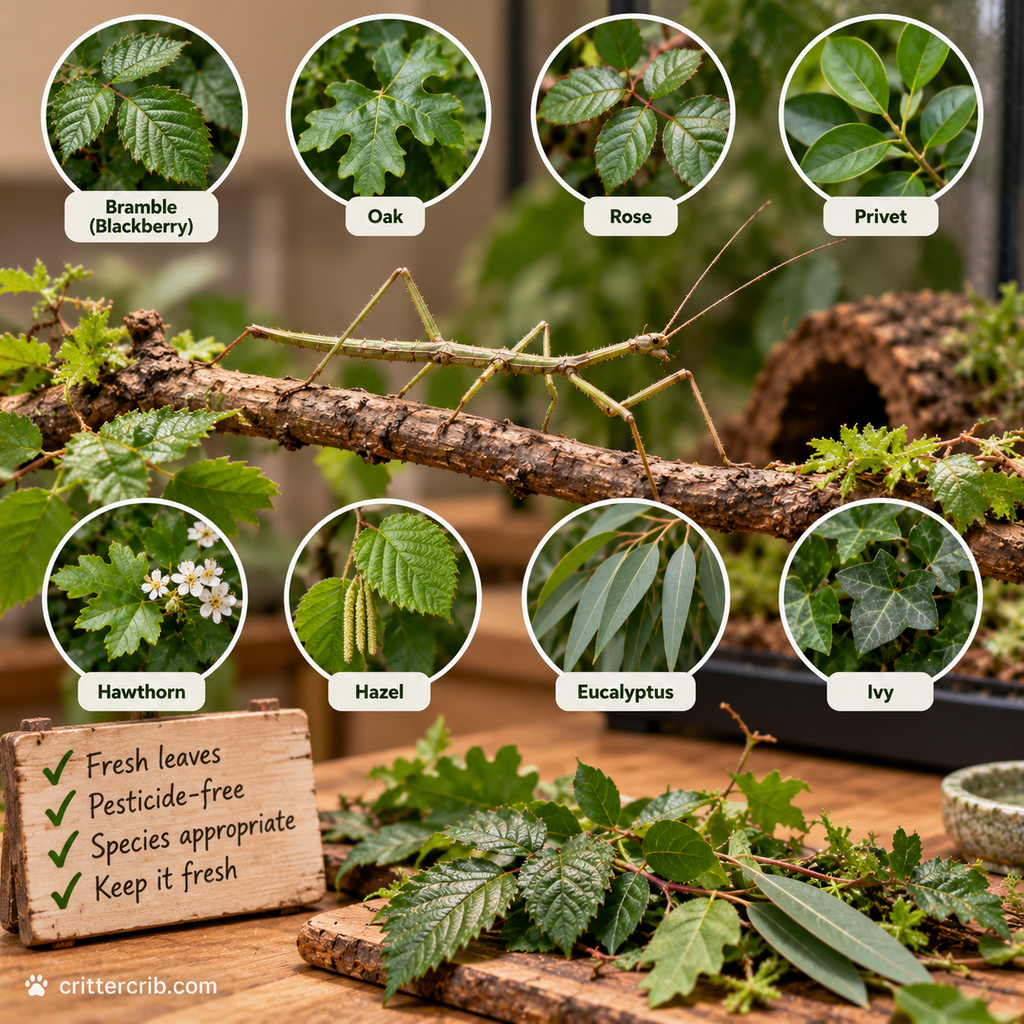
Common food plants used for captive stick insects include:
- Bramble or blackberry
- Oak
- Rose
- Privet
- Hawthorn
- Hazel
- Eucalyptus
- Ivy
This doesn’t mean every stick insect can safely eat every plant on that list.
Some species have broad diets and accept several plants. Others are much more selective.
Before bringing home a stick insect, identify the species and determine which food plants are established as appropriate for it.
Bramble Is a Staple for Many Stick Insects
Bramble—particularly blackberry leaves—is one of the most widely used foods for captive stick insects.
One reason it’s popular is availability. In many climates, bramble grows abundantly and may remain accessible for much of the year.
The leaves also stay reasonably well when cut branches are placed in water.
Many commonly kept phasmids accept bramble, although you should still confirm that it’s suitable for your species.
When collecting bramble, look for healthy leaves without obvious chemical exposure, heavy pollution, disease, or excessive damage.
And watch the thorns.
They won’t bother the stick insects much, but they can certainly bother you.
Can Stick Insects Eat Oak Leaves?
Many species can eat oak.
Oak can be particularly useful because branches provide sturdy leaves and natural climbing structure at the same time.
However, oak is seasonal in many locations.
Fresh leaves may be plentiful during spring and summer but disappear during colder months. If oak is one of your stick insect’s primary foods, you’ll need a plan for winter.
Some keepers use alternative evergreen food plants that their particular species accepts.
This is another reason to learn several suitable host plants rather than depending entirely on one.
Can Stick Insects Eat Rose Leaves?
Rose leaves are accepted by various stick insect species.
If you use roses, pesticide exposure is a major concern.
Commercial roses and garden plants are frequently treated for pests and diseases. A plant may look perfectly healthy while carrying insecticide residue that could be dangerous to your stick insects.
Never assume a rose is safe simply because you rinsed it.
Ideally, use plants you know haven’t been treated with pesticides or systemic chemicals.
Can Stick Insects Eat Privet?
Privet is another food plant used for some stick insect species.
Because certain privet varieties remain leafy through much of the year, it can be a useful food source when seasonal plants become harder to find.
Again, species matters.
A stick insect that happily eats bramble isn’t guaranteed to accept privet.
Introduce only plants that are known to be appropriate for the species you’re keeping.
Can Stick Insects Eat Eucalyptus?
Some stick insects, particularly species associated with Australian habitats, may readily eat eucalyptus.
Eucalyptus can be an important host plant for certain species, but it shouldn’t automatically be offered to every stick insect.
If your species is known to eat eucalyptus, make sure the foliage is:
- Correctly identified
- Free from pesticides
- Fresh
- Collected from a safe location
Don’t experiment with unidentified leaves simply because they look similar to a known food plant.
Can Stick Insects Eat Ivy?
Some stick insect species accept ivy.
It can be convenient because ivy is evergreen in many regions, making it potentially useful during winter.
However, ivy shouldn’t be treated as a universal stick insect food.
Confirm that your species is known to eat it before offering it.
The same principle applies to every food plant: established species-specific feeding information is more reliable than trial and error with random vegetation.
Do Stick Insects Eat Fruit and Vegetables?
Stick insects are not generally fed like pet snails, millipedes, or isopods.
Their normal captive diet revolves around fresh foliage rather than bowls of chopped produce.
You may occasionally see claims that stick insects eat foods such as:
- Lettuce
- Apple
- Cucumber
- Carrot
- Other fruits and vegetables
Even if an individual nibbles something unusual, that doesn’t make it an appropriate staple.
Fresh leaves from suitable host plants should form the foundation of the diet.
There’s little reason to replace a natural foliage-based diet with grocery-store produce when the correct host plants are available.
Do Stick Insects Need a Variety of Leaves?
It depends on the species.
Some stick insects thrive on one suitable host plant, while others readily accept several.
Providing more than one approved food plant can be useful because it gives you alternatives when one becomes unavailable.
For example, if your species accepts bramble, oak, and rose, you aren’t completely dependent on oak when winter arrives.
Variety can also help you discover preferences.
You might place two suitable food plants in the enclosure and notice that one is consistently eaten first.
Just make sure every plant offered is known to be safe for that particular species.
How Often Should You Feed Stick Insects?
Stick insects should have access to suitable fresh leaves continuously.
They don’t follow a meal schedule in the way many traditional pets do.
Instead, they feed gradually throughout the day and night.
Your job is to keep appropriate foliage available and replace it when it:
- Dries out
- Wilts badly
- Becomes moldy
- Is heavily eaten
- Becomes soiled
- Is no longer usable
How frequently you need to replace branches depends on the plant, enclosure conditions, and number of insects.
Branches kept properly in water may remain usable for several days.
Check them daily.
How Much Do Stick Insects Eat?
The amount varies with:
- Species
- Body size
- Life stage
- Number of insects
- Temperature
- Food plant
Large adults naturally consume more than tiny newly hatched nymphs.
You don’t need to weigh the leaves.
Provide enough foliage that your stick insects have easy access to food throughout the enclosure without packing the habitat so densely that movement and molting become difficult.
Look at the leaves each day.
Visible feeding damage along the edges is a good indication that your insects are eating.
How to Keep Stick Insect Food Fresh
Cut branches last much longer when their stems are placed in water.
A simple method is:
- Cut fresh branches from a safe food plant.
- Inspect them carefully for other animals.
- Rinse them if appropriate.
- Place the cut stems into a container of water.
- Secure the opening around the stems.
- Put the container inside the enclosure.
- Replace the branches as they deteriorate.
The water container should be stable enough that it can’t easily tip over.
More importantly, the opening should be covered.
Cover Water Containers to Prevent Drowning
An open jar of water can be dangerous, particularly for small nymphs.
Stick insects may fall into the container and drown.
You can reduce the risk by covering the opening around the plant stems with a suitable material so the insects can’t enter the water.
Possible approaches include:
- Mesh
- Foam
- A lid with appropriately sized holes
- Other secure barriers around the stems
The exact method matters less than the result: branches can access the water, but the insects cannot.
This simple precaution makes it much safer to keep foliage fresh.
Where Should You Get Leaves for Stick Insects?
If you’re collecting leaves outdoors, location matters just as much as plant identification.
Avoid collecting from:
- Roadsides
- Heavily trafficked areas
- Public landscaping that may be sprayed
- Agricultural fields
- Golf courses
- Areas treated with pesticides
- Plants exposed to herbicides
- Recently treated gardens
A quiet area doesn’t automatically mean pesticide-free, but knowing the history of the collection site helps.
Your own untreated garden can be an excellent source if you know exactly what’s been used there.
Pesticides Are a Serious Risk
Stick insects are insects.
That sounds obvious, but it’s worth remembering when selecting their food.
Products designed to kill garden pests can also kill the animal you’re intentionally keeping.
Pesticide residues may remain on plants even when you can’t see or smell anything unusual.
Systemic pesticides are particularly concerning because they’re absorbed into plant tissues. Washing the leaves doesn’t necessarily remove them.
For that reason, don’t rely on rinsing as a way to make chemically treated plants safe.
The better solution is to obtain foliage from a source you trust.
Should You Wash Leaves Before Feeding?
Gently rinsing collected foliage can help remove dirt and some unwanted hitchhikers.
However, washing doesn’t magically turn contaminated leaves into safe food.
If you suspect a plant has been treated with pesticides, don’t use it.
After rinsing, you can shake off excess water before putting the branches into the enclosure.
Small droplets left on foliage may also provide drinking opportunities for some species, depending on their care requirements.
Check Leaves for Predators and Hitchhikers
Fresh branches can bring unexpected guests into the enclosure.
Before adding them, inspect both sides of the leaves and the stems.
You may encounter:
- Spiders
- Ants
- Beetles
- Caterpillars
- Other insects
- Eggs
- Snails
- Slugs
Some hitchhikers are harmless.
Others may compete for food, disturb eggs or nymphs, or even prey on your stick insects.
A quick inspection every time you collect foliage is worth the effort.
Do Stick Insects Need Water?
Stick insects need hydration, but a traditional open water bowl generally isn’t the best way to provide it.
Many species drink droplets from leaves and enclosure surfaces.
Light misting can provide these droplets while also contributing to appropriate humidity.
How frequently you mist depends on:
- Species
- Life stage
- Temperature
- Ventilation
- Local humidity
Tropical species may have different moisture requirements from species adapted to drier environments.
Don’t keep the enclosure permanently soaked unless the species genuinely requires very wet conditions.
Can Stick Insects Drink From Their Food?
Fresh leaves contain moisture and contribute to hydration.
However, depending on the species and enclosure conditions, foliage alone may not always provide all the accessible water your insects need.
This is why appropriate misting is commonly incorporated into stick insect care.
You may see the insects drink droplets directly from leaves after spraying.
Use fine droplets rather than blasting the insects with a strong stream of water.
Feeding Baby Stick Insects
Newly hatched stick insects, or nymphs, eat the same general host plants as older individuals of their species, but their small size introduces a few challenges.
Tiny nymphs need easy access to leaf edges.
Some keepers lightly tear or trim the edges of tougher leaves to expose fresh feeding surfaces, particularly when working with very young insects.
Make sure:
- Leaves are within easy reach.
- Water containers are completely covered.
- The enclosure has suitable ventilation.
- Food remains fresh.
- Tiny nymphs can’t escape through ventilation holes.
Don’t assume a nymph isn’t eating just because you don’t see it feeding.
Look for small areas of leaf damage.
Why Isn’t My Stick Insect Eating?
A stick insect may temporarily stop eating for several reasons.
One of the most common is an approaching molt.
Before molting, a stick insect may:
- Eat less
- Stop eating temporarily
- Become less active
- Spend more time hanging
This can be normal.
Other possible causes include:
- Incorrect food plant
- Wilted foliage
- Temperature problems
- Dehydration
- Stress
- Illness
- Poor enclosure conditions
If several insects suddenly stop eating at the same time, take a closer look at the food source and environment.
Molting and Feeding
Like other insects with exoskeletons, stick insects must molt as they grow.
Molting requires adequate vertical space.
A stick insect typically hangs while shedding its old exoskeleton, so the enclosure needs sufficient height and secure climbing surfaces.
Don’t disturb a molting insect.
Avoid:
- Handling it
- Moving the branch it’s hanging from
- Spraying it directly
- Trying to remove the old skin manually
Once the new exoskeleton has hardened, normal feeding usually resumes.
Can You Grow Your Own Stick Insect Food?
Yes, and doing so can make feeding much easier.
Growing suitable food plants gives you more control over pesticide exposure and provides a convenient supply close to home.
Depending on your species and climate, you might grow:
- Bramble
- Rose
- Privet
- Eucalyptus
- Other appropriate host plants
Container-grown plants can be particularly useful if you have limited outdoor space.
Just remember that potted plants purchased from nurseries may have been treated with systemic pesticides.
If you’re specifically growing plants as insect food, start with material you can confidently manage without insecticides.
Planning for Winter
Winter can make feeding stick insects more difficult in colder climates.
A food plant that’s abundant in July may be completely unavailable in January.
Plan ahead.
Before winter arrives:
- Identify several food plants your species accepts.
- Determine which remain evergreen locally.
- Locate safe collection areas.
- Consider growing suitable plants yourself.
- Research how other experienced keepers maintain that species during winter.
Don’t wait until your only food plant loses its leaves.
A backup plan makes stick insect care much easier.
Can You Refrigerate Stick Insect Leaves?
Some cut foliage can be stored temporarily under refrigeration, although how well it keeps depends on the plant.
If you’re storing leaves, prevent them from drying out excessively and inspect them before use.
Long-term storage isn’t a substitute for a reliable fresh-food source.
Stick insects do best with fresh, usable foliage rather than old leaves that have spent too long deteriorating in storage.
Should You Remove Old Leaves?
Yes, but you don’t necessarily need to replace every branch the moment one leaf develops a dry edge.
Remove foliage when it becomes excessively wilted, moldy, contaminated, or largely consumed.
Regularly removing old plant material helps prevent the enclosure from becoming cluttered and makes it easier to monitor:
- Feeding
- Droppings
- Eggs
- Mold
- Insect health
Be careful during cleanup.
Stick insects camouflage themselves exceptionally well and can easily remain attached to a branch you’re about to throw away.
Check every piece before removing it.
Watch for Eggs When Cleaning
Adult females may drop eggs onto the enclosure floor or attach them to surfaces, depending on species.
If you’re breeding stick insects—or simply keeping a species capable of reproducing without mating—cleaning deserves extra attention.
Eggs can resemble:
- Seeds
- Tiny pellets
- Bits of dirt
- Plant debris
It’s surprisingly easy to throw them away accidentally.
Know what the eggs of your species look like before doing major enclosure maintenance.
Common Stick Insect Feeding Mistakes
Most feeding problems are preventable.
Common mistakes include:
- Offering unidentified plants
- Assuming every species eats the same leaves
- Collecting foliage from pesticide-treated areas
- Relying on one seasonal food plant
- Allowing leaves to dry out completely
- Leaving open water jars in the enclosure
- Overcrowding the enclosure with branches
- Failing to inspect foliage for predators
- Using grocery-store produce as the main diet
- Forgetting to plan for winter
Getting the food plant right solves a large portion of stick insect feeding challenges.
A Simple Stick Insect Feeding Routine
Once you’ve established a reliable food source, daily feeding care is straightforward.
Use this basic routine:
- Check the foliage every day.
- Look for feeding damage.
- Remove badly wilted or moldy leaves.
- Refill the branch container with water when necessary.
- Make sure the water opening remains securely covered.
- Replace foliage with fresh, pesticide-free branches.
- Mist according to your species’ requirements.
- Inspect the enclosure for uneaten debris, mold, and hitchhikers.
You don’t need to constantly replace perfectly good foliage.
If the branches remain fresh and the insects are eating them, leave them available.
Frequently Asked Questions About Feeding Stick Insects
What is the best food for stick insects?
There isn’t one best food for every species. Bramble or blackberry leaves are widely used for many commonly kept stick insects, while others may eat oak, rose, privet, eucalyptus, ivy, or other host plants. Always research your particular species.
Can stick insects eat lettuce?
Fresh host-plant foliage is generally a more appropriate diet than lettuce. Even if a stick insect samples lettuce, it shouldn’t automatically be considered a suitable replacement for the plants that species normally eats.
Can stick insects eat fruit?
Stick insects primarily feed on leaves rather than fruit. A species-appropriate foliage diet should be the foundation of their feeding routine.
How often should I change stick insect leaves?
Replace leaves when they become badly wilted, dry, moldy, soiled, or heavily consumed. Cut branches placed safely in water may remain fresh for several days.
How long can stick insects go without food?
Rather than intentionally testing how long they can survive without eating, keep suitable foliage available continuously. Temporary fasting can occur before molting, but healthy animals should have access to fresh food.
Do stick insects need water?
Yes. Fresh foliage provides some moisture, and many stick insects drink droplets created by appropriate misting. Avoid deep, open water containers that can create a drowning hazard.
Can I feed stick insects leaves from my garden?
Yes, if you’ve correctly identified the plant, know it’s suitable for your species, and are confident it hasn’t been exposed to pesticides or other harmful chemicals.
Why is my stick insect not eating?
It may be preparing to molt, or the food plant may be unsuitable or no longer fresh. Temperature, hydration, stress, and health can also influence feeding.
Can baby stick insects eat the same leaves as adults?
Generally, nymphs eat the appropriate host plants for their species just as adults do. Very young nymphs may benefit from easy access to fresh or lightly torn leaf edges.
Final Thoughts
So, what do stick insects eat?
For most species, the answer is refreshingly simple: leaves.
The important part is figuring out which leaves.
Bramble is a staple for many commonly kept stick insects, while oak, rose, privet, eucalyptus, ivy, and other plants may be suitable depending on the species.
Once you’ve identified the correct food plants, focus on keeping them fresh and pesticide-free. Place cut branches safely in water, cover the container opening, inspect collected foliage for unwanted hitchhikers, and keep appropriate leaves available at all times.
It’s also worth thinking ahead. Find more than one suitable food plant and develop a winter feeding plan before seasonal leaves disappear.
Stick insects may look unusual, but their feeding routine doesn’t have to be complicated. Give them the right foliage, keep it fresh, and they’ll handle the rest one leaf at a time.