Gerbils may be tiny, but feeding them well involves more than filling a bowl with whatever small-animal food happens to be on the pet store shelf.
A healthy gerbil diet needs the right balance of nutrients, with a quality gerbil food forming the foundation. Small amounts of appropriate vegetables, occasional treats, and safe foods for chewing and foraging can add variety without turning their diet into an all-you-can-eat snack bar.
Portion size matters too. Foods that seem harmless can quickly become excessive when you’re feeding an animal that weighs only a fraction of what you do.
So, what do gerbils eat, how often should you feed them, and which foods should stay off the menu?
Here’s what gerbil owners need to know.
What Do Gerbils Eat?
Pet gerbils are omnivores, meaning their natural diet can include both plant and animal-based foods.
In the wild, gerbils may consume foods such as seeds, grasses, grains, roots, herbs, and occasional insects depending on what’s available in their environment.
A pet gerbil’s diet doesn’t need to recreate the wild menu exactly. Instead, it should provide complete and balanced nutrition appropriate for a domesticated gerbil.
A typical pet gerbil diet may include:
- A nutritionally complete gerbil food
- Seeds and grains as part of an appropriate diet
- Small amounts of safe vegetables
- Occasional appropriate fruits
- Limited treats
- Fresh water
The simplest approach is to use a quality commercial gerbil food as the nutritional foundation rather than trying to create a homemade diet from scratch.
What Is the Best Food for Gerbils?
Look for a commercial food formulated specifically for gerbils or one clearly labeled as nutritionally appropriate for them.
Commercial diets generally come in two broad styles.
Pellets or lab blocks
These contain nutrients in uniform pieces.
One advantage is that your gerbil can’t easily pick out only its favorite ingredients and leave everything else behind.
Seed and grain mixes
These contain visible ingredients such as seeds, grains, and other dried foods.
They can provide more variety and encourage natural foraging behaviors, but selective feeding can become an issue.
A gerbil might enthusiastically eat all the high-fat seeds while leaving less exciting ingredients behind.
Some owners use a nutritionally balanced food that combines different textures while carefully monitoring what their gerbils actually consume.
Whatever you choose, check that the product is intended for gerbils and follow the manufacturer’s feeding guidance as a starting point.
How Much Should You Feed a Gerbil?
There isn’t one perfect portion for every gerbil.
The correct amount can depend on:
- Age
- Body size
- Activity level
- Health
- Type of food
- Calorie density
- Whether other foods are being offered
Commercial gerbil foods usually provide recommended portions on the packaging.
Use those instructions as a starting point and adjust only when appropriate based on your gerbil’s body condition and veterinary guidance.
It’s also important to remember that an empty bowl doesn’t necessarily mean your gerbil ate everything.
Gerbils naturally stash food.
Your missing dinner may actually be buried underneath the bedding.
Gerbils Love to Hoard Food
Food hoarding is normal gerbil behavior.
If you regularly refill the bowl whenever it looks empty, you may accidentally provide far more food than your gerbils need.
During cage cleaning, you may discover impressive hidden collections beneath bedding, inside tunnels, or tucked into corners.
Some food storage is completely normal.
The problem comes when fresh foods are hidden and left to spoil.
Keep an eye on food caches
When offering vegetables or fruit, remove uneaten fresh food before it becomes moldy or rotten.
You don’t need to destroy every dry-food cache you discover, but regularly check the enclosure for spoiled food.
Can Gerbils Eat Vegetables?
Yes, gerbils can eat certain vegetables in small amounts.
Vegetables should supplement a balanced diet rather than become the main food source.
Potential options may include small portions of appropriate foods such as:
- Carrot
- Broccoli
- Bell pepper
- Cucumber
- Peas
- Pumpkin
- Zucchini
- Some leafy greens
Not every vegetable is suitable, and individual gerbils may tolerate foods differently.
Introduce new foods gradually and one at a time.
That makes it easier to identify the cause if a particular food leads to digestive upset.
How Much Vegetable Should a Gerbil Eat?
Think tiny.
A portion that looks ridiculously small to you can be significant for a gerbil.
Fresh foods also contain much more water than a gerbil’s usual dry diet. Offering too much at once may contribute to digestive problems or loose stools.
Start with a very small piece.
If your gerbil tolerates it well, suitable fresh foods can be offered periodically as part of a varied diet.
Don’t fill an entire bowl with vegetables the way you might prepare a salad for a larger pet.
Can Gerbils Eat Fruit?
Gerbils can have certain fruits occasionally, but fruit should generally be treated as a small treat rather than an everyday food.
Fruit contains naturally occurring sugars, and it’s easy to offer too much.
Appropriate options may include tiny amounts of:
- Apple with seeds removed
- Pear with seeds removed
- Blueberry
- Strawberry
- Melon
- Banana
The exact suitability of individual foods can vary, so verify unfamiliar fruits before feeding them.
Keep fruit portions very small
A tiny piece is enough.
You don’t need to give your gerbil an entire strawberry or a large slice of banana.
Fruit is best viewed as an occasional bit of variety rather than an essential part of the diet.
Can Gerbils Eat Seeds?
Seeds can be part of a gerbil’s diet, but they’re also where portion control can become tricky.
Many gerbils love seeds.
Given the opportunity, some will selectively eat their favorites while ignoring other foods.
Certain seeds are also relatively high in fat.
Sunflower seeds are a classic example. They’re often enthusiastically accepted, making them useful as occasional treats or training rewards, but that doesn’t mean the food bowl should be packed with them.
Use favorite seeds strategically
A small seed can work well when:
- Hand-taming your gerbil
- Rewarding calm behavior
- Teaching your gerbil to approach
- Encouraging interaction
- Providing occasional variety
This makes a high-value food more useful without allowing it to dominate the diet.
Can Gerbils Eat Nuts?
Some nuts may be suitable in very small quantities, but their high fat and calorie content means they should generally be limited.
Never assume that a flavored nut from your snack cabinet is appropriate.
Avoid nuts that are:
- Salted
- Sugared
- Chocolate-covered
- Spiced
- Honey-roasted
- Heavily processed
If offering a suitable nut, it should be plain and given in a very small amount.
For most gerbils, nuts are optional treats rather than necessary foods.
Do Gerbils Eat Insects?
Gerbils are omnivores and can consume some animal-based foods.
Commercial gerbil diets are designed to provide appropriate nutrition, so you don’t necessarily need to add insects to a balanced diet.
Some owners may occasionally offer an appropriate feeder insect, such as a mealworm, as a treat.
If you choose to do this, use insects intended for pet feeding rather than insects collected from outdoors.
Wild insects may have been exposed to:
- Pesticides
- Parasites
- Chemicals
- Environmental contaminants
Insects are another food where moderation matters.
Can Gerbils Eat Hay?
Gerbils aren’t dependent on hay in the same way rabbits or guinea pigs are, but suitable hay can still have a place in their environment.
They may chew it, shred it, forage through it, or incorporate it into their nest.
That makes hay useful for enrichment even when it isn’t the primary source of nutrition.
Choose clean, dry, good-quality hay that hasn’t become dusty, damp, or moldy.
What Treats Can Gerbils Eat?
The best gerbil treats are small, simple, and infrequent.
Depending on the individual animal and its normal diet, treats might include tiny portions of:
- Safe vegetables
- Appropriate fruit
- Sunflower seeds
- Pumpkin seeds
- Plain grains
- Suitable nuts
- Appropriate feeder insects
Treats can be especially useful for bonding.
Instead of dropping treats into a bowl, offer one from your hand. Over time, your gerbil may begin associating your presence with positive experiences.
Just don’t let successful hand-taming turn into constant snacking.
Foods Gerbils Should Avoid
A gerbil’s small size means inappropriate foods can quickly become a problem.
Some foods should simply stay out of the enclosure.
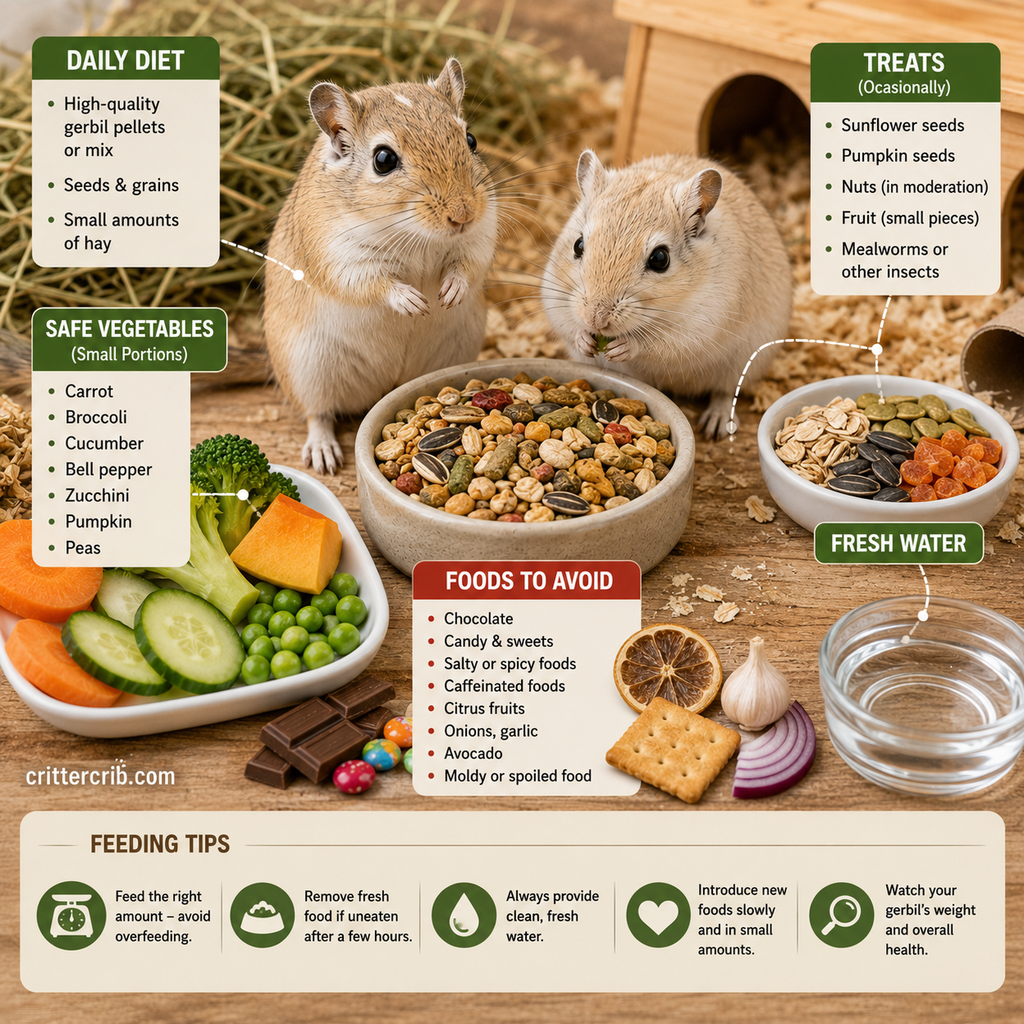
Avoid offering foods such as:
- Chocolate
- Candy
- Alcohol
- Caffeinated drinks or foods
- Highly processed human snacks
- Salty foods
- Sugary desserts
- Foods containing artificial sweeteners
- Moldy or spoiled food
- Seasoned foods
- Fried foods
Certain fruits, vegetables, plants, seeds, and household foods can also contain parts or compounds that aren’t appropriate for gerbils.
When you’re unsure whether a particular food is safe, check before feeding it.
“Natural” doesn’t automatically mean safe.
Why Chocolate Is Not a Gerbil Treat
Chocolate belongs firmly in the human snack cabinet.
It contains compounds that can be harmful to pets and also contains sugar and fat that have no useful role in a gerbil’s everyday diet.
Don’t offer chocolate-flavored foods either.
Your gerbil won’t feel deprived.
A sunflower seed will probably generate just as much enthusiasm.
Avoid Salty and Sugary Human Foods
Crackers, chips, cookies, breakfast cereals, pastries, and similar foods may attract a curious gerbil, but that doesn’t make them appropriate.
Human snack foods can contain excessive:
- Salt
- Sugar
- Fat
- Flavorings
- Preservatives
- Seasonings
Gerbils don’t need human junk food to have an interesting diet.
Use safe foods and enrichment activities instead.
Be Careful With Sticky Foods
Sticky foods can be difficult for small animals to manage and may adhere to the mouth or teeth.
Avoid giving your gerbil thick, sticky foods simply because the ingredients themselves seem harmless.
Whole, appropriately sized foods are generally a better choice than sugary spreads or sticky processed treats.
Fresh Water Is Essential
Gerbils come from dry environments, but that doesn’t mean they can go without water.
Pet gerbils should always have access to clean, fresh drinking water.
A water bottle is commonly used because it reduces the chance of bedding contaminating the water.
Check the bottle every day
Don’t simply glance at it and assume everything is fine.
Make sure:
- Water is present
- The bottle isn’t leaking
- The drinking tube isn’t blocked
- Water can actually flow
- The bottle is securely attached
- The water remains clean
A full bottle with a blocked drinking tube isn’t useful to your gerbil.
Clean the bottle regularly as well.
Should Gerbils Eat From a Bowl?
They can, but a food bowl isn’t the only way to feed them.
Gerbils are natural foragers, and using food as enrichment can make their environment more interesting.
Instead of placing every piece of dry food into one bowl, you can scatter some of the normal daily portion around clean areas of the enclosure.
Your gerbils then have to search for it.
Scatter feeding can encourage natural behavior
Food can be distributed:
- Across clean bedding
- Near tunnels
- Around hides
- In safe cardboard items
- Among appropriate nesting materials
Don’t add extra food for scatter feeding.
Use part of the normal daily allowance.
The goal is to change how they find their food, not increase how much they eat.
Feeding Multiple Gerbils
Gerbils are social animals and are often kept in compatible pairs or established groups.
When feeding multiple gerbils, make sure each animal can access food.
Scatter feeding can help distribute food throughout the enclosure rather than concentrating everything in one bowl.
Watch for signs that one gerbil consistently prevents another from eating.
You should also monitor each gerbil’s body condition rather than assuming that everyone is eating appropriately because the food disappears.
How Often Should You Feed Gerbils?
Gerbils naturally eat small amounts throughout the day and may store food for later.
Rather than thinking only in terms of breakfast and dinner, focus on providing an appropriate daily quantity of nutritionally balanced food.
Follow the instructions for your particular commercial diet and observe how much food is actually being consumed versus stored.
Fresh foods should be offered separately in small quantities and removed if they aren’t eaten before spoiling.
Can Baby Gerbils Eat the Same Food as Adults?
Young gerbils have nutritional needs associated with growth, so don’t automatically assume that an adult feeding routine is appropriate for every life stage.
If you’ve adopted young gerbils, find out what they were eating previously.
Sudden dietary changes can be stressful and may cause digestive problems.
Ask a veterinarian about appropriate nutrition for:
- Growing gerbils
- Pregnant gerbils
- Nursing gerbils
- Older gerbils
- Gerbils with medical conditions
Individual circumstances matter more than a one-size-fits-all feeding chart.
How to Change Your Gerbil’s Food
Avoid suddenly replacing a familiar diet with a completely different food unless a veterinarian specifically tells you to do so.
A gradual transition allows the digestive system time to adjust and lets you see whether your gerbil actually eats the new food.
A simple transition approach
Depending on veterinary or manufacturer guidance, you can gradually:
- Add a small amount of the new food to the old diet.
- Increase the proportion of new food over several days.
- Monitor appetite, droppings, and behavior.
- Continue reducing the old food until the transition is complete.
If your gerbil stops eating or develops significant digestive symptoms, contact a veterinarian.
Common Gerbil Feeding Mistakes
Even a generally good diet can become unbalanced through everyday habits.
Giving too many treats
A few extra seeds don’t look like much, but they’re significant to an animal as small as a gerbil.
Constantly refilling an “empty” bowl
The food may be buried rather than eaten.
Offering too much fresh food
Large portions can spoil in hidden caches and may upset digestion.
Allowing selective feeding
If your gerbil eats only favorite seeds from a mix, the overall diet may no longer be balanced.
Changing diets suddenly
Fast changes can disrupt eating habits and digestion.
Forgetting to check the water bottle
A mechanical problem can prevent access to water even when the bottle appears full.
Assuming hamster food is automatically suitable
Gerbils and hamsters aren’t identical animals. Choose food specifically formulated or confirmed as nutritionally appropriate for gerbils.
How to Tell If Your Gerbil’s Diet Is Working
Don’t judge a diet solely by whether your gerbil eagerly eats it.
Gerbils can be enthusiastic about foods that should only be occasional treats.
Instead, look at the bigger picture.
A healthy gerbil should generally maintain an appropriate body condition and show normal levels of activity, grooming, eating, and drinking.
Pay attention to changes such as:
- Unexplained weight gain
- Weight loss
- Reduced appetite
- Changes in drinking
- Diarrhea or abnormal droppings
- Difficulty eating
- Drooling
- Low activity
- Changes in coat condition
Any significant or persistent change deserves attention.
Weigh Your Gerbils Regularly
Gerbils are small enough that meaningful weight changes may be difficult to notice by sight alone.
A small digital scale can help.
Weigh your gerbil periodically under similar conditions and keep a simple record.
You’re looking for trends.
A single slightly different measurement may not mean much, but continuing unexplained weight loss is worth discussing with a veterinarian.
Dental Health and Diet
Like many rodents, gerbils have continuously growing front teeth.
They need appropriate opportunities to gnaw and chew.
Diet and enrichment can work together here.
Provide safe chew materials such as gerbil-appropriate wooden items, cardboard, and other products specifically designed for safe gnawing.
Watch for possible dental problems, including:
- Difficulty eating
- Dropping food
- Excessive drooling
- Visible tooth abnormalities
- Weight loss
- Reduced interest in food
If you suspect a dental problem, don’t attempt to trim your gerbil’s teeth yourself. Seek veterinary care.
A Simple Gerbil Feeding Routine
Gerbil feeding doesn’t need to be complicated.
A practical routine might look something like this:
Daily
- Provide the appropriate amount of balanced gerbil food
- Check the water bottle
- Remove spoiled fresh food
- Observe eating and behavior
Occasionally
- Offer a tiny amount of a safe vegetable
- Use an appropriate seed or other treat for hand-taming
- Scatter part of the normal food ration for enrichment
Regularly
- Check food caches for spoilage
- Clean the water bottle
- Monitor body weight
- Review how much food is being eaten versus stored
Consistency makes it easier to notice when something changes.
Frequently Asked Questions About Feeding Gerbils
What is the best food for gerbils?
A nutritionally complete commercial food formulated specifically for gerbils is the simplest foundation for a balanced diet. Depending on the product, this may consist of pellets, blocks, seeds and grains, or a combination.
Can gerbils eat carrots?
Gerbils can generally have a small amount of appropriate fresh carrot as an occasional addition to a balanced diet. Keep the portion tiny and remove uneaten fresh food before it spoils.
Can gerbils eat apples?
A tiny amount of apple flesh may be offered occasionally, but remove the seeds and don’t make sugary fruit a major part of the diet.
Can gerbils eat bananas?
A very small amount can be an occasional treat, but banana is relatively sugary and shouldn’t be an everyday food.
Can gerbils eat sunflower seeds?
Sunflower seeds can be given in moderation. Because they’re high in fat and highly appealing to many gerbils, they work particularly well as occasional treats or training rewards.
Can gerbils eat cheese?
Gerbils don’t need cheese as part of a healthy everyday diet. A nutritionally balanced gerbil food provides a much more appropriate dietary foundation than human foods.
Do gerbils need fresh vegetables every day?
Fresh vegetables don’t need to form the bulk of a gerbil’s diet. Small amounts of suitable vegetables can provide variety, but a balanced commercial gerbil food should remain the nutritional foundation.
How long can gerbils go without food?
Gerbils should have reliable access to appropriate food and water. Don’t intentionally withhold food to encourage a gerbil to eat something else or to prevent hoarding.
If your gerbil suddenly stops eating, contact a veterinarian rather than waiting to see how long it can go without food.
Why does my gerbil bury its food?
Food caching is a natural behavior.
Gerbils may carry food away from a bowl and store it under bedding for later. This is one reason an apparently empty food bowl doesn’t always mean the food has been eaten.
Final Thoughts
Feeding gerbils well is mostly about balance and moderation.
Start with a nutritionally complete food designed for gerbils. From there, small amounts of appropriate vegetables, occasional fruit, seeds, and other suitable treats can provide variety and enrichment.
The biggest thing to remember is scale.
A piece of food that seems tiny in your hand can be a substantial snack for a gerbil. Treats, seeds, nuts, fruit, and fresh foods should therefore remain small additions rather than taking over the diet.
Pay attention to food hoarding, too. Gerbils naturally stash their meals, so check hidden caches for spoiled fresh food and avoid automatically refilling a bowl simply because it looks empty.
Combine a balanced diet with clean water, safe chewing opportunities, regular weight monitoring, and attention to changes in appetite or behavior.
Once you understand those basics, feeding gerbils becomes fairly straightforward—and mealtime can double as one of the easiest ways to provide enrichment and build trust with these curious little pets.