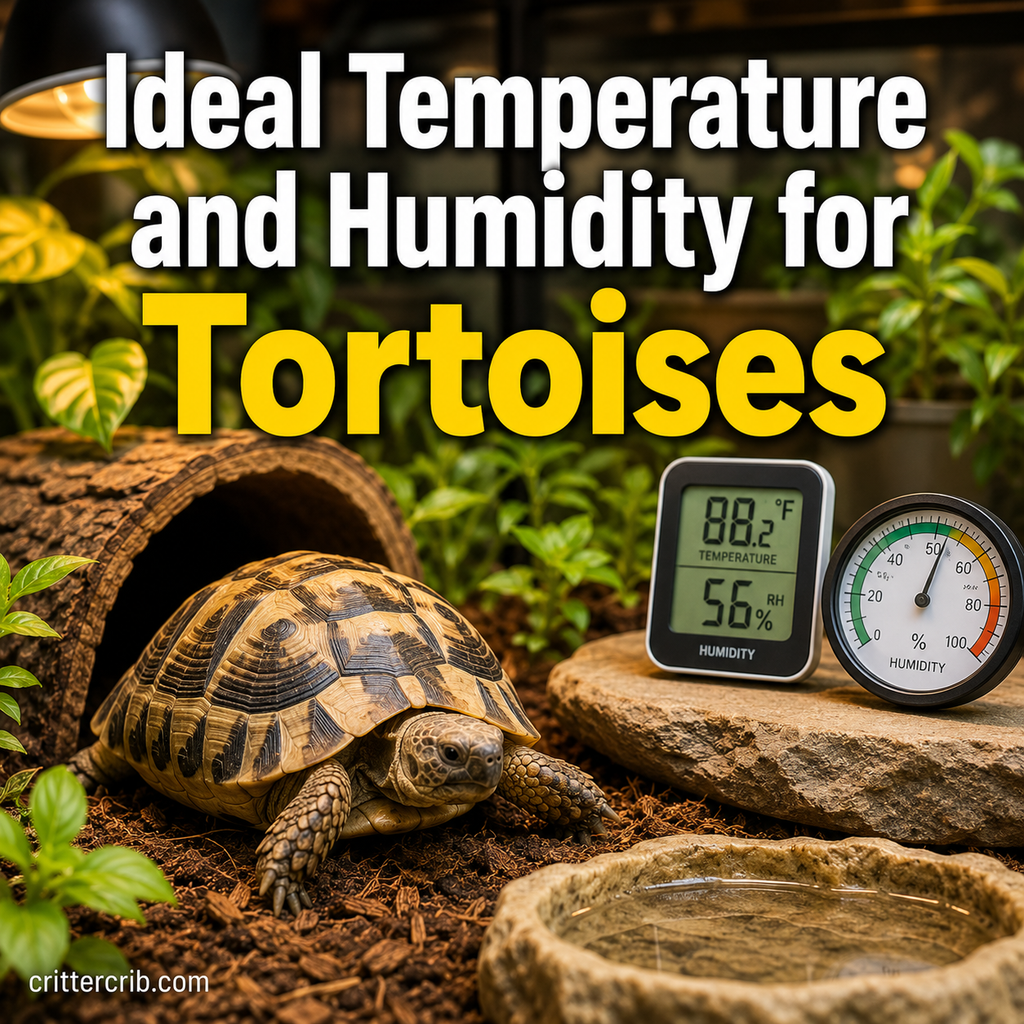
Getting the temperature and humidity right is one of the most important parts of keeping a tortoise healthy. Unfortunately, it’s also an area where generic advice can cause problems.
There isn’t one perfect temperature or humidity level for every tortoise.
A sulcata from a relatively dry environment has different needs from a red-footed tortoise adapted to humid tropical conditions. Young tortoises may also need different conditions from adults of the same species.
The goal isn’t simply to make an enclosure “warm.” Your tortoise needs a temperature gradient that allows it to move between warmer and cooler areas, along with humidity appropriate for its species, age, and environment.
Here’s how to get those conditions right—and how to recognize when something needs adjusting.
Why Temperature Is So Important for Tortoises
Tortoises are ectothermic animals. Instead of maintaining a constant internal body temperature the way humans do, they depend heavily on their surroundings for warmth.
That’s why you’ll often see a tortoise basking beneath a heat source and later moving into a cooler or shaded area.
This behavior is called thermoregulation.
Proper temperatures support essential functions including:
- Digestion
- Activity
- Appetite
- Immune function
- Metabolism
- Normal behavior
If the enclosure is too cold, a tortoise may become sluggish and have difficulty digesting food properly.
If it’s too hot and the animal has nowhere cooler to retreat, overheating and dehydration can become serious concerns.
Tortoises Need a Temperature Gradient
One of the biggest mistakes in tortoise husbandry is trying to maintain the entire enclosure at one temperature.
Instead, create different temperature zones.
A typical setup includes:
- A basking area
- A warm zone
- A cooler zone
- A nighttime temperature range
Your tortoise can then move around the enclosure according to its needs.
The exact temperatures depend on the species.
General Tortoise Temperature Guidelines
Although species-specific research should always take priority, many commonly kept tortoises use daytime environments somewhere within these broad ranges:
- Basking area: approximately 90–105°F
- Warm side: approximately 80–90°F
- Cool side: approximately 70–80°F
- Nighttime: often around 65–75°F, depending on species and age
These are starting points—not universal rules.
Some species prefer particularly hot basking surfaces, while tropical tortoises may require warmer nighttime conditions than species adapted to cooler environments.
Before setting your thermostat, identify exactly which tortoise species you have.
Ideal Temperature for Popular Pet Tortoises
Different species come from very different climates.
Here’s a practical overview of several commonly kept tortoises.
Russian Tortoise Temperature
Russian tortoises are adapted to environments that can experience considerable temperature variation.
A typical captive setup may provide:
- Basking area: around 90–100°F
- Warm area: approximately 80–85°F
- Cool area: approximately 70–75°F
Temperatures can drop at night, provided conditions remain appropriate for the animal.
A cooler zone is particularly important. Don’t turn the entire habitat into a 95°F box simply because the basking area needs to be hot.
Hermann’s Tortoise Temperature
Hermann’s tortoises generally do well with a warm basking area and a noticeable gradient.
A typical setup might include:
- Basking area: approximately 90–100°F
- Warm side: around 80–85°F
- Cool side: around 70–75°F
Nighttime temperatures can be cooler than daytime conditions for healthy animals when appropriate for their age and circumstances.
Greek Tortoise Temperature
Greek tortoises also benefit from a strong thermal gradient.
Depending on the particular subspecies and environment, a setup may provide:
- Basking area: approximately 90–100°F
- Warm side: around 80–85°F
- Cool side: approximately 70–75°F
Because “Greek tortoise” can refer to animals originating from different geographic areas, research the specific type you’re keeping whenever possible.
Sulcata Tortoise Temperature
Sulcata tortoises come from hot environments and need access to substantial warmth.
A typical setup may provide:
- Basking area: approximately 95–105°F
- Warm daytime area: roughly 80–90°F
- Cooler area: around the mid-70s to low 80s°F
Young sulcatas require particular attention to both warmth and humidity.
Cold, damp conditions should be avoided.
Large adult sulcatas kept outdoors may require heated shelters when temperatures drop, depending on the local climate.
Leopard Tortoise Temperature
Leopard tortoises generally require warm conditions.
A setup may include:
- Basking area: approximately 95–105°F
- Warm side: around 80–90°F
- Cooler area: roughly mid-70s to low 80s°F
Nighttime temperatures shouldn’t be allowed to become excessively cold, particularly for juveniles.
Red-Footed Tortoise Temperature
Red-footed tortoises come from warmer, more humid environments than Mediterranean species.
They generally do well with relatively stable warmth rather than an extremely intense hot spot.
A typical range may include:
- Daytime temperatures: roughly 80–88°F
- Basking or warmer area: upper 80s to low 90s°F
- Nighttime temperatures: generally kept warm, often above the low 70s°F
Avoid excessively hot, dry conditions.
Red-footed tortoises also have substantially different humidity requirements from many arid and Mediterranean species.
How Hot Should a Tortoise Basking Area Be?
For many commonly kept tortoises, the basking surface falls somewhere around 90–105°F.
But the exact target depends on the species.
The important word here is “surface.”
The temperature directly beneath a basking lamp can be quite different from the surrounding air temperature.
That’s why it’s useful to measure both.
An infrared temperature gun is especially convenient for checking basking surfaces, while digital probe thermometers can monitor ambient temperatures.
Don’t estimate basking temperature by placing your hand underneath the lamp.
Your hand and your tortoise experience heat differently, and “feels warm” isn’t an accurate measurement.
Choosing a Heat Source for a Tortoise
Overhead heating is generally the most useful way to create a natural basking area.
Common options include:
- Halogen basking lamps
- Reptile basking bulbs
- Ceramic heat emitters for supplemental non-light heat
- Radiant heat panels in suitable setups
The exact equipment depends on enclosure size and design.
Whatever you use, your tortoise shouldn’t be able to touch dangerously hot equipment.
Use Temperature Controls When Appropriate
Heating equipment can create dangerously high temperatures if something goes wrong.
Thermostats and appropriate temperature controllers can help maintain safer conditions, depending on the type of heat source.
You should still verify actual temperatures with independent thermometers.
Never assume a thermostat setting guarantees the enclosure is exactly that temperature.
Nighttime Temperature for Tortoises
Many tortoise species benefit from a natural reduction in temperature at night.
That doesn’t mean every tortoise should be allowed to become cold.
Nighttime requirements depend on:
- Species
- Age
- Health
- Indoor vs. outdoor housing
- Humidity
- Seasonal conditions
Mediterranean species may tolerate cooler nighttime temperatures than tropical species such as red-footed tortoises.
Young tortoises may also require more carefully controlled conditions.
If supplemental nighttime heat is necessary, use a heat source that doesn’t produce visible light.
Tortoises need a normal day-night cycle.
Why Humidity Matters for Tortoises
Humidity is sometimes treated as less important than temperature, especially with tortoises commonly described as “desert” animals.
That’s an oversimplification.
Even tortoises from relatively dry environments can seek humid microclimates in burrows, beneath vegetation, or under other cover.
Humidity plays a role in:
- Hydration
- Skin health
- Eye health
- Respiratory health
- Shell development
- Normal shedding
- Overall comfort
Young tortoises can be particularly sensitive to inappropriate humidity.
General Humidity Guidelines for Tortoises
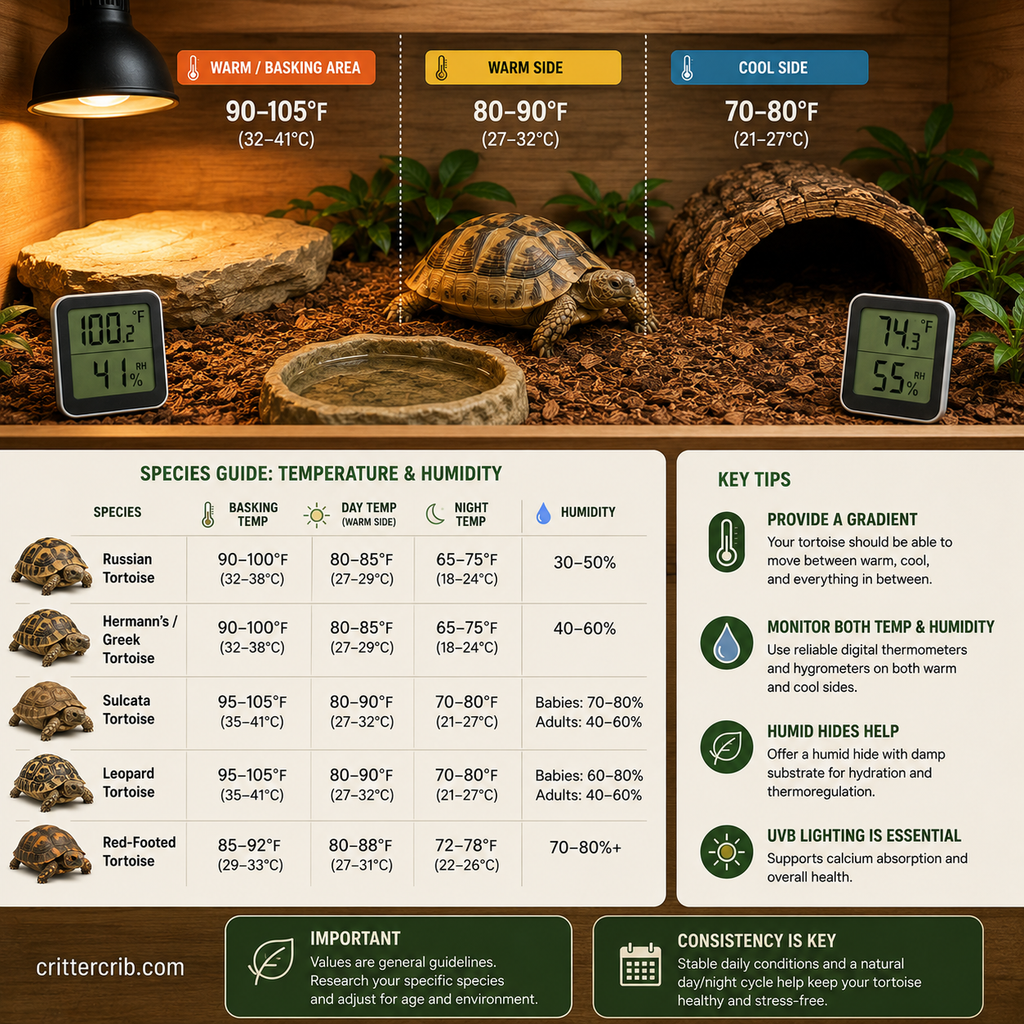
Humidity requirements vary dramatically between species.
As a broad comparison:
- Mediterranean species: often around 40–60%
- Russian tortoises: often around 30–50%
- Adult sulcatas: generally moderate to relatively dry ambient conditions, with access to appropriate humid microclimates
- Young sulcatas: commonly kept at substantially higher humidity than adults while maintaining warm temperatures
- Leopard tortoises: moderate humidity, with juveniles generally benefiting from more humidity than adults
- Red-footed tortoises: often around 70–80% or higher depending on conditions
These numbers should be treated as general guidance.
Actual requirements depend on the animal’s age, species, housing style, ventilation, and temperature.
Humidity for Russian Tortoises
Russian tortoises generally don’t need a tropical environment.
For many adults, moderate to relatively low ambient humidity works well.
A rough range of around 30–50% may be appropriate in many setups.
However, that doesn’t mean the enclosure should be bone dry everywhere.
Providing access to a humid hide or slightly more humid microclimate gives the tortoise a choice.
Juveniles may benefit from somewhat more humidity than adults.
Humidity for Hermann’s and Greek Tortoises
Mediterranean tortoises such as Hermann’s and Greek tortoises generally do well under moderate humidity rather than tropical conditions.
Around 40–60% is a useful general target for many setups, although exact conditions vary.
Juveniles should have access to adequate moisture and humid microclimates.
Avoid interpreting “Mediterranean” as meaning the animal should live on extremely dry, dusty substrate at all times.
Humidity for Sulcata Tortoises
Sulcata humidity is one area where older husbandry advice can be misleading.
Although sulcatas originate from relatively dry regions, young tortoises spend considerable time in protected microclimates and shouldn’t necessarily be raised under extremely dry captive conditions.
Juveniles are often maintained with considerably higher humidity—frequently around 70–80%—while keeping temperatures appropriately warm.
The combination matters.
High humidity with cold conditions can be problematic.
As sulcatas grow, their ambient humidity requirements can become more moderate, although they should continue to have access to hydration and suitable microclimates.
Humidity for Leopard Tortoises
Leopard tortoise humidity also varies with age.
Juveniles generally benefit from more humid conditions than older animals, particularly when maintained in warm environments.
Adults may do well with more moderate ambient humidity.
Providing humid retreats and suitable substrate can help the animal regulate its exposure to moisture.
Humidity for Red-Footed Tortoises
Red-footed tortoises are the major contrast to many popular Mediterranean and African tortoises.
They thrive in warm, humid environments.
Humidity around 70–80% or higher is commonly maintained, along with good ventilation.
The enclosure shouldn’t be cold and soaking wet.
Warmth, moisture, and airflow need to work together.
A warm, humid enclosure with appropriate substrate and ventilation is very different from a stagnant habitat with constantly waterlogged surfaces.
Baby Tortoises Often Need More Humidity Than Adults
This point is worth emphasizing.
Juvenile tortoises shouldn’t automatically be kept under exactly the same conditions as large adults.
Young tortoises spend much of their time close to the ground, beneath vegetation, inside burrows, and in other protected microhabitats where humidity can be considerably higher than the surrounding air.
Adequate humidity during growth may support healthy shell development and hydration.
Research juvenile-specific husbandry for your species rather than simply copying conditions used for an adult.
Humidity and Tortoise Shell Pyramiding
Pyramiding refers to abnormal raised growth of the individual scutes on a tortoise’s shell.
For years, it was commonly blamed almost entirely on diet.
Shell development is more complicated.
Environmental conditions—including humidity and hydration—appear to play important roles, along with factors such as growth rate, nutrition, and overall husbandry.
Keeping a growing tortoise excessively dry may contribute to abnormal shell development.
That doesn’t mean simply increasing humidity will prevent every shell problem.
Healthy shell growth depends on the complete husbandry picture:
- Proper species-specific humidity
- Good hydration
- Appropriate diet
- Correct calcium intake
- UVB exposure
- Proper temperatures
- Appropriate growth rate
- Regular activity
No single setting replaces good overall care.
How to Measure Humidity in a Tortoise Enclosure
Use a digital hygrometer.
Small analog dial gauges can be difficult to read accurately and may not provide the precision you need.
Position the hygrometer where it reflects conditions your tortoise actually experiences.
For larger enclosures, you may want more than one.
Humidity can vary substantially between:
- Warm and cool areas
- Surface and substrate level
- Inside and outside hides
- Different ends of a large enclosure
A single reading doesn’t always tell the whole story.
Creating a Humid Hide
A humid hide is one of the easiest ways to provide a moisture-rich microclimate without increasing humidity throughout the entire enclosure.
The hide should be:
- Large enough for the tortoise to enter comfortably
- Easy to clean
- Stable
- Filled with suitable moisture-retaining substrate
- Damp rather than waterlogged
Depending on the setup, materials may include damp soil mixtures, coco coir, or other species-appropriate substrate.
Monitor the hide regularly.
You don’t want mold, stagnant water, or contaminated substrate accumulating inside.
Choosing Substrate for Proper Humidity
Substrate has a major influence on enclosure humidity.
Suitable choices depend on the tortoise species and housing conditions.
Common materials include:
- Organic topsoil without fertilizers or pesticides
- Coco coir
- Cypress mulch
- Orchid bark
- Species-appropriate soil mixtures
Some keepers combine materials to achieve the desired texture and moisture retention.
The substrate should allow natural behaviors such as digging while helping maintain appropriate environmental conditions.
Avoid constantly wet substrate unless the species and specific microhabitat require it.
How to Increase Humidity Safely
If your enclosure is consistently too dry, don’t simply soak everything with water.
Instead, make gradual adjustments.
You can:
- Use a more moisture-retentive substrate.
- Increase substrate depth.
- Add water to lower substrate layers where appropriate.
- Provide a humid hide.
- Adjust ventilation carefully.
- Add safe live plants in suitable setups.
- Monitor conditions after each change.
Misting can temporarily increase humidity, but it isn’t always the best long-term solution.
You want stable environmental conditions rather than dramatic spikes followed by immediate drops.
How to Lower Humidity
If humidity is consistently too high for your species:
- Increase ventilation
- Replace waterlogged substrate
- Reduce unnecessary misting
- Check for leaking or spilled water
- Move water away from intense heat if evaporation is excessive
- Evaluate whether the substrate retains too much moisture
Never sacrifice hydration just to reduce humidity.
Fresh drinking water should remain available.
Signs a Tortoise May Be Too Cold
A cold tortoise may:
- Become unusually inactive
- Remain hidden for long periods
- Show reduced appetite
- Move sluggishly
- Have difficulty digesting food
- Spend excessive time beneath the heat source
Some of these behaviors can also occur for other reasons.
Check actual enclosure temperatures before assuming temperature is the problem.
Persistent lethargy or appetite changes can also indicate illness.
Signs a Tortoise May Be Too Hot
Possible signs of excessive heat include:
- Constantly trying to escape the warm area
- Remaining in the coolest available location
- Excessive digging in an attempt to escape heat
- Persistent restlessness
- Signs of dehydration
- Unusual inactivity in extreme conditions
If the enclosure is dangerously hot, correct the environmental problem immediately.
Every tortoise should have access to a cooler retreat.
Signs Humidity May Be Incorrect
Humidity problems aren’t always obvious from behavior alone.
Potential warning signs include:
- Dry or flaky skin
- Signs of dehydration
- Eye irritation
- Repeated shell growth concerns
- Respiratory symptoms
- Persistently damp skin or shell
- Mold developing in the enclosure
Respiratory symptoms such as nasal discharge, wheezing, bubbles around the nose, or open-mouth breathing require veterinary attention.
Don’t assume adjusting humidity alone will resolve an established respiratory illness.
Indoor vs. Outdoor Tortoise Temperatures
Outdoor housing can provide excellent opportunities for natural sunlight, grazing, exercise, and temperature variation.
It also gives you less direct control over the weather.
Outdoor tortoise keepers need to monitor:
- Daytime highs
- Nighttime lows
- Direct sun exposure
- Shade
- Ground temperature
- Rainfall
- Humidity
- Seasonal changes
A tortoise shouldn’t be placed outside simply because the air temperature seems pleasant.
Ground surfaces in direct sunlight can become much hotter than the surrounding air.
Likewise, nighttime temperatures can fall rapidly.
Don’t Forget Shade Outdoors
Every outdoor tortoise enclosure needs reliable shade.
The animal must be able to escape direct sunlight at any time.
Provide:
- Shaded shelters
- Vegetation
- Burrows or appropriate hide structures
- Multiple temperature zones
Shade should remain available as the sun moves throughout the day.
A shaded area at 9 a.m. may be fully exposed by 2 p.m.
Common Temperature and Humidity Mistakes
Many husbandry problems begin with a few simple misconceptions.
Avoid:
- Using one temperature for the entire enclosure
- Guessing temperatures without thermometers
- Assuming all tortoise species need the same humidity
- Keeping baby tortoises excessively dry
- Using uncontrolled heating equipment
- Leaving visible heat lights on overnight
- Allowing tropical species to become too cold
- Maintaining constantly waterlogged substrate
- Ignoring ventilation
- Measuring only air temperature and never checking the basking surface
- Using one hygrometer reading to represent a very large enclosure
- Placing an enclosure in direct sunlight
- Following adult husbandry recommendations for a hatchling
Good tortoise care is less about memorizing one perfect number and more about creating an appropriate range of conditions.
Tortoise Temperature and Humidity Checklist
Before bringing home a tortoise, make sure you have:
- Species-specific temperature targets
- Appropriate basking lamp
- Reliable digital thermometers
- Infrared temperature gun
- Digital hygrometer
- Suitable substrate
- Proper UVB lighting
- Warm and cool areas
- Secure hiding places
- Humid hide when appropriate
- Fresh drinking water
- Appropriate ventilation
- Safe nighttime heating if required
Set everything up before the tortoise arrives.
Run the enclosure for several days and monitor how temperatures and humidity change between daytime and nighttime.
Frequently Asked Questions About Tortoise Temperature and Humidity
What temperature should a tortoise enclosure be?
It depends on the species.
Many tortoises use basking areas around 90–105°F with cooler areas elsewhere in the enclosure. Tropical species and Mediterranean species have different requirements, so always research your particular tortoise.
What humidity should a tortoise enclosure be?
There is no universal tortoise humidity.
Some adult Russian tortoises may do well around 30–50%, Mediterranean species often fall around 40–60%, while red-footed tortoises commonly require around 70–80% or higher.
Juveniles of several species may need higher humidity than adults.
Do tortoises need heat at night?
Sometimes.
Whether supplemental nighttime heat is needed depends on the species, age, health, enclosure type, and room temperature.
If nighttime heating is necessary, use a non-light-producing heat source.
Do tortoises need a heat lamp all day?
Most indoor setups provide a daytime basking period that corresponds with the tortoise’s light cycle.
A timer can maintain a consistent schedule.
Heat and visible lighting requirements at night are different, so bright basking lamps generally shouldn’t remain on 24 hours a day.
Should I mist my tortoise every day?
Not necessarily.
Whether misting is useful depends on the species and enclosure.
It’s better to monitor humidity with a hygrometer and adjust the habitat based on measured conditions rather than misting according to an arbitrary schedule.
Can humidity be too high for a tortoise?
Yes.
Persistently excessive humidity—particularly when combined with cool temperatures, poor ventilation, and wet substrate—can create unhealthy conditions.
Humidity should always be considered together with temperature and airflow.
How do I know if my tortoise is warm enough?
Monitor enclosure temperatures rather than relying only on behavior.
A tortoise should have access to an appropriately warm basking area while also being able to retreat to cooler locations.
Unusual inactivity, poor appetite, or constantly remaining under the heat source may warrant checking your temperatures.
The Right Conditions Depend on Your Tortoise
When it comes to tortoise temperature and humidity, the most important rule is simple: know your species.
A Russian tortoise, sulcata, leopard tortoise, Hermann’s tortoise, and red-footed tortoise shouldn’t all be kept under identical conditions.
Age matters too.
Young tortoises often benefit from higher humidity and carefully controlled warmth compared with large adults.
Instead of chasing one perfect temperature or humidity reading, create a habitat that gives your tortoise options. Provide an appropriate basking area, cooler retreat, species-specific humidity, adequate hydration, suitable substrate, and good ventilation.
Then measure everything.
Reliable thermometers and hygrometers remove the guesswork and make it much easier to spot problems before they affect your tortoise.
Get the environment right, and you’ve established one of the most important foundations for keeping your tortoise healthy for years to come.