
Corydoras catfish have a reputation for being peaceful, busy little bottom dwellers. Watch a comfortable group for a while and you’ll see why they’re so popular. They search through the substrate, rest together, explore the aquarium, and occasionally make surprisingly quick trips toward the surface.
But how can you actually tell whether your Corydoras are happy?
Fish can’t show happiness in quite the same way a dog or cat might, so it’s more useful to look for signs that they’re healthy, comfortable, and behaving normally. Their activity level, appetite, social behavior, breathing, and even the way they rest can tell you quite a bit.
Once you become familiar with your Corydoras’ normal routine, changes become much easier to spot.
What Does a Happy Corydoras Look Like?
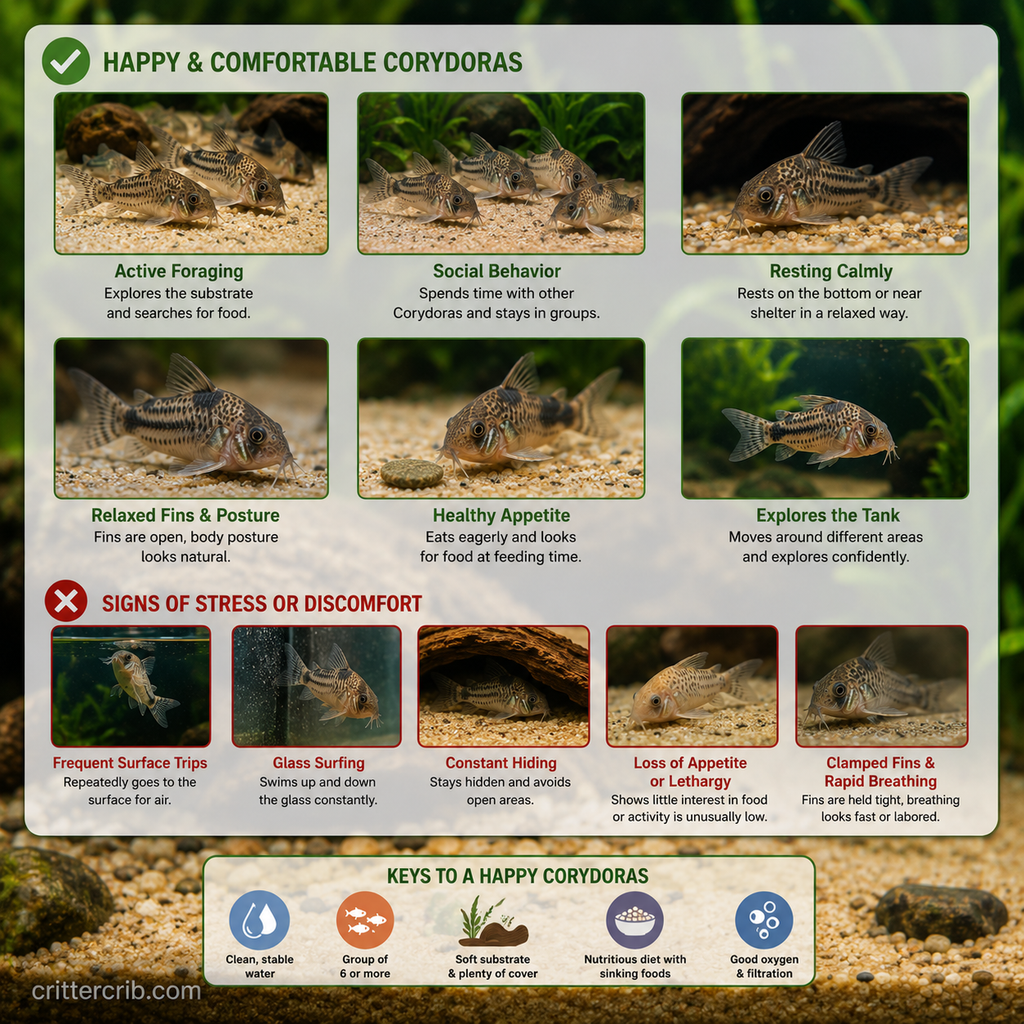
A comfortable Corydoras generally looks alert, eats readily, interacts with other Corydoras, and spends time naturally exploring the bottom of the aquarium.
Some individuals are more active than others, and behavior can vary between Corydoras species. That’s why you shouldn’t judge your fish based on one behavior alone.
Instead, look at the overall picture.
Good signs commonly include:
- Regularly searching the substrate for food
- Eating with a healthy appetite
- Spending time near other Corydoras
- Exploring different areas of the aquarium
- Resting calmly between periods of activity
- Normal, steady breathing
- Healthy-looking fins and barbels
- Reacting normally to food and activity around the tank
- Moving confidently rather than constantly hiding
A Corydoras doesn’t need to swim around nonstop to be comfortable. Resting is a normal part of its day.
1. Your Corydoras Actively Searches for Food
One of the most recognizable Corydoras behaviors is foraging.
A comfortable Cory may move across the bottom with its head angled downward, using its sensitive barbels to investigate the substrate and search for edible material.
You’ll often see them:
- Investigating the sand or substrate
- Searching around plants and decorations
- Exploring underneath pieces of wood
- Moving from one feeding area to another
- Returning to places where food was previously found
This doesn’t necessarily mean your fish is starving.
Foraging is natural behavior for Corydoras. A fish that has recently eaten may continue exploring the bottom because searching for food is simply part of what it does.
Foraging Doesn’t Mean Corydoras Can Live on Leftovers
There’s a persistent idea that bottom-dwelling fish will survive by cleaning up whatever other fish don’t eat.
Corydoras shouldn’t be treated as aquarium cleanup equipment.
They need their own nutritionally appropriate diet. Sinking foods can help ensure that food actually reaches them, especially when faster fish occupy the upper levels of the aquarium.
Observe feeding closely enough to make sure your Corydoras are getting their share.
2. They Spend Time With Other Corydoras
Corydoras are social fish.
Although an individual may occasionally wander away from the group, Corydoras generally benefit from living with others of their own kind.
When comfortable, you may see several Corys:
- Foraging together
- Resting near one another
- Following each other around the aquarium
- Gathering in the same sheltered area
- Becoming more active as a group during feeding
Not every Corydoras needs to remain physically beside another fish every minute. It’s perfectly normal for one to explore independently.
However, regular social interaction is a good sign.
If you’re keeping only one Corydoras and it spends much of its time hiding or behaving timidly, its social environment is worth considering.
3. Your Corydoras Has a Healthy Appetite
Feeding time is one of the easiest opportunities to assess your fish.
Healthy Corydoras will generally notice food and begin searching for it. Depending on what you’re feeding and how the aquarium is set up, they may not always rush toward food instantly, but they should regularly eat.
Pay attention to whether each fish gets access to food.
In a community aquarium, faster tank mates can sometimes consume a surprising amount before sinking foods reach the bottom.
A Corydoras that suddenly stops eating deserves attention, particularly if the loss of appetite is accompanied by other behavioral or physical changes.
Possible reasons can include:
- Poor water quality
- Stress
- Illness
- Inappropriate water temperature
- Competition for food
- Recent changes to the aquarium
- Bullying or incompatible tank mates
Missing one meal isn’t automatically an emergency. A persistent change from the fish’s normal appetite is much more important.
4. They Explore the Aquarium Confidently
A comfortable Corydoras shouldn’t look permanently terrified of its surroundings.
You’ll often see Corys moving between open areas, plants, decorations, and shaded sections of the aquarium.
Some may spend plenty of time out in the open, while others prefer areas with more cover.
The important distinction is between choosing to rest somewhere sheltered and appearing too frightened to come out.
Healthy exploration can include swimming along the bottom, investigating plants, searching beneath wood, and occasionally moving into the middle levels of the aquarium.
5. Your Corydoras Rests Calmly
Seeing a Corydoras sitting motionless on the substrate can worry new owners.
Often, it’s completely normal.
Corydoras don’t need to be moving constantly. They may settle on the substrate, rest beneath plants, sit beside decorations, or gather together during quieter periods.
A resting Cory should generally look relaxed rather than distressed.
Pay attention to its breathing and posture. If the fish periodically becomes active again, eats normally, and otherwise behaves as usual, resting by itself isn’t necessarily concerning.
When Resting May Signal a Problem
Be more cautious if inactivity appears suddenly or is accompanied by:
- Rapid breathing
- Loss of appetite
- Clamped fins
- Difficulty swimming
- Unusual coloration
- Visible injuries
- Long periods of isolation
- Failure to react to food
- Lying in an abnormal position
Behavior becomes much more useful when considered alongside other symptoms.
6. They Make Occasional Trips to the Surface
You may occasionally see a Corydoras shoot toward the surface, take in air, and quickly return to the bottom.
This can be normal.
Corydoras have the ability to gulp atmospheric air at the surface and use their intestinal tract to obtain oxygen from it. An occasional trip to the surface isn’t automatically a sign that your aquarium lacks oxygen.
The key word is occasional.
If your Corydoras suddenly begin making frequent trips to the surface, particularly if several fish are doing it, investigate the aquarium conditions.
Check for problems such as:
- Poor water quality
- Low dissolved oxygen
- Excessive temperature
- Inadequate surface movement
- Problems with filtration
Don’t assume repeated surface visits are harmless simply because Corydoras naturally breathe atmospheric air.
7. Their Breathing Looks Normal
A comfortable Corydoras should generally breathe steadily when resting.
You can watch the movement around the gill area to get a sense of what’s normal for your fish.
Breathing rate can temporarily increase after activity or stress, but persistent rapid breathing can indicate a problem.
If several fish are breathing heavily at the same time, water conditions should be one of the first things you investigate.
Test the water rather than trying to diagnose the problem based on appearance alone.
8. Their Barbels Look Healthy
Those whisker-like structures around a Corydoras’ mouth are called barbels.
Corydoras use them while exploring and searching for food, so they’re an important part of the fish’s anatomy.
Healthy barbels should look intact rather than severely shortened, damaged, or inflamed.
Barbel problems can be associated with poor environmental conditions, injury, or unsuitable substrate conditions.
Keeping the aquarium clean and choosing substrate that doesn’t have dangerously sharp or abrasive edges can help create a better environment for natural foraging.
Is Sand Best for Corydoras?
Fine, smooth sand is popular in Corydoras aquariums because it allows them to naturally sift and search through the substrate.
Other substrates may also be suitable if they’re smooth and don’t have sharp edges that could cause injury.
Whatever you choose, cleanliness matters.
Food and organic debris can accumulate in neglected substrate, so regular aquarium maintenance remains important even with a Cory-friendly setup.
9. Their Fins Are Open and Undamaged
Take a moment to look at your Corydoras’ fins.
A healthy fish should generally carry its fins naturally rather than keeping them tightly clamped against its body for extended periods.
Watch for:
- Torn fins
- Redness
- White spots or unusual growths
- Frayed edges
- Persistent clamping
- Difficulty using a fin normally
An occasional minor injury can happen, particularly in a community aquarium, but recurring damage deserves investigation.
Tank mates, decorations, illness, and environmental conditions may all play a role.
10. They Show Bursts of Activity
Corydoras can sometimes surprise you with sudden bursts of energy.
A group may become particularly active around feeding time, after aquarium maintenance, or during periods when they’re naturally inclined to explore.
You might see them swimming together, moving up and down sections of the aquarium, or enthusiastically searching the substrate.
This doesn’t automatically mean something is wrong.
As long as the behavior isn’t frantic and the fish otherwise appear healthy, periods of increased activity can simply be part of normal Corydoras behavior.
What Is “Glass Surfing” in Corydoras?
Corydoras sometimes repeatedly swim up and down along the aquarium glass.
Aquarists commonly call this behavior glass surfing.
A newly introduced Cory may do this while becoming accustomed to its environment. Corys may also become temporarily energetic for other reasons.
Occasional glass swimming isn’t necessarily concerning.
Persistent, frantic glass surfing deserves a closer look, particularly when combined with hiding, rapid breathing, appetite changes, or other signs of stress.
Check:
- Water parameters
- Temperature
- Social group
- Tank mates
- Available cover
- Recent changes to the aquarium
Context matters more than the behavior by itself.
Signs Your Corydoras May Be Stressed
Knowing what comfortable behavior looks like makes stress easier to recognize.
Possible warning signs include:
- Constant hiding
- Sudden loss of appetite
- Persistent rapid breathing
- Frequent frantic trips to the surface
- Clamped fins
- Erratic swimming
- Unusual lethargy
- Long-term isolation from the group
- Faded or unusual coloration
- Damaged fins or barbels
- Rubbing against aquarium surfaces
- Difficulty maintaining a normal swimming position
One symptom doesn’t always identify the cause.
For example, hiding could result from stress, inappropriate tank mates, a new environment, illness, or simply a lack of confidence.
Look for combinations of symptoms and changes from the fish’s established routine.
Water Quality Is One of the Most Important Factors
If your Corydoras suddenly start behaving differently, checking the aquarium water is a sensible first step.
Clear water isn’t necessarily healthy water. Ammonia, nitrite, nitrate, temperature, pH, and other conditions can’t be accurately judged by appearance alone.
In an established, properly cycled freshwater aquarium, ammonia and nitrite should generally remain at undetectable levels.
Regular testing helps you identify changes before they become serious.
Keep Conditions Stable
Fish don’t benefit from aquarium owners constantly adjusting water chemistry in pursuit of a supposedly perfect number.
Stability is extremely important.
The appropriate temperature and water parameters can vary somewhat depending on the Corydoras species you’re keeping, so research your particular species rather than assuming every Cory has identical requirements.
Regular partial water changes, adequate filtration, sensible stocking, and avoiding overfeeding all help maintain good conditions.
Give Corydoras Appropriate Tank Mates
Corydoras are peaceful fish and generally aren’t equipped to defend themselves against aggressive tank mates.
A Cory that’s repeatedly chased, nipped, or prevented from feeding isn’t likely to behave comfortably.
Suitable tank mates depend on the Corydoras species, aquarium size, temperature, and other environmental requirements.
In general, look for peaceful community fish with compatible care needs.
Don’t choose tank mates based solely on whether two species are labeled “community fish.” Make sure their adult size, temperature range, temperament, and other requirements actually overlap.
Give Them Places to Explore and Rest
A completely bare aquarium doesn’t provide much environmental variety.
Plants, smooth wood, suitable rocks, and other aquarium-safe structures can create sheltered areas while leaving open substrate available for foraging.
You don’t need to pack every inch of the tank with decorations.
A balanced setup can provide:
- Open bottom areas for searching
- Shaded resting areas
- Plants for cover
- Sheltered areas
- Clear swimming space
Arrange the aquarium so Corydoras can explore naturally without navigating sharp or dangerous decorations.
Feed Your Corydoras a Varied, Appropriate Diet
Corydoras are often described as scavengers, but that description can be misleading.
They’re active foragers that require proper nutrition.
Depending on the species and food being used, a varied diet may include appropriate sinking pellets or wafers along with suitable frozen, live, or other prepared foods.
The important thing is making sure food reaches the Corydoras.
Watch Them Eat
Don’t simply drop food into a community tank and assume the bottom dwellers eventually get something.
Watch occasionally.
If upper-level fish consume most of the food, you may need to adjust how or when you feed.
At the same time, avoid dumping excessive amounts of food into the aquarium in an attempt to make sure something reaches the bottom. Uneaten food can contribute to poor water quality.
Keep Corydoras in an Appropriate Social Group
One Corydoras may survive alone, but surviving isn’t the same as providing an environment that encourages natural behavior.
Corydoras are social and generally do best when kept with a suitable group of their own species.
A group can make these fish much more interesting to watch, too. Instead of a single timid Cory hiding behind a decoration, you may see them exploring, feeding, and resting together.
Make sure the aquarium is large enough to accommodate the adult size and number of fish you’re planning to keep.
Different Corydoras species vary significantly in size, so stocking recommendations shouldn’t be treated as universal.
Learn Your Corydoras’ Normal Routine
Perhaps the best way to judge whether your Corydoras is comfortable is simply to pay attention.
Every aquarium develops its own rhythm.
You may notice your Corys become active shortly before feeding. Perhaps they rest under a particular plant during part of the day. Maybe they explore more after the aquarium lights change.
These patterns give you a baseline.
If a normally enthusiastic eater suddenly ignores food or a confident Cory spends an entire day hiding, you’ll notice much sooner if you’re already familiar with its usual behavior.
Frequently Asked Questions About Happy Corydoras
How Do I Know if My Corydoras Is Happy?
Look for a combination of normal behaviors rather than one definitive sign. Comfortable Corydoras generally eat well, forage regularly, interact with other Corys, explore their environment, rest normally, and breathe steadily.
Why Is My Corydoras Sitting Still?
Corydoras regularly rest, so sitting motionless on the substrate isn’t automatically concerning.
Look at the overall situation. If the fish resumes normal activity, eats, breathes normally, and shows no obvious symptoms, it may simply be resting.
Sudden or prolonged lethargy accompanied by other symptoms deserves investigation.
Why Does My Corydoras Swim to the Surface?
Corydoras can gulp atmospheric air from the surface as part of their normal physiology.
Occasional surface trips can therefore be normal. A sudden increase in frequency, especially involving multiple fish, may indicate a water-quality or oxygen problem and should be investigated.
Why Is My Corydoras Swimming Up and Down the Glass?
Corydoras sometimes swim repeatedly along aquarium glass, particularly when they’re new to the tank or experiencing a period of increased activity.
Persistent or frantic glass surfing can also occur when a fish is stressed. Check water conditions and consider whether its social group, tank mates, or environment could be contributing.
Do Corydoras Like Being in Groups?
Yes. Corydoras are social fish and generally benefit from being kept with an appropriate group of their own species.
Group living can encourage more natural social, resting, and foraging behavior.
Do Corydoras Need Hiding Places?
Providing sheltered areas is a good idea.
Plants, smooth wood, and aquarium-safe decorations can create places where Corydoras feel secure and rest. You should also leave suitable open substrate where they can forage.
Are Corydoras Happy When They’re Active?
Activity can be a positive sign, but activity alone doesn’t prove that a fish is comfortable.
A stressed Corydoras can also swim frantically.
Relaxed exploration and foraging are different from persistent erratic swimming, so consider breathing, appetite, posture, social behavior, and water conditions alongside activity level.
Why Is My Corydoras Hiding All the Time?
Some hiding is normal, particularly when a Corydoras is resting or adjusting to a new aquarium.
Constant hiding may indicate that the fish feels insecure.
Consider whether it has an appropriate social group, suitable tank mates, adequate cover, stable water conditions, and enough time to become accustomed to its surroundings.
A Comfortable Corydoras Acts Like a Corydoras
You don’t need your Corydoras to perform a particular behavior to prove it’s happy.
What you’re really looking for is a fish that’s able to behave naturally.
A comfortable Cory should have opportunities to forage, interact with other Corydoras, explore, eat a nutritious diet, and rest without constantly being disturbed.
Pay attention to those everyday behaviors. They often tell you far more than any single “happy fish” checklist.
And when something suddenly changes, don’t ignore it.
Test the water, observe the other fish, check for physical symptoms, and think about what’s recently changed in the aquarium.
The better you know your Corydoras’ normal behavior, the easier it becomes to recognize when your little bottom dwellers are comfortable — and when they might need your attention.