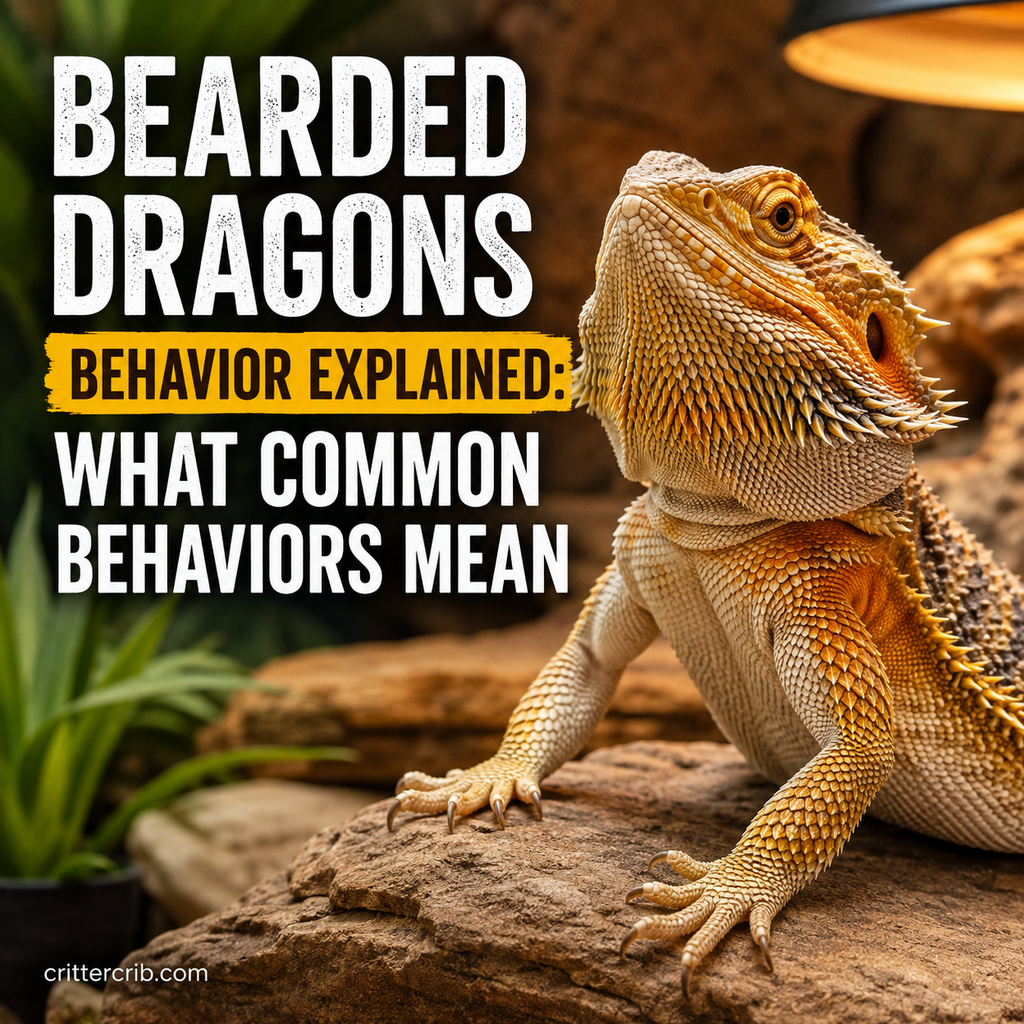
Bearded dragons are often described as calm, easygoing reptiles, but that doesn’t mean they’re boring. Spend enough time around one and you’ll notice head bobbing, arm waving, glass surfing, digging, puffing up, changing colors, and plenty of intense staring.
Some of these behaviors are simple forms of communication. Others are connected to temperature, breeding instincts, shedding, stress, or the way a bearded dragon interacts with its surroundings.
Learning what your bearded dragon’s behavior means can make everyday care much easier. It helps you recognize when your dragon is comfortable, when something in the enclosure needs attention, and when a behavior may be worth discussing with a reptile veterinarian.
Here are some of the most common bearded dragon behaviors and what may be behind them.
Why Understanding Bearded Dragon Behavior Matters
Bearded dragons can’t tell us when they’re uncomfortable, frightened, too hot, or simply in the mood to be left alone. Instead, much of their communication happens through body language and changes in normal routines.
The important thing is not to interpret one behavior in isolation.
A bearded dragon hiding for an afternoon may be perfectly normal. A dragon that suddenly hides every day, stops eating, loses weight, and becomes unusually inactive deserves much closer attention.
When evaluating behavior, consider:
- Age
- Time of year
- Enclosure temperature
- UVB lighting
- Diet and hydration
- Recent changes to the enclosure
- Shedding
- Exposure to other pets
- Handling frequency
- Appetite and bowel movements
- Whether the behavior is new or typical for that individual
Knowing your dragon’s usual routine gives you a baseline for spotting meaningful changes.
Bearded Dragon Head Bobbing
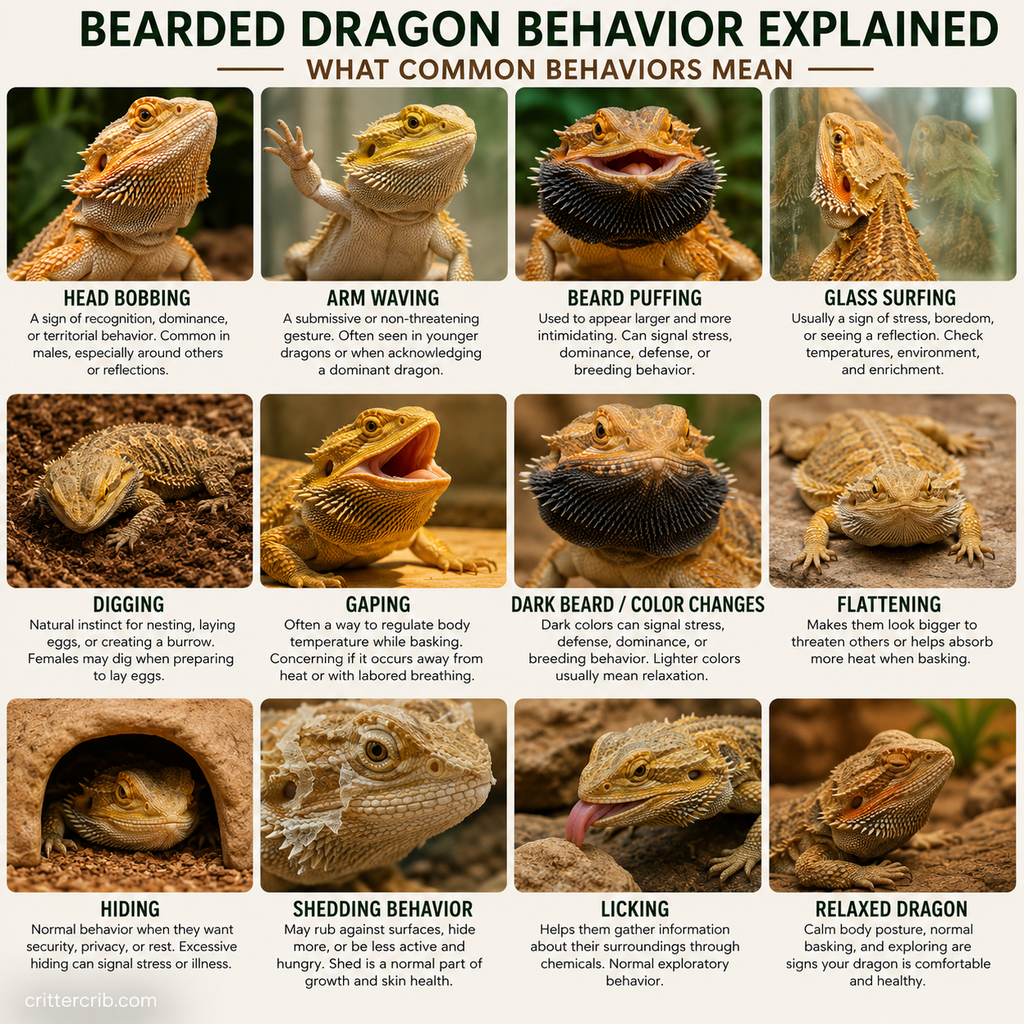
Head bobbing is one of the most recognizable bearded dragon behaviors. The dragon repeatedly moves its head up and down, sometimes slowly and sometimes surprisingly quickly.
What Does Head Bobbing Mean?
Head bobbing is generally a form of visual communication. Depending on the situation, it may be associated with dominance, territorial behavior, courtship, or excitement.
Adult males are especially known for vigorous head bobbing. A male may bob after seeing another bearded dragon, his own reflection, or even movement outside the enclosure.
During breeding behavior, head bobbing can also be directed toward a female.
Is Head Bobbing Normal?
Occasional head bobbing is usually normal. If it happens constantly, look for environmental triggers.
For example, a dragon may repeatedly react to its reflection in the enclosure glass because it perceives the reflection as another dragon.
Why Do Bearded Dragons Wave Their Arms?
Arm waving looks almost comical the first time you see it. The dragon raises one front leg and slowly moves it in a circular motion.
Despite appearances, your bearded dragon probably isn’t saying hello.
Arm waving is commonly interpreted as a submissive or non-threatening signal. It may occur when a dragon sees another bearded dragon that it perceives as dominant.
Young bearded dragons can be particularly likely to display this behavior.
A dragon may also wave at:
- Its reflection
- Another bearded dragon
- A person approaching the enclosure
- An unfamiliar animal nearby
Occasional arm waving is generally nothing to worry about.
Bearded Dragon Beard Puffing
The expandable throat area beneath a bearded dragon’s jaw is where the animal gets its name.
When a bearded dragon expands this area, the beard becomes much more noticeable.
Why Do Bearded Dragons Puff Their Beards?
Beard puffing can occur for several reasons.
A bearded dragon may puff its beard when it:
- Feels threatened
- Is displaying dominance
- Encounters another bearded dragon
- Is showing breeding behavior
- Is stretching
- Is shedding around the head or neck
- Is reacting to an unfamiliar situation
Context makes a big difference.
A relaxed dragon briefly puffing its beard while stretching is very different from a dragon that flattens its body, opens its mouth, darkens its beard, and reacts defensively when approached.
Why Does a Bearded Dragon’s Beard Turn Black?
A bearded dragon’s beard can become dramatically darker, sometimes appearing almost completely black.
A dark beard is often associated with heightened arousal. That can include stress, defensive behavior, territorial displays, or reproductive behavior.
Males may develop particularly dark beards during breeding-related displays.
However, persistent dark coloration accompanied by other changes should receive more attention.
Watch for additional signs such as:
- Unusual lethargy
- Loss of appetite
- Difficulty moving
- Abnormal breathing
- Persistent hiding
- Significant behavioral changes
Color alone doesn’t tell you exactly what is happening. Look at the entire animal and its recent behavior.
Bearded Dragon Glass Surfing
Glass surfing happens when a bearded dragon repeatedly scratches or runs along the enclosure walls, often appearing as though it is trying to climb through the glass.
An occasional attempt to climb the enclosure isn’t unusual. Repeated glass surfing, however, can suggest that something is bothering the dragon.
Why Do Bearded Dragons Glass Surf?
Possible causes include:
- Enclosure temperatures that are too high
- An enclosure that doesn’t provide enough usable space
- Seeing its reflection
- Seeing another bearded dragon
- Stress after an enclosure change
- Too little environmental stimulation
- Breeding-related activity
- Wanting to explore outside the enclosure
Start by checking husbandry rather than assuming your dragon simply wants attention.
Verify the temperature gradient, basking conditions, UVB setup, hiding areas, and overall enclosure design.
If husbandry looks good, consider visual triggers. Reflections and nearby animals can cause some dragons to repeatedly patrol the glass.
Why Do Bearded Dragons Dig?
Digging is another behavior with several possible explanations.
Some bearded dragons occasionally scratch or dig at their substrate simply because digging is part of their natural behavioral repertoire.
Frequent digging can also be associated with:
- Creating a resting area
- Looking for a place to hide
- Preparing for brumation
- Breeding behavior
- Egg laying in females
- Trying to escape uncomfortable enclosure conditions
Digging in Female Bearded Dragons
Digging deserves particular attention in mature females.
Female bearded dragons can develop eggs even if they have never been housed with a male. These eggs will be infertile, but the dragon still needs an appropriate place to lay them.
A gravid female may become restless and spend considerable time digging while searching for a suitable nesting location.
If you suspect your female is carrying eggs, research appropriate laying conditions and consult a reptile veterinarian if she appears unable to lay, becomes weak, or shows other concerning symptoms.
Bearded Dragon Gaping
Seeing your bearded dragon sitting under the basking light with its mouth open can look alarming.
In many cases, it’s completely normal.
Why Do Bearded Dragons Sit With Their Mouths Open?
Bearded dragons may gape while basking as part of thermoregulation.
Because reptiles rely on environmental heat sources, opening the mouth can help prevent further increases in body temperature once the dragon reaches an appropriate basking temperature.
A relaxed dragon gaping under its basking lamp is therefore not automatically in distress.
When Open-Mouth Behavior May Be Concerning
Pay closer attention if open-mouth breathing happens away from the basking area or is accompanied by:
- Wheezing
- Clicking sounds
- Mucus or bubbles around the mouth or nose
- Labored breathing
- Unusual lethargy
- Loss of appetite
Those signs can indicate a health problem and warrant veterinary attention.
Bearded Dragon Flattening Its Body
Bearded dragons sometimes flatten their bodies until they look remarkably wide.
There are a few reasons they do this.
One is thermoregulation. Flattening the body increases the surface area exposed to heat, which can help a dragon warm itself while basking.
Flattening can also be defensive.
A threatened bearded dragon may make itself appear larger by flattening its body while puffing its beard and changing posture.
Again, the surrounding body language tells you much more than the flattened body alone.
Why Do Bearded Dragons Change Color?
Bearded dragons can change the intensity and shade of their coloration.
These changes may relate to:
- Temperature
- Stress
- Social signaling
- Breeding behavior
- Shedding
- Individual mood or activity
You may notice a dragon becoming darker while warming up and lighter after reaching a comfortable temperature.
Different parts of the body can also change independently. For example, the beard may darken dramatically during a social display while the rest of the body changes much less.
Color changes are therefore useful clues, but they should always be interpreted alongside behavior and environmental conditions.
Bearded Dragon Tail Twitching
Occasional tail movement can occur when a bearded dragon is highly alert, excited, hunting, or focused on something in its environment.
Young dragons can be especially animated when pursuing insects.
Repeated twitching or unusual involuntary movements are different.
If twitching appears uncontrolled, occurs frequently without an obvious behavioral trigger, or is accompanied by weakness, tremors, difficulty walking, or other neurological-looking symptoms, veterinary evaluation is appropriate.
Why Does My Bearded Dragon Stare at Me?
Sometimes a bearded dragon simply watches everything you do.
This isn’t necessarily a sign of affection or aggression. Bearded dragons are visually oriented animals and pay close attention to movement in their surroundings.
Your dragon may watch you because:
- You frequently bring food
- You’re moving near the enclosure
- It has learned your normal routine
- Something you’re holding caught its attention
- It’s simply observing its environment
Over time, captive bearded dragons can become accustomed to their caretakers and familiar household activity.
That doesn’t mean they experience the interaction exactly the way a dog or cat would, but they can certainly learn routines and associations.
Bearded Dragon Licking Things
Bearded dragons sometimes briefly touch objects with their tongues.
This helps them gather chemical information about their surroundings.
You may notice increased licking when your dragon is:
- Exploring somewhere new
- Investigating a new enclosure item
- Walking outside its enclosure
- Examining unfamiliar objects
Exploratory licking is generally normal.
The bigger concern is allowing a dragon to explore areas containing cleaners, pesticides, small objects, unsafe plants, or other substances it could accidentally ingest.
Why Is My Bearded Dragon Hiding?
Hides are an important part of a properly designed bearded dragon enclosure, and using them is normal.
A dragon may retreat to a hide because it wants:
- Privacy
- A cooler location
- Security
- Rest
- Reduced exposure to activity outside the enclosure
Temporary increases in hiding can also happen after moving to a new home or changing the enclosure.
Persistent hiding becomes more significant when combined with other symptoms.
If your normally active bearded dragon suddenly spends nearly all of its time hiding, check temperatures, UVB lighting, appetite, bowel movements, hydration, and general condition.
Seasonal behavior should also be considered.
Bearded Dragon Brumation Behavior
Brumation is a period of reduced activity that resembles hibernation in some ways, although the physiology is not identical.
Some adult bearded dragons may naturally become less active during cooler or shorter-day periods.
Possible brumation behaviors include:
- Sleeping more
- Spending more time hiding
- Reduced appetite
- Less basking
- Reduced activity
- Remaining in a sheltered area for long periods
Not every captive bearded dragon brumates in exactly the same way.
Don’t Automatically Assume It’s Brumation
This is especially important for newer keepers.
Several health problems can also cause appetite loss and lethargy. Assuming that every inactive dragon is brumating could allow an illness or husbandry problem to go unnoticed.
If the behavior is unusual for your dragon, especially if there is weight loss or other concerning symptoms, speak with a reptile veterinarian rather than assuming brumation is the cause.
Bearded Dragon Shedding Behavior
Behavior can temporarily change before and during a shed.
A shedding bearded dragon may:
- Eat less
- Become less active
- Rub against enclosure surfaces
- Puff its body or beard
- Appear irritated by handling
- Spend more time hiding
Skin often becomes dull or pale before it sheds.
Avoid pulling loose skin from your dragon. Proper hydration, appropriate husbandry, and safe textured enclosure surfaces can help the normal shedding process.
Young bearded dragons shed more frequently than adults because they’re growing rapidly.
Why Does My Bearded Dragon Close Its Eyes When I Pet It?
This behavior is easy to anthropomorphize.
A person might interpret closed eyes as, “That feels great.”
With reptiles, the meaning isn’t necessarily the same.
A bearded dragon may close its eyes during handling or petting because it is tolerating the interaction or because the close contact is uncomfortable or overstimulating.
Pay attention to the rest of its body language.
A calm posture is different from a dragon that repeatedly turns away, flattens its body, darkens its beard, tries to escape, or otherwise appears uncomfortable.
Don’t use closed eyes alone as proof that your bearded dragon enjoys being petted.
Signs of a Relaxed Bearded Dragon
There isn’t one universal “happy bearded dragon” pose, but a comfortable dragon generally shows normal behavior appropriate for its environment.
Signs that things are going well can include:
- Regular basking
- Normal exploration
- A healthy appetite
- Normal bowel movements
- Alertness when awake
- Relaxed posture
- Consistent use of different enclosure areas
- Normal sleeping patterns
- Interest in food and surroundings
Individual personalities vary considerably.
Some dragons are active explorers. Others are much more content to bask and observe.
The best comparison is usually your dragon’s own established behavior.
Common Signs of Stress in Bearded Dragons
Stress doesn’t always look the same.
Possible signs include:
- Persistent glass surfing
- Frequent defensive beard displays
- Repeated attempts to escape
- Excessive hiding
- Reduced appetite
- Unusual aggression
- Restlessness
- Significant changes in normal activity
Stress can result from environmental problems as well as what’s happening outside the enclosure.
Common triggers include incorrect temperatures, inadequate hiding opportunities, reflections, excessive handling, frequent enclosure changes, and seeing other animals.
Even another bearded dragon housed nearby can become a source of visual stress.
Can Bearded Dragons Live Together?
Some behaviors become especially important when more than one bearded dragon is involved.
Bearded dragons are generally best housed individually.
What appears to a person as two dragons “cuddling” can actually involve competition for resources. One dragon sitting on top of another, for example, may prevent the lower animal from receiving optimal heat or UVB exposure.
Competition can involve:
- Basking locations
- Food
- Space
- Hiding areas
- UVB exposure
Dominance can also be subtle. One dragon may consistently eat more and grow faster while the other gradually becomes stressed or undernourished.
Individual housing makes it much easier to provide each bearded dragon with appropriate resources and monitor its health.
Why Is My Bearded Dragon Suddenly Aggressive?
A normally calm dragon can occasionally become defensive.
Before labeling the animal “aggressive,” consider what might have changed.
Possible triggers include:
- Breeding season
- Stress
- Recent relocation
- Excessive handling
- Seeing another animal
- Reflections
- Discomfort
- Illness or injury
- Being startled
A defensive dragon may puff its beard, darken its coloration, flatten its body, gape, hiss, or attempt to bite.
Give the animal space and look for the underlying cause rather than forcing interaction.
If the personality change is sudden and accompanied by other physical or behavioral symptoms, a veterinary examination may be appropriate.
How to Better Understand Your Bearded Dragon’s Body Language
No single behavior provides a complete picture.
Instead, use a simple three-part approach.
1. Look at the Entire Body
Don’t focus exclusively on the beard or head.
Look at posture, coloration, eyes, limbs, tail position, breathing, and movement.
2. Look at the Environment
Ask what was happening immediately before the behavior.
Did another pet enter the room? Did you turn on the basking lamp? Did your dragon see its reflection? Did you recently rearrange the enclosure?
The trigger can make an otherwise confusing behavior much easier to understand.
3. Look for Patterns
One unusual afternoon isn’t necessarily meaningful.
A persistent change lasting several days—or a change accompanied by appetite loss, weight loss, abnormal stools, weakness, or breathing problems—is much more significant.
Keeping basic notes about feeding, weight, shedding, and unusual behavior can help you recognize these patterns.
When Bearded Dragon Behavior May Indicate a Health Problem
Behavior changes are sometimes among the earliest signs that something isn’t right.
Contact a qualified reptile veterinarian if your bearded dragon develops concerning symptoms such as:
- Persistent lethargy outside expected seasonal changes
- Significant or unexplained weight loss
- Difficulty breathing
- Weakness or difficulty walking
- Tremors or uncontrolled twitching
- Swelling
- Persistent refusal to eat
- Abnormal stool combined with other symptoms
- Inability to lay eggs
- Sudden major behavioral changes
- Signs of injury or severe discomfort
Behavior should never be evaluated separately from husbandry.
Incorrect temperatures, inadequate UVB exposure, nutritional problems, and other environmental issues can eventually affect both behavior and physical health.
Frequently Asked Questions About Bearded Dragon Behavior
Do Bearded Dragons Recognize Their Owners?
Bearded dragons can become familiar with routines, sights, and repeated interactions associated with their caretakers. They may learn that a particular person is associated with feeding or handling.
It’s better to describe this as recognition and learned association rather than assume they experience the same owner relationship as a dog or cat.
Why Does My Bearded Dragon Scratch at the Glass?
Repeated scratching is commonly called glass surfing. Check enclosure temperatures, reflections, enclosure setup, nearby animals, and other possible sources of stress or stimulation.
Why Does My Bearded Dragon Bob Its Head at Me?
Your dragon may be responding to you, your movement, its reflection, or something else nearby. Head bobbing is commonly associated with social, territorial, dominance, and breeding displays.
Why Does My Bearded Dragon Wave at Me?
Arm waving is generally considered a submissive or non-threatening display rather than a human-style greeting.
Why Does My Bearded Dragon Sleep So Much?
An occasional sleepy day isn’t necessarily concerning. Seasonal brumation can also dramatically reduce activity in some adults. However, excessive sleeping combined with appetite loss, weight loss, weakness, or other unusual symptoms should not automatically be attributed to brumation.
Why Does My Bearded Dragon Open Its Mouth While Basking?
A bearded dragon may gape while basking to help regulate its body temperature. If open-mouth breathing occurs away from the basking area or comes with wheezing, mucus, labored breathing, or lethargy, seek veterinary advice.
Do Bearded Dragons Like Being Held?
Many captive bearded dragons become tolerant of regular gentle handling, but individuals vary. Watch your dragon’s body language rather than assuming every animal enjoys prolonged handling.
Final Thoughts
Bearded dragons communicate more than many new keepers realize. Head bobbing, arm waving, beard puffing, digging, glass surfing, color changes, and even the way a dragon positions its body can provide clues about what’s happening.
The key is context.
A behavior that is completely normal in one situation may deserve attention in another. Gaping beneath a basking lamp can be normal thermoregulation, for example, while persistent open-mouth breathing elsewhere in the enclosure can be more concerning.
Get familiar with your bearded dragon’s normal routine and pay attention to changes in appetite, activity, weight, posture, and appearance alongside its body language. Over time, those patterns become much easier to recognize.
And when a behavioral change comes with physical symptoms or simply doesn’t seem right, don’t rely on body-language interpretation alone. A reptile veterinarian can help determine whether there’s an underlying health issue.