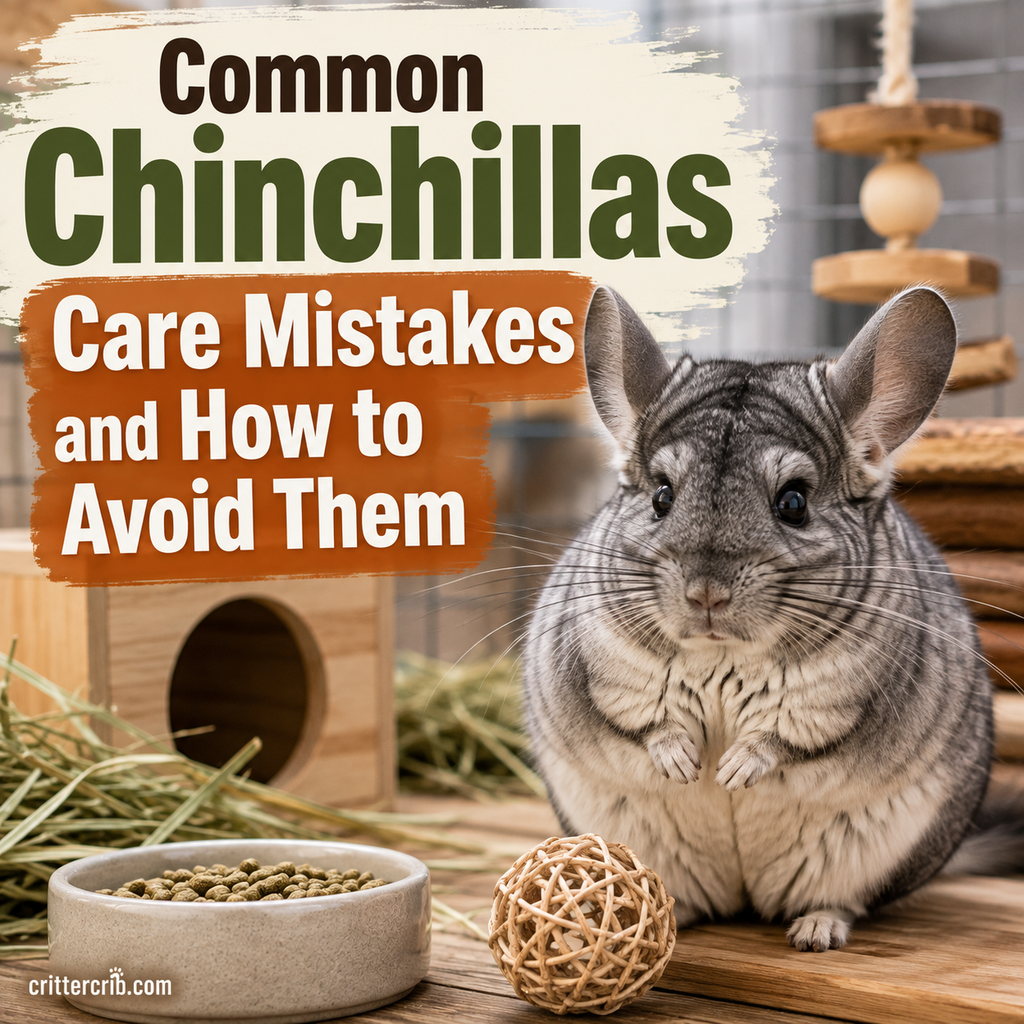
Chinchillas are adorable, energetic, and surprisingly entertaining pets, but their care isn’t quite the same as caring for a hamster, guinea pig, or rabbit. Their dense coats, sensitive digestive systems, chewing habits, and need for a cool environment create some very specific requirements.
Unfortunately, a few common chinchilla care mistakes can cause problems even when an owner has the best intentions.
Something as simple as keeping the room too warm, offering too many treats, or using the wrong type of exercise wheel can affect a chinchilla’s health and well-being.
The good news is that most of these mistakes are preventable.
Whether you’re preparing for your first chinchilla or already have one at home, here are some of the most common chinchilla care mistakes and what you can do instead.
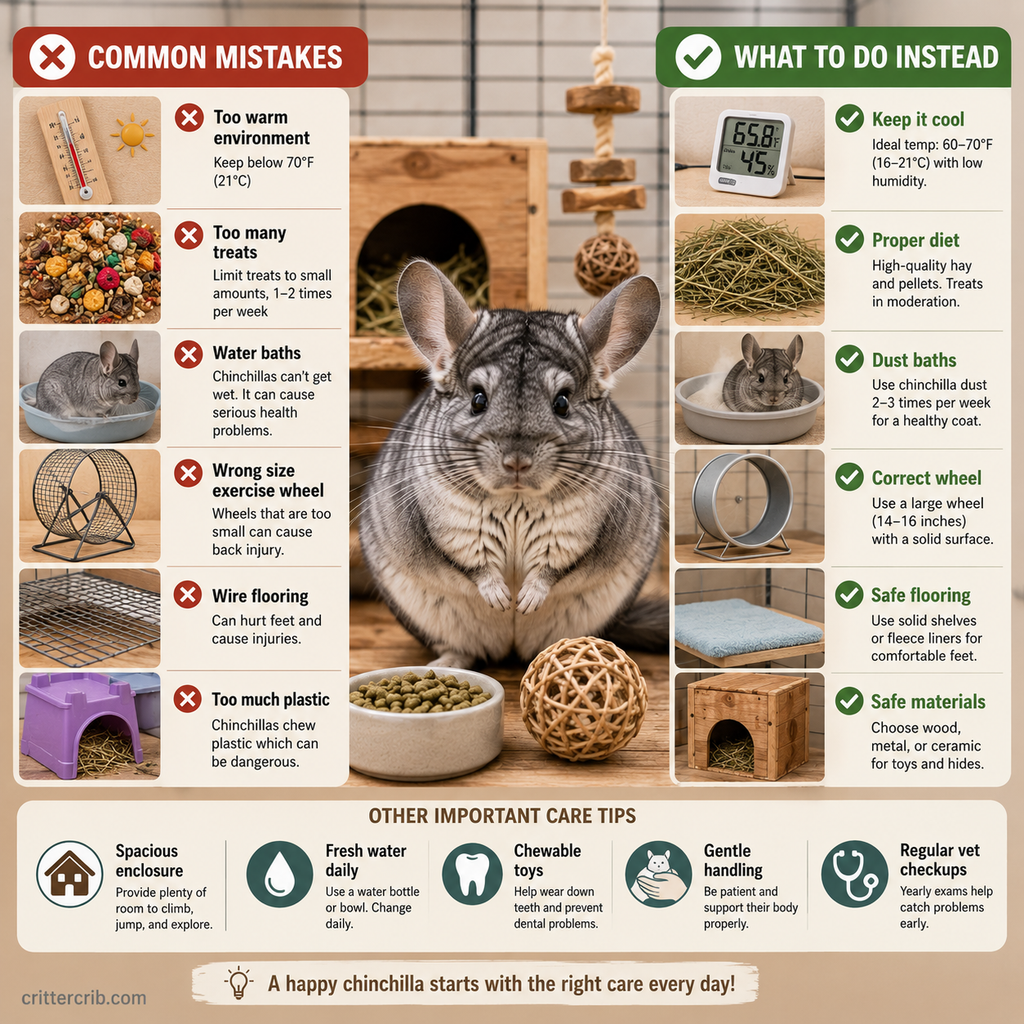
1. Keeping a Chinchilla in a Room That’s Too Warm
One of the most important things to understand about chinchillas is that they tolerate cool conditions much better than excessive heat.
Their incredibly dense fur helped their ancestors survive in the cool, dry climate of the Andes Mountains. That same coat makes it difficult for a pet chinchilla to cope with high temperatures.
A warm room that feels merely uncomfortable to you can become dangerous for a chinchilla.
How to avoid this mistake
Keep your chinchilla in a cool, dry, well-ventilated area away from direct sunlight.
Air conditioning may be necessary during hot weather. A fan alone doesn’t cool a chinchilla the way it cools a sweating human, so don’t rely on one to make an overheated room safe.
It’s also useful to keep a thermometer near the enclosure so you know the actual temperature rather than guessing.
Be particularly careful during:
- Summer heat waves
- Air-conditioning failures
- Power outages
- Hot afternoons
- Travel
- Moves to a new home
If your home regularly becomes warm, have a plan for keeping your chinchilla safely cool before summer arrives.
2. Putting the Cage in Direct Sunlight
Even if the room temperature is comfortable, direct sunlight can heat one section of an enclosure surprisingly quickly.
A cage beside a sunny window may therefore become much warmer than the surrounding room.
Chinchillas also need places where they can retreat and rest without constant bright light.
What to do instead
Position the enclosure in a temperature-controlled part of the home away from direct sunlight, heating vents, radiators, fireplaces, and other heat sources.
Check the location at different times of day.
A spot that seems shaded at 8 a.m. may receive intense afternoon sunlight several hours later.
3. Feeding Too Many Treats
It’s hard to resist giving a chinchilla a treat when they’re standing at the cage door waiting for one.
But chinchillas aren’t built for a rich diet.
Their digestive systems are adapted to a relatively simple, high-fiber diet. Frequent sugary, fatty, or inappropriate treats can interfere with that balance.
Treats should be exactly that—treats.
A better approach
Build your chinchilla’s diet around appropriate hay and quality chinchilla pellets rather than snacks.
If you offer treats, make sure they’re safe for chinchillas and keep portions small and infrequent.
Don’t assume something is healthy simply because it’s a fruit, vegetable, nut, seed, or “natural” food. Foods that are perfectly reasonable for humans—or even other pets—aren’t automatically appropriate for chinchillas.
When you’re unsure about a particular food, ask an exotic-animal veterinarian familiar with chinchillas.
4. Not Providing Enough Hay
Hay isn’t just something to occasionally toss into the enclosure.
It’s a major part of appropriate chinchilla nutrition.
Hay provides fiber for the digestive system while also encouraging the prolonged chewing that helps with normal tooth wear.
A chinchilla without adequate hay may end up consuming too many pellets or inappropriate foods instead.
How to avoid this mistake
Provide consistent access to suitable, good-quality grass hay.
Keep it clean and dry, and replace hay that becomes wet, dirty, or contaminated.
Store your supply in a dry area with appropriate airflow rather than sealing damp hay where mold could develop.
5. Feeding an Inappropriate Pellet Mix
Walk down the small-pet aisle and you’ll see some impressively colorful food mixtures.
Colorful doesn’t necessarily mean better.
Mixes containing lots of seeds, dried fruit, nuts, colorful pieces, or other extras may encourage selective eating. A chinchilla can pick out favorite ingredients while leaving the nutritionally important portions behind.
What to choose instead
Look for a quality pellet formulated specifically for chinchillas.
A simple, uniform pellet makes it harder for your chinchilla to selectively eat only the tastiest pieces.
If you need to change foods, don’t suddenly replace the entire diet overnight. Ask your veterinarian about an appropriate transition, especially if your chinchilla has digestive problems or other health concerns.
6. Giving Chinchillas Water Baths
This is one of the biggest differences between chinchillas and many other pets.
Chinchillas should not routinely be bathed in water.
Their coats are extraordinarily dense. When the fur becomes wet, it can take a long time to dry completely, potentially creating skin and coat problems.
Instead, chinchillas maintain their coats by rolling in specialized dust.
What to do instead
Provide an appropriate chinchilla dust bath.
Use dust specifically intended for chinchillas rather than ordinary sand, dirt, powders, or household materials.
If your chinchilla becomes wet accidentally, contact your veterinarian for advice if you’re concerned about getting the coat safely and thoroughly dry.
7. Leaving the Dust Bath in the Cage Constantly
If dust baths are good, leaving one available 24/7 might sound even better.
Not necessarily.
Constant access can encourage excessive bathing and expose the chinchilla to more dust than needed. The bath can also quickly become contaminated with urine, feces, bedding, or food.
A better routine
Offer dust baths regularly for limited periods rather than automatically leaving the bath inside the enclosure all the time.
Bathing frequency may vary with climate, humidity, coat condition, and your veterinarian’s recommendations.
Keep the bathing container clean and monitor the dust for contamination.
8. Using the Wrong Bedding
Not every product labeled “small animal bedding” is suitable for every small animal.
Some bedding materials may be excessively dusty, contain fragrances, or use materials you wouldn’t want your chinchilla chewing.
How to choose bedding
Choose a low-dust, chinchilla-appropriate bedding or enclosure-lining system.
Avoid heavily fragranced products.
If you’re considering wood-based bedding, research the specific wood and how it has been processed rather than assuming all wood shavings are interchangeable.
The best choice can depend partly on your enclosure design, so discuss bedding options with your veterinarian if you’re uncertain.
9. Choosing a Cage That’s Too Small
Chinchillas are active animals.
They jump, climb, explore, chew, and move between different levels. A tiny cage severely limits those behaviors.
A suitable enclosure should provide enough room for movement while also safely accommodating ledges, hiding areas, hay, water, and enrichment.
Think vertically as well as horizontally
Chinchillas can make use of vertical space when it’s designed safely.
A good setup may include:
- Multiple levels
- Secure ledges
- Platforms
- Hideouts
- Chew items
- Appropriate enrichment
- Room to move comfortably
However, height needs to be managed carefully. Poorly positioned shelves can create dangerous falls.
The goal isn’t simply to buy the tallest cage possible. It’s to create usable space with safe movement between levels.
10. Using Unsafe Cage Flooring
Wire flooring may allow waste to fall through, but that convenience can come at the expense of your chinchilla’s feet.
Chinchillas need appropriate surfaces where they can stand and rest comfortably.
What to do
Provide solid, safe surfaces throughout the enclosure.
Inspect flooring regularly for:
- Sharp edges
- Broken pieces
- Exposed wire
- Chewed plastic
- Loose fabric
- Wet areas
- Excessive waste buildup
If you use fleece or another reusable liner, make sure your chinchilla isn’t pulling it apart or ingesting fibers.
11. Using Too Much Plastic Inside the Cage
Chinchillas chew.
A lot.
A plastic shelf, hideout, bowl, or toy may eventually become a chewing target. Swallowing pieces of plastic can potentially create serious problems.
Safer alternatives
Where practical, consider chinchilla-safe materials such as:
- Appropriate untreated wood
- Metal
- Ceramic
- Safe natural chew materials
That doesn’t mean every wooden object is automatically safe. The species of wood, treatments, glues, paints, and coatings all matter.
Check enrichment products carefully before placing them in the enclosure.
12. Not Providing Enough Chewing Opportunities
Chewing isn’t bad behavior that needs to be stopped.
It’s something chinchillas need to do.
Chinchilla teeth continuously grow, making appropriate chewing opportunities and a suitable high-fiber diet important parts of their care.
Provide safe options
Depending on veterinary guidance, enrichment can include appropriate:
- Wooden chews
- Branches from confirmed safe sources
- Hay-based items
- Chinchilla-safe chew toys
- Natural materials designed for chinchillas
Rotate items occasionally to keep the environment interesting.
Never collect random branches from outdoors without knowing the tree species and whether the wood has been exposed to pesticides, pollution, mold, or other contaminants.
13. Buying an Exercise Wheel That’s Too Small
A wheel can provide exercise, but the wrong wheel may force a chinchilla’s body into an unnatural curved position.
Many exercise wheels marketed for small pets are designed for much smaller animals.
Choose carefully
If you provide a wheel, choose one specifically appropriate for a chinchilla’s size and body shape.
It should:
- Be large enough for comfortable running
- Have a solid running surface
- Operate securely
- Avoid openings that could trap feet
- Be constructed from safe materials
Avoid wire or mesh running surfaces.
Remember that a wheel is supplemental enrichment. It doesn’t compensate for an undersized enclosure.
14. Using Exercise Balls
The clear plastic exercise balls commonly sold for small animals aren’t a good choice for chinchillas.
They can restrict normal movement, provide poor ventilation, and potentially contribute to overheating. The animal also can’t freely leave when it wants to stop.
Better exercise options
Instead, provide exercise through:
- A spacious enclosure
- Appropriate ledges
- Safe climbing opportunities
- A properly sized wheel
- Supervised play in a chinchilla-proofed area
This gives your chinchilla much more control over how and when to move.
15. Allowing Unsupervised Free Roaming
Letting a chinchilla explore the house sounds like fantastic enrichment—until it discovers the electrical cords.
Or the baseboards.
Or the furniture.
Or the tiny opening behind a cabinet that you didn’t realize existed.
Chinchillas are excellent chewers and can squeeze into surprisingly inconvenient places.
Chinchilla-proof the area first
Before playtime, remove or block access to:
- Electrical cords
- Toxic plants
- Cleaning products
- Plastic objects
- Unsafe wood
- Small gaps
- Reclining furniture
- Open doors and windows
- Other pets
- Anything that could be swallowed
Supervise out-of-cage activity rather than assuming a room is safe because it looks empty.
16. Handling a Chinchilla Too Roughly
Chinchillas can be quick, nervous, and surprisingly slippery.
Grabbing or restraining one roughly can frighten the animal and potentially cause injury.
Not every chinchilla enjoys being held for long periods, either.
Build trust gradually
Start with calm interactions.
Allow your chinchilla to become familiar with your presence and hands. Offer appropriate rewards and let the animal approach you when possible.
When handling is necessary, support the body securely without squeezing.
Children should always be closely supervised when interacting with a chinchilla.
The goal should be safe, positive interaction rather than forcing cuddling.
17. Grabbing a Chinchilla by the Fur
Chinchillas have a defensive response known as “fur slip,” in which patches of fur can release when they’re grabbed or frightened.
This can leave an obvious bare or thin area in the coat.
Avoid unnecessary grabbing
Handle your chinchilla calmly and support the body properly.
If your chinchilla is difficult to catch, work on creating predictable routines rather than chasing it around the enclosure.
Training your chinchilla to enter a carrier voluntarily can make transportation much less stressful.
18. Ignoring the Need for Enrichment
A cage containing only food, water, and a hideout isn’t a very interesting environment.
Chinchillas are active and curious animals that benefit from opportunities to explore, chew, jump, investigate, and interact with their surroundings.
Easy enrichment ideas
Consider providing:
- Safe chew toys
- Multiple ledges
- Hideouts
- Tunnels
- Foraging activities
- A suitable exercise wheel
- Rotating enrichment items
- Supervised exploration outside the cage
You don’t have to change everything constantly.
Small changes can make a familiar environment interesting again.
19. Making the Cage Too Cluttered
There’s a flip side to enrichment.
You can provide too much stuff.
Filling every inch of the enclosure with toys, ledges, houses, bridges, bowls, and accessories can leave little usable space for movement.
Aim for balance
Your chinchilla should have enrichment without having to navigate an obstacle course every time it wants to move across the enclosure.
Keep clear pathways between important resources such as:
- Hay
- Water
- Food
- Sleeping areas
- Litter areas
- Platforms
When adding something new, consider whether it actually improves the habitat or simply takes up space.
20. Not Cleaning the Cage Often Enough
A chinchilla enclosure needs regular maintenance.
Urine, feces, old hay, food debris, and contaminated bedding can accumulate quickly.
At the same time, completely dismantling and aggressively cleaning everything constantly isn’t always necessary.
Develop a cleaning routine
Your routine might include:
- Removing soiled bedding
- Cleaning wet areas
- Removing old food
- Refreshing hay
- Washing bowls and water containers
- Cleaning litter areas
- Periodically performing a more thorough enclosure cleaning
How often you need to clean depends on the cage size, bedding system, number of chinchillas, and individual habits.
The enclosure should remain dry, sanitary, and well ventilated.
21. Forgetting About Dental Health
A chinchilla’s teeth aren’t something you can ignore until there’s an obvious problem.
Because their teeth continuously grow, dental issues can become serious.
Warning signs may include:
- Reduced appetite
- Dropping food
- Difficulty chewing
- Drooling
- Wet fur around the mouth
- Weight loss
- Changes in fecal output
- Pawing at the mouth
Dental problems aren’t something to treat with more chew toys after symptoms appear.
A chinchilla showing possible dental trouble needs veterinary evaluation.
22. Not Monitoring Body Weight
Chinchillas are covered in thick fur, which can make changes in body condition difficult to notice visually.
Regular weight monitoring can help you spot changes earlier.
Make weighing part of the routine
A digital scale capable of measuring small changes can be useful.
Record your chinchilla’s weight consistently so you can identify trends rather than relying on memory.
An unexplained or continuing weight loss deserves veterinary attention, especially when accompanied by changes in appetite, activity, or fecal output.
23. Ignoring Changes in Eating or Droppings
With small herbivores, changes in appetite and fecal output deserve attention.
A chinchilla that suddenly stops eating or produces fewer droppings shouldn’t simply be watched for several days to see what happens.
Know what’s normal
Pay attention to your chinchilla’s everyday patterns.
You should have a general sense of:
- How much hay disappears
- Typical pellet consumption
- Water intake
- Normal droppings
- Activity level
- Usual behavior
You don’t need to obsessively count every piece of hay.
You’re looking for noticeable changes from your chinchilla’s normal routine.
If eating or fecal output decreases significantly, contact an exotic-animal veterinarian promptly.
24. Waiting Too Long to Find a Chinchilla-Savvy Veterinarian
Don’t wait until your chinchilla becomes sick to search for a veterinarian.
Not every veterinary practice treats chinchillas, and not every emergency clinic has a veterinarian experienced with exotic mammals available at all hours.
Finding appropriate care during an emergency can waste valuable time.
Prepare in advance
Before you need help:
- Locate an exotic-animal veterinarian who treats chinchillas.
- Confirm the clinic’s normal hours.
- Ask how after-hours emergencies are handled.
- Identify the nearest emergency option that can treat chinchillas.
- Save the contact information in your phone.
It’s a small amount of preparation that can make a major difference during a stressful situation.
25. Assuming Chinchillas Are Low-Maintenance Pets
Chinchillas don’t need daily walks, and they don’t require the same level of constant attention as some pets.
That doesn’t make them maintenance-free.
They need:
- Appropriate temperature control
- A carefully managed diet
- Fresh hay
- Clean water
- Regular cage maintenance
- Dust baths
- Enrichment
- Safe chewing opportunities
- Social interaction
- Health monitoring
- Access to specialized veterinary care
They can also live for many years.
Bringing home a chinchilla should therefore be viewed as a long-term commitment rather than an inexpensive or temporary small-pet experience.
Creating a Better Daily Chinchilla Care Routine
Avoiding mistakes becomes much easier when basic care turns into a routine.
Every day
Check:
- Food and hay
- Fresh water
- Temperature
- Droppings
- Activity and behavior
- Wet or dirty areas
- Condition of toys and cage accessories
Regularly
Make time for:
- Dust baths
- Enclosure cleaning
- Enrichment
- Safe exercise
- Weight monitoring
- Basic health checks
Periodically
Inspect the entire enclosure for wear, damage, sharp edges, or chewed components.
Also review your emergency plan and make sure your veterinarian’s contact information is still current.
Signs Your Chinchilla May Need Veterinary Attention
Knowing when something isn’t right is just as important as providing good everyday care.
Contact a veterinarian if you notice concerning symptoms such as:
- Not eating
- Significant reduction in droppings
- Unexplained weight loss
- Difficulty breathing
- Extreme lethargy
- Drooling
- Difficulty chewing
- Diarrhea
- Abnormal movement
- Serious injury
- Signs of overheating
- Sudden major behavioral changes
This isn’t a complete list.
When your chinchilla’s behavior or physical condition changes significantly and you aren’t sure why, contacting a veterinarian is safer than attempting to diagnose the problem at home.
Frequently Asked Questions About Chinchilla Care
Are chinchillas hard to take care of?
Chinchillas aren’t necessarily difficult once you understand their needs, but they require more specialized care than many people expect. Temperature control, diet, dental health, dust bathing, housing, and access to an exotic-animal veterinarian are particularly important.
Can chinchillas get wet?
Routine water bathing isn’t recommended because a chinchilla’s extremely dense coat can be difficult to dry thoroughly. Chinchillas normally maintain their coats with appropriate dust baths.
Do chinchillas need dust baths every day?
Not necessarily. Bathing frequency can depend on humidity, coat condition, and the individual animal. Excessive dust bathing may dry the skin, so follow appropriate care guidance rather than leaving a dust bath available constantly.
What should chinchillas eat?
An appropriate chinchilla diet generally centers on quality grass hay and chinchilla-specific pellets, with treats kept limited. Individual nutritional needs can vary, so consult a veterinarian experienced with chinchillas for specific feeding recommendations.
Do chinchillas need a large cage?
Chinchillas are active animals that benefit from a spacious enclosure with safe opportunities to move, jump, explore, and use multiple levels. The layout should also minimize dangerous falls.
Can chinchillas use exercise balls?
Exercise balls aren’t recommended for chinchillas. They can restrict natural movement and ventilation while increasing the risk of overheating. A safe enclosure and supervised chinchilla-proofed exercise area are better options.
How can I tell if my chinchilla is too hot?
A chinchilla that appears overheated, unusually lethargic, weak, or otherwise distressed may require urgent attention. Move the animal to an appropriately cool environment and contact a veterinarian promptly if you suspect heat-related illness.
Final Thoughts
Many common chinchilla care mistakes happen because these animals are treated like other small pets.
Chinchillas have their own requirements.
They need a cool environment, a high-fiber diet centered around appropriate hay, safe chewing opportunities, dust baths rather than routine water baths, plenty of room to move, and carefully selected enrichment.
Just as importantly, owners need to watch for subtle changes.
A chinchilla that stops eating, loses weight, produces fewer droppings, or suddenly behaves differently may be telling you something is wrong long before the problem becomes visually obvious.
You don’t need a perfect cage filled with expensive accessories to provide excellent care. Focus on the fundamentals, learn your chinchilla’s normal behavior, and establish a relationship with an experienced exotic-animal veterinarian before you need one.
Avoiding the most common mistakes becomes much easier once you understand what makes chinchillas different—and that’s the foundation for keeping one healthy, comfortable, and active for years to come.