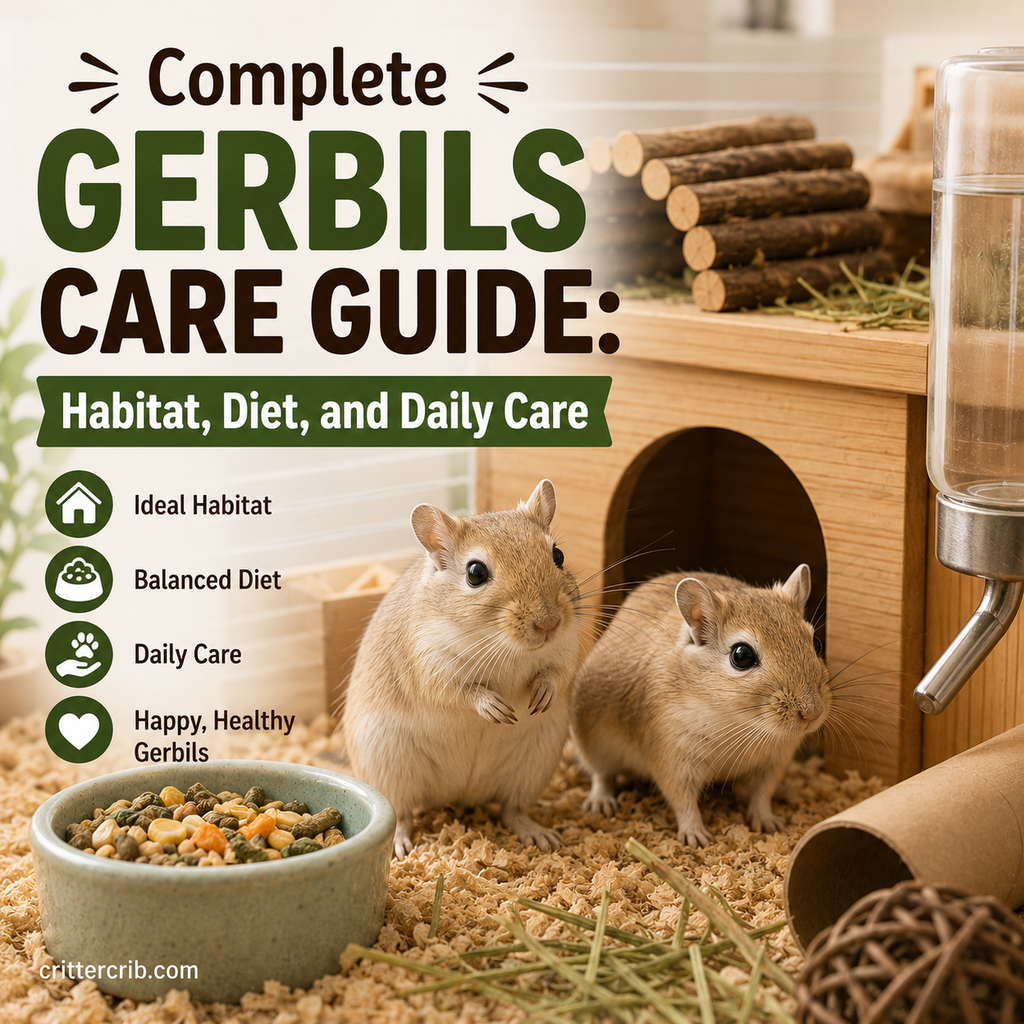
Gerbils are small, curious, energetic pets with personalities that can make them surprisingly entertaining to live with. They’re constantly digging, rearranging bedding, chewing cardboard, storing food, and investigating whatever you’ve changed in their habitat.
They’re also sometimes mistaken for being especially easy pets simply because they’re small.
Gerbils don’t need walks or a huge room to themselves, but they do have specific needs. Deep bedding, companionship, safe chewing materials, a suitable diet, and enough room to create tunnels all play a major role in their well-being.
If you’re thinking about getting gerbils—or you’ve recently brought some home—this complete gerbil care guide covers the essentials, from setting up their habitat to feeding, cleaning, handling, enrichment, and everyday health monitoring.
Gerbil Care at a Glance
Before getting into the details, here’s a quick overview of what pet gerbils need:
- A spacious, secure enclosure
- Deep bedding for digging and tunneling
- Compatible gerbil companionship
- A balanced gerbil food
- Fresh drinking water
- Safe chew materials
- Hiding and nesting areas
- Opportunities to forage and explore
- A suitable sand bath
- Regular spot cleaning
- Gentle handling
- A veterinarian experienced with small mammals
Gerbils can be relatively tidy compared with some other small pets, but good care is about much more than keeping the enclosure clean.
The goal is to create an environment where they can behave like gerbils.
Are Gerbils Good Pets?
Gerbils can make excellent pets for people who enjoy observing active small animals and don’t expect constant cuddling.
They’re naturally curious and often become comfortable interacting with their owners over time.
Some advantages of gerbils include:
- Interesting social behavior
- Relatively low odor when housed properly
- Fascinating digging and burrowing
- Active personalities
- Small size
- Plenty of opportunities for enrichment
However, they aren’t the right pet for everyone.
Gerbils are quick, delicate animals. Young children need close supervision when interacting with them, and anyone looking for a pet that enjoys sitting still for long periods may prefer another species.
Do Gerbils Need a Companion?
Gerbils are social animals and generally do best with compatible companions of the same sex.
A bonded pair is a common arrangement.
Gerbils that have grown up together often establish close social relationships. You may see them:
- Sleeping together
- Grooming each other
- Exploring together
- Sharing a nest
- Interacting throughout the day
This companionship is something humans can’t fully replace.
Can You Keep One Gerbil Alone?
There are circumstances where a gerbil may need to live alone, particularly after the loss of a companion or when introductions aren’t safe.
But keeping a single gerbil shouldn’t automatically be the default.
If you’re getting gerbils for the first time, consider adopting an already compatible same-sex pair.
Don’t Put Unfamiliar Gerbils Together Immediately
Gerbils can be territorial.
Two unfamiliar gerbils shouldn’t simply be placed together and expected to become friends.
Introductions require an appropriate process, often involving a divided enclosure or “split cage” method that allows the animals to gradually become familiar with each other’s scent.
Poor introductions can lead to serious fighting.
If you need to introduce gerbils, research the process carefully and seek experienced guidance before attempting it.
Choosing the Right Gerbil Habitat
Gerbils need more than a shallow cage with a wheel and food dish.
Digging is central to how they live.
In nature, gerbils create underground burrow systems. Pet gerbils retain this instinct and may spend hours creating, destroying, and rebuilding tunnels.
Your enclosure should support that behavior.
If you’re starting from scratch, our gerbil habitat setup guide takes a closer look at enclosure size, deep bedding, wheels, hides, sand baths, food, water, and enrichment.
Tank-Style Habitats
Glass tanks and tank-based setups are popular for gerbils because they can hold deep bedding without sending it across the room.
They also make it easy to watch tunnel construction from the side.
Good ventilation is essential, so the enclosure needs an appropriate secure mesh top rather than a solid sealed lid.
Tank Toppers
Some owners use a tank with a ventilated topper.
This can create separate areas:
- Deep bedding below
- Food and water above
- Wheel and sand bath above
- Burrowing and nesting areas below
The design can work well when it remains safe, spacious, and easy for the gerbils to navigate.
How Much Space Do Gerbils Need?
More usable space generally gives gerbils greater opportunities to dig, explore, forage, and maintain separate activity areas.
Exact recommendations vary, so rather than buying the smallest enclosure marketed for gerbils, choose the largest practical habitat you can appropriately furnish.
For a pair, prioritize enough room for:
- Deep bedding
- A large nest
- A properly sized wheel
- Food and water
- Sand bath
- Chewing materials
- Open exploration
- Multiple activity areas
Remember that an enclosure loses usable space quickly once you start adding several inches of bedding and accessories.
Floor Space and Bedding Depth Both Matter
A very tall enclosure with a tiny footprint isn’t automatically spacious.
Likewise, a wide but shallow cage that can only contain an inch or two of bedding doesn’t allow much burrowing.
A good gerbil habitat provides both horizontal room and substantial depth for digging.
How Deep Should Gerbil Bedding Be?
Provide a generous layer of bedding so your gerbils can build tunnels.
Deeper is generally better when the enclosure allows it. Bedding depth also needs to work with the enclosure’s overall layout, so it’s worth considering it as part of your complete gerbil habitat setup rather than treating substrate as an afterthought.
You’ll know your setup is working when your gerbils can disappear underneath the bedding and create networks of tunnels that remain at least partially intact.
A very shallow layer doesn’t provide the same opportunity.
Choosing Gerbil Bedding
Good bedding should be:
- Absorbent
- Low in dust
- Safe for burrowing
- Comfortable
- Able to support tunnels
Owners often combine compatible bedding materials to improve tunnel stability.
Shredded paper-based bedding combined with hay can give gerbils useful building material.
Avoid heavily scented or dusty bedding.
Gerbil Nesting Materials
Gerbils will collect bedding and other safe materials to build a sleeping nest.
Plain, unscented toilet tissue or similar safe paper can provide additional nesting material.
You’ll probably notice your gerbils carrying pieces into their preferred sleeping area.
Avoid fluffy cotton-like nesting products that can create entanglement or ingestion risks.
Simple, safe paper materials are usually a much better choice.
What Should Be Inside a Gerbil Habitat?
Once you have the enclosure and bedding, you’ll need to furnish it.
A good setup may include:
- Deep bedding
- Nesting material
- Hideouts
- Water bottle
- Food
- Exercise wheel
- Sand bath
- Wooden chews
- Cardboard
- Tunnels
- Platforms where appropriate
Don’t feel obligated to make everything look perfectly organized.
Your gerbils will have opinions.
A tunnel you carefully placed above the bedding may be completely buried by morning.
That’s part of the fun.
Gerbil Hideouts and Sleeping Areas
Gerbils appreciate secure places to rest.
Wooden houses, appropriate tunnels, and cardboard structures can provide cover.
However, don’t worry if they ignore the expensive hideout and build a nest underneath it instead.
Gerbils often incorporate objects into their own burrow designs.
Choose hides that are:
- Made from safe materials
- Large enough for the gerbils
- Free from sharp edges
- Stable
- Safe to chew
Avoid excessive plastic inside the habitat because gerbils are enthusiastic chewers.
Do Gerbils Need an Exercise Wheel?
A properly sized exercise wheel can provide useful additional activity.
Choose a wheel large enough that your gerbil can run without sharply curving its back.
The running surface should be solid rather than made from widely spaced bars or mesh that could potentially trap feet or tails.
The wheel also needs to be positioned carefully.
If it’s placed directly on loose bedding, gerbils may bury it within hours.
A stable platform or separate area can help keep it usable.
Gerbils Need Things to Chew
Chewing isn’t optional enrichment for gerbils.
Their teeth continue growing, and gnawing is an important natural behavior.
Fortunately, gerbils can turn extremely simple materials into entertainment.
Appropriate options may include:
- Safe untreated wooden chews
- Cardboard tubes
- Plain cardboard boxes
- Appropriate chew sticks
- Gerbil-safe wooden toys
A cardboard toilet paper tube may last five minutes.
That’s okay.
Destroying it is the activity.
Be Careful With Household Cardboard
Use clean, plain cardboard without potentially unsafe coatings, tape, staples, plastic windows, or heavy residues.
Remove adhesive labels and other materials your gerbils shouldn’t chew.
Do Gerbils Need a Sand Bath?
A suitable sand bath gives gerbils an opportunity to clean and maintain their coats.
Use an appropriate bathing sand rather than very dusty powder.
Provide the sand in a stable container that gives the gerbil enough room to roll.
Depending on your setup, you may offer the bath periodically or keep it available if it remains clean.
Some gerbils decide the sand bath is also a toilet.
If that happens, scoop out waste and replace contaminated sand as needed.
What Do Gerbils Eat?
A balanced diet is essential for long-term gerbil care.
The foundation should be an appropriate food formulated for gerbils.
Depending on the product and your veterinarian’s recommendations, this may be a nutritionally balanced pellet, block, or appropriate gerbil food mixture.
The goal is consistent nutrition rather than a bowl filled primarily with colorful treats.
Avoid Selective Feeding
Seed-heavy mixtures can encourage some gerbils to pick out their favorite high-fat ingredients and ignore everything else.
A balanced formulation helps reduce selective eating.
If you use a mixture, pay attention to what your gerbils actually consume rather than simply whether the bowl looks emptier.
How Much Should You Feed Gerbils?
Feeding amounts depend on the food you’re using, the number of gerbils, and their individual needs.
Follow the manufacturer’s guidelines as a starting point and adjust with veterinary guidance if necessary.
Don’t automatically refill a bowl every time it looks empty.
Gerbils frequently carry food away and store it underground.
What appears to be an empty food dish may mean there’s a miniature grocery warehouse underneath the bedding.
Scatter Feeding Gerbils
Scatter feeding can turn mealtime into enrichment.
Instead of placing all dry food in a bowl, you can distribute an appropriate portion around clean areas of the enclosure.
Your gerbils then have to search and forage.
This encourages movement and natural food-seeking behavior.
You can still use a bowl if you prefer, or combine both approaches.
Can Gerbils Eat Fresh Vegetables?
Small amounts of appropriate fresh foods may be offered as part of a properly balanced diet.
Because gerbils are small, portions should also be small.
Introduce unfamiliar foods gradually.
Remove uneaten fresh food before it spoils or disappears into a burrow where you can’t easily find it.
Not every fruit, vegetable, plant, or human food is safe for gerbils, so check before offering something new.
Gerbil Treats
Treats should remain treats.
It’s easy to overfeed calorie-dense foods because the portions look tiny to us.
Your gerbil is tiny too.
Seeds and other appropriate treats can be useful for bonding and enrichment, but they shouldn’t replace balanced daily nutrition.
Avoid sugary human foods and random snacks that haven’t been confirmed as gerbil-safe.
Fresh Water for Gerbils
Gerbils need constant access to clean drinking water.
A water bottle is commonly used because it keeps water away from bedding.
Attach it securely and position the drinking tube where both gerbils can reach it.
Check the bottle every day.
Make sure it:
- Contains fresh water
- Isn’t leaking
- Isn’t blocked
- Is securely attached
- Hasn’t been chewed
- Dispenses water properly
A bottle can look full even when the drinking mechanism isn’t working.
Where Should You Put a Gerbil Habitat?
Place the enclosure in a stable indoor environment.
A good location should be:
- Away from direct sunlight
- Protected from drafts
- Away from heating and cooling vents
- Free from extreme temperature changes
- Away from constant loud noise
- Secure from other household pets
Gerbils may become accustomed to normal household activity, but that doesn’t mean the enclosure belongs beside a booming television speaker.
Choose somewhere you can easily observe them without constantly disturbing their nest.
Gerbil Enrichment Ideas
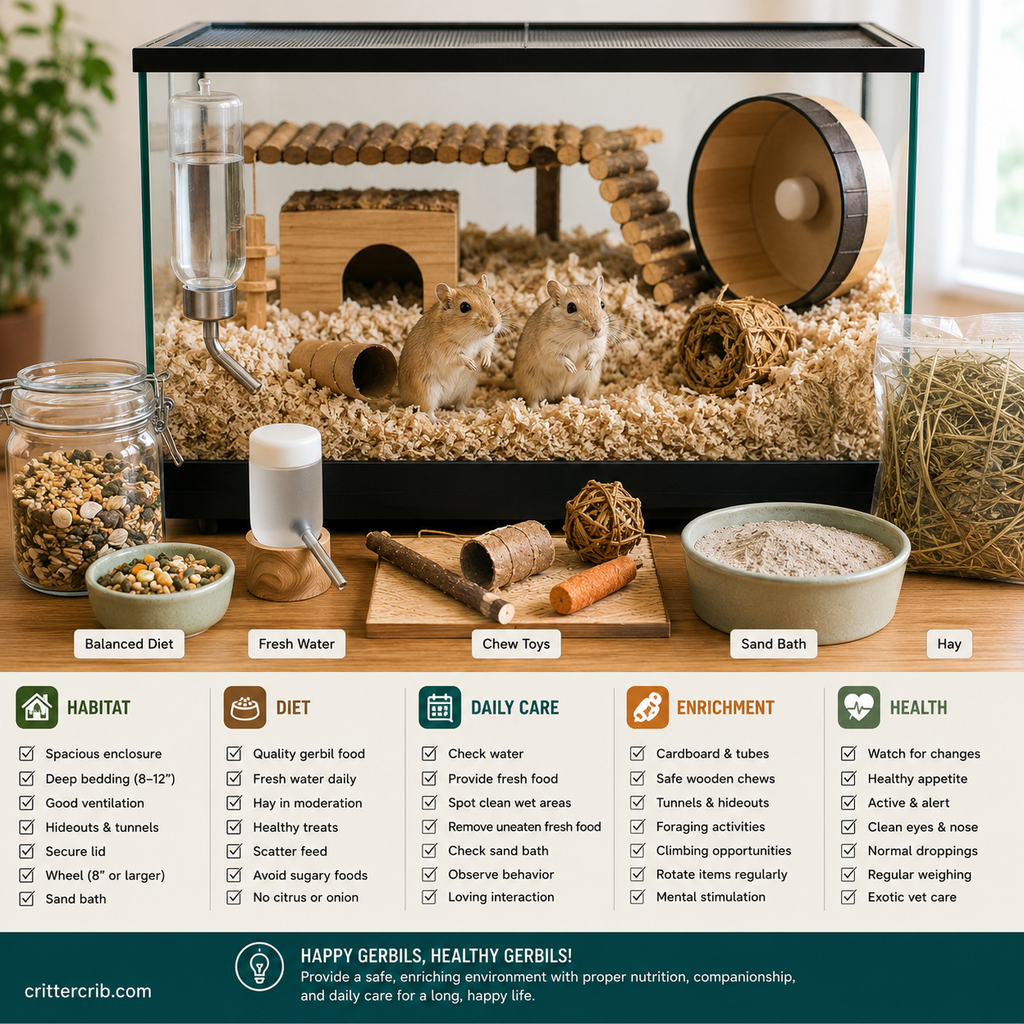
A good gerbil habitat changes slightly over time without becoming completely unfamiliar.
You don’t need expensive toys to provide enrichment.
Try:
- Cardboard tubes
- Cardboard boxes
- Safe wooden chews
- Hay
- Scatter feeding
- Hidden food
- Tunnels
- Safe branches or sticks prepared for small animals
- New nesting materials
- Occasional layout changes
Gerbils create much of their own enrichment through digging and construction.
Give them materials to work with.
Handling and Taming Gerbils
New gerbils may need time before they’re comfortable being handled.
Don’t rush the process.
Start by allowing them to adjust to their new habitat.
Then gradually introduce your presence.
How to Build Trust With a Gerbil
A simple process might look like this:
- Spend time near the enclosure.
- Speak quietly around your gerbils.
- Place your hand inside without chasing them.
- Offer a small appropriate treat.
- Allow the gerbil to approach voluntarily.
- Let it investigate your hand.
- Gradually progress to gentle handling.
Some gerbils become confident quickly.
Others need more time.
Work at the animal’s pace.
Never Pick Up a Gerbil by the Tail
This is one of the most important handling rules.
Never lift or restrain a gerbil by its tail.
Gerbil tails can be seriously injured.
Instead, gently scoop the gerbil with both hands or encourage it to walk into your hands.
Handle gerbils close to a safe surface whenever possible.
They’re fast and may suddenly jump.
How Often Should You Clean a Gerbil Habitat?
Gerbils often produce less odor than people expect, especially when housed in a spacious, well-maintained enclosure.
That doesn’t mean the habitat never needs cleaning.
The best approach is usually regular spot cleaning combined with less frequent larger cleanings.
Daily or Frequent Spot Cleaning
Check for:
- Wet bedding
- Soiled sand
- Spoiled fresh food
- Dirty water areas
- Excessively soiled surfaces
Remove problem areas without unnecessarily destroying the entire burrow system.
Deeper Cleaning
When a more thorough cleaning is necessary:
- Move the gerbils to a secure temporary enclosure.
- Remove accessories.
- Discard heavily soiled bedding.
- Clean the enclosure with an appropriate pet-safe method.
- Rinse surfaces if required.
- Allow everything to dry.
- Add fresh bedding.
- Return clean accessories.
- Rebuild the habitat with plenty of burrowing material.
You may retain a small amount of clean old bedding to preserve familiar scent, provided there’s no health reason requiring complete disinfection.
Don’t Overclean a Gerbil Habitat
This surprises some new owners.
More cleaning isn’t always better.
Gerbils build complex burrows and establish familiar scents throughout their environment.
Completely stripping the habitat too frequently can destroy their tunnels and remove those scents.
Instead, keep the enclosure sanitary through spot cleaning and perform major changes when genuinely needed.
Your nose and visual inspection can help, but also check hidden areas for moisture or spoiled food.
Daily Gerbil Care Routine
Gerbil care becomes easy to manage when you turn it into a short daily routine.
Each day:
- Check that both gerbils appear active and normal
- Check the water bottle
- Provide food according to your feeding routine
- Remove spoiled fresh food
- Check for wet bedding
- Inspect the sand bath
- Add safe chew material when needed
- Observe eating and movement
This usually takes only a few minutes.
The observation is just as important as the cleaning.
You learn what normal looks like for your gerbils.
Weekly Gerbil Care Routine
Once a week, take a closer look at the entire setup.
Check:
- Wheel condition
- Water bottle cleanliness
- Food storage
- Chew toys
- Wooden accessories
- Sand bath
- Bedding condition
- Enclosure security
- Mesh lid or topper
- Platforms and furniture
Replace heavily chewed items when they become unsafe.
This is also a good time to provide new cardboard or enrichment.
Understanding Normal Gerbil Behavior
Gerbils display plenty of behaviors that can seem strange at first.
Normal activities can include:
- Digging constantly
- Kicking bedding everywhere
- Chewing cardboard
- Hoarding food
- Grooming one another
- Sleeping together
- Standing upright
- Thumping the hind feet
- Rearranging the habitat
Understanding these behaviors makes it easier to distinguish normal gerbil activity from potential problems.
Why Do Gerbils Thump?
Gerbils may rapidly thump their hind feet when they’re excited, alarmed, or communicating with other gerbils.
If one gerbil starts thumping, another may respond.
A brief episode isn’t necessarily a problem.
Look at what was happening immediately beforehand. A sudden noise or movement may have startled them.
Signs Your Gerbils Are Comfortable
There isn’t one universal sign of a “happy gerbil.”
Instead, look for a pattern of normal behaviors.
Comfortable gerbils may:
- Dig and build tunnels
- Eat normally
- Groom themselves
- Groom each other
- Sleep together
- Explore
- Use enrichment
- Approach familiar people
- Maintain normal activity
Individual personalities differ.
One gerbil may rush over every time you enter the room while its companion hangs back and watches.
Gerbil Fighting vs. Normal Play
Gerbils may chase, wrestle, or interact physically without actually fighting.
Serious aggression tends to look more intense.
Potential warning signs include:
- Relentless aggressive chasing
- Biting that causes injury
- One gerbil being prevented from resting or eating
- Persistent hostile interactions
- Gerbils forming a tight rolling ball during a fight
A serious fight requires immediate attention.
Don’t put your bare hands directly into a fighting pair, as you may be bitten.
If bonded gerbils suddenly become aggressive, seek experienced advice about safely managing the situation.
Common Gerbil Health Problems to Watch For
Gerbils can hide illness, so changes in normal behavior matter.
Potential warning signs include:
- Reduced appetite
- Unexplained weight loss
- Lethargy
- Difficulty breathing
- Discharge from the eyes or nose
- Diarrhea
- Abnormal posture
- Hair loss
- Skin irritation
- Difficulty walking
- Swelling or lumps
- Dental problems
- Injuries
- Sudden major behavioral changes
Don’t wait for a small animal to become obviously very sick before seeking help.
If something seems significantly different, contact a veterinarian experienced with gerbils or other small mammals.
Find a Gerbil Veterinarian Before You Need One
Do this before an emergency.
Not every veterinary clinic routinely treats gerbils.
Find an exotic or small-mammal veterinarian and save:
- Clinic name
- Phone number
- Address
- Business hours
- Emergency instructions
Ask where you should go if your gerbil becomes ill outside normal hours.
Having that information ready is much easier than searching for it during a stressful situation.
Should You Weigh Your Gerbils?
Regular weight checks can be a useful way to monitor small animals.
A digital kitchen scale capable of accurately measuring small weights can work well.
Record each gerbil’s weight so you can track trends.
Because bonded gerbils may look similar, make sure you know which measurement belongs to which animal.
A meaningful unexplained decline deserves attention, especially if accompanied by reduced eating or behavioral changes.
Common Gerbil Care Mistakes
Most beginner mistakes come from treating gerbils like generic “small pets” instead of animals with their own needs. Our guide to common gerbil care mistakes and how to avoid them goes deeper into housing, companionship, bedding, enrichment, feeding, handling, and other problems new owners commonly run into.
Using Too Little Bedding
A thin layer may absorb waste, but it doesn’t provide much opportunity to burrow.
Give gerbils enough depth to actually construct tunnels.
Keeping a Social Gerbil Alone Without Reason
Human attention isn’t a complete substitute for appropriate gerbil companionship.
Whenever possible, plan around compatible social housing.
Using Too Much Plastic
Gerbils chew aggressively.
Plastic accessories can quickly become damaged and may be ingested.
Giving Too Many Treats
Tiny treats add up quickly in a tiny animal.
Keep the main diet balanced.
Using an Undersized Wheel
A wheel should allow comfortable running without forcing the back into an extreme curve.
Cleaning Too Aggressively
Constantly destroying burrows and removing every familiar scent can unnecessarily disrupt the habitat.
Grabbing the Tail
Never pick up a gerbil by its tail.
Use safe, gentle handling instead.
Assuming All Small-Animal Products Are Safe
Products marketed for hamsters, mice, rats, gerbils, and guinea pigs aren’t automatically appropriate for every species.
Evaluate the actual material, size, and design.
What Supplies Do Gerbils Need?
Before bringing home your gerbils, prepare:
Housing
- Spacious enclosure
- Secure ventilated lid
- Deep bedding
- Safe nesting material
- Hideouts
Food and Water
- Balanced gerbil food
- Food dish if used
- Water bottle
- Appropriate treats
Exercise and Enrichment
- Properly sized wheel
- Safe wooden chews
- Cardboard
- Tunnels
- Foraging materials
Grooming and Cleaning
- Suitable bathing sand
- Sand bath container
- Small cleaning tools
- Pet-appropriate cleaning supplies
Health and Transportation
- Secure carrier
- Digital scale
- Exotic-animal veterinarian information
Having everything ready before arrival allows your gerbils to settle into a complete habitat immediately.
Frequently Asked Questions About Gerbil Care
Are gerbils easy to take care of?
Gerbils can be manageable pets once their habitat is properly established, but they still require daily attention.
You’ll need to provide food and water, monitor their health, maintain the habitat, supply chewing materials, and provide appropriate enrichment.
They’re low-maintenance compared with some larger pets, not no-maintenance.
Do gerbils smell?
Gerbils often have relatively little odor when housed in a spacious, dry, properly maintained habitat.
Strong odors may indicate wet bedding, spoiled food, an overdue sand bath cleaning, or another sanitation issue.
Should gerbils be kept in pairs?
Gerbils are social and are commonly kept in compatible same-sex pairs.
An already bonded pair can be a good option for a first-time owner.
Don’t simply combine unfamiliar gerbils without an appropriate introduction process.
How much bedding do gerbils need?
Gerbils should have enough bedding to create meaningful tunnels and burrows rather than just a thin covering over the enclosure floor.
The enclosure should be designed around providing substantial digging depth.
Do gerbils need hay?
Hay can be useful as part of the habitat, particularly as a material that gerbils can chew and incorporate into tunnels and nests.
Dietary needs should be met through an appropriate balanced gerbil diet rather than assuming hay serves the same nutritional role it does for animals such as guinea pigs or rabbits.
Do gerbils need a sand bath?
Providing appropriate bathing sand allows gerbils to maintain their coats naturally.
Use sand suitable for small animals rather than very dusty bathing powder.
How often should you clean a gerbil cage?
Spot clean whenever you notice wet bedding, spoiled food, or contaminated areas.
More extensive cleaning can be done when the enclosure genuinely needs it rather than according to an unnecessarily aggressive schedule.
A spacious habitat with appropriate bedding may remain surprisingly clean with regular spot maintenance.
Can gerbils live in a wire cage?
Some wire components can be incorporated into a gerbil setup, but an enclosure that can’t contain deep bedding isn’t ideal for their natural burrowing behavior.
Tank-style habitats or setups combining a deep-bedding tank with a ventilated topper are popular for this reason.
Can gerbils eat fruit?
Some fruits may be suitable in very small quantities, but treats shouldn’t make up a significant portion of the diet.
Always verify that a particular food is safe before offering it.
How long do gerbils live?
Pet gerbils commonly live for several years, although lifespan varies with genetics, health, diet, environment, and veterinary care.
Anyone considering gerbils should be prepared for a multi-year commitment rather than viewing them as temporary starter pets.
Final Thoughts on Caring for Gerbils
Gerbil care makes much more sense once you stop thinking of the enclosure as a cage you arrange for them and start thinking of it as raw material for them to redesign.
They want to dig.
They want to chew.
They want to build nests, create tunnels, stash food in places you’ll never find, and turn perfectly good cardboard into confetti.
A good habitat gives them the freedom to do those things safely.
Start with a spacious, well-ventilated enclosure and plenty of deep bedding. Keep compatible gerbils together, provide balanced nutrition and fresh water, offer safe chewing and enrichment materials, and avoid overcleaning the environment.
Then spend a little time observing them every day.
You’ll quickly learn which gerbil is first to investigate something new, which one hoards the food, where they prefer to sleep, and what their normal routines look like.
That familiarity is an important part of good care. It helps you provide an environment suited to your gerbils while making it easier to recognize when something has changed.
Give them the right foundation, and your gerbils will handle much of the interior decorating themselves.