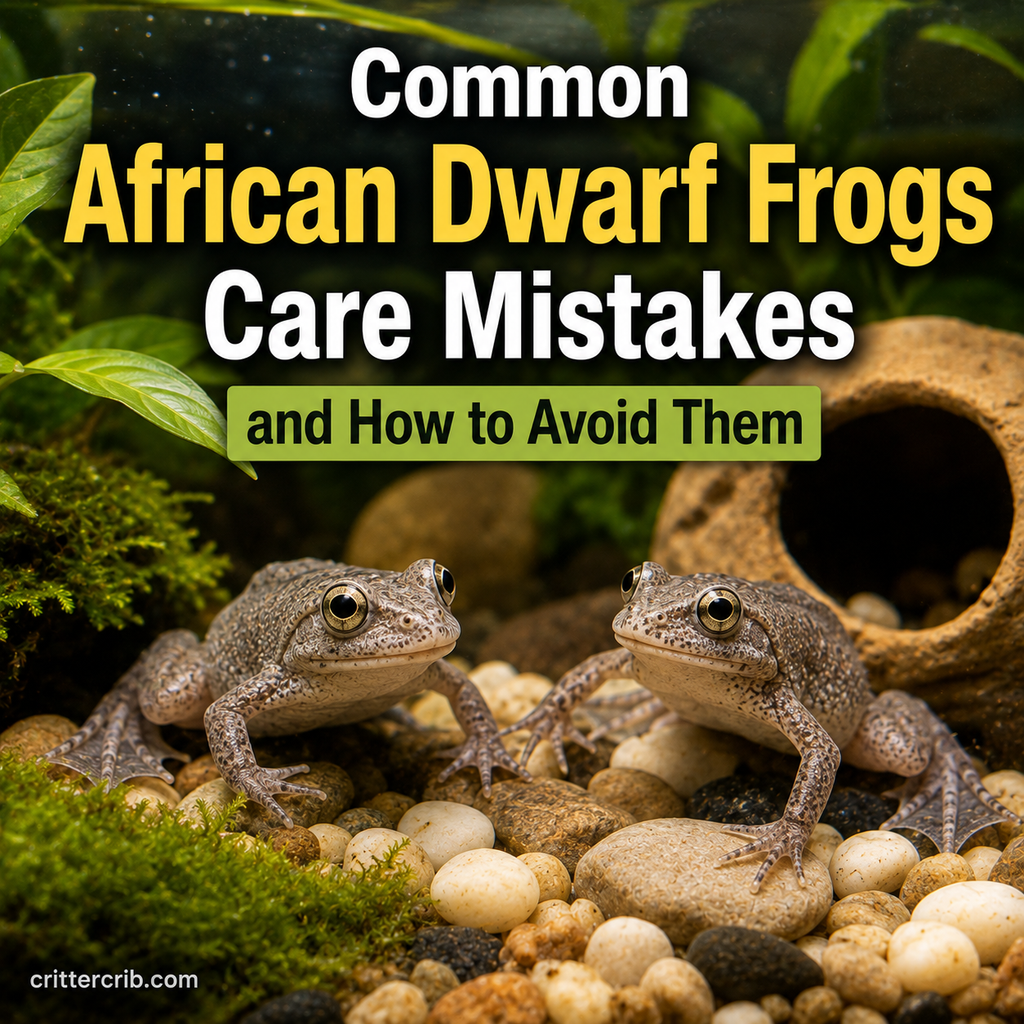
African dwarf frogs can look like easy pets. They’re small, fully aquatic, and don’t need the elaborate terrestrial habitat that many other amphibians require.
But small doesn’t mean maintenance-free.
Many African dwarf frog care mistakes happen because owners treat them exactly like fish. These frogs have their own needs when it comes to feeding, water flow, tank mates, access to the surface, and aquarium design.
Fortunately, most common problems are preventable.
If you’re new to African dwarf frogs—or you’re trying to figure out why yours doesn’t seem quite right—here are the care mistakes worth watching for and what to do instead.
1. Putting African Dwarf Frogs in an Uncycled Tank
One of the most serious beginner mistakes happens before the frogs even arrive.
African dwarf frogs shouldn’t be added directly to a newly filled aquarium that hasn’t established a biological cycle.
Like fish, they produce waste that eventually becomes ammonia. Beneficial bacteria in a cycled aquarium process ammonia into nitrite and then nitrate.
Both ammonia and nitrite are toxic.
For an established aquarium, you generally want:
- Ammonia: 0 ppm
- Nitrite: 0 ppm
- Nitrate: kept controlled through regular maintenance
- Stable water chemistry appropriate for the frogs
Clear water doesn’t necessarily mean safe water.
Ammonia and nitrite are invisible, which is why a reliable aquarium test kit is so important.
How to Avoid It
Set up and cycle the aquarium before purchasing your frogs.
Test the water throughout the cycling process and don’t rely solely on waiting a certain number of days. The tank is ready when testing confirms the biological filter is functioning properly.
2. Using Untreated Tap Water
Tap water may be safe for you to drink while still being unsafe for an aquatic amphibian.
Municipal water commonly contains chlorine or chloramine.
African dwarf frogs have delicate, permeable skin and spend their entire lives in the water, so water treatment isn’t optional.
How to Avoid It
Use an aquarium water conditioner appropriate for your local water supply whenever adding tap water.
Treat replacement water during partial water changes as well.
Don’t assume leaving a bucket of water overnight is enough. Chloramine doesn’t simply disappear through brief aging the way free chlorine may dissipate.
3. Keeping the Water Too Cold or Too Hot
African dwarf frogs are tropical amphibians.
A useful general temperature range is approximately 72–78°F (22–26°C).
Water that’s consistently too cold may reduce activity and appetite, while excessive temperatures can cause stress and create other problems.
The important word is consistently.
Stable, appropriate temperatures are better than repeated swings.
How to Avoid It
Use a reliable aquarium thermometer.
If your room doesn’t maintain appropriate water temperatures naturally, use an appropriately sized aquarium heater controlled and positioned safely.
Don’t guess based on how the water feels to your hand.
4. Creating Too Much Water Current
African dwarf frogs aren’t powerful open-water swimmers.
They regularly travel to the surface to breathe air and generally do better without a strong current constantly pushing them around.
An oversized or high-flow filter can make the aquarium unnecessarily difficult to navigate.
Signs the Flow May Be Too Strong
You might notice your frogs:
- Being pushed around the tank
- Struggling to remain in one area
- Avoiding the filter side
- Having difficulty resting
- Working unusually hard to reach the surface
How to Avoid It
Choose gentle filtration appropriate for the aquarium size.
Sponge filters can work well in many African dwarf frog setups.
Adjustable filters and baffled filter outputs are other possibilities.
You still need adequate biological filtration. The goal isn’t stagnant water—it’s clean water without excessive current.
5. Using a Tank That’s Too Deep
African dwarf frogs breathe air.
Even though they’re fully aquatic, they need to reach the surface regularly.
Healthy adults can swim upward, but an excessively tall aquarium can make every breath more work than necessary, particularly for a weak, young, elderly, or sick frog.
How to Avoid It
Prioritize horizontal swimming space rather than an extremely tall aquarium.
Provide plants, decorations, or resting areas at different heights so the frogs have convenient places to pause near the surface.
Make sure nothing blocks a clear route upward.
6. Keeping Them in a Tiny Container
Their small size makes African dwarf frogs tempting candidates for tiny desktop tanks.
That’s not a good reason to use one.
Small water volumes can change quickly.
Waste becomes concentrated faster, temperature can fluctuate more easily, and water parameters may be less stable.
For a small group, an aquarium around 10 gallons or larger is often much easier to maintain than a tiny container.
How to Avoid It
Give your frogs enough horizontal space to swim, forage, rest, and reach the surface comfortably.
A larger aquarium also gives you more room for plants and hiding places while providing greater water volume.
7. Choosing the Wrong Substrate
African dwarf frogs aren’t always graceful eaters.
They may snap at food near the bottom and accidentally take substrate into their mouths.
Small gravel can potentially be swallowed.
How to Avoid It
Consider safer options such as:
- Bare-bottom setups
- Fine aquarium sand
- Smooth stones too large to swallow
Whichever substrate you choose should be aquarium-safe and easy to keep clean.
Avoid sharp materials that could injure delicate skin.
8. Assuming Flakes Are Enough
African dwarf frogs are carnivorous.
A generic tropical fish flake isn’t an ideal complete diet simply because other animals in the aquarium eat it.
These frogs generally do better with appropriately formulated sinking foods and suitable animal-based foods.
Depending on your feeding plan, options may include:
- Quality sinking amphibian or carnivore pellets
- Frozen or thawed foods appropriate for aquatic frogs
- Other nutritionally suitable foods
Dietary variety can help provide balanced nutrition.
Be Careful With Food Choices
Not every food marketed for aquarium animals is equally suitable as a staple.
Research the nutritional value of foods rather than choosing them simply because your frog will eat them.
9. Letting Fish Eat All the Food
African dwarf frogs can be slow and somewhat clumsy feeders.
Fast fish aren’t.
In a community aquarium, fish may consume most of the food before the frogs realize dinner has arrived.
The owner sees food entering the tank and assumes everyone has eaten.
Meanwhile, the frog may gradually lose weight.
How to Avoid It
Watch your frogs actually eat.
Target feeding can be extremely helpful.
You can use aquarium-safe feeding tongs, a pipette, turkey baster, or feeding dish depending on the type of food.
The important part is verifying that each frog receives an appropriate amount.
10. Overfeeding
Underfeeding isn’t the only problem.
African dwarf frogs can also be overfed.
Excess food contributes to weight problems and deteriorating water quality.
Uneaten food breaks down and adds waste to the aquarium.
How to Avoid It
Feed appropriate portions based on the frogs’ age, body condition, and food type.
Remove leftovers rather than letting them decay.
If food regularly remains after feeding, reduce the amount offered.
11. Keeping Incompatible Tank Mates
Community aquariums can look appealing, but not every fish or aquatic animal makes a good companion for African dwarf frogs.
Potential problems include:
- Fin or skin nipping
- Food competition
- Aggression
- Predation
- Different temperature requirements
- Different water-flow preferences
- Disease introduction
African dwarf frogs are small enough to be vulnerable around larger or aggressive animals.
How to Avoid It
A species-only setup is often the simplest choice, particularly for beginners.
If you do consider tank mates, research compatibility carefully rather than relying on whether the animals are sold near each other at the pet store.
12. Confusing African Dwarf Frogs With African Clawed Frogs
This is an important identification mistake.
African dwarf frogs and African clawed frogs aren’t the same animal.
African clawed frogs grow substantially larger and have different care considerations.
Young animals can sometimes be confused in stores.
How to Tell the Difference
One useful clue is the front feet.
African dwarf frogs have webbing on all four feet, including the front feet.
African clawed frogs lack the same full webbing on their front feet.
Never rely on a vague label like “aquatic frog.”
Know which species you’re actually purchasing.
13. Providing No Hiding Places
An empty aquarium may be easy to clean, but it doesn’t provide much security.
African dwarf frogs benefit from cover and places to rest.
Good options include:
- Live aquatic plants
- Soft artificial plants
- Smooth caves
- Driftwood
- Aquarium-safe hides
- Broad leaves near the surface
Avoid Dangerous Hides
Inspect every decoration before putting it in the tank.
Avoid:
- Sharp edges
- Tiny openings
- Narrow tubes
- Unstable rock piles
- Rough plastic
- Holes a frog could enter but not exit
African dwarf frogs can squeeze into surprisingly awkward spaces.
14. Using Sharp Artificial Plants and Decorations
Frog skin isn’t protected by scales.
Rough or sharp decorations can cause abrasions.
Some inexpensive plastic aquarium plants have surprisingly stiff edges.
How to Avoid It
Run your fingers carefully over decorations before using them.
Choose smooth aquarium-safe materials.
Soft artificial or silk plants are generally preferable to rigid plastic plants with sharp points.
Live plants can also provide excellent natural cover.
15. Cleaning the Aquarium Too Aggressively
A clean aquarium is good.
Sterilizing everything constantly isn’t.
Beneficial bacteria live throughout the aquarium, particularly in the filter media.
Replacing all the filter media, scrubbing every surface, changing all the water, and deep-cleaning the substrate simultaneously can disrupt the biological balance.
How to Avoid It
Perform regular partial maintenance instead.
This may include:
- Partial water changes
- Siphoning waste
- Removing uneaten food
- Cleaning algae as needed
- Gently maintaining filter media
- Trimming plants
When appropriate, rinse reusable biological filter media in removed aquarium water rather than untreated tap water.
Avoid replacing all biological media at once unless there’s a specific reason.
16. Skipping Regular Water Testing
An aquarium can look beautiful while its chemistry is deteriorating.
Water testing isn’t something you only do during the initial cycle.
It’s useful throughout the frogs’ lives.
How to Avoid It
Keep a reliable test kit available and periodically check:
- Ammonia
- Nitrite
- Nitrate
- pH
Test more frequently when:
- The aquarium is new
- You’ve changed filtration
- You’ve added animals
- A frog becomes ill
- You’ve had an unexpected death
- The water suddenly looks or smells different
Knowing your normal baseline makes unusual readings easier to spot.
17. Handling African Dwarf Frogs
African dwarf frogs aren’t handling pets.
Taking them out of the aquarium unnecessarily exposes them to stress and potential skin damage.
They also need water to live normally.
How to Avoid It
Enjoy your frogs through observation.
If one must be moved for medical care or an emergency, use an appropriate aquatic container and minimize direct handling.
Don’t remove a frog from the water just to hold it, take photographs, or let someone pet it.
18. Leaving Gaps in the Aquarium Lid
African dwarf frogs can reach the surface and may escape through openings.
An escaped aquatic frog can dehydrate quickly.
How to Avoid It
Use a secure aquarium lid.
Check gaps around:
- Filter openings
- Cables
- Airline tubing
- Corners
- Feeding openings
You still need appropriate ventilation and equipment access, but don’t leave unnecessarily large escape routes.
19. Assuming Floating Always Means Something Is Wrong
African dwarf frogs sometimes float near the surface.
They may rest among plants or simply hang there.
Floating by itself isn’t automatically an emergency.
The context matters.
When Floating Deserves Attention
Be more concerned if floating is:
- Persistent and unusual for your frog
- Accompanied by bloating
- Combined with loss of appetite
- Associated with difficulty submerging
- Accompanied by unusual skin changes
- Combined with severe lethargy
Learn your individual frogs’ normal habits so changes are easier to recognize.
20. Ignoring Changes in Appetite or Body Condition
African dwarf frogs are small, which can make gradual weight changes easy to miss.
A frog that’s repeatedly losing meals to tank mates may slowly become thin.
How to Avoid It
Observe your frogs from above and from the side regularly.
Watch for:
- Noticeable weight loss
- Persistent bloating
- Reduced appetite
- Changes in swimming
- Skin abnormalities
- Injuries
- Difficulty reaching the surface
If something changes, check environmental conditions first and seek qualified veterinary guidance when appropriate.
21. Adding New Animals Without Quarantine
A new frog may look healthy while still carrying a disease or parasite.
Adding it directly to an established group puts every animal at risk.
How to Avoid It
Use an appropriate quarantine setup for new animals.
Quarantine also gives you an opportunity to observe:
- Appetite
- Waste
- Swimming
- Skin condition
- Body condition
- Overall behavior
It’s much easier to identify problems when you’re watching the new animal separately.
22. Assuming Every Strange Behavior Means Illness
African dwarf frogs can look downright odd sometimes.
They may:
- Float with limbs spread out
- Rest motionless
- Stand awkwardly
- Hang near the surface
- Wedge themselves among plants
- Suddenly dart upward for air
Some behaviors that look strange to us can be perfectly normal.
How to Avoid It
Learn your frogs’ individual routines.
Rather than diagnosing illness based on one unusual-looking posture, consider the complete picture:
- Is the frog eating?
- Is its weight stable?
- Can it swim normally?
- Is the skin healthy?
- Are water parameters correct?
- Is the temperature appropriate?
- Is the behavior new?
Sudden changes combined with other symptoms deserve more attention than an isolated quirky posture.
23. Not Having an Exotic Vet in Mind
Many regular veterinary clinics don’t treat aquatic amphibians.
Waiting until your frog is seriously ill to start looking for a veterinarian can waste valuable time.
How to Avoid It
Before you need one, locate an exotic-animal veterinarian who treats amphibians.
Ask specifically whether the clinic has experience with aquatic frogs.
Keep the contact information somewhere easy to find.
Quick African Dwarf Frog Care Checklist
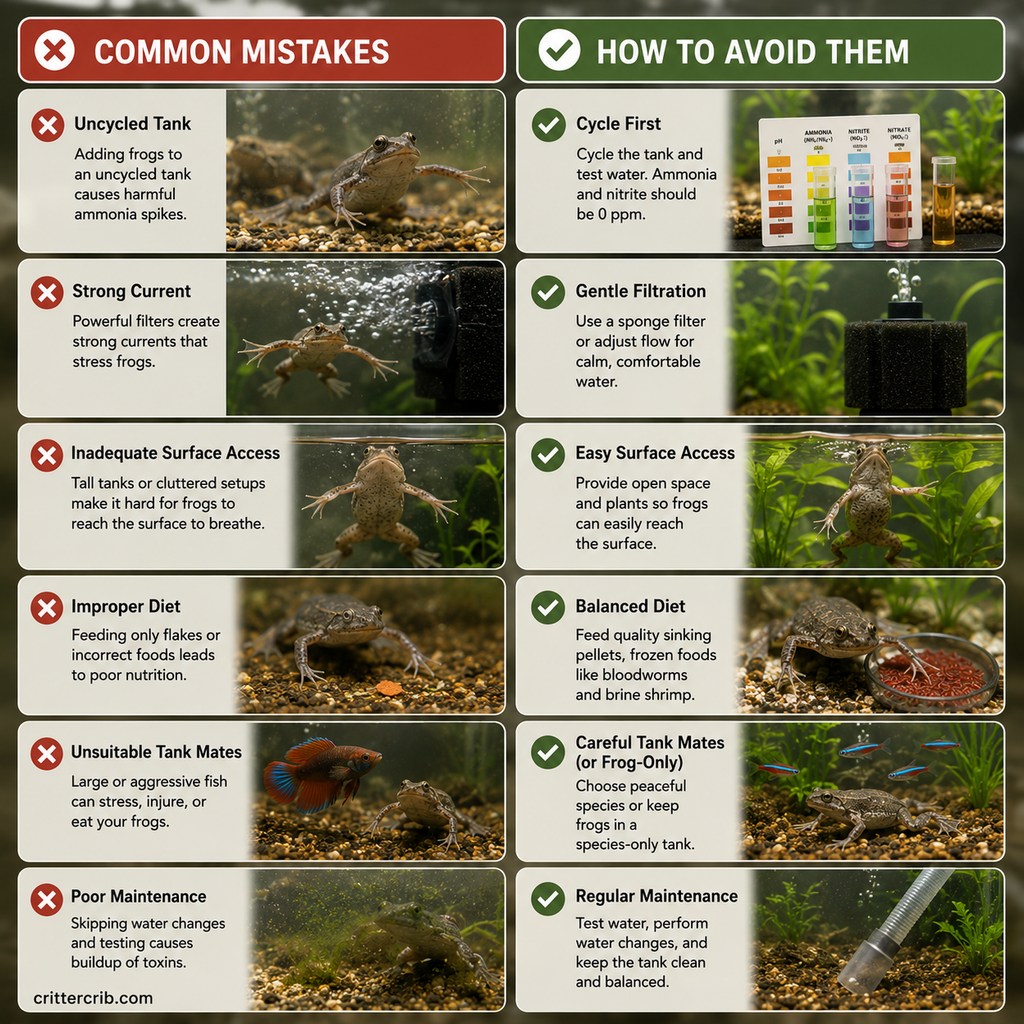
Good care doesn’t need to be complicated.
Focus on the fundamentals:
- Fully cycle the aquarium before adding frogs.
- Keep ammonia and nitrite at 0 ppm.
- Maintain stable, appropriate water temperatures.
- Use treated water.
- Provide gentle filtration.
- Make the surface easy to reach.
- Choose safe substrate.
- Feed a nutritious carnivorous diet.
- Make sure every frog actually eats.
- Provide plants and safe hiding places.
- Avoid incompatible tank mates.
- Perform regular partial water changes.
- Test water periodically.
- Minimize handling.
- Secure the aquarium lid.
- Quarantine new animals when appropriate.
- Monitor appetite, weight, skin, and behavior.
Consistency matters more than constantly changing the setup.
What to Do If You Realize You’ve Made a Care Mistake
Don’t panic and change everything simultaneously.
Start with the factors most likely to affect your frog immediately.
- Test the aquarium water.
- Check the temperature.
- Confirm the frog can reach the surface easily.
- Observe its breathing and swimming.
- Check for injuries, bloating, or skin changes.
- Make sure it is eating.
- Correct environmental problems gradually and safely.
- Contact an amphibian-experienced veterinarian if the frog appears ill.
Avoid using random medications simply because someone online described similar symptoms.
Different illnesses and environmental problems can look surprisingly alike.
Treating the wrong condition can make matters worse.
Final Thoughts
Most African dwarf frog care mistakes aren’t caused by owners who don’t care.
They happen because these little frogs are often marketed as extremely simple aquarium pets.
They’re certainly manageable, but they still need proper amphibian husbandry.
The biggest priorities are straightforward: maintain a cycled aquarium, keep the water clean and appropriately warm, provide gentle filtration, make the surface easy to reach, feed a nutritious diet, and verify that each frog is actually getting enough food.
Then pay attention.
Notice how your frogs normally swim, rest, eat, and surface. That familiarity makes it much easier to recognize when something changes.
You don’t need a complicated aquarium full of expensive equipment to keep African dwarf frogs successfully.
You need a stable environment designed around the frogs rather than around what looks impressive to us.
Avoid the common mistakes, stay consistent with routine maintenance, and you’ll give your African dwarf frogs a much better chance of staying healthy and comfortable for years to come.